
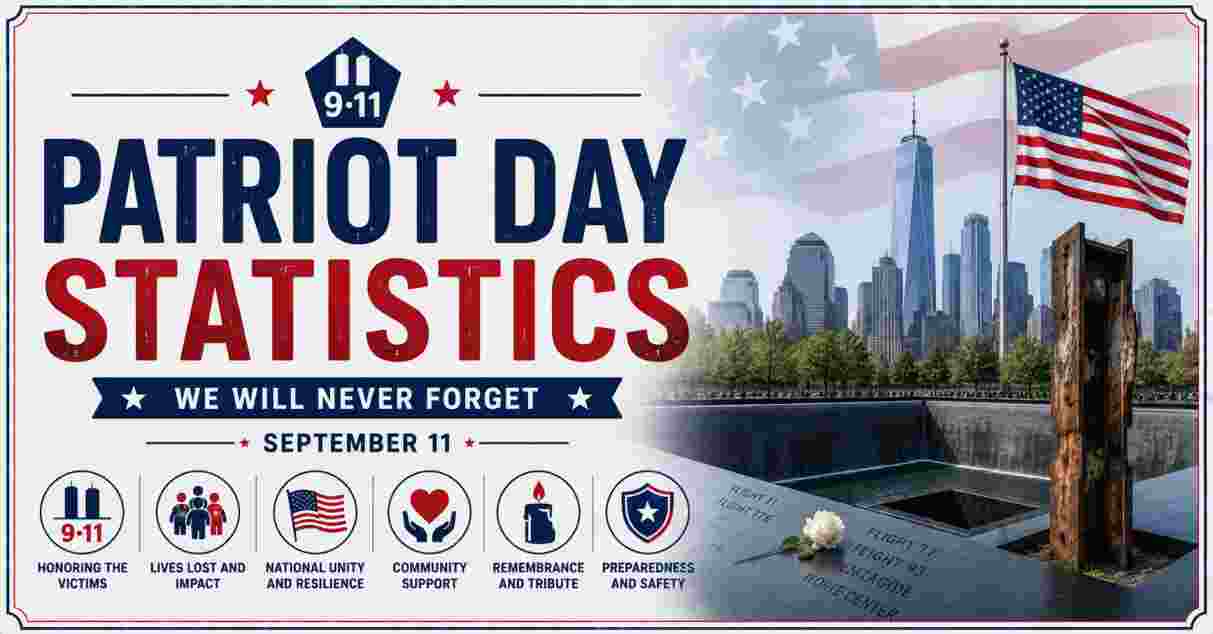
Patriot Day in America 2026
Patriot Day falls on Friday, September 11, 2026, and this year carries particular weight as the nation marks the 25th anniversary of the terrorist attacks that killed 2,977 people in New York City, Arlington, Virginia, and near Shanksville, Pennsylvania. Unlike Labor Day or Memorial Day, Patriot Day is not a federal holiday — schools, government offices, and most businesses remain open — but it is written into U.S. law as a permanent day of national remembrance. Flags are lowered to half-staff at the White House, government buildings, and countless private homes, and Americans are asked to pause for a moment of silence at 8:46 a.m. Eastern Time, the exact moment the first hijacked plane struck the North Tower of the World Trade Center.
What began as a presidential proclamation in 2002 has since grown into something broader: a day that honors both the victims of September 11, 2001, and the tens of thousands of first responders, volunteers, and service members who answered the attacks with acts of courage. In 2009, Congress formally folded a National Day of Service into the observance, meaning Patriot Day now functions as two things simultaneously — a solemn memorial and an organized call to charitable action. As the 25th anniversary approaches in 2026, memorial organizations are treating this year’s observance as a milestone moment, one aimed specifically at reaching the more than 100 million Americans who were born after the attacks or are too young to remember them firsthand. That generational shift has become a central talking point among memorial and service organizations this year, since a quarter-century is roughly long enough for an entire adult generation to have grown up with September 11 as history rather than memory — a transition that shapes how ceremonies, curricula, and volunteer campaigns are being designed for 2026 specifically.
Interesting Facts About Patriot Day in the US 2026
| Fact | Detail |
|---|---|
| Patriot Day 2026 Date | Friday, September 11, 2026 |
| Anniversary Milestone | 25th anniversary of the September 11, 2001 attacks |
| Total Lives Lost | 2,977 victims (excluding the 19 hijackers) |
| Federal Holiday Status | Not a federal holiday; schools and offices remain open |
| First Proclaimed | September 4, 2002, by President George W. Bush |
| National Day of Service Added | 2009, under the Edward M. Kennedy Serve America Act |
| Moment of Silence | 8:46 a.m. Eastern, marking the first plane’s impact |
| Firefighters Killed | 343 members of the FDNY |
| Law Enforcement Officers Killed | 72 officers across multiple agencies |
| Tribute in Light Installation | 88 xenon searchlights, visible up to 60 miles away |
Source: U.S. Department of Homeland Security; National September 11 Memorial & Museum; Britannica; CNN
The gap between 2001 and today explains why Patriot Day looks different depending on who is observing it. For anyone who lived through the attacks, September 11 remains a fixed point of personal memory — most adults can still describe exactly where they were at 8:46 a.m. that morning. But with more than 100 million Americans now either too young to remember the day or born after it entirely, the 25th anniversary in 2026 represents a genuine turning point for how the country transmits that memory forward, which is part of why memorial organizations have scaled up educational and service programming specifically for this milestone year.
The facts above also highlight something easy to overlook: Patriot Day’s unusual legal status. It is one of the only major American observances that is written into federal law and marked with an official presidential proclamation every year, yet it grants no day off work. That combination — full legal recognition without the practical trappings of a holiday — reflects a deliberate choice: the day was designed to preserve normal civic life while still compelling national reflection, rather than functioning as a rest day the way Labor Day or Memorial Day do. Lawmakers debating the original proclamation in 2001 and 2002 were explicit about this distinction, reasoning that turning September 11 into a paid day off risked shifting public attention toward the practical benefits of a long weekend rather than keeping the focus squarely on remembrance and service.
Patriot Day 2026 Date and Observance Status in the US
| Detail | Data |
|---|---|
| 2026 Observance Date | Friday, September 11, 2026 |
| Legal Basis | Congressional joint resolution, signed into law December 2001 |
| First Official Observance | September 11, 2002 |
| Federal Holiday? | No — offices, schools, and businesses remain open |
| Flag Protocol | Flags flown at half-staff nationwide |
| National Moment of Silence | 8:46 a.m. ET |
| Additional Ceremony Times | 9:03 a.m., 9:37 a.m., 10:03 a.m. ET (marking each subsequent attack) |
Source: U.S. Department of Homeland Security; National Law Enforcement Officers Memorial Fund
The four ceremonial moments of silence observed each year at memorial events are not arbitrary — each one corresponds to a specific event from the morning of September 11, 2001: the 8:46 a.m. strike on the North Tower, the 9:03 a.m. strike on the South Tower, the 9:37 a.m. attack on the Pentagon, and the 10:03 a.m. crash of Flight 93 near Shanksville. Ceremonies at the National 9/11 Memorial, the Pentagon Memorial, and the Flight 93 National Memorial all follow this same timeline, which is why national remembrance events tend to run in stages throughout the morning rather than as a single unified moment.
Because Patriot Day carries no day off attached to it, its observance depends almost entirely on voluntary participation — a structure that distinguishes it sharply from other federally recognized days. Congress deliberately avoided converting September 11 into a paid holiday, partly out of concern that doing so would eventually dilute its solemnity into a routine three-day weekend the way some other observances have evolved. That legislative choice, made in the immediate aftermath of the attacks, is part of why Patriot Day has kept its character as a day of reflection and civic duty rather than becoming primarily associated with retail sales or travel, unlike several other dates on the American calendar.
September 11, 2001 Attack and Victim Statistics in the US 2026
| Location | Deaths |
|---|---|
| World Trade Center, New York City | 2,753 |
| The Pentagon, Arlington, Virginia | 184 |
| Near Shanksville, Pennsylvania (Flight 93) | 40 |
| Total Victims (excludes 19 hijackers) | 2,977 |
| WTC Victims Who Were Firefighters | 343 |
| Age Range of Victims | 2 to 85 years old |
| WTC Remains Positively Identified (as of Aug 2025) | 1,653 of 2,753 |
Source: Britannica; CNN; New York City Office of the Chief Medical Examiner
These numbers have been revised more than once since 2001, and that history is worth understanding rather than glossing over. On the first anniversary of the attacks, New York’s official death toll stood at 2,801; it was later adjusted to 2,792 after duplicate or erroneous names were removed, and again lowered to 2,752 in 2003 after further verification, before eventually settling near the figure used today. The exact number of WTC victims remains technically uncertain because the fires and structural collapse destroyed so much physical evidence — a fact underscored by the ongoing identification effort, which as of August 2025 had positively matched remains for only 1,653 of the 2,753 people who died at the site, using DNA technology that continues to improve decades after the attacks.
The age range of victims — from 2 years old to 85 — is a detail that resists easy summary, since it spans an infant on one of the hijacked flights to retirees working in the towers that morning. Roughly 75 to 80% of all victims were men, a proportion tied to the demographics of the finance, first-responder, and building-trade sectors that made up much of the World Trade Center’s workforce. At the Pentagon, the toll of 184 included both military and civilian personnel working inside the building alongside the 59 passengers and crew aboard Flight 77, a mix that reflected the Pentagon’s dual role as a military headquarters and a large civilian workplace. Near Shanksville, all 40 passengers and crew aboard Flight 93 died when the plane crashed into a reclaimed coal field after passengers attempted to retake control from the hijackers — an act widely credited with preventing the aircraft from reaching its intended target in Washington, D.C., and one that the Flight 93 National Memorial now commemorates as a distinct and separate act of resistance within the broader tragedy of the day.
First Responders Lost on September 11 in the US 2026
| Agency | Lives Lost |
|---|---|
| New York City Fire Department (FDNY) | 343 |
| New York City Police Department (NYPD) | 23 |
| Port Authority Police Department | 37 |
| Total Law Enforcement Officers (all agencies) | 72 |
| Total First Responders Killed | More than 400 |
Source: CNN; National Law Enforcement Officers Memorial Fund; History.com
The loss of 343 FDNY firefighters in a single morning remains the largest loss of life in the history of any American fire department, and it reshaped how the department trains and organizes emergency response to this day. Combined with the 23 NYPD officers and 37 Port Authority officers who died attempting to complete evacuations, the first-responder death toll — commonly cited as more than 400 — represents roughly one in seven of all who died that day. These were people who were, in nearly every case, moving toward the danger rather than away from it, entering buildings that were already structurally compromised in order to guide civilians to safety. Many of the 343 FDNY firefighters who died were part of units that had already completed multiple trips up and down the towers’ stairwells before the structures collapsed, a detail that continues to inform how fire departments nationwide train for large-scale building evacuations today.
Halfway through any honest account of September 11, it’s worth pausing on what that first-responder sacrifice still costs decades later — many surviving firefighters and police officers who worked at Ground Zero continue to face elevated health risks tied to their exposure during the response and cleanup. For readers interested in how the country formally honors military and first-responder service beyond September 11 itself, the US Veterans by State Statistics report offers a broader look at how service-related recognition is tracked across the country. The 72 law enforcement officers honored each year at the National Law Enforcement Officers Memorial in Washington, D.C., are read aloud by name during ceremonies that have continued uninterrupted since the attacks, a tradition organizers say they intend to carry forward through the 25th anniversary and beyond.
Tribute in Light and 9/11 Memorial Statistics in the US 2026
| Metric | Data |
|---|---|
| Number of Searchlights | 88 xenon lightbulbs |
| Bulb Wattage | 7,000 watts each |
| Formation | Two 48-foot squares, echoing the Twin Towers |
| Maximum Beam Height | Up to 4 miles into the sky |
| Visibility Radius | Up to 60 miles around lower Manhattan |
| First Presented | Six months after the attacks, in March 2002 |
| Display Hours, 2026 | Dusk on September 11 to dawn on September 12 |
Source: National September 11 Memorial & Museum
The Tribute in Light installation has run every year since its debut just six months after the attacks, making it one of the longest-running annual memorials of its kind in the country. Each September, technicians spend several days testing, aligning, and bench-focusing all 88 individual searchlights so the two beams appear as clean, uniform columns rather than a scattered blur — a technical process that light-installation crews describe as more demanding than most viewers realize, given that the beams must remain visually consistent across a four-mile vertical span. The installation’s presenting sponsor for recent years has been Con Edison, working alongside the 9/11 Memorial & Museum, which opens its plaza to the public each September 11 from mid-afternoon until midnight specifically so visitors can view the tribute from the site where the towers once stood.
Flags flown at half-staff represent another visual thread running through the day, one governed by longstanding federal protocol rather than a Patriot Day–specific rule. Readers curious about how and when American flags are lowered for national observances more broadly may find the Facts about the American Flag overview useful context, since the same half-staff conventions applied on Patriot Day also govern flag protocol for other national days of mourning throughout the year. Together, the Tribute in Light and the nationwide half-staff order form the two most visually recognizable elements of the observance — one confined to lower Manhattan, the other visible in front of nearly every government building and many private homes across the country.
9/11 Memorial and Museum Visitor Statistics in the US 2026
| Metric | Data |
|---|---|
| 20th Anniversary Ceremony Attendance | More than 8,500 family members and guests |
| UN General Assembly Tribute Attendance | 300+ heads of state, ministers, and delegates from 120+ nations |
| Visitor Origin, Annual Programming | All 50 states, 6 U.S. territories, and 48 countries |
| Daffodil Project Bulbs Planted Since 2001 | Over 8 million |
| Landmarks Illuminated in “Memorial Blue” | Nearly 50 across the tri-state area |
Source: National September 11 Memorial & Museum; New Yorkers for Parks
The 9/11 Memorial & Museum in lower Manhattan functions as both a physical memorial and an active educational institution, drawing visitors, students, and researchers from every U.S. state and territory along with dozens of other countries each year. Beyond the September 11 ceremony itself, the museum runs year-round programming that extends the day’s reach well past its calendar date — the Daffodil Project, run in partnership with New Yorkers for Parks, has planted more than 8 million daffodil bulbs across New York City since 2001, making it the largest volunteer horticultural effort in the city’s history and a living memorial that blooms each spring rather than marking a single day.
Patriot Day’s reach also extends into how the country frames its broader civic identity, something the founding generation would likely have recognized as central to national memory-making even though the holiday itself is a modern one. Readers interested in how America’s civic and constitutional origins connect to days of national remembrance may find the US Founding Fathers Statistics 2026 overview a useful companion piece, since both topics touch on how the country institutionalizes collective memory through law and public ceremony. International attention to the anniversary has also grown steadily — the UN General Assembly tribute in 2021 drew more than 300 heads of state, ministers, and delegation members from over 120 countries and organizations, reflecting how September 11 has become a point of shared global reflection rather than a purely domestic observance.
Patriot Day 25th Anniversary National Day of Service Statistics in the US 2026
| Metric | 2026 Figure |
|---|---|
| Americans Who Typically Observe via Service | Approximately 35 million annually |
| Volunteers Recruited for 2026 Meal-Packing Events | More than 50,000 |
| Meals Targeted for Packing, 2026 | 20 million |
| Cities Hosting Large-Scale Service Projects | 50 cities, all 50 states |
| Grant Program Funding | $3 million, funded by AmeriCorps and the Popeyes Foundation |
| Legal Basis for Day of Service | Edward M. Kennedy Serve America Act, 2009 |
Source: 9/11 Day; PRNewswire
For the 25th anniversary, the nonprofit 9/11 Day — the organization that originally created the National Day of Service concept before it became federally recognized — announced its largest push yet, aiming to organize tens of millions of Americans across all 50 states in a single coordinated day of volunteer activity. The centerpiece effort recruits more than 50,000 volunteers to pack 20 million meals for people facing food insecurity, working alongside AmeriCorps and local food banks in 50 cities nationwide. A new $3 million grant program, jointly funded by AmeriCorps and the Popeyes Foundation, is also directed specifically at funding student-led service projects, reflecting organizers’ stated goal of reaching younger Americans who have no direct memory of the attacks.
This service-based approach to Patriot Day has deep roots in the same instinct that shaped the holiday’s original design: rather than mandating time off, the Edward M. Kennedy Serve America Act built volunteerism directly into the day’s legal framework back in 2009, placing September 11 alongside Martin Luther King Jr. Day as one of only two dates recognized by federal law specifically as a National Day of Service. Organizers estimate that roughly 35 million Americans participate in some form of charitable activity on September 11 in a typical year, a figure that made it, by their account, the largest annual day of charitable service in the country even before this year’s 25th-anniversary expansion was announced.
Disclaimer: This research report is compiled from publicly available sources. While reasonable efforts have been made to ensure accuracy, no representation or warranty, express or implied, is given as to the completeness or reliability of the information. We accept no liability for any errors, omissions, losses, or damages of any kind arising from the use of this report.