
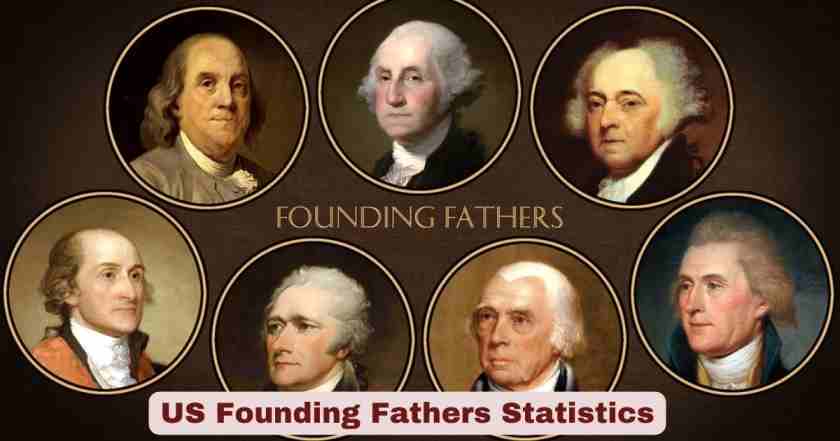
The Founding Fathers of the United States 2026 — Overview
Few groups of people in recorded history have had a more consequential impact on the world than the men who founded the United States of America in the latter half of the 18th century. In 1973, historian Richard B. Morris formally identified seven figures as the principal Founding Fathers — George Washington, John Adams, Benjamin Franklin, Alexander Hamilton, John Jay, Thomas Jefferson, and James Madison — though the broader definition encompasses the 56 signers of the Declaration of Independence, the 39 signers of the Constitution, and scores of other military leaders, diplomats, writers, and statespeople who made the American experiment possible. What makes the founding generation so remarkable from a purely statistical standpoint is how young most of them were: Thomas Jefferson was 33 when he drafted the Declaration of Independence. Alexander Hamilton was just 21 in 1776. James Madison was only 25 at the time of the signing. Benjamin Franklin, at 70, was the elder statesman who towered over a cohort that was, in many ways, a generation of extraordinary young men attempting something that had never been done before — building a functioning republic from scratch, in real time, against the most powerful military empire on Earth.
The legacy of the Founding Fathers in 2026 is both celebrated and critically examined with a sophistication that earlier generations rarely applied. Their documents — the Declaration of Independence, the US Constitution, and the Bill of Rights — remain foundational to not just American law but to constitutional frameworks around the world. The Constitution, at roughly 4,200 words in its original form, is the oldest written national constitution still in use on Earth. The Federalist Papers — 85 essays written by Hamilton, Madison, and Jay to argue for the Constitution’s ratification — are still assigned in law schools and political theory courses globally. Yet the same men who wrote that “all men are created equal” held enslaved people: 41 of the 56 signers of the Declaration owned slaves. Four of the first five US presidents were slaveholders. That contradiction — between the soaring idealism of the founding documents and the brutal reality of slavery at the heart of the founding economy — is not a footnote to the Founding Fathers’ story. It is inseparable from it. Understanding both dimensions, in full, is how the history of the founding generation is most honestly engaged with in 2026.
US Founding Fathers 2026 — Key Interesting Facts
| # | Fact | Detail |
|---|---|---|
| 1 | Seven Principal Founders (per historian Richard B. Morris, 1973) | Washington, Adams, Franklin, Hamilton, Jay, Jefferson, Madison — identified by “triple tests” of leadership, longevity, and statesmanship |
| 2 | Total Signers of the Declaration of Independence | 56 signers from all 13 original colonies — formally signed August 2, 1776 (not July 4) |
| 3 | Total Signers of the US Constitution | 39 of 55 delegates signed on September 17, 1787; 3 refused, some had already left Philadelphia |
| 4 | Youngest Founder in 1776 | Alexander Hamilton — age 21 on July 4, 1776 |
| 5 | Oldest Founder in 1776 | Benjamin Franklin — age 70 on July 4, 1776; oldest Constitutional Convention delegate at age 81 in 1787 |
| 6 | Jefferson’s Age When Writing the Declaration | Thomas Jefferson was 33 years old when he wrote the Declaration of Independence |
| 7 | Benjamin Franklin’s Unique Record | The only Founding Father to sign all four key founding documents: Declaration of Independence (1776), Treaty of Alliance with France (1778), Treaty of Paris (1783), and Constitution (1787) |
| 8 | Declaration Signers Who Were Lawyers | 23 of the 56 signers (41%) earned their living primarily as lawyers — the single most common profession |
| 9 | Slaveholders Among Declaration Signers | 41 of the 56 signers of the Declaration of Independence owned enslaved people |
| 10 | The Federalist Papers | 85 essays written by Hamilton (50+), Madison (fewer than 20), and Jay (5) to advocate for ratification of the Constitution |
| 11 | US Constitution Word Count | The original Constitution contains approximately 4,200 words — the oldest written national constitution still in active use |
| 12 | Average Age at Constitutional Convention | The average age of delegates to the 1787 Constitutional Convention was 42 years old |
| 13 | John Adams and Thomas Jefferson’s Deaths | Both died on July 4, 1826 — exactly 50 years after the signing of the Declaration of Independence |
| 14 | Last Surviving Signer of the Declaration | Charles Carroll of Carrollton, who died on November 14, 1832 at age 95 — 56 years after signing |
| 15 | Rhode Island’s Absence | Rhode Island was the only state that did not send delegates to the 1787 Constitutional Convention |
Source: American Battlefield Trust; Wikipedia — Founding Fathers of the United States; National Archives — Signers Gallery; Gilder Lehrman Institute; Constitution Center FAQs; American Battlefield Trust — Declaration Signers; History.com; HISTORY
The biographical statistics surrounding the founding generation consistently challenge the popular image of old men in powdered wigs deliberating gravely over ancient wisdom. The reality is that the American Republic was largely built by people in their twenties and thirties — men who, in modern terms, would be considered early-career professionals taking on tasks of earth-shaking consequence. Hamilton at 21, Monroe at 18, Madison at 25 — these were not seasoned elder statesmen. They were young, ideologically driven, and in some cases reckless individuals working within a compressed historical window. The contrast with Benjamin Franklin — who at 70 in 1776 had already spent decades as a printer, scientist, diplomat, and postmaster — was itself a source of the founding generation’s extraordinary productivity. Franklin’s experience and prestige lent credibility; the younger men’s energy drove output.
The constitutional statistics are equally remarkable. The fact that 39 of 55 delegates signed the Constitution — meaning 16 either left early or refused to sign — reflects how genuinely contested the document was. Three delegates present on the final day (George Mason, Edmund Randolph, and Elbridge Gerry) refused outright, fearing the Constitution gave too much power to the federal government and lacked a Bill of Rights. The document that has governed the United States for nearly 240 years was ratified under significant opposition, by a relatively small group of men acting under enormous pressure, in the sweltering summer of a single Pennsylvania building. The 4,200 words of the original Constitution — shorter than most corporate terms-of-service agreements today — have been interpreted, debated, and litigated in hundreds of thousands of cases across more than two centuries, making it arguably the most consequential short document in the history of governance.
The Seven Principal Founding Fathers — Biographical Facts
| Founder | Born | Died | Age in 1776 | Primary Role | Key Achievement |
|---|---|---|---|---|---|
| George Washington | Feb 22, 1732 | Dec 14, 1799 | 44 | Commander-in-Chief; 1st President | Led Continental Army to victory; unanimously elected first President |
| John Adams | Oct 30, 1735 | July 4, 1826 | 40 | Diplomat; 2nd President | Argued for independence; negotiated Treaty of Paris; first VP, second President |
| Thomas Jefferson | Apr 13, 1743 | July 4, 1826 | 33 | Primary author Declaration of Independence; 3rd President | Drafted Declaration of Independence; Louisiana Purchase; founded University of Virginia |
| Benjamin Franklin | Jan 17, 1706 | Apr 17, 1790 | 70 | Diplomat; Inventor; Statesman | Signed all 4 founding documents; negotiated French alliance; invented lightning rod and bifocals |
| Alexander Hamilton | ~1755–1757 | July 12, 1804 | ~21 | 1st Secretary of the Treasury | Founded US financial system; primary author of 51+ Federalist Papers; established First Bank of the US |
| John Jay | Dec 23, 1745 | May 17, 1829 | 30 | Diplomat; 1st Chief Justice of Supreme Court | Negotiated Treaty of Paris; wrote 5 Federalist Papers; first Chief Justice |
| James Madison | Mar 16, 1751 | June 28, 1836 | 25 | “Father of the Constitution”; 4th President | Drafted Virginia Plan; co-authored Federalist Papers; championed Bill of Rights |
Source: American Battlefield Trust — 10 Facts: The Founding Fathers; White House Official Founding Fathers page (whitehouse.gov, updated June 2025); Wikipedia — individual biographies; History.com
The biographical arc of the seven principal Founding Fathers reveals a group of men whose collective output is astonishing by any measure. George Washington’s unanimously elected presidency — he remains the only president ever to win the Electoral College unanimously, and he did it twice — set a standard for executive legitimacy that shaped American political culture for generations. Jefferson’s Declaration was written over roughly 17 days in June 1776 in a rented room in Philadelphia, largely in isolation from the rest of the Committee of Five, producing a document that has been cited in independence movements on six continents. Hamilton’s prolific Federalist output — more than 51 essays written under the pseudonym Publius, often completing multiple essays per week — remains one of the most intensive feats of political writing in the history of democratic theory.
James Madison’s distinction as the only delegate to attend every session of the Constitutional Convention, combined with his meticulous private notes that were kept secret until after his death in 1836, means that the most complete record of how the Constitution was actually debated and drafted comes from a single man’s hand. Benjamin Franklin’s longevity — he was 84 years old at death, extraordinary for the 18th century — meant that he was the living link between the colonial era and the fully constituted republic, having been born in 1706 when the American colonies were still 70 years from independence. John Jay’s founding of the New York Manumission Society alongside Hamilton in 1785, and his signing of New York’s abolition law as governor in 1798, represent one of the founding generation’s clearest anti-slavery legislative legacies, a counterpoint to the failures of his colleagues in the slaveholding states.
Declaration of Independence — Signers Statistics 1776
| Metric | Data |
|---|---|
| Total Signers | 56 delegates from all 13 original colonies |
| Actual Signing Date | August 2, 1776 — not July 4 (most delegates signed then; the last signed November 4, 1776) |
| Youngest Signer | Edward Rutledge of South Carolina — age 26 |
| Oldest Signer | Benjamin Franklin — age 70 |
| Most Common Profession | Lawyers — 23 of 56 (41%) |
| Plantation Owners | 12 of 56 |
| Merchants | 12 of 56 |
| Physicians | 4 of 56 |
| Farmers | 3 of 56 |
| Ministers | 1 of 56 |
| Signers born in Europe | 8 — Ireland (3), England (2), Scotland (2), Wales (1) |
| Signers who owned slaves | 41 of 56 |
| Signers who also signed the Constitution | 6 — Franklin, Roger Sherman, Robert Morris, George Clymer, George Read, James Wilson |
| First signer to die | John Morton — died April 1777 |
| Last surviving signer | Charles Carroll of Carrollton — died November 14, 1832, age 95 |
| Signers who died from wounds or hardships of Revolutionary War | 9 |
| Signers captured and tortured by the British as traitors | 5 |
| John Adams and Jefferson’s death | Both died July 4, 1826 — the 50th anniversary of Independence |
| State with most delegates | Pennsylvania and Virginia — 9 and 7 delegates respectively |
Source: National Archives — Signers Gallery (archives.gov); American Battlefield Trust — Who Were the Signers of the Declaration of Independence; Gilder Lehrman Institute — Pledging Their Fortunes; Heritage Foundation; Daughters of the American Revolution
The 56 men who signed the Declaration of Independence risked something tangible and real. Delegate Benjamin Rush later described the act as signing “our own death warrants.” This was not hyperbole — by putting their names to a declaration of treason against the British Crown, they made themselves targets for execution. British forces imprisoned five signers, tortured them, and left them permanently damaged. Richard Stockton of New Jersey was captured, imprisoned, and had his estate looted; his health never recovered and he died in 1781. Francis Lewis of New York had his home destroyed and his wife taken prisoner. Thomas Nelson Jr. of Virginia reportedly ordered cannon fire on his own mansion when British forces occupied it during the Siege of Yorktown. The popular image of these signatures as a ceremonial gesture misses the gravity of what they represented.
The professional composition of the signers reflects the makeup of the colonial elite of the era. 23 lawyers out of 56 — nearly 41% — is consistent with the role that legal education played in the colonial upper class, where law was the primary vehicle of political advancement. The 12 plantation owners and 12 merchants completing the top three professions underline that this was, fundamentally, a document produced by men of wealth and property who had specific economic interests in independence from British taxation and trade restriction. That 41 of these 56 men owned enslaved people is the defining moral paradox of the document they produced — men who wrote about “unalienable rights” and the consent of the governed while legally owning other human beings, a contradiction that Benjamin Rush, John Adams, and others acknowledged privately but could not resolve publicly.
Constitutional Convention 1787 — Facts & Statistics
| Metric | Data |
|---|---|
| Dates of Convention | May 25 to September 17, 1787 — Philadelphia, Pennsylvania |
| Location | Pennsylvania State House (Independence Hall) — same building where Declaration was signed |
| Total Delegates Appointed | 70 — across all original states except Rhode Island |
| Total Delegates Who Attended | 55 |
| Delegates Who Signed | 39 |
| Delegates Present on Final Day Who Refused to Sign | 3 — George Mason (VA), Edmund Randolph (VA), Elbridge Gerry (MA) |
| State that sent no delegates | Rhode Island — only state absent |
| Presiding Officer | George Washington — unanimously elected |
| Youngest Delegate | Jonathan Dayton of New Jersey — age 26 |
| Oldest Delegate | Benjamin Franklin — age 81 |
| Average Age of Delegates | 42 years old |
| Only Delegate to Attend Every Session | James Madison |
| Constitution’s Word Count | ~4,200 words — oldest written national constitution still in use |
| Constitution’s Ratification | Required 9 of 13 states to ratify; New Hampshire was the 9th state in June 1788 |
| Delegates who were also Declaration signers | Only 6 signed both documents |
| Delegates with Congressional experience | Approximately three-fourths had served in Congress |
| Delegates with Revolutionary War service | Many — including Washington, Hamilton, and others |
| “Father of the Constitution” | James Madison — author of the Virginia Plan; only delegate at every session |
Source: Constitution Center FAQs (constitutioncenter.org); HISTORY.com — US Constitution; Southern Adventist University Constitutional History Guide; LAWS.com — Constitution Authors and Signers; Reader’s Digest — How Many People Signed the Constitution
The Constitutional Convention of 1787 is among the most consequential political gatherings in human history, and its statistics tell the story of just how fragile and contentious the American founding really was. The convention was called only to revise the Articles of Confederation — the delegates exceeded their mandate entirely by drafting an entirely new framework of government. Rhode Island’s total refusal to participate meant that the Constitution was written without the involvement of one of the 13 colonies, a reminder that American unity in 1787 was political rhetoric as much as political reality. The three delegates who refused to sign — George Mason, Edmund Randolph, and Elbridge Gerry — were not fringe figures. Mason had written Virginia’s Declaration of Rights, which directly influenced Jefferson’s Declaration of Independence. His refusal because the Constitution lacked a Bill of Rights directly led to the first ten amendments being added in 1791.
The average age of 42 at the convention stands in contrast to the popular memory of ancient wisdom. The convention’s most intellectually productive member, James Madison, was 36. Hamilton was in his early 30s. The oldest man in the room, Franklin at 81, was so physically infirm that he had to be carried in a sedan chair and had a colleague read his speeches for him — yet his presence alone carried an authority that helped bridge factional disputes when the convention threatened to collapse entirely. The 4,200-word document they produced, signed on September 17, 1787, has since been amended 27 times — the first 10 amendments (the Bill of Rights) ratified together in 1791 — and has governed the United States through civil war, two world wars, the Great Depression, and the digital revolution, making it by any measure the most durable written constitutional framework in the history of democratic governance.
The Founding Fathers & Slavery — Historical Record
| Founder / Group | Slavery-Related Data |
|---|---|
| Declaration Signers — Slaveholders | 41 of 56 signers (73%) owned enslaved people |
| Constitutional Convention — Slaveholders | Approximately 25 of 55 delegates (45%) owned slaves |
| George Washington | Owned hundreds of enslaved people; freed them in his will; came to oppose slavery |
| Thomas Jefferson | Enslaved approximately 600 people over his lifetime; never freed them at death; conflicted in writings |
| James Madison | Owned enslaved people; did not free them; privately expressed opposition but never acted legislatively |
| Benjamin Franklin | Owned a small number of enslaved people early in life; became president of the first US abolitionist society |
| Alexander Hamilton | Did not own slaves; founded the New York Manumission Society (1785); opposed slavery throughout his life |
| John Jay | Founded the New York Manumission Society (1785); helped found the African Free School; as governor signed New York’s abolition law in 1798 |
| Four of first five presidents | Washington, Jefferson, Madison, Monroe — all slaveholders; John Adams was the exception |
| US Transatlantic slave trade | Constitutionally protected until 1808 — the Founders enshrined a 20-year protection of the trade |
| Jefferson’s Declaration draft | Included an anti-slavery clause blaming King George — removed to satisfy Southern delegates |
| “Three-Fifths Compromise” | Enslaved people counted as 3/5 of a person for congressional representation — a foundational constitutional compromise |
Source: American Battlefield Trust — Founding Fathers’ Views of Slavery; Wikipedia — Founding Fathers of the United States; Smithsonian Magazine — Founding Fathers and Slaveholders; PolitiFact fact-check (July 2021); Study.com — Founding Fathers & Slavery
The slavery record of the Founding Fathers is the most contested and morally complex dimension of their legacy, and the statistics make the contradiction undeniable. When 41 of the 56 men who signed the Declaration of Independence owned enslaved people, the phrase “all men are created equal” was not a universally held conviction — it was, for many of them, a political statement that explicitly excluded the people they legally owned. Jefferson, who enslaved approximately 600 people over his lifetime and is now believed by historians to have fathered multiple children with his enslaved woman Sally Hemings, wrote “I tremble for my country when I reflect that God is just” — while continuing to profit from slave labor every day of his adult life. Washington owned hundreds of enslaved people and freed them in his will, coming to privately oppose the institution under the influence of figures like Lafayette and John Laurens, but never acting legislatively against it.
The contrast within the founding generation between those who acted and those who did not is historically significant. Hamilton and Jay’s New York Manumission Society, founded in 1785, led directly to Jay signing New York’s abolition law in 1798 — making New York a state that had formally committed to ending slavery before the Constitution’s 1808 slave trade deadline even arrived. Franklin’s presidency of the first abolitionist society in the United States came after he had personally owned enslaved people earlier in his life, representing a genuine ideological evolution. The Three-Fifths Compromise enshrined in Article I, Section 2 of the Constitution — counting enslaved people as three-fifths of a person for purposes of congressional apportionment — was not an oversight or a reluctant concession. It was a deliberate constitutional structure that gave slaveholding states disproportionate political power for the next 74 years, until the 14th Amendment in 1868.
Benjamin Franklin — Individual Statistics & Achievements
| Metric | Data |
|---|---|
| Full Name | Benjamin Franklin |
| Born | January 17, 1706 — Boston, Massachusetts |
| Died | April 17, 1790 — Philadelphia, Pennsylvania; age 84 |
| Position in family | 15th of 17 children of Josiah Franklin |
| Funeral attendance | Estimated 20,000 people — one of the largest funerals in American history at the time |
| Formal education | Largely self-educated — withdrew from school at age 10 |
| Age at retirement from printing | 42 — retired to pursue science and politics |
| Key inventions | Lightning rod (1752), bifocals, Franklin stove (1741), flexible urinary catheter, swim fins |
| Lightning experiment | Kite-and-key experiment in a thunderstorm, 1752, proving lightning is electrical |
| Publication | Published Poor Richard’s Almanac and The Pennsylvania Gazette |
| Four founding documents signed | Declaration of Independence (1776), Treaty of Alliance with France (1778), Treaty of Paris (1783), Constitution (1787) — only Founding Father to sign all four |
| Diplomatic roles | Ambassador to France, Sweden, Great Britain; first US Postmaster General |
| Abolitionist role | President of the Pennsylvania Society for Promoting the Abolition of Slavery |
| Currency honor | His image appears on the US $100 bill |
| Age at Constitutional Convention | 81 — the oldest delegate; had to be carried in a sedan chair |
Source: History.com — Benjamin Franklin; Wikipedia — Benjamin Franklin; Britannica (updated April 13, 2026); Boston Tea Party Ships & Museum — Franklin Facts; White House Official Founding Fathers page
Benjamin Franklin stands apart from every other Founding Father in both the breadth of his achievements and the extraordinary arc of his life. He was the 15th of 17 children, the son of a candle maker, with almost no formal education — yet he became the most celebrated American in the world during his own lifetime, more famous in France than in his own country during the years he lived in Paris. His science was real, not amateur curiosity: the lightning rod he invented in 1752 is still the standard technology used on buildings worldwide, and his conceptual framework for understanding electricity as a unified force was a genuine contribution to 18th-century physics. His kite experiment — flying a metal key on a kite in a thunderstorm to prove lightning was electrical — has become one of the most famous scientific demonstrations in popular history, though modern historians debate whether he actually performed it as described.
What makes Franklin statistically unique among the founders is that no other man signed all four key founding documents. The Declaration, the Treaty of Alliance with France, the Treaty of Paris, and the Constitution together represent the complete legal architecture of American independence — and Franklin alone was present for all four. His 20,000-person funeral in 1790 was the largest public gathering in Philadelphia since the Continental Congress itself, a measure of how universally his loss was felt. His image on the $100 bill — the highest denomination in regular US circulation — represents a deliberate choice to honor not a president but the founding generation’s most intellectually versatile and internationally recognized figure, the man Thomas Jefferson called “the greatest man and ornament of the age and country in which he lived.”
The Founding Fathers’ Constitutional Legacy — Enduring Impact
| Constitutional Element | Key Data |
|---|---|
| US Constitution ratified | June 1788 — after New Hampshire became the 9th of 13 states to ratify |
| First Congress convened | March 4, 1789 |
| George Washington inaugurated | April 30, 1789 — first President; unanimously elected by the Electoral College |
| Bill of Rights ratified | December 15, 1791 — first 10 amendments to the Constitution |
| Total Constitutional Amendments | 27 amendments in nearly 240 years |
| The Federalist Papers | 85 essays — Hamilton wrote 50+, Madison fewer than 20, Jay wrote 5 |
| Constitution’s age | ~238 years old (as of 2026) — oldest written national constitution in active use |
| First Supreme Court | Established 1789; John Jay was the first Chief Justice |
| First US Census | 1790 — mandated by Article I of the Constitution |
| Countries influenced by US Constitution | Considered a direct model or influence for constitutions worldwide |
| Founders Online archive | Over 184,000 documents authored by or addressed to the seven principal Founding Fathers — searchable digital archive |
| George Washington’s Electoral College victories | Unanimously elected twice — 1789 and 1792 |
| American Revolutionary War duration | 1775–1783 — 8 years of armed conflict |
| Treaty of Paris signed | September 3, 1783 — negotiated by Franklin, Adams, and Jay |
| US population at founding (1790 Census) | Approximately 3.9 million people — including approximately 700,000 enslaved people |
Source: National Constitution Center; History.com; Wikipedia — Founding Fathers of the United States; Library of Congress — James Madison Papers; Constitution Center FAQs; American Battlefield Trust
The enduring constitutional legacy of the Founding Fathers is perhaps best measured not in monuments or currency portraits but in the document’s sheer operational longevity. A constitution written by 55 men in Philadelphia in the summer of 1787 — men who had no model for what a constitutional republic at continental scale would look like — has governed a nation that has grown from 3.9 million people in the 1790 Census to over 330 million in 2026. It has survived a Civil War, two World Wars, the Great Depression, the Civil Rights Movement, and the rise of the internet age — all while remaining the supreme law of the land. The 27 amendments added in nearly 240 years represent a remarkably stable framework for change, with the most recent amendment (the 27th, regarding congressional pay) ratified in 1992 — a provision originally proposed by James Madison in 1789.
The Founders Online archive — a searchable database of over 184,000 documents — is a reminder that the founding generation was as prolific on paper as it was in action. The 85 Federalist Papers, written under urgent deadline pressure in 1787–1788, remain the most authoritative commentary on constitutional interpretation ever written. Hamilton’s more than 51 essays, produced at a pace of multiple per week while also managing other political affairs, represent a feat of intellectual productivity that has few parallels in political history. The Treaty of Paris, negotiated by Franklin, Adams, and Jay in Paris in 1783, secured American independence on terms far more favorable than most observers expected — establishing US territorial rights to the land east of the Mississippi River and setting the boundaries that shaped the nation’s continental expansion for the following century. The men who signed that treaty, who ratified that Constitution, and who built those first institutions were operating — as every generation ultimately must — under conditions of radical uncertainty. That the framework they built has lasted as long as it has is the most accurate single measure of their collective achievement.
Disclaimer: This research report is compiled from publicly available sources. While reasonable efforts have been made to ensure accuracy, no representation or warranty, express or implied, is given as to the completeness or reliability of the information. We accept no liability for any errors, omissions, losses, or damages of any kind arising from the use of this report.