
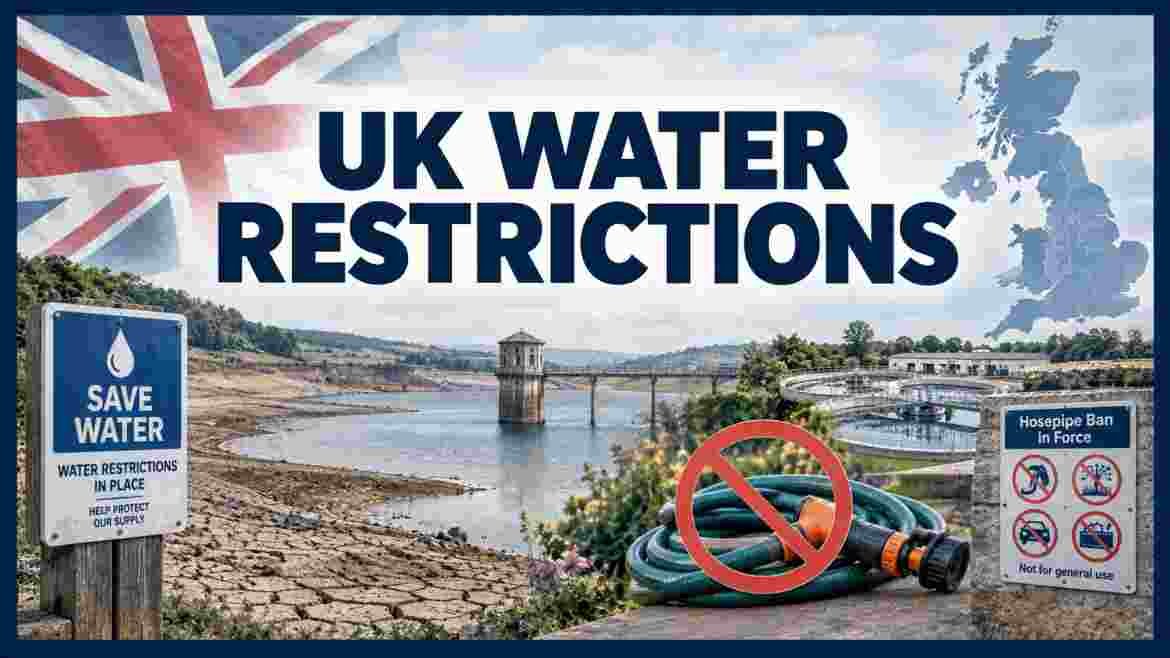
England’s reservoirs stood at 72% capacity as of late September 2026, nearly 2.5 points below the seasonal average of 74.3%, after the sixth dry month of the year. Nine water companies had active hosepipe bans as of early August, with Wessex Water declaring its first ban in 50 years.
Water Restrictions in the UK 2026 – Introduction
UK water restrictions 2026 have followed an unusual path: a drought that gripped England through the winter of 2025 into early 2026 actually cleared by March, only for a second, separate drought to develop through the summer and persist into autumn. The Environment Agency’s own National Drought Group confirmed on October 2, 2026 that reservoir storage continues to feel strain after the sixth dry month of the year, with Chief Executive Philip Duffy stating plainly that “the drought is far from over.”
That second wave produced one of the broadest sets of hosepipe bans England has seen in decades, including Wessex Water’s first restriction in 50 years and Bristol Water’s first since 1975. This report walks through the current reservoir levels, which water companies have active bans, the drought classification system behind these decisions, and the broader UK water restrictions 2026 picture, using Environment Agency and water company data confirmed through October 2, 2026.
Interesting Facts About UK Water Restrictions 2026
ENGLAND RESERVOIR STORAGE 2026 (percent of capacity)
Late Sept 2026 (actual)       | ████████████████████████████ 72.0%
Seasonal average expectation  | █████████████████████████████ 74.3%
Ardingly Reservoir (28 Sept)  | █████████ 23.0%
| Fact | Confirmed 2026 Data |
|---|---|
| England reservoir storage (late September 2026) | 72% |
| Seasonal average expectation for this time of year | 74.3% |
| Ardingly Reservoir level (28 September 2026) | 23% |
| Water companies with active hosepipe bans (early August) | 9 |
| Dry months in 2026 so far (as of October report) | 6 |
| Wessex Water’s last hosepipe ban before 2026 | 1976 (50 years ago) |
| National Drought Group meeting | Chaired by Philip Duffy, October 1, 2026 |
Source: Environment Agency, Defra press release, October 2, 2026; GOV.UK dry weather and drought summary reports.
The chart shows England’s reservoirs running below where they should be for the time of year: 72% actual storage against a 74.3% seasonal expectation, a gap of roughly 2.3 percentage points that might look small but represents billions of litres of shortfall across the national network. Ardingly Reservoir in Sussex, one of the worst-affected sites, had fallen to just 23% of capacity by late September, a level the Environment Agency has flagged repeatedly throughout 2026.
The table captures how widespread the restrictions became by their peak: nine water companies had active bans in early August, and the six dry months recorded through the year to October explain why. Wessex Water’s ban was particularly notable, its first since 1976, the benchmark drought year every subsequent UK dry spell gets measured against.
Hosepipe Ban Status 2026: Which Water Companies Restricted and When
HOSEPIPE BAN TIMELINE 2026 (declaration order)
South East Water (Kent)          | June 25
Yorkshire Water (Yorkshire)      | July 11
Southern Water (Hants/IoW)       | July 10
Thames Water                     | July 22
Anglian Water (parts)            | Summer 2026
South West Water / Affinity      | Summer 2026
Bristol Water                    | August 27 (first since 1975)
Wessex Water                     | August 18 (first since 1976)
| Water Company | Ban Status (as of 4 August 2026) | Notable Detail |
|---|---|---|
| Wessex Water | Active | First ban since 1976; ~1.4 million customers |
| Bristol Water | Active | First ban since 1975; ~1.2 million customers |
| Yorkshire Water | Active | First ban in 27 years; reservoirs fell below 50% |
| Thames Water, South East Water, Southern Water, Anglian Water, South West Water, Affinity Water, Welsh Water, Essex & Suffolk Water | Active | Nine companies total with bans in place |
| Yorkshire Water (by October) | No restrictions | Later confirmed healthier reservoirs than 2025 |
Source: Water Industry Hub hosepipe ban tracker; Wego Travel Blog drought summary, August 2026; Bristol Water official drought page.
The timeline shows restrictions arriving in waves rather than all at once. South East Water moved first, in late June, after the Environment Agency declared drought status for parts of Yorkshire and sustained dry conditions built pressure elsewhere. By 4 August 2026, nine companies — Thames Water, South East Water, Southern Water, Anglian Water, South West Water, Affinity Water, Cambridge Water, Welsh Water and Essex & Suffolk Water — all had active bans, together covering a substantial share of England and Wales’s population.
Two bans stood out for their historical rarity. Wessex Water’s restriction, covering Bath, Somerset, Dorset, Wiltshire and parts of Gloucestershire and Hampshire, was its first in 50 years, dating back to the legendary 1976 drought. Bristol Water’s ban, covering its entire supply area and following an Environment Agency drought order on the River Severn, was its first since 1975. Notably, Yorkshire Water’s position reversed over the year: having declared its own ban in July after reservoirs fell below 50%, the company later confirmed its reservoirs had recovered to levels healthier than the same point in 2025, with no restrictions remaining in place by autumn.
Reservoir Levels and Drought Classification 2026: How the System Works
ENVIRONMENT AGENCY DROUGHT LEVELS (escalation scale)
Level 1 | ████████ Early warning, water companies begin monitoring
Level 2 | ██████████████ Heightened pressure, drought permits sought
Level 3 | ████████████████████ Formal drought declared, TUBs likely
Level 4 | ██████████████████████████ Severe, Drought Orders/NEUBs possible
| Drought Level | What It Means |
|---|---|
| Level 1 | Water companies begin enhanced monitoring and drought plan activation |
| Level 2 | Companies may apply for drought permits to draw from alternative sources |
| Level 3 | Formal drought declared; Temporary Use Bans (hosepipe bans) likely |
| Level 4 | Most severe; Drought Orders and Non-Essential Use Bans (NEUBs) possible |
Source: GOV.UK, “Drought: how it is managed in England”; Environment Agency summary reports, 2025–2026.
England’s drought response runs on a four-level escalation system, and the terminology matters for understanding what each restriction actually permits. A Temporary Use Ban, the formal name for a hosepipe ban, restricts specific domestic activities like using hosepipes for garden watering, car washing or filling paddling pools, but does not affect indoor water use. A Drought Order goes further, requiring government approval, and can introduce a Non-Essential Use Ban (NEUB) that restricts certain business and commercial water uses as well — the escalation Southern Water pursued for Hampshire and the Isle of Wight in August 2026 after formal drought was declared there on 30 July.
Yorkshire’s case illustrates how fast conditions can shift at Level 3 or above: the Environment Agency formally declared drought status there on 12 June 2026, and Yorkshire Water’s own ban followed within a month after reservoir storage fell to roughly 55.8% during a June heatwave — a date brought forward from an initially projected late-August timeline. The same pattern of accelerated declarations played out across multiple companies through summer 2026, a season that also drove a sharp rise in heat-related harm tracked in this breakdown of heat-related deaths statistics in the UK where record May and June heatwaves compounded the same dry conditions straining reservoirs.
England’s 2026 Drought in Two Parts: Winter Recovery, Summer Return
ENGLAND DROUGHT STATUS TIMELINE, 2025-2026
Oct-Nov 2025: Active drought, reservoirs 63-66%       | ████████████████
Dec 2025-Jan 2026: Recovery begins                    | ██████████
Mar 2026: Drought officially ends, "weather whiplash" | ████
May-Jun 2026: Heatwaves return, new dry spell begins  | ████████████
Jul-Oct 2026: Second drought, hosepipe bans widen     | ████████████████████
| Period | Status |
|---|---|
| October–November 2025 | Active drought; reservoir storage 63–66% |
| December 2025–January 2026 | Conditions improve; several areas move to recovery status |
| 23 March 2026 | Environment Agency stands down Gold Command; drought declared over |
| 22 May 2026 | Record-breaking May heatwave begins (peak 35.1°C at Kew Gardens) |
| July–October 2026 | New drought develops; hosepipe bans spread to nine companies |
Source: GOV.UK dry weather and drought summary reports; UK Met Office; Wikipedia, May 2026 United Kingdom heatwave.
The 2025-26 drought and the 2026 drought are, technically, two separate events, even though most people experienced them as one long dry stretch. The first drought built through autumn 2025, with reservoir storage hovering between 63% and 66% through October and November, before a wetter winter brought real recovery. By 23 March 2026, the Environment Agency felt confident enough to stand down its national Gold Command drought structure entirely, describing the shift as England having “recovered from drought as weather whiplash sees floods.”
That recovery proved short-lived. A record-breaking heatwave struck from 22 May 2026, with temperatures reaching 35.1°C at Kew Gardens and at least 15 water-related deaths recorded nationally as people sought relief from the early-season heat. The dry, hot pattern continued through a second heatwave in mid-June and a third in early July, each one drawing down reservoirs further and setting up the conditions for the widespread hosepipe bans that followed from late June onward. The whiplash between the two events — drought ending in March, a new one emerging within weeks of summer starting — illustrates how quickly England’s water security position can turn, a volatility also visible in broader climate change statistics, which track the wider pattern of extreme weather swings behind both the heatwaves and the reservoir stress.
Looking Ahead: What Happens to UK Water Restrictions Through Winter 2026
RESERVOIR OUTLOOK WITHOUT MAJOR RAINFALL (projected trend)
Current (late Sept 2026)        | ████████████████████████████ 72%
Projected, no intervention      | ████████████████████████ Continued decline
Target needed to avoid NEUBs    | ██████████████████████████████ Sustained above-average rain
| Scenario | Outcome |
|---|---|
| No major rainfall intervention | Reservoir storage continues to decline through remainder of 2026 |
| Sustained above-average winter rainfall | Gradual recovery toward seasonal norms, similar to winter 2025–26 |
| Possible next step if decline continues | More Non-Essential Use Bans (NEUBs), following Southern Water’s example |
Source: GOV.UK, “England’s reservoirs continue to feel drought strain after sixth dry month of 2026,” October 2, 2026.
The Environment Agency’s own October 2026 assessment is unambiguous about the path forward: without major interventions such as additional NEUBs, reservoir storage is “set to continue to decline throughout the rest of the year.” That mirrors almost exactly what happened the previous winter, when sustained rainfall through December 2025 and January 2026 pulled reservoirs back from similarly stressed levels and ultimately ended the first drought entirely by March.
Whether history repeats depends entirely on rainfall patterns nobody can guarantee in advance, which is precisely why the Environment Agency continues to warn water companies and the public against assuming recovery is automatic. Southern Water’s pursuit of a Drought Order and NEUB for Hampshire and the Isle of Wight — a step beyond an ordinary hosepipe ban — offers one preview of where other stressed regions could head if autumn and early winter rainfall underperform again, a risk compounded by the housing and tourism pressures documented in this look at UK National Parks statistics, where several of the country’s most visited landscapes sit directly within the drought-affected catchment areas.
Frequently Asked Questions About UK Water Restrictions 2026
Is there currently a drought in the UK in 2026?
Yes, in parts of England. The Environment Agency confirmed on October 2, 2026, that drought conditions persist after the sixth dry month of the year, though the severity varies significantly by region.
Which UK water companies have hosepipe bans in 2026?
As of early August 2026, nine companies had active bans: Thames Water, South East Water, Southern Water, Anglian Water, South West Water, Affinity Water, Cambridge Water, Welsh Water and Essex & Suffolk Water. Status changes through the year, so check your supplier directly for the latest position.
What is England’s reservoir level right now?
England’s overall reservoir storage stood at approximately 72% of capacity in late September 2026, compared with a seasonal expectation of 74.3% for that time of year.
Why did England have two separate droughts in such a short time?
A drought through autumn 2025 ended by March 2026 after a wet winter. A new, separate dry spell developed from May 2026 onward, driven by record early-summer heatwaves, and has persisted into autumn.
What is the difference between a hosepipe ban and a Drought Order?
A hosepipe ban (Temporary Use Ban) restricts specific domestic water uses like garden hoses and car washing. A Drought Order requires government approval and can introduce a Non-Essential Use Ban affecting certain business water uses as well.
Has Yorkshire Water lifted its hosepipe ban?
Yorkshire Water declared a ban in July 2026 after reservoirs fell below 50%, but later confirmed no restrictions remained in place, with reservoir and river levels described as healthier than the same point in 2025.
When did Wessex Water last have a hosepipe ban before 2026?
1976, exactly 50 years before its August 2026 ban, which covered Bath, Somerset, Dorset, Wiltshire and parts of Gloucestershire and Hampshire.
What caused the water shortage in the UK in 2026?
A combination of below-average rainfall across six months of 2026 and record-breaking heatwaves in May, June and July, which increased water demand while reservoirs and groundwater were already depleted.
Will UK water restrictions continue into 2027?
That depends on autumn and winter 2026 rainfall. The Environment Agency has stated reservoir storage will keep declining without significant rainfall intervention, similar to the pattern that preceded the previous drought’s resolution in early 2026.
How low did reservoir levels get during the 2026 drought?
Some individual sites fell much lower than the national average. Ardingly Reservoir in Sussex stood at just 23% of capacity on September 28, 2026, and Yorkshire’s Pennines reservoir group fell to around 41% earlier in the year.
Who decides when a hosepipe ban is introduced?
Individual water companies make the decision based on their own drought management plans, which set out specific triggers tied to reservoir levels, river flows and demand, rather than a single national rule applying to all suppliers at once.
Disclaimer: This research report is compiled from publicly available sources. While reasonable efforts have been made to ensure accuracy, no representation or warranty, express or implied, is given as to the completeness or reliability of the information. We accept no liability for any errors, omissions, losses, or damages of any kind arising from the use of this report.