
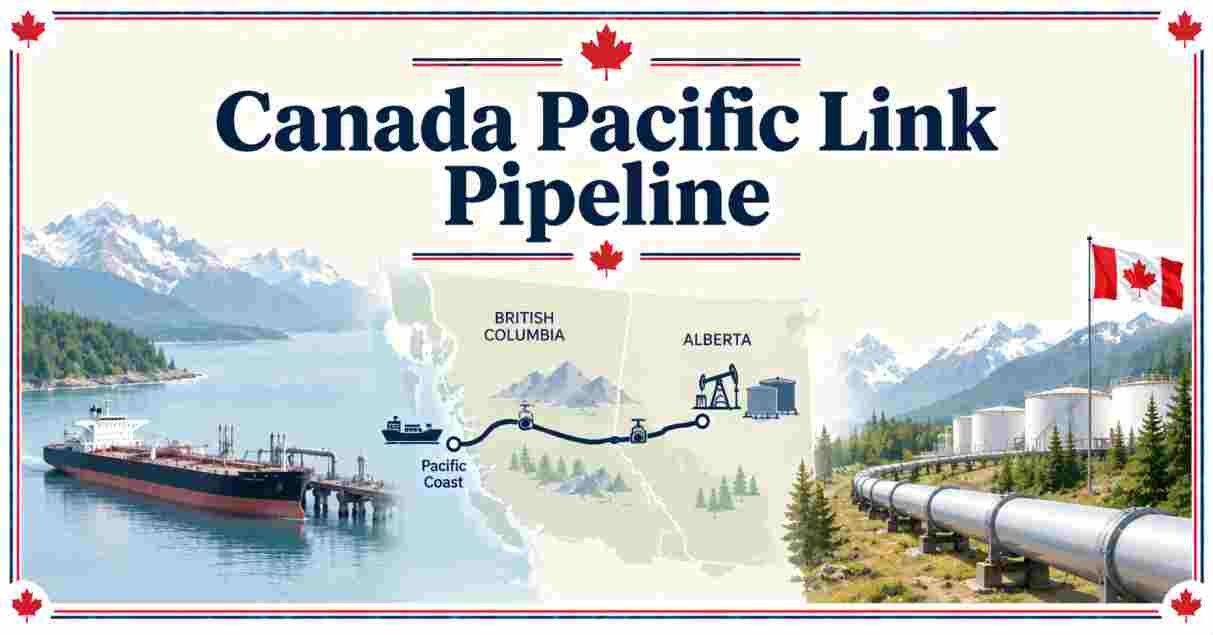
Pacific Link is a proposed 1,250-kilometre, 1-million-barrel-per-day oil pipeline from Bruderheim, Alberta, to an export terminal near Delta, British Columbia, costing between $35.2 billion and $43.7 billion. Ottawa designated it Canada’s first project of national interest on October 1, 2026, though no route, financing or construction date has been finalized.
Canada Pacific Link Pipeline – Introduction
Canada Pacific Link Pipeline 2026 became official policy on October 1, 2026, when Prime Minister Mark Carney and Alberta Premier Danielle Smith stood together in Fort McMurray to designate the project Canada’s first-ever pipeline under the national-interest provisions of the Building Canada Act. Previously known as the West Coast Oil Pipeline, Pacific Link would carry roughly one million barrels of Alberta crude a day along a southern corridor largely following the existing Trans Mountain route, ending at a new export terminal capable of loading the largest crude tankers on the market.
The announcement capped nearly a year of negotiation between Ottawa and Edmonton, built on a November 2025 energy agreement and a formal Alberta proposal submitted in July 2026. What it did not settle is almost as notable as what it did: the final route, the financing structure, and whether enough oil producers will actually commit their barrels to fill the line all remain open questions. This report walks through the Canada Pacific Link Pipeline 2026 route, cost estimates, ownership structure and the Alberta oil context driving the project, using figures confirmed through October 3, 2026.
Interesting Facts About the Canada Pacific Link Pipeline 2026
PACIFIC LINK PIPELINE KEY NUMBERS (billions of dollars)
Low-end cost estimate   | ███████ 35.2
High-end cost estimate  | █████████ 43.7
Annual GDP contribution | ████ 20 (projected, CAD)
| Fact | Confirmed 2026 Data |
|---|---|
| National interest designation date | October 1, 2026 |
| Pipeline length | Up to 1,250 kilometres |
| Daily capacity | 1 million barrels |
| Estimated cost | $35.2 billion to $43.7 billion |
| Starting point | Bruderheim, Alberta |
| Endpoint | Near Delta, British Columbia |
| Projected peak construction jobs | Up to 140,000 |
| Federal conditions document deadline | September 1, 2027 |
Source: Major Projects Office; Government of Canada national interest designation, October 1, 2026; Canada Gazette, August 1, 2026; Reuters and BOE Report, October 2026.
The chart lines up the two cost bookends Ottawa has published: a $35.2 billion floor and a $43.7 billion ceiling, a roughly 24% spread that reflects how early-stage this project still is. The table fills in the operational basics: a pipeline stretching up to 1,250 kilometres, moving 1 million barrels a day from Bruderheim to a terminal near Delta, with the federal government promising its conditions document by September 1, 2027, nearly a full year after the designation itself.
The job and GDP numbers deserve a caveat the government itself has acknowledged: these are projections tied to a project with no confirmed route, no final investment decision and no in-service date. The 140,000-job figure represents peak construction employment, not permanent operating jobs, and Ottawa’s own national-interest order lists capacity rather than contracted throughput, meaning producers still have to commit their barrels before the number means much in practice.
Pacific Link Pipeline Route 2026: Bruderheim to Delta
PACIFIC LINK ROUTE MILESTONES
Bruderheim, Alberta (origin)          | Start of line
~1,250 km southern corridor           | Follows Trans Mountain path
11 pump stations along route          | Per Canada Gazette filing
Delta, British Columbia (terminus)    | ~35 km south of Vancouver
Offshore VLCC-loading facility        | Accommodates largest tankers
| Route Element | Detail |
|---|---|
| Origin | Bruderheim, Alberta |
| Corridor | Southern route, largely parallel to Trans Mountain |
| Length | Up to 1,250 km |
| Pump stations | 11 |
| Terminus | Delta, British Columbia, ~35 km south of Vancouver |
| Marine facility | Accommodates very large crude carriers (VLCCs) |
Source: Canada Gazette notice, August 1, 2026; Baird Maritime; Wikipedia Pacific Link pipeline entry, October 2026.
Alberta’s July 2026 submission settled one major question early: Pacific Link would take a southern route, not the northern path that previous West Coast pipeline proposals explored and that drew fierce opposition over risks to the Great Bear Sea and British Columbia’s North Coast. Instead, the line largely follows the existing Trans Mountain pipeline corridor from Bruderheim to a new terminal near Delta, a choice meant to leverage an already-developed right-of-way and reduce the kind of ecological and regulatory conflict that delayed Trans Mountain’s own expansion for years.
The terminus itself is the project’s most technically demanding element. A standard marine terminal would not suffice for a line this size; Pacific Link’s export facility needs the capacity to load very large crude carriers, the largest class of oil tankers on the water, meaning significant new port infrastructure beyond the pipeline itself. Carney has referenced roughly $10 billion in planned expansion at the Delta facility, though that figure is tied to broader cargo and port capacity work already underway rather than confirmed VLCC-specific infrastructure, leaving a real gap between what’s funded and what the project will ultimately require. For the production side feeding this new export route, see this breakdown of Canada oil pipeline statistics, which covers the country’s existing pipeline network and capacity constraints.
Pacific Link Cost and Ownership 2026: Who Pays and Who Owns It
PACIFIC LINK OWNERSHIP STRUCTURE (percent)
Alberta Petroleum Marketing Commission | ████████████████████ 45%
Trans Mountain Corporation (Canada)    | ████████████████████ 45%
Pembina Pipeline Corporation           | ██████████ 10%
(Indigenous stake: minimum 10%, structure still unresolved)
| Owner | Stake |
|---|---|
| Alberta Petroleum Marketing Commission | 45% |
| Trans Mountain Corporation (federal Crown corp.) | 45% |
| Pembina Pipeline Corporation | 10% (option to add up to 10% more once operating) |
| Indigenous communities (minimum commitment) | 10% equity stake, financed via loan guarantee programs |
Source: Wikipedia Pacific Link pipeline entry; BOE Report timeline, October 2026; National Observer, October 2026.
The ownership structure places Pacific Link firmly in government hands: Alberta and Ottawa each hold 45% through the Alberta Petroleum Marketing Commission and Trans Mountain Corporation respectively, with Pembina Pipeline Corporation taking the remaining 10% and an option to double that stake once the line is operational. Trans Mountain, the Crown corporation that already builds and runs Canada’s only existing Alberta-to-coast pipeline, is set to develop, construct and operate Pacific Link as well, drawing on the same institutional experience.
A minimum 10% equity stake has also been earmarked for Indigenous communities, to be financed through federal and provincial Indigenous loan guarantee programs, though officials have not clarified how this stake fits into the existing 45/45/10 split announced earlier. Industry skepticism about the project’s commercial viability has been pointed: Stand.earth’s Sven Biggs argued that no private pipeline company has stepped forward to take real ownership risk because “the financial risks of the project outweigh the rewards,” a critique that goes to the heart of why government entities, rather than private capital, are carrying the bulk of the ownership stake.
Pacific Link and Alberta Oil 2026: Why Alberta Wants Another Pipeline
CANADA'S WEST COAST PIPELINE CAPACITY (barrels per day)
Trans Mountain (current, post-expansion)            | ████████████████ 890
Trans Mountain (with drag-reducing agents, 2026-27) | █████████████████ 960
Pacific Link (proposed)                             | ████████████████████ 1,000
| Metric | Figure |
|---|---|
| Trans Mountain current capacity | 890,000 barrels/day |
| Trans Mountain utilization rate (2025) | 90%+ |
| Trans Mountain near-term expansion (drag-reducing agents) | +70,000–75,000 b/d by early 2027 |
| Pacific Link proposed capacity | 1,000,000 barrels/day |
| Alberta’s share of total Canadian crude production | 82.7% |
Source: Bloomberg, Trans Mountain capacity reporting, 2025–2026; US Energy Information Administration; Canada Energy Regulator.
Alberta’s case for a second West Coast pipeline rests on a simple capacity problem: Trans Mountain, the only existing pipeline connecting Alberta’s oil sands to the Pacific, has been running at 90% utilization or higher through 2025, according to the company’s own reporting, even after its expansion tripled capacity to 890,000 barrels per day in 2024. Trans Mountain CEO Mark Maki has said drag-reducing agents could add another 70,000 to 75,000 barrels per day by early 2027, and further pumping upgrades could eventually push the line to roughly 1.14 million barrels per day — but that ceiling would still require dredging the approach waterway to let larger tankers load.
Alberta’s underlying production keeps climbing regardless of pipeline capacity. The province now accounts for 82.7% of all Canadian crude oil production, up from roughly 76% a decade ago, and Canadian oil producers have consistently outpaced the egress capacity available to move that oil to non-US buyers. That dynamic is central to the political case for Pacific Link: diversifying export markets toward Asia reduces Canada’s reliance on pipelines running south into the United States, a priority that gained urgency following trade tensions between Washington and Ottawa and ties directly into the broader national push tracked in this look at Canada’s fastest-growing cities, where Calgary and Edmonton’s rapid growth reflects the same Alberta energy-sector momentum driving the pipeline push.
Pacific Link’s Carbon Condition 2026: The Pathways Trade-Off
THE "GRAND ENERGY BARGAIN" — LINKED CONDITIONS
Pacific Link pipeline approval      | Contingent on →
Pathways carbon capture project     | Contingent on →
Federal emissions policy rollback   | Part of same May 2026 accord
| Condition | Status |
|---|---|
| Pathways CCS project | Prerequisite for federal pipeline backing |
| Pathways led by | Oil Sands Alliance (five major Canadian oil producers) |
| Pathways technology | Absorption towers capturing CO2 before atmospheric release |
| Agreement signed | May 15, 2026 (“grand energy bargain”) |
Source: National Observer, October 2026; Torys LLP summary of the Canada-Alberta implementation agreement, May 2026.
Ottawa’s backing for Pacific Link is not unconditional. Under the May 2026 “grand energy bargain” between Canada and Alberta, federal support for the pipeline is explicitly tied to advancing the Pathways carbon capture and storage project, a companion initiative led by the Oil Sands Alliance — a group of five major Canadian oil producers — using absorption towers to capture CO2 emissions before they reach the atmosphere and store them permanently underground. Carney has framed this pairing as making Alberta oil “among the world’s lowest-carbon intensity crude,” positioning the pipeline and the carbon capture project as a single package rather than two separate decisions.
The reverse condition applies too: Pathways’ own advancement is tied to the pipeline moving forward, meaning neither project is guaranteed independently of the other. The same May 2026 accord also rolled back certain federal environmental policies that industry had identified as obstacles, a trade-off that has drawn criticism from environmental groups even as it satisfied Alberta’s long-standing demand for faster project approvals.
Frequently Asked Questions About the Canada Pacific Link Pipeline 2026
What is the Pacific Link pipeline?
Pacific Link is a proposed oil pipeline that would carry 1 million barrels of crude per day from Bruderheim, Alberta, to an export terminal near Delta, British Columbia, for shipment to Asian markets.
When was Pacific Link designated a project of national interest?
October 1, 2026, when Prime Minister Mark Carney and Alberta Premier Danielle Smith made the announcement together in Fort McMurray, Alberta.
How much will the Pacific Link pipeline cost?
Ottawa’s preliminary estimate, submitted by Alberta in July 2026, puts the cost between $35.2 billion and $43.7 billion, including contingency.
What route will Pacific Link take?
A southern route largely following the existing Trans Mountain pipeline corridor, running up to 1,250 kilometres from Bruderheim, Alberta, to Delta, British Columbia. The final route has not yet been confirmed.
Who owns the Pacific Link pipeline?
The Alberta Petroleum Marketing Commission and Trans Mountain Corporation each hold 45%, with Pembina Pipeline Corporation holding 10% and an option to add another 10% later. A minimum 10% Indigenous equity stake is also planned.
When will construction start on Pacific Link?
No construction start date has been confirmed. Early work could begin as soon as September 1, 2027, once Indigenous consultation concludes and all approvals and permits are in place.
Why does Pacific Link’s approval depend on a carbon capture project?
Under a May 2026 agreement between Canada and Alberta, federal backing for Pacific Link is contingent on the Pathways carbon capture and storage project also advancing, and vice versa.
How many jobs would Pacific Link create?
The federal government projects up to 140,000 jobs at peak construction, including roughly 45,000 in Alberta and 70,000 in British Columbia. These are construction-phase projections, not permanent jobs.
Does Canada already have a pipeline to the Pacific coast?
Yes. The Trans Mountain pipeline, Canada’s only existing Alberta-to-coast oil pipeline, carries 890,000 barrels per day and has been running above 90% utilization through 2025.
Has Pacific Link received final approval?
No. National interest designation accelerates the regulatory review process but does not constitute final approval. A federal conditions document is due by September 1, 2027, and no final investment decision has been made.
Why did Pacific Link choose a southern route instead of a northern one?
The southern route follows Trans Mountain’s existing corridor and was designed to avoid the ecologically sensitive Great Bear Sea and British Columbia’s North Coast, areas that drew strong opposition to earlier northern pipeline proposals.
Disclaimer: This research report is compiled from publicly available sources. While reasonable efforts have been made to ensure accuracy, no representation or warranty, express or implied, is given as to the completeness or reliability of the information. We accept no liability for any errors, omissions, losses, or damages of any kind arising from the use of this report.