
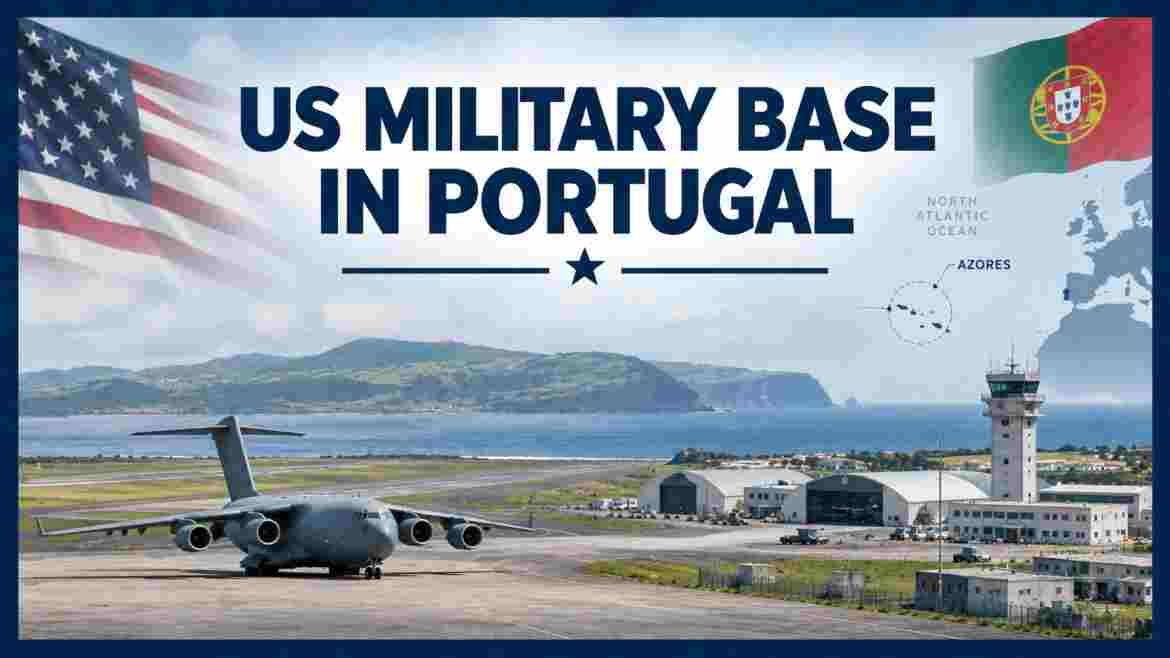
Lajes Field, officially Portuguese Air Base No. 4, sits on Terceira Island in the Azores roughly 1,500 kilometers west of mainland Portugal, hosting the US Air Force’s 65th Air Base Group — the largest American military organization in the archipelago. First used by Allied forces in 1943, the base underwent a $11.4 million modernization in 2026 to support US Navy P-8A Poseidon maritime patrol aircraft, which operated from Lajes during the year’s Iran-related military activity in the Middle East.
US Military Base in Portugal 2026 – Introduction
Lajes Air Base occupies a uniquely strategic position in American overseas military infrastructure: a mid-Atlantic stepping stone that has connected US forces in North America to Europe, Africa, and beyond for more than eight decades. Located on Terceira Island in Portugal’s Azores archipelago, the base began as a British-built airfield during the Second World War and evolved, through a series of defense agreements between Washington and Lisbon, into a joint Portuguese-American installation that remains central to transatlantic air operations today. Unlike the large, sprawling American bases found in Germany, the United Kingdom, or the Middle East, Lajes operates as a comparatively lean facility — but its geographic position gives it outsized strategic value that has only grown more visible in 2026.
That renewed visibility stems directly from recent world events. As tensions involving Iran escalated earlier in the year, Lajes Field saw a marked increase in US military air traffic, including extended deployments of refueling tankers and maritime patrol aircraft transiting between the Americas and the Middle East. The base’s ongoing modernization, centered on supporting the Navy’s P-8A Poseidon aircraft, reflects a broader American effort to keep this Atlantic waypoint relevant to 21st-century military requirements. This report covers Lajes Field’s location, history, command structure, and current 2026 operations based on official US Air Force, Department of Defense, and Portuguese government sources.
Interesting Facts about US Military Base in Portugal 2026
| Category | Figure |
|---|---|
| Official designation | Air Base No. 4 (Base Aérea n.º 4), Azores Air Zone Command |
| Location | Terceira Island, Azores, Portugal |
| Distance from mainland Portugal | ~1,500 km (~900 miles from Lisbon) |
| US military unit stationed | 65th Air Base Group, under the 86th Airlift Wing (Ramstein AB, Germany) |
| First Allied use | 1943, by the British Royal Air Force |
| First American personnel arrived | 1944, to construct a runway |
| 2026 modernization contract value | $11.4 million (€10 million) |
| P-8A Poseidon aircraft present during 2026 Iran-related operations (May) | At least 4 |
| KC-46 Pegasus tankers stationed during March 2026 operations | 15 |
Lajes Field’s defining characteristic is its sheer geographic isolation combined with its strategic indispensability. The base sits on a volcanic island roughly 8 by 15 miles in size, bordered almost entirely by high cliffs, with a local population of around 50,000 — yet it boasts the largest flight line of any US Air Forces in Europe facility, a reflection of its historic role as a refueling and staging checkpoint for aircraft making the long crossing between North America and Europe. Its distance from the US Navy’s East Coast P-8A fleet at Naval Air Station Jacksonville, Florida — roughly 5,000 kilometers — illustrates just how far forward-positioned this small Atlantic outpost actually is.
The base’s role sharpened considerably in 2026. Portuguese defense reporting documented the US Navy maintaining at least four P-8A Poseidon maritime patrol aircraft at Lajes during May 2026, alongside French Bréguet Atlantique aircraft, in connection with operations tied to the conflict involving Iran. Separately, in March 2026, 15 US Air Force KC-46 Pegasus refueling aircraft were stationed at the base for more than a week, with the majority departing once the associated US military activity concluded — underscoring how quickly American air traffic through Lajes can scale up in response to events far from the Azores themselves.
Where Lajes Air Base Is Located in 2026
LAJES FIELD: GEOGRAPHIC POSITION
DISTANCE TO MAINLAND PORTUGAL (LISBON)   ███████  ~900 miles / 1,500 km
DISTANCE TO NEW YORK CITY                ███████████████████  ~2,200 miles
DISTANCE TO NAS JACKSONVILLE, FL         █████████████████████████████  ~5,000 km
| Geographic Fact | Detail |
|---|---|
| Island | Terceira Island, Azores archipelago |
| Island size | Roughly 8 by 15 miles, oval-shaped, bordered by high cliffs |
| Local population | ~50,000 |
| Distance to Lisbon, Portugal | ~900 miles |
| Distance to New York City | ~2,200 miles |
| Co-located civilian airport | Lajes Airport (IATA: TER, ICAO: LPLA), shares the runway |
| Environmental designation | Located within a UNESCO Biosphere Reserve |
Data Source: US Air Force, Wikipedia, MilitaryBases.us
Lajes Field sits on the northeastern tip of Terceira Island, roughly in the geographic middle of the North Atlantic Ocean — approximately 900 miles west of mainland Portugal and about 2,200 miles east of New York City. That mid-ocean position has been the base’s entire strategic rationale since its founding: an aircraft crossing the Atlantic in either direction can refuel and rest at Lajes roughly halfway through the journey, a function that remains relevant even in an era of longer-range aircraft, because military cargo and tanker operations still benefit enormously from a reliable, allied-controlled waypoint partway across the ocean.
The base shares its runway and support infrastructure with the civilian Lajes Airport, which serves both inter-island flights within the Azores and scheduled international service connecting North America and mainland Europe through carriers including Azores Airlines and TAP Air Portugal. The surrounding area sits within a UNESCO Biosphere Reserve, meaning military operations at the base are conducted alongside deliberate environmental coordination, a detail that distinguishes Lajes from most other overseas US installations. For broader context on how NATO allies collectively fund and host American military infrastructure across Europe, see our US NATO Funding Statistics report.
History of Lajes Air Base
LAJES FIELD: KEY HISTORICAL MILESTONES
1943   ████  First RAF use (anti-U-boat operations)
1944   ██████  US personnel arrive, begin runway construction
1946   ████████  US consolidates Azores operations at Lajes
1991   ██████████████  Supports Operations Desert Shield/Storm
2003   ████████████████  Hosts the Atlantic Summit (President Bush)
| Year | Milestone |
|---|---|
| 1943 | Royal Air Force first uses the airfield for anti-submarine operations against German U-boats |
| 1944 | American personnel arrive to construct a runway |
| September 1, 1946 | US transfers its primary Azores operations from Santa Maria Island to Lajes |
| Cold War era | Serves as a vital NATO airlift hub and emergency landing site for US strategic forces |
| 1990-1991 | Supports Operations Desert Shield and Desert Storm |
| March 2003 | Hosts the Atlantic Summit, attended by President George W. Bush |
Data Source: Wikipedia, VetFriends, US Air Force historical records
Lajes Field’s origins trace back to 1943, when the Royal Air Force first used the airfield to support Allied anti-submarine operations against German U-boats menacing transatlantic shipping lanes during the Second World War. American involvement began the following year, in 1944, when US personnel arrived specifically to construct a runway, laying the groundwork for what would become a central node in the Allied transatlantic air bridge. Following the war, the United States formally consolidated its Azores operations at Lajes on September 1, 1946, moving its primary presence from nearby Santa Maria Island and establishing the foundation for the decades of continuous American use that followed.
Throughout the Cold War, Lajes functioned as an essential NATO airlift waypoint and a designated emergency landing site for US strategic bomber and reconnaissance forces operating across the Atlantic, with American personnel levels fluctuating considerably based on the era’s strategic requirements — 1950s-era diplomatic correspondence documented requests to expand the US presence at Lajes to nearly 5,800 personnel during periods of heightened Cold War tension. The base also played a logistical role during the 1990-1991 Gulf War, supporting Operations Desert Shield and Desert Storm, and gained renewed international attention in March 2003 when it hosted the Atlantic Summit, bringing President George W. Bush and other heads of government to the island ahead of the Iraq War.
Who Operates Lajes Field in 2026
LAJES FIELD: COMMAND STRUCTURE
65TH AIR BASE GROUP (USAF) → 86TH AIRLIFT WING → USAFE-AFAFRICA → THIRD AIR FORCE
PORTUGUESE AIR FORCE: 502 & 752 SQUADRONS (CO-LOCATED, PARALLEL COMMAND)
| Element | Detail |
|---|---|
| US unit | 65th Air Base Group |
| Parent wing | 86th Airlift Wing, Ramstein Air Base, Germany |
| Higher command | US Air Forces in Europe – Air Forces Africa, Third Air Force |
| Portuguese units co-located | 502 Squadron and 752 Squadron “Fénix” (Portuguese Air Force) |
| Portuguese command authority | Headquarters Azores Air Zone, commanded by a Portuguese Air Force brigadeiro |
| Key subordinate USAF squadrons | 65th Civil Engineer Squadron; 65th Logistics Readiness Squadron; 65th Air Base Squadron; 65th Comptroller Squadron |
| Legal framework | Portugal-US Defense Cooperation Agreement |
Data Source: Wikipedia, US Air Force fact sheets, GlobalSecurity.org
Lajes Field operates under a genuinely joint command structure rather than as a purely American installation. The base is formally Portuguese Air Base No. 4, under the direction of the Portuguese Air Force’s Azores Air Zone headquarters, commanded by a Portuguese brigadeiro — the equivalent of a US one-star general. The American presence, the 65th Air Base Group, operates as a tenant unit under this Portuguese command framework while itself reporting up through the 86th Airlift Wing at Ramstein Air Base in Germany, and further through US Air Forces in Europe – Air Forces Africa and Third Air Force.
The legal basis for American operations at Lajes runs through the Portugal-US Defense Cooperation Agreement, a bilateral framework that governs how, and under what circumstances, US forces can use the base. Under that agreement, routine NATO-aligned operations proceed under standing authorization, while any American use of Lajes beyond the NATO or broader international-organization framework is generally understood to require prior Portuguese authorization — a distinction that has drawn public attention in Portugal during periods of intensified American air traffic tied to operations outside Europe. The Portuguese Air Force’s own 502 and 752 “Fénix” squadrons remain co-located at the base, reflecting the installation’s dual-nation character more than eight decades after its founding. For a comparative look at how a similarly structured US overseas air base operates in a different NATO country, see our US UK Troop Statistics report, and for how Portugal’s own defense budget fits into the alliance’s broader spending picture, see our NATO Defense Spending Statistics report.
Lajes Field’s Strategic Operations in 2026
LAJES FIELD 2026: NOTABLE AIRCRAFT DEPLOYMENTS
MARCH 2026 — KC-46 PEGASUS TANKERS    ████████████████  15 aircraft, 1+ week
MAY 2026 — P-8A POSEIDON PATROL       ████████  4+ aircraft
| Deployment | Detail |
|---|---|
| March 2026 | 15 KC-46 Pegasus refueling aircraft stationed at Lajes for more than a week; 13 departed following associated operations |
| May 2026 | US Navy maintained at least 4 P-8A Poseidon maritime patrol aircraft at Lajes, alongside French Bréguet Atlantique aircraft |
| Typical role | Centralized refueling, maintenance support, and lodging for transient DoD, allied, and NATO aircraft |
| Transit function | Jump-off/stopover point connecting US forces to Rota (Spain), Sigonella (Italy), and other European bases |
| Normal annual aircraft operations supported | Up to 3,000 per year |
Data Source: Lusa News Agency, Portugal Resident, GlobalSecurity.org, Ramstein Air Base public affairs
Lajes Field’s core mission has remained consistent for decades: providing centralized refueling, maintenance, and logistical support for US, NATO, and allied aircraft transiting the mid-Atlantic. In an average year, the base supports up to roughly 3,000 aircraft operations, serving as what the 65th Air Base Squadron’s leadership has described as a strategically located checkpoint executing mission-essential requirements for everything from bombers and fighters to tankers and cargo aircraft, while also functioning as a commuting point for US Navy personnel moving between the United States and jump-off bases in Spain and Italy.
2026 brought a visible uptick in that transient traffic tied directly to geopolitical events. In March, 15 KC-46 Pegasus refueling tankers were stationed at Lajes for more than a week in connection with US military operations, with 13 of the aircraft departing once that activity concluded. Two months later, in May, the US Navy kept at least four P-8A Poseidon maritime patrol aircraft at the base, operating alongside French maritime patrol assets, as part of broader activity connected to the regional situation involving Iran — a pattern of use that reflects Lajes’s enduring value as a flexible, forward-positioned waypoint whenever US and allied forces need to surge aircraft between the Americas, Europe, and the Middle East on short notice.
Modernization and the P-8 Poseidon Upgrade in 2026
BUILDING 705 MODERNIZATION PROJECT, 2026
CONTRACT VALUE       ████████████████████████  $11.4 million (€10 million)
| Project Element | Detail |
|---|---|
| Contractor | CMS Corporation |
| Contract value | $11.4 million (€10 million) |
| Primary facility upgraded | Building 705 and associated support areas |
| New construction | Automatic aircraft post-flight Clear Water Rinse System facility |
| Additional work | Repair of ~282 square meters of paved area for secure equipment storage/staging |
| Purpose | Prepare Lajes to support Boeing P-8A Poseidon maritime patrol aircraft operations |
| P-8A crew/ground support requirement | Crew of ~9; 40-80 ground personnel typically required per aircraft |
Data Source: Jane’s Defence Intelligence, Portugal Resident, Ramstein Air Base
The centerpiece of Lajes Field’s 2026 infrastructure investment is a $11.4 million (€10 million) contract awarded to CMS Corporation to prepare the base for a potentially expanded role supporting Boeing P-8A Poseidon multimission maritime aircraft. The project centers on a complete renovation of Building 705 and its surrounding support areas, including construction of a new automatic post-flight Clear Water Rinse System — a facility designed to remove corrosive salt deposits that accumulate on aircraft operating at low altitude over the ocean, a routine but critical maintenance requirement for maritime patrol operations. The contract also covers repairing approximately 282 square meters of paved area to create a secure outdoor staging and storage zone for the additional equipment the upgraded mission would require.
The scale of personnel this modernization could eventually support remains notable: a single P-8A Poseidon typically operates with a crew of around nine — pilots, tactical operations officers, and sensor operators — but requires an additional 40 to 80 ground personnel per aircraft to sustain operations, a meaningful increase over the base’s current comparatively lean staffing levels if the full scope of any proposed Poseidon deployment were eventually realized. As of this report, officials had not finalized the precise scale of the planned operation, but the infrastructure investment itself signals a clear American intent to keep Lajes relevant for a maritime surveillance and anti-submarine mission set that has grown in strategic importance amid renewed great-power naval competition in the Atlantic.
Frequently Asked Questions
Where is the US military base in Portugal located?
The primary US military presence in Portugal is Lajes Field, officially Air Base No. 4, located on Terceira Island in the Azores archipelago, roughly 900 miles west of mainland Portugal in the mid-Atlantic Ocean.
What US military unit is stationed at Lajes Field?
The 65th Air Base Group, a US Air Force unit under the 86th Airlift Wing (headquartered at Ramstein Air Base, Germany), is the American unit stationed at Lajes Field. It is the largest US military organization in the Azores.
When was Lajes Air Base established?
The airfield was first used by the British Royal Air Force in 1943 for anti-submarine operations. American personnel arrived in 1944 to build a runway, and the US consolidated its primary Azores operations at Lajes on September 1, 1946.
Is Lajes Field a Portuguese or American base?
Both. Lajes is formally Portuguese Air Base No. 4, under Portuguese Air Force command through the Azores Air Zone headquarters, with the US 65th Air Base Group operating as a tenant unit under the bilateral Portugal-US Defense Cooperation Agreement.
What aircraft operate from Lajes Field?
Lajes primarily supports transient refueling tankers, cargo aircraft, and maritime patrol aircraft. In 2026, the base hosted 15 KC-46 Pegasus refueling tankers in March and at least 4 P-8A Poseidon maritime patrol aircraft in May, alongside its routine role supporting up to 3,000 aircraft operations annually.
Why is Lajes Field being modernized in 2026?
The US awarded an $11.4 million contract in 2026 to renovate Building 705 and surrounding facilities at Lajes Field to support potential Boeing P-8A Poseidon maritime patrol aircraft operations, including a new aircraft rinse system to manage salt corrosion from low-altitude ocean flights.
How far is Lajes Field from the United States?
Lajes Field sits approximately 2,200 miles from New York City and roughly 5,000 kilometers from Naval Air Station Jacksonville, Florida, home of the US Navy’s East Coast P-8A Poseidon fleet.
Does the US need Portugal’s permission to use Lajes Field?
For routine operations within the NATO framework, standing authorization applies under the Defense Cooperation Agreement. For US military use of Lajes beyond that NATO or international-organization framework, the agreement generally calls for prior Portuguese authorization.
Disclaimer: This research report is compiled from publicly available sources. While reasonable efforts have been made to ensure accuracy, no representation or warranty, express or implied, is given as to the completeness or reliability of the information. We accept no liability for any errors, omissions, losses, or damages of any kind arising from the use of this report.