
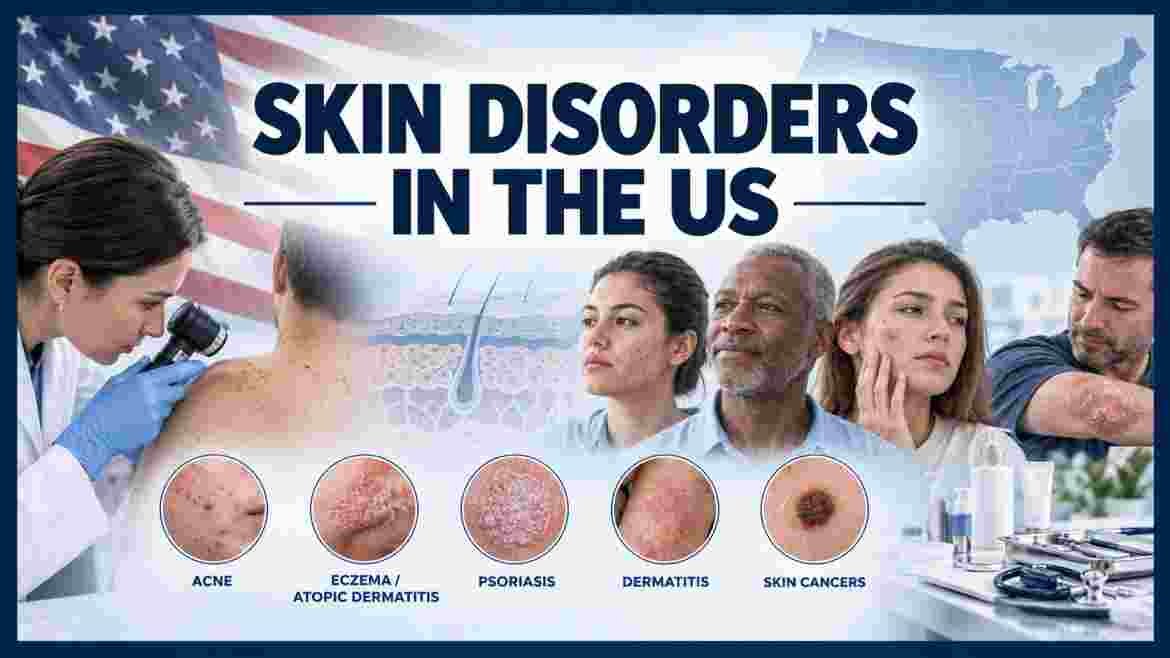
Skin disorders affect the large majority of Americans at some point in their lives, with 31.6 million people living with some form of eczema, 7.5 million with psoriasis, up to 50 million affected by acne annually, and skin cancer remaining the single most commonly diagnosed cancer in the country. In 2026, an estimated 234,680 new melanoma cases will be diagnosed nationwide, a 10.6% increase over the prior year, alongside roughly 5.4 million nonmelanoma skin cancer diagnoses.
Skin Disorders in the US 2026 – Introduction
Skin disorders in the US span an enormous range of conditions, from mild, temporary irritations to chronic inflammatory diseases that persist for decades and, in the case of skin cancer, conditions that can be life-threatening if caught late. Collectively, dermatologic conditions touch more Americans than almost any other category of illness — more people live with some form of eczema or acne than with diabetes, and skin cancer alone accounts for more diagnoses each year than all other cancers combined. Despite that scale, skin disease has historically received less research funding and public attention relative to its overall health burden, a gap researchers and dermatology organizations have worked to close over the past two decades.
2026 brings both encouraging and concerning trends depending on the specific condition. Melanoma diagnoses continue climbing, projected to rise more than 10% over the prior year according to the American Cancer Society’s latest Facts & Figures report, even as improved detection and treatment keep five-year survival rates for early-stage disease relatively high. Meanwhile, chronic inflammatory conditions like eczema and psoriasis continue to affect tens of millions of Americans with no cure, placing a persistent financial and quality-of-life burden on patients that extends well beyond the visible symptoms on their skin. This report breaks down the current prevalence, demographics, and economic impact of the most common skin disorders affecting Americans in 2026.
Interesting Facts about Skin Disorders in the US 2026
| Category | Figure |
|---|---|
| Americans with some form of eczema | 31.6 million (~10% of the population) |
| Americans with psoriasis | 7.5 million (~2.2% of the population) |
| Americans affected by acne annually | Up to 50 million |
| Projected new melanoma cases, 2026 | 234,680 (up 10.6% year-over-year) |
| Projected melanoma deaths, 2026 | 8,510 |
| Nonmelanoma skin cancers diagnosed annually | ~5.4 million |
| Americans diagnosed with skin cancer daily | ~9,500 |
| Lifetime risk of developing skin cancer | 1 in 5 Americans |
| Annual direct and indirect healthcare cost of psoriasis alone | $11.25 billion |
The sheer reach of skin disease across the US population is best illustrated by comparing a few of these figures side by side: skin cancer is diagnosed in roughly 9,500 Americans every single day, a pace that makes it the most commonly diagnosed cancer in the country by a wide margin, while chronic inflammatory conditions — eczema and psoriasis combined — are estimated to affect somewhere between 20% and 25% of the entire population at any given time. Few other categories of disease touch such a broad cross-section of Americans simultaneously, across every age group from infancy through old age.
The 2026 melanoma projection stands out as a particularly notable data point: the American Cancer Society’s latest Facts & Figures report projects 234,680 new melanoma cases, a 10.6% increase over the prior year’s total, driven by both genuine increases in incidence and continued improvements in early detection that catch more cases at the in-situ (non-invasive) stage. Men continue to face meaningfully higher risk than women, with 65,400 projected invasive cases compared with 46,600 among women — a gap researchers attribute to a combination of occupational sun exposure patterns and documented differences in sun-protective behavior and dermatology screening rates between men and women.
Eczema (Atopic Dermatitis) in the US in 2026
US ECZEMA PREVALENCE BY GROUP
ALL FORMS OF ECZEMA (TOTAL)        ████████████████████████████████  31.6 million
ADULTS WITH ATOPIC DERMATITIS      ████████████████  16.5 million
CHILDREN WITH ATOPIC DERMATITIS    █████████  9.6 million
| Metric | Figure |
|---|---|
| Americans with some form of eczema | 31.6 million (~10% of population) |
| US adults with atopic dermatitis | 16.5 million, including 6.6 million moderate-to-severe |
| US children (under 18) with atopic dermatitis | 9.6 million, roughly one-third moderate-to-severe |
| Adults reporting inadequate disease control (moderate/severe AD) | More than 55% |
| Median annual out-of-pocket cost per patient | $600 |
| Annual inpatient costs (adults) | ~$8.3 million |
Data Source: National Eczema Association
Eczema, with atopic dermatitis as its most common form, affects an estimated 31.6 million Americans, roughly 10% of the US population, making it one of the most widespread chronic skin conditions in the country. Among adults specifically, 16.5 million live with atopic dermatitis, and of those, 6.6 million meet clinical criteria for moderate-to-severe disease. The condition is similarly widespread among children, affecting an estimated 9.6 million Americans under age 18, with roughly a third experiencing moderate-to-severe symptoms that can disrupt sleep, school attendance, and daily activities.
Despite decades of available treatments, disease control remains a persistent challenge: more than 55% of adults with moderate-to-severe atopic dermatitis report inadequate control of their symptoms, and over half say they have either found a treatment ineffective or continue to worry about the long-term safety of ongoing treatment use. That gap between available therapy and actual symptom control carries a real financial dimension as well — patients report a median annual out-of-pocket cost of $600 for disease management, on top of system-wide inpatient costs that reach roughly $8.3 million annually for adults and $3.3 million for children. The condition is also not evenly distributed demographically: atopic dermatitis is more prevalent among African Americans than European Americans in the US, and research has documented that Black and Hispanic patients, along with those with lower incomes, often face greater barriers to consistent, effective care.
Psoriasis in the US in 2026
PSORIASIS: PREVALENCE AND ECONOMIC BURDEN
US PREVALENCE                 ████  7.5 million (2.2% of population)
ANNUAL HEALTHCARE COST        █████████████████████████████████  $11.25 billion
| Metric | Figure |
|---|---|
| Americans with psoriasis | 7.5 million (~2.2% of the population) |
| Peak age range for diagnosis | 45-64 years old |
| Total annual direct and indirect healthcare costs | $11.25 billion |
| Share of total cost attributable to work loss | 40% |
| Global psoriasis prevalence | ~125 million people |
| New cases diagnosed annually (US) | 150,000-260,000 |
Data Source: National Institutes of Health, National Psoriasis Foundation
Psoriasis affects an estimated 7.5 million Americans, according to National Institutes of Health figures, representing approximately 2.2% of the US population, with the condition occurring in people of all ages but concentrated most heavily among adults between 45 and 64 years old. Globally, the National Psoriasis Foundation estimates roughly 125 million people live with the condition, underscoring that the US prevalence rate sits broadly in line with patterns seen across other Western populations.
The economic footprint of psoriasis is disproportionately large relative to its prevalence: total direct and indirect healthcare costs attributable to the condition reach an estimated $11.25 billion annually in the US, with work loss accounting for 40% of that total cost burden — a reflection of how a visibly chronic skin condition can affect a patient’s professional life, self-confidence, and workplace attendance well beyond the physical discomfort of the disease itself. Between 150,000 and 260,000 new cases are diagnosed in the US each year, and because psoriasis is a lifelong, non-contagious condition with no cure, that growing cumulative patient population continues adding to the long-term economic and healthcare system burden the disease represents. For a broader look at how other chronic conditions and triggers, including seasonal allergens, affect the US population, see our Spring Allergy Statistics in US report.
Acne in the US in 2026
ACNE PREVALENCE BY AGE GROUP
AGES 12-24 (AT LEAST MINOR ACNE)   ████████████████████████████████████████  ~85%
ADULT WOMEN WITH ACNE              ██████████████  Up to 15%
| Metric | Figure |
|---|---|
| Americans affected by acne annually | Up to 50 million |
| Share of people aged 12-24 with at least minor acne | ~85% |
| Adult women affected by acne | Up to 15% |
| Typical onset | Puberty, though it can persist or begin in adulthood |
Data Source: American Academy of Dermatology
Acne remains the single most common skin condition in the United States, affecting as many as 50 million Americans annually across every adult age bracket, though it remains most strongly associated with adolescence and young adulthood. Roughly 85% of people between the ages of 12 and 24 experience at least minor acne at some point, reflecting how closely the condition tracks with the hormonal changes of puberty, even as the American Academy of Dermatology notes that a one-size-fits-all treatment approach doesn’t work given how many distinct forms acne can take — blackheads, whiteheads, pimples, and cystic or nodular acne all require somewhat different management strategies.
Adult acne represents a persistent and, by some measures, growing subset of cases: the condition continues to affect up to 15% of adult women, often extending well into a patient’s 30s and 40s rather than resolving entirely after adolescence. That persistence has helped drive sustained demand for both over-the-counter and prescription acne treatments across a wider age range than acne care was traditionally marketed toward, with board-certified dermatologists increasingly emphasizing individualized treatment plans based on acne type and skin type rather than generic, one-size-fits-all regimens. For more on how the broader skincare and dermatological treatment market has evolved alongside rising consumer interest, see our PDRN Statistics in US report.
Skin Cancer in the US in 2026
PROJECTED 2026 MELANOMA CASES BY SEX
MEN (INVASIVE)       ████████████████████████████████████████  65,400
WOMEN (INVASIVE)     ████████████████████████████  46,600
| Metric | 2026 Figure |
|---|---|
| Total projected new melanoma cases | 234,680 (up 10.6% year-over-year) |
| In-situ (non-invasive) melanoma cases | 122,680 |
| Invasive melanoma cases | 112,000 |
| Invasive cases in men | 65,400 |
| Invasive cases in women | 46,600 |
| Projected melanoma deaths | 8,510 (5,500 men, 3,010 women) |
| Annual nonmelanoma skin cancer diagnoses | ~5.4 million |
| Melanoma incidence, American Indian/Alaska Native | 11.3 per 100,000 |
| Melanoma incidence, Asian/Pacific Islander | 1.3 per 100,000 |
Data Source: American Cancer Society Cancer Facts & Figures 2026, American Academy of Dermatology
Skin cancer remains the most commonly diagnosed cancer in the United States, with current estimates suggesting one in five Americans will develop some form of it during their lifetime. The American Cancer Society’s 2026 projections put total new melanoma diagnoses at 234,680, a 10.6% increase over the prior year, split between 122,680 in-situ (non-invasive, early-stage) cases and 112,000 invasive cases. Invasive melanoma is projected to rank as the fourth most commonly diagnosed cancer among men, with 65,400 cases, and the fifth most common among women, with 46,600 cases — a gap that has persisted across multiple years of American Cancer Society reporting.
Beyond melanoma, nonmelanoma skin cancers — primarily basal cell and squamous cell carcinomas — account for roughly 5.4 million diagnoses annually, a far larger raw case count than melanoma, though one that generates a correspondingly lower mortality burden since these cancer types are typically highly treatable when caught early. Melanoma mortality remains the primary driver of skin cancer deaths overall, with 2026 projections estimating 8,510 deaths, split between 5,500 men and 3,010 women. Risk varies substantially by race and ethnicity: American Indian and Alaska Native populations show a melanoma incidence rate of 11.3 per 100,000, compared with just 1.3 per 100,000 among Asian and Pacific Islander populations — though dermatologists emphasize that skin cancer can affect people of any skin tone, and that patients with darker skin are more likely to be diagnosed with melanoma in less sun-exposed areas like the palms, soles, and nail beds, often at a later and more dangerous stage. For broader context on how skin cancer fits into the overall US cancer burden, see our Cancer Statistics in the US report.
Treatment and Economic Burden of Skin Disorders in 2026
ANNUAL US HEALTHCARE SPENDING BY CONDITION
PSORIASIS                    ████████████████████████  $11.25 billion
AD/ECZEMA INPATIENT COSTS    █  $8.3M (adults) + $3.3M (children)
| Metric | Figure |
|---|---|
| Psoriasis total annual healthcare cost | $11.25 billion |
| Eczema median annual out-of-pocket cost per patient | $600 |
| Share of global population affected by some form of skin disease | ~1 in 3 people |
| Share of global population with chronic inflammatory skin disease | ~20-25% |
| Distinct skin diseases catalogued in dermatology research | More than 2,000 |
Data Source: National Psoriasis Foundation, National Eczema Association, published dermatology research
Taken together, the treatment and management of skin disorders represents a substantial and often underappreciated share of US healthcare spending. Psoriasis alone accounts for $11.25 billion in annual direct and indirect costs, while eczema patients separately report a median $600 per year in out-of-pocket spending on top of whatever their insurance covers — figures that don’t even account for the considerably larger costs associated with skin cancer screening, biopsy, and treatment across the millions of Americans diagnosed annually. Globally, research estimates that skin diseases affect roughly one in three people at some point, with chronic inflammatory conditions specifically — primarily eczema and psoriasis — accounting for an estimated 20% to 25% of the global population.
Part of what makes skin disorders such a persistent and costly category of illness is their sheer diversity: dermatology researchers have catalogued more than 2,000 distinct skin diseases, ranging from common, well-understood conditions like acne and eczema to rare genetic disorders affecting only a small number of patients nationwide. That diversity has increasingly driven interest in technology-assisted diagnosis, including deep learning image analysis tools that researchers have found achieve diagnostic accuracy rates as high as 94% for conditions like acne and rosacea — a development dermatologists hope could eventually improve both the speed and consistency of skin disease diagnosis, particularly in regions with limited access to board-certified dermatologists.
Frequently Asked Questions
How many Americans have eczema?
An estimated 31.6 million Americans, roughly 10% of the population, have some form of eczema. Atopic dermatitis specifically affects 16.5 million adults and 9.6 million children under 18.
How common is psoriasis in the US?
Psoriasis affects approximately 7.5 million Americans, or about 2.2% of the population, according to National Institutes of Health estimates, with the condition most commonly diagnosed between ages 45 and 64.
How many people get acne?
Acne affects up to 50 million Americans annually, making it the most common skin condition in the country. Roughly 85% of people aged 12 to 24 experience at least minor acne, while up to 15% of adult women continue to be affected.
How common is skin cancer in the United States?
Skin cancer is the most commonly diagnosed cancer in the US. An estimated one in five Americans will develop it during their lifetime, with roughly 9,500 people diagnosed every day and 234,680 new melanoma cases projected for 2026 alone.
How many people die from skin cancer each year?
Melanoma, which accounts for the vast majority of skin cancer deaths, is projected to cause 8,510 deaths in the US in 2026 — 5,500 among men and 3,010 among women.
What is the difference between melanoma and nonmelanoma skin cancer?
Melanoma is a more aggressive form of skin cancer that develops in pigment-producing cells and accounts for most skin cancer deaths despite representing a smaller share of total cases. Nonmelanoma skin cancers — primarily basal cell and squamous cell carcinomas — are far more common, with roughly 5.4 million diagnosed annually, but are generally highly treatable when caught early.
Can skin cancer affect people with darker skin tones?
Yes. Skin cancer can affect anyone regardless of skin color. People with darker skin tones are more likely to develop skin cancer in areas not commonly exposed to the sun, such as the palms, soles of the feet, groin, and under the nails, and are often diagnosed at a later, more dangerous stage.
How much does psoriasis cost the US healthcare system?
Psoriasis is estimated to cost the US healthcare system $11.25 billion annually in combined direct and indirect costs, with work loss accounting for roughly 40% of that total economic burden.
Disclaimer: This research report is compiled from publicly available sources. While reasonable efforts have been made to ensure accuracy, no representation or warranty, express or implied, is given as to the completeness or reliability of the information. We accept no liability for any errors, omissions, losses, or damages of any kind arising from the use of this report.