
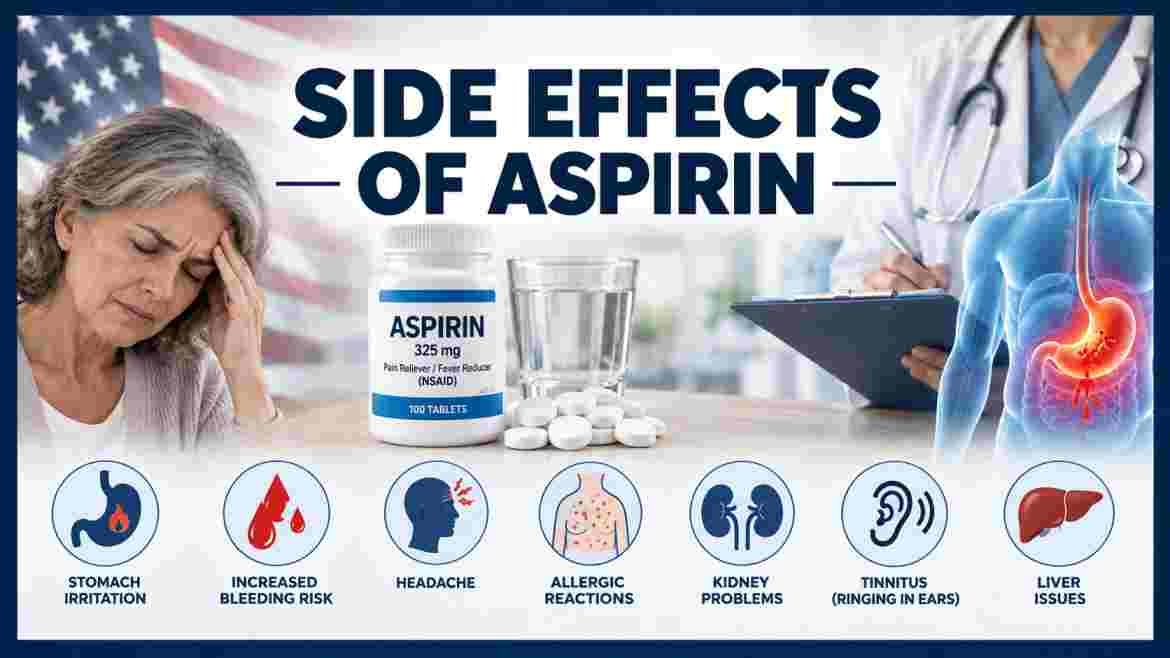
Aspirin’s most significant risk is bleeding: even very-low-dose aspirin (100 mg or less daily) increases major gastrointestinal bleeding risk by 58% and hemorrhagic stroke risk by 27% compared with not taking it, according to a systematic review conducted for the US Preventive Services Task Force. A 2023 secondary analysis of a randomized trial involving more than 19,000 older adults found daily low-dose aspirin increased intracranial bleeding risk by 38%, without a statistically significant reduction in ischemic stroke.
Side Effects of Aspirin – Introduction
Aspirin’s side effects center overwhelmingly on one mechanism: the drug works by making blood platelets less likely to clump together and form clots, which is precisely what makes it useful for preventing heart attacks and strokes — and precisely what makes bleeding its defining risk. Unlike many medications where side effects are scattered across unrelated body systems, aspirin’s risk profile is unusually concentrated, with gastrointestinal bleeding and, less commonly, bleeding inside the brain representing the overwhelming majority of serious adverse events reported in clinical research. Milder, more common side effects — stomach upset, heartburn, and nausea — stem from the same underlying mechanism affecting the stomach lining’s protective barrier.
What makes aspirin’s risk profile genuinely complicated to communicate is that the same bleeding risk exists at every dose level studied, including the very low doses used purely for long-term heart protection. Research consistently shows this risk doesn’t disappear at low doses — it’s simply smaller in absolute terms, and for many patients with existing cardiovascular disease, the benefit of preventing a heart attack or stroke clearly outweighs that bleeding risk. For people without existing cardiovascular disease taking aspirin purely as a precaution, the calculation looks different, which is exactly why major health guidelines have shifted toward more selective aspirin recommendations in recent years. This report breaks down aspirin’s documented side effects, bleeding risks, and long-term safety data based on major clinical studies and systematic reviews.
Interesting Facts about Aspirin Side Effects
| Category | Figure |
|---|---|
| Increased major GI bleeding risk, very-low-dose aspirin (≤100mg) | +58% (odds ratio 1.58) |
| Increased hemorrhagic stroke risk, very-low-dose aspirin | +27% (odds ratio 1.27) |
| Excess major GI bleeding events | 1.39 per 1,000 person-years of aspirin use |
| Excess hemorrhagic stroke events | 0.32 per 1,000 person-years of aspirin use |
| Share of major bleeding cases involving daily (vs. less-frequent) aspirin use | 72.6% |
| Increase in intracranial bleeding risk, older adults (2023 trial analysis) | +38% |
| Risk of death given a clinically detectable bleeding gastric ulcer | 0.5% to 10% |
| Annual intracranial hemorrhage risk with chronic aspirin use | Less than 0.04% |
| Relative bleeding ulcer risk at 300mg vs. 75mg aspirin dose | Nearly double (OR 3.9 vs. 2.3) |
The clearest way to understand aspirin’s side effect profile is through its consistent dose-response relationship: the higher the dose, the higher the bleeding risk, in a pattern researchers have documented across multiple independent studies. A case-control study examining hospitalization for bleeding peptic ulcers found the odds ratio climbed from 2.3 at 75 mg to 3.2 at 150 mg and 3.9 at 300 mg — meaning the risk at the highest commonly used dose runs nearly double the risk at the lowest. That pattern holds true even though 75-81 mg doses are generally considered the safest effective option for long-term cardiovascular protection.
The other defining statistic in aspirin’s safety profile is how concentrated bleeding risk is among daily users specifically: researchers found that 72.6% of major bleeding cases occurred among people taking aspirin daily, rather than less frequently, reinforcing that cumulative, ongoing exposure — not occasional use — drives the overwhelming majority of serious bleeding events. That finding has particular relevance for the tens of millions of Americans currently taking daily low-dose aspirin for heart protection, many of whom may not realize that even the smallest commonly prescribed dose carries a measurable, ongoing bleeding risk rather than a one-time or negligible one.
Common Aspirin Side Effects in 2026
ASPIRIN SIDE EFFECTS BY SEVERITY
MILD/COMMON (stomach upset, heartburn, nausea)   ███████████████████████████
MODERATE (tinnitus/ringing in ears)              ████████████
SERIOUS (GI bleeding, intracranial bleeding)     ████████
| Side Effect | Severity | Typical Context |
|---|---|---|
| Stomach upset/indigestion | Mild | Common even at low doses, worse on an empty stomach |
| Heartburn | Mild | Related to aspirin’s effect on the stomach lining |
| Nausea | Mild-moderate | More common at higher, pain-relief-level doses |
| Tinnitus (ringing in ears) | Moderate | Classic warning sign of excess salicylate levels |
| Gastrointestinal bleeding | Serious | Most significant risk, rises with dose and duration |
| Intracranial (brain) bleeding | Serious, rare | Less common than GI bleeding, but more dangerous |
Data Source: Drugs.com, clinical pharmacology literature
The majority of people who take aspirin, particularly at low doses for heart protection, experience no side effects at all or only mild gastrointestinal discomfort — stomach upset, heartburn, or mild nausea, generally related to aspirin’s effect on the protective mucus layer lining the stomach. These milder effects can often be reduced by taking aspirin with food, though they don’t fully eliminate the underlying mechanism driving aspirin’s more serious risks. Tinnitus, a ringing or buzzing sound in the ears, represents a step up in severity and is specifically recognized as an early clinical warning sign that aspirin or salicylate levels in the bloodstream have climbed too high, typically at doses well above standard low-dose cardiovascular regimens.
The more serious end of aspirin’s side effect spectrum — gastrointestinal bleeding and, less commonly, bleeding inside the brain — represents a fundamentally different category of risk rather than simply a more severe version of stomach upset. These bleeding events stem directly from aspirin’s core pharmacological action: by inhibiting platelet aggregation, aspirin makes it genuinely harder for the body to form clots and stop bleeding once it starts, whether that bleeding originates from a stomach ulcer, an injury, or a blood vessel in the brain. This is also precisely why aspirin remains effective for cardiovascular protection — the same antiplatelet action that raises bleeding risk is what prevents the clots that cause heart attacks and ischemic strokes.
Gastrointestinal Bleeding Risk in 2026
BLEEDING ULCER HOSPITALIZATION RISK BY ASPIRIN DOSE (ODDS RATIO)
75 MG    ████████████████  2.3
150 MG   ██████████████████████  3.2
300 MG   ███████████████████████████  3.9
| Metric | Figure |
|---|---|
| Increased major GI bleeding risk, ≤100mg aspirin daily | +58% (OR 1.58) |
| Excess major GI bleeding events (aspirin vs. non-use) | 1.39 per 1,000 person-years |
| Bleeding ulcer hospitalization odds ratio at 75mg | 2.3 |
| Bleeding ulcer hospitalization odds ratio at 150mg | 3.2 |
| Bleeding ulcer hospitalization odds ratio at 300mg | 3.9 |
| Risk of death from a clinically detectable bleeding gastric ulcer | 0.5% to 10% |
| Added risk from combined NSAID use | 13-15% higher bleeding risk |
Data Source: Systematic review for the US Preventive Services Task Force, case-control clinical research
Gastrointestinal bleeding is aspirin’s single most common serious side effect, and the research behind it is unusually consistent across study designs. A major systematic review conducted for the USPSTF found that even very-low-dose aspirin (100 mg or less, taken daily or every other day) increased major GI bleeding risk by 58% compared with not taking aspirin at all, translating to roughly 1.39 excess major bleeding events per 1,000 person-years of use. That risk climbs in a clear, dose-dependent pattern: separate case-control research found the odds of hospitalization for a bleeding peptic ulcer rose from 2.3 at 75 mg, to 3.2 at 150 mg, to 3.9 at 300 mg — meaning tripling a typical low dose roughly doubles the associated bleeding-ulcer risk.
The consequences of a serious GI bleeding event, once it occurs, are not uniformly mild: researchers estimate the risk of death associated with a clinically detectable bleeding gastric ulcer ranges from 0.5% to as high as 10%, a wide range reflecting how much outcomes depend on how quickly the bleeding is identified and treated. Combining aspirin with other medications compounds this risk further — taking aspirin alongside other NSAIDs (like ibuprofen or naproxen) increases bleeding risk by an additional 13-15%, and research has separately found that SSRIs, a common class of antidepressant, can double the rate of upper gastrointestinal bleeding on their own, making the combination with aspirin a particularly important one for patients and doctors to discuss. For a broader look at how gastrointestinal conditions and mortality patterns intersect more generally in the US, see our Death Statistics in the US report.
Hemorrhagic Stroke Risk in 2026
HEMORRHAGIC STROKE RISK: KEY FINDINGS
INCREASED RELATIVE RISK (very-low-dose aspirin)            █████████  +27%
INTRACRANIAL BLEEDING INCREASE (2023 trial, 19,114 adults) ███████████████  +38%
| Metric | Figure |
|---|---|
| Increased hemorrhagic stroke risk, very-low-dose aspirin | +27% (OR 1.27) |
| Excess hemorrhagic stroke events | 0.32 per 1,000 person-years |
| Alternate AHA estimate of excess hemorrhagic stroke risk | ~0.2 events per 1,000 patient-years |
| Increase in intracranial bleeding, 2023 trial (19,114 older adults) | +38% |
| Annual intracranial hemorrhage risk, chronic aspirin use | Less than 0.04% |
| Trade-off (moderate-risk patients, 5-year window) | ~1 excess hemorrhagic stroke vs. ~14 heart attacks prevented per 1,000 patients |
Data Source: USPSTF systematic review, American Heart Association, JAMA Network Open (2023)
Hemorrhagic stroke — bleeding inside the brain, as opposed to the more common ischemic stroke caused by a blood clot — represents aspirin’s rarer but more severe bleeding risk. The same USPSTF-commissioned systematic review that found elevated GI bleeding risk also found very-low-dose aspirin increased hemorrhagic stroke risk by 27%, translating to an estimated 0.32 excess events per 1,000 person-years of use, a figure broadly consistent with the American Heart Association’s own separate estimate of roughly 0.2 excess events per 1,000 patient-years in primary prevention populations. A 2023 secondary analysis published in JAMA Network Open, examining more than 19,000 older adults in a randomized trial, found an even larger 38% increase in combined intracranial bleeding (hemorrhagic stroke plus other causes of brain bleeding) among those taking daily low-dose aspirin — notably, without a statistically significant corresponding reduction in ischemic stroke risk in that same study population.
The overall annual risk of intracranial hemorrhage from chronic aspirin use remains low in absolute terms, estimated at less than 0.04% per year, but the clinical trade-off becomes genuinely meaningful at scale: American Heart Association research estimates that for every 1,000 patients treated with aspirin over a 5-year period at moderate cardiovascular risk, the therapy would be expected to cause roughly 1 excess hemorrhagic stroke while preventing approximately 14 heart attacks — a favorable trade-off for patients with real cardiovascular risk, but one that looks far less favorable for healthy people with no elevated risk taking aspirin purely as a precaution. That exact calculation is central to why current guidelines increasingly emphasize individualized risk assessment rather than broad, population-wide aspirin recommendations. For more on how hemorrhagic and ischemic stroke patterns compare across the broader US population, see our Stroke Statistics in the US report.
Long-Term Effects of Daily Aspirin Use in 2026
RISK CONCENTRATION: DAILY VS. LESS-FREQUENT ASPIRIN USE
DAILY USE           ████████████████████████████████  72.6% of major bleeding cases
LESS-FREQUENT USE   ████████████  27.4% of major bleeding cases
| Metric | Figure |
|---|---|
| Share of major bleeding cases involving daily aspirin use | 72.6% |
| Pattern of risk over time | Current evidence suggests relatively constant risk throughout duration of use |
| Effect on cardiovascular mortality (vs. nonfatal events) | Reduces nonfatal MI/stroke; no clear reduction in CVD death risk |
| Women aged 65+ relative risk of hemorrhagic stroke (self-reported cohort data) | ~4x higher than non-users |
Data Source: USPSTF systematic review, Cardiovascular Health Study
One of the more reassuring findings in long-term aspirin research is that bleeding risk does not appear to accumulate or worsen the longer someone takes the drug — available evidence suggests the risk remains relatively constant across years of continuous use rather than climbing progressively over time, meaning a person’s risk in year ten of aspirin therapy is broadly similar to their risk in year one. That said, because risk doesn’t decline with continued use either, the cumulative probability of experiencing a bleeding event over a lifetime of daily use is meaningfully higher than the risk associated with any single year of use.
Older observational research has also identified specific demographic patterns worth noting: the Cardiovascular Health Study found that healthy women aged 65 and older who took aspirin faced roughly four times the relative risk of hemorrhagic stroke compared with non-users, a self-reported, non-randomized finding that nonetheless illustrates how certain populations may face disproportionately elevated bleeding risk from aspirin relative to the general population. This evidence feeds into one of the more counterintuitive findings in cardiovascular prevention research: while daily low-dose aspirin reliably reduces the risk of nonfatal heart attacks and nonfatal strokes, research has not demonstrated a corresponding reduction in overall cardiovascular death risk — meaning the drug can meaningfully change the type of cardiovascular event a person experiences without necessarily extending their life expectancy. For context on how rehabilitation and long-term outcomes differ between stroke types, including hemorrhagic strokes that aspirin use can contribute to, see our Stroke Recovery Statistics in US report.
Drug Interactions and Who Faces Higher Risk in 2026
FACTORS THAT COMPOUND ASPIRIN'S BLEEDING RISK
CONCURRENT ANTICOAGULANT USE (warfarin, heparin)    ███████████████████████
OTHER NSAID USE                                     ████████████████
SSRI USE                                            ████████████████████
HISTORY OF ULCER/GI BLEED                           ████████████████████████
| Risk Factor | Effect on Bleeding Risk |
|---|---|
| Concurrent anticoagulant use (warfarin, heparin) | Substantially increases bleeding risk; requires close medical supervision |
| Other NSAID use (ibuprofen, naproxen) | +13-15% additional bleeding risk |
| SSRIs (common antidepressants) | Can double the rate of upper GI bleeding independently |
| History of ulcer or prior GI bleed | +5-8% additional risk, per clinical research |
| Age 65 and older | Generally higher baseline bleeding risk across all categories |
| Coagulopathy (clotting disorders) | Significantly elevated hemorrhage risk; aspirin generally avoided or closely monitored |
Data Source: Clinical pharmacology literature, USPSTF systematic review
Aspirin’s bleeding risk is not static — it compounds significantly when combined with other medications or underlying health conditions that independently affect clotting or the GI tract. The clearest and most dangerous interaction involves anticoagulant medications like warfarin or heparin, where combining a drug that thins blood through a different mechanism with aspirin’s antiplatelet effect can multiply bleeding risk well beyond what either drug carries alone, which is why patients on these combinations require close medical monitoring. Other NSAIDs, including common over-the-counter pain relievers like ibuprofen and naproxen, add an estimated 13-15% to aspirin’s baseline bleeding risk when taken together, while SSRIs, one of the most widely prescribed classes of antidepressant, have been shown to independently double the rate of upper gastrointestinal bleeding — a combination worth specifically discussing with a doctor or pharmacist given how commonly both aspirin and SSRIs are used by older adults.
A documented history of ulcers or prior gastrointestinal bleeding adds a further 5-8% to baseline bleeding risk according to clinical research reviewed by the USPSTF, while underlying coagulopathy, or clotting disorders, generally represents one of the clearest reasons a doctor might advise against aspirin therapy altogether, or recommend only highly supervised use. Age itself functions as a general risk multiplier across nearly every category of aspirin-related bleeding, reinforcing why current cardiovascular prevention guidelines increasingly weigh age, alongside specific medication combinations and medical history, when evaluating whether aspirin’s benefits outweigh its risks for any individual patient.
Frequently Asked Questions
What are the most common side effects of aspirin?
The most common side effects are mild gastrointestinal symptoms — stomach upset, heartburn, and nausea — along with tinnitus (ringing in the ears) at higher doses. More serious but less common side effects include gastrointestinal bleeding and, rarely, bleeding inside the brain.
How much does aspirin increase bleeding risk?
Research conducted for the USPSTF found that even very-low-dose aspirin (100 mg or less daily) increases major gastrointestinal bleeding risk by 58% and hemorrhagic stroke risk by 27% compared with not taking aspirin, with risk rising further at higher doses.
Can low-dose aspirin cause a brain bleed?
Yes. A 2023 analysis of a randomized trial involving more than 19,000 older adults found daily low-dose aspirin increased intracranial bleeding risk by 38%, though the overall annual risk of intracranial hemorrhage from chronic aspirin use remains low, estimated at under 0.04% per year.
Does the risk of aspirin side effects increase the longer you take it?
Current evidence suggests bleeding risk stays relatively constant throughout the duration of aspirin use rather than increasing over time, though the cumulative probability of an event over many years of continuous use is naturally higher than the risk in any single year.
What medications should not be combined with aspirin?
Anticoagulants like warfarin or heparin significantly increase combined bleeding risk and require close medical supervision. Other NSAIDs add roughly 13-15% additional bleeding risk, and SSRIs can independently double the rate of upper gastrointestinal bleeding.
Does aspirin reduce the risk of dying from heart disease?
Research has found that daily low-dose aspirin reduces the risk of nonfatal heart attacks and strokes but has not been shown to reduce overall cardiovascular mortality, an important nuance reflected in updated prevention guidelines.
Who is at higher risk for aspirin side effects?
People taking anticoagulants or other NSAIDs, those with a history of ulcers or GI bleeding, adults 65 and older, and people with underlying clotting disorders all face elevated bleeding risk from aspirin and generally require closer medical guidance before starting or continuing use.
What is the warning sign of taking too much aspirin?
Tinnitus, or ringing in the ears, is a classic early warning sign that aspirin or salicylate levels in the body have risen too high. Other signs of excess use can include rapid breathing, nausea, and confusion, which warrant prompt medical attention.
Disclaimer: This research report is compiled from publicly available sources. While reasonable efforts have been made to ensure accuracy, no representation or warranty, express or implied, is given as to the completeness or reliability of the information. We accept no liability for any errors, omissions, losses, or damages of any kind arising from the use of this report.