
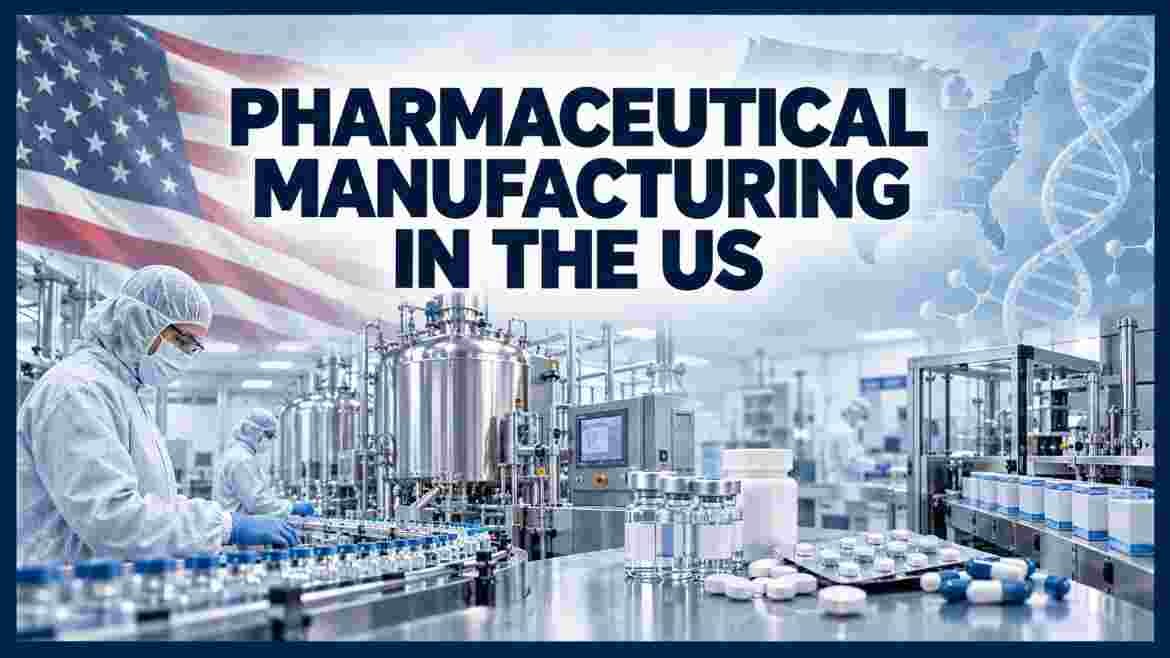
US pharmaceutical companies have pledged more than $500 billion in domestic manufacturing investment since 2025, spanning 22-plus new sites and roughly 44,000 announced jobs, after Section 232 tariffs of up to 100% on imported branded medicines took full effect in September 2026. The industry already directly employs 1.3 million Americans across more than 1,500 facilities in 47 states.
Pharmaceutical Manufacturing in the US in 2026
Pharmaceutical manufacturing in the United States is in the middle of its largest reshoring wave in decades, driven almost entirely by a single policy shift: Section 232 tariffs on imported patented medicines, which took effect for the companies named in the original proclamation on July 31, 2026, and expanded to apply industry-wide on September 29, 2026. Drugmakers responded well before either deadline arrived, announcing a combined $500 billion-plus in new US manufacturing commitments, the largest coordinated capital investment wave the industry has ever seen.
This report lays out where that money is actually going, how many jobs it’s expected to create, and how the existing US pharmaceutical manufacturing base, already the world’s largest national pharmaceutical market, is positioned to absorb it. It covers individual company commitments from Eli Lilly, Johnson & Johnson, and AstraZeneca, the Bureau of Labor Statistics’ own employment projections through 2034, and the structural barriers, thin margins, years-long construction timelines, workforce shortages, that stand between today’s announcements and tomorrow’s finished factories. Every figure below comes from company statements, the Bureau of Labor Statistics, or named industry analysis, not from independent estimates.
The reshoring wave didn’t start from zero. The US pharmaceutical manufacturing base entering 2025 was already the largest in the world by market value, and the current investment surge is best understood as an acceleration of an existing, decade-long trend rather than an entirely new phenomenon. What changed in 2025 and 2026 was the policy environment: tariffs turned what had been a gradual, commercially-driven shift toward domestic capacity into an urgent, deadline-driven one.
Interesting Facts About Pharmaceutical Manufacturing in 2026
ANNOUNCED PHARMA RESHORING INVESTMENT, 2025-2026 ($ billions)
Industry-wide total pledged     ███████████████████████████████ $500B+
Tracked across named sites      ████████████████████ $480B (22 sites, ~44,000 jobs)
| Fact | Detail |
|---|---|
| Total pledged US pharma manufacturing investment | $500 billion+ |
| Tracked investment across named projects | $480 billion across 22 sites |
| Jobs attached to those named projects | ~44,000 |
| Section 232 tariff rate on imported branded medicines | Up to 100% |
| Tariffs took effect (named companies) | July 31, 2026 |
| Tariffs took effect (industry-wide) | September 29, 2026 |
| US pharmaceutical market size, 2025 | $520.38 billion, ~45% of global sales |
| Direct US pharmaceutical industry employment | 1.3 million |
Source: Pharmaceutical Executive interview with Ryan Last; Pharmaceutical Commerce; Section 232 proclamation, April 2026; manufacturingleadgeneration.com industry compilation.
The jump from an earlier tracked total of $480 billion to an industry-wide figure “over $500 billion,” reported by trade consultant Ryan Last based on direct client conversations, shows the investment wave accelerating even as the tariff deadlines themselves approached. That’s a larger commitment than analysts initially expected when the Section 232 tariffs were first announced, suggesting drugmakers are treating the policy as a durable, long-term cost of doing business in the US market rather than a temporary negotiating position.
Set against the $520.38 billion US pharmaceutical market, which accounts for roughly 45% of all global pharmaceutical sales, the scale of reshoring investment starts to look proportional to the market it’s defending: companies are committing nearly a full year’s worth of US sales revenue to securing continued, tariff-free access to that same market over the coming decade.
Section 232 Pharmaceutical Tariffs: Timeline and Rules in 2026
SECTION 232 PHARMA TARIFF TIMELINE, 2025-2026
Apr 2025        Proclamation signed
Jul 31, 2026    Takes effect for named companies
Sep 29, 2026    Takes effect for all remaining companies
| Date | Milestone |
|---|---|
| April 2025 | President signs Section 232 proclamation on pharmaceutical tariffs |
| Tariff rate, imports without a US onshoring commitment | Up to 100% |
| Reduced rate for companies with onshoring agreements | 20% |
| July 31, 2026 | Tariffs take effect for companies specifically named in the proclamation |
| September 29, 2026 | Tariffs take effect for all other pharmaceutical importers |
| FDA PreCheck Pilot Program launched | February 2026 |
Source: Vector/Pharmaceutical Commerce, “Pharma Reshoring Recruitment,” 2026; Section 232 proclamation text.
The Section 232 policy’s two-tier structure is its defining feature: companies that commit to domestic production or agree to Most Favored Nation pricing terms qualify for a reduced 20% tariff rate, while those that don’t face the full 100% rate on imported patented medicines and their active ingredients. That structure gave drugmakers a direct financial incentive to announce US investment commitments well before either deadline, since the gap between a 20% and 100% tariff on branded pharmaceutical imports represents an enormous swing in landed cost for any company still relying on offshore manufacturing.
To help companies actually building new US facilities move faster through the regulatory process, the FDA launched its PreCheck Pilot Program in February 2026, giving manufacturers early technical guidance and pre-submission engagement before they file a formal drug application, a structural change aimed at shortening the yearslong gap between breaking ground on a new facility and actually receiving FDA approval to manufacture a specific drug there.
That regulatory bottleneck is one of the least visible but most consequential constraints on how quickly reshoring investment actually converts into working factories. Unlike many other manufacturing sectors, a pharmaceutical facility cannot simply open its doors once construction finishes; each specific drug-and-facility combination typically requires its own FDA approval process, a step that can add a year or more even after a building is physically complete and staffed, which is precisely the gap the PreCheck program is designed to narrow.
Major Pharmaceutical Company Investment Pledges in 2026
TOP INDIVIDUAL COMPANY US MANUFACTURING PLEDGES ($ billions)
Johnson & Johnson    █████████████████████████████████████████████ $55B
Eli Lilly            ████████████████████████████████████████ $50B
AstraZeneca          ████████████████████████████████████████ $50B
| Company | Pledged Investment | Key Detail |
|---|---|---|
| Johnson & Johnson | $55 billion | Includes $2B biologics facility in Wilson, NC, adding 5,000 jobs |
| Eli Lilly | $50 billion ($27B for 4 new plants) | Includes $6B API facility in Huntsville, AL |
| AstraZeneca | $50 billion | New Virginia facility; expands Maryland and Massachusetts sites |
| Eli Lilly, separate Houston plant | $6.5 billion | Operational within ~5 years of construction start |
Source: UNC Center for Business of Health; NASDAQ/Due; jmco.com manufacturing facility tracker, 2026.
Johnson & Johnson’s $55 billion pledge currently stands as the single largest individual company commitment, described in industry coverage as the largest pharmaceutical investment in US history, and includes a $2 billion biologics manufacturing facility in Wilson, North Carolina expected to add 5,000 new jobs on its own. Eli Lilly and AstraZeneca each followed with $50 billion commitments, with AstraZeneca CEO Pascal Soriot framing his company’s investment explicitly around growing the US share of AstraZeneca’s global revenue from 42% toward 50%, using new manufacturing capacity for the company’s weight-management and metabolic drug portfolio.
Eli Lilly’s investment breaks down into some of the most specific, trackable commitments in the entire reshoring wave: a $27 billion program to build four new production facilities, including a $6 billion active pharmaceutical ingredient plant breaking ground in Huntsville, Alabama in 2026, plus a separate $6.5 billion facility in Houston expected to become operational within roughly five years of construction starting. These company-specific numbers illustrate just how capital-intensive pharmaceutical manufacturing reshoring is compared to other industries: a single API facility can cost as much as an entire mid-sized factory in other sectors, reflecting pharmaceutical manufacturing’s uniquely stringent regulatory and quality-control requirements.
The emphasis on active pharmaceutical ingredient (API) production specifically, rather than only finished-dose packaging and formulation, is a notable feature of this investment round. Historically, a large share of US pharmaceutical reshoring discussion focused on final drug production, the visible, finished-product end of the supply chain, while the raw chemical ingredients those drugs are built from continued to come largely from overseas. Lilly’s Huntsville API plant and comparable projects elsewhere represent an attempt to pull that earlier, more chemically intensive stage of manufacturing back onto US soil as well, not just the final assembly step.
Pharmaceutical Manufacturing Employment Statistics in 2026
US PHARMACEUTICAL/MEDICINE MANUFACTURING EMPLOYMENT (BLS)
2024            ███████████████████████████████████ 350,500
2034 (proj.)    █████████████████████████████████████ 369,500 (+5.4%)
| Employment Metric | Figure |
|---|---|
| Pharmaceutical/medicine manufacturing employment, 2024 | 350,500 |
| Projected employment, 2034 | 369,500 |
| Projected growth, 2024-2034 | +5.4% (+19,000 jobs) |
| Industry ranking among manufacturing sectors (growth) | 8th-fastest growing, by percentage and job count |
| Broader direct pharmaceutical industry employment | 1.3 million |
| Total US jobs supported (including multiplier effect) | ~4.9 million |
| Life sciences unemployment rate, Jan 2026 | 3.1% |
| Unfilled biopharma positions, Jan 2026 | ~60,000 |
Source: US Bureau of Labor Statistics, Employment Projections 2024-2034, released June 2026; manufacturingleadgeneration.com; Vector/Pharmaceutical Commerce, 2026.
The Bureau of Labor Statistics projects pharmaceutical and medicine manufacturing employment will grow 5.4% between 2024 and 2034, from 350,500 to 369,500 jobs, making it the 8th-fastest-growing manufacturing industry in the country by both percentage and raw job count. Within that growth, specific occupations stand out: chemists are projected to add 1,900 positions (15.6% growth), industrial machinery mechanics are expected to grow 26.1%, and packaging and filling machine operators are projected to add 1,700 jobs as facilities scale up production.
The narrower BLS manufacturing figure sits well below the broader 1.3 million direct pharmaceutical industry employment figure cited elsewhere, a gap that reflects the difference between production-line manufacturing jobs specifically and the full pharmaceutical industry workforce, including research, sales, and administrative roles. Even with record investment flowing into the sector, the labor market remains tight: life sciences unemployment stood at just 3.1% in January 2026, with roughly 60,000 biopharma positions unfilled and an estimated 8% skills gap across the manufacturing workforce specifically, a constraint that could slow how quickly announced investment translates into actual production capacity. For context on how this reshoring wave compares to other capital-intensive US manufacturing sectors competing for the same skilled labor pool, the US steel production statistics report covers a separate but related wave of domestic industrial investment.
Pharmaceutical Manufacturing Facility Statistics in 2026
US PHARMA/BIOPHARMA MANUFACTURING FOOTPRINT
Total manufacturing facilities       ███████████████ 1,500+
States with facilities               █████████████████████ 47 + DC + Puerto Rico
States with 10,000+ industry jobs ████████████████████████ 24 + Puerto Rico| Facility Metric | Figure |
|---|---|
| Total biopharmaceutical manufacturing facilities | 1,500+ |
| States with pharmaceutical manufacturing presence | 47 states, plus DC and Puerto Rico |
| States with 10,000+ industry jobs | 24 states, plus Puerto Rico |
| States with 5,000-10,000 industry jobs | 6 states |
| Biopharmaceutical industry growth, 2015-2022 | +30% |
| Direct biopharmaceutical economic output, 2022 | $800 billion+ |
| Total output with supply chain multiplier | $1.65 trillion (3.6% of all US output) |
Source: PhRMA/TEConomy Partners, “Biopharmaceutical industry supports jobs and drives economic growth across the United States,” 2024-2025 data.
Pharmaceutical and biopharmaceutical manufacturing already has a remarkably wide geographic footprint: 1,500-plus facilities spread across 47 states, the District of Columbia, and Puerto Rico, with 24 states plus Puerto Rico each hosting more than 10,000 industry jobs. That existing base grew 30% between 2015 and 2022 even before the current tariff-driven investment wave began, demonstrating the industry was already expanding steadily under its own commercial momentum.
The sector’s $800 billion-plus in direct economic output for 2022 expands to a full $1.65 trillion once its supply chain and broader economic multiplier effects are included, a figure PhRMA’s analysis describes as equal to 3.6% of all US economic output. With at least $1 billion in economic output generated in each of 48 states plus Puerto Rico and DC, pharmaceutical manufacturing functions as a genuinely national industry rather than one concentrated in just a handful of traditional biotech hubs like Massachusetts or New Jersey.
Where the New Pharmaceutical Capacity Is Being Built in 2026
LEADING STATES FOR NEW PHARMA/BIOTECH RESHORING PROJECTS
North Carolina, Massachusetts, Indiana   ███ highest concentration (2026 announcements)
| Factor | Detail |
|---|---|
| Leading reshoring destination states | North Carolina, Massachusetts, Indiana |
| Facility types covered by current announcements | APIs, sterile generics, radioligand therapies, biologics, small molecules, gene/weight-management therapies |
| Typical construction start | 2026-2027 for most announced projects |
| Typical production start | 2028-2030 |
| CDMO leads expecting reshored business, 2026-2028 | 72% expect it to exceed 25% of new commercial manufacturing |
Source: ifactoryapp.com reshoring investment guide; Vector/Pharmaceutical Commerce CDMO survey, 2026.
North Carolina, Massachusetts, and Indiana have emerged as the leading destinations for new pharmaceutical and biotech manufacturing projects in the current reshoring wave, building on each state’s existing research and manufacturing infrastructure rather than starting from scratch in entirely new locations. The projects themselves span a wide range of drug categories: traditional small-molecule manufacturing alongside more specialized capacity for active pharmaceutical ingredients (APIs), sterile injectable generics, radioligand cancer therapies, and the GLP-1 weight-management drugs currently driving much of the industry’s commercial growth.
Timing remains the biggest gap between announcement and reality: most projects won’t break ground until 2026 or 2027, with actual production not beginning until 2028 to 2030, a multi-year lag inherent to an industry where facility qualification and FDA approval processes simply cannot be compressed regardless of how much capital is available upfront. Contract manufacturers are positioning for this shift already: 72% of surveyed CDMO leadership expect more than a quarter of their new commercial manufacturing business between 2026 and 2028 to come specifically from reshoring contracts that previously belonged to Chinese contract manufacturers, a sign the shift extends beyond the branded drugmakers announcing headline investment figures.
Barriers to Pharmaceutical Reshoring in the US 2026
WHY TARGETED RESHORING IS DIFFICULT
Generic drug margin (COGS share)        ███████████████ up to 50% of revenue
Generics' share of US drug spending     █████ only 13.1%
Generics' share of US prescriptions     ████████████████████████ ~90%
| Barrier | Detail |
|---|---|
| Generic manufacturing margin pressure | COGS can reach 50% of total sales revenue |
| Generics’ share of US prescriptions | ~90% |
| Generics’ share of total US drug spending | Only 13.1% |
| Primary source of US pharma API imports | India and the European Union |
| CSIS assessment of tariffs-alone approach | Tariffs and executive orders cannot overcome regulatory complexity, commercial disincentives, and workforce shortfalls |
Source: Pharmaceutical Commerce FAQ, “Where US Pharma Reshoring Stands in 2026”; CSIS 2025 analysis; US Pharmacopeia.
Not every corner of the pharmaceutical supply chain is reshoring at the same pace, and generic drugs illustrate why most clearly: they account for roughly 90% of US prescriptions but only 13.1% of total drug spending, a margin structure so thin, with cost of goods sold running as high as 50% of revenue, that tariffs alone rarely make US-based generic manufacturing economically competitive against lower-cost production in India or China. Most of the $500 billion reshoring wave described above is concentrated in branded, higher-margin drugs rather than the generic medications that fill the vast majority of American prescriptions.
A 2025 CSIS analysis reached a similarly cautious conclusion at the policy level, finding that tariffs and executive orders alone cannot overcome the deeper structural barriers facing US pharmaceutical manufacturing: regulatory complexity, commercial disincentives built into how drugs are priced and reimbursed, and genuine workforce shortfalls in the specialized technical roles facility construction requires. That assessment lines up with the industry’s own stated hesitation: Eli Lilly CEO Dave Ricks has specifically proposed carve-outs exempting low-margin and generic medications from tariff policy altogether, arguing that applying the same reshoring pressure to high-margin branded drugs and thin-margin generics alike risks pushing some generic manufacturers out of the US market entirely rather than attracting new domestic generic capacity. Pharmaceutical drug pricing itself remains tightly connected to this entire reshoring calculus, since a manufacturer’s return on a new US facility depends heavily on what it can ultimately charge for the drugs produced there; the prescription drug price statistics report covers how US drug pricing compares internationally and where recent policy changes have begun to narrow that gap. The scale of federal policy now steering this investment also reflects a broader pattern of government involvement in reshoring decisions, detailed further in the federal government spending report, which tracks how tariff and industrial policy choices ripple through the wider federal budget.
Pharmaceutical Manufacturing FAQs 2026: What People Are Asking
How much has the pharmaceutical industry pledged to invest in US manufacturing?
More than $500 billion, with roughly $480 billion tracked across 22 specifically named sites and about 44,000 announced jobs.
When did pharmaceutical tariffs take effect in 2026?
July 31, 2026 for companies named in the original Section 232 proclamation, and September 29, 2026 for all other pharmaceutical importers.
How much are pharmaceutical tariffs?
Up to 100% on imported patented medicines without a domestic onshoring commitment, reduced to 20% for companies that commit to US production or Most Favored Nation pricing.
Which companies have made the largest US pharma manufacturing pledges?
Johnson & Johnson ($55 billion), Eli Lilly ($50 billion), and AstraZeneca ($50 billion) lead the current wave of commitments.
How many people work in US pharmaceutical manufacturing?
350,500 in the BLS’s narrower manufacturing classification as of 2024, projected to reach 369,500 by 2034; a broader industry-wide figure puts direct pharmaceutical employment at 1.3 million.
How many pharmaceutical manufacturing facilities are in the US?
More than 1,500, spread across 47 states, the District of Columbia, and Puerto Rico.
When will the newly announced pharma factories actually start production?
Most won’t begin construction until 2026 or 2027, with production typically starting between 2028 and 2030.
Why isn’t generic drug manufacturing reshoring as fast as branded drugs?
Generics make up about 90% of US prescriptions but only 13.1% of spending, leaving thin margins that tariffs alone don’t typically overcome.
How big is the US pharmaceutical market?
$520.38 billion in 2025, representing roughly 45% of global pharmaceutical sales.
What is the FDA PreCheck Pilot Program?
A program launched in February 2026 that gives companies building new US facilities early technical guidance before they file a formal drug application.
How tight is the pharmaceutical manufacturing labor market?
Life sciences unemployment stood at 3.1% in January 2026, with an estimated 60,000 unfilled biopharma positions nationwide.
Which states are seeing the most new pharmaceutical manufacturing investment?
North Carolina, Massachusetts, and Indiana currently lead the reshoring wave, building on each state’s existing biotech infrastructure.
Disclaimer: This research report is compiled from publicly available sources. While reasonable efforts have been made to ensure accuracy, no representation or warranty, express or implied, is given as to the completeness or reliability of the information. We accept no liability for any errors, omissions, losses, or damages of any kind arising from the use of this report.