
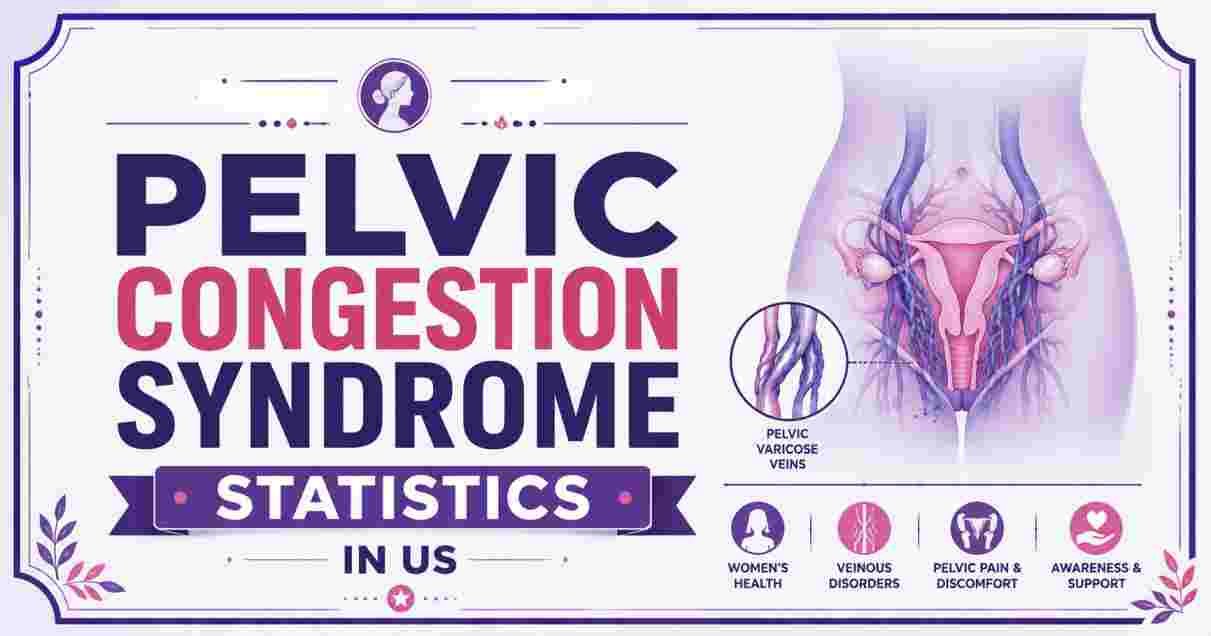
Pelvic Congestion Syndrome affects an estimated 6% to 27% of women worldwide and drives up to 30% of chronic pelvic pain cases across the US, UK, Canada, and Australia in 2026. Embolization treatment now resolves symptoms in roughly 83% to 94% of confirmed cases, making it the leading minimally invasive fix for this often-missed vascular condition.
What is Pelvic Congestion Syndrome?
Pelvic Congestion Syndrome is a vascular condition where the veins draining blood from the ovaries and pelvis become dilated, weakened, or unable to close properly. Blood pools instead of flowing back toward the heart, and that pooling raises pressure inside the pelvis. Women describe the resulting pain as a dull, heavy ache that gets worse after standing for long periods, during or after sex, and in the days before a period starts. Doctors have known about this pattern for decades, yet Pelvic Congestion Syndrome still gets missed in routine gynecological visits because the symptoms overlap with endometriosis, fibroids, and irritable bowel syndrome.
The condition mostly shows up in women who have been pregnant before, typically between the ages of 20 and 45, because pregnancy stretches pelvic veins and can leave valves permanently weakened. Hormones play a role too — estrogen relaxes vein walls, which is part of why symptoms often calm down after menopause. Left unaddressed, the constant pain wears down quality of life, disrupts work and intimacy, and pushes many women through years of normal test results before someone finally checks the pelvic veins directly.
Interesting Facts About Pelvic Congestion Syndrome in 2026
| Fact | Data Point |
|---|---|
| Global prevalence range | 6% to 27% of women |
| US prevalence in reproductive-age women | Roughly 15% of women aged 18–50 |
| Share of chronic pelvic pain cases linked to PCS | 30% to 40% |
| Women with isolated ovarian varices who develop PCS | About 60% |
| Embolization technical success rate | 94% to 99.8% |
| Average age at diagnosis | 37 to 38 years old |
| Annual US cost burden tied to chronic pelvic pain | Over $39 billion |
| Symptom recurrence after embolization at 5 years | Around 13% |
The numbers above tell a consistent story: Pelvic Congestion Syndrome is common, expensive to leave untreated, and highly responsive to the right procedure once it gets diagnosed correctly. A prevalence band this wide, from 6% on the conservative end to 27% in broader population screening, reflects how much diagnostic criteria still vary between hospitals, countries, and imaging protocols. Some studies count any dilated vein found incidentally on a scan, while others require confirmed reflux plus matching symptoms before labeling a case as PCS.
The financial figure stands out just as much as the clinical ones. Chronic pelvic pain broadly, with PCS as a major contributor, costs the United States healthcare system billions every year in repeat visits, imaging, and exploratory procedures that happen before anyone considers the pelvic veins. That cost curve is a big reason interventional radiology departments across the US, UK, Canada, and Australia have pushed harder in the past few years to get PCS recognized earlier in the diagnostic pathway rather than treated as a last resort.
Pelvic Congestion Syndrome Prevalence Statistics 2026: How Many Women Are Affected
| Population Group | Reported Rate |
|---|---|
| Women worldwide with PCS | 6% – 27% |
| US women aged 18–50 with chronic pelvic pain | 15% |
| Worldwide chronic pelvic pain prevalence | Up to 43.4% |
| Chronic pelvic pain share of gynecology visits | 10% – 20% |
| CPP cases referred to a specialist | ~40% |
| Premenopausal women with dilated pelvic veins on imaging | 21% |
| Postmenopausal women with dilated pelvic veins on imaging | 10% |
Data sourced from peer-reviewed clinical literature indexed on the National Library of Medicine (NCBI) and published vascular surgery journals.
Pelvic Congestion Syndrome prevalence data spreads across a wide range because researchers measure different things. The 6% to 27% global figure comes from pooled clinical studies that combine symptomatic diagnoses with incidental vein findings on imaging. The tighter 15% figure for US women aged 18 to 50 reflects population-level chronic pelvic pain data, of which PCS makes up a meaningful slice rather than the whole picture. Notice the sharp drop between premenopausal (21%) and postmenopausal (10%) vein dilation rates on cross-sectional imaging — that gap lines up almost exactly with the hormonal explanation doctors give for why PCS symptoms often fade once estrogen levels drop.
The 40% referral rate matters just as much as the prevalence numbers themselves. It means six out of ten women with unexplained chronic pelvic pain never make it to a specialist equipped to test for venous causes. That gap is one of the clearest, most fixable pieces of the PCS underdiagnosis problem, and it is a big part of why awareness campaigns in the US, UK, Canada, and Australia have picked up momentum this year.
Pelvic Congestion Syndrome Causes 2026: Risk Factors Behind Venous Insufficiency
| Risk Factor | Clinical Association |
|---|---|
| Multiple pregnancies (multiparity) | Strongest structural risk factor |
| Ovarian vein valve incompetence | Direct anatomical cause |
| Estrogen exposure | Weakens and dilates vein walls |
| Retroverted uterus | Alters pelvic venous drainage |
| Nutcracker syndrome (left renal vein compression) | Secondary contributing cause |
| May-Thurner syndrome (iliac vein compression) | Secondary contributing cause |
| Prolonged standing occupations | Symptom aggravator, not root cause |
Data compiled from vascular medicine research archived through the National Library of Medicine.
Pregnancy history sits at the top of nearly every study on Pelvic Congestion Syndrome causes, and the mechanism is straightforward. Each pregnancy increases blood volume moving through the pelvic veins by a significant margin, and that extra pressure can stretch the vein walls past the point where the internal valves close properly again. Once a valve stays open even slightly, blood starts flowing backward instead of toward the heart, and that backward flow, called reflux, is the defining feature radiologists look for on a venogram.
Anatomical compression syndromes add a second layer that clinicians increasingly screen for. Nutcracker syndrome pinches the left renal vein between two arteries, and May-Thurner syndrome compresses the left iliac vein against the spine — both conditions raise pressure downstream in the same venous network that PCS affects. Recognizing these overlapping syndromes has changed how interventional radiologists approach a workup, since treating PCS alone while ignoring an underlying compression syndrome often leads to symptoms returning within months.
Planning your recovery timeline after a procedure like this often means confirming your specific health data first, and resources such as Chronic Pain Statistics in US offer useful context on how vascular and nerve-related pelvic pain compares with other chronic pain categories nationally.
Pelvic Congestion Syndrome Symptoms 2026: Chronic Pelvic Pain Data by Type
| Symptom | Reported Frequency in PCS Patients |
|---|---|
| Non-cyclical pelvic pain lasting 6+ months | Core diagnostic requirement |
| Pain worsened by prolonged standing | Reported in the majority of cases |
| Dyspareunia (pain during/after intercourse) | Reduced by 70.8% post-treatment |
| Dysmenorrhea (painful periods) | Reduced by 72.4% post-treatment |
| Vulvar, thigh, or buttock varicose veins | Common physical exam finding |
| Lower urinary tract symptoms | Frequently co-reported |
| Fatigue, low mood, headaches | Nonspecific but documented |
Data drawn from single-institution retrospective series published through ScienceDirect and PubMed-indexed vascular studies.
The symptom pattern of Pelvic Congestion Syndrome is what makes it so easy to confuse with other conditions. Pain that builds through the day and eases when lying down is a strong clue pointing toward a venous cause rather than a structural one like fibroids, since fibroid pain does not typically respond to gravity in the same way. The post-treatment reduction numbers, a 70.8% drop in dyspareunia and a 72.4% drop in dysmenorrhea, come from patients tracked before and after embolization, and they double as some of the best evidence that the venous theory of PCS holds up in practice.
Physical exam findings add another diagnostic layer that many general practitioners skip. Visible varicose veins on the vulva, inner thigh, or buttocks are a strong external sign of underlying pelvic venous insufficiency, yet these areas rarely get examined during a standard pelvic exam. Clinicians who specialize in pelvic venous disease routinely ask patients to check for these signs at home and photograph any changes across the menstrual cycle, since varicosities often become more visible right before menstruation starts.
Pelvic Congestion Syndrome Diagnosis 2026: Imaging Accuracy and Sensitivity Rates
| Imaging Method | Sensitivity / Accuracy |
|---|---|
| Transvaginal ultrasound (TVUS) | 92.3% sensitivity, 75% specificity |
| Contrast-enhanced MR angiography | 88% sensitivity, 67% specificity |
| Static MRI | 88% – 100% sensitivity |
| CT venography | 94.8% sensitivity |
| Catheter-based venography (gold standard) | Considered definitive confirmation |
| Ovarian vein diameter threshold flagged as abnormal | Greater than 8 mm |
Data referenced from radiology and vascular imaging studies indexed via PubMed Central.
No single imaging test gives a perfect answer for Pelvic Congestion Syndrome, which is exactly why most vascular specialists use a stepwise approach. Transvaginal ultrasound usually comes first because it is noninvasive and widely available, and a sensitivity of 92.3% makes it a strong initial filter, even though its 75% specificity means false positives happen often enough that follow-up imaging is standard practice. MRI and MR angiography step in next when ultrasound results are unclear, particularly because static imaging alone cannot always tell whether blood in the ovarian vein is flowing the normal direction or refluxing backward.
Catheter-based venography remains the gold standard because it lets the radiologist watch blood flow directly and, in the same session, move straight into treatment if reflux is confirmed. This combined diagnose-and-treat approach is one reason interventional radiology has become the primary specialty managing PCS in the US, UK, Canada, and Australia rather than gynecology alone. Anyone comparing their own symptom timeline against population data may also find Women in Menopause Statistics in US useful, since PCS symptom resolution around the menopausal transition is a pattern that shows up consistently across both data sets.
Pelvic Congestion Syndrome Treatment 2026: Embolization Success Rate Data
| Treatment Outcome Metric | Reported Result |
|---|---|
| Technical success rate of embolization | 94% – 99.8% |
| Overall clinical improvement, long-term follow-up | 83% |
| No significant change after treatment | 13% |
| Symptoms worsened after treatment | 4% |
| Overall complication rate | ~9% (mostly minor) |
| Major complication rate | 0.6% – 1.7% |
| Recurrence rate at 5 years | 13% |
| Average pain score drop (VAS scale, 0–10) | From 7.6 to 2.9 |
Data aggregated from systematic reviews and long-term outcome studies published in vascular and interventional radiology journals.
Ovarian and iliac vein embolization has become the default treatment for Pelvic Congestion Syndrome because the numbers back it up consistently across dozens of independent studies. A technical success rate above 94% means the procedure itself, closing off the faulty vein with coils, plugs, or a sclerosing agent, works as intended in nearly every attempt. The clinical improvement figure of 83% at long-term follow-up is the number that matters most to patients, since it reflects actual pain relief rather than just a technically successful procedure.
The pain score drop from 7.6 to 2.9 on a standard 10-point visual analogue scale represents one of the larger effect sizes seen in any chronic pain intervention, surgical or otherwise. Complication rates stay low by comparison, with most adverse events limited to minor coil migration or short-term abdominal discomfort rather than anything life-threatening. The 13% five-year recurrence figure is the honest caveat specialists give patients: embolization treats the veins present at the time of the procedure, but new venous insufficiency can develop later, particularly after another pregnancy.
Pelvic Congestion Syndrome Cost and Healthcare Burden 2026 in the United States
| Cost / Burden Metric | US Figure |
|---|---|
| Annual direct and indirect CPP costs | Over $39 billion |
| Share of hysterectomies performed for CPP | ~25% |
| Share of exploratory laparoscopies for CPP | ~33% |
| PCS-coded case volume growth, 2016–2021 | 8,605 to 9,250 cases |
| Varicose vein diagnoses growth, 2004–2021 | 44,185 to 71,180 cases |
| Chronic venous insufficiency growth, same period | 173,430 to 232,850 cases |
Data referenced from national health billing-code analyses published in the Journal of Vascular Surgery: Venous and Lymphatic Disorders.
Chronic pelvic pain, and the share attributable to Pelvic Congestion Syndrome, carries an economic weight that rarely gets discussed alongside the clinical statistics. A $39 billion annual figure covers everything from repeat physician visits and imaging to lost workdays and, in a significant number of cases, surgery that may not have been the right first step. The fact that roughly a quarter of hysterectomies and a third of exploratory laparoscopies happen for unexplained chronic pelvic pain suggests a portion of these procedures might be avoidable if pelvic venous causes got ruled in or out earlier in the workup.
The billing-code trend data tells its own story about growing recognition rather than a true rise in cases. PCS diagnosis codes climbed from 8,605 to 9,250 between 2016 and 2021, a period that overlaps with the broader rollout of ICD-10 coding, which gave physicians a more specific label to use than the older, vaguer chronic pelvic pain codes. Rising varicose vein and venous insufficiency diagnoses over the same stretch point to the same underlying pattern: better coding and better awareness, not necessarily a sudden increase in how many women actually have the condition.
Pelvic Congestion Syndrome Recovery and Recurrence Statistics 2026
| Recovery Metric | Typical Outcome |
|---|---|
| Procedure duration | 45 – 90 minutes |
| Hospital stay | Usually outpatient, same-day discharge |
| Return to light activity | 1 – 2 days |
| Full symptom improvement window | 1 – 3 months |
| Successful pregnancies reported post-embolization | Documented in multiple cohorts |
| Five-year sustained improvement rate | ~87% |
Data compiled from long-term follow-up cohorts published across interventional radiology journals.
Recovery from Pelvic Congestion Syndrome embolization tends to surprise patients who expect something closer to open surgery. Because the procedure runs through a small catheter inserted in the groin or wrist, most women go home the same day and resume light daily activity within 48 hours. Full symptom relief takes longer to settle in, typically stretching across one to three months, because the treated veins need time to fully close off and for pelvic blood flow to reroute through healthy pathways.
The five-year data offers the clearest long-term reassurance available for this condition: roughly 87% of patients maintain their improvement, leaving the 13% recurrence figure as the main outstanding challenge in the field. Multiple studies have also tracked successful pregnancies after embolization, addressing one of the most common concerns among women of reproductive age who worry that treating pelvic veins might affect future fertility. Anyone weighing treatment against a broader reproductive health picture may find added context in Female Fertility Rate Statistics in US, particularly around how age and prior pregnancies intersect with vascular health outcomes.
Interestingly, PCS shares more overlap with other underdiagnosed women’s conditions than most people realize. The diagnostic delay pattern echoes what shows up in Polycystic Ovary Syndrome (PCOS) Statistics in US, where symptoms also get dismissed for years before a clear hormonal or vascular explanation is confirmed.
Frequently Asked Questions About Pelvic Congestion Syndrome 2026
What is Pelvic Congestion Syndrome caused by?
Pelvic Congestion Syndrome is caused by weakened or incompetent valves in the ovarian and pelvic veins, which lets blood flow backward and pool under pressure instead of draining normally toward the heart.
Is Pelvic Congestion Syndrome serious?
It is not life-threatening, but it can cause years of debilitating chronic pain, disrupt intimacy and daily activity, and lead to unnecessary surgeries if it stays undiagnosed.
How do doctors test for Pelvic Congestion Syndrome?
Doctors typically start with transvaginal ultrasound, follow up with MRI or CT venography if results are unclear, and confirm the diagnosis with catheter-based venography when treatment is being planned.
Can Pelvic Congestion Syndrome go away on its own?
Symptoms often ease significantly after menopause as estrogen levels drop and vein pressure decreases, but the underlying vein damage typically does not reverse without treatment.
What is the success rate of embolization for Pelvic Congestion Syndrome?
Technical success rates run between 94% and 99.8%, with roughly 83% of patients reporting sustained clinical improvement at long-term follow-up.
Does insurance cover Pelvic Congestion Syndrome treatment?
Coverage varies by provider and country; many insurers in the US, UK, Canada, and Australia require documented imaging evidence of reflux and a failed trial of conservative management first.
Can you get pregnant after Pelvic Congestion Syndrome treatment?
Yes, multiple studies have documented successful pregnancies following ovarian vein embolization, and the procedure is not associated with reduced fertility.
What does Pelvic Congestion Syndrome pain feel like?
Most women describe a heavy, dull, aching pressure in the lower pelvis that worsens with standing, during or after sex, and in the days leading up to menstruation.
How common is Pelvic Congestion Syndrome misdiagnosis?
Very common — studies suggest only about 40% of women with unexplained chronic pelvic pain get referred to a specialist who tests specifically for venous causes.
Is Pelvic Congestion Syndrome the same as varicose veins?
They are related but not identical. Pelvic Congestion Syndrome involves internal pelvic and ovarian veins, while visible varicose veins on the legs, vulva, or thighs are often a secondary sign of the same underlying venous insufficiency.
Disclaimer: This research report is compiled from publicly available sources. While reasonable efforts have been made to ensure accuracy, no representation or warranty, express or implied, is given as to the completeness or reliability of the information. We accept no liability for any errors, omissions, losses, or damages of any kind arising from the use of this report.