
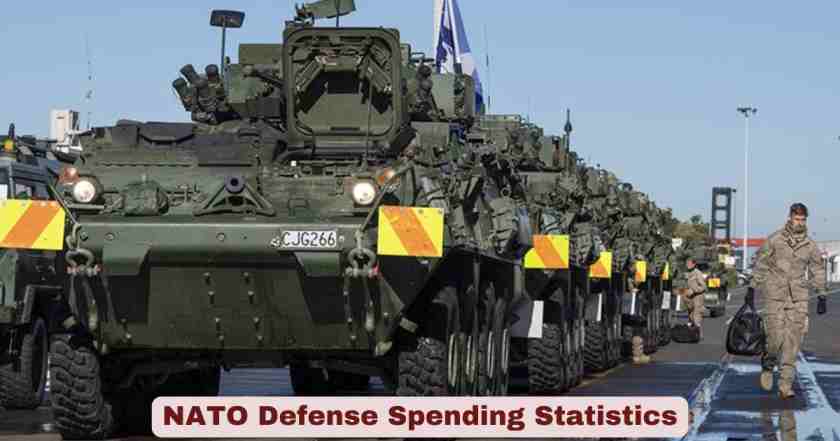
NATO Defense Spending in 2026
The North Atlantic Treaty Organization (NATO) — the 77-year-old collective defense alliance binding 32 member states across North America and Europe — is in the midst of the most dramatic and consequential financial transformation in its entire history. In 2026, NATO’s combined allied defense spending exceeds $1.5 trillion for the first time ever, driven by a historic convergence of threat perception, political will, and institutional pressure that would have seemed impossible as recently as 2021, when European allies were still routinely missing the alliance’s 2% of GDP spending benchmark and treating defense budgets as a residual item in their fiscal planning. The catalyst for this transformation was Russia’s full-scale invasion of Ukraine on February 24, 2022 — a single event that shattered three decades of post-Cold War complacency across the Euro-Atlantic community and forced every NATO government to confront the real cost of collective defense in a world where a nuclear-armed revisionist power was actively using conventional military force to redraw international borders on European soil. What followed was the fastest sustained increase in NATO allied defense spending since the height of the Cold War: European allies and Canada increased defense spending by 20% in real terms in 2025 alone — the sharpest annual rise among European NATO members since 1953 — bringing the alliance’s total spending to $1.581 trillion and achieving, for the first time, full 2% compliance across all 32 members simultaneously.
The June 24–25, 2025 NATO Summit in The Hague crystallized this transformation into a formal, binding commitment that will define the alliance’s financial and strategic trajectory for the next decade. The Hague Declaration — adopted unanimously by all 32 member states, with Spain receiving a partial exemption — committed allies to invest 5% of GDP annually on core defense requirements and defense-and security-related spending by 2035. Structured as a two-tier framework — at least 3.5% of GDP for core military capabilities (personnel, equipment, operations, and research) plus up to 1.5% of GDP for broader security-related spending on critical infrastructure, cybersecurity, civil resilience, and defense industrial capacity — the Hague commitment represents a doubling of the previous 2% Wales benchmark and a multi-trillion-dollar pledge from the combined economies of the democratic world. NATO Secretary General Mark Rutte called it a “transformational leap” and “quantum leap” for collective defense; President Trump described it as a “historic achievement” — and both were right, though whether the pledge translates from declaration to delivered capability depends on a decade of sustained political will that NATO’s history of burden-sharing disputes makes anything but guaranteed. In 2026, the Ankara Summit in July will be the first major test of that political will, as allies present their national plans for reaching the 5% target and face scrutiny over whether their roadmaps represent genuine military investment or the “creative accounting” that SIPRI researchers have already warned against.
Interesting Facts About NATO Defense Spending 2026 | Key Stats at a Glance
| Fact Category | Key Detail |
|---|---|
| NATO Total Allied Spending (2025, SIPRI) | $1.581 trillion (55% of world military spending) |
| NATO Total Allied Spending (2026, est.) | >$1.5 trillion (U.S. Congress approved >$1 trillion for U.S. alone in 2026) |
| U.S. Spending (2025, SIPRI) | $954 billion — more than next 6 countries combined; 7.5% decline from 2024 |
| U.S. Spending (2026, approved) | >$1 trillion — Congress approved; potential $1.5 trillion in 2027 (Trump proposal) |
| European NATO + Canada Spending (2025) | $574 billion (adjusted to 2021 prices) |
| European NATO Spending Growth (2025) | +14% to $864 billion — highest SIPRI has ever recorded for Europe |
| European + Canada Growth Rate (2025 vs. 2024) | +20% in real terms — fastest growth since 1953 |
| All 32 Members at 2% (First Time) | 2025 — first time all 32 NATO members met the 2% target simultaneously |
| Members at 2%+ in 2014 (Wales Summit) | Only 3 members (USA, Greece, UK) |
| Members at 2%+ in 2017 | Only 4 members (USA, Greece, UK, Poland) |
| Members at 2%+ in 2024 | 23 members |
| Members at 2%+ in 2025 | All 32 |
| NATO Average Spending % of GDP (2025) | 2.76% of GDP |
| Hague Summit New Target (June 2025) | 5% of GDP by 2035 (3.5% core defense + 1.5% security-related) |
| Highest Spender by % of GDP (2025) | Poland — 4.48% |
| 2nd Highest by % of GDP | Lithuania — 4.0% |
| 3rd Highest by % of GDP | Latvia — 3.73% |
| Highest Spender by Absolute Amount (2025) | United States — $954 billion |
| 2nd Highest by Absolute Amount (2025) | Germany — $114 billion (#4 globally) |
| Largest Single-Year Increase (2025) | Belgium +59%, Spain +50%, Norway +49%, Denmark +46% |
| Germany 2025 Increase | +24% — first time above 2% of GDP since 1990 |
| Norway — Historic Milestone | First European ally to surpass the U.S. in defense spending per capita |
| Spain Exception | Only member to receive exemption from the 5% target; capped self at 2.1% of GDP |
| Italy “Creative Accounting” Warning | SIPRI cited Italy’s reported attempt to count Sicily bridge construction as military spending |
| NATO Common Funded Budget (2025) | Approximately $3.7 billion (direct NATO HQ/shared costs) |
| NATO Secretary General | Mark Rutte (former Dutch PM; took office October 2024) |
Source: SIPRI Military Expenditure Database — April 27, 2026 Annual Report; SIPRI Press Release April 27, 2026; NATO Official – Defence Expenditures of NATO Countries 2014–2025 (August 2025); NATO.int – Hague Summit Declaration (June 25, 2025); Wikipedia – Agreement on 5% NATO Defence Spending by 2035; Atlantic Council Defense Spending Tracker (updated April 9, 2026); Statista – NATO Defense Expenditures by Country 2025 (citing NATO official data); CNN (April 27, 2026 – SIPRI report)
The statistics above document a transformation in NATO burden-sharing so rapid that it has fundamentally altered the political dynamics of the alliance. The journey from 3 members meeting 2% in 2014 to all 32 members meeting it in 2025 — in just eleven years — is remarkable by any historical standard, even accounting for the fact that the vast majority of the progress was compressed into the three years after Russia’s 2022 Ukraine invasion. The Belgium +59% and Spain +50% increases in a single year are particularly striking given that both countries had been among the alliance’s most persistent under-spenders: Belgium, hosting NATO’s headquarters in Brussels, had for years spent barely 1.1% of GDP on defense while sheltering under the collective security umbrella; Spain, protected by geography, had maintained essentially flat defense budgets for over a decade. The Norway milestone — becoming the first European ally to surpass the United States in defense spending per capita — captures in a single figure how dramatically the relative burden distribution within NATO has shifted, with Nordic and Baltic frontline states outpacing even the superpower in per-person investment terms as they confront an existential Russian threat on their borders.
NATO Defense Spending 2026 – All 32 Members Spending Data
| NATO Member | 2025 Spending (% of GDP) | Key Notes |
|---|---|---|
| Poland | 4.48% | Highest in NATO by % of GDP; plans to reach 4.7%; eastern flank leader |
| Lithuania | 4.0% | Baltic frontline state; rapid increase post-2022 |
| Latvia | 3.73% | Baltic frontline state; shares border with Russia |
| Estonia | ~3.4% | Baltic frontline; strong advocate for 5% target |
| United States | ~3.4% | $954B in 2025; >$1T approved for 2026; declined 7.5% in 2025 (no Ukraine supplemental) |
| Greece | ~3.1% | Historically high spender due to Turkey tensions |
| Finland | ~2.4% | Joined NATO April 2023; rapid spending increase |
| Denmark | ~2.4% | +46% increase in 2025 |
| United Kingdom | ~2.3% | Pledged to reach 3.5% core + 1.5% by 2035 |
| Germany | 2.3% | +24% in 2025; $114B = #4 globally; first >2% since 1990 |
| Romania | ~2.3% | Eastern flank; consistent high spender |
| Norway | ~2.2% | First European ally to exceed U.S. in per capita spending |
| Netherlands | ~2.1% | Committed to 3.5% + 1.5% ahead of Hague summit |
| Sweden | ~2.1% | Joined NATO March 2024; rapid ramp-up |
| France | ~2.1% | $68B (2025); equipment spending +11%; Macron targets 3.5% |
| Spain | 2.1% | +50% in 2025; received Hague exemption; capped own target at 2.1% |
| Slovakia | ~2.1% | Increased post-2022 |
| Czechia | ~2.0% | Met 2% target; EU/NATO eastern flank |
| Turkey | ~2.0% | Large military; figures exclude some national spending per NATO notes |
| Hungary | ~2.0% | Met target; political friction with NATO on Ukraine |
| Croatia | ~2.0% | Recent increase to meet target |
| Bulgaria | ~2.0% | Increased spending to meet target |
| Albania | ~2.0% | Met target amid southeastern Europe security concerns |
| North Macedonia | ~2.0% | Smallest economies; met target |
| Montenegro | ~2.0% | Smallest economy in NATO; met target |
| Italy | ~2.0% | Plans to double spending over 4 years; SIPRI flag on “creative accounting” |
| Canada | ~2.0% | +23% increase in 2025; under heavy U.S. pressure to spend more |
| Portugal | ~2.0% | Increased to meet target |
| Belgium | ~2.0% | +59% increase in 2025 — largest single-year jump in NATO; hosts NATO HQ |
| Slovenia | ~2.0% | Met target |
| Luxembourg | ~2.0% | Tiny economy; historically a low spender; now meets target |
| Iceland | N/A | No standing military; contributes through civilian/infrastructure support |
Source: SIPRI Military Expenditure Database Annual Report April 27, 2026; NATO Official — Defence Expenditure of NATO Countries 2014–2025 (August 2025); Statista – NATO Defense Expenditures by Country 2025 (citing NATO official data, August 2025); Atlantic Council Defense Spending Tracker (April 9, 2026); Wikipedia – Agreement on 5% NATO Defence Spending by 2035; European Parliament – EU Member States’ Defence Budgets (2025)
The per-member spending table reveals the profound geographic logic underlying NATO burden-sharing in 2026: proximity to Russia is almost perfectly correlated with spending intensity as a percentage of GDP. Poland, Lithuania, Latvia, and Estonia — the four members with the highest spending percentages, all sharing borders with either Russia or Russian-allied Belarus — are collectively outspending their western European counterparts by a substantial margin as a share of economic output, driven not by political signaling but by genuine threat perception rooted in geography, history, and direct intelligence assessments of Russian military intentions. The Baltic states’ combined spending, relative to their small economies, represents one of the most remarkable security investments in modern European history — the equivalent, in proportional terms, of the United States spending $7–8 trillion annually on defense.
At the other end of the spectrum, Iceland’s unique position — the only NATO member with no standing military whatsoever — and Luxembourg’s historically tiny contribution illustrate that the 2% target has always been a political benchmark rather than a precise strategic requirement. Iceland contributes through civilian infrastructure, coast guard capabilities, and hosting NATO’s Keflavik air base; Luxembourg contributes through financing, multilateral deployments, and the hosting of various NATO agencies. The controversy over Italy’s reported attempt to count Sicily bridge construction as military-related spending under the new 1.5% security tier is a preview of the definitional battles that will dominate NATO burden-sharing discussions for the next decade, as the Hague target’s deliberately broad security-related category creates both legitimate investment opportunities and significant potential for statistical inflation.
NATO Defense Spending 2026 | The Hague Summit — New Target Statistics
| Hague Summit Metric | Data |
|---|---|
| Summit Location & Dates | The Hague, Netherlands — June 24–25, 2025 |
| NATO Secretary General | Mark Rutte (former Prime Minister of the Netherlands) |
| Previous Target (Wales 2014) | 2% of GDP for core defense spending by 2024 |
| New Target (Hague 2025) | 5% of GDP annually by 2035 |
| Tier 1 — Core Defense | Minimum 3.5% of GDP — personnel, equipment, operations, R&D, maintenance |
| Tier 2 — Security-Related | Up to 1.5% of GDP — critical infrastructure, cyber, civil resilience, defense industry |
| Ukraine Aid Counting | Contributions to Ukraine’s defense and defense industry count toward the 5% target |
| Progress Review Date | 2029 |
| Full Target Deadline | 2035 |
| National Plans Submission Deadline | Mid-2026 |
| Next Summit to Review Progress | Ankara, Turkey — July 2026 |
| Exception | Spain — received partial exemption; self-capped at 2.1% of GDP |
| Spain’s Reasoning | PM Sánchez: 5% would be “disproportionate and unnecessary”; social spending concerns |
| Votes | Adopted by consensus (all 32 Allies, with Spain’s partial exemption carved out) |
| Trump’s Position | Called outcome a “historic achievement”; claimed credit for securing higher targets |
| Rutte’s Description | A “quantum leap” and “transformational leap” for collective defense |
| Air Defense Capability Target | Agrees to a fivefold increase in air defense capabilities across the alliance |
| Article 5 Reaffirmation | Declaration reaffirmed “ironclad commitment” to collective defense |
| Russia Designation | Hague Declaration frames Russia as the “most significant and direct threat” to Euro-Atlantic security |
| What Was NOT Agreed | No formal commitment on Ukraine NATO membership; deferred to preserve alliance cohesion |
| Communiqué Length | Only 5 paragraphs — unprecedentedly short vs. 38 paragraphs (2024 Washington) and 90 (2023 Vilnius) |
| SIPRI Warning on 1.5% Tier | Risk of “creative accounting” — vague definitions could allow reclassifying non-military spending |
Source: NATO.int — Hague Summit Declaration Official Text (June 25, 2025); Wikipedia — 2025 The Hague NATO Summit; Wikipedia — Agreement on 5% NATO Defence Spending by 2035; Congress.gov CRS Report IN12566; Atlantic Council Expert Reactions (June 2025); SIPRI Fact Sheet April 2026; Defense News (April 27, 2026)
The Hague Declaration’s five-paragraph brevity is itself a revealing data point about the political dynamics of modern NATO. The 38-paragraph 2024 Washington communiqué and the 90-paragraph 2023 Vilnius communiqué were expansive, everything-under-the-sun documents reflecting a tradition of using NATO summits to build consensus across every conceivable issue on the agenda. The 2025 Hague meeting was deliberately stripped to its strategic essentials: the 5% spending commitment was the single headline outcome, and the summit’s agenda was compressed to approximately two and a half hours to minimize the risk of discord or procedural disruption — particularly around the central uncertainty of U.S. commitment to the alliance under President Trump. Secretary General Rutte’s achievement in securing both the 5% target and Trump’s reaffirmation of Article 5 without triggering a public confrontation with Washington was a genuine diplomatic feat, and the Ukraine aid counting clause — allowing allies to credit contributions to Kyiv’s defense industry toward the 5% target — was a crucial bridging mechanism that allowed Trump to claim the outcome as a personal victory while delivering something substantive for Ukraine’s supporters.
The SIPRI warning about creative accounting is not merely academic. The 1.5% security-related tier is sufficiently broad that, without strict definitional enforcement, governments could theoretically count a wide range of spending that would have occurred regardless of NATO commitments — road construction with military utility, civilian cybersecurity programs, public health resilience measures — as qualifying NATO expenditure. Italy’s Sicily bridge example may be an extreme case, but it illustrates a real risk: that the Hague commitment produces impressive headline numbers in 2029’s review without delivering the genuine military capability enhancement that NATO’s threat assessment demands.
NATO Defense Spending 2026 | U.S. vs. European Burden-Sharing Statistics
| Burden-Sharing Metric | Data |
|---|---|
| U.S. Defense Spending (2025) | $954 billion — declined 7.5% from 2024 (no Ukraine supplemental appropriations) |
| U.S. Share of NATO Total Spending (2025) | ~60% of total NATO spending |
| U.S. GDP % for Defense (2025) | ~3.4% — above old 2% target; below new 3.5% core threshold |
| U.S. Spending (2026, approved) | >$1 trillion — Congress approved for 2026 |
| U.S. Proposed 2027 Budget (Trump) | ~$1.5 trillion — Trump administration proposal |
| Reason for 2025 U.S. Decline | No new supplemental Ukraine aid appropriations in 2025 vs. $127B cumulative in prior 3 years |
| European NATO + Canada (2025) | $574 billion (adjusted 2021 prices) |
| European NATO + Canada GDP % (2025) | 2.3% of combined GDP (up from 1.4% in 2014) |
| European + Canada Growth (2025 vs. 2024) | +20% in real terms |
| European NATO Total Spending (2025) | $864 billion — highest SIPRI has ever recorded for Europe |
| European Growth Rate vs. History | Fastest since 1953 (SIPRI, April 2026) |
| Norway Per Capita Milestone | First European ally to surpass the U.S. in per capita defense spending |
| Trump’s Demand | Called for NATO members to reach up to ~5% of GDP; called existing spending inadequate |
| U.S. Pressure Impact | Directly cited by Rutte and European governments as key driver of 2025 increases |
| Germany vs. U.S. Role Shift | Germany ($114B) now #2 in NATO by absolute spending — a position held by UK for decades |
| U.S. Share of NATO in 2014 | ~73% of total NATO spending |
| U.S. Share of NATO in 2025 | ~60% of total NATO spending |
| Trump Troop Withdrawal (Germany) | 5,000 U.S. troops ordered withdrawn from Germany (May 1, 2026) — signals U.S. posture reconsideration |
| Operation Epic Fury Cost | Iran war costing U.S. approximately $1 billion per day (CNN, April 2026) |
Source: SIPRI Military Expenditure Database — April 27, 2026 Fact Sheet and Press Release; CNN (April 27, 2026); Defense News (April 27, 2026); Atlantic Council Defense Spending Tracker (April 9, 2026); Breaking Defense (May 1, 2026 — Hegseth Germany withdrawal); Wikipedia — Agreement on 5% NATO Defence Spending by 2035
The burden-sharing narrative within NATO in 2026 is more complex than the headline numbers suggest. The 7.5% decline in U.S. spending in 2025 — which reduced America’s share of total NATO spending from its historical dominance toward approximately 60% — was not a strategic withdrawal but largely an accounting artifact: the absence of new supplemental Ukraine appropriations in 2025 (compared to a cumulative $127 billion in the previous three years) mechanically reduced the U.S. number without changing U.S. military capability or posture. The 2026 approved spending of over $1 trillion already reverses this decline, and Trump’s $1.5 trillion 2027 proposal — largely driven by the costs of Operation Epic Fury against Iran, which is reportedly costing Washington approximately $1 billion per day — would bring American military spending to levels that dwarf all of NATO’s other members combined.
The U.S. share declining from ~73% in 2014 to ~60% in 2025 is the structural trend that matters: European allies have finally begun to absorb a meaningfully larger share of the collective defense burden, driven by a combination of genuine threat perception, U.S. political pressure, and the industrial opportunity presented by rearmament contracts. The May 1, 2026 withdrawal of 5,000 U.S. troops from Germany — announced by Secretary Hegseth amid the Trump-Merz dispute over Iran strategy — introduces a new dimension of uncertainty into this burden-sharing calculus: if the U.S. reduces its physical presence in Europe while demanding higher financial contributions, NATO’s political cohesion faces a different kind of test than the simple arithmetic of spending percentages.
NATO Defense Spending 2026 | Top Spenders & Historical Growth
| Country | 2025 Spending (USD) | % of GDP | YoY Change | Rank (World) |
|---|---|---|---|---|
| United States | $954 billion | ~3.4% | -7.5% (no Ukraine supplemental) | #1 |
| China | $336 billion | ~2.0% | +7.4% (31st consecutive annual rise) | #2 |
| Russia | $190 billion | 7.5% | +5.9% | #3 |
| Germany | $114 billion | 2.3% | +24% | #4 |
| India | $92 billion | — | — | #5 |
| Saudi Arabia | $83.2 billion | — | +1.4% | ~#6 |
| Ukraine | $84.1 billion | ~40% | +20% | #7 |
| United Kingdom | ~$79 billion | ~2.3% | — | ~#8 |
| France | $68 billion | ~2.1% | +1.5% | ~#9 |
| Japan | $62.2 billion | 1.4% | +9.7% | ~#10 |
| Israel | $48.3 billion | — | -4.9% (Gaza ceasefire) | — |
| South Korea | $47.8 billion | — | +2.6% | — |
| Poland | Significant | 4.48% | +23% | Eastern European leader |
| Spain | $40.2 billion | 2.1% | +50% | — |
| Taiwan | $18.2 billion | 2.1% | +14.2% — biggest jump since 1988 | — |
| World Total (2025) | $2.887 trillion | 2.5% of world GDP | +2.9% real | 11th consecutive year of growth |
Source: SIPRI Military Expenditure Database — April 27, 2026 Annual Fact Sheet (Table 1, Top 40 spenders); SIPRI Press Release April 27, 2026; Al Jazeera (April 29, 2026 — citing SIPRI); CNN (April 27, 2026); Defense News (April 27, 2026)
The global military spending table for 2025 — with the world total reaching $2.887 trillion, the 11th consecutive year of growth, and the highest share of world GDP (2.5%) since 2009 — reflects a world in which the post-Cold War assumption of a long-term peace dividend has been definitively and perhaps irreversibly abandoned. The three dominant spenders — the USA ($954B), China ($336B), and Russia ($190B) — collectively accounted for 51% of all global military spending, or $1.48 trillion combined. Within this landscape, NATO’s $1.581 trillion dwarfs any adversary coalition: Russia’s $190 billion — even at the extraordinary rate of 7.5% of GDP — is roughly one-eighth of what NATO collectively spent in 2025. The asymmetry in absolute spending is so large that even Russia’s extraordinary wartime mobilization cannot close it in dollar terms; what Russia has instead done is exploit the gap between NATO’s aggregate spending and NATO’s actual wartime readiness — revealed by the 1–2 day ammunition stocks that characterized several major European armies as recently as 2022.
Ukraine’s position in this table — spending an estimated 40% of GDP on defense, ranking it #7 globally by absolute spending at $84.1 billion — is perhaps the single most extraordinary data point in modern military economics. A country with a GDP comparable to Portugal’s pre-war output is sustaining a defense effort comparable to France or the UK in dollar terms, underwritten almost entirely by allied financial transfers, loans, and direct military aid. The EU’s expected loan to Ukraine and the ongoing allied support are effectively what makes this equation possible — and Ukraine’s inclusion in NATO’s allowed accounting of the 5% Hague target reflects the alliance’s recognition that Kyiv’s fight is, in the most direct strategic sense, NATO’s fight.
NATO Defense Spending 2026 | Gaps, Risks & Capability Concerns
| Gap / Risk / Challenge | Detail & Data |
|---|---|
| “Creative Accounting” Risk | SIPRI warned vague 1.5% tier definitions risk inflated headline numbers without real capability gains |
| Italy Sicily Bridge Example | Italy reportedly attempted to classify Sicily bridge construction as defense-related spending under 1.5% tier |
| Defense Cost Inflation | SIPRI: nominal budget increases often deliver smaller real capability gains than numbers suggest |
| Ammunition Stockpile Gap | Multiple European NATO members had only 1–2 days of high-intensity combat ammunition stocks as of 2022 |
| Production Rate vs. Consumption | Ukraine war revealed NATO industrial production rates are far below wartime consumption rates |
| Personnel Gap | Bundeswehr target: 203,000 by 2031 (from 186,221 now); multiple allies face recruitment shortfalls |
| Equipment Readiness | Pre-2022: most German fighter aircraft and helicopters were not in deployable condition |
| Interoperability Gap | Rapid procurement from diverse suppliers risks NATO interoperability challenges |
| Russia Threat Window | NATO Secretary General Rutte: Russia could be ready for military force against NATO within 5 years |
| NATO Rutte Warning (Dec. 2025, Berlin) | “We are Russia’s next target. Too many are quietly complacent. The time for action is now.” |
| Russia War Economy | Russia dedicating 40% of its budget and 70% of machinery output to war-related activities |
| Russia Drone/Missile Output | Russia launched 46,000 drones and missiles against Ukraine in 2025 alone |
| NATO Air Defense Capability Target | Alliance agreed to a fivefold increase in air defense capabilities |
| Spain’s Structural Non-Compliance | Spain’s 2.1% cap means one of NATO’s largest economies will consistently undershoot the new core 3.5% target |
| Canada Gap | Despite +23% increase in 2025, Canada has historically been among the lowest spenders relative to GDP |
| U.S. Posture Uncertainty | Trump Germany troop withdrawal (May 2026) raises questions about U.S. European commitment |
| Industrial Base Constraint | Lockheed Martin, Rheinmetall, and other contractors face production capacity bottlenecks |
| 3.5% Core Target Feasibility | SIPRI: reaching 3.5% of GDP in core defense for all European members would require hundreds of billions in annual increases |
| 2029 Review Risk | If progress is insufficient, 2029 review could expose “aspirational” vs. “implementable” gap |
Source: SIPRI Fact Sheet April 2026 and Press Release; Defense News (April 27, 2026); Wikipedia — Bundeswehr (May 2026); GlobalSecurity.org NATO Spending 2035; Atlantic Council (June 2025 — Hague summit expert reactions); Congress.gov CRS IN12566; Beyond the Horizon ISSG (July 2025)
The gap between NATO’s aggregate spending figures and its actual wartime readiness is the central challenge that no amount of impressive headline statistics can fully obscure. The revelation that several major European NATO armies maintained only one to two days of high-intensity combat ammunition stocks as recently as 2022 — despite having technically met spending benchmarks in some years — illustrates a fundamental point: how money is spent matters as much as how much is spent. Decades of European defense budgets heavily weighted toward personnel costs, pensions, and legacy maintenance — with inadequate investment in actual equipment, ammunition, and operational readiness — created armed forces that looked capable on paper but were structurally hollow in terms of their ability to sustain combat. The SIPRI warning about the 1.5% security tier is relevant here: if the new target similarly allows substantial portions of national “defense spending” to flow to civilian infrastructure, cyber, and resilience programs rather than to tanks, missiles, and ammunition stockpiles, the 2035 outcome could again be a gap between impressive aggregate numbers and inadequate genuine military capability.
Russia’s threat window — assessed by Secretary General Rutte as potentially as little as five years and by German military planners as concretely 2028–2029 — gives NATO an extremely compressed timeline to convert budget pledges into delivered military capability. The industrial production constraint is the binding factor: Rheinmetall, Lockheed Martin, BAE Systems, and other major NATO defense contractors are already operating at elevated capacity, and expanding production lines for complex weapons systems requires lead times of three to five years for new facilities and equipment. NATO’s commitment to a fivefold increase in air defense capability is a case in point: given the backlog in Patriot PAC-3 MSE production (which can currently produce approximately 550 interceptors per year against a U.S. Army target of 13,773), achieving a fivefold increase in alliance-wide air defense capacity by any near-term date would require factory investments and production ramp-ups that simply cannot be achieved within a two-to-three year window regardless of how much money is allocated.
NATO Defense Spending 2026 | Equipment Investment & Modernization Statistics
| Equipment / Modernization Metric | Data |
|---|---|
| NATO 20% Equipment Target (Wales 2014) | At least 20% of defense expenditures must go to major equipment including R&D |
| NATO Equipment Target Compliance (2025) | Majority of allies now meeting 20% equipment threshold |
| Germany Procurement 2026 | €22.4 billion (~27% of regular defense budget) — nearly 3× larger than 2025 |
| Germany Long-Term Procurement Total | €350–377 billion across ~320 programs to 2041 |
| Poland Procurement Focus | Leopard 2A8 tanks, K2 Black Panther tanks, HIMARS, F-35As, Patriot/SHORAD systems |
| U.S. 2026 Defense Budget (Congress approved) | >$1 trillion |
| U.S. 2027 Proposed Budget (Trump) | ~$1.5 trillion |
| NATO Air Defense Investment | Fivefold increase targeted; Patriot, THAAD, IRIS-T, Arrow-3, SHORAD all in procurement |
| European Ammunition Production Target | EU ReArm Europe plan: €800 billion leveraged for defense through 2029 |
| EU Defense Loans (SAFE Instrument) | €150 billion in proposed EU-backed defense loans under Security Action for Europe |
| EU Member States Requested Escape Clause | 16 EU member states requested activation of National Escape Clause (allowing >1.5% extra GDP on defense) |
| UK Equipment Investment | Equipment spending +significant; Challenger 3 tanks, F-35Bs, Type 26 frigates |
| France Equipment Spending (2025) | +11% to $21.1 billion in equipment — dedicated to French arms industry |
| NATO Defense Industrial Forum (Hague) | Defense industry forum held June 24 alongside Hague summit — commitment to expand production |
| ReArm Europe Plan (EU) | Presented March 4, 2025 by Commission President von der Leyen; €800B leveraged by 2029 |
| Ukraine Aid Counting Rule | Contributions to Ukraine’s defense and defense industry now count toward 5% target |
| NATO Capability Targets | New targets include 5× air defense, modernized armor, expanded ammunition, advanced drones, cyber |
Source: NATO.int — Hague Summit Declaration; NATO.int — Funding NATO; Atlas Institute (December 2025); European Parliament — EU Member States’ Defence Budgets (2025); Defense News (April 27, 2026); Nordic Defence Review (February 2026)
The 20% equipment spending threshold — agreed at Wales in 2014 as a companion to the 2% GDP target — has proven more reliably achieved than the GDP benchmark itself, because it functions as an internal allocation requirement rather than a total spending floor. An ally that falls below 2% of GDP on total defense can still meet the 20% equipment ratio; what the threshold prevents is the kind of spending that floods budgets with personnel costs and pensions while leaving equipment inventories to deteriorate. The broad compliance with the equipment ratio in 2025 — driven by the massive procurement programs announced across the alliance — is one of the genuinely positive signals in NATO’s spending data. Germany’s €22.4 billion procurement allocation (27% of its regular budget), France’s $21.1 billion equipment investment (+11%), and Poland’s extraordinary array of F-35As, K2 Black Panthers, HIMARS, and Patriot systems all represent genuine additions to the alliance’s warfighting inventory — not accounting exercises.
The EU’s ReArm Europe / Readiness 2030 plan — announced by Commission President von der Leyen on March 4, 2025 and aiming to leverage €800 billion in defense spending by 2029 — adds a parallel institutional framework to NATO’s burden-sharing architecture that is significant precisely because it operates through EU mechanisms (loans, escape clauses, cohesion fund redeployment) rather than the bilateral U.S.-ally pressure dynamics that have historically defined NATO spending debates. By enabling 16 EU member states to activate the National Escape Clause and borrow an additional 1.5% of GDP above normal deficit limits for defense, the EU has effectively aligned its fiscal architecture with NATO’s strategic requirements — a development that would have been politically impossible before 2022 and that signals the enduring structural transformation that Russia’s Ukraine invasion has produced in European security policy.
Disclaimer: This research report is compiled from publicly available sources. While reasonable efforts have been made to ensure accuracy, no representation or warranty, express or implied, is given as to the completeness or reliability of the information. We accept no liability for any errors, omissions, losses, or damages of any kind arising from the use of this report.