
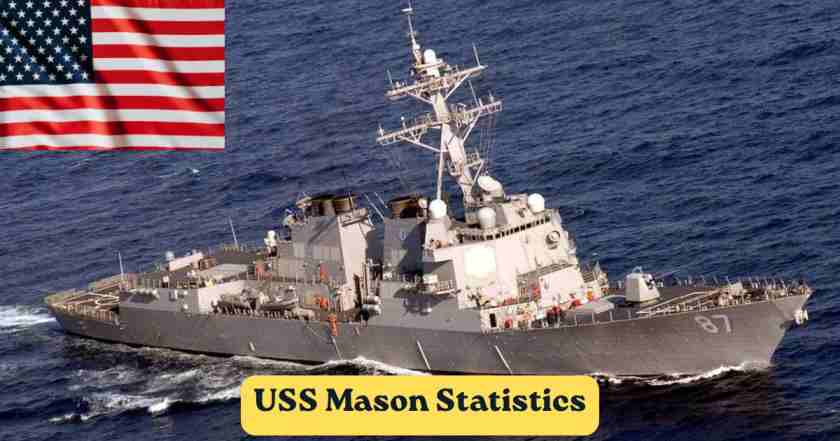
USS Mason (DDG-87) in 2026
The USS Mason (DDG-87) is an Arleigh Burke-class Flight IIA Aegis guided-missile destroyer in active service with the United States Navy — and one of the most historically significant surface combatants in the entire American fleet. Named in honor of the Black crewmembers who served aboard USS Mason (DE-529) during World War II, at a time when racial segregation in the U.S. Armed Forces was government policy, the DDG-87 carries a name that is a deliberate tribute to one of the most remarkable chapters in American naval history: the second Mason (DE-529) was the only ship in the U.S. Navy during WWII to have a predominantly Black crew, and its sailors served with distinction on some of the most dangerous North Atlantic convoy runs of the war despite facing institutional discrimination from the Navy itself. In 2026, the USS Mason (DDG-87) homeports at Naval Station Mayport in Mayport, Florida — having transferred there from its previous home at Naval Station Norfolk, Virginia in August 2022 — and is currently assigned to the George H.W. Bush Carrier Strike Group (CSG-10), with which it conducted COMPTUEX (Composite Training Unit Exercise) in the Atlantic Ocean in February 2026, preparing the strike group for sustained high-end joint combat operations. As of late March 2026, public shipping data tracked the Mason en route in the Atlantic Ocean after departing the Norfolk area, assigned to its role in the strike group’s deployment cycle.
The DDG-87 is not merely a significant ship by lineage — it is one of the most combat-tested warships in the modern U.S. Navy, having established two extraordinary firsts in the history of naval warfare that no other vessel can claim. During its 2016 Yemen deployment, USS Mason became the first warship in history to fire ship-based anti-air missiles from vertical launching cells in combat in response to an actual inbound missile threat (October 9, 2016), and days later achieved the first-ever destruction of an inbound anti-ship missile by a surface-to-air missile in actual self-defense in naval history (October 12, 2016). Seven years later, during its landmark 2023–2024 Red Sea deployment with the Eisenhower Carrier Strike Group, USS Mason’s crew added another page to their extraordinary combat record: they became the first naval warship crew in history to shoot down anti-ship ballistic missiles (ASBMs) in combat — a feat repeated multiple times across a grueling seven-month deployment in which the ship engaged Houthi drones and missiles with a regularity that USNI News described as “sustained naval combat for the first time since World War II.” Chief of Naval Operations Admiral Lisa Franchetti personally visited Mason in Mayport in August 2024 following the deployment, telling USNI News it was a testament to the training and weapons systems investments that the Navy’s combat systems work as designed.
Interesting Facts About USS Mason DDG-87 2026 | Key Stats at a Glance
| Fact Category | Key Detail |
|---|---|
| Hull Designation | DDG-87 |
| Ship Class | Arleigh Burke-class, Flight IIA |
| Combat System | Aegis Combat System |
| Hull Number in Class | 37th Arleigh Burke-class destroyer in the US Navy |
| 21st Ship Built at BIW | 21st ship of the class built at Bath Iron Works, Bath, Maine |
| Namesake | Black crewmembers of USS Mason (DE-529) — WWII’s only predominantly Black-crewed US Navy ship |
| Motto | “Proudly We Serve” |
| Commissioned | April 12, 2003 at Port Canaveral, Florida |
| Current Homeport (2026) | Naval Station Mayport, Mayport, Florida |
| Homeport Through 2022 | Naval Station Norfolk, Virginia (transferred August 22, 2022) |
| Current Assignment (2026) | George H.W. Bush Carrier Strike Group (CSG-10) |
| 2026 Training Activity | COMPTUEX (Composite Training Unit Exercise) — Atlantic Ocean, February 2026 |
| Current Status (May 2026) | Active service — en route in Atlantic after departing Norfolk area (March 2026) |
| 1st Naval History Record (Oct. 9, 2016) | First warship to fire ship-based anti-air missiles from VLS cells in combat vs. actual inbound missile threat |
| 2nd Naval History Record (Oct. 12, 2016) | First warship in history to destroy an inbound anti-ship missile with a SAM in actual self-defense |
| 3rd Naval History Record (2023–2024) | First warship crew to shoot down anti-ship ballistic missiles (ASBMs) in naval combat history |
| Combat Action Ribbons | Awarded for multiple incidents between December 2023 and April 2024 |
| Battenberg Cup Winner | 2016 — Best all-around ship/submarine in US Atlantic Fleet |
| Navy Unit Commendations | Oct. 2006–May 2007; Sep. 2008–Apr. 2009; Oct. 2023–May 2024 |
| Tomahawk Strike Participant | January 12, 2024 — Mason, Philippine Sea, and Gravely fired Tomahawk cruise missiles at Houthi targets in Yemen |
| CENTCOM-Confirmed Intercepts (Dec. 28, 2023) | Shot down 1 drone + 1 anti-ship ballistic missile in Southern Red Sea |
| Operation Prosperity Guardian | Mason deployed as part of US-led coalition protecting Red Sea/Gulf of Aden international shipping |
Source: Wikipedia — USS Mason (DDG-87) (updated January 23, 2026); DVIDSHUB — USS Mason (DDG-87) Official Unit Page (updated May 2026); USNI News — “Crew of USS Mason Adapted to Demands of Intense Red Sea Deployment” (August 5, 2024); NavSource Online — DDG-87 Data; U.S. Central Command — Official Statements (December 2023–January 2024); Navy Division — USS Mason Official History (usnsccmasonddg87.org); Cruising Earth AIS Tracker (updated April 2026)
The key facts above establish the USS Mason (DDG-87) as a vessel that sits in uniquely distinguished company in the 240-year history of the United States Navy. Three separate first-in-naval-history combat milestones — the first VLS missile engagement against an inbound threat (2016), the first anti-ship missile destruction by a SAM in self-defense (2016), and the first anti-ship ballistic missile shootdown in naval combat history (2023–2024) — form a combat record that no other currently serving U.S. Navy surface warship can match by the specific nature of the engagements. The Battenberg Cup award for 2016 — recognizing the best all-around ship or submarine in the entire Atlantic Fleet based on crew achievements — was won the same year the Mason was dodging Houthi missiles in the Bab-el-Mandeb strait, a coincidence that speaks both to the extraordinary professionalism of the ship’s crew and to the extreme operational demands placed on this particular destroyer across multiple consecutive deployments.
USS Mason DDG-87 2026 | Core Technical Specifications
| Specification | Official Data |
|---|---|
| Class & Type | Arleigh Burke-class, Flight IIA, guided-missile destroyer (DDG) |
| Builder | Bath Iron Works (BIW), Bath, Maine |
| Ordered | December 13, 1996 |
| Keel Laid | January 19, 2000 |
| Launched | June 23, 2001 |
| Commissioned | April 12, 2003 |
| Displacement | 9,200 tons (full load) |
| Length | 509 ft 6 in (155.30 m) |
| Beam | 66 ft (20 m) |
| Draft | 31 ft (9.4 m) |
| Propulsion | 4 × General Electric LM2500-30 gas turbines; 2 shafts |
| Power Output | 100,000 shp (75,000 kW) |
| Speed | Exceeds 30 knots (56 km/h; 35 mph) |
| Range | 4,400 nautical miles at 20 knots |
| Complement | 380 officers and enlisted |
| Radio Callsign | NPWS |
| MMSI Number | 369918000 |
| Hull Classification | Flight IIA — first sub-class to include full helicopter hangars for 2 MH-60R Seahawks |
| Years in Active Service (as of 2026) | 23 years |
Source: Wikipedia — USS Mason (DDG-87) (January 23, 2026); NavSource Online — DDG-87 Destroyer Photo Index; Navy Recognition (December 28, 2023 article citing specifications); Cruising Earth AIS Tracker (2026)
The USS Mason’s core specifications place it firmly in the class of warship that has defined U.S. Navy surface warfare dominance for three decades. The Arleigh Burke Flight IIA designation is significant: the Flight IIA sub-variant was the first to incorporate full helicopter hangars capable of housing and maintaining two MH-60R Seahawk helicopters — a major enhancement over earlier Flight I and II Burkes that lacked the enclosed hangar space to fully support rotary-wing assets at sea. This upgrade dramatically expanded the DDG-87’s anti-submarine warfare (ASW), search-and-rescue, and surface surveillance capabilities compared to earlier ships in the class, because the two MH-60Rs can be maintained, armed, fueled, and launched from the ship’s own resources rather than depending on periodic returns to a carrier or shore facility.
The four General Electric LM2500-30 gas turbines producing 100,000 shaft horsepower give the Mason the power plant of a medium-sized power station — energy that drives a 9,200-ton warship to speeds exceeding 30 knots while simultaneously powering the Aegis Combat System’s enormous radar, weapons control, and communications infrastructure. The 4,400 nautical mile range at 20 knots represents the operational radius that allows USS Mason to operate as a genuine blue-water escort, capable of accompanying carrier strike groups across ocean transits without the continuous tanker support that earlier destroyer classes required. After 23 years of active service — more than two decades of continuous deployments, combat operations, and blue-water steaming — the Mason remains fully mission-capable and has recently been assigned to one of the Navy’s most active carrier strike groups.
USS Mason DDG-87 2026 | Weapons & Combat Systems
| Weapons / Combat System | Detail |
|---|---|
| Combat System | Aegis Combat System (AWS) — centralized, automated C2 and weapons control from detection to kill |
| Primary Radar | SPY-1D(V) multifunction phased-array radar (Aegis standard) |
| Vertical Launch System (VLS) | 1 × 32-cell + 1 × 64-cell = 96 total Mk 41 VLS cells |
| VLS Missiles — Anti-Aircraft | RIM-66M SM-2 Standard (surface-to-air; used in 2016 Yemen engagements) |
| VLS Missiles — Extended Range AA | RIM-156 SM-2ER surface-to-air missile |
| VLS Missiles — Anti-Ballistic | RIM-161 SM-3 (Standard Missile 3) — anti-ballistic missile capability |
| VLS Missiles — Long-Range AA | RIM-174A SM-6 ERAM (Standard Missile 6) — also anti-ship and terminal BMD role |
| VLS Missiles — Close-In AA | RIM-162 ESSM (Evolved Sea Sparrow Missile) — quad-packed; 4 per cell |
| VLS Missiles — Land Attack | BGM-109 Tomahawk cruise missile (used in January 12, 2024 Yemen strikes) |
| VLS Missiles — Anti-Submarine | RUM-139 Vertical Launch ASROC |
| Deck Gun | 1 × 5-inch (127 mm)/62 Mk 45 Mod 4 lightweight gun |
| Close-In Weapon System | 1 × 20 mm Phalanx CIWS (last-ditch anti-missile, anti-drone defense) |
| Secondary Guns | 2 × 25 mm Mk 38 machine gun systems; 4 × .50 caliber (12.7 mm) guns |
| Torpedoes | 2 × Mark 32 triple torpedo tubes (6 tubes total) |
| Torpedo Types | Mark 46; Mark 50; Mark 54 lightweight torpedoes |
| Electronic Countermeasures | Nulka missile decoy (deployed October 9, 2016 during Houthi attack) |
| Infrared Countermeasures | Infrared decoy launchers (used October 15, 2016 against 5 Houthi cruise missiles) |
| Sonar | AN/SQS-53 bow-mounted sonar; AN/SQR-19 towed array |
| Aircraft | 2 × MH-60R Seahawk helicopters (Flight IIA full hangar support) |
| Helicopter Squadron (2026) | HSC-5 “Nightdippers” — MH-60S Seahawk (confirmed DVIDSHUB Feb. 2026) |
Source: Wikipedia — USS Mason (DDG-87) (January 23, 2026) full armament section; NavSource Online DDG-87 Data (full armament listing); Navy Recognition — USS Mason Intercept Article (December 2023, citing Aegis specifications); DVIDSHUB DDG-87 Unit Page (February 2026 photo caption confirming HSC-5 helicopter assignment)
The 96-cell Mk 41 VLS battery is the USS Mason’s most strategically significant asset — a magazine of vertical launch cells that can be loaded with any combination of the missiles listed above depending on mission requirements. The flexibility this provides is extraordinary: a Mason departing for a Red Sea anti-Houthi deployment loads heavy on SM-2, SM-6, and ESSM for air and missile defense; the same ship preparing for a land-attack mission loads Tomahawk cruise missiles; in an anti-submarine warfare environment, ASROC cells take priority. The Aegis Combat System coordinates all of these weapons through a single, integrated, automated command and control architecture that can simultaneously track hundreds of targets, assign engagements, and execute firing solutions faster than any human crew could manage manually — which is precisely why the DDG-87 was able to respond to the simultaneous multi-axis Houthi attacks of 2016 and the fast-developing Red Sea threat environment of 2023–2024 as effectively as it did.
The Phalanx CIWS — a last-ditch, fully autonomous 20 mm Gatling gun radar system — and the Nulka active missile decoy represent the final layers of the Mason’s defensive architecture. The Nulka — a rocket-propelled decoy that mimics a large ship’s radar signature and draws incoming anti-ship missiles away from the vessel — was specifically deployed during the October 9, 2016 Houthi attack, and the combination of SM-2 Standard missiles, ESSM, Nulka decoys, and infrared countermeasures all working simultaneously during the October 15, 2016 five-missile attack (where all five Houthi cruise missiles were ultimately neutralized) is a real-world demonstration of the layered defensive architecture that Arleigh Burke designers built into the class from the outset.
USS Mason DDG-87 2026 | Combat History & Operational Record
| Combat Event / Operation | Date & Key Detail |
|---|---|
| Maiden Deployment | Late 2004 — Harry S. Truman CSG; Operation Iraqi Freedom / Operation Enduring Freedom |
| Persian Gulf Deployment | Oct. 2006–May 2007 — War on Terror support; Exercise Neon Falcon; Navy Unit Commendation |
| Theodore Roosevelt CSG Deployment | Sep. 2008–Apr. 2009 — Port calls: Mykonos, Nice, Aqaba, Istanbul, Dubai, Bahrain, Jebel Ali; Navy Unit Commendation |
| Libya Civil War Response | March 12, 2011 — Mason sailed through Suez Canal en route Mediterranean for possible humanitarian/military response |
| Somali Pirate Interdiction | April 2011 — Boarding team liberated 5 Yemeni hostages from 11 Somali pirates aboard F/V Nasri; RPGs and weapons destroyed |
| Harry S. Truman CSG Deployment | July 2013–April 2014 — Fifth and Sixth Fleet AOR |
| PLAN Passing Exercise | November 7, 2015 — First East Coast Passing Exercise with People’s Republic of China’s PLA-Navy ships, as DESRON 26 flagship |
| Yemen Deployment (Houthi Attack #1 — VLS First) | October 9, 2016 — Fired 2 × SM-2, 1 × ESSM, deployed Nulka decoy vs. 2 Houthi missiles — First-ever VLS combat engagement vs. actual inbound missile threat |
| Yemen (Houthi Attack #2 — ASM First Kill) | October 12, 2016 — Intercepted 2nd incoming missile at ~8 miles (13 km) — First time in history a warship destroyed an inbound anti-ship missile with a SAM in actual self-defense |
| Yemen (Houthi Attack #3 — Five Missiles) | October 15, 2016 — Five anti-ship cruise missiles fired at Mason; all five neutralized using SM-2 missiles, radar decoys, IR decoys; Nitze neutralized 5th after Mason alert |
| Battenberg Cup | May 23, 2017 — Awarded best all-around ship/submarine in US Atlantic Fleet for 2016 |
| MV Central Park Piracy Response | November 26, 2023 — Responded to seized tanker; 5 gunmen captured after chased by Mason’s search-and-seizure team; 2 Houthi ballistic missiles fired near Mason/Central Park landed ~10 nm away |
| MV Strinda Assistance | December 11, 2023 — Responded to Norwegian tanker struck by anti-ship cruise missile in Bab-el-Mandeb; rendered assistance |
| Drone Shootdown #1 | December 6, 2023 — Shot down 1 Houthi air drone, Southern Red Sea |
| MV Ardmore Encounter Response + Drone Kill | December 13, 2023 — Responded to tanker distress call; shot down 1 Houthi drone heading directly at Mason (CENTCOM confirmed) |
| CENTCOM-Confirmed ASBM + Drone Intercept | December 28, 2023 — Shot down 1 drone + 1 anti-ship ballistic missile in Southern Red Sea; first ASBM shootdown in naval combat history (CENTCOM official statement) |
| Tomahawk Strike Participant | January 12, 2024 — Mason, Philippine Sea, and Gravely fired Tomahawk cruise missiles at Houthi targets in Yemen alongside Eisenhower Carrier Air Wing Three |
| ASBM Intercept (Gulf of Aden) | February 24, 2024 — Shot down 1 anti-ship ballistic missile launched from Houthi-controlled Yemen into Gulf of Aden (CENTCOM confirmed) |
| Additional Houthi ASBM Kill | May 2024 — Shot down Houthi ballistic missile over Red Sea (CENTCOM confirmed; Houthis also claimed targeting Mason) |
| Operation Prosperity Guardian (OPG) | Oct. 2023–May 2024 — Full 7-month deployment; part of US-led coalition protecting international shipping; Navy Unit Commendation Oct. 2023–May 2024 |
| CNO Visit | August 1, 2024 — CNO Admiral Lisa Franchetti visited Mason at Mayport; praised crew’s Red Sea performance |
| COMPTUEX 2026 | February 19, 2026 — George H.W. Bush CSG COMPTUEX, Atlantic Ocean; HSC-5 “Nightdippers” MH-60S helicopter operations confirmed |
Source: Wikipedia — USS Mason (DDG-87) (updated January 23, 2026); USNI News — “Crew of USS Mason Adapted to Demands of Intense Red Sea Deployment” (August 5, 2024); DVIDSHUB Unit Page DDG-87 (updated May 2026 with February 2026 COMPTUEX entry); U.S. Central Command — Official Statements (Dec. 2023–Feb. 2024, centcom.mil); USS Mason Division Official History (usnsccmasonddg87.org); Navy Recognition (December 2023); NavyTimes (May 16, 2024); Navy4JAX (May 16, 2024)
The USS Mason’s combat record from 2016 through 2026 is unmatched among currently serving U.S. Navy surface combatants for the specificity and historical significance of its engagements. The 2016 Yemen campaign established two firsts that rewrote the Naval Warfare Development Command’s doctrinal textbooks: for the first time ever, a warship fired its Mk 41 VLS-launched missiles in combat against an actual inbound missile threat — and then, three days later, achieved the first-ever destruction of an inbound anti-ship missile by a surface-to-air missile in actual naval combat (as opposed to test conditions). These events settled, in the most definitive possible way, a debate that had existed since the Falklands War (1982) and the USS Stark incident (1987) about whether modern naval air defense systems could actually defeat anti-ship missiles in real-world combat conditions, where an adversary does not broadcast their intentions and attacks come without warning.
The 2023–2024 Eisenhower CSG deployment elevated the USS Mason’s combat record to an entirely new level of historical significance. Deployed with the Eisenhower Strike Group just one week after the Hamas attacks of October 7, 2023, the Mason became one of the most continuously active combat ships in the Navy as Houthi forces mounted more than 150 attacks on commercial shipping between October 2023 and May 2024. The crew’s achievement in shooting down anti-ship ballistic missiles (ASBMs) — weapons that travel at hypersonic velocities during their terminal phase and follow a ballistic trajectory that differs fundamentally from cruise missiles — was a genuine operational breakthrough: prior to the 2023–2024 Red Sea campaign, no naval vessel had ever intercepted an ASBM in actual combat. The crew’s adaptation to what one senior petty officer described as “an everyday rhythm” — the normalization of live missile engagement operations — was recognized by CNO Franchetti in her August 2024 visit and by the Navy Unit Commendation covering the entire October 2023–May 2024 deployment period.
USS Mason DDG-87 2026 | Naming History & Legacy
| Name / Lineage Metric | Detail |
|---|---|
| Third US Navy Ship Named Mason | DDG-87 is the third vessel to carry the name USS Mason |
| First Mason — DD-191 | In service 1920–1941; named for John Young Mason — Secretary of the Navy for Presidents Tyler and Polk |
| Second Mason — DE-529 (Namesake of DDG-87) | Formally named for Ensign Newton Henry Mason — naval aviator; posthumously awarded Distinguished Flying Cross |
| DE-529 True Distinction | The only ship in U.S. Navy history during WWII to have a predominantly Black crew during racial segregation |
| DE-529 Keel Laid | October 14, 1943 — Boston Navy Yard |
| DE-529 Launched | November 17, 1943 |
| DE-529 Commissioned | March 20, 1944 |
| DE-529 Service Period | 1944–1945 — Atlantic convoy escort; North Africa convoys |
| DE-529 Commanding Officers | Originally all-white officers; crew of ~160 Black enlisted men; later Black officers were also assigned |
| DE-529 Notable Action | Escorted convoys on dangerous North Atlantic routes at height of German U-boat campaign |
| DDG-87 Named For | The Black enlisted crew of DE-529 — honoring their service during segregation era |
| Commissioning Location | Port Canaveral, Florida — April 12, 2003 |
| Homeport History | Norfolk, Virginia (2003–2022) → Mayport, Florida (August 22, 2022–present) |
| Destroyer Squadron Assignment | Previously DESRON 26 (flagship) — now assigned to George H.W. Bush CSG |
| Ship Motto | “Proudly We Serve” — a direct tribute to the motto and spirit of the DE-529’s Black crew |
| Coat of Arms | White background; double chevron; opposing lions above; gold trident below; inscribed “USS Mason” / “DDG 87” in gold on dark blue oval with gold rope edging |
Source: Wikipedia — USS Mason (DDG-87) (January 23, 2026); Wikipedia — USS Mason (DE-529); USS Mason Division Official History (usnsccmasonddg87.org); NavSource Online — DDG-87 Data including commissioning and homeport history
The naming history of USS Mason (DDG-87) connects the modern Aegis destroyer to one of the most remarkable stories of racial courage and institutional resistance in American military history. When USS Mason (DE-529) was commissioned in March 1944, the United States Navy was institutionally segregated: Black sailors were confined to the most menial roles — stewards, servants, ammunition handlers — and were explicitly excluded from virtually all combat assignments. The DE-529’s crew of approximately 160 Black enlisted men, assigned to a destroyer escort and given combat duties as gunners, engineers, and watchstanders, was a genuine institutional anomaly — one that occurred not through enlightened Navy policy but through the persistence of Black officers and the political pressure of civil rights advocates who used the opportunity to prove that Black sailors could perform combat duties at the highest level. They did exactly that, escorting convoys through the most dangerous stretches of the North Atlantic at the height of the German U-boat campaign, under conditions that killed more experienced crews with none of the institutional obstacles the DE-529’s men faced.
The USS Mason (DDG-87)’s motto — “Proudly We Serve” — is not merely a phrase but a direct tribute to the spirit of the DE-529’s crew, who served proudly despite being asked to do so under conditions of institutional discrimination that would have broken less committed men. Every time the DDG-87 fires its Mk 41 VLS cells in combat — as it has done more times than any other currently serving destroyer — it does so under a name that carries the weight of that history. The ship that achieved the first combat VLS engagement in naval history, the first SAM kill of an anti-ship missile in self-defense, and the first ASBM intercept in combat is named for men who were told they could not be combat sailors — and proved every doubter wrong.
USS Mason DDG-87 2026 | Deployments, Awards & Current Status
| Deployment / Award / Status Metric | Data |
|---|---|
| Deployment #1 (2004–2005) | Harry S. Truman CSG — Operations Iraqi Freedom / Enduring Freedom; returned April 18, 2005 |
| Deployment #2 (2006–2007) | Persian Gulf — Global War on Terror support; Navy Unit Commendation |
| Deployment #3 (2008–2009) | Theodore Roosevelt CSG — Mediterranean, Persian Gulf; Navy Unit Commendation |
| Deployment #4 (2013–2014) | Harry S. Truman CSG — Fifth and Sixth Fleet AOR |
| Deployment #5 (2016) | Yemen / Bab-el-Mandeb — Three Houthi missile attacks; Battenberg Cup 2016 |
| Deployment #6 (2023–2024) | Eisenhower CSG — Red Sea / Gulf of Aden; Operation Prosperity Guardian; Navy Unit Commendation |
| Awards & Honors Summary | Navy Unit Commendation ×3; Navy Meritorious Unit Commendation (Jan. 2011–Nov. 2012); Battenberg Cup 2016; Combat Action Ribbons (multiple, Dec. 2023–Apr. 2024) |
| Battenberg Cup | Awarded May 23, 2017 for calendar year 2016 — Best all-around ship/sub in US Atlantic Fleet |
| Navy Meritorious Unit Commendation | January 2011–November 2012 deployment period |
| Combat Action Ribbons (2024) | Issued for multiple incidents between December 2023 and April 2024 (Red Sea campaign) |
| DESRON 26 Flagship Role | USS Mason served as flagship for Destroyer Squadron 26 — flag-level command ship |
| Homeport Transfer | August 22, 2022 — Norfolk, Virginia → Mayport, Florida |
| Current CSG Assignment (2026) | George H.W. Bush Carrier Strike Group (CVN-77 / CSG-10) |
| COMPTUEX 2026 | Atlantic Ocean, February 2026 — most recent confirmed major training evolution |
| Current Location (late March/May 2026) | En route in the Atlantic Ocean — deployed from Norfolk area per public USNI/AIS data |
| Commanding Officer (2016 — historical) | Capt. Chavius Lewis — confirmed by DVIDSHUB photo records |
| Years Active (as of April 2026) | 23 years since commissioning on April 12, 2003 |
Source: USS Mason Division Official History (usnsccmasonddg87.org — full deployment and awards list); Wikipedia — USS Mason (DDG-87) (January 23, 2026); DVIDSHUB DDG-87 Unit Page (updated May 2026); USNI News (August 5, 2024); Cruising Earth AIS Tracker (updated April 2026 — departure from Norfolk area); NavSource Online — DDG-87 commissioning officer list
The deployment record of USS Mason (DDG-87) since commissioning in 2003 maps directly onto the most contested maritime theaters of 21st-century American military engagement: the Persian Gulf and Indian Ocean of the Global War on Terror era, the Mediterranean and Red Sea during the Arab Spring and Libya crisis, and now the Red Sea and Gulf of Aden in the age of Houthi maritime aggression. The six major deployments documented above have collectively taken the ship to five continents and through four carrier strike groups — Harry S. Truman (×2), Theodore Roosevelt, Eisenhower, and now George H.W. Bush — demonstrating the operational versatility and sustained readiness that the Arleigh Burke class was designed to provide.
The award record — three Navy Unit Commendations, a Navy Meritorious Unit Commendation, the Battenberg Cup, and Combat Action Ribbons for the Red Sea campaign — is among the most distinguished of any currently serving destroyer in the fleet, and it tells the story of a ship whose crews have consistently been asked to perform at the absolute edge of operational demand. The 2026 COMPTUEX with the George H.W. Bush Strike Group signals that USS Mason will likely deploy again in the near term as part of CSG-10’s operational cycle — carrying its 96 VLS cells, its Aegis combat system, its two MH-60R Seahawks from HSC-5, and the combat experience of a crew trained against lessons learned in the most sustained naval missile combat since World War II into whatever theater the United States requires next.
Disclaimer: This research report is compiled from publicly available sources. While reasonable efforts have been made to ensure accuracy, no representation or warranty, express or implied, is given as to the completeness or reliability of the information. We accept no liability for any errors, omissions, losses, or damages of any kind arising from the use of this report.