
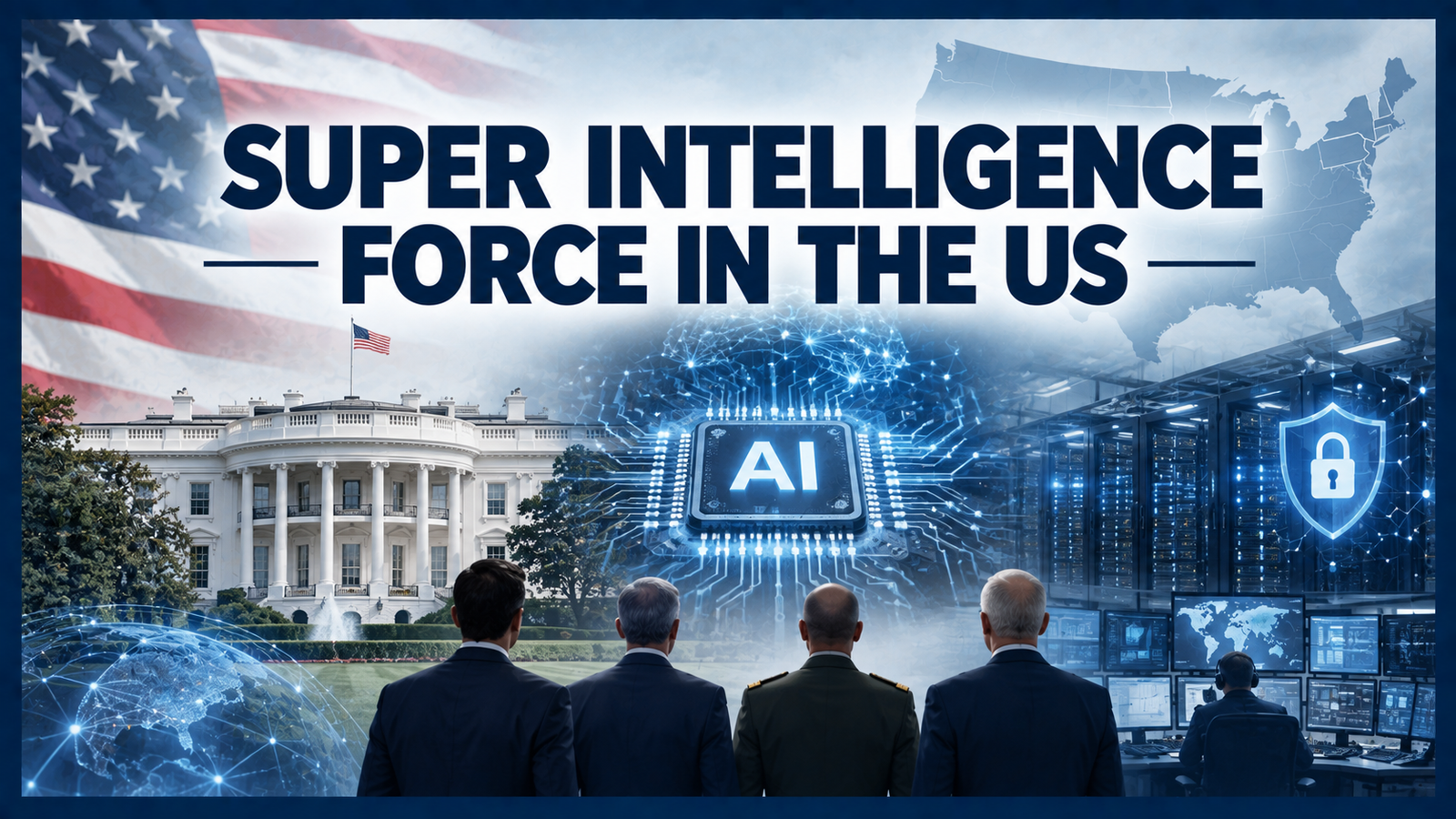
President Trump announced the creation of the “Super Intelligence Force” on October 4, 2026, naming Director of National Intelligence Jay Clayton as chair alongside three vice chairs drawn from the FTC, the Department of War, and the Office of Personnel Management. The task force has 120 days to deliver a report on AI’s risks and opportunities and to recommend what role the federal government should play in overseeing the technology.
Super Intelligence Force – Introduction
The Super Intelligence Force arrived as the latest and most concrete step in a month-long campaign by the Trump administration to reshape how Washington talks about, and organizes around, artificial intelligence. Announced in a Truth Social post on a Sunday morning, the new task force brings together four senior officials representing different corners of the federal government — intelligence, consumer and competition regulation, defense technology, and federal personnel policy — reflecting what multiple outlets have described as internal turf battles over who should actually own the government’s AI policy response. The force reports directly to President Trump and to White House Chief of Staff Susie Wiles, placing it firmly inside the West Wing’s chain of command rather than as an independent commission.
The announcement landed just one week after Trump signed a separate executive order directing federal agencies to replace the term “artificial intelligence” with “Super Intelligence” in official government communications, and on the heels of a White House-brokered voluntary safety accord signed by six major AI company CEOs. Taken together, these moves represent the administration’s answer to a specific political problem: rising public anxiety about AI’s pace and safety, paired with a stated commitment to avoid the kind of binding regulation that could, in the administration’s view, slow American AI development relative to competitors like China. This report covers who leads the Super Intelligence Force, its stated mission, the timeline that produced it, and what its first deliverable will cover.
Interesting Facts about Super Intelligence Force
| Category | Figure |
|---|---|
| Date announced | October 4, 2026 (via Truth Social post and executive order) |
| Chair | Jay Clayton, Director of National Intelligence |
| Number of named vice chairs | 3 — Andrew Ferguson (FTC), Emil Michael (Dept. of War), Scott Kupor (OPM) |
| Deadline for first report | 120 days from announcement |
| Reports to | President Trump and White House Chief of Staff Susie Wiles |
| Days since Trump first promised an “AI Force” and “AI czar” | 15 days (first floated September 19, 2026) |
| Intelligence agencies Clayton separately oversees | 18 |
| Companion executive order | Renamed “artificial intelligence” to “Super Intelligence” in federal usage, signed ~1 week earlier |
The most important fact about the Super Intelligence Force, structurally, is what it is not: a new federal agency created by statute, a binding regulatory body, or a body with independent rulemaking authority. It is an executive branch task force, created by presidential action rather than an act of Congress, explicitly designed to coordinate existing federal authorities and lean on voluntary industry commitments — including the AI accord Trump has described as “morally binding” rather than legally enforceable — rather than to write new, enforceable AI law. That structural choice reflects the administration’s stated goal of avoiding what its own charter language describes as overregulation that could stifle American AI competitiveness.
The speed of the rollout is also notable: just 15 days passed between Trump’s initial September 19 promise of an “AI Force” and “AI czar” on Truth Social, and the October 4 announcement naming Clayton and the three vice chairs. That compressed timeline places the Super Intelligence Force’s creation in the same two-week window as the administration’s UN General Assembly remarks proposing the “Super Intelligence” rebrand, the signed executive order implementing that rebrand across federal agencies, and the voluntary industry safety accord — suggesting a coordinated rollout of several related AI initiatives rather than a series of independent decisions.
Who Leads the Super Intelligence Force in 2026
SUPER INTELLIGENCE FORCE: LEADERSHIP STRUCTURE
CHAIR: JAY CLAYTON (DNI)
VICE CHAIR: ANDREW FERGUSON (FTC)   —   VICE CHAIR: EMIL MICHAEL (DEPT. OF WAR)   —   VICE CHAIR: SCOTT KUPOR (OPM)
| Role | Name | Position | Background |
|---|---|---|---|
| Chair | Jay Clayton | Director of National Intelligence | Former SEC Chairman; former US Attorney, Southern District of New York; no tech industry background |
| Vice Chair | Andrew Ferguson | Chairman, Federal Trade Commission | FTC has an active investigation into AI safety practices at major AI companies |
| Vice Chair | Emil Michael | Under Secretary of War for Research and Engineering / Chief Technology Officer | Former senior Uber executive |
| Vice Chair | Scott Kupor | Director, Office of Personnel Management | Former managing partner at venture capital firm Andreessen Horowitz |
Data Source: The Washington Post, NPR, SiliconANGLE, BigGo Finance
Jay Clayton chairs the Super Intelligence Force while continuing to serve as Director of National Intelligence, a post the Senate confirmed him to in July 2026 overseeing the 18 agencies that make up the US Intelligence Community. Clayton’s background is notably light on technology-sector experience — he previously chaired the Securities and Exchange Commission and served as the US Attorney for the Southern District of New York — a profile several outlets noted makes him something closer to a process-and-oversight figure than a Silicon Valley insider, distinguishing his appointment from how some other administrations have approached technology policy leadership.
The three vice chairs were each assigned distinct coordination responsibilities under the task force’s charter: Emil Michael, the Department of War’s chief technology officer and a former senior Uber executive, is responsible for coordinating directly with AI companies; Scott Kupor, a former Andreessen Horowitz managing partner now running the Office of Personnel Management, handles engagement with critical infrastructure operators and broader industry stakeholders; and Andrew Ferguson, chairman of the Federal Trade Commission, brings the perspective of an agency that has separately opened a broad investigation into the safety practices of leading AI developers including Anthropic and OpenAI. Reporting from the Wall Street Journal indicated that Vice President JD Vance, Defense Secretary Pete Hegseth, and Treasury Secretary Scott Bessent would also participate in the force’s work, broadening its reach across the cabinet beyond the four formally named leaders.
The Super Intelligence Force’s Mission and Mandate in 2026
SUPER INTELLIGENCE FORCE: STAKEHOLDER ENGAGEMENT SCOPE
CONSUMERS  •  PUBLIC INTEREST GROUPS  •  RELIGIOUS ORGANIZATIONS  •  CRITICAL INFRASTRUCTURE PROVIDERS  •  SI COMPANIES
| Element | Detail |
|---|---|
| Primary stated mission | Coordinate federal government engagement with stakeholders on US “Super Intelligence” leadership |
| Named stakeholder groups | Consumers, public interest groups, religious organizations, critical infrastructure providers, SI companies |
| Charter directive | Develop plans for SI-enabled threats while avoiding overregulation and regulatory capture |
| Reporting structure | Reports to the President and White House Chief of Staff Susie Wiles |
| Legal basis | Executive action; not created by congressional statute |
Data Source: Presidential Truth Social statement, SiliconANGLE, Engadget
According to the administration’s own framing, the Super Intelligence Force exists to coordinate the federal government’s engagement across a deliberately broad set of stakeholders: consumers, public interest groups, religious organizations, critical infrastructure providers, and the AI (or “Super Intelligence”) companies themselves. That five-category stakeholder list is notably wider than a typical industry-regulator relationship, explicitly folding in religious organizations and public interest groups alongside the more conventional categories of consumers and infrastructure operators — a scope that reflects the administration’s broader framing of AI as a societal transformation on the scale of the Industrial Revolution or the internet, rather than purely a technology-sector or economic policy issue.
The task force’s charter language, as reported, directs it to “develop plans for responding to SI-enabled threats to our society,” while simultaneously working to prevent the kind of overregulation and regulatory capture that, in the administration’s framing, could stifle American innovation and competitiveness. That dual mandate — address genuine risks while avoiding heavy-handed rules — mirrors the same balancing language found in the earlier White House Accord on Super Intelligence, suggesting the Force is intended to operationalize and extend that voluntary framework rather than introduce an entirely separate regulatory philosophy. For more on how that earlier accord and the broader “Super Intelligence” rebranding effort came together, see our related coverage of What Is Super Intelligence (SI)?
The Path to the Super Intelligence Force: Timeline in 2026
2026 AI POLICY TIMELINE: FROM REBRAND TO TASK FORCE
SEPT 19   ████  Trump promises "AI Force" and "AI czar" on Truth Social
SEPT 22   ████████  Trump proposes "Super Intelligence" rebrand at UN General Assembly
SEPT 29   ████████████████  EO renames AI to SI; White House Accord signed; America.gov launches
OCT 4     ████████████████████  Super Intelligence Force announced and formally chartered
| Date | Event |
|---|---|
| September 19, 2026 | Trump first promises an “AI Force” and an “AI czar” in a Truth Social post/poll |
| September 22, 2026 | Trump proposes renaming AI to “Super Intelligence” in UN General Assembly remarks |
| September 29, 2026 | Executive order renaming AI to “Super Intelligence” signed; White House Accord signed by 6 CEOs; America.gov launched |
| October 4, 2026 | Super Intelligence Force announced via Truth Social; formal executive order signed naming Clayton as chair |
Data Source: TechCrunch (via FourWeekMBA), The Washington Post, BigGo Finance
The Super Intelligence Force did not emerge as a standalone announcement but as the culmination of a tightly sequenced, roughly two-week rollout of AI-related initiatives. It began on September 19, 2026, when Trump first floated the idea of an “AI Force” and an “AI czar” in a Truth Social post, before proposing the broader “Super Intelligence” terminology shift in his September 22 address to the United Nations General Assembly. The administration then moved quickly to formalize that rebrand: on September 29, Trump signed the executive order instructing federal agencies to adopt “Super Intelligence” terminology, the same day six major AI company CEOs signed the voluntary White House Accord on Super Intelligence and the administration launched America.gov, a new government information portal built around the rebranded terminology.
The October 4 announcement of the Super Intelligence Force closed out that sequence, arriving — by one outlet’s count — exactly 15 days after Trump’s initial September 19 promise. That pacing suggests the administration treated these four moves (the rebrand proposal, the executive order, the industry accord, and the task force) as components of a single coordinated policy rollout rather than as separate, independently timed initiatives, each reinforcing the others’ framing of “Super Intelligence” as both a technological inevitability and a defined area of federal coordination.
What the 120-Day Report Will Cover in 2026
SUPER INTELLIGENCE FORCE: 120-DAY REPORT SCOPE
RISKS & OPPORTUNITIES ASSESSMENT    ████████████████████████████████████████
FEDERAL ROLE RECOMMENDATIONS        ████████████████████████████████
SECURITY BREACH DISCLOSURE REVIEW   ████████████████████
| Report Element | Detail |
|---|---|
| Deadline | 120 days from the task force’s formation |
| Core deliverable | Assessment of AI’s risks and opportunities |
| Policy recommendation scope | What role the federal government should play in AI oversight |
| Additional coverage area | How agencies handle disclosure of AI-related security breaches |
| Stated goal | Recommendations on how agencies can respond better using existing powers |
Data Source: SiliconANGLE, The Implicator, BigGo Finance
The Super Intelligence Force’s first and, as of this report, only formally defined deliverable is a comprehensive report due within 120 days of its formation, covering both the risks and opportunities presented by advanced AI systems and specific recommendations on what role the federal government should play in overseeing the technology going forward. Clayton told the Wall Street Journal that the report will also specifically address how federal agencies currently handle the disclosure of AI-related security breaches, with the task force expected to recommend improvements agencies could implement using authorities they already hold — a framing that again emphasizes working within existing regulatory structures rather than seeking new statutory powers from Congress.
That 120-day window places the report’s expected delivery in early February 2027, timing that will arrive well after the November 2026 midterm elections and amid the continuing implementation of both the “Super Intelligence” terminology executive order and the voluntary industry accord’s layered audit and oversight commitments. Whether the report ultimately recommends new legislation, continued reliance on voluntary industry self-policing, or some combination of the two remains an open question the administration has deliberately left unanswered pending the task force’s work. For broader context on the kinds of AI-enabled risks — including fraud and security threats — that a federal oversight effort like this one is likely to weigh, see our Consumer Fraud Statistics in US report.
Reactions and Context in 2026
| Context Element | Detail |
|---|---|
| FTC’s parallel activity | Active investigation into AI safety practices at Anthropic and OpenAI |
| White House tech lunch (days before announcement) | Hosted CEOs including Amazon founder Jeff Bezos |
| Trump’s subsequent public comment | Said the AI industry should police itself |
| Broader backdrop | Rising public and expert calls for a slowdown in frontier AI development |
| Framing of the Force by observers | Described as “self-policing”, not a source of new binding law |
Data Source: The Washington Post, Hoosier Enquirer, NPR
The Super Intelligence Force’s launch came directly on the heels of a White House lunch earlier that same week with top technology executives, including Amazon founder Jeff Bezos, after which Trump publicly said he believed the AI industry should largely police itself — a comment that previewed the voluntary, accord-based approach the task force itself has since embodied. That framing has drawn a mixed reaction from observers: supporters describe the structure as a pragmatic way to keep pace with China in frontier AI development without the delays associated with new federal legislation, while critics note that a task force built around voluntary commitments and existing agency authorities offers considerably less enforceable protection than binding statutory regulation would.
The announcement also landed amid genuine, documented public unease about AI’s trajectory, with the Washington Post specifically framing the Force’s creation as a response to calls for an AI slowdown from various quarters, including from within the AI industry itself. The Federal Trade Commission’s own ongoing investigation into AI safety practices at Anthropic and OpenAI — an inquiry now technically connected to the Super Intelligence Force through Chairman Ferguson’s vice-chair role — adds a layer of institutional tension to the task force’s work, since the FTC maintains independent investigatory authority even as its chairman now also sits on a White House-coordinated body explicitly tasked with avoiding what the administration considers excessive regulation. For more on the kinds of AI-related security risks shaping this debate, see our Phishing Statistics in US report, which covers the rapid rise of AI-generated phishing attacks through 2025 and 2026.
Frequently Asked Questions
What is the Super Intelligence Force?
The Super Intelligence Force is a federal task force President Trump announced on October 4, 2026, tasked with coordinating the government’s response to AI and delivering a report within 120 days on the technology’s risks, opportunities, and the federal government’s appropriate role.
Who leads the Super Intelligence Force?
Jay Clayton, the Director of National Intelligence, chairs the task force. Three vice chairs serve alongside him: Andrew Ferguson (FTC Chairman), Emil Michael (Department of War’s chief technology officer), and Scott Kupor (Director of the Office of Personnel Management).
Is the Super Intelligence Force a new federal agency?
No. It is an executive branch task force created through presidential action, not a new agency established by Congress. It coordinates existing federal authorities and relies heavily on voluntary industry commitments rather than new binding regulation.
What is the Super Intelligence Force supposed to produce?
A comprehensive report due within 120 days of its formation, assessing AI’s risks and opportunities, recommending what role the federal government should play in oversight, and addressing how agencies handle disclosure of AI-related security breaches.
Why is it called “Super Intelligence” instead of “AI”?
The naming follows a separate executive order Trump signed in late September 2026 directing federal agencies to replace “artificial intelligence” with “Super Intelligence” in official government communications, a rebranding effort the administration first floated at the UN General Assembly.
Who does the Super Intelligence Force report to?
The task force reports directly to President Trump and White House Chief of Staff Susie Wiles, placing it within the White House’s direct chain of command rather than operating as an independent commission.
Does the Super Intelligence Force create new AI regulations?
Not directly. Its charter emphasizes developing plans to respond to AI-related risks while explicitly working to avoid overregulation and regulatory capture, leaning instead on voluntary industry commitments and existing federal agency authorities.
How does the Super Intelligence Force relate to the White House Accord on Super Intelligence?
The two initiatives emerged within the same roughly two-week policy rollout. The Accord, signed by six AI company CEOs on September 29, 2026, established voluntary safety controls for AI developers, while the Force, announced October 4, coordinates the federal government’s own response and oversight role, with Vice Chair Emil Michael specifically tasked with maintaining the government’s relationship with AI companies going forward.
Disclaimer: This research report is compiled from publicly available sources. While reasonable efforts have been made to ensure accuracy, no representation or warranty, express or implied, is given as to the completeness or reliability of the information. We accept no liability for any errors, omissions, losses, or damages of any kind arising from the use of this report.