
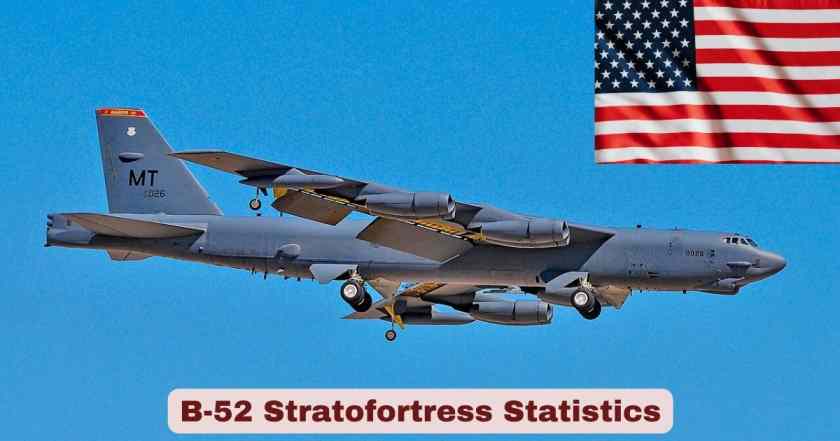
B-52 Stratofortress Bomber 2026
The Boeing B-52 Stratofortress — known universally across the United States Air Force (USAF) by its legendary nickname the “BUFF” (Big Ugly Fat Fellow, in polite company) — is America’s longest-serving, most combat-tested, and most continuously modernized long-range heavy strategic bomber. Designed by Boeing in 1948, first flown on April 15, 1952, and delivered to the USAF in February 1955, the B-52 Stratofortress has now been in continuous frontline operational service for over 70 years — a record unmatched by any combat aircraft in the history of military aviation. Powered by eight Pratt & Whitney TF33 turbofan engines, the B-52H — the sole remaining variant still in service — can carry up to 70,000 pounds (31,500 kg) of mixed ordnance, reach speeds of Mach 0.84 (650 mph), fly at altitudes of up to 50,000 feet, and strike targets at distances exceeding 8,800 miles (14,080 km) without aerial refueling. As of March 2026, the USAF operates a fleet of 76 B-52H Stratofortresses, split between the 5th Bomb Wing at Minot Air Force Base, North Dakota and the 2nd Bomb Wing at Barksdale Air Force Base, Louisiana, both under Air Force Global Strike Command (AFGSC), plus 18 reserve aircraft with the 307th Bomb Wing also at Barksdale. The Air Force currently plans to operate the B-52 through at least 2050 — meaning the airframe will have served for approximately 95 years by the time it retires.
In 2026, the B-52 Stratofortress is simultaneously waging war and undergoing the most transformative modernization of its entire life. On February 28, 2026, B-52H bombers were confirmed by U.S. Central Command (CENTCOM) as participating in Operation Epic Fury — the large-scale U.S. and Israeli military campaign targeting Iranian IRGC missile sites, command-and-control facilities, and nuclear infrastructure — with a B-52 strike package directly attacking Iranian missile command-and-control positions. At the same time, the B-52 Commercial Engine Replacement Program (CERP) is progressing rapidly: on February 24, 2026, Rolls-Royce announced the successful completion of altitude and operability testing for the new F130 engine at the U.S. Air Force Arnold Engineering Development Complex in Tennessee, moving the program closer to flight testing. When the B-52J — the re-engined, radar-upgraded variant — enters service in the early 2030s, it will extend the Stratofortress’s operational life well into the 2050s, making this the first combat aircraft in history poised to serve a full century in frontline military service.
B-52 Stratofortress 2026 — Interesting Facts
| # | B-52 Stratofortress Fact | Details |
|---|---|---|
| 1 | 70+ Years of Continuous Service | The B-52 first flew on April 15, 1952 and entered USAF service in February 1955 — it has been in continuous frontline service for over 70 years as of 2026 |
| 2 | Operation Epic Fury, 2026 | B-52H bombers were officially confirmed by CENTCOM as part of Operation Epic Fury (commenced February 28, 2026), striking Iranian missile command-and-control positions |
| 3 | Total Aircraft Built: 744 | A total of 744 B-52s were built across all variants (A through H), with the last — a B-52H — delivered in October 1962 |
| 4 | Only 76 Remain in Service | Of 744 built, only 76 B-52H Stratofortresses remain in the USAF active inventory as of early 2026 |
| 5 | Designed in a Hotel Room Overnight | Boeing engineers famously redesigned the B-52 concept from a turboprop to a swept-wing turbojet in a single overnight session at a Dayton, Ohio hotel in October 1948 |
| 6 | Desert Storm: 40% of All Bombs Dropped | During Operation Desert Storm (1991), B-52s delivered 40% of all weapons dropped by coalition forces |
| 7 | $2.6 Billion Engine Upgrade Contract | In September 2021, Rolls-Royce won a $2.6 billion contract to re-engine all 76 B-52Hs with the F130 turbofan engine |
| 8 | F130 Altitude Testing Completed Feb 24, 2026 | On February 24, 2026, Rolls-Royce confirmed the F130 engine passed all altitude and operability tests at the USAF Arnold Engineering Development Complex, Tennessee |
| 9 | Will Potentially Serve 100 Years | If the B-52 serves until 2050 as planned, it will be the first combat aircraft in history to serve approximately 95–100 years in frontline military service |
| 10 | Can Monitor 140,000 sq mi of Ocean in 2 Hours | Two B-52s operating together can survey 140,000 square miles (364,000 sq km) of ocean surface in just two hours during maritime patrol missions |
| 11 | 1,800 Combat Sorties vs. ISIS (2016) | B-52s flew approximately 1,800 combat sorties against ISIS targets in Syria and Iraq in 2016 alone during Operation Inherent Resolve |
| 12 | Carries Up to 20 Air-Launched Cruise Missiles | The B-52H can carry up to 20 AGM-86 air-launched cruise missiles — more than any other aircraft in the USAF bomber fleet |
| 13 | Longest Combat Mission (1996) | On September 2–3, 1996, two B-52Hs flew a 34-hour, 16,000-mile round-trip from Barksdale AFB, Louisiana to strike Baghdad — then the longest combat mission in aviation history |
| 14 | $2.04 Billion CERP Boeing Contract (Dec 2025) | On December 23, 2025, the USAF awarded Boeing Defense Systems a $2.04 billion task order to continue B-52 CERP post-CDR phase work |
| 15 | B-52J IOC Planned for 2033 | The modernized B-52J variant — with new F130 engines and AN/APQ-188 AESA radar — is currently projected to reach Initial Operational Capability (IOC) in fiscal year 2033 |
Source: U.S. Air Force Fact Sheet – B-52H Stratofortress (af.mil); U.S. Central Command (CENTCOM) official statements; The Aviationist (theaviationist.com, December 2025 & February 2026); Rolls-Royce press release (February 24, 2026); Air & Space Forces Magazine (airandspaceforces.com); GlobalSecurity.org
These 15 B-52 Stratofortress facts for 2026 collectively paint the portrait of a machine that has repeatedly defied its own retirement. No other combat aircraft in American history — not the F-15, not the F-16, not even the legendary F-4 Phantom — has come close to matching the B-52’s operational lifespan. The fact that in the same week of late February and early March 2026 the aircraft was simultaneously confirmed in active combat over Iran during Operation Epic Fury and completing final F130 engine altitude tests in Tennessee speaks to a duality that is uniquely the B-52’s own: it is always fighting today’s wars while preparing for tomorrow’s. The sheer scale of 744 aircraft built, 40% of Desert Storm ordnance delivered, 1,800 ISIS sorties in a single year — these are not the statistics of a relic kept around for nostalgia, but of a machine that has been the backbone of American air power projection across eight decades.
What makes the 2026 B-52 facts particularly compelling is the window they open into both the past and the future simultaneously. The $2.6 billion Rolls-Royce CERP contract and the $2.04 billion Boeing December 2025 task order represent a level of investment that no military would make in an aircraft it did not believe in wholeheartedly. When you pair that with a planned 2050 retirement date — giving the B-52 a service life that no combat aircraft has ever achieved — the picture becomes clear. The B-52 Stratofortress in 2026 is not a holdover from a different era. It is an actively modernizing, actively combat-deployed, actively funded platform that the United States Air Force has made a deliberate and expensive choice to keep relevant for the next quarter century.
B-52 Stratofortress 2026 Technical Specifications
| Specification | B-52H Data (Official USAF) |
|---|---|
| Primary Function | Long-range heavy bomber — nuclear and conventional |
| Contractor | Boeing Military Airplane Co. |
| Current Engine | 8 × Pratt & Whitney TF33-P-3/103 turbofan |
| Future Engine (B-52J) | 8 × Rolls-Royce F130 (replacing TF33 by ~2030) |
| Thrust Per Engine | Up to 17,000 lbs |
| Wingspan | 185 feet (56.4 meters) |
| Length | 159 feet, 4 inches (48.5 meters) |
| Height | 40 feet, 8 inches (12.4 meters) |
| Empty Weight | Approximately 185,000 pounds (83,250 kg) |
| Maximum Takeoff Weight | 488,000 pounds (219,600 kg) |
| Fuel Capacity | 312,197 pounds (141,610 kg) |
| Maximum Payload | 70,000 pounds (31,500 kg) |
| Maximum Speed | Mach 0.84 (650 mph / 1,046 km/h) |
| Service Ceiling | 50,000 feet (15,151 meters) |
| Unrefueled Combat Range | 8,800 miles (14,080 km / 7,652 nautical miles) |
| Crew | 5 (aircraft commander, pilot, radar navigator, navigator, electronic warfare officer) |
| Unit Cost | $84 million (FY 2012 constant dollars) |
| Initial Operating Capability | April 1952 |
| Inventory (2026) | 76 active (AFGSC) + 18 reserve (AFRC) |
Source: United States Air Force official fact sheet – B-52H Stratofortress (af.mil); The War Zone (twz.com, February 2026); The Aviationist
The B-52H’s official technical specifications from the U.S. Air Force underscore why this aircraft continues to anchor American strategic bomber doctrine in 2026. The combination of 70,000 pounds of mixed ordnance capacity, a 50,000-foot service ceiling, and an unrefueled range of 8,800 miles means that a B-52H departing Barksdale AFB, Louisiana can reach virtually any target on the planet without a tanker — and with aerial refueling, its range is limited only by crew endurance. The eight-engine TF33 powerplant, while increasingly difficult to sustain (the TF33 has been out of production since 1985), still delivers enough combined thrust to push 488,000 pounds of fully-loaded bomber to near-Mach speeds at altitude. The crew of five manages a cockpit that has been repeatedly updated with modern avionics, night vision goggle compatibility, and advanced targeting pod integration since the Cold War era.
What is critically important to understand in the B-52H specs for 2026 is the trajectory they are on. The Rolls-Royce F130 replacement engine — which completed its critical design review in December 2024 and altitude testing in February 2026 — will deliver measurably superior fuel efficiency, reduced maintenance burden, and extended range compared to the 60-year-old TF33. The B-52 Radar Modernization Program (RMP) is simultaneously replacing the aged AN/APQ-166 radar with the AN/APQ-188 Active Electronically Scanned Array (AESA) radar — derived from the F/A-18E/F Super Hornet’s AN/APG-79 — which will give the bomber a dramatically improved all-weather navigation and targeting capability. When the B-52J emerges from these programs in the early 2030s, its physical dimensions will be unchanged, but under the skin it will be a fundamentally different and vastly more capable aircraft.
B-52 Stratofortress 2026 Fleet & Basing Statistics
| Unit / Location | Command | Aircraft | Role | Status (2026) |
|---|---|---|---|---|
| 5th Bomb Wing — Minot AFB, North Dakota | Air Force Global Strike Command (AFGSC) | B-52H | Nuclear + conventional strike | Active — primary nuclear alert wing |
| 2nd Bomb Wing — Barksdale AFB, Louisiana | Air Force Global Strike Command (AFGSC) | B-52H | Nuclear + conventional strike | Active — primary conventional operations wing |
| 307th Bomb Wing — Barksdale AFB, Louisiana | Air Force Reserve Command (AFRC) | B-52H | Reserve conventional operations | Active Reserve — 18 aircraft |
| Total Active Fleet (AFGSC) | USAF | 58 aircraft (+ 4 test) | Full-spectrum nuclear + conventional | Active |
| Total Reserve Fleet (AFRC) | USAF Reserve | 18 aircraft | Conventional reserve bomber | Active Reserve |
| Total B-52H Fleet (2026) | USAF | 76 aircraft | Combined active + reserve | Operational |
| Andersen AFB, Guam (rotational) | PACOM / AFGSC | Rotating B-52Hs | Indo-Pacific Continuous Bomber Presence | Ongoing rotational deployments |
| Diego Garcia / RAF Fairford (potential) | USCENTCOM / USEUCOM | Rotating B-52Hs | Middle East / European theater | Under operational use consideration for Operation Epic Fury |
Source: U.S. Air Force Fact Sheet (af.mil); The War Zone (twz.com, February 2026); SOF News (sof.news, March 2026); The Aviationist (theaviationist.com)
The B-52H fleet and basing statistics for 2026 reflect a global bomber force structured for both nuclear deterrence and conventional power projection across every theater of conflict. The 5th Bomb Wing at Minot AFB and 2nd Bomb Wing at Barksdale AFB form the two permanent pillars of the fleet, with Barksdale serving as the operational hub for the bulk of conventional tasking, including the Operation Epic Fury strike packages launched in late February and early March 2026. The 307th Bomb Wing’s 18 reserve aircraft provide operational depth that would be critical in any extended campaign, and the wing’s crews are maintained to active-duty standards through regular integration training with AFGSC. The Andersen AFB rotational presence in Guam — the “Continuous Bomber Presence” mission that has sent B-52s to the Indo-Pacific for years — signals to both allies and adversaries in the Pacific that American bomber power is always within range.
The 2026 basing picture also reveals an aircraft under extraordinary operational demand. With the B-52H simultaneously supporting the Pacific deterrence mission, active combat in Operation Epic Fury, and undergoing the first stages of the CERP modification program, the 76-aircraft fleet is stretched across more concurrent operational requirements than at almost any point in recent memory. Defense analysts at The War Zone noted in February 2026 that the relatively small fleet size creates real challenges for the CERP program — because pulling aircraft offline for modification directly reduces the number of mission-ready bombers at a time when CENTCOM and PACOM commanders are both placing maximum demand on the fleet. This tension between modernization and operational readiness is the defining strategic management challenge for the B-52 program in 2026 and beyond.
B-52 Stratofortress 2026 Modernization — CERP & B-52J Upgrade Statistics
| Program | Key Detail | Status / Value (2026) |
|---|---|---|
| Commercial Engine Replacement Program (CERP) | Replace 8 × TF33 engines on all 76 B-52Hs with 8 × Rolls-Royce F130 | In progress — post-CDR phase |
| Rolls-Royce CERP Contract Award | September 24, 2021 | Up to $2.6 billion (Rolls-Royce North America) |
| Number of F130 Engines to be Delivered | 608 primary engines + spare powerplants | Total ~650 engines across fleet |
| Boeing CERP Task Order (Dec 23, 2025) | Post-CDR integration, modification kits, 2 test aircraft | $2.04 billion |
| FY 2026 Initial CERP Funding Obligated | Research, development, test & evaluation | $35,774,115 |
| F130 Critical Design Review (CDR) | Completed | December 2024 |
| F130 Altitude & Operability Testing | Completed at USAF Arnold Engineering Development Complex, Tullahoma, Tennessee | February 24, 2026 |
| CERP Test Aircraft Delivery to Boeing | First 2 modified B-52H test aircraft | Planned: 2027 |
| B-52 Radar Modernization Program (RMP) | Replace AN/APQ-166 with AN/APQ-188 AESA radar | In progress — first modified B-52H to Edwards AFB Dec 8, 2025 |
| First RMP Aircraft to Edwards AFB | December 8, 2025 | Flight testing ongoing |
| B-52J Initial Operational Capability (IOC) | First operational B-52J unit delivery | Fiscal Year 2033 (est.) |
| Planned Service Life Extension to | With B-52J upgrades | 2050+ |
| Rolls-Royce Indianapolis Investment | Manufacturing facility upgrades for F130 production | $600 million–$1 billion |
Source: The Aviationist (theaviationist.com, December 2025 & February 2026); Air & Space Forces Magazine (airandspaceforces.com); GlobalSecurity.org; Breaking Defense (breakingdefense.com, December 2024); The War Zone (twz.com, February 2026); Rolls-Royce press release (February 24, 2026)
The B-52 Stratofortress modernization statistics for 2026 represent arguably the most significant and expensive upgrade effort ever undertaken on a single bomber airframe in aviation history. The combined value of the $2.6 billion Rolls-Royce F130 engine contract and the $2.04 billion Boeing CERP task order already places the total known CERP investment at over $4.6 billion — before accounting for classified modifications, avionics upgrades, and the parallel Radar Modernization Program. The key milestone of February 24, 2026 — when Rolls-Royce confirmed the F130 passed all altitude and operability testing at the Arnold Engineering Development Complex — represents the most significant CERP milestone to date, clearing the path toward flight-testing on actual B-52 airframes beginning in 2027. Lt. Col. Timothy Cleaver, the USAF’s Program Manager for B-52 CERP, confirmed that the test data “gives us confidence in the engine and associated systems as we proceed into test aircraft modification and flight testing.”
The B-52 CERP and RMP programs also highlight a broader truth about American strategic airpower investment in 2026: the United States is betting heavily on the B-52’s future at exactly the same time it is introducing the B-21 Raider as its next-generation stealth bomber. Far from being contradictory, this dual investment reflects a deliberate “high-low” force structure. The B-21 Raider will penetrate the most heavily defended airspace; the B-52J — with its standoff missiles, cruise weapons, and dramatically improved range efficiency from the F130 engine — will devastate targets from outside defended airspace. The F130’s superior fuel efficiency compared to the aging TF33 is expected to meaningfully reduce the B-52J’s dependence on tanker support, a critical operational advantage when aerial refueling assets are themselves contested. Together, the two bombers form a complementary force that leverages each platform’s strengths across the full spectrum of peer and near-peer conflict scenarios.
B-52 Stratofortress 2026 — Operation Epic Fury Combat Statistics
| Detail | Data | Source |
|---|---|---|
| Operation Name | Operation Epic Fury | CENTCOM official |
| Operation Start Date | February 28, 2026 | CENTCOM official statement |
| Operation Objectives | (1) Prevent Iran nuclear weapon; (2) Destroy missile arsenal; (3) Degrade proxy networks; (4) Annihilate Iranian navy | President Trump / CENTCOM |
| B-52H Role Confirmed | Strike package targeting Iranian missile command-and-control positions | CENTCOM official asset list |
| B-52H Official Confirmation | B-52H Stratofortress added to CENTCOM’s official published asset list | CENTCOM fact sheet update |
| Targets Struck — First 72 Hours | 1,700+ targets across Iran | CENTCOM (March 3, 2026) |
| Targets Struck — First 48 Hours | 1,250+ targets (IRGC C2 facilities, air defense sites, missile launch sites, military airfields) | CENTCOM (March 2, 2026) |
| Other USAF Bombers in Operation | B-2 Spirit (stealth bomber, day-one strikes on underground facilities); B-1B Lancer (from Ellsworth AFB, direct) | The Aviationist; Naval Today |
| B-52 Home Bases | Barksdale AFB, Louisiana; Minot AFB, North Dakota | USAF |
| Primary Weapon in Iranian Airspace | AGM-158 JASSM-ER standoff cruise missile (range up to 575 miles / 918 km) — allowing B-52 to strike from outside Iranian air defense reach | Defense analysts |
| CENTCOM Commander | Admiral Brad Cooper, U.S. Navy (as of August 2025) | CENTCOM |
Source: U.S. Central Command (CENTCOM) official fact sheet and statements (centcom.mil, February 28 – March 3, 2026); The Aviationist (theaviationist.com, March 2, 2026); Naval Today (navaltoday.com, March 3, 2026); SOF News (sof.news, March 2026); CSIS (csis.org, March 2026)
The B-52 Stratofortress’s confirmed involvement in Operation Epic Fury adds yet another chapter to the bomber’s remarkable combat history — and this chapter is unfolding as these words are written. CENTCOM’s official asset list, updated in the first days of March 2026, explicitly names the B-52H Stratofortress as part of the force conducting strikes in Iran, with a B-52 strike package confirmed to have attacked Iranian missile command-and-control positions. This deployment follows the established pattern of how the B-52 is used in contested environments: not as a day-one stealth penetrator — that role fell to the B-2 Spirit in the opening hours of Operation Epic Fury — but as a standoff cruise missile truck, launching AGM-158 JASSM-ER missiles from well outside the reach of Iran’s S-300 and Bavar-373 air defense systems, with the JASSM-ER’s 575-mile (918 km) range providing ample standoff distance. Defense analyst Dr. Brent M. Eastwood noted that this was precisely the B-52’s intended contribution: overwhelming Iranian missile infrastructure from safe standoff range once initial air defense suppression had been achieved by stealthier platforms.
The scale of Operation Epic Fury — 1,700+ targets struck in the first 72 hours according to CENTCOM — is a figure that places this operation among the most intense air campaigns in modern military history, and the B-52H’s participation is part of a three-bomber effort that deployed every strategic bomber type in the USAF inventory simultaneously. The fact that the B-52H, alongside the B-1B Lancer and B-2 Spirit, is operating in this campaign confirms that the aging Stratofortress remains a fully relevant and irreplaceable element of U.S. strategic airpower in 2026. No other aircraft in the American inventory can carry as many cruise missiles as the B-52H, and in a campaign specifically designed to systematically dismantle Iran’s missile belt — which comprises thousands of ballistic missiles — the B-52’s standoff strike capacity is not just useful, it is essential.
B-52 Stratofortress 2026 Combat History Summary Statistics
| Conflict / Operation | Years | Key B-52 Contribution |
|---|---|---|
| Vietnam War (Operation Arc Light & Linebacker) | 1965–1973 | Over 126,000 sorties flown; carried 30% of all bombs dropped during the war |
| Operation Desert Storm (Gulf War) | 1991 | Delivered 40% of all weapons dropped by coalition forces |
| Operation Desert Strike (Iraq) | 1996 | Two B-52Hs flew 34-hour, 16,000-mile mission — longest combat mission at the time |
| Operation Allied Force (Yugoslavia) | 1999 | Struck wide-area targets, troop concentrations, and fixed installations |
| Operation Enduring Freedom (Afghanistan) | 2001–2002 | Provided close air support via precision-guided munitions from loiter altitude |
| Operation Iraqi Freedom | 2003 | Launched approximately 100 CALCMs in a single night (March 21, 2003) |
| Operation Inherent Resolve (ISIS) | 2016 | Flew approximately 1,800 combat sorties vs. ISIS in Syria and Iraq |
| Operation Epic Fury (Iran) | February 28, 2026 – ongoing | Confirmed in CENTCOM official asset list — striking Iranian missile C2 positions with standoff cruise missiles |
Source: U.S. Air Force Fact Sheet – B-52H Stratofortress (af.mil); U.S. Central Command (CENTCOM, centcom.mil, March 2026); The Aviationist; SOF News; National Security Journal
The B-52 Stratofortress combat history is simply without parallel in aviation. From the jungles of Vietnam, where B-52 Arc Light strikes shook the earth for miles in every direction, to the deserts of Iraq during Desert Storm, to the mountains of Afghanistan, to the plains of Syria during the ISIS campaign, and now to the skies above Iran in 2026 — the B-52 has fought in every major American military campaign of the past 60 years. The 126,000 Vietnam sorties, the 40% of all Desert Storm ordnance delivered, the 100 cruise missiles in a single Iraq night mission, and the 1,800 ISIS sorties in a single year are numbers that no other single aircraft type in the American inventory can come close to matching in terms of sustained, high-tempo combat contribution across multiple decades and multiple theaters. Operation Epic Fury (2026) now adds a new conflict to that list — and it does so while the aircraft is simultaneously undergoing its most ambitious modernization program in history.
What the B-52 combat statistics across its history also reveal is a consistent pattern of adaptation. The aircraft that dropped iron bombs over Vietnam in the 1960s became the precision standoff missile launcher of Desert Storm in 1991, became the close-air-support loiter platform over Afghanistan in 2001, became the anti-ISIS conventional bomber of 2016, and is now the standoff JASSM-ER cruise missile carrier of Operation Epic Fury in 2026. In each era, the mission changed — but the B-52 adapted. Its enormous payload, its massive internal weapons bay, its aerial refueling capability, and its integration of successive generations of precision weapons have allowed it to remain relevant across every warfare paradigm the United States has encountered since the Eisenhower administration. This adaptability — more than any single specification — is the true secret of the B-52’s seven-decade operational longevity.
Disclaimer: This research report is compiled from publicly available sources. While reasonable efforts have been made to ensure accuracy, no representation or warranty, express or implied, is given as to the completeness or reliability of the information. We accept no liability for any errors, omissions, losses, or damages of any kind arising from the use of this report.