
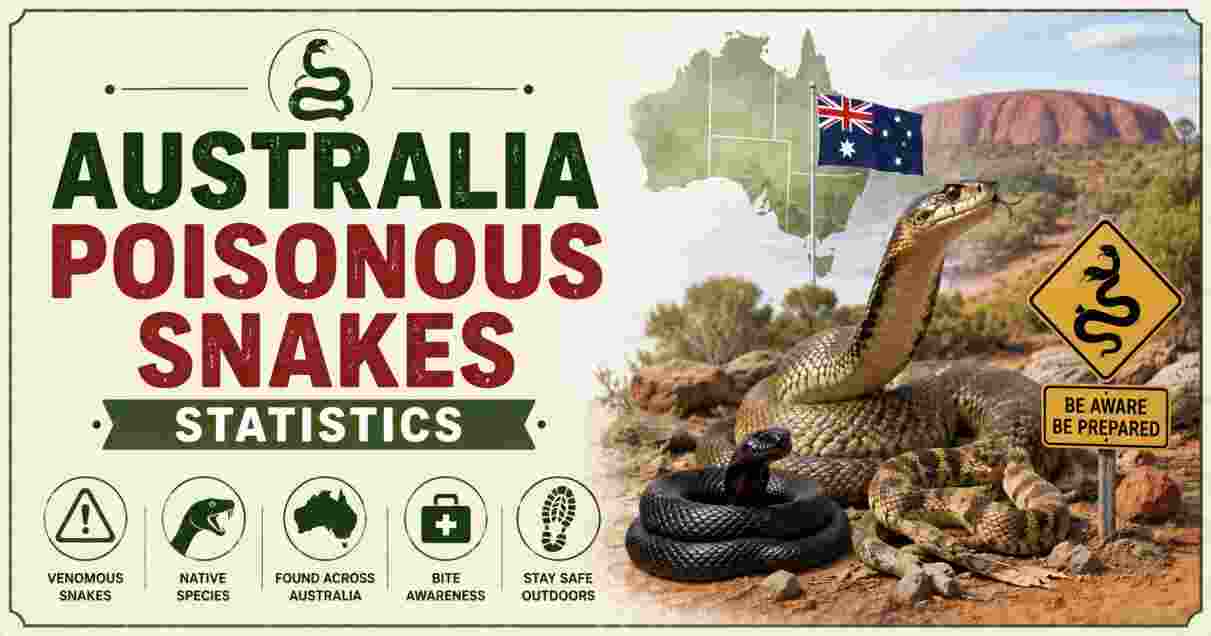
Poisonous Snakes in Australia 2026
Australia’s poisonous snakes hold a genuinely unmatched global title: according to rankings from the Australian Venom Research Unit based on LD50 toxicity values, 20 of the world’s 25 most venomous snake species call this continent home, more than any other country on Earth. Of the roughly 170 species of land snakes found across Australia, somewhere between 100 and 110 are venomous, though only around 12 species are considered capable of inflicting a genuinely life-threatening bite. Despite this extraordinary concentration of venomous reptiles, Australia’s advanced antivenom program and high-quality healthcare system mean that fatal snakebites remain remarkably rare, averaging just 2 deaths per year nationally.
This report compiles the key verified statistics on Australia’s poisonous snakes in 2026, ranking the top 10 deadliest species by venom potency and human impact, alongside hospitalization data, antivenom program details, and the demographic patterns behind Australian snakebite cases. Sources include the Australian Venom Research Unit, the Australian Snakebite Project (ASP-20), the Australian Venomous Injuries Project (AVIP), and the Australian Institute of Health and Welfare. Because different sources measure “deadliest” by different criteria — raw venom toxicity (LD50) versus actual human fatality counts — this article distinguishes clearly between these two rankings throughout.
Interesting Facts About Australia’s Poisonous Snakes 2026
| Fact Category | Key Data Point |
|---|---|
| Land snake species in Australia | ~170, with 100–110 venomous |
| Species capable of a fatal bite | ~12 |
| World’s top 25 most venomous snakes that are Australian | 20 of 25 (Australian Venom Research Unit, LD50 ranking) |
| World’s most venomous snake overall | Inland Taipan — endemic to Australia |
| Snake responsible for the most human deaths in Australia | Eastern Brown Snake |
| Lethal human dose, Eastern Brown Snake venom | Just 3 mg |
| Largest single venom “milking” on record | 5.2 grams — Coastal Taipan named Cyclone, enough to kill ~400 humans |
| Average annual snakebite deaths in Australia | 2 (median, per ASP-20 study) |
| Annual estimated snakebite incidents | 1,000–3,000 |
| Snakebite cases requiring antivenom annually | 100–500 |
| Hospitalizations from venomous snake contact, 2021-22 | 539 cases (19% of all venomous-animal hospitalizations) |
| Deaths from horses, cattle, and kangaroos vs. reptiles (annual comparison) | ~6 times more than snakebite deaths |
Source: Australian Venom Research Unit LD50 rankings; Australian Snakebite Project (ASP-20), 2005-2015; Australian Institute of Health and Welfare, Contact with Animals 2024; Reptiles Magazine, 2022
The numbers above capture the genuine paradox at the heart of Australia’s relationship with its venomous wildlife: the country hosts an extraordinary concentration of the world’s most toxic snake species by pure venom potency, yet actual human fatalities remain vanishingly rare thanks to a combination of shy, non-aggressive snake behavior, effective public education, and one of the world’s most sophisticated antivenom systems. The gap between the Inland Taipan’s status as the world’s single most venomous snake and the Eastern Brown Snake’s position as the actual leading cause of snakebite deaths illustrates a crucial distinction: raw venom toxicity and real-world danger to humans are not the same measurement, since the Eastern Brown’s far greater abundance in populated areas — including suburban Sydney, Melbourne, and Brisbane — makes it statistically responsible for more encounters and fatalities than the more reclusive, remote-dwelling Inland Taipan.
What stands out most is the stark comparison with domestic and farm animals: horses, cattle, and kangaroos collectively cause roughly six times more deaths annually than snakes do in Australia, a statistic that consistently surprises visitors who arrive expecting snakes and spiders to represent the country’s most significant wildlife risk. This context matters for anyone planning to spend time in the Australian bush, since the actual data suggests venomous snake encounters, while genuinely dangerous when they occur, represent a far smaller practical risk than commonly assumed.
Top 10 Deadliest Snakes in Australia by Venom Potency 2026
TOP AUSTRALIAN SNAKES — VENOM DANGER RANKING
════════════════════════════════════════════════════════════════════
1. Inland Taipan        ████████████████████████████████  World's most toxic venom
2. Eastern Brown Snake  ███████████████████████████░░░░░  Most human deaths in Australia
3. Coastal Taipan       ██████████████████████████░░░░░░  Largest venom yield on record
4. Tiger Snake          █████████████████████████░░░░░░░  Numerous historical deaths
5. Mulga Snake          ████████████████████████░░░░░░░░  Largest venom gland
6. Death Adder          ███████████████████████░░░░░░░░░  ~50% pre-antivenom mortality
7. Red-Bellied Black    ██████████████████░░░░░░░░░░░░░░  Common, rarely fatal
8. Dugite (WA)          ██████████████░░░░░░░░░░░░░░░░░░  Western Australia's key threat
9. Belcher's Sea Snake  ████████████████████████████░░░░  Most venomous sea snake
10. Rough-Scaled Snake  ████████████░░░░░░░░░░░░░░░░░░░░  Rare, highly toxic
════════════════════════════════════════════════════════════════════
| Rank | Species | Key Danger Metric |
|---|---|---|
| 1 | Inland Taipan (Fierce Snake) | Most venomous snake in the world by LD50; one bite can kill up to 100 adult humans |
| 2 | Eastern Brown Snake | Causes more human deaths than any other Australian species; 3 mg lethal dose |
| 3 | Coastal Taipan | Second-longest venomous snake (up to 3 meters); record single-milking venom yield of 5.2 grams |
| 4 | Mainland Tiger Snake | Distinctive banded pattern; responsible for numerous deaths throughout Australian history |
| 5 | Mulga Snake (King Brown) | Produces the largest venom volume per bite of any Australian snake |
| 6 | Common Death Adder | Ambush predator; ~50% mortality rate in untreated bites historically |
| 7 | Red-Bellied Black Snake | Common in eastern Australia; bites rarely fatal but require medical treatment |
| 8 | Dugite (Western Brown Snake) | Leading venomous snake threat in Western Australia |
| 9 | Belcher’s Sea Snake | Most venomous sea snake; can kill a victim in under 30 minutes |
| 10 | Rough-Scaled Snake | Rare species with highly potent, medically significant venom |
Source: Reptiles Magazine “Top 10 Venomous Snakes of Australia”; FirstAidPro Australia venomous snake guide; EnviroBug “Australia’s Most Venomous Snakes”; Wildlife Nomads “Most Dangerous Snakes in Australia,” 2025–2026
The Inland Taipan’s status atop this list reflects a measurement most people don’t intuitively understand: it is ranked by LD50 (lethal dose for 50% of test subjects), a laboratory toxicity metric rather than a measure of real-world danger to humans. Despite holding the title of the world’s most venomous snake, the Inland Taipan is responsible for extremely few recorded human deaths, since it inhabits remote, semi-arid regions of central-eastern Australia and rarely encounters people at all. This is precisely why the Eastern Brown Snake sits second on this list despite less potent venom than the Inland Taipan — its far wider distribution across populated eastern Australia, combined with a comparatively fast-moving and occasionally defensive temperament, makes it the species most frequently implicated in serious and fatal bites nationwide.
The Coastal Taipan’s record-setting venom yield deserves specific attention: a male taipan named Cyclone, housed at the Australian Reptile Park specifically for antivenom production, produced 5.2 grams of pure venom in a single milking — enough, according to researchers, to theoretically kill around 400 humans. This figure illustrates why antivenom-milking programs treat taipans as particularly valuable and particularly dangerous animals to handle, requiring specialized training and protective protocols even among experienced herpetologists.
Venom Potency and Toxicity Data 2026
| Toxicity Metric | Data Point |
|---|---|
| Inland Taipan — venom potential | Enough in one bite to kill up to 100 adult humans |
| Eastern Brown Snake — lethal human dose | 3 mg |
| Coastal Taipan — record venom yield (single milking) | 5.2 grams (Cyclone, Australian Reptile Park) |
| Alternative Coastal Taipan record cited | 4.9 grams, enough to kill 1,000+ adults per some estimates |
| Share of world’s top 25 most venomous snakes that are Australian | 80% (20 of 25) |
| Global snakebite deaths annually (worldwide comparison) | 81,000–138,000 |
| Australia’s share of global snakebite deaths | A tiny fraction — averaging just 2 per year |
| Venom detection method used in Australian hospitals | Snake Venom Detection Kit (SVDK) |
| Primary toxic mechanism of Australian elapid venom | Neurotoxic and procoagulant effects — targets nervous system and blood clotting |
Source: Australian Venom Research Unit; GBD 2019 Snakebite Envenomation Collaborators; Live Science top-3 deadliest snakes ranking; Discover Wildlife, October 2025
The contrast between global and Australian snakebite mortality is one of the most important statistics for understanding why Australia’s venomous reputation, while scientifically accurate regarding raw toxicity, doesn’t translate into the death tolls seen elsewhere. Global snakebite deaths run between 81,000 and 138,000 annually, concentrated overwhelmingly in Sub-Saharan Africa, Southeast Asia, and South Asia, where limited access to antivenom and healthcare infrastructure turns treatable envenomations into fatalities. Australia’s roughly 2 deaths per year, despite hosting the most toxic snake species on the planet, stands as a direct testament to the effectiveness of its public health system rather than any inherent safety advantage from the snakes themselves.
Australian elapid snakes — the family that includes taipans, brown snakes, tiger snakes, and death adders — predominantly produce venom with neurotoxic and procoagulant properties, meaning bites can cause both nervous system paralysis and dangerous blood clotting disorders simultaneously. This dual mechanism is part of why rapid Snake Venom Detection Kit (SVDK) testing in Australian hospitals is so critical: correctly identifying which venom type a patient has been exposed to determines which of Australia’s several distinct antivenoms should be administered, since using the wrong antivenom provides little to no protective benefit against a different species’ venom chemistry.
Snakebite Hospitalizations and Medical Outcomes 2026
AUSTRALIAN SNAKEBITE HOSPITALIZATIONS (2002-2020, AVIP STUDY)
════════════════════════════════════════════════════════════════════
Total hospitalizations recorded    ████████████████████████████████  10,700+
Male hospitalization rate          ████████████████████████████████  >2x female rate
Highest-risk age group             ██████████████████████████████  25-44 years
Highest regional rate: NT          ████████████████████████████████  7.6 per 100,000
Brown snakes' share of envenomings ████████████████████████████████  ~50%
Patients receiving antivenom       ████████████░░░░░░░░░░░░░░░░░░░░  ~1 in 4
════════════════════════════════════════════════════════════════════
| Hospitalization Metric | Data Point |
|---|---|
| Total hospitalizations, 2002–2020 (AVIP study) | >10,700 |
| Trend over the study period | Rates remained stable |
| Male vs. female hospitalization rate | Males hospitalized more than twice as often |
| Highest-risk age group | 25–44 years |
| Highest regional hospitalization rate | Northern Territory — 7.6 per 100,000 |
| Regions with rising hospitalizations | Tasmania, ACT, and people over 65 — all up more than 5% |
| Brown snakes’ share of envenoming cases | Nearly half |
| Envenomed patients receiving antivenom | ~1 in 4 |
| ASP-20 study: total suspected snakebite patients (2005-2015) | 1,548 |
| ASP-20 study: confirmed envenomed patients | 835 (median 87 per year) |
Source: Afroz, Jackson & Watt, “Trends in injury hospitalisations due to contact with snakes in Australia, 2002 to 2020,” PLOS Neglected Tropical Diseases, December 2025; Australian Snakebite Project (ASP-20), Medical Journal of Australia, 2017
The Australian Venomous Injuries Project’s analysis of nearly two decades of hospitalization data reveals a snakebite burden that has remained genuinely stable despite significant population growth, urban expansion, and climate change over the study period — a finding researchers describe as reassuring given how dramatically Australia’s population and land use have shifted since 2002. The more than twofold higher hospitalization rate among men, concentrated specifically in the 25-to-44 age bracket, aligns with occupational and recreational exposure patterns: this demographic is disproportionately represented among agricultural workers, tradespeople, and outdoor recreation enthusiasts most likely to encounter snakes in rural and semi-rural settings.
The Northern Territory’s position as the highest-risk jurisdiction, with a hospitalization rate of 7.6 per 100,000 — nearly double the rate of most other states — reflects both its tropical climate supporting year-round snake activity and its larger remote and rural population share, where snake encounters during outdoor work and travel are simply more frequent. Notably, the study also flagged rising hospitalization rates among Tasmania, the ACT, and people over 65, three trends researchers specifically called out as warranting further investigation, since none of these groups fit the traditional profile of highest snakebite risk and may signal shifting exposure patterns tied to demographic aging or changing land use in areas not traditionally associated with high snake activity.
Clinical Effects and Antivenom Treatment Data 2026
| Clinical Metric (ASP-20 Study, 2005–2015) | Data Point |
|---|---|
| Venom-induced consumption coagulopathy (VICC) | 73% of envenomed patients |
| Myotoxicity (muscle tissue damage) | 17% of envenomed patients |
| Acute kidney injury | 12% of envenomed patients |
| Cardiac arrest cases | 25 cases (2.9%) |
| Major haemorrhage cases | 13 cases (1.6%) |
| Total deaths recorded (2005-2015) | 23 — median 2 per year |
| Deaths by species: Brown snakes | 17 |
| Deaths by species: Tiger snakes | 4 |
| Deaths by species: Unknown/unidentified | 2 |
| Deaths preceded by out-of-hospital cardiac arrest | 10 of 23 |
| Deaths preceded by intracranial haemorrhage | 6 of 23 |
| Antivenom supplier | CSL, Melbourne — Australia’s single source |
Source: Isbister et al., “The Australian Snakebite Project, 2005-2015 (ASP-20),” Medical Journal of Australia, 2017
The clinical breakdown from the decade-long ASP-20 study provides the most detailed picture available of exactly how Australian snakebites cause harm: venom-induced consumption coagulopathy, a dangerous depletion of the body’s clotting factors that can lead to uncontrolled bleeding, affected nearly three-quarters of all envenomed patients — making it by far the most common serious clinical complication of Australian snakebite. The relatively small numbers of cardiac arrest (25 cases) and major haemorrhage (13 cases) over a full decade underscore just how effectively modern antivenom and supportive hospital care intervene before these life-threatening complications typically develop.
The species breakdown behind Australia’s 23 total snakebite deaths over the 2005-2015 study period confirms the pattern seen throughout this report: brown snakes were responsible for 17 of the 23 deaths, more than triple the toll attributed to tiger snakes, despite tiger snake venom often being cited as comparably or more potent gram-for-gram. This gap reflects brown snakes’ far greater geographic overlap with Australia’s populated eastern seaboard. The fact that Australia’s entire antivenom supply flows through a single manufacturer, CSL in Melbourne, represents a notable point of centralization in the country’s snakebite response system — a structure that has functioned reliably for decades but that public health researchers have periodically flagged as a potential single point of vulnerability worth monitoring. For a broader look at how Australia’s healthcare system performs on mortality outcomes more generally, our Life Expectancy in Australia report documents the national health infrastructure that underpins this same rapid-response antivenom capability.
Where Australia’s Deadliest Snakes Live 2026
| Species | Primary Habitat Region |
|---|---|
| Inland Taipan | Semi-arid regions of central-eastern Australia (Queensland, South Australia) |
| Coastal Taipan | Northern and eastern coastline — Queensland, Northern Territory, northern NSW |
| Eastern Brown Snake | Open grasslands, farmlands, and suburban areas across eastern Australia |
| Mainland Tiger Snake | Southeastern Australia, including Victoria, Tasmania, southern NSW |
| Mulga Snake (King Brown) | Found across most of mainland Australia except the far southeast |
| Death Adder | Woodlands and heath across most states; ambush hunter in leaf litter |
| Dugite | Western Australia specifically — the region’s primary venomous threat |
| Belcher’s Sea Snake | Warm waters around the Gulf of Thailand, Solomon Islands, and northwest Australian coast (NT, QLD) |
| Red-Bellied Black Snake | Wetlands and waterways of eastern Australia |
Source: NSW Environment and Heritage; EnviroBug Australia venomous snake guide; FirstAidPro Australia, 2025–2026
The geographic distribution of Australia’s most dangerous snakes shows a clear pattern: the far northern, tropical regions — Queensland, the Northern Territory, and northern NSW — host the greatest concentration of the most toxic species, including both taipan varieties and Belcher’s Sea Snake, reflecting the tropical and subtropical climate these species favor. This directly explains the Northern Territory’s leading hospitalization rate documented earlier in this report, since the region combines high snake density with a population whose outdoor work and remote travel patterns increase genuine exposure risk.
Meanwhile, the Eastern Brown Snake’s presence specifically in suburban and agricultural areas, rather than remote bushland, is the single most important factor explaining its position as Australia’s leading cause of snakebite death: unlike the reclusive Inland Taipan or the coastal-specialist taipan, the Eastern Brown Snake readily inhabits open grasslands, farms, and the edges of suburban development across the country’s most densely populated eastern states, dramatically increasing the frequency of human-snake encounters relative to its raw venom ranking. For broader context on how Australia’s population distribution shapes exposure to this and other regional risks, our Population of Australia report documents the state-by-state population data that helps explain why certain snake species account for a disproportionate share of Australia’s actual snakebite incidents.
Snake Safety and First Aid Statistics 2026
| Safety Metric | Data Point |
|---|---|
| Most bites occur when | Snakes are provoked, handled, or accidentally stepped on/near |
| Snake behavior toward humans | Non-aggressive by default; venom primarily reserved for hunting prey |
| Recommended first aid method | Pressure immobilization bandage technique |
| Correct response upon sighting a snake in the bush | Calmly walk away; do not attempt to kill or capture |
| Home/garden snake removal | Contact a licensed reptile handler / snake catcher |
| Non-venomous solid-toothed snakes | Pythons, blind snakes, file snakes |
| Rear-fanged (mildly venomous) species | Brown tree snake, mangrove snake |
Source: NSW Department of Climate Change, Energy, the Environment and Water; Australian first aid and wildlife safety guidance, 2025–2026
Public health messaging around Australian snake safety consistently emphasizes one central fact backed by the behavioral data throughout this report: the overwhelming majority of documented snakebites occur specifically when a snake is handled, provoked, or accidentally disturbed, rather than from unprovoked attacks on passing humans. Australian snakes, despite their fearsome venom potency, are fundamentally defensive rather than aggressive animals, reserving their venom primarily for subduing prey and using it against humans only as a last-resort response to a perceived direct threat.
The pressure immobilization bandage technique — firmly wrapping the bitten limb and immobilizing it to slow lymphatic venom spread while the patient is transported to medical care — remains the gold-standard first aid response recommended across Australian health authorities, and its widespread public awareness is credited by researchers as a meaningful contributor to the country’s consistently low snakebite mortality rate documented throughout this article, even as raw hospitalization numbers have remained stable rather than declining over the past two decades.
Data Reliability Notes for Australia Poisonous Snakes Statistics 2026
| Category | Status as of 2026 |
|---|---|
| “Deadliest” rankings | Vary depending on whether measured by LD50 venom toxicity or actual human fatality count |
| Most recent comprehensive hospitalization study | Covers 2002–2020 (AVIP); published December 2025 |
| Most recent comprehensive clinical/mortality study | Covers 2005–2015 (ASP-20); no more recent equivalent decade-long study identified |
| Full 2026 calendar-year snakebite data | Not yet available; year in progress |
Source: Cross-referenced Australian Venom Research Unit, AVIP, ASP-20, and AIHW data, current as of mid-2026
Because “deadliest snake” rankings can be constructed using genuinely different and equally valid methodologies — laboratory-measured venom toxicity (LD50) versus real-world human fatality counts — readers should note that a species topping one list, such as the Inland Taipan by toxicity, will not necessarily top the other, where the Eastern Brown Snake’s wider habitat overlap with humans makes it the more statistically significant threat. This report has presented both measurement approaches explicitly throughout rather than collapsing them into a single ambiguous ranking, and readers should treat the top-10 list in this article as reflecting a composite of both danger dimensions rather than a single definitive scientific ranking.
Disclaimer: This research report is compiled from publicly available sources. While reasonable efforts have been made to ensure accuracy, no representation or warranty, express or implied, is given as to the completeness or reliability of the information. We accept no liability for any errors, omissions, losses, or damages of any kind arising from the use of this report.