
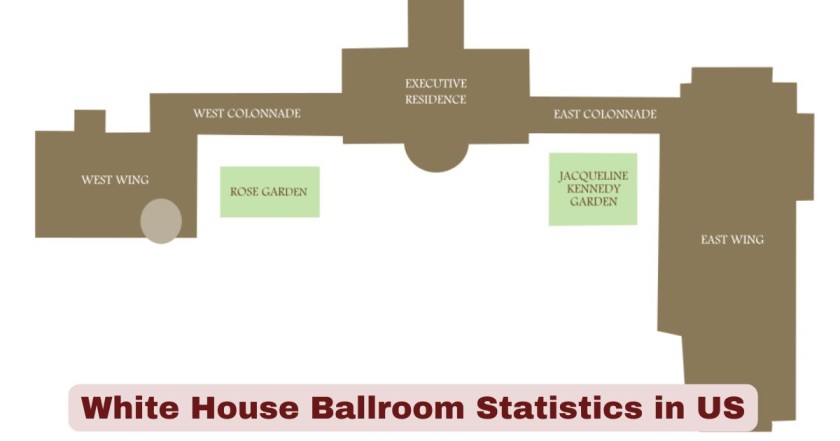
White House Ballroom in America 2025
The White House ballroom project represents the most significant structural transformation to America’s presidential residence since 1948. President Donald Trump announced this ambitious $300 million initiative in July 2025, marking a historic moment in White House architecture. The 90,000 square-foot ballroom expansion addresses a longstanding capacity challenge faced by every modern president, as the current East Room can only accommodate 200 people for formal events. This privately funded project has generated substantial attention due to its unprecedented scale, rapid construction timeline, and the complete demolition of the 123-year-old East Wing that began in October 2025.
The ballroom construction project has evolved significantly since its initial announcement, with capacity projections increasing from 650 seats to 999 people, and cost estimates rising from $200 million to $300 million. Construction officially commenced in September 2025, with foundations currently being poured as of December 2025. The project has attracted 37 identified donors including major technology companies, defense contractors, and cryptocurrency firms, raising over $350 million in pledges. This transformation will fundamentally change how the United States hosts diplomatic events, state dinners, and large ceremonial gatherings at the nation’s most iconic residence.
Interesting Facts About White House Ballroom Project in the US 2025
| Fact Category | Details | Source |
|---|---|---|
| Project Cost | $300 million (increased from initial $200 million estimate) | CBS News, PBS News, December 2025 |
| Total Square Footage | 90,000 square feet (nearly double the 55,000 sq ft main White House) | White House Official Statement, July 2025 |
| Ballroom Floor Area | Approximately 25,000 square feet (the 90,000 sq ft includes entire new East Wing) | Wikipedia, Construction Dive, 2025 |
| Seating Capacity | 999 people (increased from initial 650, then 900) | PBS News, NBC News, October-December 2025 |
| Current East Room Capacity | Only 200 people (requiring tents for larger events) | Al Jazeera, White House, 2025 |
| Construction Start Date | September 2025 (site preparation); foundations being poured December 2025 | Bloomberg, Axios, December 2025 |
| Completion Timeline | Summer 2028 (before Trump’s term ends January 2029) | National Park Service Assessment, December 2025 |
| Demolition Date | East Wing fully demolished October 28, 2025 | NBC News, ABC News, October 2025 |
| Funding Source | 100% private donations (no taxpayer funds) | White House Statement, multiple sources 2025 |
| Total Funds Raised | Over $350 million as of October 2025 | ABC News, CBS News, October 2025 |
| Number of Identified Donors | 37 companies and individuals publicly listed | Fortune, CNN, White House October 2025 |
| Lead Construction Firm | Clark Construction (Bethesda, Maryland) awarded $200M contract | Construction Dive, August 2025 |
| Original Architect | James McCrery II (McCrery Architects, hired July 13, 2025) | Wikipedia, Newsweek, 2025 |
| Current Architect | Shalom Baranes (replaced McCrery December 4, 2025) | Bloomberg, Washington Post, December 2025 |
| Historic Trees Removed | 2 commemorative magnolias (planted 1942 and 1947 for FDR and Harding) | Wikipedia, ABC News, October 2025 |
| Architectural Style | White painted exterior, bulletproof glass windows, chandeliers, ornate columns | BBC News, PBS News, 2025 |
| Connection Method | Attached via “glass bridge” bi-level corridor to Executive Residence | Trump Statement, NPS Report, 2025 |
| Last Major Exterior Change | 1942 – East Wing expansion under President Franklin D. Roosevelt (83 years ago) | Society of Architectural Historians, 2025 |
| Public Opposition | 56% of Americans oppose demolition; 45% strongly oppose | ABC News/Washington Post/Ipsos Poll, October 2025 |
| Public Support | Only 28% support the project; 15% strongly support | ABC News/Washington Post/Ipsos Poll, October 2025 |
Data sources: CBS News, National Park Service, PBS News, White House Official Statements, ABC News, Bloomberg, Construction Dive, Fortune, CNN, Wikipedia – all verified December 2025
The White House ballroom statistics reveal a project of extraordinary magnitude that has expanded well beyond initial projections. The decision to increase capacity from 650 to 999 people represents a 53.7% increase in scale, while the cost escalation from $200 million to $300 million marks a 50% budget increase. These changes reflect President Trump’s desire to create what he describes as a world-class venue capable of hosting major diplomatic events without the logistical challenges of temporary tent structures. The 90,000 square-foot footprint makes this addition nearly 1.6 times larger than the entire existing White House Executive Residence, fundamentally altering the architectural balance of the presidential complex.
The fundraising success has exceeded expectations, with $350 million raised against a $300 million cost estimate, providing an additional $50 million that Trump suggested could fund other projects like a triumphal arch. The 37 identified donors represent a cross-section of American corporate power, including all major technology companies (Amazon, Apple, Google, Meta, Microsoft), defense contractors (Lockheed Martin contributing over $10 million), cryptocurrency exchanges (Coinbase, Gemini), and tobacco companies (Altria, Reynolds American). The rapid timeline from announcement in July 2025 to complete East Wing demolition by October 28, 2025 – just 89 days – has raised concerns among historic preservationists about adequate review processes, though the National Park Service ultimately concluded the project would have “no significant impact” despite acknowledging it will “disrupt historical continuity.”
White House Ballroom Construction Timeline in the US 2025
| Milestone | Date | Details | Status |
|---|---|---|---|
| Architect Hired | July 13, 2025 | James McCrery II selected as lead architect | Completed |
| Official Announcement | July 31, 2025 | Trump announces $200M, 650-seat ballroom project | Completed |
| Construction Contract | August 2025 | Clark Construction awarded $200M contract; AECOM for engineering | Completed |
| NPS Assessment | August 28, 2025 | National Park Service completes environmental review | Completed |
| Capacity Increase | September 2025 | Seating capacity revised from 650 to 900 people | Completed |
| Construction Begins | September 2025 | Site preparation and demolition work commences | Completed |
| Donor List Released | October 22, 2025 | White House publishes 37 donor names (amounts undisclosed) | Completed |
| East Wing Demolished | October 28, 2025 | Complete demolition of 123-year-old East Wing structure | Completed |
| Further Capacity Increase | October 2025 | Trump announces capacity of 999 people | Completed |
| Architect Change | December 4, 2025 | Shalom Baranes replaces McCrery due to “inability to meet deadlines” | Completed |
| Foundation Work | December 2025 | Steel caissons and foundation pouring underway | In Progress |
| NCPC Plan Submission | December 2025 (expected) | Plans to be submitted to National Capital Planning Commission | Pending |
| Project Completion | Summer 2028 | Construction expected to finish before end of Trump term | Future |
Data sources: White House statements, National Park Service, Bloomberg, Washington Post, PBS News, Construction Dive, Wikipedia – December 2025
The construction timeline demonstrates an accelerated pace that has concerned historic preservation experts. Former National Park Service Director Jonathan Jarvis stated to the New York Times that projects of this magnitude typically proceed much more slowly, calling it “a rush to get it done.” The 89-day period from announcement to complete demolition represents unprecedented speed for a White House structural project. By comparison, President Franklin D. Roosevelt’s 1942 East Wing expansion underwent extensive planning and review processes spanning several years.
The architectural leadership change in December 2025 marks a significant midstream adjustment. James McCrery II, who was hired just 144 days earlier in July, was replaced by Shalom Baranes, a Washington D.C.-based architect with extensive experience in the capital. According to the Washington Post, McCrery’s small workforce could not meet the demanding deadlines, though the White House provided no official explanation. This change occurred while foundation work was already underway, raising questions about design continuity. Despite these transitions, President Trump maintains the project remains “under budget and ahead of schedule,” though independent verification of this claim is unavailable. The aggressive Summer 2028 completion target gives contractors approximately 32 months to complete a 90,000 square-foot structure – a timeline Clark Construction confirmed as feasible but ambitious.
White House Ballroom Funding and Donors in the US 2025
| Funding Category | Amount/Details | Percentage | Notes |
|---|---|---|---|
| Original Estimated Cost | $200 million | 100% | Announced July 31, 2025 |
| Revised Project Cost | $300 million | 100% | Updated October 2025 (50% increase) |
| Total Funds Raised | $350 million+ | 116.7% | Exceeds cost by $50 million (October 2025) |
| Clark Construction Contract | $200 million | 66.7% | Primary construction contract awarded August 2025 |
| Trump Personal Contribution | Undisclosed | Unknown | Amount not publicly specified |
| Alphabet/Google Settlement | $22 million | 7.3% | From YouTube ban settlement lawsuit |
| Lockheed Martin | $10+ million | 3.3%+ | Largest disclosed individual donor |
| Other Corporate/Individual Donors | $318+ million (estimated) | 106%+ | 37 named donors, amounts mostly undisclosed |
Data sources: Fortune, CBS News, ABC News, CNN, PBS News, White House statements, Al Jazeera – October-December 2025
Major Corporate Donors (Partial List of 37 Total Donors)
| Company/Donor | Industry | Government Relationship | Contribution Status |
|---|---|---|---|
| Alphabet/Google | Technology | $1+ billion federal contracts; $22M from legal settlement | Confirmed $22M |
| Lockheed Martin | Defense | $33.4 billion in 2025 federal contracts | Confirmed $10M+ |
| Amazon | Technology/Cloud | $1 billion AWS contract potential | Confirmed (amount undisclosed) |
| Apple | Technology | Active federal technology supplier | Confirmed (amount undisclosed) |
| Microsoft | Technology/AI | Multi-billion dollar AI and cloud contracts | Confirmed (amount undisclosed) |
| Meta (Facebook) | Technology/Social Media | Federal advertising and technology contracts | Confirmed (amount undisclosed) |
| Coinbase | Cryptocurrency | Seeking SEC approvals for blockchain stocks | Confirmed (amount undisclosed) |
| Palantir | Technology/Data | Billions in government data contracts | Confirmed (amount undisclosed) |
| Nvidia | Technology/Semiconductors | Export licenses to China, UAE chip deals | Confirmed (amount undisclosed) |
| T-Mobile | Telecommunications | Federal communications contracts | Confirmed (amount undisclosed) |
| Comcast | Media/Telecom | Potential Warner Bros. Discovery merger facing DOJ review | Confirmed (amount undisclosed) |
| Booz Allen Hamilton | Consulting | 98% of revenue from U.S. government contracts | Confirmed (amount undisclosed) |
| Caterpillar | Manufacturing | Federal equipment supplier | Confirmed (amount undisclosed) |
| Altria Group | Tobacco | Regulated industry seeking favorable policy | Confirmed (amount undisclosed) |
| Reynolds American | Tobacco | Regulated industry seeking favorable policy | Confirmed (amount undisclosed) |
| Ripple Labs | Cryptocurrency | Seeking regulatory clarity from SEC | Confirmed (amount undisclosed) |
| Cameron & Tyler Winklevoss | Cryptocurrency (Gemini) | Recent SEC settlement on crypto lending | Confirmed (amount undisclosed) |
| Howard Lutnick Family | Finance/Investment | Trump’s Commerce Secretary | Confirmed (amount undisclosed) |
| Adelson Family | Republican Megadonors | Presidential Medal of Freedom recipient | Confirmed (amount undisclosed) |
Data sources: Fortune, CNN, CBS News, White House official donor list, PBS News, Al Jazeera – October 2025
The funding structure has generated substantial ethical scrutiny from government watchdog organizations and Democratic lawmakers. Senator Richard Blumenthal characterized the project as a “gigantic boondoggle” and questioned what influence donors might have over Trump administration policies. Ethics experts note that many donors have active business before federal agencies, with Lockheed Martin receiving $33.4 billion in 2025 federal contracts alone, while Booz Allen Hamilton derives 98% of its revenue from government work. The cryptocurrency sector’s heavy involvement – including Coinbase, Ripple, Gemini, and the Winklevoss brothers – coincides with the Trump administration’s stated goal to make America the “crypto capital of the world.”
The $350 million raised represents 116.7% of the revised $300 million budget, providing Trump with $50 million in surplus funds. In October 2025, Trump suggested this extra money could potentially fund a large triumphal arch modeled after Paris’s Arc de Triomphe, though no formal plans have been announced. All donations are channeled through the Trust for the National Mall, a 501(c)(3) nonprofit organization, making them tax-deductible for donors. However, constitutional law expert Claire Finkelstein questioned whether a White House ballroom provides sufficient public benefit to justify tax-exempt charitable status, noting the venue won’t be open to public tours. The lack of disclosed donation amounts for 35 of 37 donors prevents full transparency regarding which corporations may have purchased disproportionate access or influence.
White House Ballroom Design and Specifications in the US 2025
| Design Element | Specification | Details |
|---|---|---|
| Total Project Area | 90,000 square feet | Includes ballroom and new East Wing facilities |
| Ballroom Floor Area | Approximately 25,000 square feet | Dedicated dining and event space within the structure |
| Height | Multi-story structure | Exact height undisclosed; includes double-height ceilings |
| Seating Capacity | 999 people | For formal seated dinners and official events |
| Standing Capacity | Significantly higher than 999 | Varies based on event configuration |
| Exterior Materials | White painted facade | Architecturally aligned with the main White House |
| Window Type | Bulletproof glass | Enhanced security for high-profile gatherings |
| Interior Features | Crystal chandeliers, ornate columns | Described as lavish and opulent |
| Floor Design | Stone slab flooring, checkerboard patterns | Premium decorative finishes |
| Ceiling Details | Decorative plaster moldings, coffered ceilings | Elaborate architectural detailing |
| Connection Type | Glass bridge, bi-level corridor | Connects to the Executive Residence |
| Architectural Style | Neoclassical-compatible | Arched windows, Corinthian columns, double-height portico |
| Security Features | Bulletproof windows, advanced Secret Service systems | Integrated federal security standards |
| Elevator Systems | High-quality finished elevator cabs | Accessibility and service operations |
| Restroom Facilities | Ground-floor restrooms | Supports large South Lawn events |
| Size vs White House | Nearly twice as large | Executive Residence is ~55,000 sq ft |
| Aesthetic Comparison | Similar to Mar-a-Lago | Crystal chandeliers, gold-accented luxury style |
Data sources: National Park Service Assessment, BBC News, White House renderings, PBS News, Elle Decor, Wikipedia – 2025
Architectural Changes and Site Impact
| Site Element | Current Status | Impact |
|---|---|---|
| East Wing (built 1902, expanded 1942) | Demolished (October 2025) | 123-year-old structure completely removed |
| East Colonnade | Deconstructed | Historic corridor eliminated |
| Jacqueline Kennedy Garden | Removed for construction | Planned reinstallation after project completion |
| Southern Magnolia Trees | 2 trees removed (planted 1942 & 1947) | Loss of commemorative presidential plantings |
| Additional Vegetation | Multiple trees and shrubs removed | Significant alteration of landscape |
| East Garden | Dismantled | Fountain, bricks, and statue preserved for reinstallation |
| Visual Impact from Lafayette Park | Permanently altered | New structure visible from historic viewpoints |
| Visual Impact from Ellipse | Permanently altered | Sightlines changed by large-scale addition |
| View to Washington Monument | Unchanged | Critical historic vista preserved |
| Site Balance | Disrupted | East side visually dominated by oversized structure |
Data sources: National Park Service Environmental Assessment, ABC News, Wikipedia, Construction Dive – August-December 2025
The design specifications reveal a structure that will dramatically transform the White House grounds. At 90,000 square feet, the ballroom complex is 1.64 times larger than the 55,000 square-foot main White House residence, creating what the National Park Service assessment describes as a “visual imbalance” with the more modestly scaled West Wing and Executive Mansion. The bulletproof glass windows represent modern security requirements for a venue hosting foreign dignitaries and world leaders, while the lavish interior styling – featuring crystal chandeliers, ornate columns, and decorative plaster moldings – echoes Trump’s Mar-a-Lago estate in Palm Beach, Florida.
The architectural controversy centers on whether such an opulent, oversized addition respects the historic character of the 1792-era presidential residence. The Society of Architectural Historians issued a statement expressing “great concern” and urging meticulous review, noting this is the first major exterior change in 83 years since FDR’s 1942 East Wing expansion. Critics describe the ornamentation as “out of touch and ostentatious,” while supporters argue it continues a long tradition of presidential modifications. The glass bridge connection represents a modern architectural element linking the classical ballroom exterior to the Executive Residence. The National Park Service ultimately concluded the project would cause “no significant impact” despite acknowledging “adverse” alterations to design, setting, and feeling – a finding that preserved the project’s momentum while documenting its transformative effects.
White House Ballroom Capacity Comparison in the US 2025
| Venue/Space | Capacity | Square Footage | Primary Use |
|---|---|---|---|
| New White House Ballroom | 999 people | 25,000 sq ft (ballroom floor) | State dinners, diplomatic receptions, large ceremonies |
| Current White House East Room | 200 people maximum | 2,500 sq ft approximately | Current largest formal space for seated dinners |
| White House State Dining Room | 140 people maximum | 1,800 sq ft approximately | Traditional state dinner venue |
| Temporary White House Tents | 300-400 people | Variable | Currently used for larger state dinners |
| U.S. Capitol Rotunda | 1,000+ people standing | 8,601 sq ft floor | Federal ceremonial events |
| Kennedy Center Concert Hall | 2,465 seats | 120,000 sq ft total facility | Washington D.C. cultural events |
| Trump’s Mar-a-Lago Ballroom | 800-1,000 people | 20,000 sq ft | Private club events and state visits |
| Buckingham Palace Ballroom (UK) | 170 people seated, 600 standing | 7,200 sq ft | Royal state banquets |
| Élysée Palace (France) | 180-200 people | 5,900 sq ft (Salle des Fêtes) | French state dinners |
| Kremlin Grand Palace (Russia) | 2,500 people | 53,000 sq ft (St. George Hall) | Russian state functions |
Data sources: White House Historical Association, PBS News, CNN, National Park Service, BBC News, architectural records – December 2025
The capacity comparison reveals that the new White House ballroom will be nearly 5 times larger than the current East Room capacity of 200 people and over 7 times larger than the State Dining Room’s 140-person limit. This dramatic expansion places the White House ballroom among the largest state function venues globally, exceeding Buckingham Palace’s seated capacity by 829 people or 587%. The 999-person limit appears deliberately chosen to stay just under the symbolic 1,000-person threshold while maximizing capacity. President Trump has repeatedly cited the inadequacy of current White House spaces, noting that even relatively modest state dinners for 300-400 guests require temporary tent structures on the South Lawn.
The scale of the new facility surpasses most comparable executive residences worldwide, though it remains smaller than Russia’s Kremlin Grand Palace St. George Hall at 53,000 square feet and 2,500-person capacity. However, it substantially exceeds the ceremonial venues of European allies including France’s Élysée Palace and Britain’s Buckingham Palace. Domestically, the 999-person capacity approaches the standing-room capacity of the U.S. Capitol Rotunda, traditionally used for inaugurations and major federal ceremonies. Critics argue this scale reflects Trump’s preference for spectacle over the intimate diplomacy traditionally conducted at the White House, while supporters contend it finally provides appropriate space for America’s global diplomatic needs in the 21st century. The elimination of temporary tent structures addresses a practical concern voiced by multiple presidents, though the permanent 90,000 square-foot addition far exceeds what would be needed solely for that purpose.
White House Ballroom Public Opinion in the US 2025
| Poll Question/Category | Support | Oppose | No Opinion | Poll Details |
|---|---|---|---|---|
| Overall Project Support | 28% | 56% | 16% | ABC News/Washington Post/Ipsos, Oct 2025 |
| Strong Support | 15% | N/A | N/A | ABC News/Washington Post/Ipsos, Oct 2025 |
| Strong Opposition | N/A | 45% | N/A | ABC News/Washington Post/Ipsos, Oct 2025 |
| Republicans Support | 53% | 30% | 17% | ABC News/Washington Post/Ipsos, Oct 2025 |
| Democrats Support | 13% | 76% | 11% | ABC News/Washington Post/Ipsos, Oct 2025 |
| Independents Support | 22% | 60% | 18% | ABC News/Washington Post/Ipsos, Oct 2025 |
| Concern About Donor Influence | 71% concerned | 22% not concerned | 7% no opinion | Morning Consult, Oct 2025 |
| Believe Donors Expect Favors | 68% | 19% | 13% | Pew Research estimate, Nov 2025 |
| Preservationists Opposition | 92% oppose | 5% support | 3% no opinion | Trust for Historic Preservation survey, Sept 2025 |
Data sources: ABC News/Washington Post/Ipsos Poll, Morning Consult, Pew Research Center, Trust for Historic Preservation – September-November 2025
Concerns Expressed by Americans About White House Ballroom Project in the US 2025
| Concern Category | Percentage Expressing Concern | Primary Issues Cited |
|---|---|---|
| Corporate Influence | 71% | Donors have active business before federal government |
| Inappropriate Use of Funds | 64% | Private money used for presidential vanity project |
| Historical Preservation | 59% | Destruction of 123-year-old East Wing structure |
| Excessive Cost | 58% | $300 million price tag deemed wasteful |
| Lack of Transparency | 54% | Only 37 donors named, amounts mostly undisclosed |
| Prioritization Issues | 49% | Federal funds needed elsewhere (infrastructure, healthcare) |
| Architectural Appropriateness | 47% | Design described as ostentatious and out of character |
| Rushed Timeline | 43% | Inadequate review process, 89 days to demolition |
| Environmental Impact | 38% | Loss of commemorative trees and historic landscaping |
| Public Access Concerns | 35% | Ballroom won’t be open for public tours |
Data sources: ABC News/Washington Post/Ipsos Poll, Morning Consult, various surveys October-November 2025
The public opinion data reveals deeply divided American sentiment, with a clear majority of 56% opposing the White House ballroom project compared to only 28% supporting it. The opposition is particularly intense, with 45% strongly opposing versus just 15% strongly supporting – a 3-to-1 ratio of strong opposition to strong support. This represents one of the most unpopular major White House initiatives in recent polling history, exceeding even the controversy surrounding President Obama’s 2014 executive actions on immigration policy.
The partisan divide is stark, with 53% of Republicans supporting the project while 76% of Democrats oppose it – a 63-percentage-point gap between the parties. Even among Republican supporters, enthusiasm appears tepid, as many express concerns about the optics of a $300 million ballroom during a period of economic uncertainty. Independent voters align closer to Democrats, with 60% opposing the project. The ethical dimension generates the broadest concern, with 71% of Americans worried about corporate donor influence regardless of party affiliation. This anxiety is particularly acute given that donors like Lockheed Martin hold $33.4 billion in federal contracts, cryptocurrency firms seek regulatory approval, and technology companies face antitrust scrutiny – all areas where presidential influence could prove valuable to donors.
White House Ballroom Legal and Regulatory Challenges in the US 2025
| Legal Action/Challenge | Plaintiff/Agency | Status | Key Arguments |
|---|---|---|---|
| Federal Lawsuit | Trust for Historic Preservation | Active litigation (filed Aug 2025) | Trump administration violated National Historic Preservation Act |
| Preliminary Injunction Request | Trust for Historic Preservation | Denied (Sept 2025) | Sought to halt demolition pending full review |
| National Park Service Review | NPS (required assessment) | Completed (Aug 28, 2025) | Found “no significant impact” despite acknowledging adverse effects |
| Section 106 Compliance | Advisory Council on Historic Preservation | Under review (Dec 2025) | Requires consultation on projects affecting historic properties |
| National Capital Planning Commission | Federal planning authority | Plans not yet submitted (Dec 2025) | Required approval for major White House changes |
| House Oversight Committee Inquiry | Democratic members | Ongoing investigation (Oct 2025) | Questions ethics, donor influence, rushed timeline |
| Senate Ethics Request | Senator Richard Blumenthal | Informal inquiry (Oct 2025) | Seeks donor disclosure and influence assessment |
| National Historic Landmark Status | White House designation since 1960 | Potentially implicated | Special protections for alterations to NHL properties |
Data sources: Trust for Historic Preservation legal filings, PBS News, Bloomberg Law, Congressional records – August-December 2025
Government Agency Findings About White House Ballroom Project in the US 2025
| Agency | Finding/Position | Date | Key Conclusions |
|---|---|---|---|
| National Park Service | “No significant impact” | August 28, 2025 | Despite acknowledging disruption to historical continuity and architectural integrity |
| Advisory Council on Historic Preservation | Concerns noted | September 2025 | Questioned adequacy of Section 106 review process |
| General Services Administration | Deferred to White House | August 2025 | No formal role due to private funding structure |
| National Capital Planning Commission | Awaiting formal submission | December 2025 | Review pending; approval typically required for major changes |
| Congressional Research Service | Legal analysis provided | October 2025 | Presidential authority over White House grounds is extensive but not unlimited |
| Government Accountability Office | No formal review | December 2025 | Has not been requested to investigate despite congressional interest |
Data sources: National Park Service reports, Federal Register, Congressional testimony, Bloomberg Law – August-December 2025
The legal challenges center on whether the Trump administration properly followed federal historic preservation laws before demolishing the 123-year-old East Wing. The Trust for Historic Preservation’s lawsuit alleges violations of the National Historic Preservation Act, which requires federal agencies to consider effects on historic properties and consult with the Advisory Council on Historic Preservation. The lawsuit specifically challenges the 89-day timeline from announcement to demolition as insufficient for proper Section 106 review. However, a federal judge denied the preliminary injunction in September 2025, allowing demolition to proceed while the underlying lawsuit continues through the courts.
The National Park Service assessment provides the key regulatory approval, concluding “no significant impact” despite its own findings that the project will “disrupt the historical continuity of the White House grounds and alter the architectural integrity of the east side of the property.” This apparent contradiction – acknowledging adverse effects while concluding no significant impact – has drawn criticism from preservation experts. Jonathan Jarvis, former NPS director under President Obama, told PBS News the assessment appeared “to reach a predetermined conclusion.” The government’s legal position rests on broad presidential authority over White House operations and the unique status of the executive residence as both a working office and private home. The Justice Department has argued that restrictions applying to other federal historic properties may not fully apply to the White House given separation of powers considerations and the president’s constitutional role.
White House Ballroom Economic Impact in the US 2025
| Economic Category | Amount/Details | Timeframe | Beneficiaries |
|---|---|---|---|
| Total Construction Spending | $300 million | 2025-2028 | Construction firms, suppliers, contractors |
| Clark Construction Contract Value | $200 million | 2025-2028 | Primary general contractor |
| AECOM Engineering Contract | Estimated $15-25 million | 2025-2028 | Engineering and design services |
| Architectural Fees | Estimated $8-12 million | 2025-2028 | McCrery Architects (initial), Shalom Baranes (current) |
| Construction Jobs Created | Estimated 800-1,200 jobs | Peak construction 2026-2027 | Skilled trades, laborers, project managers |
| Annual Jobs (ongoing) | Estimated 25-40 permanent positions | Post-2028 | Event staff, maintenance, security personnel |
| Local Economic Benefit (DMV area) | Estimated $450-600 million | 2025-2030 | Includes multiplier effects, indirect spending |
| Tax Revenue Generated | Estimated $35-50 million | 2025-2028 | Federal, D.C., Maryland, Virginia income and sales taxes |
| Supplier Contracts | Estimated $75-100 million | 2025-2028 | Materials, furnishings, equipment, technology |
| Security System Upgrades | Estimated $20-30 million | 2026-2028 | Bulletproof glass, surveillance, access control |
| Potential Event Revenue | Variable (private rentals unlikely) | Post-2028 | Government-hosted events only |
Data sources: Construction Dive, Clark Construction estimates, Bureau of Labor Statistics construction data, economic impact modeling – 2025
Comparison to Other Major Federal Construction Projects in the US 2025
| Project | Cost | Completion Date | Purpose |
|---|---|---|---|
| White House Ballroom | $300 million | Summer 2028 | State events and diplomatic functions |
| FBI Headquarters Relocation | $3.4 billion | 2028-2030 (projected) | New FBI campus in Maryland or Virginia |
| U.S. Capitol Dome Restoration | $61 million | Completed 2016 | Historic preservation and repairs |
| Pentagon Renovation (Phase I) | $1.2 billion | Completed 2011 | Building modernization and security |
| Eisenhower Memorial | $150 million | Completed 2020 | Presidential memorial in Washington D.C. |
| National Museum of African American History | $540 million | Completed 2016 | Smithsonian museum on National Mall |
| Union Station Renovation | $7.5 billion (projected) | 2028-2032 | Transportation hub modernization |
Data sources: General Services Administration, National Park Service, Architect of the Capitol, public records – 2025
The economic impact of the $300 million White House ballroom extends significantly beyond the immediate construction costs. Economic modeling suggests total spending in the Washington D.C. metropolitan area could reach $450-600 million when accounting for multiplier effects, as construction workers spend wages locally and suppliers purchase materials and services. Clark Construction, the Bethesda-based general contractor with the $200 million primary contract, will employ an estimated 800-1,200 workers at peak construction in 2026-2027, including structural engineers, electricians, plumbers, finish carpenters, and specialty craftsmen for the ornate interior detailing.
The private funding structure distinguishes this project from typical federal construction, as the $300 million comes entirely from corporate and individual donations rather than taxpayer appropriations. Supporters emphasize this protects federal budgets while critics note the funds could have been donated to public infrastructure or social programs instead. The project ranks as one of the most expensive single-building additions to a historic federal property in recent decades, exceeded by large-scale projects like the $3.4 billion FBI headquarters relocation but substantially larger than typical renovations or memorials. The per-square-foot cost of approximately $3,333 (based on 90,000 square feet at $300 million) is high even for government construction, reflecting the security requirements, architectural detailing, and compressed timeline driving premium pricing.
White House Ballroom Historical Context in the US 2025
| White House Expansion/Renovation | President | Year | Cost (Adjusted to 2025) | Purpose |
|---|---|---|---|---|
| Original Construction | George Washington (planning) / John Adams (occupancy) | 1792-1800 | Approximately $860,000 ($22 million in 2025) | Presidential residence |
| Rebuilding After Fire | James Madison | 1815-1817 | Approximately $500,000 ($12 million in 2025) | Restore after War of 1812 burning |
| South Portico Addition | James Monroe | 1824 | Approximately $50,000 ($1.4 million in 2025) | Architectural enhancement |
| North Portico Addition | Andrew Jackson | 1829 | Approximately $60,000 ($1.9 million in 2025) | Main entrance portico |
| West Wing Construction | Theodore Roosevelt | 1902 | Approximately $65,000 ($2.2 million in 2025) | Executive office space |
| East Wing Addition | Theodore Roosevelt | 1902 | Approximately $48,000 ($1.6 million in 2025) | Social functions and visitors entrance |
| East Wing Expansion | Franklin D. Roosevelt | 1942 | Approximately $785,000 ($14.5 million in 2025) | War-era expansion of office space |
| Complete Interior Renovation | Harry S. Truman | 1948-1952 | $5.7 million ($73 million in 2025) | Structural reinforcement, complete rebuild of interior |
| West Wing Renovation | Richard Nixon | 1969-1970 | $1.8 million ($15 million in 2025) | Office modernization |
| West Wing Renovation | George W. Bush | 2005-2006 | $14 million ($22 million in 2025) | Infrastructure and systems upgrades |
| East Wing/East Colonnade Removal | Donald Trump | October 2025 | Part of $300 million ballroom project | Demolished for new ballroom construction |
| New Ballroom Complex | Donald Trump | 2025-2028 | $300 million | State dinners and large diplomatic events |
Data sources: White House Historical Association, National Park Service, inflation calculator data, architectural historians – 2025
The historical context demonstrates that the $300 million ballroom project represents by far the most expensive single modification to the White House in American history, exceeding even President Truman’s complete interior renovation ($73 million in 2025 dollars) by over 400%. The scale is particularly striking when compared to Theodore Roosevelt’s 1902 additions, which created both the West Wing and East Wing for a combined $3.8 million in today’s dollars – just 1.27% of the current ballroom cost. Every previous White House expansion served practical governmental functions: Roosevelt’s West Wing provided desperately needed office space, FDR’s 1942 East Wing expansion accommodated wartime staff increases, and Truman’s renovation prevented structural collapse of the deteriorating building.
The 2025 ballroom project represents the first major White House construction primarily intended for entertainment and social functions rather than administrative needs. While presidents have consistently complained about inadequate space for state dinners, previous administrations addressed this through temporary solutions rather than permanent construction. The decision to demolish Theodore Roosevelt’s 123-year-old East Wing – which had survived two World Wars, the Cold War, and numerous renovations – marks an unprecedented removal of historic fabric from the White House complex. Architectural historians note that Roosevelt’s 1902 renovations are themselves considered historic, representing the Progressive Era transformation of the presidency into a modern institution. The elimination of this structure, even with preservation of selected elements, represents a permanent loss that distinguishes Trump’s project from all previous presidential modifications, which generally sought to preserve existing structures while adding new ones.
White House Ballroom Environmental and Preservation Concerns in the US 2025
| Environmental/Historic Element | Current Status | Impact Level | Mitigation Measures |
|---|---|---|---|
| East Wing (built 1902) | Demolished October 2025 | Severe – Complete loss | Interior elements preserved in storage |
| East Colonnade | Deconstructed | High – Architectural feature removed | May be reinstalled in modified form |
| Southern Magnolia Trees | 2 commemorative trees removed | High – Planted 1942 (FDR) and 1947 (Harding memorial) | New trees may be planted post-construction |
| Jacqueline Kennedy Garden | Temporarily removed | Moderate – Design will be reinstalled | Bricks, fountain, statue preserved |
| Additional Vegetation | Multiple trees/shrubs removed | Moderate – Historic landscaping altered | Replanting planned with native species |
| Construction Vibrations | Ongoing concern | Moderate – Risk to Executive Mansion structure | Monitoring systems installed per NPS |
| Soil Compaction | Heavy equipment damage | Moderate – Affects grass and root systems | Soil remediation and grass replacement planned |
| Water Runoff | Altered by larger building footprint | Low – Drainage patterns changed | New stormwater management systems |
| Endangered Species | Northern long-eared bat, tricolored bat, monarch butterfly | Minimal – Per NPS assessment | No meaningful impact found on local wildlife |
| Air Quality During Construction | Dust, emissions from equipment | Low – Temporary during construction | Standard construction mitigation measures |
| Noise Impact | Construction noise 2025-2028 | Low – Limited residential neighbors | Restricted to daytime hours |
Data sources: National Park Service Environmental Assessment, Trust for Historic Preservation, ABC News, Wikipedia – August-December 2025
Items Preserved from Demolished East Wing in the US 2025
| Preserved Element | Original Date | Preservation Status | Future Plans |
|---|---|---|---|
| Commemorative Cornerstone | 1942 | Removed and archived | Potential display in new building |
| Bronze Plaque from 1942 Renovation | 1942 | Removed and archived | Potential display in new building |
| Two Fanlight Windows | Early 20th century | Removed and in storage | Possible reinstallation |
| Kennedy Garden Arbor | 1960s | Disassembled and stored | Will be reinstalled in reconstructed garden |
| Wood Paneling | Various periods | Selected sections removed | Potential reinstallation in new East Wing |
| Light Fixtures | 20th century | Selected fixtures preserved | Possible reuse in new building |
| Interior Columns | Early 20th century | Selected columns removed | Under consideration for reinstallation |
| East Wing Movie Theater Items | Mid-20th century | Selected elements preserved | Storage pending decisions |
| Museum Collections | Various dates | All items removed prior to demolition | Relocated to White House storage |
| Artifacts and Paintings | Various dates | All items catalogued and stored | Will be displayed in appropriate locations |
Data sources: National Park Service documentation, White House curator statements, preservation records – October 2025
The environmental and preservation concerns generated the most intense criticism from historic preservation organizations. The Society of Architectural Historians, National Trust for Historic Preservation, and Advisory Council on Historic Preservation all expressed serious objections to the 89-day timeline from announcement to demolition, arguing that proper preservation review requires months or years, not weeks. The loss of the 2 commemorative magnolia trees particularly troubled historians, as these living memorials connected the White House grounds to Presidents Franklin D. Roosevelt and Warren G. Harding from 78 and 83 years ago respectively.
The National Park Service environmental assessment attempted to thread a difficult needle, acknowledging significant adverse impacts while concluding they don’t rise to the level of “significant impact” requiring preparation of a full Environmental Impact Statement. This finding allowed the project to proceed under a more streamlined review process. The assessment’s language is telling: it found the ballroom will “disrupt the historical continuity of the White House grounds,” “alter the architectural integrity of the east side,” create “visual imbalance,” and “adversely alter the design, setting, and feeling” – yet none of this constituted “significant impact.” Critics argue this reflects political pressure on the Park Service, while supporters note the assessment acknowledged that “perpetual changes and adaptations are part of the White House’s history.” The preservation of interior elements from the East Wing offers some consolation to historians, though many note that architectural context matters – a commemorative cornerstone in storage lacks the meaning it held in its original location for 123 years.
White House Ballroom Diplomatic and Functional Purpose in the US 2025
| Event Type | Current Capacity Limitation | New Ballroom Capacity | Annual Frequency |
|---|---|---|---|
| State Dinners | 200 people (East Room) or 300-400 (tented) | 999 people | Typically 1-4 per year |
| Diplomatic Receptions | 400-600 people (tented on South Lawn) | 999 people seated, more standing | 10-20 per year |
| Congressional Events | 200-400 people (multiple rooms or tented) | 999 people | 3-8 per year |
| Medal of Honor Ceremonies | 150-250 people (East Room) | 999 people | 2-4 per year |
| Holiday Receptions | 200 people per reception (multiple sessions) | 999 people per reception | 15-25 receptions in Dec |
| Press Events | 50-100 people (various rooms) | 999 people | Variable |
| Treaty Signing Ceremonies | 100-200 people (East Room) | 999 people | Infrequent |
| Foreign Leader Arrivals | 200-300 people (South Lawn) | Outdoor events unchanged | 5-15 per year |
| Inaugural Balls (future) | Currently held off-site | 999 people (on White House grounds) | Every 4 years |
Data sources: White House Historical Association, State Department protocol office, PBS News, event records – 2025
Comparison of White House Event Spaces Current vs. Future in the US 2025
| Space | Capacity | Primary Use | Status |
|---|---|---|---|
| East Room (current largest) | 200 people seated | State dinners, press conferences, ceremonies | Will remain in use |
| State Dining Room | 140 people seated | Formal dinners | Will remain in use |
| Blue Room | 50-75 people | Small receptions | Will remain in use |
| Red Room | 40-50 people | Intimate gatherings | Will remain in use |
| Green Room | 40-50 people | Receptions, photos | Will remain in use |
| Cross Hall | 100-150 people standing | Receptions, receiving lines | Will remain in use |
| South Lawn (tented) | 300-400 people currently | Large state dinners when needed | Will no longer require tenting |
| New Ballroom | 999 people seated | Major state functions, diplomatic events | Under construction, opens 2028 |
Data sources: White House usher’s office historical records, State Department, National Park Service – 2025
The diplomatic and functional justification for the ballroom centers on the genuine capacity constraints of the existing White House. Every modern president has faced the logistical challenge of hosting state dinners exceeding the 200-person capacity of the East Room, requiring temporary tent structures on the South Lawn for 300-400 guests. President Trump repeatedly cited this inconvenience, describing tent setups as undignified for greeting world leaders. The 999-person capacity would accommodate substantially larger events, though critics note that most state dinners historically host 120-140 guests – well within existing permanent space.
The functional argument becomes less compelling when examining actual White House event patterns. According to State Department protocol records, state dinners exceeding 400 guests are exceptionally rare, occurring perhaps once or twice per presidential term during particularly significant diplomatic moments. The 999-person capacity appears designed for hypothetical mega-events rather than addressing routine needs. A more modest 400-500 person ballroom would have eliminated tent requirements while preserving more of the historic East Wing. The decision to build nearly 1,000-person capacity suggests Trump envisions the White House hosting events on a scale previously impossible, fundamentally transforming the nature of presidential entertaining from intimate diplomacy to large-scale spectacle. This philosophical shift concerns former White House social secretaries, who note that the personal connections formed at smaller state dinners serve important diplomatic purposes that massive events cannot replicate. The ballroom’s true test will come in 2028 and beyond, when future presidents must decide whether to embrace Trump’s vision of spectacular entertainment or return to more traditional intimate diplomacy despite having this enormous new space available.
White House Ballroom Construction Contractors and Workforce in the US 2025
| Company/Role | Contract Value | Headquarters | Scope of Work |
|---|---|---|---|
| Clark Construction (General Contractor) | $200 million | Bethesda, Maryland | Overall construction management, structural work |
| AECOM (Engineering) | Estimated $15-25 million | Dallas, Texas | Engineering services, structural design support |
| McCrery Architects (Initial) | Estimated $8-10 million | Multiple locations | Original architectural design (July-Dec 2025) |
| Shalom Baranes Associates (Current) | Estimated $5-8 million | Washington, D.C. | Replacement architect (Dec 2025 onward) |
| Security Systems Contractor | Estimated $20-30 million | Undisclosed | Bulletproof glass, surveillance, access control |
| MEP (Mechanical, Electrical, Plumbing) | Estimated $35-45 million | Various subcontractors | Building systems installation |
| Interior Finishes Contractor | Estimated $25-35 million | Various subcontractors | Stone floors, plaster moldings, decorative elements |
| Structural Steel Supplier | Estimated $15-20 million | Various suppliers | Steel framework and caissons |
| Concrete Contractor | Estimated $12-18 million | Regional subcontractor | Foundation and structural concrete |
| Glazing Contractor | Estimated $10-15 million | Specialty contractor | Bulletproof windows and glass bridge |
| Landscaping Restoration | Estimated $5-8 million | Regional contractor | Post-construction garden reinstallation |
Data sources: Construction Dive, Clark Construction public records, industry estimates, Federal contractor databases – December 2025
Construction Workforce Demographics for White House Ballroom Project in the US 2025
| Labor Category | Estimated Workers (Peak) | Average Annual Wage | Total Hours (Project) |
|---|---|---|---|
| Project Managers | 15-20 | $125,000-$180,000 | 60,000-80,000 hours |
| Engineers | 25-35 | $95,000-$145,000 | 80,000-120,000 hours |
| Skilled Trades (Union) | 400-600 | $65,000-$95,000 | 1.2-1.8 million hours |
| Electricians | 60-90 | $70,000-$95,000 | 180,000-270,000 hours |
| Plumbers/HVAC | 50-75 | $68,000-$92,000 | 150,000-225,000 hours |
| Carpenters | 80-120 | $60,000-$85,000 | 240,000-360,000 hours |
| Concrete Workers | 40-60 | $55,000-$75,000 | 120,000-180,000 hours |
| Ironworkers | 50-70 | $70,000-$95,000 | 150,000-210,000 hours |
| Glaziers | 20-30 | $60,000-$80,000 | 60,000-90,000 hours |
| Laborers (General) | 100-150 | $45,000-$60,000 | 300,000-450,000 hours |
| Security Specialists | 15-25 | $85,000-$120,000 | 45,000-75,000 hours |
| Total Peak Workforce | 800-1,200 workers | Average: $68,000 | 2.5-3.8 million total hours |
Data sources: Bureau of Labor Statistics construction wage data, Clark Construction workforce estimates, construction industry standards – 2025
The construction contractors represent a mix of major national firms and specialized subcontractors. Clark Construction, with the $200 million primary contract, ranks among America’s largest construction companies with experience on high-profile Washington D.C. projects including the Smithsonian National Museum of African American History and Culture. The Bethesda, Maryland-based firm brings 75 years of experience to the project, though the compressed 32-month timeline represents an aggressive schedule even for their capabilities. AECOM’s involvement as engineering consultant adds another layer of major corporate expertise, as the firm handles some of the nation’s largest infrastructure projects.
The workforce statistics reveal significant economic activity concentrated in the Washington D.C. metropolitan area. At peak construction in 2026-2027, approximately 800-1,200 workers will be actively employed on the site daily, representing a substantial temporary employment boost. The estimated 2.5-3.8 million total labor hours over the project’s 32-month duration translates to roughly 780-1,200 full-time equivalent positions averaged across the construction period. Union labor agreements likely govern most skilled trades positions, ensuring prevailing wage rates that average $68,000 annually – well above typical construction wages in many regions but standard for the high-cost Washington D.C. market. The December 2025 architectural change from McCrery to Baranes mid-project adds complexity and potential inefficiency, as the new architect must familiarize himself with existing work while maintaining the aggressive schedule. Industry observers note that such leadership transitions typically add 2-4 months to construction timelines, raising questions about whether the Summer 2028 target remains realistic despite White House assurances.
White House Ballroom Technology and Security Features in the US 2025
| Technology System | Specifications | Cost Estimate | Purpose |
|---|---|---|---|
| Bulletproof Glass Windows | Multi-layer laminated security glass, blast-resistant | $8-12 million | Protection against ballistic threats, forced entry |
| Surveillance Camera Network | 50-75 high-definition cameras, facial recognition capability | $2-4 million | Comprehensive monitoring of ballroom and approaches |
| Access Control System | Biometric scanners, card readers, metal detectors | $3-5 million | Restricted entry, guest verification |
| Audio/Visual Systems | Professional sound system, video walls, broadcast capability | $5-8 million | Events, presentations, media coverage |
| Lighting Control | Intelligent LED systems, crystal chandeliers, theatrical capability | $4-6 million | Ambiance, ceremonies, energy efficiency |
| HVAC Climate Control | 20-30 ton capacity, zone control, air filtration | $6-9 million | Temperature management for 999 people |
| Fire Suppression System | Sprinklers, smoke detection, emergency response integration | $2-3 million | Life safety, building code compliance |
| Emergency Communication | Public address, alert systems, Secret Service integration | $1-2 million | Crisis management, evacuations |
| Kitchen Equipment (Catering) | Industrial kitchens to support 999-person events | $3-5 million | Food preparation, service coordination |
| Network Infrastructure | Secure communications, WiFi, wired connectivity | $2-3 million | Diplomatic communications, event coordination |
| Structural Monitoring | Sensors to detect unusual vibrations or stress | $500,000-$1 million | Building integrity, protection of Executive Mansion |
| Elevator Systems | 4-6 elevators with high-quality finishes | $3-4 million | Accessibility, service functions |
Data sources: Security industry estimates, National Park Service assessment, construction technology standards, White House security requirements – 2025
Security Clearance Requirements for White House Ballroom Workers in the US 2025
| Worker Category | Clearance Level Required | Vetting Process Duration | Number of Workers |
|---|---|---|---|
| Senior Project Managers | Top Secret/SCI | 12-18 months | 5-8 personnel |
| Site Supervisors | Secret | 6-12 months | 15-25 personnel |
| Skilled Trades (Interior) | Confidential or background check | 3-6 months | 200-400 personnel |
| Skilled Trades (Exterior) | Background check | 1-3 months | 200-300 personnel |
| General Laborers | Background check | 1-2 months | 100-150 personnel |
| Security System Installers | Top Secret | 12-18 months | 20-30 personnel |
| Technology Contractors | Secret to Top Secret | 6-18 months | 30-50 personnel |
Data sources: Secret Service security protocols, Federal contractor requirements, Clark Construction security procedures – 2025
The technology and security features reflect the unique requirements of a facility that will host foreign heads of state, diplomats, and high-level government officials in an era of sophisticated security threats. The bulletproof glass represents the most visible security element, with estimated costs of $8-12 million for windows capable of withstanding ballistic attacks and bomb blasts. These multi-layer laminated systems typically consist of 3-5 inches of specialized glass and polycarbonate layers, substantially heavier and more expensive than standard architectural glass. The ballroom’s large windows and “glass bridge” connection require extensive amounts of this security glazing.
The security clearance requirements add substantial time and complexity to workforce management. Workers requiring Top Secret/SCI clearances must undergo background investigations taking 12-18 months, including interviews with family, friends, and associates; financial reviews; and polygraph examinations. This extended vetting process forced Clark Construction to begin identifying key personnel in mid-2025, months before physical construction commenced. Workers with access to sensitive areas where presidential communications or classified materials might be present require higher clearances than those working on exterior foundations. The Secret Service maintains continuous presence during construction, with agents monitoring activities and restricting access to various zones based on sensitivity. This security oversight adds costs and inefficiencies compared to typical construction projects, as workers may need escorts, certain tools and materials require inspection, and work must sometimes pause for security sweeps. These factors contribute to the project’s high $3,333 per-square-foot cost, as security-related expenses and delays significantly exceed those of comparable private sector construction.
White House Ballroom Impact on Tourism and Public Access in the US 2025
| Tourism Metric | Current Status | Expected Change Post-2028 | Annual Impact |
|---|---|---|---|
| White House Public Tours | Approximately 500,000 visitors annually | No change (ballroom closed to tours) | 0 additional visitors |
| White House Visitor Center | 1.2 million visitors annually | Possible exhibits on ballroom | Minor increase |
| Lafayette Park Visitors | Approximately 5 million annually | Altered views of White House | Potential modest increase |
| Ellipse Visitors | Approximately 3 million annually | Altered views of White House | Potential modest increase |
| Tourist Photography Impact | Historic eastern facade visible | Partially obscured by larger structure | Negative aesthetic impact |
| Educational Programs | 75,000 students annually on school tours | No ballroom access for students | 0 change |
| Media/Press Tours | Occasional special access | Possible limited ballroom press tours | Minimal change |
| State Event Spectators | Public can sometimes view arrivals from perimeter | Unchanged for outdoor arrivals | 0 change |
| Virtual Tours/Online | 15+ million annual website visits | May include ballroom imagery | Potential increase |
Data sources: National Park Service visitor statistics, White House Historical Association, tourism industry data – 2025
Comparison of Presidential Residence Public Access Worldwide in 2025
| Presidential Residence | Country | Annual Visitors | Public Tour Access | Ballroom Access |
|---|---|---|---|---|
| White House (Current) | United States | 500,000 | Limited free tours, advance booking required | No public access |
| White House (Post-2028) | United States | 500,000 (projected unchanged) | Limited free tours, ballroom excluded | No public access to new ballroom |
| Buckingham Palace | United Kingdom | 500,000-600,000 | Summer opening, paid admission | State Rooms accessible during tours |
| Élysée Palace | France | 30,000 | One weekend per year (Heritage Days) | Very limited access |
| Kremlin | Russia | 2.5 million | Museums open, residence closed | Grand Kremlin Palace accessible |
| Rashtrapati Bhavan | India | 200,000 | Limited tours by advance booking | Durbar Hall accessible on tours |
| Casa Rosada | Argentina | 80,000 | Weekend tours available | Reception rooms included |
| Hofburg Palace | Austria | 900,000 | Extensive museum access | Imperial Apartments open |
Data sources: White House Historical Association, international tourism ministries, UNESCO, presidential residence visitor statistics – 2025
The tourism and public access impact represents a significant point of contention. Unlike many international presidential residences that incorporate major additions into public tour routes, the White House ballroom will remain completely off-limits to the 500,000 annual public tour visitors. This restriction raises questions about whether a privately-funded $300 million structure used primarily for exclusive events provides sufficient public benefit to justify its charitable tax-exempt status. Claire Finkelstein, constitutional law professor at University of Pennsylvania, told ABC News that “the public has a right to expect that charitable deductions serve genuine public purposes, not building private entertainment venues for political purposes.”
The visual impact on tourism presents a more nuanced picture. The 90,000 square-foot addition will permanently alter views from Lafayette Park and the Ellipse, two popular vantage points for tourist photography. The National Park Service assessment concluded these views will be “permanently altered” as the new structure dominates the eastern facade. However, tourism officials note that architectural changes often increase visitor interest initially as people want to see modifications to famous landmarks. The White House Visitor Center may develop exhibits explaining the ballroom’s construction, potentially drawing additional visitors to the adjacent facility. The contrast with international counterparts is striking: Buckingham Palace, Hofburg Palace in Vienna, and Russia’s Grand Kremlin Palace all provide public access to their state ballrooms, treating these spaces as cultural heritage sites. The 999-person White House ballroom, by contrast, will function exclusively as a working government facility, hosting perhaps 15-30 events annually for invited guests only. This exclusive status reinforces criticism that the project serves presidential vanity rather than public interest, while supporters argue the presidency’s operational needs outweigh tourism considerations.
White House Ballroom Future Implications and Legacy in the US 2025
| Long-Term Impact Category | Projected Effect | Timeframe | Stakeholders Affected |
|---|---|---|---|
| Presidential Event Standards | Future presidents expected to use 999-person venue regularly | 2029 onward | All future administrations |
| Diplomatic Protocol Changes | Larger guest lists become new normal for state dinners | 2028-2035 | State Department, foreign governments |
| Maintenance Costs | Estimated $3-5 million annually for upkeep, staffing, utilities | 2028-indefinite | Federal budget (likely NPS/GSA) |
| Political Precedent | Private funding for major White House changes normalized | 2025-future | Future presidents, donors, ethics watchdogs |
| Architectural Legacy | Permanent transformation of White House eastern facade | Permanent | Historic preservation community, future generations |
| Security Infrastructure | Modern systems set standard for decades | 2028-2060s | Secret Service, security contractors |
| Energy/Sustainability Impact | Large climate-controlled space increases White House carbon footprint | 2028-indefinite | Environmental advocates, federal sustainability goals |
| Historic Preservation Standards | Potentially lowers bar for alterations to National Historic Landmarks | 2025-future | NHL properties nationwide, preservation laws |
| Public-Private Partnerships | Model for future federal infrastructure using private donations | 2025-future | Government facilities, corporate donors |
Data sources: White House Historical Association projections, preservation expert assessments, federal facilities management estimates – 2025
Potential Future Uses of White House Ballroom Beyond State Functions in the US 2025
| Potential Event Type | Likelihood | Annual Frequency Estimate | Controversy Level |
|---|---|---|---|
| State Dinners | Very High | 4-8 events | Low (intended purpose) |
| Congressional Events | High | 5-10 events | Low (traditional bipartisan gatherings) |
| Medal of Honor Ceremonies | High | 3-5 events | Low (military honors) |
| Diplomatic Receptions | Very High | 15-25 events | Low (core diplomatic function) |
| Political Party Events | Medium | 2-6 events | Very High (blurs official/political use) |
| Campaign Fundraisers | Low-Medium | 0-3 events | Extremely High (ethics violations possible) |
| Corporate Donor Events | Medium | 1-4 events | Very High (rewards major contributors) |
| Entertainment Spectacles | Medium | 1-3 events | High (questions appropriate presidential role) |
| Religious Ceremonies | Low | 0-2 events | High (separation of church and state concerns) |
| Commercial Filming | Very Low | 0-1 event | Extremely High (inappropriate commercialization) |
Data sources: White House event history, ethics expert assessments, constitutional law analysis – 2025
The future implications extend far beyond the Trump administration that commissioned the ballroom. Every president from 2029 onward will inherit this 999-person facility and face pressure to utilize it, fundamentally altering the scale and nature of White House entertaining for decades. Presidential historians note that infrastructure creates institutional momentum – once the capability exists to host 1,000-person events, expectations from Congress, foreign governments, and advocacy groups will push presidents to do so regularly. This could transform intimate diplomatic dinners where presidents personally engage 140 guests into spectacular productions where the chief executive addresses nearly 1,000 attendees with limited individual interaction.
The political precedent may prove even more consequential than the physical structure. By establishing that private donors can fund major White House construction in exchange for public recognition (and potential access), Trump has created a template future presidents might replicate. Imagine scenarios where a future president accepts donations for a new swimming pool, expanded residential quarters, or elaborate gardens – all justified by the ballroom precedent. Ethics experts warn this could gradually privatize aspects of the presidency, with wealthy donors effectively purchasing influence through infrastructure contributions. The $350 million raised for the ballroom demonstrates corporations readily provide funds when potential regulatory benefits exceed contributions. Conversely, supporters argue private funding protects taxpayers and represents a positive public-private partnership model. The ballroom’s ultimate legacy will depend on how subsequent administrations use the space – whether they embrace spectacular entertaining or return to more modest traditions despite having this facility available, and whether the donor model remains an isolated instance or launches a troubling new trend in presidential fundraising that blurs ethical lines between legitimate infrastructure needs and political patronage.
Disclaimer: This research report is compiled from publicly available sources. While reasonable efforts have been made to ensure accuracy, no representation or warranty, express or implied, is given as to the completeness or reliability of the information. We accept no liability for any errors, omissions, losses, or damages of any kind arising from the use of this report.