
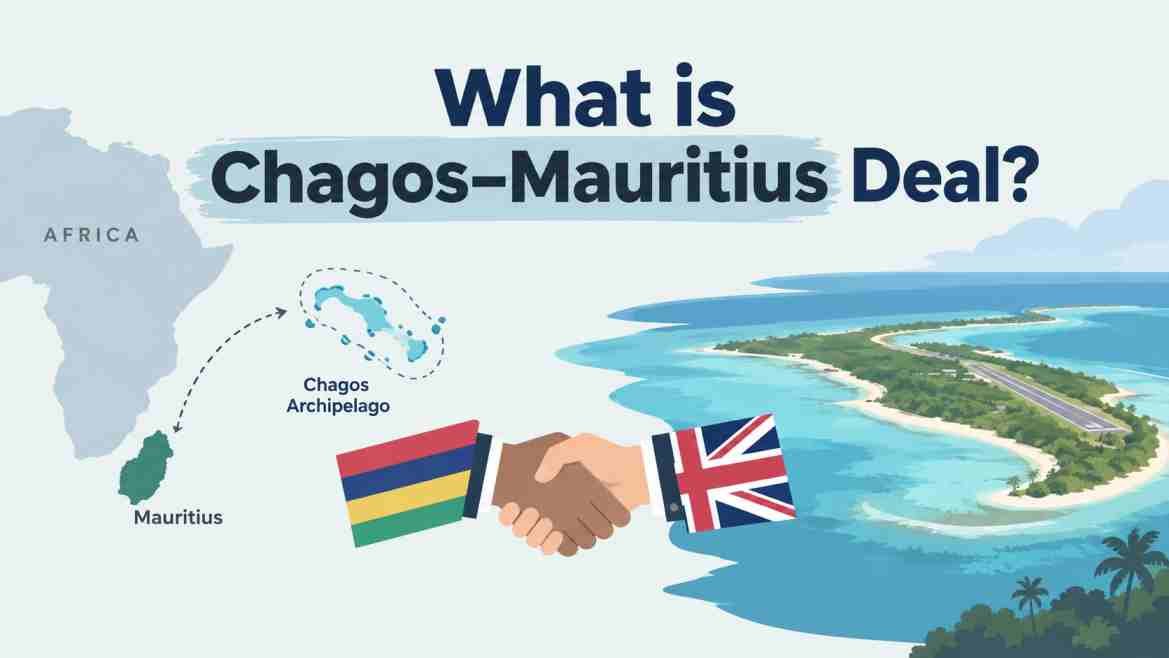
The Chagos–Mauritius Deal is a treaty signed on May 22, 2025, under which the United Kingdom agrees to transfer sovereignty of the Chagos Archipelago to Mauritius while retaining a 99-year lease on the Diego Garcia military base for £101 million annually. As of September 2026, the treaty has been signed but has not yet been ratified by the UK Parliament and has not entered into force.
What is the Chagos–Mauritius Deal?
The Chagos–Mauritius Deal is the formal agreement resolving a sovereignty dispute over the Chagos Archipelago, a small group of islands in the central Indian Ocean that the United Kingdom has administered since 1965 as the British Indian Ocean Territory (BIOT). Under the deal, signed by representatives of the UK and Mauritius on May 22, 2025, sovereignty over the entire archipelago — including Diego Garcia, the largest island — passes to Mauritius. In exchange, the UK secures continued operational access to the Diego Garcia military base, which it jointly runs with the United States, through an initial 99-year lease worth roughly £3.4 billion over the full term.
The deal exists because of a long legal and diplomatic process that stretched back to a 2019 International Court of Justice advisory opinion, which found that Mauritius’s decolonization was not lawfully completed when Britain separated the archipelago before Mauritian independence in 1968. That opinion, combined with subsequent United Nations resolutions, pushed the UK toward negotiations that began in 2022 and concluded with the May 2025 signing. This article explains exactly what the Chagos–Mauritius Deal is, what it covers, how much it costs, and where its ratification process stands as of 2026.
Interesting Facts about Chagos–Mauritius Deal 2026
| Interesting Fact | Detail |
|---|---|
| Treaty signed | May 22, 2025 |
| Parties | United Kingdom and Republic of Mauritius |
| What transfers | Full sovereignty of the Chagos Archipelago, including Diego Garcia |
| What the UK retains | 99-year lease on the Diego Garcia military base |
| Annual UK payment | £101 million |
| Total treaty value | Approximately £3.4 billion |
| Legal basis | 2019 International Court of Justice advisory opinion |
| Ratification status (Sept 2026) | Signed but not yet in force; UK ratification pending |
The table above captures the deal’s core structure: a straightforward exchange of sovereignty for guaranteed military access, backed by a well-documented payment schedule. The £101 million annual figure, verified by the UK government’s actuary department, represents what officials have described as a modest fraction of the overall UK defense budget — less than 0.2% of annual defense spending, by government estimates — in exchange for securing one of the most strategically located military installations either country operates.
The most important fact for anyone tracking this deal in real time is its current legal status: as of September 2026, the treaty remains signed but not ratified. The legislation needed to implement the agreement did not complete its passage through the UK Parliament during the 2024–26 parliamentary session, meaning the deal has not yet taken legal effect. Sovereignty has not formally transferred, and the terms described throughout this article represent what the treaty provides for once ratification is complete, not the current legal reality on the ground.
Chagos–Mauritius Deal – Sovereignty Terms
The sovereignty provisions are the foundation of the entire agreement, determining which country holds legal authority over the archipelago once the treaty takes effect.
Sovereignty Structure Under the Deal
Mauritius  ████████████████████████████ Full sovereignty (entire archipelago)
UK         ████████░░░░░░░░░░░░░░░░░░░░ Operational base rights (Diego Garcia only)
| Sovereignty Term | Detail |
|---|---|
| Sovereign authority | Mauritius, over the full Chagos Archipelago |
| UK administrative role after ratification | Ends — BIOT ceases to exist as a UK Overseas Territory |
| Diego Garcia legal status | Remains part of Mauritius; UK holds operational base rights only |
| Resettlement authority | Mauritius may permit Chagossian resettlement on islands other than Diego Garcia |
| Security buffer zone | 12 nautical miles around Diego Garcia reserved for UK/US use |
Source: UK House of Commons Library research briefing, 2025 treaty text summary.
Once ratified, the deal ends nearly six decades of British administration of the BIOT, one of 14 UK Overseas Territories, transferring full legal sovereignty to Mauritius rather than any partial or shared arrangement. This is a clean sovereignty transfer rather than a joint-administration model — Mauritius becomes the sole sovereign authority over every island in the archipelago, including Diego Garcia itself, while the UK’s presence on Diego Garcia continues purely as a function of the lease agreement rather than any residual territorial claim.
The 12-nautical-mile security buffer around Diego Garcia is the one geographic carve-out within Mauritius’s sovereign territory, giving the UK and US operational assurance that no third-party military activity can occur immediately adjacent to the base without their agreement. Resettlement authority sits with Mauritius as the new sovereign, meaning any Chagossian return to the outer islands will be governed by Mauritian, not British, law and policy once the treaty is in force.
Chagos–Mauritius Deal – Diego Garcia Military Base Terms
Diego Garcia sits at the center of the entire agreement, since securing continued access to the base was the UK and US’s primary objective throughout negotiations.
| Diego Garcia Base Term | Detail |
|---|---|
| Base operators | Joint UK–US facility |
| Initial lease length | 99 years |
| Extension option | Additional 40 years, by mutual agreement |
| UK rights under lease | Access, maintenance, and investment in the base for defense purposes |
| Chagossian settlement on Diego Garcia | Not permitted under treaty terms |
| Historical operations supported | Gulf War (1990–91), Afghanistan operations (2001), Iraq War (2003) |
Source: UK Foreign, Commonwealth & Development Office treaty summary; Library of Congress legal analysis, 2025.
The 99-year initial term, with an option to extend by 40 additional years, gives the UK and US a lease horizon comparable to some of the longest-running overseas basing arrangements either country maintains anywhere in the world. That duration reflects how central Diego Garcia has become to Western military logistics in the Indian Ocean region — the base has directly supported major operations across three decades, including the 1991 Gulf War, the 2001 campaign in Afghanistan, and the 2003 Iraq War, giving it an operational track record that made continued access a non-negotiable requirement for both London and Washington during talks.
The lease grants the UK rights to access, maintain, and invest in the base specifically for defense purposes, meaning day-to-day base operations, infrastructure upgrades, and force posture on Diego Garcia continue largely unchanged from current practice once the treaty takes effect. The explicit exclusion of Chagossian settlement from Diego Garcia itself is one of the treaty’s most specific provisions — resettlement is permitted on other islands in the archipelago, but the base island remains reserved exclusively for its military function.
Chagos–Mauritius Deal – Financial Terms and Payments
The financial architecture of the deal breaks down into three distinct payment streams, each serving a different purpose within the broader agreement.
Chagos Deal Payment Streams (Total Over Treaty Life)
Diego Garcia lease (99 yrs)     ████████████████████████ £3.4 billion
Mauritius development (25 yrs)  ██████░░░░░░░░░░░░░░░░░░ £1.125 billion
Chagossian trust fund           █░░░░░░░░░░░░░░░░░░░░░░░ £40 million
| Payment Type | Amount | Duration |
|---|---|---|
| Diego Garcia lease payment | £101 million/year | 99 years (£3.4 billion total) |
| Mauritius development grant | £45 million/year | 25 years (£1.125 billion total) |
| Chagossian trust fund | £40 million | One-time |
| Share of UK annual defense budget | Approximately 0.2% | Ongoing |
Source: UK House of Commons Library briefing and Library of Congress treaty analysis, verified by HM Government Actuary’s Department.
The £101 million annual lease payment forms the backbone of the deal’s financial structure, calculated in 2025/26 prices and producing a net present value of £3.4 billion across the full 99-year term. UK officials have consistently framed this figure in comparative terms, noting it costs less annually than operating a single aircraft carrier without its aircraft complement for one year — a way of contextualizing the expenditure against existing defense budget line items rather than treating it as a novel cost category.
Separate from the lease payment, the treaty includes a £45 million annual grant to Mauritius for 25 years, structured explicitly as development and welfare funding rather than base rent, alongside a standalone £40 million Chagossian trust fund intended to benefit the diaspora community. These three funding streams together represent the complete financial commitment the UK has agreed to under the treaty, spanning from the immediate one-time trust fund to payments that will continue for nearly a century once ratification is complete.
Chagos–Mauritius Deal – Ratification Status and Timeline
Understanding where the deal currently stands requires tracking its path through the UK’s treaty ratification process, which remains incomplete as of late 2026.
| Ratification Milestone | Date | Status |
|---|---|---|
| Treaty signed | May 22, 2025 | Complete |
| Laid before UK Parliament | May 22, 2025 | Complete |
| Objection period ended | July 3, 2025 | Complete |
| Mauritius internal ratification process | Ongoing | Requires separate domestic completion |
| UK implementing legislation | 2024–26 parliamentary session | Did not complete passage |
| Treaty in force | Not yet | Pending |
Source: UK House of Commons Library and House of Lords Library treaty tracking, updated through September 2026.
Under UK constitutional practice, a treaty ceding sovereign British territory to a foreign power requires Parliament to enact enabling legislation before ratification can occur — simply signing the treaty and allowing the standard 21-sitting-day objection period to pass, as happened by July 3, 2025, is not sufficient on its own. That enabling legislation did not complete its passage through both Houses of Parliament before the end of the 2024–26 parliamentary session, meaning the government must reintroduce and pass the bill again before ratification can proceed.
Mauritius must also complete its own internal ratification steps before the treaty can enter into force for both parties, a process that runs in parallel with, and independent of, the UK’s own legislative timeline. As of September 2026, officials on both sides have described the agreement as remaining under review rather than abandoned, with the UK government continuing to state its intention to bring ratifying legislation back to Parliament at an appropriate time. For broader context on how US global military commitments compare in scale to arrangements like Diego Garcia, see US Combat Operations Statistics.
Chagos–Mauritius Deal – Background and Legal History
The deal did not emerge suddenly — it’s the outcome of a legal and diplomatic process spanning more than five decades, anchored by a handful of pivotal moments.
| Historical Milestone | Year | Detail |
|---|---|---|
| BIOT created | 1965 | UK detaches Chagos Archipelago from Mauritius before independence |
| Mauritius independence | 1968 | Occurs after archipelago detachment |
| Diego Garcia base established | 1970s | Joint UK-US military facility begins operations |
| ICJ advisory opinion | 2019 | Finds decolonization of Mauritius was not lawfully completed |
| UK-Mauritius negotiations begin | 2022 | Formal talks launched |
| Treaty signed | May 22, 2025 | Current agreement concluded |
Source: International Court of Justice archives; UK Foreign, Commonwealth & Development Office historical record.
The legal foundation for the entire deal traces back to the 2019 ICJ advisory opinion, which examined whether Britain’s 1965 detachment of the Chagos Archipelago from Mauritius, carried out three years before Mauritian independence, complied with international law governing decolonization. The court found it did not, concluding that the UK’s continued administration of the archipelago constituted an ongoing wrongful act — a legal finding that, while advisory and non-binding, carried substantial diplomatic weight and was reinforced by subsequent UN General Assembly resolutions calling for the territory’s return to Mauritius.
Formal negotiations between the UK and Mauritius launched in 2022, running through 13 rounds of talks over roughly two years before producing the framework that became the May 2025 treaty. That negotiation timeline reflects the genuine complexity of balancing three separate sets of interests simultaneously: Mauritius’s sovereignty claim, the UK and US’s operational requirements for Diego Garcia, and the practical question of how any resettlement provisions for the Chagossian community would be structured within the final agreement. For a look at how US defense spending commitments extend across similar overseas basing arrangements, see US NATO Funding Statistics.
Chagos–Mauritius Deal – UK Government and Political Context
The deal’s path through UK politics has coincided with a change in national leadership, which is relevant to understanding who currently holds responsibility for completing ratification.
| Political Context Detail | Information |
|---|---|
| UK Prime Minister at signing (May 2025) | Keir Starmer |
| Current UK Prime Minister (Sept 2026) | Andy Burnham, in office since July 20, 2026 |
| Mauritian Prime Minister | Navin Ramgoolam |
| UK ratification requirement | Act of Parliament required to cede sovereign territory |
| US position | Publicly supportive of the agreement at signing in 2025 |
Source: UK government records; Wikipedia premiership timelines, verified through September 2026.
The treaty was originally signed under Keir Starmer’s premiership in May 2025, but UK leadership changed in the intervening period — Andy Burnham became Prime Minister on July 20, 2026, following Starmer’s resignation. That leadership transition means the current UK government inherited responsibility for completing the treaty’s ratification process rather than having negotiated its original terms, a common circumstance for long-running international agreements that span multiple parliamentary sessions and, in this case, more than one premiership.
On the Mauritian side, Navin Ramgoolam has served as Prime Minister throughout the negotiation and signing process, providing continuity on that side of the agreement even as the UK’s political leadership shifted. The core requirement — that any cession of sovereign British territory needs a specific Act of Parliament — remains constant regardless of which government holds office, meaning ratification depends on parliamentary time and votes rather than executive decision alone. For a broader picture of how US and allied defense budgets factor into agreements like this one, see Department of Defense Spending in US.
Frequently Asked Questions About the Chagos–Mauritius Deal
What is the Chagos–Mauritius Deal in simple terms?
It’s a treaty under which the UK transfers sovereignty of the Chagos Archipelago to Mauritius while keeping a 99-year lease on the Diego Garcia military base, paying Mauritius £101 million annually for that access.
When was the Chagos–Mauritius Deal signed?
The treaty was signed on May 22, 2025, by representatives of the United Kingdom and the Republic of Mauritius.
Is the Chagos–Mauritius Deal in effect yet?
No. As of September 2026, the treaty has been signed but has not been ratified by the UK Parliament, and the implementing legislation did not complete its passage during the 2024–26 parliamentary session.
Who controls Diego Garcia under the deal?
Once ratified, Mauritius holds sovereignty over Diego Garcia, but the UK and US retain operational control of the military base itself through the 99-year lease, plus a 12-nautical-mile security buffer zone.
How much does the UK pay Mauritius under the deal?
The UK pays £101 million annually for the Diego Garcia lease, plus a separate £45 million annual grant to Mauritius for 25 years and a one-time £40 million Chagossian trust fund.
Why did the UK agree to transfer sovereignty?
A 2019 International Court of Justice advisory opinion found that Britain’s decolonization of Mauritius was not lawfully completed when it detached the Chagos Archipelago in 1965, three years before Mauritian independence. Subsequent UN resolutions reinforced that finding.
Can Chagossians resettle on Diego Garcia under this deal?
No. The treaty permits Mauritius to authorize Chagossian resettlement on other islands in the archipelago, but Diego Garcia itself remains reserved exclusively for the military base.
Who is the UK Prime Minister overseeing the deal’s ratification in 2026?
Andy Burnham, who became Prime Minister on July 20, 2026, succeeding Keir Starmer, who signed the original treaty in May 2025.
Disclaimer: This research report is compiled from publicly available sources. While reasonable efforts have been made to ensure accuracy, no representation or warranty, express or implied, is given as to the completeness or reliability of the information. We accept no liability for any errors, omissions, losses, or damages of any kind arising from the use of this report.