
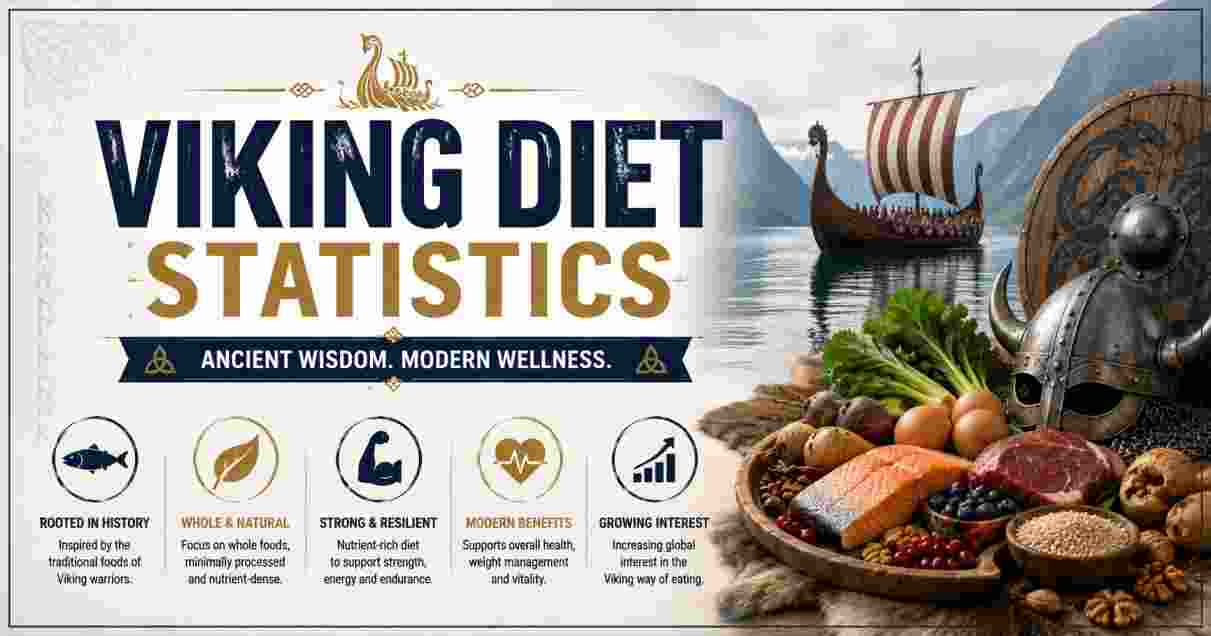
The Viking Diet in 2026
The Viking diet has moved from history books into mainstream wellness culture, marketed as an ancient, whole-food eating pattern based on what Norse people actually ate between the 8th and 11th centuries. Registered dietitians and major outlets covered its 2025-2026 revival as a natural extension of interest in the Mediterranean diet and other whole-food eating patterns, built around fish, root vegetables, whole grains, and lean meats rather than processed or packaged food.
This report breaks down the Viking diet for 2026: what archaeological and historical evidence actually shows Vikings ate, the macronutrient breakdown of a typical Norse diet, how the modern commercial “Viking diet” differs from the historical one, the genuine science sometimes cited alongside it, and its potential nutritional gaps. All figures come from peer-reviewed nutrition research, archaeological food-availability studies, and registered dietitian analysis published through 2025 and 2026.
Key Facts About the Viking Diet in 2026
| Statistic | Figure |
|---|---|
| Estimated protein share of the historical Viking diet | 30-35% |
| Estimated fat share of the historical Viking diet | 35-40% |
| Estimated carbohydrate share of the historical Viking diet | ~30% |
| Smoking prevalence among Finnish men before Nordic dietary reforms (1970s baseline) | ~52% |
| Average serum cholesterol reduction, North Karelia region, 1972-2012 | -21% (men and women) |
| Coronary mortality reduction, middle-aged Finns, 1972-2014 | 84% |
| Share of that mortality decline attributed to risk-factor changes (diet, smoking, cholesterol) | ~2/3 |
| Time period the historical Viking diet actually spans | 8th to 11th centuries |
| Americans following an optimal Mediterranean-style diet pattern (comparable benchmark) | ~15% |
| Life expectancy extension linked to Mediterranean-style diet adherence | 4-6 years |
| Modern Nordic Diet framework established | 2004 |
Source: Sons of Vikings nutritional analysis of Norse-era food availability; PubMed, “The North Karelia Project: Cardiovascular Disease Prevention in Finland,” 2018; Fox News/Registered Dietitian Lauren Harris-Pincus commentary, 2025.
The Viking diet’s modern popularity rests heavily on a genuine nutritional insight: reconstructions of what Norse people actually ate — cattle, fish, root vegetables, rye, and berries — plug into a nutritional calculator at roughly 30-35% protein, 35-40% fat, and 30% carbohydrates, a macronutrient split researchers note closely resembles what many strength and physique athletes today consider optimal for muscle growth and performance. This wasn’t a designed diet plan; it was survival adaptation to Scandinavia’s short growing seasons and limited arable land, which pushed Norse populations toward a higher reliance on livestock, hunting, and fishing than their grain-heavy counterparts in France and England.
The clinical evidence most often cited alongside the “Viking diet” actually comes from a different, more specific source: Finland’s North Karelia Project, a public health intervention launched in 1972 in response to the highest coronary heart disease mortality ever recorded in any population in the world at the time. Over the following four decades, coronary mortality among middle-aged Finns fell 84%, with roughly two-thirds of that decline attributed to measurable changes in cholesterol, blood pressure, and smoking rather than new medical treatments. It’s worth being precise here: the North Karelia Project targeted saturated fat reduction and increased vegetable fat and vegetable intake, not a reconstruction of the historical Viking diet specifically — the two are often marketed together, but they are genuinely distinct interventions separated by roughly a thousand years and a different dietary philosophy.
What Vikings Actually Ate: Historical and Archaeological Evidence
| Food Category | Specific Foods (Archaeological/Historical Record) |
|---|---|
| Meat | Cattle, pigs, sheep, ducks, hens, horses, geese |
| Seafood | Herring, salmon, mackerel, cod, halibut, plaice, mussels, oysters, shrimp, whale, seal |
| Grains | Rye, barley, oats, millet, buckwheat |
| Vegetables | Onions, garlic, leeks, cabbage, carrots, turnips, parsnips |
| Fruit and nuts | Raspberries, bilberries, plums, wild apples, walnuts, hazelnuts |
| Dairy | Milk, buttermilk, salted butter, cheese, fermented milk (skyr, surmjölk) |
| Beverages | Beer, mead (honey-based fermented drink) — consumed even by children due to limited clean water access |
Source: Fox News Health, “Ancient ‘Viking diet’ makes a comeback,” August 2025; Hurstwic Norse-era nutritional analysis; O&H Danish Bakery historical food guide.
Norse diets were notably more varied than most of medieval Europe’s, according to food historians, a direct consequence of Scandinavia’s extensive coastlines giving ordinary people — not just nobility — regular access to fish and shellfish. This stands in contrast to England and France at the time, where inland populations had limited fish access and nobility actively discouraged peasants from hunting, restricting most commoners to a narrower, more grain-dependent diet. Preservation methods were central to how Vikings ate year-round in a harsh northern climate: drying, salting, and fermenting turned a short growing and hunting season into food that could last through long winters, a practical necessity rather than a wellness choice.
An Arab diplomat’s account remains one of the most-cited historical data points in modern Viking diet marketing. Ahmad Ibn Fadlan, who traded with Norse people in the 10th century, wrote “I have never seen bodies more perfect than theirs” — a subjective but frequently repeated observation that modern diet content uses to suggest a link between the historical Norse diet and physical health, even though no clinical measurement obviously backs a 10th-century travel account.
Macronutrient Breakdown: Viking Diet vs. Modern Recommendations
| Metric | Historical Viking Diet (Estimated) | Typical Modern Diet Recommendation |
|---|---|---|
| Protein | 30-35% | 10-35% (Acceptable Macronutrient Distribution Range) |
| Fat | 35-40% | 20-35% |
| Carbohydrates | ~30% | 45-65% |
| Processed food content | Effectively none — no refined sugar, minimal processing beyond preservation | Over 50% of average American caloric intake, per multiple nutrition surveys |
| Vitamin D and E intake (per nutritional database analysis) | Below modern recommended levels in database modeling, despite fatty fish consumption |
Source: Hurstwic, “Details of Nutritional Analysis of a Viking-Age Diet”; Sons of Vikings historical nutrition analysis; standard Acceptable Macronutrient Distribution Range guidelines.
The historical Viking diet’s protein and fat share sit meaningfully above most modern dietary guidelines, while its carbohydrate share sits well below the typical 45-65% range nutritionists generally recommend today. Researchers analyzing Norse-era food databases note this comparison comes with a genuine caveat: nutritional databases used for this kind of historical reconstruction often lack complete data for vitamin D and E content in foods like liver and fatty fish that Norse populations are known to have eaten, meaning the “below recommended levels” finding for those two vitamins may reflect database gaps rather than an actual historical deficiency — particularly since light-skinned Norse populations would have synthesized meaningful vitamin D from sun exposure during all but the darkest winter months.
What distinguishes the historical diet most clearly from a typical 2026 American diet isn’t the macronutrient ratio — it’s the complete absence of processing. Every food in the archaeological Viking diet record required direct hunting, fishing, farming, or foraging, with drying, salting, and fermentation as the only preservation technologies available, a sharp contrast to a modern American diet in which over half of average caloric intake now comes from ultra-processed foods, according to multiple recent nutrition surveys cited by registered dietitians discussing the diet’s 2025-2026 revival.
Modern “Viking Diet” vs. Historical Viking Diet: Key Differences
| Element | Historical Viking Diet (8th-11th century) | Modern “Viking/Nordic Diet” (2004-present) |
|---|---|---|
| Origin | Organic adaptation to climate and geography | Deliberately designed framework, created 2004 |
| Designers | None — a survival diet, not a plan | Chefs, scientists, and nutritionists |
| Saturated fat/salt-cured meat | Common and central to the diet | Actively reduced or removed |
| Alcohol | Beer and mead consumed regularly, including by children | Reserved for occasional/special use in modern framework |
| Primary goal | Survival and sustenance | Public health, sustainability, and environmental impact |
| Plant-to-animal food ratio | Meat- and fish-heavy | Primarily plant-based, moderate seafood and fermented dairy |
Source: Alibaba Wellness, “What Is the Viking Diet Menu? A Nordic Diet Foods Guide,” January 2026.
The terms “Viking diet” and “Nordic diet” are frequently used interchangeably in marketing, but nutrition researchers draw a clear line between them. The historical Viking diet describes what Norse people genuinely ate across three centuries of Scandinavian history — heavy on cured and salted meats, high in saturated fat, built around whatever a family could hunt, fish, farm, or forage. The modern Nordic Diet, formally developed in 2004 by a team of chefs, scientists, and nutritionists, is a deliberately engineered framework that draws inspiration from the same regional ingredients but actively strips out the high-salt, high-fat animal products that defined the actual historical diet, replacing them with a primarily plant-based structure supplemented by moderate seafood and fermented dairy.
This distinction matters for anyone considering the diet for health reasons in 2026. Someone following genuine historical Viking eating patterns — heavy cured meats, regular beer consumption, high saturated fat — would be eating quite differently, and by most modern cardiovascular guidance considerably less healthfully, than someone following the 2004 Nordic Diet framework that health-focused marketing often bundles under the same “Viking diet” label.
Health Considerations and Potential Downsides
| Consideration | Detail |
|---|---|
| Cardiovascular risk factor | High saturated fat content in the historical version poses documented cardiovascular risk, per registered dietitian commentary |
| Fiber and gut health | Fiber-rich carbs (fruit, vegetables, legumes, whole grains) support gut health and help prevent diabetes, cardiovascular disease, and some cancers |
| Practicality for modern life | Dietitians note it is “not important, wise or practical to follow the Viking diet exactly” in today’s food environment |
| Alcohol content | Regular beer/mead consumption in the historical diet conflicts with current alcohol health guidance |
| Best modern application | Adapting Nordic-inspired whole-food principles rather than replicating the historical diet exactly |
Source: Fox News Health, Lauren Harris-Pincus (registered dietitian) commentary, August 2025.
Registered dietitians covering the diet’s 2025-2026 revival consistently flag the same core caveat: the historical Viking diet’s high saturated fat content, appropriate for a population burning enormous calories through farming, sailing, and physical labor in a cold climate, poses a documented cardiovascular risk for a modern, largely sedentary population without the same daily energy expenditure. New Jersey-based dietitian Lauren Harris-Pincus put it directly: “It’s not important, wise or practical to follow the Viking diet exactly in our current food environment,” recommending instead that people draw on its whole-food, unprocessed principles — lean proteins, fiber-rich vegetables, fermented dairy — without replicating the heavy meat, salt, and alcohol consumption of the actual historical version.
How the Viking Diet Compares to Other Popular Whole-Food Diets
| Diet | Adherence Rate (US) | Documented Health Association |
|---|---|---|
| Mediterranean diet | ~15% of Americans follow an optimal pattern | 4-6 years of life expectancy extension linked to adherence |
| Modern Nordic/Viking-inspired diet | No standardized US adherence tracking available | Associated indirectly with North Karelia Project’s 84% regional coronary mortality decline |
| Standard American diet (comparison) | ~60% of Americans consume a heavily processed-food-based diet | Linked to 3-7 years of life expectancy reduction |
Source: The World Data, Average Life Expectancy in America coverage; American Heart Association; Dietary Guidelines for Americans.
The Viking diet is most usefully understood as a Nordic cousin of the Mediterranean diet, sharing a whole-food, minimally processed philosophy while drawing on a colder-climate ingredient set — rye and barley instead of wheat, fatty cold-water fish instead of olive oil as the primary fat source, and root vegetables and berries instead of Mediterranean produce. For context on how a comparably-documented whole-food pattern performs, our average life expectancy statistics coverage found that Mediterranean diet adherence — currently practiced optimally by only around 15% of Americans — is linked to 4 to 6 years of additional life expectancy through cardiovascular protection and anti-inflammatory effects, a benchmark researchers frequently invoke when evaluating any Nordic-style eating pattern’s plausible health upside.
The broader US dietary context helps explain why Nordic and Viking-style diets have found a receptive audience in 2025 and 2026. Diets heavy in processed foods, consumed by roughly 60% of Americans, are associated with 3 to 7 years of life expectancy reduction, according to American Heart Association-linked research — a gap that makes any genuinely whole-food-based eating pattern, whether Mediterranean, Nordic, or historically-inspired Viking, look comparatively favorable by contrast. This broader dietary landscape connects directly to national obesity trends, where our US obesity rate comparison coverage shows countries with stronger traditional whole-food dietary patterns consistently posting meaningfully lower obesity prevalence than the United States.
Viking Daily Eating Patterns and Meal Structure
| Meal Pattern Element | Historical Detail |
|---|---|
| Typical meal frequency | Two main meals per day, generally morning and evening |
| Morning meal timing | Consumed after several hours of work had already been completed |
| Cooking methods | Boiling, stewing, roasting, and sausage-making |
| Food storage strategy | Preservation (drying, salting, fermenting) to survive long, dark Scandinavian winters |
| Seasonal variation | Diet composition shifted significantly between summer (fresh produce, dairy) and winter (preserved meat, fish, grain stores) |
Source: Sons of Vikings, “Eat Like a Viking” historical analysis; O&H Danish Bakery, “How to Eat Like a Viking Today.”
Norse eating patterns looked structurally different from the modern three-meals-a-day norm. Historical and archaeological evidence points to two main meals daily, with the first typically eaten only after several hours of physical labor were already underway — a pattern some modern intermittent fasting advocates have retroactively cited as evidence for extended overnight fasting windows, though this connection is more a modern reinterpretation than something the historical record directly supports as an intentional health strategy. Cooking methods were similarly practical: boiling, stewing, and roasting dominated, chosen for their efficiency with the tools and fuel sources available rather than for any specific nutritional optimization.
Seasonality shaped the Viking diet far more dramatically than it shapes most modern eating patterns. Summer months brought fresh dairy, foraged berries, and a wider variety of vegetables, while winter relied almost entirely on preserved meat and fish, stored grains, and fermented dairy products like skyr, since fresh food production largely stopped during Scandinavia’s long, dark winters. This seasonal swing means describing “the Viking diet” as a single, consistent macronutrient profile — as most modern marketing does — somewhat flattens a diet that, in historical reality, varied substantially depending on the time of year, a nuance largely absent from the commercial framing this eating pattern has taken on heading into 2026.
Practical Access and Food Security Considerations
| Consideration | Detail |
|---|---|
| Core ingredient accessibility in the US | Fatty fish, root vegetables, rye, and berries are widely available in most US grocery markets |
| Cost barrier | Wild-caught fatty fish and specialty items (skyr, rye bread) often carry a premium price versus processed alternatives |
| Food insecurity context | 13.7% of US households, or 47.9 million Americans, experienced food insecurity at some point in 2024 |
| Relevance to diet accessibility | Whole-food diets requiring specific, sometimes premium ingredients can be harder to sustain for food-insecure households |
Source: The World Data, Food Insecurity in the US coverage, citing USDA Economic Research Service data, 2024.
Any discussion of adopting a whole-food-based diet in 2026 needs to be weighed against genuine access and affordability realities. While the Viking diet’s core ingredients — fish, root vegetables, whole grains, berries — are broadly available in most American grocery stores, premium items like wild-caught fatty fish and imported Nordic staples like skyr often carry meaningfully higher price points than the processed alternatives that currently make up over half of average American caloric intake. This matters at scale: our food insecurity statistics coverage found that 13.7% of US households — 47.9 million Americans — experienced food insecurity at some point in 2024, a population for whom any diet built around specific whole-food, less-processed ingredients presents a genuinely higher practical barrier than the guidance alone acknowledges.
Disclaimer: This research report is compiled from publicly available sources. While reasonable efforts have been made to ensure accuracy, no representation or warranty, express or implied, is given as to the completeness or reliability of the information. We accept no liability for any errors, omissions, losses, or damages of any kind arising from the use of this report.