
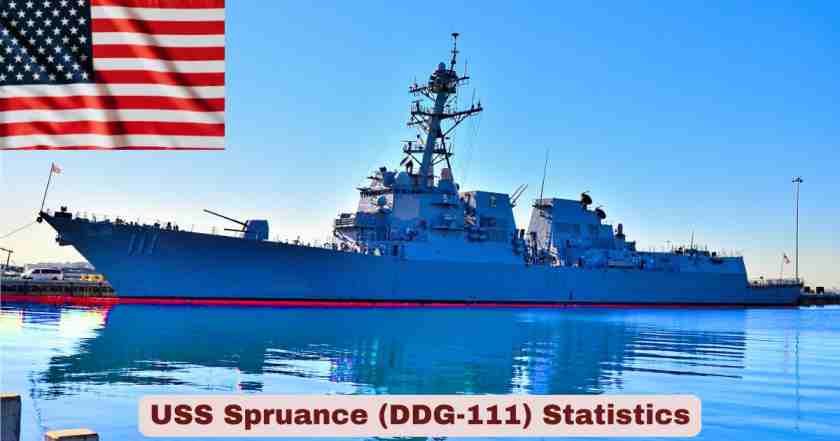
USS Spruance (DDG-111) in 2026
USS Spruance (DDG-111) is an Arleigh Burke-class Flight IIA Aegis guided-missile destroyer in the United States Navy — a warship that has, over the course of its fourteen-year operational life, evolved from a newly commissioned Fleet destroyer conducting routine Pacific patrols into one of the most operationally active and combat-proven surface combatants in the US Navy’s inventory. Named in honour of Admiral Raymond A. Spruance (1886–1969) — one of the most tactically brilliant naval commanders in American history, the architect of the decisive American victory at the Battle of Midway in June 1942 and the commander of US naval forces at the Battle of the Philippine Sea in June 1944, which destroyed the Imperial Japanese Navy’s carrier aviation for good — the ship carries a name that connects it to the two most consequential fleet engagements in naval history. Spruance is the second US Navy ship to bear the admiral’s name, the first being the lead ship of the Spruance-class destroyers (DD-963) commissioned in 1975 and decommissioned in 2005. She was built by Bath Iron Works in Bath, Maine, at a construction cost of $1 billion, with her keel laid down on 14 May 2009, her christening on 5 June 2010 — by the admiral’s granddaughter, Ellen Spruance Holscher, who serves as the ship’s sponsor — and her commissioning on 1 October 2011 at Key West, Florida. Her first commanding officer was Commander Tate Westbrook. Spruance holds a technical distinction that no other US Navy destroyer can claim: she was the first US Navy destroyer ever fitted with the Gigabit Ethernet Data Multiplex System (GEDMS), manufactured by the Boeing Company, which provides an Internet Protocol (IP) based backbone for video and data services throughout the ship — a digital networking innovation that made Spruance a prototype for the modern networked warship and whose bridge features touch-screen controls and colour readouts instead of traditional analogue gauges.
As of March 30, 2026, USS Spruance is deployed in the US 5th Fleet area of operations, assigned to the Arabian Sea as part of Destroyer Squadron 21 (DESRON 21) operating with the USS Abraham Lincoln Carrier Strike Group (CSG-3). The ship has been in active combat operations since February 28, 2026, when — as part of the US military’s Operation Epic Fury against Iran — Spruance launched Tomahawk cruise missiles at Iranian targets, joining a coordinated strike package that also included six other independently deployed DDGs operating as both strike platforms and layered air defense nodes in the Arabian Sea. This was not the ship’s first engagement in the region: in September 2024, Spruance intercepted a Houthi barrage of missiles and drones launched against three US warships in the Red Sea, and the vessel has been deployed continuously in operational theatres throughout 2024 and into 2026. The current deployment — confirmed by DVIDS (Defense Visual Information Distribution Service) in official US Navy photo releases as recently as February 12, 2026, showing Spruance crew conducting damage control training drills while deployed in the 5th Fleet area — places DDG-111 at the epicentre of the most significant US naval combat operations since the Gulf War. The ship that began its career as the Navy’s digital networking pioneer has become, in its fourteenth year of service, a fully combat-proven Aegis destroyer operating at the sharp end of American naval power in the most contested waters on Earth.
Interesting Key Facts About USS Spruance (DDG-111) in 2026
| Key Fact | Verified Detail |
|---|---|
| Hull classification | DDG-111 — Guided Missile Destroyer |
| Class / Flight | Arleigh Burke-class, Flight IIA |
| Ship’s name honours | Admiral Raymond A. Spruance (1886–1969) — Battle of Midway, Battle of the Philippine Sea |
| Second ship with this name | Yes — first was USS Spruance (DD-963), lead ship of Spruance class (1975–2005) |
| Sponsor (christening) | Ellen Spruance Holscher — admiral’s granddaughter |
| Builder | Bath Iron Works, Bath, Maine |
| Construction contract awarded | September 13, 2002 |
| Construction cost | $1 billion |
| Keel laid | 14 May 2009 |
| Christened | 5 June 2010 |
| Launched | 6 June 2010 |
| Left Bath, Maine | 1 September 2011 |
| Commissioned | 1 October 2011 — Key West, Florida |
| First Commanding Officer | Commander Tate Westbrook |
| Current homeport | Naval Base San Diego, California |
| Fleet assignment | United States Pacific Fleet |
| Squadron assignment (current deployment) | Destroyer Squadron 21 (DESRON 21) |
| Current carrier strike group | Abraham Lincoln CSG (CSG-3) |
| Current deployment area | US 5th Fleet — Arabian Sea (confirmed DVIDS February 12, 2026) |
| First US Navy destroyer fitted with GEDMS | YES — Gigabit Ethernet Data Multiplex System — Boeing Company |
| GEDMS function | IP-based backbone for video and data services — first networked destroyer |
| Bridge technology | Touch-screen controls and colour readouts — no traditional analogue gauges |
| Combat action — Operation Epic Fury | Launched Tomahawk missiles at Iranian targets — February 28, 2026 |
| Combat action — cargo ship Touska | Fired 5-inch/54-caliber Mark 45 rounds into engine room — April 19, 2026 |
| Touska seizure | Iran-flagged cargo ship seized by 31st Marine Expeditionary Unit in Gulf of Oman |
| Red Sea engagement — Sept 2024 | Intercepted Houthi barrage of missiles and drones aimed at three US warships |
| Border security mission — March 2025 | Helped Coast Guard and CBP apprehend 13 people off Mexican coast (March 22, 2025) |
| Humanitarian — people rescued | Helped rescue 18 people aboard disabled vessel ~50 miles offshore (US 5th Fleet) |
| Maiden deployment | 16 October 2013 – 17 April 2014 — 7th Fleet |
| Primary weapons system | Aegis Combat System (MK-7) + 90-cell Mk-41 Vertical Launch System (VLS) |
| Displacement (full load) | ~9,200 tonnes |
| Length | 155.3 metres (509 ft 6 in) |
| Beam | 20.1 metres (66 ft) |
| Draft | 9.4 metres (30 ft 10 in) |
| Maximum speed | 30+ knots |
| Range | ~4,400 nautical miles at 20 knots |
| Crew complement | ~281 officers and enlisted |
Source: Wikipedia — USS Spruance (DDG-111) (updated approximately March 27, 2026 — 3 days ago); DVIDS — USS Spruance (DDG 111) official US Navy imagery and press releases (February 12, 2026; February 14, 2026; February 20, 2026); USNI News — USS Spruance (DDG-111) archives (March 21, 2025; April 1, 2025); Military Fandom Wiki — USS Spruance (DDG-111) (updated with Operation Epic Fury data); MilitaryFactory.com — USS Spruance (DDG-111); TheWorldData — Guided Missile Destroyer Statistics 2026 (March 4, 2026); Naval Vessel Register (nvr.navy.mil); SURFPAC — USS Spruance (DDG-111) official page (surfpac.navy.mil)
The key facts about USS Spruance encapsulate a ship that is simultaneously a piece of US Navy digital history and a current frontline combatant. The GEDMS distinction — being the first US Navy destroyer equipped with a full Gigabit Ethernet IP backbone — may seem like a technical footnote today when networked digital systems are standard across the fleet, but in 2011 it placed Spruance at the leading edge of the Navy’s network-centric warfare vision. The touch-screen bridge was itself a maritime first for US destroyers, replacing decades of analogue instrumentation with digital interfaces that improved situational awareness and reduced the cognitive load on bridge watch teams. These technical firsts are part of why Spruance’s commissioning in October 2011 was a recognised milestone in US Navy modernisation, not just another hull number. The $1 billion construction cost at Bath Iron Works — the Maine shipyard that has been building US Navy destroyers for over a century — is a figure that almost exactly matches the average cost of a Flight IIA Arleigh Burke at the time, though the development cost of GEDMS’s integration was absorbed separately in the R&D budget.
The operational record confirmed in the Wikipedia article updated just three days ago is remarkable for a single surface combatant: Tomahawk strikes against Iranian targets in February 2026, the seizure of an Iranian cargo ship in the Gulf of Oman in April 2026, Houthi missile and drone intercepts in the Red Sea in September 2024, narcotics and border security interdiction off the Mexican coast in March 2025, and the rescue of 18 people from a disabled vessel in the Arabian Sea. This is the full-spectrum operational profile of a modern US Navy destroyer — strike warfare, air defense, surface warfare, counter-terrorism, counter-narcotics, humanitarian assistance — and Spruance has conducted all of it within an eighteen-month period. No single engagement is more significant than the February 28, 2026 Tomahawk strike confirming DDG-111 as a combat-verified strike platform in the US Navy’s Iran campaign.
USS Spruance DDG-111 Specifications & Technical Data in 2026
Arleigh Burke-class Flight IIA — Full Technical Specification
| Technical Specification | Data |
|---|---|
| Class | Arleigh Burke-class — Flight IIA |
| Ship type | Guided-missile destroyer (DDG) |
| Hull number | DDG-111 |
| Displacement (full load) | ~9,200 tonnes (approx. 9,648 long tons) |
| Length (waterline) | 155.3 m (509 ft 6 in) |
| Beam | 20.1 m (66 ft) |
| Draft | 9.4 m (30 ft 10 in) |
| Propulsion system | 4 × General Electric LM2500-30 gas turbines, 2 shafts |
| Propulsion total horsepower | ~100,000 shaft horsepower |
| Maximum speed | 30+ knots (56+ km/h) |
| Range | ~4,400 nautical miles at 20 knots |
| Crew | ~281 (officers + enlisted) |
| Primary combat system | AN/SPY-1D(V) Aegis phased array radar |
| Combat management | Aegis Combat System, Baseline 9.C1 (approximate — Flight IIA) |
| Vertical Launch System | MK-41 VLS — 96 cells (Flight IIA standard) |
| Tomahawk cruise missiles | Up to 56 — land-attack / surface-attack versions |
| Standard Missile SM-2 | Fired from MK-41 VLS — area air defense |
| SM-6 (ESSM) | Surface-to-air extended range; also from VLS |
| 5-inch gun | MK-45 Mod 4 (5-inch/54-caliber) gun mount |
| Torpedo system | MK-32 Surface Vessel Torpedo Tube (SVTT) — 2 × triple tubes for MK-46/54 torpedoes |
| Close-In Weapon System | MK-15 Phalanx CIWS — 20mm Gatling gun |
| Helicopter | 2 × SH-60B/R Sea Hawk helicopters (LAMPS III) |
| Hangar | Yes — enclosed hangar aft for 2 helicopters |
| Sonar | AN/SQS-53C hull-mounted sonar |
| ECM / electronic warfare | AN/SLQ-32(V)2 electronics suite |
| Communications | Full suite including satellite comms, TADIL-A/J/Link 16 |
| Digital backbone — GEDMS | Gigabit Ethernet Data Multiplex System — Boeing Company — FIRST US Navy destroyer fitted |
| Bridge technology | Touch-screen controls and colour readouts — first generation digital bridge |
| Stealth features | Hull sides fused into superstructure — reduces radar cross-section |
| Homeport | Naval Base San Diego, California |
Source: US Navy Fact File — Arleigh Burke-class Destroyers (navy.mil); Wikipedia — USS Spruance (DDG-111) (March 27, 2026); Wikipedia — Arleigh Burke-class destroyer; MilitaryFactory.com — USS Spruance (DDG-111); seaforces.org — DDG-111 USS Spruance
The technical specifications of USS Spruance represent the mature, combat-proven formula of the Arleigh Burke Flight IIA — the configuration that the US Navy built more of than any other single warship type in the post-Cold War era and which has remained the backbone of US surface combatant power across three and a half decades. The four General Electric LM2500-30 gas turbines powering the ship’s two shafts at approximately 100,000 shaft horsepower are adapted from the same engine family that powers the Boeing 747 aircraft — a deliberate choice by the Navy in the late 1970s that made the Arleigh Burke class easier and cheaper to maintain than alternative steam turbine designs, since GE turbine expertise is widespread across both the civilian and military aviation ecosystem. At 30+ knots maximum speed, Spruance can outrun any submarine on the surface and can keep pace with the carrier strike groups she screens — essential for her role as a multi-mission escort and strike platform.
The MK-41 Vertical Launch System with 96 cells is the defining combat feature of the Flight IIA configuration — a modular magazine that can hold any combination of Tomahawk cruise missiles, Standard Missiles (SM-2, SM-3, SM-6), Evolved Sea Sparrow Missiles (ESSM), and Anti-Submarine Rockets (ASROC) depending on the mission profile loaded before departure. The flexibility of the MK-41 VLS is what allows a single hull type like the Arleigh Burke to serve simultaneously as a land-attack strike platform (Tomahawks), an area air defense ship (SM-2, SM-6), a ballistic missile defense platform (SM-3), and an anti-submarine warfare asset (ASROC, torpedo systems, and helicopters). The 5-inch/54-caliber Mark 45 gun — confirmed in combat use against the Iranian cargo ship Touska on April 19, 2026 — provides a surface warfare and naval gunfire support capability that complements the missile systems at shorter ranges and against targets where a $2 million Tomahawk would be operationally excessive. The action against Touska was, in the context of US naval history, an unusual use of a destroyer’s main gun in a deliberate disabling operation rather than combat — a precision application of kinetic force designed to immobilise a vessel without sinking it.
USS Spruance Combat & Operational History Statistics in 2026
DDG-111 Operational Record — Deployments, Engagements & Missions
| Date / Mission | Details |
|---|---|
| Commissioning | 1 October 2011 — Key West, Florida |
| Departure from Bath, ME | 1 September 2011 |
| Maiden deployment | 16 October 2013 – 17 April 2014 — 7th Fleet (Indo-Pacific) |
| Safety Excellence Awards | 2013, 2014, 2016, 2019 |
| Vice Admiral Thomas H. Copeman III Material Readiness Award | 2016 |
| Change of command — San Diego | 30 December 2016 |
| Coast Guard Meritorious Team Commendation with Operational Distinguishing Device | 2017 |
| Return from deployment (with USS Stockdale) | Completed Western Pacific deployment — reported by USNI News |
| Abraham Lincoln CSG deployment | Part of ABECSG deployment — Tomahawk Strike Warfare Award for Thor’s Hammer 2022 |
| Sri Lanka port visit | 19 August 2024 — arrived Colombo |
| Houthi engagement — Red Sea | September 27, 2024 — intercepted Houthi barrage of missiles and drones targeting 3 US warships |
| Transfer to 5th Fleet deployment | Deployed to 5th Fleet area of operations — US Navy DVIDS confirms active deployment |
| Border security mission | 21 March 2025 — USNI News reports Spruance deploying to support NORTHCOM’s southern border mission |
| CBP drug / border interdiction | 22 March 2025 — helped Coast Guard and CBP apprehend 13 people off Mexican coast |
| Rescue of 18 persons | Spruance and Coast Guard MH-60 Jayhawk rescued 18 people aboard disabled vessel ~50 miles offshore |
| Damage control training — 5th Fleet | February 12, 2026 — DVIDS official US Navy photo, Spruance in 5th Fleet AOR |
| DESRON 21 / Abraham Lincoln CSG | Operating with USS Abraham Lincoln (CVN-72) in Arabian Sea — confirmed February 2026 |
| Operation Epic Fury — Tomahawk strikes | February 28, 2026 — Spruance launched Tomahawk missiles at Iranian targets |
| Arabian Sea DDG strike package | Part of 6 independently deployed DDGs — McFaul, John Finn, Milius, Delbert D. Black, Spruance, Michael Murphy |
| Seizure of Iranian cargo ship Touska | April 19, 2026 — Spruance fired 5-inch/54-caliber gun rounds into Touska’s engine room; vessel disabled and seized by 31st MEU in Gulf of Oman |
| Touska seizure — geopolitical aftermath | Iran described seizure as US-Iran truce violation; Iran launched retaliatory attack drones at US ships (no damage reported) |
| Touska cargo — alleged dual-use equipment | Reuters: seized ship probably carrying equipment “dual-use” for Iranian military |
Source: Wikipedia — USS Spruance (DDG-111) (updated approximately March 27, 2026); DVIDS — USS Spruance (DDG 111) official Navy imagery (February 2026); USNI News — DDG-111 archives (March–April 2025); Fandom Military Wiki — USS Spruance (DDG-111); New York Post (September 27, 2024); BBC; Sri Lanka Navy (August 2024)
The operational history of USS Spruance documented in the table above reads as a microcosm of the US Navy’s evolving mission in the 2020s — a period in which the Navy’s destroyers have been called upon simultaneously to conduct high-end warfighting (Tomahawk strikes against nation-state targets), contested air defense (intercepting Houthi ballistic missiles and drones in the Red Sea), law enforcement support (border security interdiction off the Mexican coast), and humanitarian operations (rescuing disabled vessels). This diversity of missions within a single fourteen-year deployment career is remarkable and reflects the fact that the Arleigh Burke class — and specifically the Flight IIA variants like Spruance — was designed with exactly this multi-mission flexibility in mind. The Tomahawk Strike Warfare Award for Thor’s Hammer in 2022 — awarded to Spruance for her role in the Abraham Lincoln CSG deployment — confirmed the ship’s strike capability credentials in an evaluation exercise; the February 28, 2026 real-world Tomahawk strikes against Iran confirmed them in live combat.
The April 19, 2026 engagement with the Iranian cargo ship Touska is the most tactically unusual of Spruance’s confirmed combat actions and one of the more remarkable episodes in recent US naval history. Firing a destroyer’s 5-inch/54-caliber main gun into a civilian cargo vessel’s engine room — with sufficient precision to disable the ship without sinking it — requires extraordinary fire control accuracy and restraint. The subsequent boarding and seizure of the disabled Touska by the 31st Marine Expeditionary Unit in the Gulf of Oman completed a combined Navy-Marine Corps interdiction operation that is the kind of joint action that the US military practices in exercises and executes in reality only in extraordinary circumstances. Iran’s characterisation of the seizure as a “US-Iran truce violation” and its retaliatory drone launch — against US ships that reportedly suffered no damage — illustrates how tightly wound the operational and diplomatic environments have become in the Gulf of Oman during Operation Epic Fury.
USS Spruance Awards, Designations & Ship Heritage Statistics in 2026
DDG-111 Awards, Recognitions & Heritage Data
| Award / Heritage Metric | Detail |
|---|---|
| Safety Excellence Award — 2013 | First year of service excellence recognition |
| Safety Excellence Award — 2014 | Second award — maiden deployment year |
| Vice Admiral Thomas H. Copeman III Material Readiness Award | 2016 — recognises material readiness excellence |
| Safety Excellence Award — 2016 | Third safety excellence recognition |
| Coast Guard Meritorious Team Commendation Ribbon with Operational Distinguishing Device | 2017 — joint service award for maritime operations |
| Safety Excellence Award — 2019 | Fourth safety recognition — consistent safety culture |
| Abraham Lincoln CSG Tomahawk Strike Warfare Award — Thor’s Hammer | 2022 — awarded for strike warfare excellence during ABECSG deployment |
| Christening speaker | Honorable John Baldacci — Governor of Maine |
| Ship’s sponsor | Ellen Spruance Holscher — Admiral Spruance’s granddaughter |
| First CO | Commander Tate Westbrook |
| Ship’s motto | “LAUNCH THE ATTACK!“ |
| Namesake — Battle of Midway (June 1942) | Admiral Spruance commanded Enterprise and Hornet carrier groups — decisive US victory |
| Namesake — Battle of Philippine Sea (June 1944) | Spruance’s forces destroyed Imperial Japanese Navy carrier aviation |
| Namesake — Ambassador to Philippines | Admiral Spruance later served as US Ambassador to the Philippines |
| Naval heritage — first USS Spruance (DD-963) | Lead ship of Spruance-class destroyers — commissioned 1975, decommissioned 2005 |
| Builder distinction | Bath Iron Works — also built USS Arleigh Burke (DDG-51), USS John Paul Jones (DDG-53), many others |
| Technical first distinction | First US Navy destroyer fitted with GEDMS — IP networking backbone by Boeing |
| Commissioning location | Key West, Florida — 1 October 2011 |
| Homeport | Naval Base San Diego, California |
| Official page motto | “LAUNCH THE ATTACK!” displayed prominently on SURFPAC official site |
Source: Wikipedia — USS Spruance (DDG-111) (March 27, 2026); Fandom Military Wiki — USS Spruance (DDG-111); SURFPAC official website (surfpac.navy.mil/ddg111) — “LAUNCH THE ATTACK!”; MilitaryFactory.com; Bath Iron Works historical records; NavalToday.com
The awards record of USS Spruance reveals a ship with an exceptionally strong institutional culture of safety and material readiness — four Safety Excellence Awards (2013, 2014, 2016, 2019), the Vice Admiral Copeman Material Readiness Award (2016), the Coast Guard Meritorious Team Commendation (2017), and the prestigious Tomahawk Strike Warfare Thor’s Hammer Award (2022) across its first eleven years of service. This is an unusually decorated safety and readiness record for a destroyer of Spruance’s age class and reflects positively on the succession of commanding officers and crews who have maintained the ship to a high standard across fourteen years of continuous Pacific Fleet service. The Tomahawk Strike Warfare Award is particularly significant because it confirmed, in the evaluation framework of the US Navy’s own standards, that Spruance’s strike team had achieved the highest level of proficiency in the art of coordinating and executing land-attack Tomahawk strikes — a proficiency that was subsequently confirmed in real-world combat on February 28, 2026.
The ship’s motto — “LAUNCH THE ATTACK!” — displayed prominently on the official SURFPAC website is both an homage to Admiral Spruance’s command philosophy and a statement of the ship’s own operational identity. Admiral Spruance was famous in naval history for a quality that distinguished him from contemporaries who were more aggressive but less disciplined: he was willing to launch the attack at the decisive moment without wasting opportunity on caution, but he tempered that aggression with systematic, careful planning that minimised unnecessary risk to his force. His victory at Midway was achieved partly through his willingness to strike the Japanese carrier force at maximum range before Japanese aircraft could reach US carriers — a calculated offensive risk that changed the Pacific War. The motto therefore carries a dual meaning: offensive action taken at the right moment with proper preparation — as apt a description of a modern Aegis destroyer’s operational philosophy as it is of the admiral whose name she bears.
Disclaimer: This research report is compiled from publicly available sources. While reasonable efforts have been made to ensure accuracy, no representation or warranty, express or implied, is given as to the completeness or reliability of the information. We accept no liability for any errors, omissions, losses, or damages of any kind arising from the use of this report.