
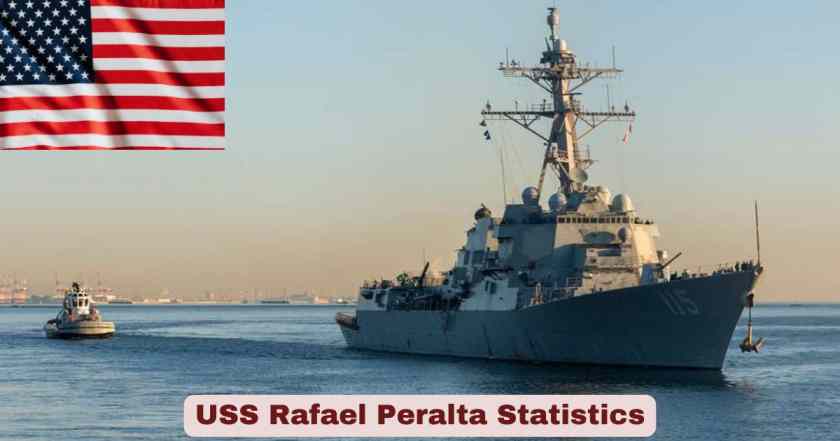
USS Rafael Peralta in 2026
The USS Rafael Peralta (DDG-115) is one of the United States Navy’s most capable and symbolically resonant warships — an Arleigh Burke-class Flight IIA guided-missile destroyer that carries not just the most advanced naval combat systems in the American surface fleet, but also the name and legacy of one of the Iraq War’s most debated and deeply honoured Marines. Commissioned on July 29, 2017, at Naval Air Station North Island in San Diego, California, and homeported at Naval Base San Diego, the ship is in active service for her ninth year in 2026, operating as part of the US Pacific Fleet and routinely deploying to the Indo-Pacific and beyond. Built by Bath Iron Works in Bath, Maine — the same shipyard that has produced dozens of Arleigh Burke-class destroyers — Rafael Peralta was constructed under a $679.6 million contract awarded on September 26, 2011, and represents one of the most expensive and militarily capable surface combatants ever built. She is the 65th ship of the Arleigh Burke class, the longest production-run surface combatant warship in US Navy history, and she carries the motto “Fortis ad Finem” — Latin for “Courageous to the End” — a direct tribute to the life and death of the Marine whose name she bears.
The ship’s namesake, Sergeant Rafael Peralta, was a Mexican-born, San Diego-raised US Marine who was killed in action on November 15, 2004, during the Second Battle of Fallujah in Iraq — one of the most brutal urban combat operations American forces had engaged in since Vietnam. Assigned to Company A, 1st Battalion, 3rd Marine Regiment, Peralta was not originally required to enter the building where he died, but volunteered to join an undermanned squad clearing houses in insurgent-heavy Fallujah. After being shot and mortally wounded when a back room door was opened onto waiting insurgents, Peralta used his final moments to pull an enemy grenade against his own body, absorbing the blast and shielding the fellow Marines beside him. He was 25 years old. He had enlisted in the Marine Corps on the same day he received his green card, and earned his US citizenship while serving. He had written to his 14-year-old brother before deploying: “Be proud of me, bro … and be proud of being an American.” That letter, that act, and those words define everything the ship bearing his name is meant to represent. In 2026, USS Rafael Peralta remains one of the US Navy’s most operationally active destroyers, having earned the PACFLT Anti-Submarine Warfare (ASW) Bloodhound Award in 2024 and contributing to high-stakes operations across the Pacific and beyond.
USS Rafael Peralta 2026 — Key Facts at a Glance
The table below captures the most critical, verified facts about USS Rafael Peralta (DDG-115) as of April 2026, drawn from the US Navy’s official ship page, NavSource Naval History, the Naval History and Heritage Command, the Surface Forces Pacific official ship pamphlet, and Wikipedia.
| Fact | Data Point |
|---|---|
| Hull designation | DDG-115 |
| Ship class | Arleigh Burke-class (Flight IIA Restart) guided-missile destroyer |
| Position in class | 65th ship of the Arleigh Burke class |
| Contract award date | September 26, 2011 |
| Contract value | $679.6 million |
| Shipbuilder | Bath Iron Works, Bath, Maine |
| Named by Secretary of Navy | February 15, 2012 (Secretary Ray Mabus) |
| Keel laid | October 30, 2014 |
| Launched / Christened | October 31, 2015 |
| Commissioned | July 29, 2017 — Naval Air Station North Island, San Diego |
| Years in active service (2026) | 9 years |
| Current homeport | Naval Base San Diego, San Diego, California |
| Fleet assignment | US Pacific Fleet |
| Ship’s motto | “Fortis ad Finem” (Latin: “Courageous to the End”) |
| Ship’s unofficial motto | “Courageous to the End” |
| Current Commanding Officer | CDR Stephen David Szachta Jr. (USNA 2006) — in command since November 20, 2023 |
| Previous CO | CDR Charles Thomas Cooper (USNA 2004) — May 4, 2022 to November 20, 2023 |
| Ship sponsor | Rosa M. Peralta (mother of Sergeant Rafael Peralta) |
| Navy Cross on board | Yes — Rosa Peralta donated the Navy Cross to the ship; displayed aboard DDG-115 |
| Total crew | ~282 officers and enlisted (28 officers, 254 enlisted) |
| Maiden deployment | January 17, 2020 — September 3, 2020 (5th/7th Fleet) |
| Notable award (2024) | PACFLT Anti-Submarine Warfare (ASW) Bloodhound Award |
| Facebook page followers | ~6,736 (official USS Rafael Peralta Facebook) |
Source: Wikipedia — USS Rafael Peralta (DDG-115) (updated April 2026); NavSource Naval History — DDG-115 USS Rafael Peralta (navsource.net); US Navy press release — Navy to Commission USS Rafael Peralta, July 2017; Naval History and Heritage Command — Sergeant Rafael Peralta namesake page; Surface Forces Pacific official ship pamphlet (DDG-115), 2024; Cruising Earth USS Rafael Peralta ship tracker
The commissioning of USS Rafael Peralta on July 29, 2017 was a ceremony that meant more to its namesake’s family than almost any ship naming in recent Navy history. For years before the christening, the Peralta family had been locked in a painful public dispute with the Department of Defense over whether Sergeant Peralta deserved the Medal of Honor rather than the Navy Cross — a dispute that the family channelled into their relationship with the ship bearing his name. It was only when the ship’s christening drew near that Rosa Peralta finally agreed to accept the Navy Cross for her son, and then immediately donated it to the USS Rafael Peralta, saying she felt it would keep Rafa’s spirit alive and protect the crew. That medal is now permanently displayed aboard DDG-115, making the ship itself a kind of living memorial in a way that few naval vessels are. The $679.6 million construction cost places Rafael Peralta solidly within the price range of modern Arleigh Burke-class destroyers, which typically cost between $600 million and $900 million depending on the build year, configuration, and outfitting.
The 65th position in the Arleigh Burke class is itself a statistic worth appreciating. The class began with USS Arleigh Burke (DDG-51), commissioned in July 1991, and has been in continuous production since — making it the longest-running surface combatant production programme in US Navy history. The fact that a class that began with DDG-51 is still producing ships numbered into the 120s in 2026 reflects a deliberate Navy decision to invest in continuous upgrades to a proven hull form rather than designing an entirely new class of destroyer. Rafael Peralta as a Flight IIA Restart ship benefits from a specific round of production improvements introduced after a brief gap in Arleigh Burke production, incorporating updated electronic cooling systems, improved radar and combat system integration, and the enclosed dual helicopter hangar that defines the Flight IIA configuration.
USS Rafael Peralta — Technical Specifications in 2026
The ship’s physical and technical characteristics place her among the most capable surface combatants in the world.
| Technical Specification | Data |
|---|---|
| Length overall | 509.5 ft (155 m) |
| Beam overall | 71 ft (21.6 m) |
| Navigational draft | 32 ft (9.8 m) |
| Full load displacement | 9,217 long tons (9,365 metric tonnes) |
| Maximum speed | 30+ knots |
| Range | 4,400+ nautical miles at 20 knots |
| Propulsion system | Combined Gas and Gas (COGAG) — 4 × General Electric LM2500 gas turbines |
| Total shaft horsepower | 100,000 HP (74,600 kW) |
| Propellers | Two controllable-pitch propellers |
| Electrical generators | 3 × 2,000 kW ship service gas turbine generators; 2 × 1,500 kW emergency diesel generators |
| Rudder configuration | Twin rudder |
| Ship class type | Arleigh Burke Flight IIA (enclosed dual helicopter hangar) |
| Crew size | 282 personnel (28 officers, 254 enlisted) |
| Meals per watch cycle | ~400 meals |
| Berthing design | Shock-isolated racks, privacy curtains, climate control |
| Hull classification | DDG — Guided Missile Destroyer |
| Construction material | Steel hull with aluminum superstructure |
| Stealth features | Radar cross-section reduction design features incorporated throughout class |
Source: Surface Forces Pacific official ship pamphlet (DDG-115), 2024; Technical Parameters EU — USS Rafael Peralta DDG-115 specifications (July 18, 2025); Wikipedia — Arleigh Burke-class destroyer specifications; US Navy DDG-51 class specifications (man.fas.org)
The four General Electric LM2500 gas turbines driving Rafael Peralta are the same engine family found in dozens of US and allied naval vessels — and in a range of commercial aircraft and industrial applications — making them one of the most tested and reliable marine propulsion units in the world. Their combined output of 100,000 shaft horsepower gives Rafael Peralta the ability to accelerate quickly to her 30+ knot maximum speed, a performance characteristic that is critical for positioning the ship for anti-submarine and anti-surface engagements where closing speed and manoeuvrability are decisive. The COGAG (Combined Gas and Gas) propulsion configuration — unlike the Combined Diesel and Gas (CODAG) systems used on some allied destroyers — means Rafael Peralta can achieve maximum sprint speed using all four turbines simultaneously, without the warm-up delay that diesel systems can introduce.
The 9,217-ton full load displacement puts Rafael Peralta firmly in the heavyweight category of surface combatants. For reference, this displacement is comparable to that of some World War II cruisers, reflecting how much equipment, weapons, electronics, and fuel a modern multi-mission destroyer must carry to execute its diverse operational mandate. The three primary ship service generators producing 6,000 kW of combined electrical power — supplemented by two 1,500 kW emergency diesels — must sustain not just the propulsion and hotel services of a floating city of nearly 300 people, but the enormous power demands of the Aegis combat system’s phased-array radar, the electronic warfare suite, the communications architecture, and the ship’s weapon system controls. This electrical power infrastructure is as much a strategic asset as the missiles and guns.
USS Rafael Peralta — Weapons Systems & Combat Capabilities in 2026
Weapons and combat systems are where USS Rafael Peralta’s role as a front-line naval combatant comes into sharpest focus.
| Weapons / Combat System | Specification / Detail |
|---|---|
| Vertical Launch System (VLS) | 96-cell Mark 41 VLS |
| VLS missile types | RIM-66 SM-2 (anti-air), RIM-161 SM-3 (ballistic missile defense), RIM-174 SM-6, BGM-109 Tomahawk (land attack/anti-ship), RUM-139 VL-ASROC (anti-submarine) |
| Naval gun | One Mk 45 Mod 4 5-inch/62-caliber naval gun |
| Close-In Weapon Systems (CIWS) | Two Phalanx Mk 15 Block 1B CIWS — automated terminal defense against missiles and fast-attack craft |
| Additional close-in defense | SeaRAM launcher (Rolling Airframe Missiles) — integrated in later overhauls |
| Torpedoes | Two triple Mk 32 torpedo tubes firing Mk 46/Mk 54 lightweight torpedoes (anti-submarine) |
| Sonar — hull-mounted | AN/SQS-53C hull-mounted sonar |
| Sonar — towed array | AN/SQR-19 towed array sonar |
| Primary radar | AN/SPY-1D(V) phased-array radar (Aegis) |
| Combat system | Aegis Baseline 9 combat management system |
| Cooperative Engagement Capability | CEC — fuses sensor data with allied units, extending radar coverage |
| Electronic warfare | AN/SLQ-32(V)6 — radar warning, signal analysis, active jamming |
| Countermeasures | SRBOC (Super Rapid Bloom Offboard Countermeasures) chaff launchers; Nulka active decoy |
| Data links | Link 16 and Link 22 — real-time coordination with aircraft, submarines, coalition vessels |
| Simultaneous contacts tracked | Hundreds of simultaneous air and surface contacts |
| Helicopters embarked | 2 × MH-60R Seahawk helicopters |
| Helicopter hangar | Enclosed dual hangar — Flight IIA signature feature |
| Future unmanned systems | Wiring and deck space reserved for UAVs and USVs; Mission Bay integration planned |
Source: Technical Parameters EU — USS Rafael Peralta DDG-115 (July 18, 2025); Wikipedia — USS Rafael Peralta and Arleigh Burke-class destroyer; US Navy DDG-51 class specifications; Surface Forces Pacific official ship pamphlet (DDG-115), 2024
The 96-cell Mark 41 Vertical Launch System is the centrepiece of USS Rafael Peralta’s combat capability, and understanding its flexibility is key to understanding why Arleigh Burke-class destroyers are so operationally valuable to US naval commanders. Unlike fixed armament that commits a ship to a single mission type, the Mk 41 VLS is a modular magazine that can be loaded with different missiles depending on the anticipated threat environment. In a ballistic missile defense configuration, a larger proportion of cells might be loaded with SM-3 interceptors capable of engaging ballistic missiles outside the atmosphere. In a strike warfare configuration, a high proportion of Tomahawk cruise missiles would be loaded for land-attack missions. For anti-submarine operations — where the PACFLT ASW Bloodhound Award indicates Rafael Peralta has particular excellence — VL-ASROC rockets that deliver lightweight torpedoes at range are the primary VLS weapon. This configurability means a single ship can shift between mission profiles in a way that earlier single-mission warships never could.
The Aegis Baseline 9 combat management system paired with the AN/SPY-1D(V) phased-array radar represents the most capable integrated air and missile defence system deployed on any surface ship in the US inventory. The system’s ability to simultaneously track hundreds of airborne and surface contacts — while simultaneously calculating engagement solutions, communicating with other networked platforms via Cooperative Engagement Capability, and managing the ship’s weapons allocation — makes it the tactical brain of the ship as much as any individual weapon system. The AN/SLQ-32(V)6 electronic warfare suite adds another layer of both defensive and offensive electronic capability, capable of detecting, classifying, and jamming radar-guided threats while the SRBOC chaff launchers and Nulka active decoy provide physical countermeasures against missiles that penetrate the outer defensive layers.
USS Rafael Peralta — Service History & Deployments in 2026
Operational history provides the human and strategic context behind the technical specifications.
| Service History Event | Date / Detail |
|---|---|
| Named by Secretary of the Navy | February 15, 2012 (Secretary Ray Mabus) |
| Keel laid | October 30, 2014 — Bath Iron Works, Bath, Maine |
| Launched and christened | October 31, 2015 — Bath Iron Works |
| Commissioned | July 29, 2017 — Naval Air Station North Island, San Diego |
| First Commanding Officer | CDR Brian Albert Ribota — July 29, 2017 to April 6, 2018 |
| Second Commanding Officer | CDR Aaron Patrick DeMeyer (USNA 2000) — April 6, 2018 to July 22, 2019 |
| Third Commanding Officer | CDR Chad Joseph Trubilla (USNA 2001) — July 22, 2019 to November 17, 2020 |
| Fourth Commanding Officer | CDR Jeffery Joseph Murawski — November 17, 2020 to May 4, 2022 |
| Fifth Commanding Officer | CDR Charles Thomas Cooper (USNA 2004) — May 4, 2022 to November 20, 2023 |
| Sixth Commanding Officer (current) | CDR Stephen David Szachta Jr. (USNA 2006) — November 20, 2023 to present |
| Maiden deployment | January 17, 2020 — September 3, 2020 (5th/7th Fleet) |
| Theodore Roosevelt Carrier Strike Group deployment | 2020 — Indo-Pacific with CSG-9 |
| RIMPAC 2020 participation | August 6, 2020 — joined HMAS Stuart, HMAS Sirius, KDB Darulehsan, RSS Supreme en route to Pearl Harbor |
| Port visit — Sasebo, Japan | February 8, 2020 — with USS Russell |
| Philippine Sea operations | August 2020 — assigned to DESRON 15, 7th Fleet |
| PACFLT ASW Bloodhound Award | 2024 |
| Wikipedia-noted 2026 operation | Operation Epic Fury — deployed as part of 2026 US naval operations |
| Destroyer Squadron (DESRON) | DESRON 15 — US Navy’s largest forward-deployed DESRON |
Source: NavSource Naval History — DDG-115 USS Rafael Peralta commanding officers list; Wikipedia — USS Rafael Peralta (updated April 2026); DVIDS — USS Rafael Peralta deployment imagery and stories; US Navy press release commissioning July 2017; Surface Forces Pacific ship pamphlet 2024
The maiden deployment of January to September 2020 placed USS Rafael Peralta in one of the most operationally consequential periods for the Pacific Fleet in recent years. Deploying just as the COVID-19 pandemic was beginning to impact global operations, the Theodore Roosevelt Carrier Strike Group — to which Rafael Peralta was attached — became one of the most high-profile naval deployments of that period, ultimately disrupted by the widely publicised outbreak aboard USS Theodore Roosevelt (CVN-71) itself. Rafael Peralta continued operations in the 7th Fleet area, the US Navy’s largest and most active forward-deployed fleet, which covers an area from the international date line westward through the Pacific, Indian Ocean, and into the Persian Gulf. Assignment to Destroyer Squadron 15 (DESRON 15) — headquartered at Fleet Activities Sasebo, Japan, and described by the Navy as its largest forward-deployed destroyer squadron — reflects the operational priority the Pacific Fleet places on this theatre.
The PACFLT Anti-Submarine Warfare Bloodhound Award in 2024 is one of the most operationally meaningful unit awards in the Pacific Fleet’s competitive recognition programme. It is given to the ship that demonstrates the highest level of proficiency in detecting, tracking, and engaging submarine threats — a capability that is arguably the most critical single mission for surface combatants in the Indo-Pacific, where potential adversaries operate significant submarine forces. Winning this award is not simply a matter of performing well on a scheduled exercise. It requires sustained excellence across multiple ASW events, competitions, and real-world tracking scenarios throughout the year. That Rafael Peralta earned it in 2024 — her seventh year of service — reflects a crew that has achieved a high level of tactical proficiency in what is widely considered the most technically demanding of a destroyer’s core mission areas.
Sergeant Rafael Peralta — The Namesake’s Story in 2026
No article about USS Rafael Peralta is complete without a thorough account of the Marine whose name, sacrifice, and legacy the ship carries into every operation.
| Sergeant Peralta — Biographical & Service Facts | Data |
|---|---|
| Full name | Sergeant Rafael Peralta, USMC |
| Date of birth | April 7, 1979 |
| Place of birth | Mexico City, Mexico |
| Date of death | November 15, 2004 |
| Age at death | 25 years old |
| Cause of death | Killed in action — Second Battle of Fallujah, Iraq |
| Unit | Company A, 1st Battalion, 3rd Marine Regiment, 3rd Marine Division, III MEF, MCBH |
| Role | Scout team leader; Platoon Guide (volunteered for assault) |
| Education | Morse High School, San Diego, 1997; San Diego City College |
| Immigration status | Born in Mexico; immigrated to US; received green card 2000 |
| Enlistment date | Same day he received his green card — 2000 |
| Citizenship | Earned US citizenship while serving on active duty in the Marine Corps |
| Previous deployment | 2001 — deployed overseas; returned home when father died in workplace accident |
| Re-enlistment | Re-enlisted for four more years; transferred to MCBH Kaneohe, Hawaii 2003 |
| Iraq deployment | 2004 — deployed to Iraq in support of Operation Iraqi Freedom |
| Action date | November 15, 2004 — Operation Al Fajr (Second Battle of Fallujah) |
| Houses cleared that day | Six houses successfully cleared before the fatal seventh house |
| Action | Shot and mortally wounded; pulled enemy grenade against his body to shield fellow Marines |
| Lives saved (estimated) | At least 4–6 Marines saved from the grenade blast |
| Posthumous award | Navy Cross — second-highest US military award for combat valor |
| Award notified | September 17, 2008 (family notified) |
| Navy Cross presented | June 8, 2015 — Camp Pendleton, California (Rosa Peralta accepted) |
| Medal of Honor consideration | Recommended by Lt. Gen. Richard Natonski; ultimately denied by Secretary of Defense Gates (2008) |
| Burial | Fort Rosecrans National Cemetery, San Diego |
| Posthumous honors | Purple Heart, Combat Action Ribbon, Marine Corps Good Conduct Medal, National Defense Service Medal, Iraq Campaign Medal with one bronze campaign star, Global War on Terrorism Service Medal |
| Honorary San Diego Police Officer | April 24, 2006 — posthumously awarded by SDPD Chief William Lansdowne |
| Peralta Hall | 2007 — command post for 31st Marine Expeditionary Unit, Camp Hansen, Okinawa, named in his honor |
| Letter to his brother | “Be proud of me, bro … and be proud of being an American.” |
Source: Wikipedia — Rafael Peralta (updated March 23, 2026); Naval History and Heritage Command — Sergeant Rafael Peralta namesake page; Task and Purpose — The Controversial Marine Grenade Hero of Fallujah (January 2026); Military Times — Peralta Family Accepts Navy Cross (June 2015); Hall of Valor — Navy Cross citation for Sergeant Rafael Peralta; NavSource Naval History DDG-115; We Are the Mighty — The Controversial Marine Grenade Hero of Fallujah (January 2026)
The story of Sergeant Rafael Peralta’s final minutes is one that resists easy summary because it resists easy certainty — and that unresolved quality is itself a part of what makes it so enduring. The basic facts are documented: Peralta was shot and mortally wounded when insurgents opened fire from a back room. A grenade was thrown as the insurgents fled. The grenade came to rest near Peralta’s head. The Marines with him survived. What remains in dispute — and what drove ten years of congressional and Defence Department wrangling — is whether the mortally-wounded Peralta consciously pulled the grenade against his own body, or whether the grenade simply ended up beneath him. The Navy Cross citation, the testimony of the seven Marines present, and the recommendation of the 1st Marine Division commander all say Peralta pulled the grenade deliberately. A DoD expert panel assembled by Secretary Gates concluded that Peralta’s wounds were too severe for conscious action to have been possible.
What the dispute has never been able to touch is the outcome: the Marines beside Peralta lived. And the manner in which Rosa Peralta ultimately handled her son’s memory is itself a story of profound generosity. Having refused for years to accept the Navy Cross — not because she didn’t honour her son but because she believed he deserved more — she relented when the ship bearing his name was about to be christened, accepted the medal, and immediately donated it to the ship so that the Navy Cross would sail with the vessel into every deployment, every operation, and every sea. “She feels that it will take Rafa’s spirit and keep all the crew members safe. She feels that it will belong there,” his sister Icelda told reporters. That medal is aboard USS Rafael Peralta today, in 2026, somewhere on the Pacific Ocean.
USS Rafael Peralta — Arleigh Burke Class Context in 2026
Understanding where DDG-115 sits within the Arleigh Burke class provides essential context for its capabilities and operational significance.
| Arleigh Burke Class Metric | Data |
|---|---|
| Class name / lead ship | USS Arleigh Burke (DDG-51) — commissioned July 1991 |
| Total ships planned | ~75+ ships (class still in production with Flight III variants) |
| Total ships currently operational / built | 70+ ships commissioned and operational |
| Longest production run | Longest for any US Navy surface combatant warship |
| Production flights | Flight I (DDG-51–DDG-71); Flight II (DDG-72–DDG-78); Flight IIA (DDG-79 onward) |
| Flight IIA introduction | Fiscal Year 1994 — added enclosed helicopter hangar for 2 embarked helicopters |
| DDG-115 flight variant | Flight IIA Restart |
| Key Flight IIA improvements | Enclosed dual helicopter hangar; 96-cell VLS (up from 90); mine-detecting capability; improved ballistic missile defense |
| First Flight IIA ship | USS Oscar Austin (DDG-79) |
| Cost range per ship | ~$600 million to $900 million+ (varies by build year and configuration) |
| DDG-115 contract value | $679.6 million |
| Primary combat roles | Anti-Air Warfare (AAW), Anti-Submarine Warfare (ASW), Anti-Surface Warfare (ASuW), Strike Warfare (STW), Ballistic Missile Defense (BMD) |
| Operational groupings | Carrier Strike Group (CSG), Expeditionary Strike Group (ESG), Surface Action Group (SAG), independent |
| AEGIS combat system upgrade | Baseline 6.1 through Baseline 9 across the class |
| Survivability improvements | Structural reinforcements, damage control improvements, redundant electrical systems |
| Builder (DDG-115) | Bath Iron Works — one of two primary Arleigh Burke builders (with Ingalls Shipbuilding) |
Source: US Navy DDG-51 class specifications (man.fas.org); Wikipedia — Arleigh Burke-class destroyer; Wikipedia — USS Rafael Peralta; Technical Parameters EU — USS Rafael Peralta specifications
The Arleigh Burke class’s record as the longest-running production series in US surface combatant history is a testament to a design philosophy that prioritised adaptability and continuous improvement over a clean-sheet replacement every generation. When USS Arleigh Burke commissioned in 1991, it was a ship designed to fight Soviet submarines and aircraft carriers in the North Atlantic — a mission that became strategically redundant within a year, when the Soviet Union collapsed. Instead of becoming obsolete, the class adapted: it took on ballistic missile defense roles in the early 2000s, expanded strike warfare capability with land-attack Tomahawks, incorporated the enclosed helicopter hangar of the Flight IIA configuration, and is currently being produced in a Flight III variant that adds the more powerful AN/SPY-6(V)1 Air and Missile Defense Radar (AMDR). The fact that DDG-115 as a Flight IIA Restart ship was commissioned in 2017 alongside Flight III ships already under construction reflects the Navy’s deliberate strategy of running multiple variants in production simultaneously to maintain shipbuilding industrial base capacity.
The enclosed dual helicopter hangar that defines the Flight IIA configuration — and that distinguishes Rafael Peralta from the earlier Flight I and II ships that could land helicopters but not permanently house them — is one of the most operationally significant improvements in the class’s history. Two permanently embarked MH-60R Seahawk helicopters extend the ship’s effective sensor and weapon range dramatically. An MH-60R can detect and engage submarines at distances far beyond the ship’s own hull-mounted sonar range, carry air-launched torpedoes, and conduct surface search and surveillance using its onboard radar and electro-optical sensors. For a ship that won the 2024 ASW Bloodhound Award, the quality of the helicopter integration and the proficiency of the embarked helicopter detachment are as important as the sonar suite and the torpedo tubes.
USS Rafael Peralta — Legacy, Tributes & Significance in 2026
The broader significance of USS Rafael Peralta extends well beyond her weapons systems and operational record.
| Legacy / Tribute Fact | Detail |
|---|---|
| Ship named after | Sergeant Rafael Peralta, USMC — recipient of the Navy Cross |
| Announcement of ship naming | February 15, 2012 — Secretary of Navy Ray Mabus |
| Navy Cross displayed aboard ship | Yes — donated by Rosa Peralta (the Marine’s mother) at christening 2015 |
| Peralta Hall, Camp Hansen | Named in Sgt. Peralta’s honor — command post for 31st MEU, Okinawa (2007) |
| Honorary San Diego police officer | Posthumously awarded April 24, 2006, by SDPD Chief Lansdowne |
| Marine Corps recruit training | Peralta’s story taught at Marine Corps Recruit Depot San Diego |
| Peralta’s flak jacket and rifle | Preserved by the Marine Corps for future display at the National Museum of the Marine Corps |
| Wall in parents’ home (pre-deployment) | Three items only: US Constitution, Bill of Rights, boot camp graduation certificate |
| Brother Ricardo Peralta | Followed Rafael into the Marine Corps |
| Ships namesakes — immigrant service | Peralta represents the thousands of immigrants who serve in the US military and earn citizenship through service |
| Medal of Honor debate | Unresolved as of 2026; seven Secretaries of Defense have reviewed the case; Navy Cross remains |
| Letter to brother | “Be proud of me, bro … and be proud of being an American.” |
| Rosa Peralta’s donation motivation | “She feels that it will take Rafa’s spirit and keep all the crew members safe.” |
| Congressional advocacy | Multiple California and Hawaii congressmembers, Congressional Hispanic Caucus, Rep. Duncan Hunter |
| Notable supporter | Lt. Gen. Richard Natonski — recommended Peralta for Medal of Honor; said “I believe beyond a shadow of a doubt” |
| Ship motto origin | “Fortis ad Finem” directly honours Peralta’s final act — courageous to the very end of his life |
Source: Wikipedia — Rafael Peralta (March 2026); Naval History and Heritage Command; Task and Purpose — Medal of Honor request article; We Are the Mighty — January 2026; Military Times — Peralta family accepts Navy Cross, June 2015; NavSource Naval History; Surface Forces Pacific ship pamphlet 2024
The story of how Rosa Peralta came to accept the Navy Cross — and then immediately give it away to the ship — is one of the most humanly resonant moments in recent US military history. For years after her son’s death, she had refused the medal entirely. Not from indifference, but from a belief so deep it bordered on inconsolable: that what her son did in that house in Fallujah, on November 15, 2004, deserved more than the country’s second-highest combat honour. She watched as Secretary of Defense Gates reversed his own initial Medal of Honor approval. She watched as Leon Panetta declined to overturn Gates’s decision. She watched as Chuck Hagel did the same. The medal sat uncollected, a symbol of a wound that official Washington could not close. It took the naming of a destroyer — a warship that would carry her son’s name across the Pacific, into harm’s way, crewed by hundreds of Americans — to finally give her a reason to accept. The Navy Cross is now aboard DDG-115, on the Pacific Ocean, exactly where Rosa Peralta decided it belonged.
The significance of Rafael Peralta’s immigrant background adds a dimension to the ship’s legacy that resonates particularly in 2026. Peralta came to the United States from Mexico, graduated from a San Diego public high school, waited for his green card, and on the day he received it — not the day after, the same day — walked into a Marine Corps recruiting office. He was not yet a citizen. He earned his citizenship while in uniform, and he died for a country that had not yet formally claimed him as its own. His bedroom walls held only three things: the Constitution, the Bill of Rights, and his boot camp certificate. He wrote his 14-year-old brother that letter before deploying to Fallujah. Every one of these details has been retold in Marine Corps training for two decades, not as recruiting rhetoric, but as an account of what citizenship and service can mean when they are taken completely seriously by someone who chose them freely. The USS Rafael Peralta takes those values out to sea, year after year, in a ship that has now sailed the Pacific for nine years in his name.
Disclaimer: This research report is compiled from publicly available sources. While reasonable efforts have been made to ensure accuracy, no representation or warranty, express or implied, is given as to the completeness or reliability of the information. We accept no liability for any errors, omissions, losses, or damages of any kind arising from the use of this report.