
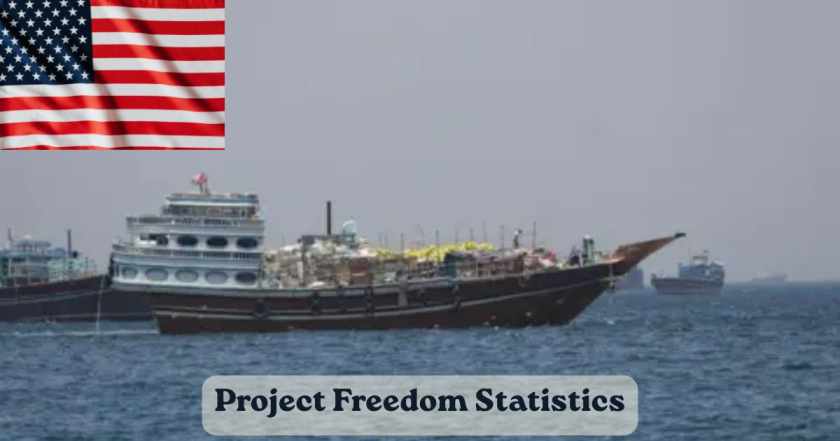
What Is Project Freedom in 2026
Project Freedom is a United States military escort operation launched on May 4, 2026, announced by President Donald Trump via a Truth Social post on the evening of Sunday, May 4, 2026, hours before the operation went into effect. The initiative directs the US Navy to escort neutral and uninvolved nations’ ships safely through the Strait of Hormuz — the narrow waterway between Iran and Oman through which approximately 20% of the world’s oil and natural gas supplies ordinarily flow — which has been effectively closed to international commercial shipping since the early stages of the 2026 Iran-US war that began on February 28, 2026, when the United States launched Operation Epic Fury, its direct military campaign against Iran. The Strait of Hormuz has remained a de facto blockade zone throughout the conflict: Iran has mined portions of the waterway, sunk or disabled Iranian naval vessels, and explicitly threatened any foreign military or commercial vessel attempting to pass. The result — confirmed by the International Maritime Organization (IMO) — is that approximately 2,000 vessels carrying approximately 20,000 seafarers are stranded in the Gulf near the strait, unable to leave, running dangerously low on food, fuel, and water, with crews from dozens of nations who have “absolutely nothing to do with” the US-Iran conflict, in Trump’s own words. Project Freedom is the US military’s direct response to that maritime humanitarian and economic crisis. In Trump’s Truth Social announcement, he described the operation as a guided exit for ships belonging to countries that are “neutral and innocent bystanders” — a framing that positions Project Freedom simultaneously as a humanitarian mission, an economic necessity, and a direct challenge to what he characterised as Iran’s illegitimate de facto control of an international waterway.
As of May 5, 2026 — today — Project Freedom is operational but its first hours have already produced the escalation that military analysts predicted. The US and Iranian militaries traded fire on Monday, May 4, immediately after the operation got underway. Two US Navy destroyers — USS Truxtun and USS Mason — transited the Strait of Hormuz under a “sustained barrage” of small boats, missiles, and drones from Iranian forces, defended by fighter aircraft and AH-64 Apache helicopters, according to reports cited by Fox News. Despite the attack, CENTCOM confirmed neither destroyer was hit — US forces intercepted or deterred each threat. Iran’s navy separately claimed in Iranian state media that it had prevented US ships from entering the Strait of Hormuz, a claim that CENTCOM denied in a post on its official X account, stating flatly: “No US Navy ships have been struck.” Iranian officials have warned that any US interference in the Strait would be considered a violation of the ceasefire that has been in effect since April 8, 2026, and Iranian lawmaker Ebrahim Azizi wrote on X that “The Strait of Hormuz and the Persian Gulf would not be managed by Trump’s delusional posts.” The first Maersk subsidiary vessel has already made the transit with US military escort, confirming at least one commercial shipping success in the operation’s opening hours. Whether Project Freedom can sustain those escorts at scale — given that more than 100 ships transited the strait daily before the conflict, while only about a dozen US Navy vessels are capable of defending shipping, per analyst assessment — is the central operational question of the coming days.
Interesting Key Facts About Project Freedom 2026
| Key Fact | Verified Detail |
|---|---|
| Operation name | Project Freedom |
| Announced by | President Donald Trump — via Truth Social post |
| Date announced | Sunday, May 4, 2026 (evening) |
| Date operation went into effect | Monday, May 5, 2026 — hours after Trump’s announcement |
| Announced by CENTCOM (official statement) | US Central Command — via post on X |
| Mission stated by Trump | Guide neutral nations’ ships safely out of the Strait of Hormuz |
| Military assets committed — CENTCOM statement | Guided-missile destroyers + 100+ land and sea-based aircraft + multi-domain unmanned platforms |
| Aircraft types confirmed (CENTCOM) | F-16 fighter aircraft among the 100+ aircraft supporting Project Freedom |
| Helicopters confirmed | AH-64 Apache helicopters — defending during first transit |
| USS Truxtun and USS Mason | Two US destroyers that transited Hormuz on May 4 under Iranian barrage |
| USS Truxtun / USS Mason — damage | Neither destroyer was hit — CENTCOM confirmed |
| Iranian attack type on US destroyers | Sustained barrage of small boats, missiles, and drones |
| Iranian navy claim | Claimed it prevented US ships entering Hormuz — denied by CENTCOM |
| CENTCOM denial | “No US Navy ships have been struck” — CENTCOM official X post |
| First confirmed commercial transit | Maersk subsidiary vessel crossed Strait with US military escort |
| Iran’s official position | Any interference = ceasefire violation — Iranian parliament security commission |
| Iranian armed forces warning | US navy “will be attacked” if it approaches or enters Hormuz — Fars news agency |
| Trump framing | Ships’ nations are “neutral and innocent bystanders” — humanitarian framing |
| Trump warning to Iran | Any interference “will have to be dealt with forcefully” |
| Vessels stranded in Gulf (IMO estimate) | ~2,000 vessels — IMO |
| Seafarers stranded (IMO estimate) | ~20,000 seafarers aboard stranded ships near Hormuz |
| Attacks on vessels since conflict began (IMO) | At least 19 attacks on vessels — 10 seafarers killed, 8 injured |
| IMO quote | “There is no precedent for the stranding of so many seafarers in the modern age” — Damien Chevallier, IMO Maritime Safety Division |
| Ships running low on | Food, fuel, water — IMO warning of critical shortages |
| Strait of Hormuz — share of global oil/gas | ~20% of global oil and gas exports pass through |
| Context: ceasefire effective since | April 8, 2026 — Iran-US ceasefire |
| Context: US blockade of Iranian ports started | April 13, 2026 (maintained as of today) |
| US-Iran war started | February 28, 2026 — Operation Epic Fury |
| Iranian navy vessels destroyed (Trump claim, April) | 158 Iranian naval vessels — Trump stated navy was “annihilated” |
| Mine-dropping vessels sunk | 28 mine-dropping vessels sunk — Trump April statement |
| Iranian submarines | All Iranian submarines reportedly sunk during conflict |
| US dedicated minesweepers | None — “The US no longer has dedicated mine-sweeping vessels” — analyst John Hackett |
| Analyst estimate: ships capable of defending shipping | “Only about a dozen” US Navy vessels — analyst quoted by Al Jazeera |
| Pre-war daily strait transits | More than 100 ships per day — Al Jazeera |
Source: CNN — “Project Freedom: Trump’s Plan to ‘Guide’ Ships Through Hormuz Leaves Many Questions Unanswered” (published 9 hours ago, May 4, 2026); Fox News Live — “Trump Iran War Hormuz Strait May 4” (4 hours ago, May 4–5, 2026); Wikipedia — “Operation Project Freedom” (updated 4 hours ago, May 5, 2026); Al Jazeera — “Trump’s Project Freedom: Can US Navy ‘Guide’ Stuck Ships Out of Hormuz?” (published 17 hours ago, May 4, 2026); CNBC — “US Military Denies Iran’s Claim It Struck American Warship in Strait of Hormuz” (16 hours ago, May 4, 2026); Reason — “Project Freedom” (17 hours ago, May 4, 2026); CENTCOM official X posts (May 4–5, 2026); International Maritime Organization (IMO) statement via Al Jazeera (May 4, 2026)
The key facts of Project Freedom confirm that today’s operation is simultaneously unprecedented in its ambition and deeply uncertain in its execution. The 100+ aircraft committed by CENTCOM — including F-16 fighters among them, along with the guided-missile destroyers and “multi-domain unmanned platforms” — is a substantial force projection. But the logistics of what Project Freedom actually means in practice have not been publicly defined, which is the central criticism that military and shipping analysts raised within hours of Trump’s announcement. CNN’s reporting, published nine hours ago, noted that the CENTCOM statement specified the military assets committed but did not define how those assets would physically get merchant ships moving through the strait. Are US ships entering the strait itself? Are they escorting vessels from a position outside Iranian missile range? How are individual ships requesting escort? Who coordinates the queue of 2,000 stranded vessels? The operation went live before any of these operational details were publicly explained — a sequencing that reflects Trump’s characteristically announcement-first, details-later approach to major policy initiatives.
The Iranian response within hours of the announcement was predictable in direction but significant in intensity. The warnings from the Iranian parliament’s national security commission, the armed forces, and state media were immediate and unambiguous — and they were followed within hours by the actual attack on USS Truxtun and USS Mason as those destroyers transited the strait. The “sustained barrage” of small boats, missiles, and drones that the two destroyers faced — and successfully defended against — is exactly the operational scenario that has made Western naval commanders cautious about committing surface ships inside the Strait of Hormuz since February 28. Iran’s “mosquito fleet” — hundreds of small, fast attack craft that can swarm destroyers in the confined waters of the strait — has been a recognized asymmetric challenge to US naval operations since at least the 1988 Operation Praying Mantis. The fact that Truxtun and Mason survived their transit undamaged is encouraging; the fact that they faced a sustained barrage doing so is a warning about the cost of operating at scale.
Project Freedom Military Assets & Forces Statistics in 2026
US Forces Committed to Project Freedom — Confirmed CENTCOM Data
| Military Asset / Metric | Detail | Source |
|---|---|---|
| Total aircraft committed | 100+ land and sea-based aircraft | CENTCOM official X statement (May 4, 2026) |
| Aircraft types confirmed (named) | F-16 fighter aircraft — CENTCOM confirmed | CENTCOM X post (May 4, 2026) |
| Other aircraft (types) | “More than 100 land- and sea-based aircraft” — full breakdown not disclosed | CENTCOM |
| Surface vessels | Guided-missile destroyers — named type | CENTCOM |
| Unmanned systems | Multi-domain unmanned platforms — named type | CENTCOM |
| Helicopters | AH-64 Apache helicopters — confirmed present during USS Truxtun/Mason transit | Fox News (4 hours ago) |
| First transit destroyers | USS Truxtun and USS Mason | Fox News / CNBC (May 4, 2026) |
| Destroyer class | Arleigh Burke-class guided-missile destroyers | Fox News (May 4, 2026) |
| USS Truxtun / USS Mason status | Unharmed — confirmed by CENTCOM | CENTCOM X (May 4, 2026) |
| AH-64 Apache role | Providing air cover for destroyer transit — not a surface escort asset | Fox News (May 4, 2026) |
| CENTCOM quote on F-16s | “Air Force F-16 fighter aircraft are among more than 100 land- and sea-based aircraft supporting Project Freedom” | CENTCOM X post — Fox News (May 4, 2026) |
| CENTCOM quote on mission | “US forces are supporting Project Freedom and enforcing the naval blockade on Iranian ports” | CENTCOM X post — CNBC (May 4, 2026) |
| Mine operations prior to Project Freedom | April 11, 2026 — two US destroyers transited Hormuz “as part of a broader mission to ensure the strait is fully clear of sea mines” | CNN (9 hours ago) |
| US dedicated minesweepers | None exist in US Navy — critical capability gap | John Hackett, analyst (Al Jazeera, May 4, 2026) |
| Mine-clearing timeline | Could take “weeks or months” — Al Jazeera citing analysts | Al Jazeera (May 4, 2026) |
| Iran’s remaining naval capacity | “Significant” — fast-attack boats capable of harassing shipping — analyst | Al Jazeera (May 4, 2026) |
| Analyst capable-ship estimate | Only “about a dozen” US Navy vessels capable of defending shipping in Hormuz | John Hackett — Al Jazeera (May 4, 2026) |
| Prior to war — daily transits | 100+ ships per day through Hormuz | Al Jazeera (May 4, 2026) |
| Project Freedom math problem | 12 capable US ships vs. 100+ daily ship transits pre-war — “maths simply does not work” — Hackett | Al Jazeera (May 4, 2026) |
| USS Pinckney | Conducting blockade operations — photographed escorting vessel April 2026 | CNN photo — May 4, 2026 |
| US Marines boarding (April 28, 2026) | 31st MEU boarded M/V Blue Star III suspected of violating Iran blockade — released after search | CNBC photo caption (May 4, 2026) |
| CENTCOM previous Hormuz transit (since April 11) | Only one occasion acknowledged — April 11 mine clearance mission | CNN (May 4, 2026) |
Source: CENTCOM official X posts (May 4–5, 2026) via Fox News (4 hours ago) and CNBC (16 hours ago); CNN (9 hours ago); Al Jazeera (17 hours ago); Fox News Live blog (4 hours ago)
The military forces committed to Project Freedom represent a significant commitment of US air and naval power — but the critical caveat is that the published numbers (100+ aircraft, guided-missile destroyers, unmanned platforms) describe the protective envelope around the operation rather than the escort capacity itself. The operative question is how many ships simultaneously can be escorted through a 33-kilometre-wide strait under Iranian threat, given the geography, the mine threat, and the speed differential between commercial shipping and military escorts. John Hackett’s “maths don’t work” assessment — that only about a dozen US Navy vessels are capable of defending shipping while over 100 commercial ships transited the strait daily before the war — identifies the core operational constraint that no amount of aircraft coverage resolves. Aircraft can defend against missiles and drones. They cannot physically escort tankers through mined waters. And with no dedicated US minesweepers in the Navy’s inventory — a capability the US declined to maintain after the Cold War — the mine threat in the Strait remains the most dangerous single obstacle to a sustained escort operation, regardless of Project Freedom’s air coverage.
The April 11 mine clearance mission — the only previous CENTCOM-acknowledged destroyer transit of the Strait since the ceasefire — provides the most direct precedent for what Project Freedom’s surface operations look like. That two-destroyer mission went through specifically to assess mine conditions, and the timeline implications are significant: if the mine clearance mission on April 11 was the first, and if clearing the strait of mines “could take weeks or months” as analysts project, then Project Freedom may be launching a convoy escort operation into waters that have not been fully cleared of an enemy mine threat. The AH-64 Apache helicopters covering the Truxtun and Mason transit are particularly interesting from a tactical standpoint: Apaches are primarily used for close air support and anti-armour operations, but their deployment in a naval escort role reflects the availability of assets aboard the carrier strike groups operating in the Arabian Sea and their effectiveness against the small boat swarm threat that Iran’s mosquito fleet represents — attack helicopters can engage small fast-attack craft at ranges and angles that are difficult for ship-mounted weapons systems to cover simultaneously.
Strait of Hormuz Strategic Statistics in 2026
Strait of Hormuz — Geographic, Economic & Military Significance
| Strait of Hormuz Metric | Figure / Detail | Source |
|---|---|---|
| Location | Between Iran (north shore) and Oman/UAE (south shore) | Geographic record |
| Width at narrowest point | ~33 kilometres (21 miles) | Geographic record |
| Navigable shipping channels | 2 shipping lanes — each 3.2 km (2 miles) wide | IMO / geographic record |
| Share of global oil passing through | ~20% of global oil supply | CNBC (May 4, 2026); Al Jazeera; CNN |
| Share of global LNG passing through | ~20% of global LNG supply | Multiple sources |
| Pre-war daily ship transits | 100+ ships per day | Al Jazeera (May 4, 2026) |
| Current ship transit status | Effectively closed — Iranian blockade and mines | CNN (May 4, 2026) |
| Vessels currently stranded (IMO) | ~2,000 vessels in Gulf near strait | IMO — Al Jazeera (May 4, 2026) |
| Seafarers stranded (IMO) | ~20,000 seafarers aboard stranded vessels | IMO — Al Jazeera (May 4, 2026) |
| Attacks on vessels since Feb 28, 2026 | At least 19 attacks — IMO confirmed | IMO — Al Jazeera (May 4, 2026) |
| Seafarers killed (IMO confirmed) | 10 killed; 8 injured | IMO — Al Jazeera (May 4, 2026) |
| IMO Director statement | “There is no precedent for the stranding of so many seafarers in the modern age” — Damien Chevallier | Al Jazeera (May 4, 2026) |
| Oil price impact | Significant spike throughout conflict — global economic strain | Multiple sources |
| Iran’s stated control mechanism | Iranian navy claims de facto control — armed forces warn against entry | Fox News / Al Jazeera (May 4, 2026) |
| Iran mines in strait | Confirmed — US mine-clearing operations underway since April 11 | CNN (May 4, 2026) |
| Mine clearing timeline | “Weeks or months” to fully clear — analyst assessment | Al Jazeera (May 4, 2026) |
| UAE tanker attacked | Iran targeted a UAE tanker in strait as Project Freedom began — Wikipedia | Wikipedia (4 hours ago) |
| US blockade of Iranian ports | In effect since April 13, 2026 | CNBC; Fox News |
| Iran-US ceasefire | In effect since April 8, 2026 — but maritime incidents continue | CNN; CNBC (May 4, 2026) |
| Trump demand for peace talks | Iran must lift blockade first — Trump insists | Al Jazeera (May 4, 2026) |
| Iran demand for peace talks | Permanent end to hostilities — Iran insists | Al Jazeera (May 4, 2026) |
| Peace negotiations via Pakistan | Pakistan acting as mediator — talks ongoing since ceasefire | Al Jazeera (May 4, 2026) |
| Trump ceasefire characterisation | Told Congress hostilities “terminated” — letter dated mid-April 2026 | Fox News (May 4, 2026) |
Source: CNN (9 hours ago); Al Jazeera (17 hours ago); CNBC (16 hours ago); Fox News Live (4 hours ago); Wikipedia — Operation Project Freedom (4 hours ago); IMO statement via Al Jazeera (May 4, 2026)
The Strait of Hormuz statistics explain why Project Freedom’s launch is simultaneously the most consequential maritime policy decision of the 2026 crisis and among the most operationally complex. The strait is 33 kilometres wide at its narrowest point, with just two 3.2-kilometre shipping lanes — an extraordinarily confined waterway for what is, in normal times, one of the world’s busiest international sea routes. The physical narrowness means that defensive operations are necessarily close-range: an Iranian shore-based anti-ship missile battery on the Iranian coast can reach any vessel in either shipping lane within seconds. Iranian small boats launching from coastal bases or islands within the strait can reach shipping lanes in minutes. The mine threat — confirmed by the April 11 mine clearance mission — exists throughout the confined waters between the lanes and the Iranian shore, and mines do not discriminate between military escorts and commercial vessels. The 2,000 stranded vessels and 20,000 seafarers documented by the IMO represent the human consequence of this geography becoming a war zone: ships that entered the Gulf before the conflict cannot leave without passing the minefield and the Iranian naval threat, and ships from outside have not dared enter since February 28.
The IMO’s unprecedented humanitarian statement — that “there is no precedent for the stranding of so many seafarers in the modern age” — is the most significant single phrase from an international institution about this crisis, because the IMO is not a political body that makes such declarations lightly. Its confirmation of 10 seafarers killed and 8 injured in at least 19 vessel attacks since the conflict began documents that the human cost of the Hormuz closure has already been measured in lives, not just barrels of oil. The insurance and liability dimension that analyst Hackett raised — that even if the US declares the strait safe, shipping companies and their insurers must independently decide whether to risk ships and crews without guarantees — is a structural barrier to Project Freedom’s success that military force alone cannot overcome. A Lloyd’s of London war risk premium at the levels that currently apply to the Strait of Hormuz can make a transit economically unviable even with a US Navy escort, because the insurance cost can exceed the commercial value of the cargo. The Maersk subsidiary vessel that made today’s transit with US escort is the first real-world test of whether that insurance calculus shifts in the face of a functioning US escort operation.
Project Freedom Escalation & Geopolitical Statistics in 2026
Military Exchanges, Iran Response & Diplomatic Context — May 4–5, 2026
| Event / Metric | Detail | Date / Source |
|---|---|---|
| Trump Truth Social announcement | Announced Project Freedom — neutral ships to be guided through Hormuz | Evening of May 4, 2026 |
| Operation went into effect | Monday, May 5, 2026 — hours after announcement | Fox News; CNBC |
| USS Truxtun and USS Mason transit | Transited Hormuz — faced sustained barrage of small boats, missiles, drones | May 4, 2026 — Fox News (4 hrs ago) |
| USS Truxtun and USS Mason outcome | Neither struck — CENTCOM confirmed | CENTCOM X post via CNBC |
| Iran navy claim | Prevented US ships from entering Hormuz | Iranian state media — CNN (9 hrs ago) |
| CENTCOM denial | “No US Navy ships have been struck“ | CENTCOM X post — CNBC (16 hrs ago) |
| Iran threat — pre-operation | Iranian armed forces: US ships “will be attacked” if they approach/enter Hormuz | Iranian armed forces HQ — Fox News / CNN |
| Ebrahim Azizi (Iranian parliament) | Calling Project Freedom a ceasefire violation | X post — CNN / Al Jazeera (May 4, 2026) |
| Iran attack on UAE tanker | Iran targeted UAE tanker in strait as Project Freedom began | Wikipedia (4 hours ago) |
| CENTCOM F-16 statement | “Air Force F-16 aircraft are helping defend US forces and protect shipping in the Strait of Hormuz” | CENTCOM X — Fox News (4 hrs ago) |
| First confirmed commercial success | Maersk subsidiary vessel crossed strait with US escort | CNN (9 hours ago); Fox News |
| Ceasefire status | Ceasefire in effect since April 8 but maritime incidents continuing | CNN; CNBC |
| US-Iran war: no exchange of fire since | Trump letter to Congress: “no exchange of fire since April 7, 2026” | Fox News (May 4, 2026) |
| Trump to Congress on hostilities | Hostilities that began Feb 28 “have terminated” — Trump letter | Fox News (May 4, 2026) |
| US blockade of Iranian ports | Maintained since April 13 — growing and “going global” — Hegseth | Fox News (May 4, 2026) |
| Pete Hegseth on blockade (April 24) | “We seized their sanctioned ships, and we will seize more. Our blockade is growing and going global” | Pentagon briefing — Fox News (May 4, 2026) |
| Iran naval strength remaining | “Significant capacity” — fast-attack boats still operational — analyst Hackett | Al Jazeera (May 4, 2026) |
| Iran’s 158 naval vessel destruction (Trump claim) | Trump announced 158 Iranian naval vessels destroyed / “annihilated” | Wikipedia — April 2026 |
| Houthi / Somali pirate collaboration | New intelligence showing Houthi-Somali alliance targeting ships in Red Sea and Gulf of Aden | Fox News analyst Shalev (May 4, 2026) |
| Pakistan mediation | Peace negotiations via Pakistan ongoing since ceasefire — no agreement yet | Al Jazeera (May 4, 2026) |
| Global economic impact | Oil prices spiked throughout conflict — economic strain worldwide | Multiple sources |
| “Goalposts shifted” analysis | Analyst: objectives moved from regime change to economic outcome focused on Hormuz | Hackett — Al Jazeera (May 4, 2026) |
Source: CNN (May 4, 2026 — 9 hours ago); Fox News Live (May 4–5, 2026 — 4 hours ago); Wikipedia — Operation Project Freedom (May 5, 2026 — 4 hours ago); Al Jazeera (May 4, 2026 — 17 hours ago); CNBC (May 4, 2026 — 16 hours ago); Reason (May 4, 2026 — 17 hours ago)
The escalation and geopolitical context of Project Freedom’s first hours confirm that it is not, in any sense, a low-risk or clearly defined military operation — it is a high-stakes gamble in the world’s most contested waterway, launched with more political urgency than operational detail, into a ceasefire environment that Iran explicitly says the operation violates. The gap between Trump’s framing — a humanitarian mission to free “neutral and innocent” ships — and Iran’s framing — a ceasefire violation that their armed forces will respond to with force — is not a gap that can be bridged through public messaging. It is a gap that will be resolved through the actual sequence of events in the strait over the coming days, and those events have already begun with an Iranian barrage against US destroyers. Analyst Hackett’s most damning observation is that the stated objective has shifted across the duration of the 2026 conflict: what began as a campaign aimed at “regime change and dismantling Iran’s nuclear and missile capabilities” has narrowed to an economic objective focused specifically on the Strait of Hormuz. Whether Project Freedom represents a genuine path to restoring the strait to international freedom of navigation, or whether it is a political announcement that outpaces its own operational capacity, will be determined in the hours and days ahead.
The Houthi-Somali pirate collaboration flagged by Israeli naval analyst Shalev in Fox News’s live blog — describing a new intelligence picture of “transactional collaboration” between Houthi forces and Somali pirate groups using “skiffs and new tech to strike ships with coordination not seen in a decade” — adds a further layer of maritime security complexity beyond the Iran-US confrontation itself. Saudi crude rerouted away from the Strait of Hormuz has created what Shalev calls a “target-rich environment” for Houthi and Somali forces in the Gulf of Aden and Red Sea approaches. This means Project Freedom, even if it successfully opens the Hormuz corridor, does not resolve the end-to-end security problem for merchant shipping trying to reach global markets — it simply moves the chokepoint from inside the strait to the waters surrounding it. Pete Hegseth’s statement that the US blockade is “growing and going global” and “sending shockwaves through China” — which imports at least 70% of its oil by sea, with 90% of that moving by sea lanes and Iran having supplied 14% of China’s imports before the conflict — adds a strategic Pacific dimension to what began as a Middle Eastern war, one whose full implications for the US-China competition are only beginning to be understood.
Disclaimer: This research report is compiled from publicly available sources. While reasonable efforts have been made to ensure accuracy, no representation or warranty, express or implied, is given as to the completeness or reliability of the information. We accept no liability for any errors, omissions, losses, or damages of any kind arising from the use of this report.