
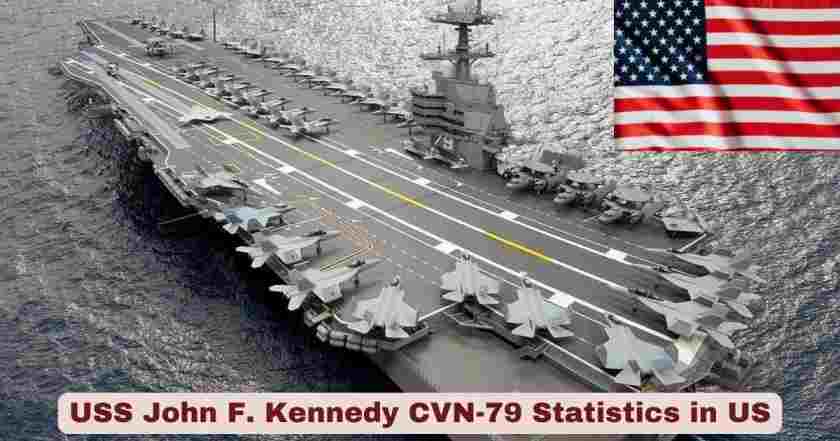
USS John F. Kennedy in America 2026
The USS John F. Kennedy (CVN-79) is the second Gerald R. Ford-class nuclear-powered aircraft carrier of the United States Navy — a 1,092-foot (333-meter), 100,000-ton warship that is simultaneously the most technologically advanced aircraft carrier ever built and the most delayed major naval construction project in recent American history. Named for the 35th President of the United States, who served as a U.S. Navy Lieutenant in World War II and was killed by an assassin in Dallas, Texas on November 22, 1963, the ship carries 23 major technological advancements over the Nimitz-class carriers that have dominated American naval aviation for the past 50 years — including the Electromagnetic Aircraft Launch System (EMALS) that replaces the steam catapults used on every previous carrier since the 1950s, the Advanced Arresting Gear (AAG) for aircraft recovery, the Advanced Weapons Elevators (AWE) that move ordnance through the ship at unprecedented speed, and a Dual Band Radar (DBR) system combining X-band and S-band capabilities that gives the ship an air and surface tracking picture far superior to anything previously mounted on a U.S. warship. Contracted at a total cost of $13.196 billion — the most expensive individual ship the United States Navy has ever built — CVN-79 is currently a Pre-Commissioning Unit (PCU), meaning it has not yet been formally delivered to the Navy and accepted into commissioned service. As of March 24, 2026, the ship is conducting manufacturer’s sea trials under its own nuclear power after departing Newport News Shipbuilding on January 28, 2026 — an event documented by The Aviationist and confirmed by multiple naval defense publications — on a trajectory toward delivery to the Navy in March 2027, with formal commissioning and homeporting at Naval Base Kitsap-Bremerton in Washington State planned to follow.
The USS John F. Kennedy’s story in 2026 is the story of American naval ambition colliding with the practical limits of industrial capacity, workforce availability, and the extraordinary complexity of integrating more than 23 brand-new technologies into a single hull simultaneously. When the Gerald R. Ford (CVN-78) — the first ship of the class — was commissioned in 2017, it took until December 2021 to achieve initial operational capability, and until 2022 for its maiden deployment, after years of struggles with the very systems that CVN-79 is now working to certify. The Advanced Weapons Elevators that took until 2021 to complete on Ford created similar challenges on Kennedy; the Advanced Arresting Gear that required years of engineering work on Ford is now the system causing the two-year delivery delay that pushed Kennedy’s delivery from an original July 2025 target to March 2027. HII’s spokesperson Todd Corillo acknowledged the situation directly: “Kennedy’s construction was fairly advanced when many Ford lessons were realized, precluding timely implementation of lessons learned for Kennedy.” The result is that the U.S. Navy, which is required by law to maintain an 11-carrier battle force, retired USS Nimitz (CVN-68) in May 2026 and will operate with only 10 carriers for the approximately 12 months until Kennedy delivers — at precisely the moment when Operation Epic Fury in the Middle East and rising tensions in the Pacific are generating the highest simultaneous carrier demand in decades. The Kennedy is the future of American naval power. In 2026, the future is late.
USS John F. Kennedy Key Facts in 2026
| Fact Category | Key Fact / Data Point |
|---|---|
| Official Designation | PCU John F. Kennedy (CVN-79) — Pre-Commissioning Unit; not yet commissioned into USN service |
| Ship Class | Gerald R. Ford-class — second ship of class (CVN-78 is Ford; CVN-79 is Kennedy) |
| Named For | President John F. Kennedy — 35th President; U.S. Navy Lieutenant, WWII; killed November 22, 1963 |
| Namesake’s Navy Service | JFK commanded PT-109 — torpedo boat — in the Solomon Islands during WWII |
| Ship’s Sponsor | Caroline Bouvier Kennedy — daughter of President Kennedy |
| Builder | Huntington Ingalls Industries (HII) — Newport News Shipbuilding, Newport News, Virginia |
| Contract Awarded | FY2013 (Fiscal Year 2013) procurement |
| Construction Start | February 2011 — fabrication began |
| Ceremonial Keel Laying | August 22, 2015 — at Newport News Shipbuilding |
| Floated Out / Launched | October 29, 2019 — dry dock flooded; first time in water |
| Christened | December 7, 2019 — by Caroline Kennedy, who reenacted the bottle break she performed at CV-67’s christening 52 years earlier |
| Crew Activated (PCU) | October 1, 2019 — Pre-Commissioning Unit crew ceremony aboard ship |
| Nuclear Propulsion First Tests | Late September 2025 — A1B reactors first operated to propel ship independently; successful |
| First Departure Under Own Power | January 28, 2026 — departed Newport News Shipbuilding for manufacturer’s sea trials |
| Current Status (March 2026) | At sea — manufacturer’s sea trials underway — testing all systems ahead of delivery |
| Planned Delivery to Navy | March 2027 — per FY2026 Navy budget justification |
| Original Planned Delivery | July 2025 — pushed back 20 months; multiple prior delays from original 2024 target |
| Total Procurement Cost (FY2026 Budget Estimate) | $13,196,000,000 ($13.196 billion) |
| FY2026 Cost-to-Complete (CTC) Request | $150 million — to cover cost growth |
| Planned Homeport | Naval Base Kitsap-Bremerton, Washington — first Ford-class on U.S. West Coast; arrival no earlier than 2029 |
| Kitsap-Bremerton Facility Upgrade | $145 million overhaul of electrical infrastructure began May 2025 ahead of Kennedy’s arrival |
| Number of New Technologies | 23 major technological advancements over Nimitz class |
| Previous USS John F. Kennedy | CV-67 — conventional carrier; served 1968–2007; towed to Texas for scrapping February 2025 |
Source: USNI News July 7, 2025 “Carrier John F. Kennedy Delivery Delayed 2 Years”; Stars and Stripes July 8, 2025; The Aviationist January 29, 2026 “Next U.S. Navy Aircraft Carrier Sets Sail for Sea Trials”; Grokipedia USS John F. Kennedy (CVN-79) updated 2 days ago, March 22, 2026; Wikipedia USS John F. Kennedy (CVN-79) updated 1 week ago; Congressional Research Service RS20643 Ford Class Aircraft Carrier Program (CRS.gov); The Aviation Geek Club July 8, 2025; Army Recognition January 2026
The December 7, 2019 christening by Caroline Kennedy — who broke the traditional bottle of champagne across the bow — held extraordinary symbolic resonance because it was a repetition of an act she had performed as a child. On October 11, 1967, a 10-year-old Caroline Kennedy christened the original USS John F. Kennedy (CV-67) four years after her father’s assassination — an image that became one of the most famous photographs in naval history. Standing at the Newport News pier 52 years later, an adult Caroline Kennedy reenacted that moment for the second ship to bear her father’s name, a visual connection between 1967 and 2019 that compressed six decades of American naval history into a single gesture. The PT-109 connection — JFK served as commander of Motor Torpedo Boat PT-109 in the Solomon Islands, surviving its ramming and sinking by a Japanese destroyer on August 2, 1943, and leading his surviving crew to rescue — links the carrier’s presidential namesake to the naval service in a way that goes beyond honorary naming. Kennedy was an actual combat sailor who knew what it meant to be at sea in a threatening environment, and the ship bearing his name is designed to project that same kind of presence — albeit at a scale and with a lethality that PT-109’s skipper could not have imagined.
The $145 million electrical infrastructure upgrade at Naval Base Kitsap-Bremerton that began in May 2025 — not as a construction project for the ship itself, but as preparation of the pier where the ship will eventually berth — is a useful illustration of the scale of preparation that a Ford-class carrier requires even before it arrives. The Kennedy’s A1B nuclear reactors and its dramatically increased electrical generation capacity — nearly three times that of a Nimitz-class carrier — require pier electrical infrastructure that existing West Coast naval facilities were not designed to provide. Bremerton’s upgrade is addressing this gap years before the ship is scheduled to arrive in 2029, because the infrastructure timeline and the ship timeline must be coordinated or the carrier arrives at a pier that cannot support it. This kind of long-lead infrastructure coordination is invisible to most public discussions of carrier programs but represents a significant fraction of the total system cost of deploying a Ford-class carrier.
USS John F. Kennedy Technical Specifications Statistics in 2026
| Technical Parameter | Specification / Data |
|---|---|
| Ship Class | Gerald R. Ford-class nuclear-powered aircraft carrier |
| Hull Classification | CVN — Carrier, Volplane (fixed-wing), Nuclear |
| Length | 1,092 feet (333 meters) |
| Beam (Extreme) | Approximately 256 feet (78 m) at widest (flight deck) |
| Displacement (Full Load) | Approximately 100,000–104,000 tons |
| Propulsion | Two A1B nuclear reactors — designed by Bechtel; manufactured by Bechtel at KAPL |
| A1B Reactor Advantage over A4W (Nimitz) | A1B provides 3× the electrical generating capacity of Nimitz-class A4W reactors |
| Service Life | 50+ years — nuclear fuel core designed to last the ship’s full service life without refueling |
| Aircraft Launch System | Electromagnetic Aircraft Launch System (EMALS) — replaces steam catapults |
| Aircraft Recovery System | Advanced Arresting Gear (AAG) — replaces hydraulic wire systems |
| Weapons Elevators | 11 Advanced Weapons Elevators (AWE) — electromagnetic; 3× faster than Nimitz hydraulic elevators |
| Radar System | Dual Band Radar (DBR) — X-band AN/SPY-3 + S-band AN/SPY-4; combined air and surface tracking |
| Aircraft Capacity | Approximately 75+ aircraft — fighters, helicopters, UAVs |
| Primary Aircraft (At Delivery) | F-35C Lightning II (required by Congressional mandate); F/A-18E/F Super Hornet; EA-18G Growler; E-2D Hawkeye; MH-60R/S Seahawk |
| Sortie Generation Rate | 33% higher than Nimitz-class — designed for higher tempo strike operations |
| Crew Size | Approximately 4,500 crew (ship’s company + air wing) — fewer than Nimitz due to automation |
| Number of New Technologies | 23 major new technologies incorporated vs. Nimitz class |
| Flight Deck Improvements | Redesigned flight deck with island moved aft — improved aircraft operations flow |
| Island Position | Moved 140 feet aft compared to previous carrier designs — creates larger flight deck area |
| Lifecycle Cost Savings vs. Nimitz | ~$4 billion per ship in lifecycle operations and support cost reduction |
| Electrical Generation | ~13,800 kilowatts continuous — supports directed energy weapons, railguns, future systems |
Source: Grokipedia USS John F. Kennedy (CVN-79) updated March 22, 2026; Wikipedia USS John F. Kennedy (CVN-79) updated 1 week ago; CRS RS20643 Navy Ford Class Aircraft Carrier Program; HII Newport News Shipbuilding official CVN-79 fact sheet; The Aviation Geek Club July 8, 2025; seaforces.org CVN-79 profile
The EMALS (Electromagnetic Aircraft Launch System) — which replaces the steam catapults that have launched aircraft from U.S. carriers since the 1950s — is the most consequential and most controversial of the 23 new technologies on the Ford class. Steam catapults work by suddenly releasing high-pressure steam accumulated in accumulators, producing a very powerful but somewhat imprecise impulse that has worked reliably for decades but cannot be precisely tuned for different aircraft weights. EMALS uses a linear induction motor powered by stored electrical energy to accelerate aircraft down the track with a launch stroke that can be precisely dialed to the weight and type of aircraft being launched — meaning the system can launch a lightweight drone at a gentle setting, an F-35C at a medium setting, and a fully loaded E-2D Hawkeye at a heavy setting, all with the same physical hardware and with dramatically reduced airframe stress on the aircraft compared to steam catapults. The 33% higher sortie generation rate promised by the Ford class is in large part the product of EMALS’s ability to reset faster between launches, the Advanced Weapons Elevators’ ability to move ordnance more quickly to the flight deck for rearming, and the redesigned flight deck geometry that reduces the movement time for aircraft between the hangar, the rearming points, and the catapult tracks. Each of these improvements is modest individually; combined, they fundamentally change the operational tempo of carrier aviation.
The $4 billion per-ship lifecycle cost savings compared to the Nimitz class — a figure cited in official program descriptions and CRS reports — is the strategic financial argument that justifies the Ford class’s enormous procurement cost. A Nimitz-class carrier operating for 50 years requires periodic nuclear refueling, extensive manpower (the Ford class’s automation reduces crew requirements), and maintenance-intensive legacy systems across its service life. The Ford class’s A1B reactors with fuel cores designed to last the ship’s full service life eliminate refueling costs entirely; its reduced crew requirements lower personnel costs continuously; and its higher sortie generation rate means more strike capacity per dollar of carrier operational cost. Whether the $4 billion lifecycle saving eventually materializes as promised depends on the new technologies performing to specification reliably over decades — which is precisely what the current sea trials period is designed to validate before the Navy accepts delivery. If EMALS, AAG, and AWE achieve the reliability rates that the Ford-class promises, the lifecycle economics will justify every dollar of the procurement cost. If they do not — as was the case for Ford in its early years — the cost calculations look considerably less favorable.
USS John F. Kennedy Construction and Delay Statistics in 2026
| Construction / Timeline Metric | Date / Data |
|---|---|
| Construction Start (Fabrication) | February 2011 |
| Ceremonial Keel Laying | August 22, 2015 — Newport News Shipbuilding |
| Dry Dock Flooded / First Water | October 29, 2019 — 100 million+ gallons pumped in over several days |
| Christening | December 7, 2019 — by Caroline Kennedy |
| PCU Crew Activation | October 1, 2019 — ceremony aboard ship |
| EMALS First Testing | 2022 — first ship-level EMALS tests |
| Combat System Testing | 2023 |
| Flight Deck / Island Upgrade Contract | ~$400 million contract awarded by Navy to HII in 2023 for flight deck, island, and weapons systems upgrades |
| EMALS Dead-Load Testing Start | February 2024 — weighted sleds shot off deck to simulate aircraft launches |
| Dead-Load Testing End | End of April 2024 |
| Nuclear Propulsion First Operation (Pier-Side) | Late September 2025 — first reactor propulsion test; tugboats assisted into James River |
| Ship Completion Level (Mid-2025) | ~76% complete (estimated from aerial photography per open sources; USNI) |
| First Departure Under Own Power | January 28, 2026 — departed Newport News for manufacturer’s sea trials |
| Original Delivery Target (FY2019 Plan) | June 2024 |
| Revised Delivery Target (FY2023 Plan) | 2025 (shifted from 2024 for single-phase delivery approach to meet F-35C mandate) |
| Revised Delivery Target (FY2024 Plan) | July 2025 |
| Current Delivery Target (FY2026 Budget) | March 2027 — per FY2026 Navy budget justification documents |
| Total Delivery Delay from Original | Approximately 33 months from June 2024 to March 2027 |
| Primary Delay Causes | AAG certification delays + AWE work — per FY2026 budget justification |
| Secondary Delay Causes | COVID-19 supply chain disruption; HII Newport News workforce challenges; complexity of new system integration |
| Congressional Mandate (Section 124, NDAA FY2020) | Kennedy must be capable of operating F-35C before completing Post-Shakedown Availability |
| Single-Phase Delivery Approach | Work normally done post-delivery (PSA) moved into construction period — intended to meet F-35C mandate while accelerating effective combat capability |
| HII Spokesperson Statement (Corillo) | “Kennedy’s construction was fairly advanced when many Ford lessons were realized, precluding timely implementation of lessons learned for Kennedy” |
Source: USNI News July 7, 2025; Stars and Stripes July 8, 2025; The Aviationist January 29, 2026; Grokipedia March 22, 2026; Wikipedia CVN-79 1 week ago; CRS RS20643; The Aviation Geek Club July 8, 2025; Bloomberg July 7, 2025 (Anthony Capaccio)
The sequence of delivery target revisions — from June 2024 to 2025 to July 2025 to March 2027 — is the most damaging statistical narrative in the Kennedy program, and understanding why it happened is essential for interpreting what the March 2026 sea trials actually mean for the ship’s future operational impact. The two systems responsible for the final, largest delay — the Advanced Arresting Gear and the Advanced Weapons Elevators — were both also the primary technical challenges on the Ford (CVN-78), whose final weapons elevator did not turn over to the Navy until 2021 — four years after the ship was commissioned. HII’s spokesperson was candid about the structural reason Kennedy is repeating some of Ford’s struggles rather than benefiting fully from Ford’s lessons: by the time the lessons were learned on Ford, Kennedy’s construction was already too far advanced to incorporate many of them. The ship that was supposed to benefit from being second — the ship whose procurement was justified in part by the “serial production savings” argument — ended up suffering from the same first-of-class challenges as Ford because its construction timeline overlapped so closely with Ford’s that the knowledge transfer was limited.
The January 28, 2026 departure for sea trials — the moment when the Kennedy moved under its own nuclear power away from the pier at Newport News for the first time on an extended operational evaluation — represents the most significant milestone in the ship’s 15-year construction history since the 2019 christening. Sea trials are the industrial equivalent of a final exam: every system that has been installed, tested pier-side, and certified by HII and Navy personnel must now demonstrate that it performs to specification in the operational environment — at sea, at speed, under the conditions of actual ship movement and vibration that no pier-side test can fully replicate. The EMALS system that has been shooting weighted sleds off the deck will now be tested launching actual aircraft. The AAG that has been pressure-tested in static configurations will now catch actual aircraft landing at full operational speed. The A1B reactors that first propelled the ship independently in September 2025 will now sustain extended propulsion across the full sea trials profile. The outcome of these tests will determine whether the March 2027 delivery date holds, slips again, or — in the optimistic scenario that the Navy is publicly hoping for — accelerates ahead of schedule.
USS John F. Kennedy vs. USS Nimitz and Fleet Gap Statistics in 2026
| Fleet / Comparison Metric | Data / Statistic |
|---|---|
| Current US Aircraft Carrier Inventory (Pre-May 2026) | 11 carriers — Nimitz scheduled to retire May 2026 |
| USS Nimitz (CVN-68) Retirement | May 2026 — commissioned 1975; 50+ years of service; oldest carrier |
| Fleet Size After Nimitz Retirement (May 2026) | 10 carriers — legally below mandated 11 minimum |
| Duration Below 11-Carrier Mandate | Approximately 12 months (May 2026 – March 2027 delivery of Kennedy) |
| Congressional 11-Carrier Mandate | US law requires 11-carrier battle force — brief dip is unavoidable given Kennedy’s delay |
| CVN-79 Total Procurement Cost | $13,196 million ($13.196 billion) — per FY2026 Navy budget |
| CVN-79 FY2026 CTC Funding Request | $150 million — cost growth above baseline |
| CVN-80 (USS Enterprise) Delivery | July 2030 — delayed from September 2029 |
| CVN-80 Procurement Cost Estimate | $14,247.5 million ($14.25 billion) |
| CVN-81 (USS Doris Miller) Status | In phased construction — benefits from Ford + Kennedy lessons |
| CVN-82 and CVN-83 | Advanced planning stage |
| USS Nimitz Class – Number Active (March 2026) | 10 Nimitz-class ships — CVN-68 retiring May 2026; others remain |
| Ford Class — Active Ships (March 2026) | 1 ship — USS Gerald R. Ford (CVN-78); CVN-79 not yet delivered |
| Ford-Class Advantage — Sortie Generation | 33% higher than Nimitz class |
| Ford-Class Lifecycle Cost Saving | ~$4 billion per ship vs. Nimitz class over 50-year life |
| Kennedy Planned Homeport | Naval Base Kitsap-Bremerton, Washington — first Ford-class on West Coast |
| Kennedy Bremerton Arrival (Planned) | No earlier than 2029 — homeporting after commissioning and workups |
| USS Gerald R. Ford (CVN-78) — Current Status | Deployed; confirmed participating in Operation Epic Fury (Iran) — Venezuela mission January 3, 2026 |
| Kennedy’s F-35C Mandate | Congressional Section 124, NDAA FY2020 — Kennedy must demonstrate F-35C capability before completing PSA |
| Kennedy vs. Ford — Improvement Focus | Software improvements, elevator reliability enhancements, system integration efficiencies from Ford’s lessons |
Source: USNI News July 7, 2025; Stars and Stripes July 8, 2025; Wikipedia CVN-79; CRS RS20643; The Aviation Geek Club; Grokipedia March 22, 2026; Army Recognition January 2026
The 10-carrier dip that began in May 2026 when USS Nimitz retired — and will last until Kennedy delivers in approximately March 2027 — is a strategic vulnerability that Navy planners and congressional critics have been flagging for years, and whose operational consequences are landing at the worst possible time. The United States currently has two carrier strike groups actively employed in the Middle East for Operation Epic Fury — the highest Middle East carrier commitment in two decades — while simultaneously managing rising tensions in the Pacific (where China’s carrier force is growing rapidly) and the ongoing Atlantic/European commitments to NATO partners in the post-Ukraine environment. An 11-carrier force operating simultaneously in the Middle East, Pacific, and Atlantic is already strained. A 10-carrier force trying to do the same is a force that will either deploy ships on shorter maintenance turnarounds (reducing long-term readiness) or accept gaps in geographic coverage (reducing deterrence credibility). The congressional mandate of 11 carriers exists precisely because the experience of operating with fewer has repeatedly demonstrated that the global commitments of the U.S. military cannot be sustained at required presence levels with a smaller fleet. Kennedy’s delay has made that mathematical reality unavoidable for approximately one year.
The West Coast homeporting plan — making Naval Base Kitsap-Bremerton the Kennedy’s permanent home and making it the first Ford-class carrier ever based on the U.S. West Coast — reflects a deliberate Indo-Pacific posture decision. The Bremerton location positions Kennedy for rapid deployment to the Western Pacific, South China Sea, and Indian Ocean without the 8,000-mile transit around South America or through Panama that East Coast carriers require to reach those waters. As China’s naval ambitions expand and the strategic importance of the Indo-Pacific grows, having a Ford-class carrier — with its 33% higher sortie generation rate and F-35C capability — forward-positioned for Pacific deployment rather than dependent on East Coast carrier redeployment is a meaningful improvement in American deterrence architecture. The $145 million Bremerton facility upgrade is the infrastructure investment expressing that strategic judgment, and the “no earlier than 2029” arrival timeline — even after the March 2027 delivery — reflects the commissioning, training, and workup schedule that a newly delivered carrier must complete before its homeport assignment becomes operational.
USS John F. Kennedy Program Costs and Budget Statistics in 2026
| Cost / Budget Metric | Data |
|---|---|
| Total Procurement Cost (FY2026 Budget Estimate) | $13,196,000,000 ($13.196 billion) |
| FY2026 CTC Request for CVN-79 | $150,000,000 — additional cost growth funding |
| CVN-78 (Ford) Final Procurement Cost | Approximately $12.9–13.0 billion — significantly over original cost estimates |
| CVN-79 Cost vs. CVN-78 | Kennedy slightly more expensive than Ford — serial production savings offset by new cost growth |
| CVN-80 (Enterprise) Cost Estimate | $14,247,500,000 ($14.25 billion) — higher than Kennedy |
| Nimitz Class Carrier Average Unit Cost | Approximately $4.5–7 billion (in year dollars) — dramatically less than Ford class |
| Lifecycle Cost Saving (Ford vs. Nimitz) | ~$4 billion per ship over 50-year service life — drives long-term financial justification |
| Flight Deck / Island Upgrade Contract (2023) | ~$400 million — awarded to HII for flight deck, island, weapons system upgrades |
| Kitsap-Bremerton Infrastructure Upgrade | $145 million — electrical infrastructure for Kennedy’s eventual homeport |
| Kennedy Cost-to-Complete Funding History | Multiple CTC requests over program’s history as cost growth materialized |
| HII / Newport News — Builder | Huntington Ingalls Industries — sole U.S. constructor of nuclear aircraft carriers |
| Newport News Workforce Challenges | HII cited workforce and supply chain issues as contributing to Kennedy and Enterprise delays |
| Production Incentives for Workforce | Navy using “revised schedules and worker incentives” to mitigate workforce-related delays — per CRS |
| Two-Ship Block Buy (CVN-80 and CVN-81) | Congress authorized block buy to achieve pricing efficiency for Enterprise and Doris Miller |
| CVN-79 vs. Nimitz-Class — Procurement Premium | Kennedy cost approximately $5–7 billion more than a comparable Nimitz-class carrier |
| Justification for Premium | $4 billion lifetime operating cost savings + 33% higher sortie rate + F-35C + directed energy capability |
| Future Weapons System Capacity | Electrical generation capacity designed to power directed energy weapons and railguns — future systems |
Source: CRS RS20643 Navy Ford Class Aircraft Carrier Program (PDF, congress.gov); FY2026 Navy Budget Justification Documents (USNI News July 7, 2025 analysis); The Aviation Geek Club July 8, 2025; USNI News July 7, 2025; Grokipedia March 22, 2026
The $13.196 billion total procurement cost for a single ship places the USS John F. Kennedy in a category of public expenditure that demands genuine financial scrutiny — and the program has received it, from the Government Accountability Office, the Congressional Research Service, and the congressional oversight committees that control Navy shipbuilding funding. The key analytical question for the Ford-class cost premium — roughly $5–7 billion more per ship than a Nimitz-class equivalent — is whether the promised $4 billion in lifecycle operating cost savings actually materializes, and whether the 33% higher sortie generation rate translates into proportionally higher combat effectiveness that justifies the difference. For the Ford (CVN-78), the answers to those questions are beginning to emerge from actual operational data rather than design projections, and the picture is mixed: the ship’s 2022 maiden deployment and subsequent operations have demonstrated that the elevated sortie generation rate is achievable, but the early technical difficulties with EMALS, AAG, and AWE imposed maintenance costs and operational limitations during the ship’s initial years that offset some of the efficiency gains. For Kennedy, which will benefit from Ford’s operational experience in its own system configurations, the lifecycle economics should be more favorable — but the March 2027 delivery date means operational data for Kennedy specifically will not be available until the late 2020s.
The congressional mandate in Section 124 of the FY2020 NDAA — requiring that Kennedy demonstrate F-35C capability before completing its Post-Shakedown Availability — is the policy decision that drove the single-phase delivery approach and, indirectly, accelerated some of the schedule pressure that contributed to the AAG and AWE certification delays. By mandating early F-35C capability, Congress was ensuring that Kennedy would not repeat Ford’s pattern of being commissioned and deployed for years without the aircraft it was specifically designed to support. The trade-off — accepting delivery at a slightly later date in exchange for a ship that is operationally more capable at delivery — is a reasonable policy choice, but it has the unfortunate effect of creating headlines about “delays” when the reality is more nuanced: Kennedy will be more capable at delivery in 2027 than it would have been at delivery in 2025, because the additional time has allowed the Navy and HII to certify systems to a higher standard and bring F-35C compatibility to a level of operational confidence that a 2025 delivery would not have achieved. The March 2027 Kennedy will be a more capable warship than the July 2025 Kennedy would have been. Whether that trade-off was worth the 20-month wait — and the one-year dip to 10 carriers — is the judgment that naval historians and defense analysts will be making for years.
Disclaimer: This research report is compiled from publicly available sources. While reasonable efforts have been made to ensure accuracy, no representation or warranty, express or implied, is given as to the completeness or reliability of the information. We accept no liability for any errors, omissions, losses, or damages of any kind arising from the use of this report.