
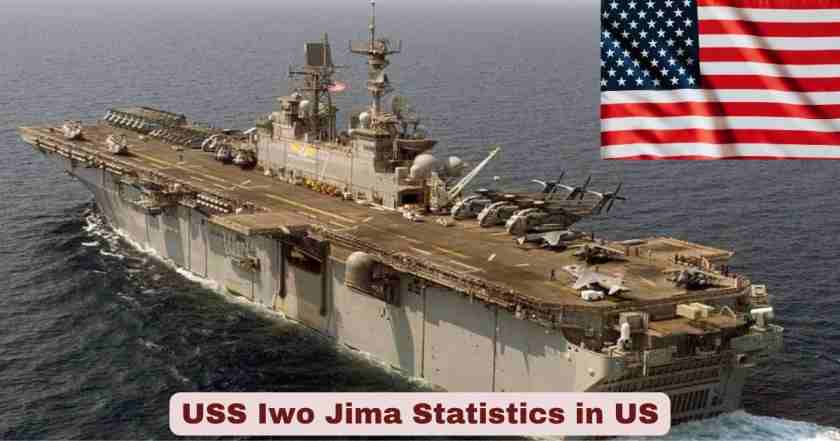
USS Iwo Jima in America 2026
The USS Iwo Jima (LHD-7) is one of the most powerful and versatile warships in the United States Navy — a Wasp-class amphibious assault ship that serves simultaneously as a command platform, an aviation base, a Marine landing force carrier, a humanitarian relief hub, and in certain configurations, a “Lightning Carrier” capable of deploying up to 20 F-35B stealth strike-fighters. Commissioned on June 30, 2001, the ship carries the name of one of the most celebrated and costly battles in Marine Corps history — the Battle of Iwo Jima (February–March 1945) — and the connection between the vessel and that heritage is not merely symbolic. At the keel laying ceremony on December 12, 1997, U.S. Army Captain Jacklyn H. Lucas — a Medal of Honor recipient who fought as a Marine at the actual Battle of Iwo Jima — placed his Medal of Honor citation inside the hull of the ship, where it remains sealed to this day. With a full-load displacement of 40,500 long tons, a length of 843 feet (257 meters), and the capacity to embark 1,687 Marines plus a 184-troop surge, the ship is the seventh vessel in the Wasp class and was built at Ingalls Shipbuilding in Pascagoula, Mississippi — the same shipyard that constructed every ship in the class. Homeported at Naval Station Norfolk, Virginia, the USS Iwo Jima is in active operational service as of March 2026, currently completing its Caribbean deployment before entering a historic two-year modernization overhaul beginning June 2026.
In 2026, the USS Iwo Jima is arguably the most operationally notable warship in the U.S. fleet — not because of its age or its technical specifications, but because of the extraordinary sequence of events it has been at the center of since departing Norfolk on August 14, 2025. That deployment — designated Operation Southern Spear — sent the ship and the 22nd Marine Expeditionary Unit (MEU) with over 4,500 sailors and Marines to the Caribbean, formally to conduct counter-narcotics and drug interdiction operations under U.S. Southern Command. What followed was one of the most consequential deployments in the ship’s 25-year history: live-fire exercises off the Venezuelan coast, the capture of Venezuelan President Nicolás Maduro during Operation Absolute Resolve on January 3, 2026, and Maduro’s temporary detention aboard the USS Iwo Jima itself — an event that President Donald Trump confirmed publicly on Truth Social. Following that extraordinary mission, the ship has been heading toward a $204.1 million Selected Restricted Availability (SRA) period at BAE Systems’ Norfolk shipyard, scheduled to begin June 2026 and run through February 2028, during which the vessel will be upgraded to fully support F-35B Joint Strike Fighter flight operations. The result is a ship whose recent operational record and near-term modernization plans make it one of the defining stories in American naval history in 2026.
USS Iwo Jima Key Facts in the US 2026
| Fact Category | Key Fact / Data Point |
|---|---|
| Hull Number & Designation | LHD-7 — Landing Helicopter Dock, Hull 7 of Wasp Class |
| Ship Class | Wasp-class amphibious assault ship — seventh of eight ships built |
| Namesake | Battle of Iwo Jima, February 19 – March 26, 1945 — World War II, Pacific Theater |
| Ship’s Motto | “Uncommon Valor” — taken from Fleet Admiral Chester W. Nimitz’s words about the Battle of Iwo Jima |
| Builder | Ingalls Shipbuilding, Pascagoula, Mississippi |
| Fabrication Start | September 3, 1996 |
| Keel Laid | December 12, 1997 |
| Launched | February 4, 2000 |
| Christened | March 25, 2000 — by sponsor Zandra Krulak, wife of General Charles C. Krulak, Commandant of the Marine Corps |
| Commissioned | June 30, 2001 — in Pensacola, Florida |
| Medal of Honor Citation in Hull | Captain Jacklyn H. Lucas placed his Medal of Honor citation inside the hull at the keel laying — remains sealed there today |
| Ship Identification | MMSI: 338813000; Call Sign: NXXG |
| Current Homeport (2026) | Naval Station Norfolk, Virginia — transferred from Naval Station Mayport December 2021 |
| Current Status (March 2026) | Active — concluding Caribbean deployment (Operation Southern Spear); entering SRA June 2026 |
| Years of Active Service (2026) | 25 years — commissioned June 2001 |
| Third Ship to Bear the Name | Third U.S. Navy vessel named for Iwo Jima; preceded by LPH-2 (Vietnam era helicopter carrier) |
| Ship’s Sponsor | Zandra Krulak — wife of General Charles C. Krulak, 31st Commandant of the Marine Corps |
| US 2nd Fleet / SURFLANT Assignment | Assigned to Commander, Naval Surface Force Atlantic (SURFLANT) / U.S. 2nd Fleet |
| Propulsion Type | Steam propulsion — one of the last US Navy warships powered by steam boilers |
| FY2026 SRA Contract Value | $204,160,189 firm-fixed-price — awarded to BAE Systems Maritime Solutions, Norfolk |
| FY2026 SRA Maximum Option Value | Up to $255.8 million if all contract options are exercised |
Source: U.S. Navy Official Fact Files, Navy.mil; USS Iwo Jima Official Ship History, navysite.de; DoD Contract Announcement January 16, 2026; USNI News, August 14, 2025; Wikipedia LHD-7 (updated March 2026)
The USS Iwo Jima’s distinguishing characteristics go well beyond its dimensions and its decorated name. The ship holds the rare distinction of being one of the last U.S. Navy warships propelled by steam boilers — a propulsion system that reflects its late-1990s design origin, before the Navy transitioned to gas turbine systems on the later USS Makin Island (LHD-8) and the subsequent America-class LHAs. This steam plant, while requiring more personnel to operate and maintain than modern gas turbines, has proven fundamentally reliable across 25 years of operational service — including hurricane response, combat deployments, and sustained at-sea operations lasting months at a time. The ship’s coat of arms tells the whole operational story in visual shorthand: three spearheads representing the amphibious triad of LCAC landing craft, the Amphibious Assault Vehicle, and the V-22 Osprey; a white disc with the Hero’s boiler recognizing the steam propulsion heritage; and an attacking Osprey at the crest, symbolizing the tilt-rotor aviation capability that defines the ship’s assault mission. The Medal of Honor citation sealed inside the hull at keel laying is not a decoration — it is a statement of identity, connecting every sailor and Marine who serves aboard to the standard of valor set on the original volcanic sands of Iwo Jima in 1945.
The transition of the ship’s homeport from Naval Station Mayport to Naval Station Norfolk in December 2021 was the final step in the Navy’s consolidation of all East Coast amphibious ships to the Norfolk area — a basing decision driven by maintenance infrastructure, coordinated readiness management, and the logistical efficiency of keeping the Wasp-class fleet within the same operational and maintenance ecosystem. For the USS Iwo Jima, this means that the upcoming BAE Systems SRA, which begins in June 2026 at BAE’s Norfolk shipyard, happens in the same geographic complex where the ship is based — minimizing transit time and allowing the crew to maintain closer ties to home during what will be a nearly two-year maintenance period through February 2028. The ship enters that overhaul with an operational record that spans Iraq, Liberia, Haiti, Lebanon evacuations, Hurricane Katrina response, NATO exercises, and now the historic Venezuela operation — a resume that reflects the full breadth of what the U.S. Navy asks of its amphibious assault fleet.
USS Iwo Jima Technical Specifications Statistics in the US 2026
| Technical Parameter | Specification / Data |
|---|---|
| Ship Type | Wasp-class Landing Helicopter Dock (LHD) — multipurpose amphibious assault ship |
| Full-Load Displacement | 40,500 long tons (41,150 metric tons) |
| Length | 843 feet (257 meters) |
| Beam (Width) | 104 feet (31.8 meters) |
| Draft | 27 feet (8.1 meters) |
| Propulsion | Two boilers, two geared steam turbines, two shafts — 70,000 shaft horsepower (52,000 kW) |
| Maximum Speed | 22 knots (41 km/h; 25 mph) |
| Range | 9,500 nautical miles (17,600 km) at 18 knots |
| Well Deck Dimensions | 266 ft × 50 ft × 28 ft high (81 m × 15.2 m × 8.5 m) |
| Flight Deck Dimensions | 819 ft × 112 ft with 9 helicopter landing spots |
| Aircraft Elevators | Two deck-edge elevators — each with 75,000 lb lifting capacity; fold for Panama Canal transit |
| Ship’s Crew (Complement) | 1,208 total — (98 officers + 1,110 enlisted) |
| Marine Detachment | 1,687 troops (plus 184 surge capacity) = 1,871 Marines maximum |
| Total Personnel Aboard (Combat Load) | Approximately 3,000–3,200 combined crew and Marines |
| Freshwater Production | Onboard distilling plants produce up to 200,000 gallons of fresh water per day |
| Hospital Capacity | 64 patient beds + 6 operating rooms standard; expandable to 600 beds in overflow casualty configuration |
| Dental Facilities | Three dental treatment rooms — among the most capable dental facilities of any combatant ship |
| Cargo Monorail System | Internal monorail runs at up to 600 feet per minute — transports cargo from storage to well deck |
| Vehicle Storage | Equipped with vehicle deck for tanks, trucks, artillery, and amphibious assault vehicles |
Source: U.S. Navy Official Fact Files, Navy.mil; Wikipedia Wasp-class Amphibious Assault Ship (updated January 2026); Federation of American Scientists / fas.org LHD-1 Wasp Class specifications; Military.com Wasp Class profile
The USS Iwo Jima’s 843-foot length puts it in a category that is genuinely difficult to visualize until you stand next to it. At nearly three football fields laid end to end, the ship is larger than many World War II aircraft carriers and operates with a level of organic capability — aviation, amphibious landing, medical, logistics, command and control — that no other class of warship in history has matched in a single hull. The flight deck with 9 helicopter landing spots can simultaneously manage helicopter and tiltrotor operations while the well deck is flooded and landing craft are exiting through the stern gates — an orchestration of simultaneous aviation, surface, and amphibious operations that requires the integration of dozens of separate teams working in coordinated real-time. The aircraft elevators’ 75,000-pound lifting capacity — and their engineering to fold for Panama Canal transit — reflect the design philosophy that pervades the entire ship: maximum capability paired with maximum operational flexibility.
The medical facilities aboard the USS Iwo Jima deserve particular emphasis because they have been operationally decisive on multiple occasions in the ship’s history. The standard 64-bed hospital with six operating rooms can expand to a 600-bed casualty ward when the ship transitions to humanitarian or mass-casualty response mode — a configuration that was activated during Hurricane Katrina in 2005, when the ship sailed up the Mississippi River to New Orleans and served as the only fully functional air field for helicopter operations in the disaster zone, providing hot meals, drinking water, showers, and surgical services to thousands of National Guardsmen and relief workers. That 200,000-gallon daily freshwater production capacity — generated by the ship’s own onboard distilling plants, completely independent of shore infrastructure — is what makes the vessel genuinely self-sustaining for extended periods at sea and makes it an indispensable tool for both combat power projection and humanitarian response in 2026.
USS Iwo Jima Aircraft and Combat Capabilities Statistics in the US 2026
| Capability Category | Aircraft / System / Data |
|---|---|
| Standard Air Combat Element — Fixed Wing | 6 F-35B Lightning II STOVL stealth strike-fighters (post-SRA 2026 upgrade) or 6 AV-8B Harrier II |
| Standard Air Combat Element — Attack Helicopters | 4 AH-1Z Viper (formerly AH-1W Super Cobra) attack helicopters |
| Standard Air Combat Element — Transport | 12 MV-22B Osprey tiltrotor assault support aircraft |
| Standard Air Combat Element — Heavy Lift | 4 CH-53E Super Stallion heavy-lift helicopters |
| Standard Air Combat Element — Utility | 3–4 UH-1Y Venom utility helicopters |
| Maximum “Lightning Carrier” Configuration | Up to 20 F-35B stealth strike-fighters + 6 SH-60F/HH-60H ASW helicopters |
| Maximum Assault Configuration | 22+ MV-22B Osprey tiltrotors for maximum troop throughput |
| F-35B Certification Status (Current) | Not yet certified for routine F-35B ops in current configuration — SRA 2026 will upgrade this |
| AV-8B Harrier Status | AV-8B Harrier II scheduled for Marine Corps decommissioning June 2026 — F-35B replacing it |
| Landing Craft — LCAC Option | 3 Landing Craft Air Cushion (LCAC) — hovercraft; capable of 40+ knot beach approach |
| Landing Craft — LCU Option | 2 Landing Craft Utility (LCU) |
| Landing Craft — LCM Option | 12 Landing Craft Mechanized (LCM) |
| Amphibious Assault Vehicles (AAV) | 40 AAVs in well deck + 21 AAVs on vehicle deck = up to 61 total |
| Armament — Missiles | 2 × RIM-116 Rolling Airframe Missile (RAM) launchers; 2 × RIM-7 Sea Sparrow missile launchers |
| Armament — Close-In | Two 20mm Phalanx CIWS systems |
| Armament — Guns | Three 25mm Mk 38 chain guns; Four .50 BMG machine guns |
| Electronic Warfare | AN/SLQ-32 EW suite; AN/SLQ-25 torpedo decoy; 4–6 Mk 36 SRBOC chaff launchers |
| Radar Suite | AN/SPS-49 2D air search; AN/SPS-48 3D air search; AN/SPS-67 surface search; AN/SPN-43 ATC; AN/SPN-35 ATC |
Source: U.S. Navy Fact Files, Navy.mil; Wikipedia USS Iwo Jima (LHD-7), updated March 2026; Zona Militar, March 2026; BAE Systems Contract Announcement, February 24, 2026; Baird Maritime, March 2026
The USS Iwo Jima’s transformation into a full F-35B-capable platform — the core purpose of its upcoming $204.1 million SRA — represents the most significant capability upgrade the ship has received since commissioning. Currently, while the vessel can embark AV-8B Harrier II STOVL fixed-wing aircraft, it is not certified for routine F-35B flight operations in its present configuration. The F-35B generates substantially more heat from its engine exhaust than the Harrier — heat that, without specific flight deck infrastructure modifications, can damage the deck surface, support equipment, and nearby aircraft during sustained operations. The SRA will address this through modifications to flight deck infrastructure, support equipment, and related shipboard systems, bringing the vessel fully in line with the operational standards required to embark F-35B squadrons. This timing is deliberate: the U.S. Marine Corps has scheduled the AV-8B Harrier II for retirement by June 2026, meaning that by the time the USS Iwo Jima completes its SRA in February 2028, the Harrier will be gone from inventory and the F-35B will be the only STOVL fixed-wing aircraft the Marines fly.
The “Lightning Carrier” concept — in which a Wasp-class or America-class LHD/LHA operates up to 20 F-35B stealth fighters instead of a mixed aviation element — has already been proven operationally by USS Tripoli (LHA-7), which conducted a demonstration with exactly 20 F-35Bs embarked. With the USS Iwo Jima’s SRA upgrading it to the same standard, the Navy will have another platform capable of operating in this configuration — effectively adding a second “mini carrier” to the fleet that can project fifth-generation stealth strike power from an amphibious hull. The tactical implications are significant: where a traditional aircraft carrier requires years of scheduled maintenance to keep in service, the broader availability of F-35B-capable LHDs means the Navy can generate stealth strike sorties from more hulls, in more geographic locations, with more operational flexibility. For 2026’s naval strategy — with one carrier strike group in the Arabian Sea and regional crises from the Caribbean to the Strait of Hormuz — that flexibility is not theoretical. It is operationally necessary.
USS Iwo Jima 2025–2026 Deployment Statistics in the US
| Deployment Event | Date | Details |
|---|---|---|
| Departure from Naval Station Norfolk | August 14, 2025 | Departed with USS San Antonio (LPD-17), USS Fort Lauderdale (LPD-28), and 2 guided-missile destroyers — ended 8-month gap in US ARG/MEU deployments |
| Embarked Force Size at Departure | August 2025 | 4,500+ sailors and Marines — including 22nd Marine Expeditionary Unit (2,200 Marines) from Camp Lejeune |
| ARG Full Composition (Sep 25, 2025) | September 2025 | 10 ships total — Iwo Jima, Fort Lauderdale, San Antonio, USS Gravely, USS Stockdale, USS Jason Dunham (DDGs), USS Lake Erie (CG), USS Minneapolis-Saint Paul (LCS), USS Newport News (SSN), MV Ocean Trader |
| Operation Southern Spear Mission | Aug 2025 – Mar 2026 | Counter-narcotics operations, drug trafficking interdiction, Venezuela show-of-force — under US Southern Command (USSOUTHCOM) |
| Live-Fire Exercise, Caribbean | November 2025 | ARG live-firing exercise off coast of Venezuela — satellite imagery confirmed Iwo Jima positioned less than 200 km off Venezuela’s coast |
| Operation Absolute Resolve | January 3, 2026 | US launched strikes in Venezuela — Venezuelan President Nicolás Maduro and First Lady Cilia Flores captured and taken aboard USS Iwo Jima |
| Maduro Detention Confirmed | January 3–4, 2026 | President Trump posted image of Maduro on Truth Social captioned “Nicolas Maduro on board the USS Iwo Jima”; confirmed by General Dan Caine in press conference |
| Maduro Transfer to US Custody | Early January 2026 | Transferred from USS Iwo Jima to US custody for legal proceedings in New York |
| Marine Overboard Incident | February 7, 2026 | Marine Cpl. Chukwuemeka E. Oforah reported overboard during Caribbean operations; 72-hour search effort conducted; declared deceased February 10, 2026 — the only reported US military fatality of Operation Southern Spear |
| ARG Operations Continue | Feb–Mar 2026 | Iwo Jima ARG continued Caribbean operations after Ford CSG redeployed to Middle East; SOUTHCOM confirmed ARG maintaining presence |
| Return to Norfolk / SRA Prep | Spring 2026 | Ship concluding deployment cycle; preparing to enter BAE Systems Norfolk shipyard June 2026 |
| SRA Period Begins | June 2026 | $204.1M–$255.8M Selected Restricted Availability begins at BAE Systems Maritime Solutions, Norfolk |
| Projected SRA Completion | Late February 2028 | Ship expected to return to operational availability after ~20-month overhaul |
Source: USNI News, August 14, 2025; Wikipedia USS Iwo Jima (LHD-7), updated March 2026; Wikipedia Operation Southern Spear Military Buildup; DVIDS USS Iwo Jima Unit Page, February 2026; 19FortyFive, February 13 & 17, 2026; navysite.de USS Iwo Jima history; DoD Contract Announcement January 16, 2026
The August 14, 2025 departure of the Iwo Jima ARG was significant even before the Venezuela operation began because it ended an eight-month gap in US Amphibious Ready Group and Marine Expeditionary Unit deployments — a gap that the acting Chief of Naval Operations Admiral Jim Kilby had publicly acknowledged as a failure of material readiness management. Speaking before the House Armed Services Committee in June 2025, Kilby stated bluntly that “I want to maximize the availability of our amphibious ships and I’ve done poorly in that, particularly in Wasp and Boxer deployments.” The broader amphibious fleet had a 46% readiness rate at that time — below the 50% requirement — per a Government Accountability Office report published December 2024. The Iwo Jima’s departure thus marked not just the beginning of a new deployment but the restoration of an operational capability that combatant commanders had been urgently requesting for months. That the deployment quickly evolved into one of the most geopolitically consequential naval operations in decades only amplified its significance.
The capture of Nicolás Maduro on January 3, 2026 and his detention aboard the USS Iwo Jima is without precedent in modern American naval history. No US ship has held a sitting head of state in custody since the founding era of American power projection. The confirmation by General Dan Caine in a formal press conference — corroborating President Trump’s own Truth Social post — made clear that the USS Iwo Jima served not just as a military platform but as the physical instrument of a major geopolitical outcome. For the ship’s 1,208-person crew and the 22nd MEU Marines aboard, this was the kind of moment that gets recorded in official naval histories: the ship’s motto of “Uncommon Valor” playing out in direct operational terms. The subsequent Marine overboard tragedy on February 7, 2026 — the loss of Corporal Chukwuemeka E. Oforah after a 72-hour search effort — added a sobering human dimension to a deployment that had otherwise been dominated by strategic headlines, reminding the public that behind every major naval operation are thousands of individual service members operating in genuinely dangerous conditions.
USS Iwo Jima FY2026 Overhaul and Modernization Statistics in the US
| Overhaul Metric | Data / Details |
|---|---|
| Overhaul Type | Selected Restricted Availability (SRA) — scheduled maintenance, modernization, and repair period |
| Contractor Awarded | BAE Systems Maritime Solutions, Norfolk, Virginia |
| Contract Announcement Date | January 16, 2026 — announced by US government as FY2026 SRA award |
| Contract Public Detail Date | February 24, 2026 — BAE Systems press release confirming full details |
| Base Contract Value (Firm-Fixed-Price) | $204,160,189 |
| Maximum Contract Value (All Options Exercised) | $255,800,000 |
| Work Start Date | August 2026 (BAE Systems); some reporting cites June 2026 start — June is the official CNO Availability start |
| Projected Completion | Late February 2028 |
| Duration | Approximately 18–20 months |
| Primary Upgrade Focus | F-35B Joint Strike Fighter flight operations support — flight deck infrastructure, support facilities, and related shipboard systems |
| AV-8B Harrier Retirement Context | AV-8B Harrier II retiring June 2026 — F-35B becoming sole USMC STOVL fixed-wing aircraft |
| F-35B Current Status on LHD-7 | Ship can embark AV-8Bs but not certified for routine F-35B operations in current config |
| Scope of SRA (Official Description) | “All labor, supervision, equipment, production, testing, facilities, and quality assurance necessary to prepare for and accomplish the CNO Availability for critical modernization, maintenance, and repair programs“ |
| BAE Norfolk Current Work | Norfolk shipyard nearing completion of repairs on USS Wasp (LHD-1) before transitioning to Iwo Jima |
| BAE VP Statement | David M. Thomas Jr.: “We will apply the lessons learned from current and past LHD-class work done within our shipyard” — February 24, 2026 |
| Strategic Impact on Fleet | Removes Iwo Jima from operational availability for approximately 2 years during period of high global naval demand |
Source: DoD Contract Announcement, January 16, 2026; BAE Systems Press Release, February 24, 2026; The Defense Post, February 24, 2026; Naval Today, February 24, 2026; 19FortyFive, February 13, 2026; Seapower Magazine, February 23, 2026; Zona Militar, March 1, 2026; Baird Maritime, March 2026
The $204.1 million base contract awarded to BAE Systems Maritime Solutions for the USS Iwo Jima’s SRA is one of the larger single-ship maintenance contracts announced by the US Navy in early 2026, and the potential $255.8 million value if all options are exercised makes it a substantial investment in a warship that has been in service for a quarter-century. BAE Systems’ choice as contractor is not incidental — the Norfolk shipyard has been the primary maintenance and overhaul facility for the Wasp-class LHD fleet for years, accumulating institutional knowledge of the class’s specific engineering challenges, including the steam propulsion systems and the complex hangar and well deck structural interfaces. The company’s VP David M. Thomas Jr. explicitly cited this experience in his February 2026 statement, noting that lessons learned from current LHD-class work — including the ongoing repairs to USS Wasp (LHD-1) at the same yard — would be directly applied to the Iwo Jima availability. That continuity of institutional knowledge is operationally significant for a ship of this complexity.
The strategic cost of the SRA is real and has been acknowledged publicly by Navy leadership. Removing the USS Iwo Jima from operational availability for up to 20 months — during a period when the Government Accountability Office reported a 46% amphibious fleet readiness rate and acting CNO Kilby told Congress he needed 46 amphibious warships (15 more than the current fleet) — tightens an already strained amphibious posture. The delays to the future USS Bougainville (LHA-8) and USS Fallujah (LHA-9), both approximately one year behind schedule due to workforce issues at HII’s Ingalls Shipbuilding in Pascagoula, compound this pressure: the new-build ships that were supposed to partially compensate for LHD maintenance downtime are not arriving on schedule. For 2026 naval planners, the Iwo Jima SRA is not simply a maintenance event — it is a 22-month operational gap in the amphibious strike inventory that must be covered by the remaining Wasp-class ships and the newer America-class LHAs during a period of simultaneous demand from SOUTHCOM, CENTCOM, and INDOPACOM.
USS Iwo Jima Historical Operations Statistics in the US 2026
| Operation / Event | Year(s) | Key Contribution |
|---|---|---|
| Maiden Voyage | June 23, 2001 | Departed with 2,000+ World War II veterans — many survivors of the Battle of Iwo Jima — aboard; historic commissioning at Pensacola, FL |
| First Ship Open to Public Post-9/11 | September 11, 2001 | First US Navy ship opened to the public after the September 11 terrorist attacks |
| Operation Enduring Freedom / Iraq War | 2003 | Deployed Marines from Mediterranean into northern Iraq in April 2003 |
| JTF Liberia | July 2003 | Deployed 26th MEU Marines to Liberia for humanitarian assessment during Second Liberian Civil War — part of 5,000-person JTF |
| Hurricane Katrina Response | 2005 | Sailed up Mississippi River to New Orleans; served as only fully functional helicopter air field in the region; 1,000+ flight deck operations; provided meals, water, showers, medical care; served as flagship for President George W. Bush during Katrina Joint Task Force; only second Navy ship to fly the Presidential flag |
| 2006 Lebanon Evacuation | 2006 | Prepared for evacuation of US citizens from Lebanon during Israeli-Hezbollah conflict — flagship of 24th MEU |
| Battle “E” Award | 2006 | Awarded the 2006 Battle “E” for excellence — February 2007 |
| Haiti Humanitarian Response | 2010, 2016 | Deployed to Haiti for Tropical Storm Tomas (2010) and Hurricane Matthew relief (2016) |
| NATO Exercise Trident Juncture | 2018 | Participated in NATO’s Exercise Trident Juncture 2018 in Norway |
| Admiral James Flatley Safety Award | 2003, 2015, 2018, 2021 | Won the Admiral James Flatley Memorial Award for Naval Aviation Safety — four times |
| Humanitarian Service Medal | 2016, 2017 | Awarded for Hurricane Matthew (2016) and Hurricane Irma (2017) response |
| Operation Southern Spear | 2025–2026 | Caribbean counter-narcotics deployment with 22nd MEU; Venezuela show-of-force; site of Nicolás Maduro’s detention January 3, 2026 |
Source: USS Iwo Jima Official Ship History, navysite.de; Wikipedia USS Iwo Jima (LHD-7), updated March 2026; DVIDS USS Iwo Jima Unit Page; US Navy Official News Releases
The operational record of the USS Iwo Jima over its 25-year service life is a compressed history of American military engagement across three continents and every category of mission the US Navy undertakes — combat, humanitarian response, evacuation, deterrence, and counter-terrorism. What stands out most clearly across the arc of that record is the ship’s recurring role in “come as you are” moments: the September 11 opening that made it the first public-facing military presence after the worst terrorist attack in American history; the Hurricane Katrina response that required sailing up a river and creating an ad-hoc airbase and hospital in the middle of a flooded city; the 2006 Lebanon standby when American citizens needed a potential emergency exit as war broke out; and the January 2026 Venezuela operation that produced one of the most geopolitically consequential moments in the ship’s history. None of these missions were what the ship was originally built for. All of them were accomplished with the same complement, the same hull, the same systems.
The four Admiral James Flatley Memorial Awards for Naval Aviation Safety — earned in 2003, 2015, 2018, and 2021 — reflect a dimension of the ship’s record that rarely makes headlines but is critically important to understanding what sustained operational excellence actually looks like in a Navy context. Aviation safety aboard an amphibious assault ship is exceptionally complex: the flight deck is smaller than a carrier’s, the aircraft mix more diverse, the operational tempo frequently higher during amphibious assaults, and the maintenance infrastructure more constrained. Earning the Flatley Award four times across an 18-year span — against competition from every other naval aviation platform in the fleet — is a testament to the institutional culture the ship’s successive commanding officers and aviation departments have maintained. That culture of disciplined excellence is precisely what the USS Iwo Jima’s 25-year record rests on — and it is what will make the ship a force multiplier again when it emerges from its F-35B-capable overhaul in 2028.
USS Iwo Jima Class Context and US Amphibious Fleet Statistics in 2026
| Fleet / Class Metric | Data / Statistic |
|---|---|
| Total Wasp-Class Ships Built | 8 ships — LHD-1 through LHD-8; all built by Ingalls Shipbuilding, Pascagoula, MS |
| Wasp-Class Ships in Active Service (2026) | 7 ships (USS Bonhomme Richard decommissioned April 2021 after fire July 2020) |
| LHD-7 Position in Class | Seventh of eight — one of the last two steam-propelled Wasp-class ships |
| Unit Cost of Wasp-Class LHD | $1.2 billion to $1.6 billion per ship |
| Current Total US Amphibious Ship Inventory | Approximately 31 ships — the Congressionally-mandated minimum per USN requirement |
| CNO Stated Requirement | 46 amphibious warships — per Acting CNO Admiral Jim Kilby, June 2025 (15 more than current fleet) |
| Amphibious Fleet Readiness Rate (Dec 2024) | 46% — below the 50% requirement — per Government Accountability Office report |
| Next-Generation Ships Delayed | USS Bougainville (LHA-8) and USS Fallujah (LHA-9) — each approximately 1 year delayed — HII Ingalls workforce issues |
| America-Class Ships in Service | USS America (LHA-6) and USS Tripoli (LHA-7) — no well deck; focused on aviation-centric operations |
| ARG/MEU Presence Requirement | 3.0 ARG/MEU presence required by combatant commanders — Navy currently unable to meet this |
| ARG Gap Before Iwo Jima Deployment | 8 months without a US-based ARG/MEU at sea — ended by Iwo Jima’s August 14, 2025 departure |
| F-35B-Capable LHDs (Post-SRA) | Currently: Wasp, Kearsarge, Bataan partially capable; Tripoli, America fully capable; Iwo Jima will join after 2028 |
| Wasp-Class Annual Operating Cost Estimate | Approximately $700 million–$900 million per year across the active Wasp-class fleet (Navy operations and maintenance) |
Source: USNI News, August 14, 2025; Government Accountability Office December 2024 Report on Amphibious Fleet Readiness; Acting CNO Admiral Jim Kilby Congressional Testimony, June 2025; Wikipedia Wasp-class Amphibious Assault Ship, updated January 2026; Naval Technology / naval-technology.com; Forecast International LHD-1 Wasp Class Unit Cost Data
The 46% readiness rate of the US amphibious fleet — documented by the Government Accountability Office in its December 2024 report and publicly confirmed by acting CNO Kilby before Congress in June 2025 — is the single most important piece of context for understanding why the USS Iwo Jima’s SRA carries such strategic weight. When fewer than half the amphibious ships in the Navy can actually deploy at any given time, the loss of the Iwo Jima to a 20-month maintenance period creates real operational strain. The acting CNO’s statement that he needs 46 amphibious warships — versus the 31 currently in the fleet — highlights a structural gap that no amount of scheduling optimization can fully bridge. The Marine Corps’ stated requirement for a 3.0 ARG/MEU presence — three simultaneous Amphibious Ready Groups deployed with Marine Expeditionary Units embarked — cannot be met with the current inventory at current readiness rates, and the one-year delays to USS Bougainville and USS Fallujah push the timeline for relief even further into the future.
The USS Iwo Jima enters this challenging fleet context as simultaneously one of the Navy’s most operationally valuable assets and one of its most maintenance-intensive ones. As one of the last steam-propelled Wasp-class ships, it requires more personnel to operate and maintain its propulsion plant than the gas turbine-powered USS Makin Island (LHD-8) or the newer America-class ships. The $204.1 million SRA is therefore not just about F-35B capability — it is about ensuring that a ship which still has years of operational life ahead of it (Wasp-class ships are built for 30–40 year service lives, and the Iwo Jima is just 25) leaves the shipyard with modernized systems, a certified F-35B flight deck, and the structural integrity to continue performing across the full range of naval missions. When the USS Iwo Jima returns from its overhaul in 2028, it will be a qualitatively different ship than the one that captured Nicolás Maduro in January 2026 — and the American amphibious fleet will be measurably stronger for it.
Disclaimer: This research report is compiled from publicly available sources. While reasonable efforts have been made to ensure accuracy, no representation or warranty, express or implied, is given as to the completeness or reliability of the information. We accept no liability for any errors, omissions, losses, or damages of any kind arising from the use of this report.