
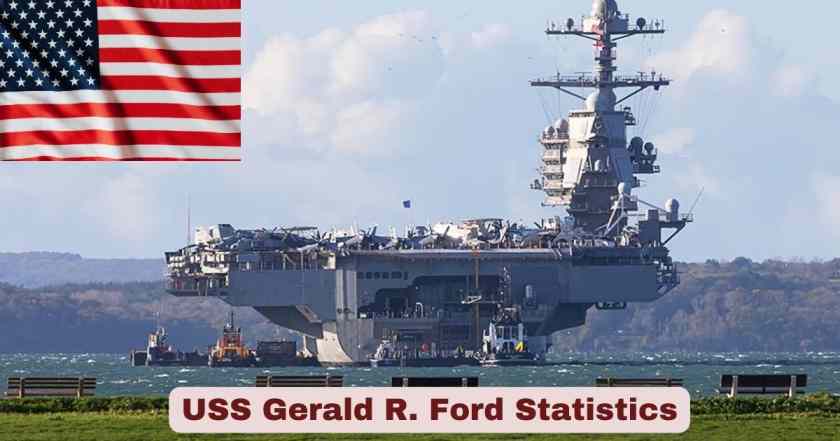
USS Gerald R. Ford in the US 2026
The USS Gerald R. Ford (CVN-78) stands as America’s most powerful warship and represents a transformative leap in naval aviation capabilities. As the lead vessel of the Ford-class nuclear-powered aircraft carriers, this engineering marvel entered service in 2017 and has since redefined what modern naval power projection means for the United States. Named after the 38th President of the United States, Gerald Ford, who served with distinction aboard the USS Monterey during World War II, this carrier embodies both historical reverence and cutting-edge innovation. With a total construction cost exceeding $13.3 billion, it holds the distinction of being the most expensive warship ever built, yet its revolutionary technologies promise to deliver substantial operational advantages over its 50-year service life.
In 2026, the USS Gerald R. Ford finds itself at the center of critical U.S. military operations, currently deployed to the Middle East as tensions with Iran escalate. After departing from the Caribbean in February 2026, where it played a central role in Operation Southern Spear off the coast of Venezuela, the carrier and its 4,500-member crew face an extended deployment that will test both the ship’s advanced systems and the endurance of its personnel. This deployment marks a pivotal moment in validating whether the massive investment in Ford-class technology can deliver the enhanced combat capabilities and operational tempo that the U.S. Navy needs to maintain maritime dominance in an increasingly contested global environment. The carrier’s current mission underscores its role as the centerpiece of American power projection, carrying an air wing of 60-70 aircraft capable of conducting 160 sorties per day during sustained operations.
Interesting Facts About USS Gerald R. Ford in the US 2026
| Fact Category | Specification | Details |
|---|---|---|
| Ship Designation | CVN-78 | Lead ship of the Ford-class carriers |
| Total Cost | $13.3 billion | Most expensive warship ever constructed |
| Displacement | 100,000 tons | Full load displacement |
| Length | 1,092 feet | Overall length (333 meters) |
| Beam (Width) | 256 feet | Flight deck width (78 meters) |
| Height | 250 feet | Draught measurement (76 meters) |
| Maximum Speed | 30+ knots | Exceeds 35 mph (56 km/h) |
| Crew Size | 2,600 sailors | Ship’s company (reduced from Nimitz-class 3,200+) |
| Air Wing Personnel | 1,800 personnel | Embarked air wing complement |
| Total Personnel | 4,500 personnel | Combined ship and air wing |
| Aircraft Capacity | 75-90 aircraft | Maximum operational capacity |
| Standard Air Wing | 60-70 aircraft | Typical deployment configuration |
| Daily Sortie Rate | 160 sorties | Sustained operational capability |
| Surge Sortie Rate | 270 sorties | Maximum 24-hour capability |
| Nuclear Reactors | 2 A1B reactors | New generation reactors |
| Power Generation | 700 MW thermal | 25% more efficient than Nimitz-class |
| Service Life | 50+ years | Expected operational lifespan |
| Commissioning Date | July 22, 2017 | Formally commissioned |
| First Deployment | May 2023 | Initial operational deployment |
| Current Deployment | February 2026 | En route to Middle East |
| Deployment Duration | 8+ months | As of February 2026 |
| Homeport | Naval Station Norfolk | Virginia, United States |
Data sources: U.S. Navy official reports, Congressional Research Service documentation, U.S. Department of Defense Selected Acquisition Reports
The USS Gerald R. Ford represents unprecedented engineering achievement in naval architecture and warfare technology. The carrier’s $13.3 billion price tag reflects its status as the first major carrier redesign in over 40 years, incorporating 23 new or upgraded systems compared to the previous Nimitz-class. At 1,092 feet in length and displacing 100,000 tons at full load, it surpasses all previous warships in size and capability. The vessel’s revolutionary Electromagnetic Aircraft Launch System (EMALS) replaces traditional steam catapults, enabling smoother launches that reduce stress on aircraft while launching both heavier and lighter aircraft with greater precision. This system contributes directly to the Ford’s ability to generate 160 sorties per day during sustained operations, representing a 33% increase over Nimitz-class capabilities, with surge capacity reaching 270 sorties during intensive combat operations.
The carrier’s operational efficiency extends beyond launch systems to encompass comprehensive design improvements. With a crew of 2,600 sailors for ship operations plus 1,800 air wing personnel, the Ford operates with approximately 700 fewer crew members than a Nimitz-class carrier, thanks to extensive automation and improved system designs. This reduction translates to $4-5 billion in lifecycle cost savings over the ship’s 50-year operational life. The ship’s two A1B nuclear reactors generate 700 MW of thermal power, providing 25% more electrical generating capacity than previous designs, crucial for supporting advanced systems including electromagnetic catapults, weapons elevators, and future directed-energy weapons. Currently on its second major deployment in February 2026, the Ford has already logged more than 10,396 sorties and 17,826 flight hours during its 2023 deployment to the Mediterranean, demonstrating its operational readiness despite earlier technical challenges.
USS Gerald R. Ford Physical Dimensions and Specifications in the US 2026
| Dimension Category | Measurement | Comparison to Nimitz-Class |
|---|---|---|
| Overall Length | 1,092 feet (333 meters) | Similar length |
| Flight Deck Width | 256 feet (78 meters) | Slightly wider |
| Hull Beam | 134 feet (40.8 meters) | Comparable width |
| Height (Draught) | 250 feet (76 meters) | Similar height |
| Full Load Displacement | 100,000 tons | Slightly heavier (Nimitz: 97,000 tons) |
| Flight Deck Area | 4.5 acres | Optimized layout |
| Island Length | Shorter than Nimitz | 140 feet farther aft |
| Island Height | 20 feet taller | Improved visibility |
| Island Position | 3 feet outboard | Better deck utilization |
Data source: Naval Sea Systems Command, Newport News Shipbuilding specifications, Congressional Research Service Reports
The USS Gerald R. Ford’s physical dimensions reflect careful engineering to maximize operational efficiency within a familiar hull form. At 1,092 feet in length, the carrier maintains similar overall dimensions to the Nimitz-class but incorporates critical design refinements. The flight deck spans 256 feet in width, providing 4.5 acres of operational space that has been reconfigured to reduce aircraft traffic congestion and improve sortie generation rates. The carrier’s 100,000-ton displacement at full load makes it one of the heaviest warships afloat, yet its nuclear propulsion system enables sustained speeds exceeding 30 knots (35 mph or 56 km/h) with virtually unlimited range. The redesigned island superstructure, positioned 140 feet farther aft than on Nimitz-class carriers and standing 20 feet taller, provides improved situational awareness while freeing up valuable flight deck space for aircraft operations.
These dimensional optimizations contribute directly to the Ford’s enhanced combat capabilities. The repositioned island and redesigned flight deck layout enable more efficient aircraft handling, contributing to the 33% increase in sortie generation rate over previous carriers. The carrier’s 134-foot beam provides stability in rough seas while the 250-foot height accommodates multiple internal deck levels for aircraft maintenance, weapons storage, crew quarters, and operational spaces. Every square foot has been optimized through advanced computer modeling to support the carrier’s primary mission: projecting air power across 75-90 aircraft that can range hundreds of miles from the ship. The 2026 deployment configuration typically includes 60-70 aircraft, balancing combat capability with operational efficiency, as the carrier transits from Caribbean operations to its new Middle East station where it will join the USS Abraham Lincoln in deterring Iranian aggression.
USS Gerald R. Ford Propulsion and Power Systems in the US 2026
| Power System Component | Specification | Performance Metrics |
|---|---|---|
| Reactor Type | 2 × A1B nuclear reactors | Next-generation design |
| Thermal Power Output | 700 MW | 25% increase over A4W reactors |
| Propulsion Shafts | 4 shafts | Four-shaft configuration |
| Maximum Speed | 30+ knots | Exceeds 35 mph (56 km/h) |
| Operational Range | Unlimited | Nuclear-powered endurance |
| Refueling Interval | 50 years | Full-life core |
| Steam Generation | Eliminated | All-electric utilities |
| Electrical Capacity | 250% increase | Compared to Nimitz-class |
| Power Distribution | Integrated power system | Advanced electrical architecture |
| Energy Efficiency | 25% improvement | Over previous reactor designs |
Data source: Naval Nuclear Propulsion Program, Bechtel Marine Propulsion Corporation, Department of Defense reports
The USS Gerald R. Ford revolutionary propulsion system centers on two Bechtel A1B nuclear reactors, representing the most significant advancement in naval nuclear power since the 1960s. These reactors generate 700 MW of thermal power, a 25% increase in efficiency over the A4W reactors that power Nimitz-class carriers. This enhanced power generation capability supports not only the ship’s propulsion through four shafts driving the vessel to speeds exceeding 30 knots, but also provides sufficient electrical capacity for the carrier’s energy-intensive systems including the Electromagnetic Aircraft Launch System (EMALS), Advanced Arresting Gear (AAG), and 11 advanced weapons elevators. The A1B reactors feature a full-life core design, meaning they will operate for the ship’s entire 50-year service life without requiring refueling, dramatically reducing maintenance downtime and lifecycle costs.
The Ford-class represents the first aircraft carrier designed with all-electric utilities, eliminating the extensive steam distribution systems that characterized previous carriers. This architectural change reduces maintenance requirements, improves reliability, and frees up significant internal volume for other uses. The 250% increase in electrical generating capacity over Nimitz-class carriers positions the Ford to accommodate future weapons systems including directed-energy weapons, railguns, and advanced electronic warfare systems that may become operational during its service life. As the carrier steams toward the Middle East in February 2026, having already been deployed for eight months since departing in June 2025, the A1B reactors continue demonstrating their reliability and endurance. The nuclear propulsion system enables the Ford to maintain station anywhere in the world for 90 days without resupply, providing strategic flexibility that conventional carriers cannot match. This unlimited operational range proved critical during the carrier’s extended 2023 Mediterranean deployment and will be equally vital as it assumes position alongside the USS Abraham Lincoln in the increasingly tense waters near Iran.
USS Gerald R. Ford Aviation Systems and Aircraft Operations in the US 2026
| Aviation System | Capability | Performance Data |
|---|---|---|
| Launch System | EMALS (Electromagnetic Aircraft Launch System) | 4 catapults |
| Recovery System | Advanced Arresting Gear (AAG) | 3 arresting wires |
| Daily Sortie Rate | 160 sorties | Sustained operations |
| Surge Sortie Rate | 270 sorties | 24-hour maximum |
| Sortie Increase | 33% improvement | Over Nimitz-class 120 sorties |
| Aircraft Weight Range | Launch up to 31 tons | F-35C maximum weight |
| Launch Precision | Variable acceleration | Tailored to each aircraft |
| Weapons Elevators | 11 advanced elevators | Electromagnetic operation |
| Elevator Speed | 5× faster | Than hydraulic systems |
| Flight Deck Efficiency | 25% improvement | Reduced congestion |
| Aircraft Capacity | 75-90 aircraft | Maximum capacity |
| Standard Air Wing | 60-70 aircraft | Typical configuration |
| F-35C Integration | Fully certified | Stealth fighter operations |
| UAV Capability | Future drone operations | MQ-25 Stingray ready |
Data source: General Atomics Electromagnetic Systems, Naval Air Systems Command, Operational Test & Evaluation reports
The USS Gerald R. Ford’s aviation systems represent the most significant technological leap in carrier operations since the introduction of angled flight decks. The Electromagnetic Aircraft Launch System (EMALS) replaces steam catapults with linear induction motors that use electromagnetic force to accelerate aircraft along a 330-foot track. This system launches aircraft more smoothly than steam catapults, reducing structural stress on airframes and extending their service life. EMALS can precisely adjust acceleration profiles for different aircraft weights, from lightweight UAVs to heavy F-35C stealth fighters weighing up to 31 tons at launch. The four EMALS catapults enable the Ford to sustain 160 sorties per day during normal operations, a 33% increase over the 120 sorties achievable by Nimitz-class carriers, with surge capability reaching 270 sorties during intensive 24-hour operations.
Complementing EMALS, the Advanced Arresting Gear (AAG) system uses electromagnetic technology to recover landing aircraft, replacing the hydraulic systems used on previous carriers. AAG can adjust arresting forces based on aircraft weight and approach speed, improving safety margins and reducing wear on both the recovery system and aircraft structures. The Ford’s 11 advanced weapons elevators, positioned strategically around the flight deck, move ordnance from magazine storage to the flight deck up to five times faster than the hydraulic elevators on Nimitz-class carriers. This rapid weapons handling capability directly supports the increased sortie generation rate. In 2026, as the carrier operates in the high-threat environment of the Middle East, these systems enable the Ford to maintain a 60-70 aircraft air wing including F/A-18E/F Super Hornets, F-35C Lightning II stealth fighters, EA-18G Growler electronic warfare aircraft, E-2D Advanced Hawkeye early warning aircraft, and MH-60 helicopters. The carrier’s first deployment in 2023 validated these systems under combat conditions, with the ship logging 10,396 sorties and 17,826 flight hours during operations supporting Israel in the Mediterranean, demonstrating that the Ford-class technology can deliver the enhanced operational tempo required for modern naval warfare.
USS Gerald R. Ford Crew and Personnel Requirements in the US 2026
| Personnel Category | Number | Comparison and Details |
|---|---|---|
| Ship’s Company | 2,600 sailors | 700 fewer than Nimitz-class (3,200+) |
| Air Wing Personnel | 1,800 personnel | Standard carrier air wing |
| Total Personnel | 4,500 personnel | Combined ship and air operations |
| Crew Reduction | 25% decrease | Compared to Nimitz-class |
| Officers | Approximately 550 | Ship’s company officers |
| Enlisted Personnel | Approximately 2,050 | Ship’s company enlisted |
| Manning Efficiency | Automation-driven | Reduced watch standing |
| Quality of Life Improvements | Enhanced berthing | Improved crew spaces |
| Maintenance Workload | Reduced by automation | Lower manning requirements |
| Deployment Duration | 8+ months | Current 2026 deployment |
| Crew Rotation | Standard Navy rotation | Approximately 6-month deployment cycles |
| Training Requirements | Advanced technical training | For new systems operation |
| Lifecycle Cost Savings | $4-5 billion | Over 50-year service life |
Data source: U.S. Navy Personnel Command, Naval Sea Systems Command, Government Accountability Office reports
The USS Gerald R. Ford operates with a ship’s company of 2,600 sailors, representing a reduction of approximately 700 personnel compared to Nimitz-class carriers that require more than 3,200 crew members. This 25% reduction in manning results from extensive automation, improved system reliability, and elimination of steam-based utilities that required constant maintenance and manning. Combined with the 1,800-member air wing, the Ford carries a total complement of 4,500 personnel, compared to over 5,000 on Nimitz-class carriers. The reduced crew size translates directly to significant cost savings, estimated at $4-5 billion over the ship’s 50-year operational life, addressing the Navy’s ongoing challenge of meeting recruitment targets while maintaining a capable fleet. In 2024, the Navy missed its recruiting goals by 20%, making the Ford’s reduced manning requirement particularly valuable for future fleet sustainability.
Despite carrying fewer personnel, the Ford maintains or exceeds all operational capabilities of its predecessors through intelligent system design and automation. Advanced damage control systems, automated weapons elevators, electric utilities requiring less maintenance, and improved habitability spaces all contribute to reduced workload while maintaining combat effectiveness. The crew benefits from enhanced berthing arrangements, improved galley facilities, and better quality-of-life spaces compared to older carriers. However, the 2026 deployment demonstrates the human cost of these operational capabilities, as the 4,500-person crew has been continuously deployed for more than eight months since departing Norfolk in June 2025. After operations in the Mediterranean, transit to the Caribbean for Operation Southern Spear off Venezuela, and now redeployment to the Middle East to join the USS Abraham Lincoln, the extended deployment duration raises questions about crew endurance and the sustainability of such extended operations. The Navy’s decision to extend the Ford’s deployment, despite concerns about maintenance needs, reflects the strategic imperative of maintaining carrier presence in critical regions, but also highlights the tension between operational requirements and crew welfare that will shape future carrier employment strategies.
USS Gerald R. Ford Operational History and Deployments in the US 2026
| Deployment Event | Date | Location/Purpose |
|---|---|---|
| Keel Laid | November 13, 2009 | Newport News Shipbuilding |
| Christening | November 9, 2013 | Named USS Gerald R. Ford |
| Delivered to Navy | May 31, 2017 | Formal delivery |
| Commissioned | July 22, 2017 | President Trump presiding |
| First Arrested Landing | July 28, 2017 | F/A-18F Super Hornet |
| Shock Trials | June-August 2021 | 40,000 lbs TNT underwater tests |
| Flight Deck Certification | March 29, 2022 | Operational readiness |
| First Foreign Port Visit | October 28, 2022 | Halifax, Nova Scotia, Canada |
| Portsmouth Visit | November 14-18, 2022 | United Kingdom waters |
| First Full Deployment | May 2023 | U.S. Sixth Fleet operations |
| Oslo Port Visit | May 24-26, 2023 | NATO exercises |
| Split, Croatia Visit | June 26-27, 2023 | Crew rest and resupply |
| Mediterranean Deployment | October 2023-January 2024 | Israel-Hamas conflict support |
| Total 2023 Deployment | 8.5 months | Extended from 6 months |
| Sorties Flown (2023) | 10,396 sorties | First deployment |
| Flight Hours (2023) | 17,826 hours | First deployment |
| Second Deployment Start | June 2025 | Atlantic and Caribbean |
| Caribbean Operations | October-December 2025 | Operation Southern Spear |
| Venezuela Operations | January 2026 | Support for Maduro arrest |
| Middle East Deployment | February 2026 | Iran deterrence mission |
| Deployment Duration (2026) | 8+ months | Extended deployment |
Data source: U.S. Navy Fleet Forces Command, Congressional Research Service, Defense Department press releases
The USS Gerald R. Ford construction and operational history spans nearly 17 years from keel laying to its current 2026 deployment. After the keel was laid on November 13, 2009, the carrier underwent an eight-year construction and testing period before delivery to the Navy on May 31, 2017. President Donald Trump presided over the commissioning ceremony on July 22, 2017, marking the formal entry of the world’s most expensive warship into active service. However, numerous technical challenges with EMALS, AAG, and weapons elevators delayed operational readiness. The carrier underwent rigorous shock trials in June-August 2021, where underwater detonations of 40,000 pounds of TNT tested the ship’s survivability, registering as a 3.9 magnitude earthquake. Flight deck certification was achieved on March 29, 2022, finally clearing the path for operational deployment.
The Ford’s first full deployment began in May 2023, initially planned as a six-month deployment to the Mediterranean for NATO exercises. The carrier made history as the first Ford-class vessel to visit foreign ports, stopping in Halifax, Nova Scotia in October 2022 and Portsmouth, United Kingdom in November 2022. During its 2023 deployment, the Ford demonstrated its combat capabilities by logging 10,396 sorties and 17,826 flight hours while working with 17 nations including France, Greece, Norway, Turkey, and the United Kingdom. The deployment was extended by 2.5 months when Hamas attacked Israel on October 7, 2023, and the Ford carrier strike group was positioned in the eastern Mediterranean to deter regional escalation. The second major deployment began in June 2025, initially focused on Atlantic operations before being redirected to the Caribbean in October 2025 for Operation Southern Spear. The carrier provided air cover and strike capabilities during U.S. operations that resulted in the arrest of Venezuelan President Nicolás Maduro in January 2026. Now, in February 2026, after eight months continuously at sea, the Ford has been redirected again to the Middle East to join the USS Abraham Lincoln as tensions with Iran escalate, demonstrating both the carrier’s strategic value and the operational demands placed on America’s most advanced warship.
USS Gerald R. Ford Cost and Economic Factors in the US 2026
| Cost Category | Amount | Details and Context |
|---|---|---|
| Total Procurement Cost | $13.3 billion | CVN-78 final cost |
| Original Estimate | $10.5 billion | 2008 estimate |
| Cost Overrun | 27% increase | Over original estimate |
| Research & Development | $3 billion+ | Non-recurring engineering costs |
| CVN-79 (Kennedy) Cost | $11.4 billion | Cost cap by Congress |
| CVN-80 (Enterprise) Cost | $14.2 billion | Estimated procurement cost |
| CVN-81 (Doris Miller) Cost | $14.0 billion | Estimated procurement cost |
| Daily Operating Cost | Approximately $7 million | Carrier strike group operations |
| Lifecycle Cost Savings | $4-5 billion per ship | Vs. Nimitz-class over 50 years |
| Annual Operating Savings | $80-100 million | Per Ford-class carrier |
| Maintenance Cost Reduction | Significant decrease | Due to reduced crew and automation |
| Crew Cost Savings | 700 fewer personnel | Reduced manning requirements |
| Total Class Program Cost | $120+ billion estimated | For planned 10 ships |
| FY2026 Budget Request | $3.4 billion | For Ford-class program continuation |
Data source: Congressional Research Service, Government Accountability Office, Department of Defense Selected Acquisition Reports, Navy budget justification documents
The USS Gerald R. Ford carries the distinction of being the most expensive warship ever constructed, with final procurement costs reaching $13.3 billion, representing a 27% cost overrun from the original $10.5 billion estimate in 2008. This substantial price tag reflects the challenges inherent in first-in-class construction, where $3 billion in non-recurring engineering costs covered the development of revolutionary technologies including EMALS, AAG, A1B nuclear reactors, and dual-band radar systems. The 23 new or upgraded systems required extensive testing, modification, and refinement, leading to delays and cost increases that drew criticism from Congress and defense analysts. However, Navy officials emphasize that these first-ship costs represent an investment in technology that subsequent carriers will benefit from at reduced cost. The second Ford-class carrier, USS John F. Kennedy (CVN-79), has a Congressional cost cap of $11.4 billion, while USS Enterprise (CVN-80) and USS Doris Miller (CVN-81) are estimated at $14.2 billion and $14.0 billion respectively, reflecting inflation and enhanced capabilities.
Despite the high acquisition cost, the Ford-class promises significant lifecycle savings that justify the initial investment. Each Ford-class carrier is projected to save $4-5 billion over its 50-year operational life compared to Nimitz-class carriers, primarily through reduced manning requirements and lower maintenance costs. Operating with 700 fewer personnel than a Nimitz-class carrier translates to approximately $80-100 million in annual savings per ship in personnel costs alone. The elimination of steam utilities and incorporation of automated systems reduce maintenance workload and improve reliability, further driving down operating costs. The Navy’s FY2026 budget requests $3.4 billion for Ford-class program continuation, supporting construction of CVN-80 and CVN-81 while funding post-delivery work on earlier ships. With plans for 10 Ford-class carriers to eventually replace the entire Nimitz fleet by the 2050s, the total program cost will exceed $120 billion. In 2026, as the Ford operates in high-threat environments off Iran, the approximately $7 million daily cost of operating a carrier strike group underscores the enormous expense of projecting American power globally. However, defense strategists argue that the Ford’s enhanced capabilities—33% more sorties, 25% more electrical power, and 25% lower manning—make it a cost-effective investment in maintaining naval supremacy against peer competitors like China, whose expanding carrier fleet poses an increasing challenge to American maritime dominance in the Pacific and beyond.
USS Gerald R. Ford Advanced Technologies and Weapons Systems in the US 2026
| Technology System | Specification | Capability Description |
|---|---|---|
| EMALS Catapults | 4 electromagnetic launch tracks | 330-foot linear induction motors |
| Advanced Arresting Gear | 3 AAG systems | Electromagnetic recovery system |
| Dual-Band Radar | AN/SPY-3 (X-band) and AN/SPY-4 (S-band) | Multi-function radar (CVN-78 only) |
| Enterprise Air Surveillance Radar | AN/SPY-6(V)3 | CVN-79 and later ships |
| Surface Search Radar | AN/SPQ-9B | X-band radar system |
| Missile Defense | RIM-162 ESSM | Evolved SeaSparrow Missile |
| Close-In Weapon System | Phalanx CIWS | 20mm Gatling guns |
| RIM-116 RAM | Rolling Airframe Missile | Point defense system |
| Electronic Warfare | AN/SLQ-32(V)6 | Advanced EW suite |
| Weapons Elevators | 11 electromagnetic elevators | 5× faster than hydraulic |
| Nuclear Reactor | 2 × A1B reactors | 700 MW thermal power |
| Combat Management System | Aegis integration | Link 16 data networking |
| Stealth Features | Reduced radar cross-section | Enhanced hull design |
| Future Weapons Capability | Directed energy weapons ready | Sufficient electrical capacity |
Data source: Naval Sea Systems Command, Raytheon Technologies, General Atomics Electromagnetic Systems
The USS Gerald R. Ford integrates cutting-edge weapons and sensor systems that establish it as the most technologically advanced warship afloat. The carrier’s defensive armament includes the RIM-162 Evolved SeaSparrow Missile (ESSM) system for medium-range air defense, RIM-116 Rolling Airframe Missiles (RAM) for close-in defense against anti-ship missiles, and Phalanx Close-In Weapon Systems (CIWS) providing last-ditch defense with rapid-fire 20mm Gatling guns. The AN/SLQ-32(V)6 electronic warfare suite detects, identifies, and counters radar and missile threats through jamming and deception. On CVN-78, the revolutionary Dual-Band Radar (DBR) system combines AN/SPY-3 X-band and AN/SPY-4 S-band radars into a single integrated sensor providing unprecedented situational awareness with detection ranges exceeding 200 nautical miles and 30 times greater sensitivity than previous radar systems. However, due to cost concerns, subsequent Ford-class carriers including CVN-79 John F. Kennedy will use the less expensive AN/SPY-6(V)3 Enterprise Air Surveillance Radar (EASR) paired with AN/SPQ-9B surface search radar.
The Ford’s 11 advanced weapons elevators represent a critical capability enhancement, using electromagnetic linear motors to move ordnance from magazines to the flight deck at speeds five times faster than the hydraulic elevators on Nimitz-class carriers. This rapid weapons handling directly supports the 160 sorties per day sustained operation rate and 270 sorties surge capability. The carrier’s electrical architecture, powered by A1B nuclear reactors generating 700 MW of thermal energy, provides sufficient capacity for current systems plus future directed-energy weapons including lasers and railguns that may become operational during the ship’s 50-year service life. The combat management system integrates with the Aegis weapon system used throughout the fleet, enabling seamless coordination with escort destroyers and cruisers through Link 16 tactical data networks. In 2026, as the Ford operates in the contested waters of the Middle East alongside the USS Abraham Lincoln, these advanced systems provide overlapping defensive layers against the full spectrum of threats including Iranian anti-ship cruise missiles, ballistic missiles, small boat swarms, and aerial threats. The carrier’s stealth design features, including reduced radar cross-section and infrared signature management, make it more difficult for adversaries to detect and target, though no carrier can be truly stealthy due to its massive size. The integration of F-35C Lightning II stealth fighters into the air wing further enhances the Ford’s offensive and defensive capabilities, providing fifth-generation fighter performance with advanced sensors that extend the carrier strike group’s detection and engagement envelope deep into denied airspace.
USS Gerald R. Ford Strategic Significance and Future Outlook in the US 2026
| Strategic Factor | Current Status (2026) | Future Implications |
|---|---|---|
| Fleet Role | Lead carrier for Ford-class | Replacing Nimitz-class fleet |
| Operational Status | Currently deployed to Middle East | 8+ months continuous deployment |
| Iran Deterrence | Joining USS Abraham Lincoln | Dual-carrier Middle East presence |
| China Competition | Future Pacific deployment expected | Countering PLAN carrier expansion |
| NATO Integration | Proven in 2022-2023 deployments | Strengthened alliance operations |
| Technology Validation | Combat-proven systems | 10,396 sorties in 2023 deployment |
| Follow-On Ships | CVN-79 delivery March 2027 | Building Ford-class fleet |
| Fleet Size Impact | 11 carriers currently | Temporary drop to 10 in 2026-2027 |
| Maintenance Needs | Extended deployment concerns | Ship requires post-deployment availability |
| Crew Endurance | 8+ months deployed | Testing personnel limits |
| Sortie Generation | 160/day sustained, 270/day surge | Combat capability advantage |
| Global Presence | Caribbean, Mediterranean, Middle East | Demonstrating strategic flexibility |
| Cost-Effectiveness | $4-5 billion lifecycle savings | Long-term value proposition |
| Future Capabilities | Directed energy weapons potential | Technology growth margin |
Data source: U.S. Naval Institute News, Congressional Research Service, Department of Defense strategy documents
The USS Gerald R. Ford strategic importance extends far beyond its impressive technical specifications to its role as the centerpiece of American naval power projection in an increasingly contested global security environment. In February 2026, the carrier’s deployment to the Middle East to join the USS Abraham Lincoln demonstrates the strategic flexibility that large-deck carriers provide, capable of rapidly repositioning from the Caribbean to the Persian Gulf to deter Iranian aggression and support diplomatic efforts. This dual-carrier presence in the region, the first since the height of the Iraq War, sends an unmistakable signal of American resolve as President Donald Trump pressures Tehran over its nuclear program. The Ford’s 160 sortie per day sustained capability means the combined carrier force can generate over 320 daily sorties, providing overwhelming air superiority and strike capacity that few adversaries can challenge. This operational tempo, sustained for 30+ days without resupply, represents a quantum leap in combat power projection that only American supercarriers can deliver.
Looking beyond immediate operational deployments, the Ford-class program represents the foundation of American carrier aviation for the next 50 years. With USS John F. Kennedy (CVN-79) scheduled for delivery in March 2027, USS Enterprise (CVN-80) expected in 2030, and USS Doris Miller (CVN-81) in 2032, the Navy is building a fleet of 10 Ford-class carriers that will eventually replace all Nimitz-class ships by the 2050s. Each successive ship incorporates lessons learned from earlier vessels, with CVN-79 and later carriers featuring the less expensive EASR radar system and improved weapons elevator designs that address issues encountered on CVN-78. However, the 2026 deployment highlights concerns about extended operations, as the 4,500-person crew has been continuously at sea for over eight months, raising questions about crew endurance and the ship’s maintenance needs. The Navy’s decision to extend the Ford’s deployment despite these concerns reflects the strategic imperative of maintaining carrier presence in critical regions, but also underscores the challenge of meeting global commitments with a 11-carrier fleet that temporarily drops to 10 when USS Nimitz (CVN-68) retires in May 2026 before Kennedy’s arrival. As China expands its carrier fleet and develops anti-access/area-denial capabilities specifically designed to target American carriers, the Ford-class represents America’s answer: more sortie generation capacity, better defensive systems, improved survivability, and sufficient electrical power to accommodate future directed-energy weapons that may provide game-changing defensive capabilities against missile threats. The $13.3 billion investment in the Ford reflects not just current needs but a strategic bet that large supercarriers will remain relevant in future conflicts, a proposition that will be tested as the ship and its sisters face increasingly sophisticated threats in the decades ahead.
Disclaimer: This research report is compiled from publicly available sources. While reasonable efforts have been made to ensure accuracy, no representation or warranty, express or implied, is given as to the completeness or reliability of the information. We accept no liability for any errors, omissions, losses, or damages of any kind arising from the use of this report.