
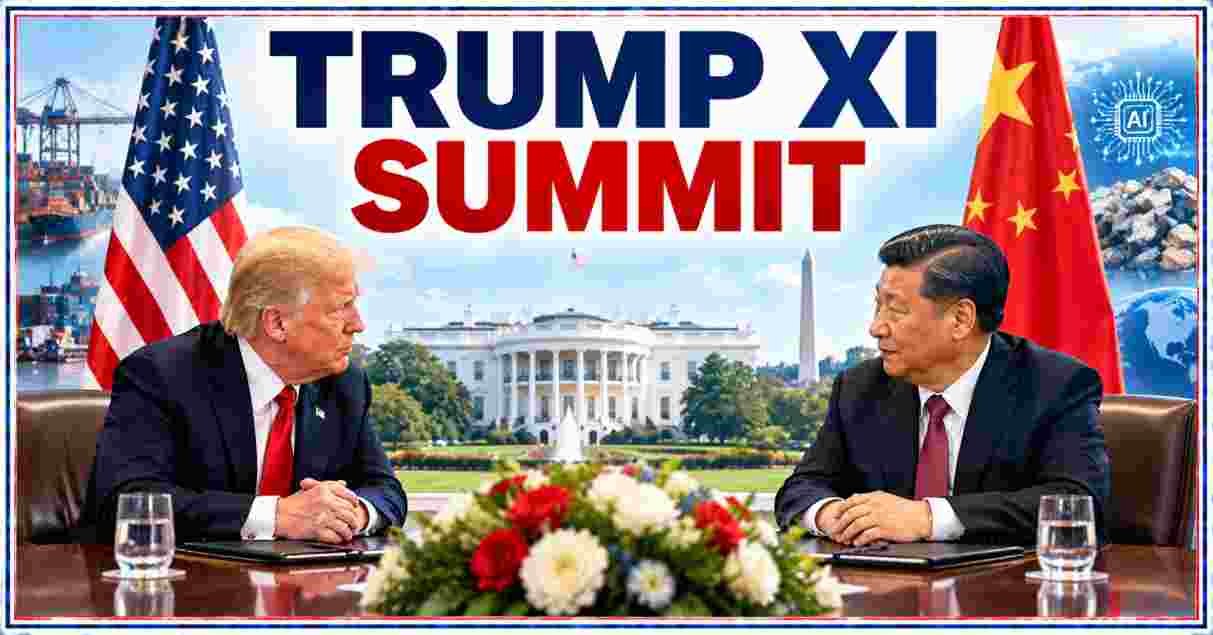
The Washington Summit between the US and Chinese leaders runs September 23-25, 2026, at the White House, marking the second head-of-state meeting between the two countries this year and the first Chinese state visit to Washington since 2015. The three-day itinerary includes a Rose Garden military review, a bilateral meeting, a state dinner, and a National Archives tour.
Trump Xi Summit 2026 – Introduction
The Trump Xi Summit 2026, formally a state visit hosted in Washington, brings the Chinese delegation to the White House for the first time in over a decade, capping a year that already included two prior meetings between the two governments. The visit follows a May 2026 state visit to Beijing and an October 2025 meeting in Busan, South Korea, making this the third face-to-face engagement between the two administrations within roughly eleven months, an unusually intensive diplomatic pace for the world’s two largest economies.
The Washington gathering arrives at a genuinely consequential moment for the bilateral relationship, with tariff levels, technology export controls, and rare earth mineral access all sitting unresolved since the Busan trade truce. Unlike a routine bilateral visit, this summit combines full state-visit ceremonial elements, an arrival ceremony, military review, and formal state dinner, with substantive economic talks expected to determine whether the fragile trade stability reached earlier in the year holds through the remainder of 2026. Understanding exactly when the summit takes place, where each event happens, and what topics are likely to dominate the agenda offers a complete picture of one of the year’s most closely watched diplomatic events.
The visit also carries outsized weight simply by virtue of how rare full state visits between the two countries have become. Where routine diplomatic contact between Washington and Beijing typically happens through working-level trade delegations, cabinet secretary visits, or sidelines meetings at multilateral summits, a full state visit with reciprocal spousal programming, a military review, and a formal state dinner signals a level of ceremonial investment neither government extends lightly, particularly given how strained the relationship had grown in the years immediately preceding this diplomatic reset.
Interesting Facts about Trump Xi Summit 2026
| Fact | Detail |
|---|---|
| Summit Dates | September 23-25, 2026 |
| Primary Venue | The White House, Washington, D.C. |
| Arrival Location | Joint Base Andrews |
| This Year’s Meeting Number | 2nd in 2026 (3rd since October 2025) |
| Prior Meeting Locations | Busan (Oct 2025), Beijing (May 2026) |
| Last Chinese State Visit to Washington | 2015 |
| Delegations Include | Both leaders’ spouses |
| UN General Assembly Attendance | Chinese leadership not attending, despite overlapping timing |
Source: White House schedule announcement, Wikipedia (2026 state visit by Donald Trump to China), Heritage Foundation
These interesting facts about the Trump Xi Summit highlight just how compressed the diplomatic calendar between the two countries has become in under a year. The September 23-25 Washington gathering marks the third in-person meeting between the two governments since October 2025, a pace that reflects both the scale of unresolved economic disputes and a deliberate effort by both sides to maintain regular high-level contact rather than let tensions escalate through prolonged silence.
The first Chinese state visit to Washington since 2015 carries symbolic weight independent of any specific policy outcome, restoring a level of ceremonial reciprocity that had lapsed for over a decade even as the two countries continued meeting periodically at multilateral gatherings like the G20 and APEC.
That decade-long gap between formal state visits reflects just how much the relationship cooled through the late 2010s and early 2020s, a period marked by escalating tariff disputes, technology export restrictions, and periods of minimal direct leader-to-leader engagement. The return to full state-visit protocol in 2026, following two prior meetings within the same year, marks a deliberate shift back toward sustained high-level dialogue after years in which lower-level officials handled the bulk of substantive bilateral engagement.
Trump Xi Summit 2026 Schedule and Itinerary
| Date | Event | Location |
|---|---|---|
| September 23 | Arrival ceremony | Joint Base Andrews |
| September 24 (morning) | White House arrival ceremony | State Floor, White House |
| September 24 (midday) | Military review | Rose Garden |
| September 24 (afternoon) | Bilateral meeting between the two leaders | White House |
| September 24 (evening) | State dinner, both leaders deliver remarks | East Room, White House |
| September 25 (morning) | Private tea | White House |
| September 25 (midday) | Tour of founding documents | National Archives |
| September 25 (afternoon) | Farewell departure | Joint Base Andrews |
Source: White House schedule, as announced by spokesperson Anna Kelly, reported by NTD and SCMP
The full three-day itinerary begins with an arrival ceremony at Joint Base Andrews on September 23, followed by the formal centerpiece events on September 24: a White House arrival ceremony on the State Floor, a military review in the Rose Garden, and the substantive bilateral meeting between the two heads of state. That evening’s state dinner in the East Room includes opening remarks from both leaders, a ceremonial element reserved for formal state visits rather than working-level trade meetings.
The September 25 schedule shifts toward a more personal register, opening with a private tea before both delegations tour the National Archives to view the country’s founding documents, an itinerary choice tied explicitly to America’s 250th anniversary commemorations. The visit concludes with farewells before the Chinese delegation departs from Joint Base Andrews later that day. Notably, while the two governments’ spouses, First Lady Melania Trump and Peng Liyuan, participate throughout much of the ceremonial programming, Peng follows a separate schedule during the working bilateral meeting itself.
This blend of ceremonial and working elements across three days distinguishes the visit from a standard diplomatic trip, which typically compresses substantive talks into a single day with minimal surrounding pageantry. The inclusion of a military review, a formal state dinner with dual remarks, and a cultural site visit signals that both governments intended the visit to project stability and mutual respect publicly, even as the underlying economic negotiations remained genuinely unresolved heading into the talks themselves.
Venue and Logistics for the Washington Summit in 2026
| Detail | Information |
|---|---|
| Host City | Washington, D.C. |
| Primary Venue | The White House |
| Arrival/Departure Airport | Joint Base Andrews |
| Additional Site Visited | National Archives |
| Confirmed Attendance Despite Health Rumors | Yes, per senior administration official |
Source: NTD, White House press briefing
Unlike the Beijing state visit in May, which required extensive overseas travel logistics for the American delegation, the Washington Summit places the full ceremonial and logistical burden on hosting the visiting Chinese delegation domestically. All primary events take place within Washington, D.C., centered on the White House itself, with Joint Base Andrews serving as the arrival and departure point for the Chinese delegation’s aircraft, standard protocol for foreign head-of-state visits to the United States.
Ahead of the summit, unconfirmed rumors circulated suggesting the Chinese leader had been hospitalized following the prior week’s BRICS summit in India, prompting reporters to directly question White House officials about whether the visit remained on schedule. A senior administration official told reporters there was “no reason to believe that there’s been any alteration” to the travel plans, and the summit proceeded on its originally announced dates without disruption.
Trump Xi Summit Timeline: From Busan to Washington in 2026
| Meeting | Date | Location | Significance |
|---|---|---|---|
| Busan Summit | October 30, 2025 | Busan, South Korea | First face-to-face meeting in 6 years, since 2019 G20 Osaka |
| Beijing State Visit | May 13-15, 2026 | Beijing, China | First China visit of the second term; second-ever as president |
| Washington Summit | September 23-25, 2026 | Washington, D.C. | First Chinese state visit to the US since 2015 |
Source: Wikipedia (Busan Summit, 2026 state visit by Donald Trump to China)
The Washington Summit represents the culmination of a diplomatic sequence that began at the Busan Summit on October 30, 2025, the first face-to-face meeting between the two leaders in six years, dating back to the 2019 G20 Osaka summit. That initial meeting produced an agreement to pursue further engagement, setting up the May 2026 Beijing state visit, during which an invitation was extended for a reciprocal visit to the United States, one now fulfilled by this September’s Washington gathering.
US Trading Partners statistics tracking how the broader bilateral trade relationship has evolved across this same period show the practical stakes behind this diplomatic sequence, since the Busan meeting’s trade truce reduced tariffs significantly on both sides, a fragile arrangement each subsequent summit has needed to reinforce or expand. The Beijing visit in May produced several notable deliverables, including a joint framing around what officials described as “constructive strategic stability,” apparent alignment on opposing Iranian nuclear weapons development, and commitments around Chinese purchases of American agricultural goods, setting the stage for the Washington summit to build on, rather than renegotiate from scratch, that foundation.
Agenda and Key Topics at the 2026 Summit
| Topic | Status Heading Into Summit |
|---|---|
| Artificial Intelligence | Folded into pre-summit economic talks |
| Rare Earth Minerals | Confirmed agenda item |
| US Auto Market Access | Confirmed agenda item, subject to national security rules |
| Busan Trade Truce Extension | Central to talks |
| Tariff Levels | Subject to further negotiation |
| Investment Screening Rules | National security restrictions to remain in place |
Source: South China Morning Post, senior administration officials
Briefings ahead of the summit confirmed that artificial intelligence, rare earth minerals, and US car market access would all feature prominently on the agenda, with AI specifically folded into pre-summit economic discussions rather than treated as a standalone topic. A senior administration official addressing potential Chinese investment in the American auto sector noted a firm limit to the openness on offer, emphasizing that national security concerns would not be compromised and that existing rules and regulations creating hurdles for certain categories of investment would remain in place regardless of other agreements reached during the visit.
US Sanctions Statistics documenting the broader sanctions and export-control architecture still governing the relationship provide relevant context for how narrow the room for major breakthroughs likely remains, since existing national security-driven restrictions on technology transfer and investment access were explicitly described as non-negotiable ahead of the summit. Extending and formalizing the Busan trade truce and the underlying tariff structure sits at the center of the economic talks, with both governments treating continuity and stability as the primary near-term objective rather than a wholesale renegotiation of trade terms.
Rare earth minerals in particular carry outsized strategic significance relative to their position on the formal agenda, since China controls the overwhelming majority of global processing capacity for these materials, which are essential inputs for everything from electric vehicle batteries to advanced semiconductors and defense systems. Any framework agreement on continued rare earth access reached during the Washington talks would likely be watched as closely by industry analysts as any headline tariff announcement, given how directly it affects supply chains across multiple critical American manufacturing sectors.
Trade and Tariff Context Heading Into the Summit in 2026
| Metric | Figure |
|---|---|
| US Tariff on Chinese Goods (post-Oct 2025 truce) | Reduced from 57% to 47% |
| Chinese Duty on US Goods (post-Oct 2025 truce) | Reduced from 125% to 10% |
| US Duty Revenue Collected From China (12 months to Nov 2025) | $89.63 billion |
| China’s Share of US Imports | Down 26.7% |
Source: US Trading Partners Statistics 2026, US Census Bureau
The trade backdrop shaping the summit reflects a relationship that has cooled substantially in relative terms even as absolute dollar figures remain enormous. Following the October 2025 Busan truce, the effective US tariff on Chinese goods dropped from 57% to 47%, while Chinese duties on American goods fell far more dramatically, from 125% to 10%, a lopsided adjustment that has drawn continued scrutiny from trade analysts. South Korea Tariffs covering a separate major Asian trading partner’s tariff arrangement offer a useful comparison point, illustrating how the current US approach to China sits within a broader pattern of country-specific tariff frameworks negotiated individually across major Asian economies over the past year.
Even with that truce in place, China’s overall share of US imports has fallen 26.7%, with other trading partners including Vietnam, Taiwan, and Switzerland climbing rapidly in the rankings as supply chains continue diversifying away from direct Chinese sourcing. The nearly $90 billion in duty revenue collected from Chinese imports over the twelve months preceding the summit underscores how, even amid diplomatic efforts to stabilize relations, tariff policy continues generating substantial federal revenue and reshaping trade patterns independent of whatever agreements emerge from the Washington talks themselves.
What to Expect: Analyst Predictions for the 2026 Summit
| Expectation | Analyst Assessment |
|---|---|
| Likelihood of Major New Agreements | Low; few substantive new topics expected |
| Success Metric | Measurable progress on prior commitments |
| Chinese Attendance at Overlapping UN General Assembly | Not planned |
| Structural Change to US-China Relations | Unlikely from this summit alone |
Source: Heritage Foundation analysis
Foreign policy analysts have generally set modest expectations for concrete deliverables from the Washington Summit itself. The Heritage Foundation’s assessment ahead of the visit concluded the meeting was “unlikely to transform the underlying structure of US-China relations or produce a large number of durable agreements,” framing that outcome as not necessarily constituting failure. Instead, analysts suggested the summit should be judged by whether China demonstrates measurable progress on commitments made at the May Beijing summit, whether US interests are protected, and whether American strategic negotiating leverage is preserved heading into further talks.
Notably, the Chinese leadership has no plans to attend the United Nations General Assembly, which occurs around the same period, with participation in the Washington summit limited to a single day of substantive White House meetings surrounded by ceremonial programming. That scheduling choice reinforces the broader analyst consensus that this visit functions primarily as a relationship-maintenance and stability-reinforcing exercise, building on the foundation established at Busan and Beijing, rather than a venue engineered to produce sweeping new agreements.
Trump Xi Summit 2026 FAQ
When is the Trump Xi Summit in 2026?
The Washington Summit runs September 23-25, 2026, with the main White House events occurring on September 24.
Where is the 2026 Trump Xi Summit being held?
The summit is hosted at the White House in Washington, D.C., with arrival and departure at Joint Base Andrews.
Is this the first meeting between the two leaders in 2026?
No. This is the second meeting of 2026, following a state visit to Beijing in May, and the third overall since the Busan Summit in October 2025.
What is on the agenda for the 2026 summit?
Confirmed topics include artificial intelligence, rare earth minerals, US auto market access, and the extension of the Busan trade truce.
When was the last Chinese state visit to Washington?
The last Chinese state visit to Washington occurred in 2015, making this the first in over a decade.
What happens at the state dinner?
The state dinner takes place in the East Room on the evening of September 24, with both leaders delivering opening remarks.
What is the current US tariff rate on Chinese goods?
Following the October 2025 Busan truce, the effective US tariff on Chinese goods was reduced from 57% to 47%.
Will Chinese officials attend the UN General Assembly during the same trip?
No. Despite the overlapping timing, Chinese leadership has no plans to attend the UN General Assembly.
Are major new agreements expected from the summit?
Analysts expect few major breakthroughs, describing the visit’s likely success as measured by progress on prior commitments rather than new agreements.
What will the two delegations do on the final day of the visit?
On September 25, the schedule includes a private tea and a tour of the National Archives before the Chinese delegation departs from Joint Base Andrews.
How much revenue has the US collected from Chinese import tariffs?
The US collected approximately $89.63 billion in duty revenue from Chinese imports over the twelve months preceding the summit.
Has the Chinese share of US imports grown or shrunk in 2026?
China’s share of total US imports has fallen 26.7%, with countries including Vietnam, Taiwan, and Switzerland climbing rapidly in the rankings as sourcing diversifies.
Disclaimer: This research report is compiled from publicly available sources. While reasonable efforts have been made to ensure accuracy, no representation or warranty, express or implied, is given as to the completeness or reliability of the information. We accept no liability for any errors, omissions, losses, or damages of any kind arising from the use of this report.