
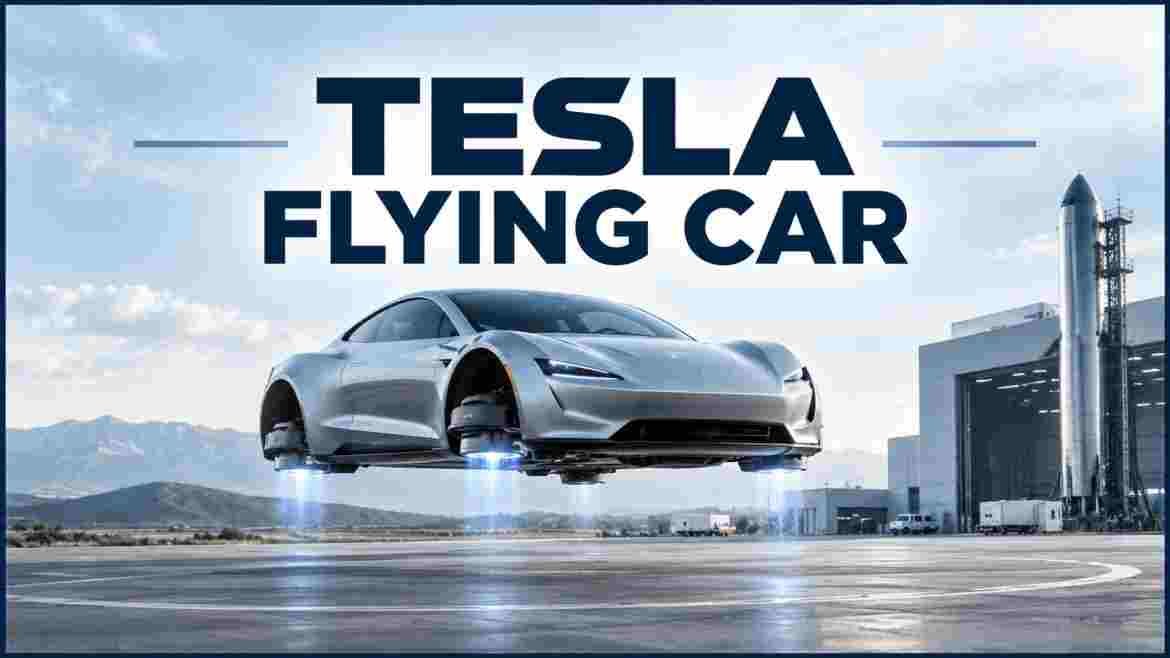
Tesla unveiled the second-generation Roadster on October 15, 2026 in three versions: Performance (0–60 mph in under 1.6 seconds), Thrust (under 0.9 seconds, $250,000 reservation), and the invite-only, single-seat Rocket (under 0.59 seconds, over 230 mph claimed) that uses 10 cold-gas thrusters for short aerial moves. Production is planned for 2028, Tesla has announced no price, no FAA certification exists, and Tesla says the Rocket is not approved for public roads.
Tesla Flying Car 2026
The Tesla Flying Car is the Roadster Rocket, a single-seat version of the new Roadster that Tesla showed at a SpaceX test site in McGregor, Texas on October 15, 2026. The car drove upside down on a curved ramp using a fan-based suction system, left the ramp on cold-gas thrusters, flipped in the air, and landed on its wheels. Later it jumped over a Cybercab, a Cybertruck, a Tesla Semi, a Model Y, and a Model 3. Tesla calls the Rocket “air ready.” The demo showed short aerial moves and no sustained flight.
The numbers matter more than the label. Tesla quotes 0–60 mph in under 0.59 seconds, a top speed above 230 mph, and range above 300 miles, with production set for 2028. Deposits run $50,000 for the Performance version and $250,000 for Thrust. No price exists, and no aviation regulator has certified the car to fly. This report covers price, speed, range, thrusters, timeline, and the FAA and road-legal rules, with each source dated.
Interesting Facts About the Tesla Flying Car 2026
| Fact | Data (Period) |
|---|---|
| Unveil date and place | October 15, 2026, SpaceX site, McGregor, Texas |
| Versions | 3: Performance (2 seats), Thrust (2 seats), Rocket (1 seat, invite only) |
| Claimed 0–60 mph | Under 1.6 s / under 0.9 s / under 0.59 s |
| Demo 0–60 mph run | 0.81 seconds |
| Top speed claim | Over 230 mph (Rocket) |
| Range claim | Over 300 miles (all versions) |
| Thrusters on Rocket | 10 cold-gas thrusters, about 600 liters of compressed air |
| Reservation deposits | $50,000 (Performance), $250,000 (Thrust) |
| Production target | 2028 |
| Price announced | None (2017 quote: $200,000 base) |
| FAA certification | None on public record |
Every spec above is a Tesla claim, and Tesla has not published independent test results. The 0.81-second run came from Tesla’s own timer during the live event, and Tesla’s page says the under 0.59-second figure belongs to the Rocket. The top speed and range figures apply to the whole lineup only as Tesla describes them, and the company gave no separate range number for each version.
The facts also show how far the car has moved from its first pitch. In 2017 Tesla promised 1.9 seconds, over 250 mph, 620 miles of range, and four seats. The 2026 car has two seats at most, 300+ miles, and a headline speed of 230 mph on the Rocket only. Tesla gained thruster-assisted acceleration and gave up range and seating.
Tesla Roadster Price & Reservation Deposits 2026
Roadster deposits and 2017 price quote, dollars
Performance reservation ████████ $50,000
2017 quoted base price  ████████████████████████████████ $200,000
Thrust reservation      ████████████████████████████████████████ $250,000
| Item | Amount or Terms |
|---|---|
| Performance reservation (total) | $50,000 ($5,000 now, $45,000 within 10 days) |
| Thrust reservation (total) | $250,000 ($5,000 now, $245,000 within 10 days) |
| Rocket reservation | Invite only; no public payment offer verified |
| Germany Performance reservation | €50,000 (about $56,100) |
| Refundable portion at signup | $5,000, described as “fully refundable” |
| Final purchase price | Not announced |
| 2017 quoted base price | $200,000 |
| 2017 Founders Series | $250,000, 1,000 units |
| Reservation agreement date | October 15, 2026 |
Data source: Tesla Roadster reservation page and Roadster Reservation Agreement (US v.20261015), as reported by Fox Business, Kingy, and Bloomberg on October 15, 2026.
A reservation is a deposit and not a purchase. Tesla’s agreement says any estimated price “is only an estimate” and that the reservation “does not constitute the purchase or order of a vehicle.” The $50,000 Performance deposit matches the 2017 reservation amount, and the $250,000 Thrust deposit matches the old Founders Series price. Tesla has set no final price for any version.
The deposit schedule moves money fast. A buyer pays $5,000 at signup and the rest within 10 days, or the reservation can be canceled. That means a Thrust buyer commits $245,000 within days for a car that will not exist in production form until 2028. Some earlier reservation holders, reportedly including some who paid $250,000 for a Founders Series spot, have waited since 2017.
Tesla Roadster Speed & Acceleration 2026
0–60 mph time, seconds
2017 claim        ████████████████████████████████████████ 1.9 s
Performance       ██████████████████████████████████ <1.6 s
Thrust            ███████████████████ <0.9 s
Demo run (Oct 15) █████████████████ 0.81 s
Rocket            ████████████ <0.59 s
| Version | Seats | Claimed 0–60 mph | Top Speed Claim |
|---|---|---|---|
| Performance | 2 | Under 1.6 seconds | Not separately stated |
| Thrust | 2 | Under 0.9 seconds | Not separately stated |
| Rocket | 1 | Under 0.59 seconds | Over 230 mph (370 km/h) |
| Live demo run | n/a | 0.81 seconds | n/a |
| Musk’s production target | n/a | n/a | Mach 0.5 (about 383 mph) |
| 2017 claim | 4 | 1.9 seconds | Over 250 mph |
Data source: Tesla launch announcement and Roadster product page, as reported by Electrek, Drive Tesla Canada, and Yahoo Finance, October 15, 2026.
The base Performance car claims 1.6 seconds, quicker than the 1.9 seconds Tesla promised in 2017. The Thrust version adds rear-mounted cold-gas thrusters and cuts the claim to under 0.9 seconds, a gain of about 0.7 seconds. The Rocket’s perimeter thrusters push it under 0.59 seconds, about 1.01 seconds faster than the base car. The thrusters supply short bursts, so these times describe a launch and not sustained speed.
Top speed deserves caution. Tesla attached the over 230 mph figure to the Rocket and gave no separate number for the other two. Electrek’s analysts doubt the thrusters help much at high speed, since the air tanks may empty fast. Musk said the production car could target Mach 0.5, about 383 mph, which would far exceed the printed spec. Treat that as a stated hope until Tesla publishes test data.
Tesla Roadster Claimed vs Demonstrated Performance 2026
Rocket 0–60 mph: claim vs demo runs, seconds
Rocket claim (under)      ████████████████████████ 0.59 s
Second demo run           ████████████████████████████████ 0.81 s
First recorded demo run   ████████████████████████████████████████ 1.0 s
| Measure | Value |
|---|---|
| First recorded demo 0–60 mph | 1.0 second |
| Second demo run (after a timer problem) | 0.81 seconds |
| Thrust claim | Under 0.9 seconds |
| Rocket claim | Under 0.59 seconds |
| Gap between Rocket claim and 0.81-second run | About 27% shorter |
| Independent verification | None as of October 16, 2026 |
| Rocket flight duration | Not stated |
| Tesla’s own caveat | Production car, specs, and capabilities “could change” before deliveries |
Data source: Electrek technical review (October 15, 2026); Kingy analysis of Tesla’s reservation and launch materials; Pulse 2.0 and Bloomberg reporting, October 15 to 16, 2026.
The demo and the claims do not match yet. Tesla’s first recorded run read 1.0 second. After what reporters described as timer trouble, a later run showed 0.81 seconds. The Rocket claim of under 0.59 seconds is about 27% shorter than that second run, so the quickest figure on Tesla’s page has not appeared in a live test. Tesla also did not say which version or thruster setup the demo car carried.
Tesla itself warns that the car may change. Coverage of the event notes that the 2028 timeline, performance specs, and final capabilities remain forward-looking. Electrek’s earlier reporting questioned whether buyers would put down $50,000 or $250,000 for a prototype that hops on compressed gas. Tesla then opened reservations anyway. Wait for independent timing, a stated flight duration, and a regulatory path before treating any of these numbers as final.
Tesla Roadster Range, Seats & Top Speed vs 2017 Claims 2026
2026 claim as % of 2017 claim
Top speed (230 vs 250 mph) █████████████████████████████████████ 92%
Seats (2 vs 4)             ████████████████████ 50%
Range (300 vs 620 mi)      ███████████████████ 48%
| Spec | 2017 Claim | 2026 Claim |
|---|---|---|
| Range | 620 miles | Over 300 miles |
| Top speed | Over 250 mph | Over 230 mph (Rocket) |
| 0–60 mph | 1.9 seconds | Under 1.6 seconds (base) |
| Seats | 4 (2+2) | 2 (Rocket: 1) |
| Battery (2017 prototype) | 200 kWh | Not disclosed |
| Wheel torque (2017) | 10,000 Nm | Not disclosed |
| Production target | 2020 (original) | 2028 |
Data source: Tesla Roadster pages (2017 specifications still on the UK site), Electrek, and Drive Tesla Canada, October 2026.
Range fell by more than half. Tesla claims over 300 miles for the 2026 car against 620 miles in 2017, a drop of about 52%. Electrek reads the cut as evidence of a smaller battery, since the 2017 design carried 200 kWh. A smaller pack saves weight, which matters for a car built to launch off a ramp. Tesla gave no battery size for the 2026 car and no EPA range rating.
Seating and speed also shrank. The 2017 design carried four people, and the new Performance and Thrust cars carry two. The Rocket carries one. The Rocket’s over 230 mph sits 20 mph below the 2017 promise of over 250 mph. The base Performance car improved only on acceleration. Buyers comparing the two specs should note that the 2017 numbers still appear on Tesla’s UK Roadster page.
Tesla Roadster Thrusters & Flight Capability 2026
0–60 mph time saved vs Performance, seconds
Thrust vs Performance ████████████████████████████ 0.7 s
Rocket vs Performance ████████████████████████████████████████ 1.01 s
| Metric | Value |
|---|---|
| Thrusters on the Rocket | 10 cold-gas thrusters |
| Compressed air supply | About 600 liters, designed to be rechargeable |
| Thrust version thrusters | Rear-mounted (count not stated) |
| Vehicles cleared in the jump demo | 5 (Cybercab, Cybertruck, Semi, Model Y, Model 3) |
| Thruster partner | SpaceX |
| First thruster idea from Musk | 2018 (about 10 thrusters) |
| Rocket road approval | Not approved for public roads (Tesla) |
| Sustained flight shown | None |
| Suction system | Fan-based; held the car on an upside-down ramp |
Data source: Lars Moravy, Tesla VP of Engineering, at the October 15, 2026 event; TechCrunch, Pulse 2.0, and Electrek reporting, October 15 to 16, 2026.
The thrusters use compressed air, not rocket fuel. Moravy said the Rocket’s 10 thrusters draw from about 600 liters of air that can be refilled. Cold-gas systems give strong but brief pushes, so the car can hop, spin, and land. They do not give lift for cruising. Electrek had reported before the event that the demo was scaled back from “flying” to a short hover, and what Tesla showed matched that.
Tesla separates the three versions carefully. Its page calls Thrust and Rocket “augments” on top of the Performance car and says the Rocket is not approved for public roads. Musk first floated the idea in 2018 as a “SpaceX option package” with about 10 small thrusters. The SpaceX tie runs through the whole project, and readers who want the company side can see SpaceX statistics in the US for launch and Starlink figures.
Tesla Roadster Production Timeline & Delays 2026
Years after the November 2017 unveil
2023 production target (set 2021) ██████████████████████ 6 years
Unveil event, October 2026        █████████████████████████████████ 9 years
2028 production target            ████████████████████████████████████████ 11 years
| Date | Event |
|---|---|
| November 2017 | First unveil: 1.9 seconds, 620 miles, $50,000 deposits |
| 2021 shareholder meeting | Musk confirms a 2023 production target |
| November 2025 | Musk targets a demo on April 1, 2026 |
| March 2026 | Demo slips to late April |
| Q1 2026 earnings call | “Maybe in a month or so” |
| September 12, 2026 | Tesla teases a launch event for October 1 |
| September 28, 2026 | Event postponed to October 15 (weather) |
| October 15, 2026 | Unveil at SpaceX site in McGregor, Texas |
| 2028 | Stated production start |
Data source: Electrek (October 13 and 15, 2026); Wikipedia timeline of the second-generation Roadster; TechCrunch; Bloomberg, October 2026.
The Roadster has slipped for nearly nine years. Tesla showed it in November 2017, and Musk confirmed a 2023 production target in 2021. The 2026 unveil itself moved three times: April 1, late April, then October 1, and finally October 15 after Tesla cited weather. Musk said production starts in 2028, which would be 11 years after the first reveal. Tesla’s own materials call the 2028 target and final specs forward-looking.
The delays matter for buyers and for Tesla’s business. The car sits outside Tesla’s volume lineup, where US sales ran about 589,000 vehicles in 2025 per Tesla statistics in the US. The Roadster is a halo project with a deposit book. A 2028 start also places it in a different regulatory climate, since the FAA and NHTSA rules for any road-and-air vehicle will keep evolving between now and then.
Tesla Flying Car FAA Certification, Airspace Rules & Legal Restrictions 2026
Claimed top speeds, mph
Alef Model A, road     ██████ ~35 mph
Alef Model A, air      ███████████████████ ~110 mph
Roadster Rocket claim  ████████████████████████████████████████ 230+ mph
| Rule or Status | Detail |
|---|---|
| FAA certification for the Roadster | None on public record |
| Tesla’s road status for Rocket | Not approved for public roads |
| Powered-lift final rule | Released October 22, 2024; published November 21, 2024 |
| Powered-lift pilot rules | SFAR 120 (14 CFR Part 194), runs 10 years |
| Powered-lift aircraft certification | Case by case under 14 CFR 21.17(b) |
| Best-known road-and-air precedent | Alef Model Zero, special airworthiness certificate, June 2023 |
| What that certificate allows | Exhibition, research, and development; no operation for hire |
| Road approval for Alef | Still needs NHTSA approval |
| Roadster reservation terms | Not a purchase; price is an estimate |
Data source: Federal Aviation Administration final rule, Integration of Powered-Lift (Federal Register, November 21, 2024); FAA statement to Simple Flying (2023); Electrek and Tech Insider reporting, October 2026.
I found no road-and-air car with full FAA type certification. Alef Aeronautics holds the best-known precedent, a special airworthiness certificate issued in June 2023 for exhibition, research, and development. The FAA noted it was not the first aircraft of its kind to get one. That certificate does not allow operation for hire, and Alef’s road version still needs NHTSA approval. The Roadster has no certificate of any kind, and the Rocket’s claimed 230+ mph is far above Alef’s 110 mph in the air.
The FAA built a path for vertical-lift aircraft, and the path is long. The powered-lift rule released on October 22, 2024 created pilot rules under SFAR 120 for 10 years. Aircraft still need a type certificate, and the FAA sets requirements case by case under 14 CFR 21.17(b). The Roadster has not been placed in the powered-lift category on public record. Aviation risk is real: for context on how FAA oversight responds to accidents, see plane crash statistics in the US.
Frequently Asked Questions About the Tesla Flying Car 2026
What is the Tesla flying car?
It is the Tesla Roadster Rocket, a single-seat version of the second-generation Roadster with 10 cold-gas thrusters. Tesla unveiled it on October 15, 2026. It showed jumps, flips, and landings, not sustained flight.
Can the Tesla Roadster fly?
Not in the way an aircraft flies. The Rocket used thrusters to leave a ramp, flip, and land, and to jump over vehicles. No sustained flight was demonstrated.
How much does the Tesla Roadster cost?
Tesla has not announced a price. It takes $50,000 reservations for the Performance version and $250,000 for the Thrust version. Tesla quoted a $200,000 base price in 2017.
How much is the Tesla Roadster reservation deposit?
The Performance version costs $50,000: $5,000 at signup and $45,000 within 10 days. Thrust costs $250,000: $5,000 now and $245,000 within 10 days. The Rocket is invite only.
How fast is the Tesla Roadster?
Tesla claims 0–60 mph in under 1.6 seconds (Performance), under 0.9 seconds (Thrust), and under 0.59 seconds (Rocket). The Rocket’s top speed claim is over 230 mph.
What is the Tesla Roadster range?
Tesla claims over 300 miles for all three versions. The 2017 design promised 620 miles.
When will the Tesla Roadster go into production?
Tesla says production starts in 2028, nearly 11 years after the 2017 unveil.
Does the Tesla Roadster have FAA approval?
No FAA certification for the Roadster appears in public records. Tesla’s own page says the Rocket is not approved for public road use.
What are the Tesla Roadster thrusters made of?
They are cold-gas thrusters developed with SpaceX. They use about 600 liters of compressed air, designed to be rechargeable, and give short bursts of push.
Is the Tesla Roadster street legal?
Tesla lists the Performance version as road ready. It says the Rocket is not approved for public roads. Final road approvals depend on the 2028 production car.
What did the Roadster demo show?
It showed a 0–60 mph run of 0.81 seconds, upside-down driving on a suction ramp, a thruster-assisted flip, and jumps over a Cybercab, Cybertruck, Semi, Model Y, and Model 3.
How many Roadster versions are there?
There are 3: Performance (2 seats), Thrust (2 seats), and Rocket (1 seat, invite only).
Has anyone independently tested the Tesla Roadster?
No. As of October 16, 2026, no independent test of the 0–60 mph or top speed claims exists. Tesla’s own demo run showed 0.81 seconds, and its Rocket claim is under 0.59 seconds.
How long can the Tesla Roadster Rocket stay in the air?
Tesla has not stated a flight duration. The Rocket carries about 600 liters of compressed air for 10 thrusters, and the demo showed hops, flips, and jumps of short length.
Why did Tesla delay the Roadster event?
Tesla moved the event from October 1 to October 15, 2026, citing weather, since the show “can only be held outdoors.” The demo date had already slipped from April 1, 2026.
Disclaimer: This research report is compiled from publicly available sources. While reasonable efforts have been made to ensure accuracy, no representation or warranty, express or implied, is given as to the completeness or reliability of the information. We accept no liability for any errors, omissions, losses, or damages of any kind arising from the use of this report.