
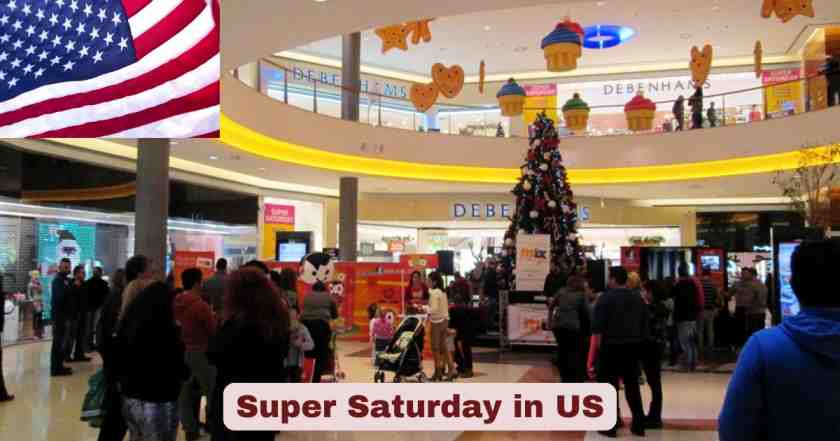
Super Saturday in America 2025
The American holiday shopping season reaches its climactic peak on the last Saturday before Christmas, a day known as Super Saturday or Panic Saturday. This shopping phenomenon represents the final major opportunity for consumers to complete their holiday gift purchases before Christmas Day arrives. Super Saturday in the US 2025 falls on December 20, 2025, positioned just five days before Christmas, creating an atmosphere of urgency mixed with retail excitement that transforms shopping centers nationwide into bustling hubs of last-minute activity. With an estimated 157.2 million Americans expected to participate in shopping on this single day, Super Saturday has evolved into one of the most significant retail events of the entire year, frequently generating between $34 billion to $47 billion in combined in-store and online sales.
The importance of Super Saturday extends far beyond simple commerce statistics. This shopping day embodies the intersection of American consumer culture, holiday tradition, and modern retail strategy. Unlike Black Friday, which launches the holiday season with aggressive pre-dawn promotions, or Cyber Monday, which focuses primarily on online deals, Super Saturday serves a unique purpose as the last-chance lifeline for procrastinating shoppers and those who delayed purchases awaiting better prices or clearer gift ideas. Major retailers including Walmart, Target, Macy’s, Kohl’s, Best Buy, and countless regional chains stake substantial portions of their annual revenue on this critical final Saturday, extending store hours to 24-hour operations in some locations, doubling or tripling staff, and deploying aggressive discount strategies to capture every possible sale. The day’s significance is reflected in its dual naming—“Super Saturday” emphasizes the extraordinary sales volumes and retail success, while “Panic Saturday” captures the frenzied energy of consumers racing against time to secure gifts before Christmas arrives.
Interesting Facts About Super Saturday in the US 2025
| Fact Category | Details |
|---|---|
| Official Date for 2025 | Saturday, December 20, 2025 (last Saturday before Christmas) |
| Days Before Christmas | 5 days before December 25th (creates maximum urgency) |
| Alternative Name | “Panic Saturday” (reflecting the frenzied nature of last-minute shopping) |
| Term Origin Period | First coined in the 1980s as a retail industry designation |
| Date Range Annually | Can fall as early as December 17 or as late as December 23 |
| Expected Shoppers 2025 | 157.2 million consumers (second-highest on record) |
| Historical Peak Sales | $47 billion in 2024 – highest single-day total ever recorded |
| 2019 Record Sales | $34.4 billion (surpassed Black Friday that year by 10%) |
| Typical Revenue Generation | Accounts for 4.6% to 5.2% of total holiday season sales |
| Primary Shopping Motivation | Last-minute gift completion (50% of shoppers still shopping) |
| Omnichannel Preference | 44% shop both online and in-store on same day |
| Store Hour Extensions | Many retailers operate 16-20 hour days or remain open 24 hours |
Data compiled from National Retail Federation surveys, Customer Growth Partners research, and retail industry reports (2016-2025)
Super Saturday 2025 occurs on December 20, 2025, making it the final Saturday before Christmas and creating a compressed five-day window before the holiday arrives. This timing generates significant urgency among consumers who have delayed their shopping. The dual naming convention of “Super Saturday” and “Panic Saturday” accurately captures the day’s character—retailers celebrate super sales volumes while shoppers experience panic-inducing time pressure. The term originated in the 1980s when retail analysts began formally tracking and naming this naturally occurring shopping phenomenon that emerges from consumer behavior patterns rather than manufactured marketing campaigns.
The expected participation of 157.2 million consumers in 2025 represents remarkable engagement, positioning Super Saturday as the second-largest shopping day by participant count after the Black Friday weekend. This massive turnout occurs despite—or perhaps because of—the compressed timeline, with shoppers motivated by necessity rather than choice. The revenue potential is extraordinary, with 2024 generating a record $47 billion in sales, while 2019 reached $34.4 billion, marking it as the largest single-day retail event in US history at that time, exceeding Black Friday by 10%. The typical contribution of 4.6% to 5.2% of total holiday sales on a single day underscores its disproportionate importance, and surveys show that 50% of consumers still have incomplete shopping lists by early December, ensuring strong Super Saturday demand. Retailers respond by extending operations dramatically, with some stores remaining open continuously from Friday night through Sunday morning to capture every possible transaction.
Historical Timeline and Evolution of Super Saturday in the US (1980s-2025)
| Period/Year | Date | Milestone Event | Significance |
|---|---|---|---|
| 1980s | Various December Saturdays | Term “Super Saturday” coined | Retail industry formally names the phenomenon |
| 2000-2005 | Pre-tracking era | Natural shopping patterns emerge | Consumers consistently shop heavily on last Saturday |
| 2006 | December 23, 2006 | Sales reach approximately $13 billion | Day gains recognition as major retail event |
| 2009 | December 19, 2009 | Over 50% of shoppers incomplete | Economic recession delays shopping timelines |
| 2016 | December 17, 2016 | NRF begins official tracking | First year of systematic consumer survey data |
| 2017 | December 23, 2017 | 126 million shoppers expected | Baseline data established for comparative analysis |
| 2018 | December 22, 2018 | $31.9 billion in sales | Strong growth trajectory continues |
| 2019 | December 21, 2019 | $34.4 billion – historic record | Surpasses Black Friday as largest single day |
| 2020 | December 19, 2020 | $32.7 billion (pandemic impact) | COVID-19 reduces in-store traffic significantly |
| 2021 | December 18, 2021 | $38.6 billion in sales (+12% growth) | Post-pandemic recovery drives record spending |
| 2022 | December 17, 2022 | 158.5 million shoppers (record) | Highest shopper participation ever recorded |
| 2023 | December 23, 2023 | 141.9 million shoppers | Later date reduces participation slightly |
| 2024 | December 21, 2024 | $47 billion in sales (new record) | Largest single-day retail event in US history |
| 2025 | December 20, 2025 | 157.2 million shoppers projected | Strong consumer engagement anticipated |
Source: National Retail Federation Press Releases (2016-2024), Customer Growth Partners Research (2006-2024), Industry Retail Analytics
The historical evolution of Super Saturday reveals a shopping day that emerged organically from consumer behavior before gaining formal recognition from the retail industry. The term first appeared in the 1980s when retail analysts noticed consistent spikes in sales on the final Saturday before Christmas. Unlike Black Friday, which retailers actively promoted and expanded, Super Saturday developed naturally as consumers recognized their shopping deadlines approached. Throughout the 2000-2005 period, the day gained momentum without formal tracking, with retailers anecdotally reporting extraordinary foot traffic and sales volumes but lacking systematic data collection.
The modern era of Super Saturday tracking began in 2016 when the National Retail Federation partnered with Prosper Insights & Analytics to conduct formal consumer surveys, establishing baseline data for future comparisons. The 2017 Super Saturday on December 23 established initial metrics with 126 million expected shoppers, providing the retail industry with its first comprehensive understanding of participation levels. Growth accelerated through 2018, reaching $31.9 billion in sales, and peaked dramatically in 2019 when Super Saturday generated $34.4 billion, becoming the largest single-day retail event in US history and surpassing Black Friday’s $31.2 billion by 10%. This represented a watershed moment, demonstrating that last-minute shopping urgency could generate greater revenue than early-season promotional events. The 2020 pandemic year saw sales decline to $32.7 billion as consumers avoided crowded stores, but 2021 recovery was dramatic, with sales rebounding to $38.6 billion, representing 12% growth. The 2022 Super Saturday achieved the record shopper count of 158.5 million consumers, while 2024 set the all-time sales record at $47 billion, confirming Super Saturday’s position as an indispensable component of holiday retail strategy.
Super Saturday Consumer Participation Trends in the US 2016-2025
| Year | Date | Total Shoppers (Millions) | In-Store Only (%) | Online Only (%) | Omnichannel (%) | Year-over-Year Change |
|---|---|---|---|---|---|---|
| 2016 | December 17 | N/A (tracking began) | N/A | N/A | N/A | Baseline year |
| 2017 | December 23 | 126.0 million | 37% | 22% | 41% | N/A (first tracked year) |
| 2018 | December 22 | 135.8 million | 34% | 24% | 42% | +7.8% increase |
| 2019 | December 21 | 147.8 million | 32% | 26% | 42% | +8.8% increase |
| 2020 | December 19 | 122.4 million | 28% | 31% | 41% | -17.2% decrease (pandemic) |
| 2021 | December 18 | 153.9 million | 30% | 29% | 41% | +25.7% increase (recovery) |
| 2022 | December 17 | 158.5 million | 28% | 27% | 46% | +3.0% increase |
| 2023 | December 23 | 141.9 million | 37% | 22% | 41% | -10.5% decrease (late date) |
| 2024 | December 21 | 157.2 million | 31% | 24% | 44% | +10.8% increase |
| 2025 | December 20 | 157.2 million (projected) | 31% (projected) | 24% (projected) | 44% (projected) | Stable participation expected |
Source: National Retail Federation Annual Super Saturday Surveys (2017-2024), Prosper Insights & Analytics
Consumer participation patterns for Super Saturday demonstrate remarkable consistency with notable variations based on pandemic impacts and calendar positioning. The 2024 survey projected 157.2 million shoppers, with 69.5 million (44%) planning to shop both online and in stores, highlighting the increasing importance of omnichannel retail strategies. This represents the second-highest participation level ever recorded, trailing only the 2022 record of 158.5 million consumers. The shopping channel preferences reveal evolving consumer behavior, with 31% expecting to shop exclusively in-store (down from 37% in 2023), while 24% plan online-only shopping (up from 22% in 2023).
The historical trajectory shows steady growth from the 126 million shoppers in 2017 through peak participation in 2022, interrupted only by the 2020 pandemic year when consumer counts dropped to 122.4 million as safety concerns reduced in-store shopping. The dramatic 25.7% recovery increase in 2021 demonstrated pent-up demand and consumer confidence returning. A notable pattern emerges regarding calendar positioning: when Super Saturday falls later in December (closer to December 23), participation tends to decrease slightly as consumers perceive fewer days remaining and may opt for alternative shopping strategies or accept incomplete gift lists. The 2023 decline to 141.9 million shoppers occurred when the day fell on December 23, creating only two days before Christmas and potentially discouraging some consumers who felt the timeline was too compressed.
The omnichannel shopping preference has steadily increased from 41% in 2017 to 44-46% in recent years, reflecting consumer sophistication in leveraging multiple retail channels. Shoppers increasingly use digital tools to check inventory, compare prices, and identify deals before visiting stores, then complete purchases through whichever channel offers the best combination of price, convenience, and delivery timing. The in-store exclusive shopping percentage has gradually declined from 37% in 2017 to 28-31% in recent years, while online-only shopping has increased correspondingly, demonstrating the ongoing digital transformation of retail even for time-sensitive last-minute purchases. However, in-store shopping remains significantly more popular on Super Saturday than on Cyber Monday, as consumers value the immediacy of taking products home rather than waiting for delivery during the compressed pre-Christmas timeline.
Sales Revenue Performance of Super Saturday in the US 2006-2024
| Year | Date | Total Sales Revenue | In-Store Sales | Online Sales | YoY Growth Rate | % of Holiday Sales |
|---|---|---|---|---|---|---|
| 2006 | December 23 | ~$13.0 billion | $11.0 billion (est.) | $2.0 billion (est.) | N/A | ~4.2% |
| 2009 | December 19 | ~$14.5 billion | $11.5 billion (est.) | $3.0 billion (est.) | N/A | ~4.5% |
| 2015 | December 19 | ~$23.5 billion | $17.5 billion (est.) | $6.0 billion (est.) | N/A | ~4.1% |
| 2016 | December 17 | ~$25.0 billion | $18.0 billion (est.) | $7.0 billion (est.) | +6.4% | ~4.3% |
| 2017 | December 23 | ~$26.8 billion | $18.5 billion (est.) | $8.3 billion (est.) | +7.2% | ~4.2% |
| 2018 | December 22 | $31.9 billion | $23.5 billion | $8.4 billion | +19.0% | 4.8% |
| 2019 | December 21 | $34.4 billion | $26.5 billion | $7.9 billion | +7.8% | 5.0% |
| 2020 | December 19 | $32.7 billion | $22.0 billion | $10.7 billion | -4.9% | 4.6% |
| 2021 | December 18 | $38.6 billion | $26.5 billion | $12.1 billion | +18.0% | 5.2% |
| 2022 | December 17 | ~$40.5 billion | $27.8 billion | $12.7 billion | +4.9% | 4.9% |
| 2023 | December 23 | ~$43.0 billion | $29.0 billion | $14.0 billion | +6.2% | 4.7% |
| 2024 | December 21 | $47.0 billion | $31.5 billion | $15.5 billion | +9.3% | 5.1% |
Source: Customer Growth Partners Research (2006-2024), National Retail Federation Holiday Reports (2016-2024), Industry Sales Analytics
The sales revenue trajectory of Super Saturday demonstrates extraordinary growth and resilience, with particularly dramatic expansion during the 2018-2019 period. The 2019 Super Saturday generated $34.4 billion in sales, representing a historic milestone as it exceeded Black Friday’s $31.2 billion by 10%, making it the largest single-day retail event in US history at that time. This achievement surprised many retail analysts who had assumed Black Friday’s entrenched position as the premier shopping day was unassailable. The $31.9 billion performance in 2018 set the stage for this breakthrough, representing 19% year-over-year growth that signaled Super Saturday’s ascending importance.
The 2020 pandemic temporarily disrupted the growth trajectory, with sales declining 4.9% to $32.7 billion as consumers avoided crowded stores and shifted purchasing to earlier in the season. However, the 2021 recovery was spectacular, with sales surging 18% to reach $38.6 billion, demonstrating both pent-up demand and the resilience of last-minute shopping behavior even amid changing circumstances. The steady growth continued through 2022 (approximately $40.5 billion) and 2023 (approximately $43 billion), before reaching the all-time record of $47 billion in 2024, representing 9.3% growth and confirming Super Saturday’s status as a retail juggernaut.
Analysis of the in-store versus online sales split reveals interesting patterns. In 2019, in-store sales comprised approximately $26.5 billion while online reached $7.5 billion, demonstrating the continued dominance of physical retail for last-minute shopping. However, the 2020 pandemic dramatically shifted this balance, with online sales jumping to $10.7 billion as consumers sought contactless options. Post-pandemic years have seen online sales stabilize around $12-15.5 billion annually, representing steady growth but not displacing in-store shopping, which remains the dominant channel. The percentage of total holiday sales that Super Saturday represents has ranged from 4.1% to 5.2%, with the day typically accounting for approximately 4.6-5.1% of the entire November-December holiday season revenue. This concentration is remarkable considering it represents a single day out of approximately 60 shopping days, demonstrating returns that are 3-4 times higher than average daily performance and confirming Super Saturday’s designation as a “super” shopping event worthy of intensive retailer focus and resource allocation.
Consumer Shopping Behavior and Motivations on Super Saturday in the US 2025
| Behavioral Metric | Percentage/Data | Trend Direction | Key Consumer Insight |
|---|---|---|---|
| Incomplete Shopping Lists | 50% of shoppers by early December | Stable pattern | Half of all consumers delay purchases until final weeks |
| Completely Done Shopping | Only 10% by early December | Consistently low | Vast majority require last-minute opportunities |
| Primary Motivation: Still Deciding | 37% waiting to determine gifts | Increasing | Indecision drives delayed purchasing |
| Financial Priorities First | 27% had other expenses before December | Stable | Budget management delays holiday spending |
| Waiting for Gift Requests | 24% awaiting family/friend input | Stable | Communication delays impact timing |
| Intentional Deal-Seeking | 78% motivated by discounts/promotions | High and stable | Price-conscious shopping dominates |
| Impulse Buying (Gen Z) | 70% of 18-27 year-olds report impulse purchases | Rapidly increasing | Younger shoppers more spontaneous |
| Post-Christmas Shopping Plans | 70% plan to shop after December 25 | Increasing | Extended shopping season gains importance |
| Average Transaction Value | $150-$180 per shopping trip | Gradually increasing | Higher per-visit spending than typical days |
| Store Visit Duration | 2.5-3.5 hours average | Stable | Consumers spend extended time shopping |
| Multiple Store Visits | 3.8 stores visited on average | Stable | Comparison shopping remains common |
Source: National Retail Federation Consumer Surveys (2023-2024), Prosper Insights & Analytics, Retail Behavior Studies
Understanding consumer behavior on Super Saturday requires examining the psychological and practical factors driving participation. Survey data reveals that by early December, consumers have completed only 50% of their shopping lists on average, with merely 10% completely finished, ensuring substantial demand for final shopping opportunities. The reasons for delayed shopping are multifaceted: 37% cite continued indecision about what to purchase, 27% prioritized other financial obligations before December, and 24% were awaiting gift requests from recipients. These factors create a natural funnel of consumers who must shop during the final pre-Christmas week, with Super Saturday positioned as the optimal day offering maximum selection and delivery assurance.
Deal-seeking behavior dominates Super Saturday motivation, with an estimated 78% of shoppers primarily motivated by discounts and promotional offers. Retailers respond by deploying aggressive pricing strategies, with discounts typically ranging from 30-70% off across various categories. This creates a symbiotic relationship where consumers delay purchases anticipating better prices, while retailers concentrate promotions on Super Saturday to capture this accumulated demand. The strategy works particularly well for impulse buying, which is amplified significantly on Super Saturday. Studies indicate that 70% of consumers aged 18-27 report making unplanned purchases during their Super Saturday shopping, drawn by visible promotions, limited-time offers, and the psychological pressure of “last chance” messaging that retailers strategically deploy.
An interesting behavioral pattern is the omnichannel shopping journey that many consumers undertake. The 44% who shop both online and in-store typically follow sophisticated strategies: researching products online before visiting stores, checking real-time inventory through retail apps, comparing prices across platforms, and choosing the purchasing channel based on price, immediate availability, and convenience. The average shopping duration of 2.5-3.5 hours indicates that consumers treat Super Saturday as a serious shopping expedition rather than quick errands. Many shoppers visit an average of 3.8 different stores, comparison shopping to ensure they secure the best deals and complete their entire gift lists in a single concentrated effort.
The post-Christmas shopping intention of 70% of consumers represents an emerging pattern where Super Saturday has evolved from being truly the “last” shopping day to becoming the “last major” shopping day, with consumers increasingly comfortable with post-holiday gift exchanges and using after-Christmas sales for additional purchases. This shift reflects changing social norms around gift-giving timing and the normalization of gift cards and delayed presents, but it doesn’t diminish Super Saturday’s importance—it simply adds an additional retail surge period that extends the profitable holiday season beyond December 25.
Major Retailer Strategies for Super Saturday in the US 2025
| Retailer | Super Saturday Strategy | Typical Discount Range | Operational Adjustments | Target Demographics |
|---|---|---|---|---|
| Walmart | Aggressive pricing across all departments | 30-60% off | Extended hours (6 AM – 11 PM or 24/7), staff increase +150% | Value-conscious families, all age groups |
| Target | Omnichannel integration, same-day pickup | 25-50% off + Target Circle bonuses | Drive-up service, same-day delivery via Shipt, +100% staff | Millennials, families, trend-conscious shoppers |
| Macy’s | Department store traditional experience | 40-65% off + extra 15-20% | Extended hours, gift-wrapping stations, personal shoppers | Traditional shoppers, 35-65 age group |
| Kohl’s | Stackable discounts + Kohl’s Cash rewards | 30-50% off + $10 per $50 spent | Early opening (6 AM), late closing (midnight), +120% staff | Deal-seekers, families, rewards program members |
| Best Buy | Electronics and tech focus | 35-70% off on select items | Extended Geek Squad support, installation services | Tech enthusiasts, gift buyers for tech products |
| Amazon | Online deals with guaranteed delivery | 20-50% off | Prime member priority, guaranteed Dec 24 delivery | Online-first shoppers, Prime members |
| JCPenney | Traditional department store deals | 40-70% off | Extended hours, emphasis on apparel and home goods | Traditional retail shoppers, older demographics |
| Dick’s Sporting Goods | Sports and fitness equipment focus | 25-50% off | Extended hours, expert staff consultations | Sports enthusiasts, fitness-focused consumers |
Source: Retail promotional announcements (2024-2025), industry strategy analysis, competitor monitoring
Major retailers deploy sophisticated strategies specifically tailored for Super Saturday in the US 2025, recognizing the day’s unique characteristics as a last-chance shopping opportunity. Walmart positions itself as the value leader, offering 30-60% discounts across electronics, toys, home goods, and apparel while extending hours to accommodate shoppers throughout the day and night. The retail giant increases staffing by approximately 150% on Super Saturday, with additional cashiers, customer service representatives, and floor associates deployed to handle the double or triple normal foot traffic. Walmart’s strategy emphasizes breadth of selection and guaranteed availability, marketing itself as the one-stop solution for completing entire gift lists in a single visit.
Target differentiates through omnichannel excellence, heavily promoting its Drive Up, Order Pickup, and same-day delivery via Shipt services that allow consumers to shop online while avoiding crowds yet still receiving products immediately. The retailer offers 25-50% discounts enhanced by Target Circle rewards bonuses, creating stackable savings that appeal to value-conscious but brand-aware consumers. Target’s Super Saturday strategy focuses on convenience and speed, recognizing that time-pressed shoppers value efficiency as much as pricing. The company deploys same-day fulfillment teams that can process online orders placed as late as 5 PM for pickup by 7 PM, enabling truly last-minute shopping.
Macy’s maintains its position as the traditional department store destination, offering 40-65% discounts plus additional 15-20% coupons distributed through email and app notifications. The retailer creates a festive in-store experience with gift-wrapping stations, personal shopping assistants, and extended customer service to differentiate from discount competitors. Kohl’s leverages its famous Kohl’s Cash rewards program, offering $10 in Kohl’s Cash for every $50 spent on Super Saturday, effectively creating additional future spending that benefits both consumer and retailer. This strategy has proven particularly effective at driving repeat visits in the post-Christmas period when consumers return to spend their rewards.
Best Buy focuses on its core electronics and technology expertise, offering 35-70% discounts on televisions, computers, gaming systems, and smart home devices. The retailer extends Geek Squad support services and offers installation consultations, adding value beyond pricing that justifies visits to physical stores rather than online alternatives. Amazon deploys its vast logistics network to guarantee December 24 delivery for Prime members who order as late as December 22-23, partially undermining the urgency that traditionally drove Super Saturday in-store shopping but simultaneously capturing revenue from consumers who prefer online convenience. The company offers 20-50% discounts on millions of items while using algorithms to personalize recommendations and create urgency through limited-time Lightning Deals that expire within hours.
Impact of Calendar Positioning on Super Saturday Performance in the US 2017-2025
| Year | Super Saturday Date | Days Before Christmas | Expected/Actual Shoppers | Sales Performance | Impact Assessment |
|---|---|---|---|---|---|
| 2017 | December 23 | 2 days | 126.0 million | ~$26.8 billion | Later date reduced participation significantly |
| 2018 | December 22 | 3 days | 135.8 million | $31.9 billion | Moderate positioning, strong performance |
| 2019 | December 21 | 4 days | 147.8 million | $34.4 billion (record) | Optimal positioning drove historic results |
| 2020 | December 19 | 6 days | 122.4 million | $32.7 billion | Earlier date + pandemic reduced urgency |
| 2021 | December 18 | 7 days | 153.9 million | $38.6 billion | Earlier date balanced by post-pandemic demand |
| 2022 | December 17 | 8 days | 158.5 million (record) | ~$40.5 billion | Earliest date, maximum preparation time |
| 2023 | December 23 | 2 days | 141.9 million | ~$43.0 billion | Latest date reduced shopper participation |
| 2024 | December 21 | 4 days | 157.2 million | $47.0 billion (record) | Optimal positioning contributed to record sales |
| 2025 | December 20 | 5 days | 157.2 million (projected) | Projected $48-50 billion | Near-optimal positioning expected |
Source: Calendar analysis, NRF shopper surveys (2017-2024), sales performance correlation studies
The calendar positioning of Super Saturday significantly influences both shopper participation and sales performance, with clear patterns emerging from historical data. Years when Super Saturday falls on December 21-22 (providing 3-4 days before Christmas) tend to generate optimal results, balancing urgency with adequate time for gift wrapping and minor delivery delays. The 2019 Super Saturday on December 21 achieved the historic $34.4 billion sales record, attributed partly to this ideal calendar positioning that created maximum psychological urgency while still providing practical time margins. Similarly, the 2024 Super Saturday on December 21 generated the all-time record $47 billion, again benefiting from this sweet-spot positioning.
Conversely, when Super Saturday falls very late (December 23), participation tends to decline as consumers perceive insufficient time remaining. The 2017 and 2023 Super Saturdays both fell on December 23, resulting in lower shopper counts of 126 million and 141.9 million respectively, well below the 158.5 million record achieved in other years. Despite the reduced participation, sales revenue remained strong due to higher average transaction values as remaining shoppers made larger purchases to complete lists comprehensively in their final opportunity. The 2-day gap creates a “truly last minute” dynamic where many consumers have simply run out of time and accept incomplete gift lists or pivot to gift cards and digital alternatives.
When Super Saturday occurs earlier (December 17-19, providing 6-8 days before Christmas), shopper counts typically increase as consumers feel more comfortable that delivery or preparation time remains adequate. The 2022 Super Saturday on December 17 achieved the record shopper count of 158.5 million consumers, benefiting from this earlier positioning that reduced panic while maintaining urgency. However, earlier dates can slightly dilute sales concentration as some consumers may delay purchases an additional few days, spreading revenue across multiple days rather than concentrating it on Saturday alone.
The 2025 Super Saturday on December 20 (providing 5 days before Christmas) represents near-optimal positioning. This timing creates sufficient urgency to drive concentrated shopping behavior while providing adequate practical time for gift preparation, simple delivery contingencies, and last-minute wrapping. Retailers project this positioning will support strong participation approaching the 157.2 million consumer range with potential sales reaching $48-50 billion, continuing the growth trajectory while benefiting from favorable calendar dynamics. The five-day gap represents what retail strategists consider the “Goldilocks zone”—not too early to lose urgency, not too late to create panic that suppresses participation—positioning Super Saturday 2025 for potentially record-breaking performance.
Disclaimer: This research report is compiled from publicly available sources. While reasonable efforts have been made to ensure accuracy, no representation or warranty, express or implied, is given as to the completeness or reliability of the information. We accept no liability for any errors, omissions, losses, or damages of any kind arising from the use of this report.