
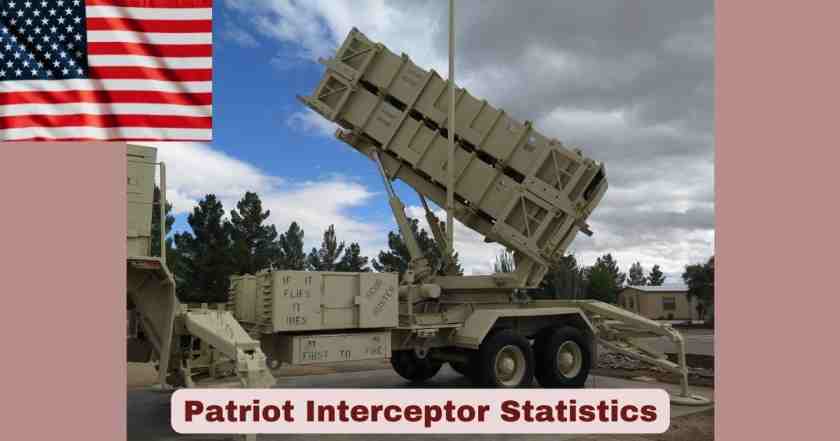
Patriot Interceptor in America 2026
The Patriot missile system — officially designated MIM-104 Patriot — is the U.S. Army’s most advanced and widely deployed ground-based air and missile defense system, and one of the most combat-tested weapons platforms on the face of the earth. Originally designed in the 1960s and 1970s as an anti-aircraft system to replace the aging Nike Hercules and HAWK surface-to-air missiles, Patriot has been continuously evolved over six decades into a full-spectrum ballistic missile, cruise missile, drone, and aircraft defense system that today anchors the air defense architecture of 18 nations across four continents. The two primary interceptors used within the Patriot system in 2026 are the PAC-2 GEM-T (Guidance Enhanced Missile – Tactical) — a blast-fragmentation interceptor optimized for aircraft and cruise missiles — and the PAC-3 MSE (Missile Segment Enhancement) — a precision hit-to-kill interceptor that destroys incoming ballistic missiles by directly colliding with them at speeds exceeding Mach 4.5, carrying no explosive warhead at all. As of 2026, the U.S. Army operates 15 active Patriot battalions, with plans already approved to grow to 18 battalions, and has confirmed deployments in South Korea, Japan, Germany, the Middle East, and actively in combat as part of Operation Epic Fury — the ongoing U.S.-Israeli military campaign against Iran that began February 28, 2026.
The current strategic moment for Patriot interceptors in 2026 is defined by an uncomfortable paradox: the system works better than ever, yet the U.S. Army has never been more acutely short of them. According to CENTCOM data, within just the first three days of Operation Epic Fury, at least 282 Iranian ballistic missiles and 833 drones were intercepted by a coalition of forces — with the U.S. Army’s PAC-3 Patriot and THAAD systems described as “the backbone of this defense.” Against this backdrop of unprecedented real-time demand, the U.S. Army has dramatically escalated its procurement ambitions: a senior weapons requirements committee increased the planned purchase of the latest Patriot PAC-3 MSE missiles from 3,376 to 13,773 units — a fourfold increase — with each interceptor costing an average of $3.871 million per the Army’s FY2026 Budget Justification Book. That single procurement target — $53+ billion at current prices — is perhaps the clearest signal yet of how fundamentally the conflicts in Ukraine, Yemen, and now Iran have redefined what it means to maintain an adequate Patriot interceptor stockpile in the modern era.
Interesting Facts About Patriot Interceptors 2026
| Fact Category | Key Detail |
|---|---|
| Full System Name | MIM-104 Patriot (Phased Array Tracking Radar to Intercept of Target) |
| Prime Contractor (System) | Raytheon Technologies (RTX), Tucson, Arizona |
| Prime Contractor (PAC-3/MSE Interceptor) | Lockheed Martin Missiles and Fire Control, Camden, Arkansas |
| Program Start | 1964 (renamed from SAM-D); first flight test November 1969 |
| First Combat Use | January 18, 1991 — Operation Desert Storm (Saudi Arabia and Israel) |
| Nations Operating Patriot (2026) | 18 countries |
| U.S. Army Active Battalions (2026) | 15 battalions (plans approved for 16th, 17th, 18th) |
| PAC-3 MSE Interceptor Speed | Exceeds Mach 4.5 |
| PAC-3 MSE Warhead | None — pure hit-to-kill kinetic energy |
| PAC-3 MSE Engagement Altitude | Up to 40 km (131,000 ft) |
| PAC-3 MSE Engagement Range vs. Ballistic Missiles | ~60 km |
| PAC-3 MSE Engagement Range vs. Aircraft | ~120 km |
| Record Production Year | 2024 — Lockheed Martin produced 500+ PAC-3 MSEs |
| FY2026 Army Procurement Target (MSE) | 13,773 missiles (increased from 3,376 — a 4× increase) |
| Cost Per PAC-3 MSE Interceptor | ~$3.871 million (U.S. Army FY2026 Budget Justification Book) |
| Total Cost of Army MSE Target Procurement | ~$53+ billion at current prices |
| Operation Epic Fury (Feb. 28, 2026) | PAC-3 Patriot and THAAD confirmed by CENTCOM as backbone of Iranian missile and drone defense |
| Largest Single-Event Patriot Expenditure | Iranian IRGC ballistic missile strike on Al Udeid Airbase, Qatar (June 23, 2025) — “dozens of interceptors” launched |
| Operation Epic Fury — Day 3 Intercepts | 282 Iranian missiles + 833 drones intercepted by coalition (CENTCOM data) |
| PAC-3 Interceptors Per Launcher | 16 PAC-3 CRI or 12 PAC-3 MSE per launcher |
Source: CSIS Missile Defense Project (missilethreat.csis.org); U.S. Army FY2026 Budget Justification Book (DoD); Lockheed Martin Official Production Statements (2025); CENTCOM Official Releases (March 2026); Defense One (March 2, 2026); The War Zone (July 2025)
The numbers in the table above tell a story that no single headline has fully captured: the Patriot system is simultaneously the most in-demand air defense platform on earth and the most production-constrained. The fourfold increase in procurement targets — from 3,376 to 13,773 PAC-3 MSE interceptors — is not a planning exercise; it is the Army’s honest acknowledgment that the gap between what it has and what it needs to fight the wars it is already fighting has grown to a scale that demands historic investment. The record 2024 production run of 500+ PAC-3 MSEs from Lockheed Martin’s Camden, Arkansas plant sounds impressive — until you set it against the fact that 282 ballistic missiles and 833 drones were intercepted in just 72 hours of Operation Epic Fury. At a minimum engagement ratio of one interceptor per threat (and in practice often higher), that single three-day period demanded a volume of interceptors that represents more than half of what the entire production line produces in a full year.
Patriot Interceptors 2026 – Core Technical Specifications
| Specification | PAC-2 GEM-T | PAC-3 MSE |
|---|---|---|
| Interceptor Variant | PAC-2 Guidance Enhanced Missile – Tactical | PAC-3 Missile Segment Enhancement |
| Developer | Raytheon Technologies | Lockheed Martin Missiles & Fire Control |
| Warhead Type | 90 kg blast-fragmentation | None — hit-to-kill kinetic energy only |
| Guidance | Track-via-missile (TVM) + command | Active Ka-band radar seeker + 180 ACMs |
| Propulsion | Single-stage solid rocket | Dual-pulse solid rocket motor |
| Speed | ~Mach 3 | Exceeds Mach 4.5 |
| Max Range vs. Aircraft | 70–100 km | ~120 km |
| Max Range vs. Ballistic Missiles | ~20 km | ~60 km |
| Max Engagement Altitude | Up to 20 km (66,000 ft) | Up to 40 km (131,000 ft) |
| Missiles Per Canister | 1 | 4 (quad-packed in PAC-3 CRI format) / 1 in MSE canister |
| Missiles Per Launcher | 4 | 12 MSE (or 16 PAC-3 CRI) |
| Unit Cost (approx.) | ~$2–3 million | ~$3.871 million (Army FY2026 Justification Book) |
| Initial Operating Capability (current variant) | 2004 (GEM-T) | August 2016 (MSE IOC) |
| Seeker Update (2025) | No recent update | Upgraded Ka-band seeker algorithms (June 2025 flight test) |
| Vs. Hypersonic Threats | Limited capability | Growing capability; seeker upgrades directly target this |
Source: CSIS Missile Defense Project (missilethreat.csis.org); Army Recognition (June 2025 PAC-3 MSE seeker upgrade); Missile Defense Advocacy Alliance (missiledefenseadvocacy.org); Wikipedia – MIM-104 Patriot; U.S. Army FY2026 Budget Justification Book
Understanding the difference between the PAC-2 GEM-T and the PAC-3 MSE is critical to understanding how the Patriot system actually works in combat. The PAC-2 — with its 90 kg blast-fragmentation warhead — was designed to destroy aircraft and cruise missiles by detonating near them, spraying shrapnel across a wide area. Against ballistic missile re-entry vehicles, this approach proved unreliable in the 1991 Gulf War, where the high-speed, hardened re-entry vehicles of Iraqi Scud missiles often survived fragmentation damage and continued on trajectory. The PAC-3 MSE fundamentally solved this problem by eliminating the warhead entirely and instead using a Ka-band active radar seeker combined with 180 miniature attitude control motors (ACMs) mounted in the missile’s forebody to steer it into a direct body-to-body collision with the target. At closing speeds that can exceed Mach 8–10, the kinetic energy released on impact is equivalent to a small explosion — more than sufficient to destroy even the hardened re-entry vehicles on advanced ballistic missiles.
The June 2025 upgrade to the PAC-3 MSE’s seeker algorithms — confirmed through a live-fire flight test — represents the system’s most significant electronic improvement in years, directly targeting the scenario that worries air defense planners most: dense threat environments where adversaries employ coordinated swarms of drones, decoys, and ballistic missiles simultaneously. By improving the seeker’s ability to discriminate real threats from chaff, debris, and electronic interference, this upgrade directly addresses the kind of saturation attack tactics that Iran employed during the June 2025 conflict and has continued deploying during Operation Epic Fury in March 2026. The PAC-3 MSE’s extended range of 60 km against ballistic missiles — compared to the standard PAC-3 CRI’s approximately 35 km — means earlier intercepts further from the defended asset, giving battery crews more decision time and reducing the blast radius risk to civilians if an intercept fails.
Patriot Interceptors 2026 – Battery Composition & U.S. Fleet Statistics
| Battery / Fleet Metric | Data |
|---|---|
| Soldiers Per Battery | ~90 soldiers total; only 3 required to operate in combat |
| Launchers Per Battery (Maximum) | Up to 8 launchers |
| Radar Per Battery | 1 × AN/MPQ-65 (current) or new LTAMDS (rolling upgrade) |
| Engagement Control Station | 1 × AN/MSQ-104 (only manned component; 2–4 operators) |
| Power Plant | 2 × 150 kW generators per battery |
| Interceptors Per Launcher (PAC-3 MSE) | 12 PAC-3 MSE per launcher |
| Max Interceptors Per Battery (PAC-3 MSE) | 96 PAC-3 MSE (8 launchers × 12) |
| U.S. Army Active Battalions (2026) | 15 battalions |
| Battery Composition per Battalion | HQ + 3 to 5 air defense batteries |
| Effectively Available Battalions | 14 (1 undergoing major overhaul) |
| Patriot Battalions — Indo-Pacific | 3 battalions assigned |
| Patriot Battalions — EUCOM (Europe) | 1 battalion assigned |
| Patriot Battalions — CENTCOM (Middle East) | Active deployment as of March 2026 |
| Battalion Expansion Plan | Approved plans to build 16th, 17th, and 18th battalions |
| Guam Battalion | Separate Patriot battalion planned for Guam Defense System |
| Battery Unit Cost (complete system) | ~$2.5 billion per battery |
| Operational Debut | Operation Desert Storm, January 1991 |
Source: CSIS Missile Defense Project (missilethreat.csis.org); Militarnyi.com citing General James Mingus, U.S. Army Deputy Chief of Staff (CSIS speech); U.S. Army Redstone Arsenal Historical Information; Congressional Research Service Report IF12297 (2025); Military Watch Magazine (July 2025)
The U.S. Army’s 15 Patriot battalions represent the thin line between America’s forward-deployed forces and the ballistic missile and drone threats they now face every day. General James Mingus, the U.S. Army Deputy Chief of Staff, stated plainly that “Patriot is our most stressed force element” — a remarkably candid admission for a senior Army leader, and one that reflects the extraordinary operational tempo these units have sustained across three simultaneous theaters. With three battalions tied to the Indo-Pacific, one to EUCOM, and multiple batteries actively deployed to the Middle East and now in combat during Operation Epic Fury, the 14 effectively available battalions are stretched in a way that has forced the Army to make difficult prioritization choices — including, as Jake Sullivan confirmed in April 2024, that the U.S. was unable to provide additional Patriot systems to Ukraine despite direct presidential-level requests from Kyiv.
The planned expansion to 18 battalions — including the dedicated Guam Defense System battalion — is the Army’s structural answer to this stress, but building new battalions requires time, training, equipment, and most critically, interceptors. The ~$2.5 billion per-battery cost means that even a single new battalion of four batteries represents a $10 billion investment in hardware alone before a single interceptor is purchased. Mingus’s observation that equipping the existing 15 battalions with LTAMDS and IBCS would operationally double their effective capability — by expanding radar coverage from 85 km × 85 km to 300 km × 300 km and enabling 360-degree coverage — explains why the Army is pursuing the technology upgrade path in parallel with the force structure expansion rather than waiting for new battalions to be fully fielded.
Patriot Interceptors 2026 – AN/MPQ-65 Radar & LTAMDS Upgrade Statistics
| Radar Specification | AN/MPQ-65 (Current) | LTAMDS (Upgrade) |
|---|---|---|
| Full Name | Army/Navy Multi-function Phased-array Radar | Lower Tier Air and Missile Defense Sensor |
| Array Type | Passively-scanned phased array | Active electronically scanned array (AESA) |
| Amplifier Technology | Traditional traveling-wave tube | Gallium nitride (GaN) power amplifiers |
| Coverage Arc | 270 degrees (limited sector) | 360 degrees (full sphere) |
| Detection Range | ~85 km (operationally effective) | ~300 km (expanded battlespace) |
| Altitude Coverage | ~85 km | ~300 km |
| Jamming Resistance | Moderate | Significantly higher (GaN + AESA beam agility) |
| Simultaneous Target Tracking | 125+ targets | Enhanced (specific number classified) |
| Link-16 / IBCS Integration | Via ECS upgrade (2019+) | Native IBCS integration |
| Initial Contract Award | — | October 2019 — 6 LTAMDS units awarded |
| LTAMDS Live Fire Test | — | February 7, 2025 — successfully tracked and guided PAC-2 GEM-T to intercept a high-speed cruise missile |
| U.S. + Poland Contract | — | $2 billion contract (Raytheon + Poland LTAMDS supply) |
| Developer | Raytheon Technologies | Raytheon Technologies, Andover, MA |
| IBCS Intercept Demo | December 2019 — first IBCS-connected intercept (PAC-2 vs. 2 cruise missiles) | 2020 LUT — PAC-3 CRI vs. 2 cruise missiles via IBCS |
Source: CSIS Missile Defense Project (missilethreat.csis.org); Wikipedia – MIM-104 Patriot; Militarnyi.com citing General Mingus (CSIS speech); Army Recognition (February 2025 LTAMDS test); Raytheon Technologies Official Statements
The AN/MPQ-65 radar’s 270-degree coverage limitation is one of the most operationally consequential constraints of the current Patriot battery architecture — it means that a Patriot battery must be deliberately oriented toward the most likely threat axis, leaving a 90-degree blind sector in the opposite direction. In a single-threat environment like the Cold War scenarios the system was originally designed for, this was a manageable trade-off. In the multi-axis, simultaneous ballistic missile and drone swarm environments of Operation Epic Fury in 2026 — where Iran launched thousands of projectiles toward U.S. bases across Jordan, Kuwait, Bahrain, Qatar, Iraq, Saudi Arabia, and the UAE simultaneously — this limitation becomes acutely dangerous. A battery protecting Al Udeid Airbase in Qatar from a northern missile threat may have its blind sector directly facing a simultaneous drone swarm from the sea.
LTAMDS changes this calculation entirely. The switch from a passively-scanned phased array to an active electronically scanned array (AESA) driven by gallium nitride (GaN) power amplifiers delivers three simultaneous improvements: 360-degree coverage so no battery has a blind sector, dramatically improved jamming resistance because GaN enables rapid electronic beam steering that makes jamming far more difficult, and expanded effective range from 85 km to 300 km that fundamentally changes the geometry of a Patriot battery’s defended footprint. The February 7, 2025 live-fire test — where LTAMDS successfully detected, tracked, and guided a PAC-2 GEM-T to intercept a high-speed cruise missile — validated the technology in a realistic operational scenario. The $2 billion Raytheon contract for U.S. and Polish LTAMDS units reflects the scale of the transition program and the urgency that both Washington and Warsaw attach to fielding this capability as fast as industrial capacity allows.
Patriot Interceptors 2026 – Combat Use History & Operational Deployment
| Operation / Deployment / Combat Event | Date & Key Detail |
|---|---|
| Operation Desert Storm | Jan–Feb 1991 — First-ever Patriot combat use; Saudi Arabia & Israel; PAC-2 effectiveness later disputed |
| Operation Iraqi Freedom | 2003 — PAC-3 CRI intercepted 2 Iraqi Scud missiles; studies confirmed largely effective performance |
| Yemen Conflict (UAE/Saudi Arabia) | 2015–present — UAE and Saudi Patriot batteries repeatedly intercepted Houthi ballistic missiles and cruise missiles |
| Israel — Iron Dome / Patriot Complement | 2014–present — Israeli Patriot batteries downed Hamas drones (2014) and a Syrian Su-24 (September 2014) — first crewed aircraft kill by Patriot |
| Ukraine — Kinzhal Intercept | May 2023 — Ukrainian Patriot PAC-2 GEM-T intercepted Russian Kh-47 Kinzhal hypersonic missile — first-ever intercept of a hypersonic weapon in combat |
| Ukraine — Fighter Kills | 2023–2025 — Ukrainian Patriots downed Russian Su-34, Su-35 jets and Mi-8 helicopters |
| IBCS-Connected Intercept Demonstration | December 2019 — First IBCS-networked intercept (2 cruise missiles, PAC-2) |
| Iranian IRGC Strike on Al Udeid (Qatar) | June 23, 2025 — “Largest ever single expenditure of Patriot interceptors” — dozens launched against Iranian ballistic missile barrage |
| Operation Epic Fury — Feb. 28, 2026 | CENTCOM confirmed Patriot and THAAD as backbone of missile and drone defense against Iranian retaliatory barrages from Day 1 |
| Operation Epic Fury — Day 3 (March 2, 2026) | 282 Iranian ballistic missiles + 833 drones intercepted by coalition forces; PAC-3 Patriot and THAAD described as “backbone of this defense” |
| Targets Defended (Operation Epic Fury) | U.S. bases in Jordan, Kuwait, Bahrain, Qatar, Iraq, Saudi Arabia, UAE; Israeli cities |
| Pentagon Claim on Stockpile | Pentagon claimed sufficient interceptor stocks while experts warned pace “could not continue indefinitely” |
| Switzerland Delivery Delayed | July 16, 2025 — DOD informed Switzerland it was reprioritizing Patriot deliveries to support Ukraine; 5 Swiss systems ordered 2022 affected |
Source: CENTCOM Official Releases (March 2026); Defense One (March 2, 2026); Military Watch Magazine (July 2025); The War Zone (July 2025); Wikipedia – MIM-104 Patriot; usarmy.com Day 3 Operation Epic Fury briefing (March 2, 2026); Congressional Research Service Report IF12297
The Patriot interceptor’s combat record from 1991 to March 2026 is the most operationally rich of any surface-to-air missile system in history — and the data from this record has shaped every major procurement decision, technical upgrade, and doctrinal change the U.S. Army has made across three decades. The 1991 Gulf War experience — where early claims of high PAC-2 intercept rates were later heavily disputed — directly drove the multibillion-dollar investment in the hit-to-kill PAC-3 interceptor, which performed far better in Operation Iraqi Freedom in 2003. The May 2023 Ukrainian intercept of a Russian Kh-47 Kinzhal — a missile Russia had specifically claimed was impossible to intercept — was a watershed moment that reshaped global perceptions of missile defense and drove several nations to accelerate their Patriot procurement timelines.
Operation Epic Fury beginning February 28, 2026 has produced the most intense and sustained Patriot combat experience in the system’s entire 35-year operational history. Patriot and THAAD batteries are intercepting Iranian drones and ballistic missiles across the region, with Iran having launched thousands of projectiles in retaliation, raising concerns among analysts that interceptor stocks — already strained by last year’s 12-day conflict and U.S. supplies to Ukraine — could be tested if the conflict drags on. The 282 ballistic missiles and 833 drones intercepted in the first 72 hours alone represent a tempo that no planner had fully modeled, and the Pentagon’s claim to have sufficient stockpiles was immediately met with skepticism from former officials and defense analysts who noted that the pace of interceptions could not continue indefinitely, as Christopher Preble of the Center for New American Security warned: “It is reasonable to speculate that the pace of operations right now, in terms of numbers of interceptions, could not continue indefinitely, certainly, and perhaps could not continue for more than several weeks.”
Patriot Interceptors 2026 – Procurement Costs & Budget Statistics
| Cost / Budget Metric | Data |
|---|---|
| PAC-3 MSE Unit Cost (Army FY2026 Justification Book) | $3.871 million per interceptor |
| PAC-2 GEM-T Unit Cost (approx.) | ~$2–3 million per interceptor |
| Complete Battery Unit Cost | ~$2.5 billion (including radar, launchers, ECS, support vehicles, missiles) |
| Army Original PAC-3 MSE Procurement Target | 3,376 missiles |
| Army Revised PAC-3 MSE Procurement Target | 13,773 missiles (4× increase — Army Requirements Oversight Council Memorandum) |
| Additional Cost of Revised Target | +$40.2 billion above original plan |
| Total Investment at $3.871M per missile (13,773 missiles) | ~$53.3 billion |
| U.S. Army MSE Purchased Through FY2024 | 2,047 PAC-3 MSE missiles |
| MSE Purchased in FY2024 | Additional 230 missiles |
| MSE in Current FY2025 Procurement | Additional 214 missiles |
| FY2026 Base Budget MSE Request | $549.6 million for 224 missiles |
| FY2026 Atlantic Resolve MSE Request | $396.3 million |
| FY2026 Total Patriot Interceptor Budget Request | $945.9 million (base + Atlantic Resolve) |
| FY2026 Trump Tax Bill — Additional MSE Funding | $366 million for 96 additional interceptors |
| FY2026 Total Patriot Procurement (all sources) | ~$1.3+ billion |
| NSPA NATO Contract (Jan 2024) | $5.6 billion — up to 1,000 PAC-2 GEM-T missiles (Germany, Netherlands, Romania, Spain) |
| Denmark Potential FMS (Aug 2025) | $8.5 billion — IBCS-enabled Patriot PAC-3 MSE systems |
Source: U.S. Army FY2026 Budget Justification Book (DoD); RBC-Ukraine (July 10, 2025 — citing Army Requirements Oversight Council Memorandum); Army Technology (January 2024 — NSPA Contract); Army Recognition (August 2025 — Denmark FMS); Military Watch Magazine (July 2025)
The procurement figures for Patriot interceptors in FY2026 represent the largest single-year commitment to air defense missile production in U.S. Army history. When the base budget request of $945.9 million, the $366 million in Trump’s spending reconciliation bill, and ongoing Foreign Military Sales deliveries are combined, the total Patriot-related missile procurement activity in FY2026 exceeds $1.3 billion — a number that would have seemed extraordinary just five years ago but is now treated as a starting point by defense analysts who say even this is insufficient given current consumption rates. The revised total procurement target of 13,773 PAC-3 MSE missiles — an additional $40.2 billion above the original plan — was driven not by future projections but by the brutal arithmetic of real-world combat consumption: the Iranian IRGC strike on Al Udeid in June 2025 alone was described as the “largest ever single expenditure of Patriot interceptors”, and Operation Epic Fury has since eclipsed that milestone entirely.
The $8.5 billion Denmark FMS announcement in August 2025 and the $5.6 billion NATO NSPA contract for 1,000 GEM-T missiles from January 2024 highlight the extraordinary global commercial demand for Patriot interceptors that runs parallel to U.S. Army requirements — and competes for the same Lockheed Martin production capacity in Camden, Arkansas. As Tom Karako of the CSIS Missile Defense Project noted: even the fourfold procurement increase “won’t be easy and won’t happen overnight.” The fundamental constraint is not budget — Congress has shown willingness to fund interceptors — but factory capacity and supply chain lead times for the sophisticated materials and components that make a PAC-3 MSE one of the most complex weapons ever mass-produced.
Patriot Interceptors 2026 – Production Capacity & Industrial Base
| Production Metric | Data |
|---|---|
| PAC-3 MSE Prime Manufacturer | Lockheed Martin Missiles and Fire Control, Camden, Arkansas |
| PAC-3 MSE Solid Rocket Motor (booster) | L3Harris Technologies, Camden, Arkansas |
| PAC-2 GEM-T European Production (New) | MBDA plant, Schrobenhausen, Germany (groundbreaking Nov. 18, 2024; completion Sept. 2026) — 300+ new jobs |
| Romania Local Production | Electromecanica Ploiești — local production of SkyCeptor interceptors beginning 2026 |
| Japan Production | Lockheed Martin contract — ~30 PAC-3 MSE per year (hit supply chain issues in 2024) |
| Annual Production Rate (PAC-3 MSE) — 2023 | ~550 interceptors per year |
| Annual Production Rate (PAC-3 MSE) — 2024 (record) | 500+ MSE produced (record year per Lockheed Martin) |
| Planned Production Rate — 2025 | Additional 20% growth planned (Lockheed Martin) |
| Planned Production Rate — 2027 | 650 PAC-3 MSE per year (Lockheed Martin target) |
| Lockheed Martin Production Ramp Investment | Ongoing — $100 million invested in Aegis/VLS PAC-3 MSE integration |
| Tripling Production Goal | Lockheed Martin commitment to reach 2,000 PAC-3 MSE per year (long-term target, per DoD FY2026 documents) |
| Army Spokesperson on Ramp Difficulty | “Ramping production is challenging” — Army spokesperson Steve Warren |
| PAC-3 CRI ACM Production Milestone | Aerojet Rocketdyne delivered 2,500th PAC-3 CRI missile (milestone) |
| Pentagon Halt of Ukraine Transfers | Temporarily halted early 2025 to assess stockpile adequacy; resumed after review |
| Swiss Delivery Delay (July 2025) | DOD reprioritized Swiss Patriot deliveries (5 systems ordered 2022) to support Ukraine |
Source: Lockheed Martin Official Statements (2024–2025); RBC-Ukraine (July 2025 citing Army); The War Zone (July 2025); Wikipedia – MIM-104 Patriot; Congressional Research Service IF12297 (2025)
The industrial production challenge facing the Patriot interceptor program in 2026 is one of the most discussed topics in U.S. defense circles — and for good reason. Lockheed Martin’s Camden, Arkansas facility is the sole U.S. manufacturer of PAC-3 MSE interceptors, and despite a record 2024 production run of 500+ missiles and ambitious plans to reach 2,000 per year as a long-term target, the gap between production capacity and operational demand has never been wider. The math is stark: if Operation Epic Fury sustains its Day 3 intercept tempo of approximately 370+ intercepted threats per day and a conservative intercept ratio of one interceptor per two threats, the Camden facility’s entire annual output could theoretically be consumed in less than three days of sustained operations. That is not a hypothetical risk — it is the operational reality that Army planners are managing in real time as of March 3, 2026.
The MBDA plant groundbreaking in Schrobenhausen, Germany in November 2024 — scheduled for completion in September 2026 and designed to produce PAC-2 GEM-T missiles under European control — represents NATO’s attempt to diversify Patriot interceptor production away from single-source dependency on the United States. Similarly, Romania’s Electromecanica Ploiești beginning local SkyCeptor production in 2026 and Japan’s Lockheed Martin contract for 30 MSE per year (currently constrained by supply chain issues) reflect the global understanding that U.S. production capacity alone is insufficient to meet the combined demand of 18 Patriot-operating nations simultaneously engaged in or preparing for high-end conflicts. The tripling production goal to 2,000 PAC-3 MSE per year is the right ambition — but Army spokesperson Steve Warren’s blunt assessment that “ramping production is challenging” is the honest summary of where the program stands today.
Patriot Interceptors 2026 – Global Deployments & Foreign Military Sales
| Country / Deployment | Status & Detail |
|---|---|
| United States | 15 active battalions — Indo-Pacific (3), EUCOM (1), CENTCOM/Middle East (active combat deployment), CONUS |
| Germany | 12 batteries; MEADS/TLVS transition underway; major PAC-2 GEM-T producer under NSPA contract |
| Japan | PAC-3 batteries operational at key sites; ~30 PAC-3 MSE/year local production contract |
| South Korea | Multiple batteries; key Indo-Pacific deterrence role |
| Saudi Arabia | Largest single Patriot operator outside U.S.; multiple batteries; used in Yemen conflict |
| UAE | Patriot batteries operational; used in Yemen conflict interceptions |
| Israel | Patriot batteries active; supplemented by Iron Dome, David’s Sling, Arrow |
| Taiwan | PAC-3 batteries operational; AN/MPY-2 radar integration |
| Poland | 8 batteries on order; domestic Homar-A HIMARS co-production; proximity to Ukraine front |
| Netherlands | Patriot batteries; part of NSPA GEM-T consortium order |
| Greece | Patriot batteries operational |
| Spain | Patriot batteries; part of NSPA GEM-T consortium |
| Romania | Patriot fire unit received Sept. 2020; local SkyCeptor production beginning 2026 |
| Sweden | Patriot PAC-3 batteries (recent acquisition) |
| Kuwait, Bahrain, Qatar | Patriot systems operational; actively defending against Iranian attacks (March 2026) |
| Denmark | Potential FMS — $8.5 billion IBCS-Patriot PAC-3 MSE deal approved Aug. 2025 |
| Switzerland | 5 Patriot systems ordered 2022; delivery delayed July 2025 due to Ukraine reprioritization |
| Total Nations Operating Patriot | 18 countries as of 2026 |
Source: CSIS Missile Defense Project (missilethreat.csis.org); Wikipedia – MIM-104 Patriot; Army Technology (army-technology.com); Army Recognition (August 2025 — Denmark FMS); Congressional Research Service IF12297 (2025); CRS IF12645
The Patriot system’s footprint across 18 nations in 2026 makes it the most widely deployed advanced air and missile defense system in the world — and the conflicts in Ukraine and the Middle East have accelerated procurement timelines for virtually every operator on this list. Poland’s 8 batteries — positioned on NATO’s eastern flank with direct exposure to Russian missile and drone threats — have become a model for European air defense investment, with Warsaw simultaneously pursuing domestic Patriot-compatible production and pushing toward 5% of GDP defense spending. The active defense of Patriot batteries in Kuwait, Bahrain, Qatar, and Saudi Arabia during Operation Epic Fury has transformed these systems from deterrence tools into combat-proven assets in the span of days, validating every investment decision their respective governments made in acquiring them.
The Switzerland delivery delay of July 2025 — where the United States told Bern its five ordered Patriot systems would arrive later than the scheduled 2026–2028 window because DOD was reprioritizing deliveries to Ukraine — is a perfect illustration of the impossible demand-management challenge facing the Patriot program. With Ukraine, Poland, the Middle East, Japan, South Korea, and the Philippines all either operating, upgrading, or actively seeking additional Patriot capacity, and with Operation Epic Fury now consuming interceptors at a historic rate, the United States finds itself in the position of being the world’s indispensable air defense supplier in a world that needs far more air defense than it can currently supply. The $8.5 billion Denmark FMS — the largest single-nation Patriot deal announced in recent years — signals that this demand will only intensify as European nations continue building out the layered air defense architectures that the Ukraine war made unavoidable.
Patriot Interceptors 2026 – Modernization & Future Upgrades
| Upgrade / Future Program | Detail & Status |
|---|---|
| LTAMDS (Lower Tier Air and Missile Defense Sensor) | AESA radar replacing AN/MPQ-65; 360-degree coverage; 300 km range; GaN amplifiers; live-fire tested Feb. 7, 2025 |
| IBCS (Integrated Battle Command System) | Integrates Patriot with Sentinel, THAAD, Aegis BMD, F-35, AN/TPY-2; enables multi-sensor engagements |
| ECS Upgrade (2019) | Upgraded consoles, improved IFF, enhanced computers; IBCS compatibility |
| PAC-3 MSE Seeker Algorithms Upgrade (June 2025) | Ka-band seeker software enhanced for dense threat environments, swarms, decoys, electronic jamming |
| PAC-3 MSE / Aegis VLS Integration | Lockheed Martin investing $100 million; first VLS vertical launch test (2024) — intercept of cruise missile; potential SM-2 Navy replacement |
| PAC-3 MSE / Mk-70 Containerized Launcher | 2024 test — PAC-3 MSE launched from containerized platform integrated with virtual Aegis; first-ever intercept from this configuration |
| PAAC-4 / SkyCeptor | Rafael/Raytheon joint venture; Stunner interceptor from David’s Sling program at 20% cost of PAC-3; Romania local production 2026 |
| IFPC (Indirect Fire Protection Capability) | Future medium-range system to supplement Patriot; primary missile: AIM-9X Sidewinder |
| Production Tripling Goal | Lockheed Martin long-term target of 2,000 PAC-3 MSE/year from current ~550 |
| TLVS (Germany) | Taktisches Luftverteidigungssystem — Germany’s next-gen system using PAC-3 MSE as primary interceptor; Lockheed Martin + MBDA |
| PAC-3 MSE as SM-2 Navy Replacement | Under active evaluation by U.S. Navy for Aegis ships; quad-pack CRI or single MSE per VLS cell |
| LTAMDS Doubles Effective Coverage | IBCS + LTAMDS turns 15 existing battalions into effective equivalent of ~30 battalions (Gen. Mingus) |
Source: CSIS Missile Defense Project (missilethreat.csis.org); Wikipedia – MIM-104 Patriot; Militarnyi.com / General Mingus (CSIS speech); Lockheed Martin Official Statements (2024–2025); Army Recognition (February 2025 — LTAMDS live fire; June 2025 — MSE seeker upgrade)
The LTAMDS and IBCS combination is the single most transformative upgrade the Patriot system will undergo in its history — and the claim by General Mingus that it would give the Army “the equivalent of about 30 Patriot battalions” from the existing 15 is not hyperbole but a straightforward consequence of the geometry involved. When each battery’s effective coverage area expands from roughly 85 km × 85 km with a 270-degree arc to 300 km × 300 km in a full 360 degrees, and when IBCS networking allows a single battery’s radar to cue interceptors from an adjacent battery, the combined defensive footprint of the existing force multiplies dramatically without a single new launcher being purchased. The urgency of fielding this upgrade is only amplified by Operation Epic Fury, where multi-axis Iranian attacks from different directions simultaneously have stress-tested every battery’s orientation assumptions in a way that LTAMDS would eliminate.
The PAC-3 MSE’s expansion into naval applications — actively pursued by Lockheed Martin through its $100 million investment in Aegis/MK-41 VLS integration and validated by the 2024 containerized launch platform test — represents the most significant expansion of the Patriot interceptor’s operational domain since the PAC-3 hit-to-kill transition in the early 2000s. By enabling Aegis destroyers and cruisers to carry PAC-3 MSE interceptors alongside Standard Missiles, the U.S. Navy could dramatically increase the quantity of hit-to-kill ballistic missile interceptors available in any given theater without requiring additional surface-to-air missile batteries ashore. In a potential Taiwan Strait conflict — where U.S. naval forces would need to defend themselves and allied territory from Chinese ballistic and cruise missile saturation attacks simultaneously — this naval PAC-3 MSE capability could prove as strategically significant as any other modernization program currently underway in the American air defense enterprise.
Disclaimer: This research report is compiled from publicly available sources. While reasonable efforts have been made to ensure accuracy, no representation or warranty, express or implied, is given as to the completeness or reliability of the information. We accept no liability for any errors, omissions, losses, or damages of any kind arising from the use of this report.