
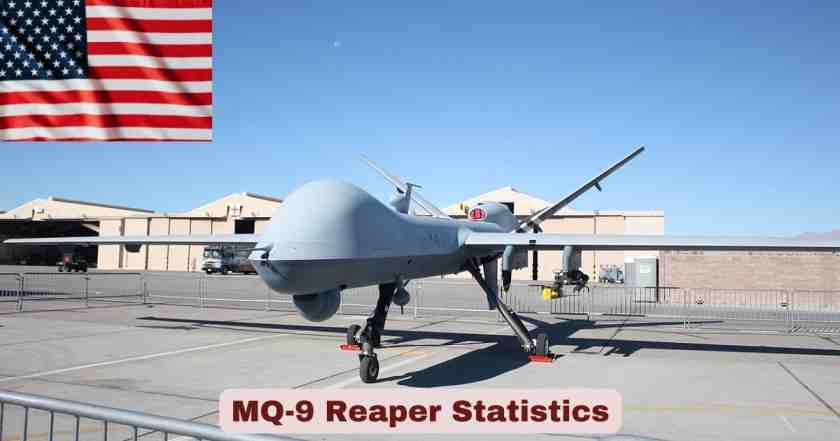
MQ-9 Reaper in America 2026
The MQ-9 Reaper — officially designated as the General Atomics MQ-9A Reaper and sometimes referred to as Predator B — is the United States Air Force’s primary armed, long-endurance remotely piloted aircraft (RPA), and the most combat-experienced hunter-killer drone ever built. Designed and manufactured by General Atomics Aeronautical Systems (GA-ASI) in San Diego, California, the MQ-9 entered service with the USAF in October 2007 and has since logged well over 2 million combined flight hours alongside its predecessor the MQ-1 Predator. Unlike early surveillance drones that merely watched targets, the Reaper was purpose-built from the outset for the dual role that defines it: persistent intelligence, surveillance, and reconnaissance (ISR) combined with the ability to carry up to 3,850 pounds of weapons and sensors and strike high-value, time-sensitive targets with lethal precision from altitudes that no adversary could see or hear. Powered by a single Honeywell TPE331-10GD turboprop engine producing 950 shaft horsepower — roughly eight times the power of the original MQ-1 Predator’s engine — the Reaper cruises at up to 240 knots (276 mph) and can remain airborne for over 27 hours on internal fuel, or up to 42 hours when carrying external fuel tanks instead of a full weapons load.
In 2026, the MQ-9 Reaper exists at a pivotal crossroads in its operational life. The USAF current inventory stands at 230 aircraft — a deliberately managed drawdown from 338 total produced — as the Air Force executes a phased retirement plan targeting 140 retained aircraft through 2035, when a more survivable next-generation RPA is expected to replace it. The final MQ-9 was delivered to the USAF in 2025, closing the production line after more than two decades of continuous manufacture. Yet even as the fleet shrinks, the Reaper’s operational tempo has never been higher — and its combat losses have never been more costly. The Air Force is rapidly upgrading the surviving fleet with the Mission Design Series (M2DO) upgrade, testing the MQ-9 in contested peer-adversary environments for the first time during Exercise Sentry South 26-2 in February 2026, and working to evolve the platform for a world where the kind of permissive, uncontested airspace that defined the Reaper’s golden age of operations in Iraq and Afghanistan no longer exists.
Interesting Facts About the MQ-9 Reaper 2026
| Fact Category | Key Detail |
|---|---|
| Full Designation | General Atomics MQ-9A Reaper (also called Predator B) |
| Nickname | “Reaper”; also “Predator B” informally |
| Designer | Abraham Karem (original Predator concept); General Atomics Aeronautical Systems |
| Manufacturing Location | Poway, California (General Atomics facility) |
| Proof-of-Concept First Flight | February 2, 2001 (Predator B-001) |
| IOC (Initial Operating Capability) | October 2007 (USAF); 2015 (Extended Range variant) |
| Total MQ-9s Produced | 338 aircraft |
| Current USAF Inventory (2026) | 230 aircraft (as of December 2024 Pentagon data) |
| Target Retained Fleet Through 2035 | 140 aircraft |
| Final USAF MQ-9 Delivery | 2025 — production line now closed |
| Unit Cost (2024 dollars) | ~$34 million per aircraft |
| Flight Endurance (standard) | Over 27 hours |
| Flight Endurance (with external fuel tanks) | Up to 42 hours |
| Maximum Operating Altitude | 50,000 feet (15,240 meters) |
| Maximum Speed | 240 KTAS (276 mph / 444 km/h) |
| Combined MQ-1/MQ-9 Flight Hours Milestone | 2,000,000 flight hours (reached October 22, 2013) |
| Most Famous Single Strike | January 3, 2020 — MQ-9 killed Iranian General Qasem Soleimani and Abu Mahdi al-Muhandis at Baghdad International Airport |
| Total MQ-9 Losses to Houthis (Nov. 2023–Apr. 2025) | At least 15 claimed by Houthis; 7 confirmed lost in 6 weeks (March–April 2025) |
| Cost of Each Yemen Loss | ~$30 million per aircraft |
| 2026 Training Focus | Peer-adversary contested airspace — Exercise Sentry South 26-2 (February 2026) |
| Operators | USAF (ACC, AFSOC, AFMC, AFRC, ANG); U.S. Customs & Border Protection; 12+ foreign nations |
Source: U.S. Air Force Official Fact Sheet – MQ-9 Reaper (af.mil); Air & Space Forces Magazine Almanac (2025); Wikipedia – General Atomics MQ-9 Reaper; Atlantic Council (February 2025); Stars and Stripes (March 5, 2025); Euronews (April 25, 2025); Army Recognition (February 2026); General Atomics Aeronautical Systems Official Specifications
The table above captures just how extraordinary — and how complicated — the MQ-9 Reaper’s legacy has become in 2026. On one hand, it is the drone that executed the most strategically significant single strike in recent American military history: killing IRGC Quds Force Commander Qasem Soleimani with Hellfire R9X Ninja missiles fired from an MQ-9 launched from Al-Udeid Air Base in Qatar in the early hours of January 3, 2020 — a strike that reshaped the entire geopolitical landscape of the Middle East and cemented the Reaper’s place in history as more than just a surveillance platform. On the other hand, it is also an aircraft that has been shot down at least 15 times by a non-state actor — the Houthis of Yemen — using surface-to-air missiles supplied by Iran, at a total hardware cost of approximately $450 million in airframes alone. These two realities sit side by side in the MQ-9’s 2026 profile: incomparable precision strike capability in permissive environments, and growing vulnerability in contested airspace.
MQ-9 Reaper 2026 – Core Technical Specifications
| Specification | Official Data |
|---|---|
| Primary Function | Armed ISR, precision strike, close air support, combat search and rescue, target development |
| Contractor / Manufacturer | General Atomics Aeronautical Systems (GA-ASI), Poway, CA |
| Sensors Contractor | L3Harris Technologies; Raytheon Technologies |
| Engine | Honeywell TPE331-10GD turboprop |
| Engine Power | 950 shaft horsepower (712 kW) |
| Wingspan | 66 feet (20.1 meters) |
| Length | 36 feet (11 meters) |
| Height | 12.5 feet (3.8 meters) |
| Empty Weight | ~4,900 pounds (2,223 kg) |
| Maximum Takeoff Weight | 10,494 pounds (4,760 kg) |
| Payload Capacity (total) | 3,850 pounds (1,746 kg) |
| External Stores Capacity | 3,000 pounds (1,361 kg) on 6 wing pylons |
| Maximum Speed | 240 KTAS (276 mph / 444 km/h) |
| Cruise Speed | ~150–170 KTAS |
| Operating Altitude | Up to 50,000 feet (15,240 m) |
| Endurance (fully loaded) | 14 hours |
| Endurance (standard ISR config) | Over 27 hours |
| Endurance (with 2 external fuel tanks + 1,000 lb weapons) | Up to 42 hours |
| Range | Over 1,150 miles (1,850 km) |
| Crew | 2 (pilot + sensor operator; remote ground-based) |
| Primary Satellite Link | Predator Primary Satellite Link (PPSL); LOS and BLOS data links |
| Command Latency | 1.2 seconds via satellite link |
| Current Production Variant | Block 5 (increased electrical power, enhanced secure comms, expanded weapons growth) |
Source: U.S. Air Force Official Fact Sheet – MQ-9 Reaper (af.mil); General Atomics Aeronautical Systems Official Specifications (ga-asi.com); Creech AFB Official Fact Sheet; Military.com MQ-9 Profile
The MQ-9 Reaper’s performance specifications reveal a platform that sits in a remarkable operational sweet spot for the kind of counterterrorism and counterinsurgency warfare that defined American military operations for the two decades following September 11, 2001. The 950 shaft horsepower Honeywell turboprop engine — compared to the MQ-1 Predator’s 115 hp piston engine — gives the Reaper 15 times the ordnance payload of its predecessor and allows it to cruise at three times the speed, transforming it from a pure surveillance asset into a genuine strike aircraft. The six hardpoint pylon system — with inner pylons capable of carrying 1,500 pounds each, mid-wing pylons at 600 pounds each, and outer pylons at 200 pounds each — provides tremendous mission flexibility: a Reaper can be configured with a maximum of 14 AGM-114 Hellfire missiles, or a mixed load of Hellfires, GBU-12 Paveway II laser-guided bombs, and GBU-38 JDAMs, depending entirely on the mission’s requirements.
The 1.2-second satellite command latency is one of the most operationally significant numbers in the entire spec sheet — and one that is rarely discussed in public discourse about drone warfare. In a fluid combat engagement, that 1.2-second gap between a ground operator’s input and the aircraft’s response represents the fundamental constraint on how aggressively the MQ-9 can be maneuvered or how quickly a weapons release decision can be executed in a time-critical scenario. The Block 5 configuration that now makes up the entire USAF MQ-9 fleet specifically addresses this through enhanced secure communications, increased electrical power generation (which supports more advanced sensors and processing hardware), and expanded systems architecture for future growth — building in the infrastructure for the M2DO upgrade that will continue modernizing the platform even as the overall fleet size shrinks toward the 140-aircraft target for 2035.
MQ-9 Reaper 2026 – Weapons & Sensor Systems
| System / Weapon | Detail |
|---|---|
| Primary Targeting Sensor | Multi-Spectral Targeting System B (MTS-B) |
| MTS-B Components | Infrared sensor, color/monochrome daylight TV camera, shortwave infrared camera, laser designator, laser illuminator |
| Full-Motion Video | FMV from each sensor as separate streams or fused; supports real-time ISR and targeting |
| SAR (Synthetic Aperture Radar) | Upgraded Lynx SAR — used for JDAM targeting and dismounted target tracking |
| Wide-Area Surveillance | Gorgon Stare — fielded on 7+ modified aircraft; provides wide-area persistent surveillance |
| Primary Air-to-Ground Missile | AGM-114 Hellfire (standard Hellfire and R9X “Ninja” variants) |
| Maximum Hellfire Load | Up to 14 AGM-114 Hellfire missiles |
| Laser-Guided Bomb | GBU-12 Paveway II (500-lb class) |
| GPS-Guided Bomb | GBU-38 JDAM (500-lb class) |
| Laser JDAM | GBU-54 Laser Joint Direct Attack Munition |
| AIM-92 Stinger | Air-to-air self-defense capability (tested/limited fielding) |
| AGM-176 Griffin | Smaller, lower-collateral-damage strike missile (select configurations) |
| Total External Payload | 3,000 pounds (1,361 kg) |
| Buddy-Lase Capability | Can designate targets for other aircraft using its laser designator |
| Camera Reported Capability | Onboard optics reportedly capable of reading a license plate from 2 miles (3.2 km) |
| Hellfire Missile Guidance | Semi-active laser homing (standard); millimeter-wave radar (Longbow Hellfire); passive IR (Romeo variant) |
| Soleimani Strike Weapon | Hellfire R9X — kinetic warhead with six pop-out blades; minimizes collateral damage |
Source: U.S. Air Force Official Fact Sheet – MQ-9 Reaper (af.mil); Air & Space Forces Magazine MQ-9 Almanac Entry; Wikipedia – General Atomics MQ-9 Reaper; Arab News / U.S. military sources (Soleimani strike details)
The MQ-9 Reaper’s weapons suite is where the aircraft’s defining tactical philosophy is most clearly expressed: persistent presence overhead, precise identification, and precision strike — all delivered from an altitude where the aircraft is invisible to the naked eye and inaudible to human ears on the ground. The Multi-Spectral Targeting System B (MTS-B) is the heart of this capability, providing a sensor package that fuses infrared, shortwave infrared, daylight TV, and laser illumination into a comprehensive targeting picture that a ground-based pilot and sensor operator can use to track a moving vehicle, identify its occupants, and guide a missile to a specific point on that vehicle. The Gorgon Stare wide-area sensor — fielded on a limited number of modified MQ-9s — takes this further, providing a persistent wide-area surveillance picture that can track multiple moving objects simultaneously across an entire city, then cue the MTS-B for precise engagement of selected targets.
The Hellfire R9X “Ninja” missile — the weapon that killed Qasem Soleimani in January 2020 — represents perhaps the most remarkable refinement of precision strike capability in the entire Reaper arsenal. By replacing the explosive warhead with a kinetic kill vehicle equipped with six retractable blades that deploy immediately before impact, the R9X allows the MQ-9 to strike a target sitting in a vehicle or building with enough energy to destroy that specific target while the people immediately adjacent may survive. This is not just a tactical refinement — it is a strategic capability that allows policymakers to authorize strikes in densely populated areas with lower acceptable collateral damage thresholds than would be possible with any explosive warhead. The R9X was kept classified for years after its first use in 2017 and has since been employed in a series of high-profile targeted killings in Syria, Yemen, and Iraq, always launched from the MQ-9’s hardpoints.
MQ-9 Reaper 2026 – Fleet Inventory & Deployment Status
| Fleet / Inventory Metric | Data |
|---|---|
| Total MQ-9s Produced (all variants) | 338 aircraft |
| Current USAF Inventory (2026) | 230 aircraft (December 2024 Pentagon data) |
| Target Fleet Size Through 2035 | 140 aircraft |
| Final USAF Delivery | 2025 (production line closed) |
| Block 1s Status | All retired (USAF retired all Block 1 airframes as planned) |
| Block 5 Status | Entire current fleet — all remaining MQ-9s operate in Block 5 config |
| Block 5 Highest-Time Airframe Retirements | Ongoing divestiture through FY2027 |
| USAF Operators | ACC (Air Combat Command), AFSOC (Air Force Special Operations Command), AFMC, AFRC (associate), ANG (Air National Guard) |
| Primary CONUS Bases | Cannon AFB, NM; Creech AFB, NV; Eglin AFB, FL; Holloman AFB, NM; Nellis AFB, NV; Hancock Field, NY; Ellington Field, TX; Fort Drum, NY; Fort Huachuca, AZ; Hector Airport, ND; March ARB, CA |
| Planned Future Bases | Tyndall AFB, FL; Whiteman AFB, MO |
| Forward Deployed Locations | Worldwide classified/undisclosed deployed locations |
| AFSOC Specific Role | Irregular warfare, time-sensitive targeting, CSAR; SOCOM-assigned MQ-9s (now replaced by MQ-9B SkyGuardian in some roles) |
| U.S. CBP Operation | U.S. Customs and Border Protection operates MQ-9 variants for border surveillance |
| Non-USAF U.S. Operators | U.S. Customs and Border Protection; NASA (leases unarmed Altair variant) |
| Projected Fleet End-of-Life | 2035 |
| M2DO Upgrade Completion Target | FY2026 — fleetwide completion of M2DO retrofits |
| Single Operator Control | Tested capability: 1 operator controlling up to 3 MQ-9s simultaneously |
Source: Air & Space Forces Magazine Almanac (2025 – airandspaceforces.com); Wikipedia – General Atomics MQ-9 Reaper; U.S. Air Force Official Fact Sheet (af.mil); Army Recognition (February 2026 – Exercise Sentry South 26-2 report); Pentagon/Fox News (December 2024 inventory data cited by Militarnyi.com)
The managed drawdown of the MQ-9 fleet from 338 to a target of 140 aircraft is one of the more counterintuitive force structure decisions in recent U.S. Air Force history — shrinking a combat-proven platform at exactly the moment when demand for persistent ISR and precision strike is at a historic high. The logic, however, is straightforward and reflects hard lessons from the Yemen losses: the MQ-9’s design-heritage makes it fundamentally unsurvivable in any environment where a peer or near-peer adversary — or even a capable non-state actor like the Houthis — has access to surface-to-air missiles. Operating at speeds between 150 and 240 knots with a 66-foot wingspan, the Reaper is a large, slow, non-stealthy aircraft that has no meaningful self-defense capability against radar-guided surface-to-air missiles. The decision to retire the highest-time airframes and concentrate the remaining fleet around 140 upgraded Block 5 aircraft is the Air Force’s way of acknowledging that the MQ-9 remains enormously valuable in permissive and semi-permissive environments — but that continuing to operate more than 100 additional airframes in a world of proliferating air defense threats is an unjustifiable cost and risk.
The M2DO (Mission Design Series) upgrade — with fleetwide completion targeted for FY2026 — represents the Air Force’s investment in keeping the remaining 140 aircraft relevant for the next decade. By adding enhanced data link resilience, anti-jam GPS, Link 16 connectivity, and double the previous electrical power output, the M2DO upgrade addresses the specific vulnerabilities that have been exposed in contested environments: susceptibility to GPS jamming and spoofing, limited communications resilience under electronic attack, and the inability to integrate into the Link 16 tactical data link network that connects modern joint force elements. The Exercise Sentry South 26-2 in February 2026 — where the 174th Attack Wing’s MQ-9s operated in a simulated peer-adversary electromagnetic and air defense threat environment — was the first major validation of whether these upgrades actually change the Reaper’s survivability calculus in a high-end fight.
MQ-9 Reaper 2026 – Combat History & Operational Record
| Operation / Event | Date & Key Detail |
|---|---|
| First USAF Combat Deployment | October 2007 — Afghanistan; IOC declared |
| Afghanistan Operations | 2007–2021 — Thousands of ISR and strike sorties; primary hunter-killer platform for AFCENT |
| Iraq Operations | 2007–present — ISR, strike, overwatch; up to 48 Predator/Reaper combat air patrols flying by March 2011 |
| “Jihadi John” Strike | November 12, 2015 — Two U.S. MQ-9s (+ one British) killed ISIS executioner Mohammed Emwazi in Raqqa, Syria |
| Libya Loss | November 23, 2019 — MQ-9 shot down over Tripoli by Pantsir SAM operated by Wagner Group / LNA |
| Qasem Soleimani Strike | January 3, 2020 — MQ-9 launched from Al-Udeid, Qatar killed Iranian IRGC Quds Force Commander Soleimani + Abu Mahdi al-Muhandis at Baghdad Airport using Hellfire R9X missiles |
| Syria Mid-Air Collision | August 18, 2020 — Two USAF MQ-9s collided mid-air over Syria; both lost |
| Black Sea Incident | March 14, 2023 — Russian Su-27 intercepted and collided with a USAF MQ-9 over the Black Sea in international airspace; drone lost; U.S. State Dept condemned as “unsafe and unprofessional” |
| Houthi Campaign — First Loss | November 8, 2023 — First MQ-9 shot down by Houthis over the Red Sea (Gaza war era) |
| Iraq Loss (Jan. 2024) | January 18, 2024 — Islamic Resistance of Iraq claims MQ-9 shot down near Muqdadiyah, Diyala; Iranian-supplied missile confirmed |
| Houthi Campaign — Ongoing Losses | Nov. 2023–Apr. 2025 — Houthis claimed downing of at least 15 MQ-9 Reapers |
| Houthi Campaign — U.S. Confirmed (6 weeks) | March–April 2025 — USAF confirmed losing 7 MQ-9s in approximately 6 weeks of intensified operations |
| March 3–4, 2025 Loss | CENTCOM confirmed losing contact with a Reaper over the Red Sea on March 3, 2025, same day Houthis claimed shootdown over Hodeidah |
| USAF Friendly Fire Incident | September 13, 2009 — First U.S. drone destroyed by allied forces; F-15E fired AIM-9 at a runaway MQ-9 over Afghanistan |
| Syria Kurdish Friendly Fire | 2024 — An MQ-9 was mistakenly shot down by U.S.-backed Kurdish fighters in Syria |
| 2026 Training — Contested Airspace | February 23, 2026 — Exercise Sentry South 26-2 at Gulfport, MS — MQ-9 tested in peer-adversary contested battlespace environment for the first time at scale |
Source: Air & Space Forces Magazine Almanac (2025); Wikipedia – General Atomics MQ-9 Reaper; Atlantic Council (February 26, 2025); Stars and Stripes (March 5, 2025); Euronews (April 25, 2025); The War Zone / TWZ; U.S. Air Force Official Fact Sheet (af.mil); Army Recognition (February 2026)
The MQ-9 Reaper’s combat record from 2007 to 2026 is simultaneously the most impressive and the most cautionary tale in modern American drone warfare. On the impressive side: a platform that killed ISIS’s “Jihadi John” in Syria in 2015, that carried out the most strategically consequential targeted killing in post-9/11 U.S. history when it killed Qasem Soleimani in 2020, and that has flown tens of thousands of combat sorties across Afghanistan, Iraq, Syria, Yemen, Libya, and Somalia — providing persistent surveillance and lethal overwatch that no manned aircraft could replicate at comparable cost or risk to American service members. The USAF was training more pilots for advanced UAVs than for any other single weapons system by March 2011 — a fact that underscores how completely the MQ-9 reshaped the Air Force’s manpower and training priorities during the counterterrorism era.
On the cautionary side: the Yemen drone losses represent the most dramatic demonstration of the MQ-9’s survivability limitations that the U.S. military has yet encountered in live operations. Between November 2023 and April 2025, the Houthis — a non-state actor operating with Iranian-supplied surface-to-air missiles in a third-world country under continuous U.S. and coalition air attack — claimed the destruction of 15 MQ-9 Reapers, with the U.S. confirming at least 7 losses in a six-week window during the intensified Operation Poseidon Archer / Trump-ordered strike campaign. The March 14, 2023 Black Sea incident — where a Russian Su-27 fighter conducted a hazardous intercept that resulted in a mid-air collision and the loss of a USAF Reaper — added a peer-adversary dimension to the vulnerability picture that the Yemen losses had established. Together, these incidents have made the MQ-9’s transition away from contested environments and toward the contested-airspace-survivable next generation RPA the Air Force’s most urgent unmanned aviation priority.
MQ-9 Reaper 2026 – Cost & Budget Statistics
| Cost Metric | Data |
|---|---|
| Unit Cost Per Aircraft (2024 dollars) | ~$34 million |
| Earlier Unit Cost Estimates (media reports) | $4–5 million (incorrect; typically cited for airframe only without sensors/GCS) |
| Full System Cost (aircraft + GCS + PPSL + support) | Significantly higher than airframe-only figure |
| Cost Per Flight Hour (approx.) | ~$3,000–$4,000 (test/contractor estimates) |
| Comparison — F-16 Cost Per Flight Hour | ~$25,000–$30,000 (MQ-9 is approximately 10× cheaper per flight hour) |
| Total Value of 7 Yemen Losses (6-week period) | ~$210 million in airframes alone |
| Total Value of 15 Houthi-Claimed Losses | ~$450–510 million in airframes at $30–34M each |
| Canada MQ-9B Contract (Dec. 2023) | CA$2.49 billion for 11 MQ-9Bs + 219 Hellfires + 12 Mk82 bombs + 6 GCS + infrastructure |
| India MQ-9B Contract (Oct. 2024) | ₹28,350 crore (US$3.4 billion) for 31 MQ-9Bs; MRO facility additional ₹4,000 crore ($470M) |
| Belgium MQ-9B Contract (approved 2019) | $600 million (CA$724 million in 2024 terms) for 4 MQ-9B SkyGuardians |
| USAF Total Program Cost (MQ-9) | Classified / not publicly disclosed in full |
| M2DO Upgrade Cost | Not publicly disclosed; program ongoing |
| Annual USAF Operating Cost (entire MQ-9 fleet) | Not individually published; embedded in ACC/AFSOC budget lines |
Source: Wikipedia – General Atomics MQ-9 Reaper; Air & Space Forces Magazine Almanac (2025); Euronews (April 25, 2025); Militarnyi.com (citing Fox News Pentagon data); General Atomics Aeronautical Systems official pages
The $34 million unit cost of an MQ-9 Reaper in 2024 dollars is a figure that captures the full production cost of the airframe, engine, and basic avionics — but it understates the true cost of fielding and operating the platform when the ground control station, satellite link infrastructure, sensor packages, and sustainment contracts are included. For context, this figure is approximately one-tenth the cost of an F-35A — which is precisely the economic argument that made the Reaper so appealing during the counterterrorism era: you could field ten MQ-9s for the cost of a single fifth-generation fighter jet, and those ten drones could collectively provide ten times the persistent loiter coverage. The ~$3,000–$4,000 per flight hour operating cost — compared to $25,000–$30,000 for an F-16 — compounded this economic advantage across the tens of thousands of hours that MQ-9s accumulated over Afghanistan and Iraq.
The scale of the Yemen losses puts this cost efficiency in a different light entirely. When seven aircraft are lost in six weeks at $30 million per copy, the per-hour cost advantage of the MQ-9 disappears instantly — and the strategic cost of the intelligence, surveillance, and targeting capability lost with each downed Reaper cannot be measured in dollars at all. The India $3.4 billion MQ-9B contract and the Canada CA$2.49 billion deal for MQ-9Bs demonstrate that export demand for the platform remains strong internationally — particularly for the MQ-9B SkyGuardian and SeaGuardian variants that offer improved aerodynamics, STANAG 4671 airworthiness certification for unsegregated civilian airspace, and V-tail design that distinguishes them from the original MQ-9A. For these nations, the Reaper remains the gold standard of affordable, capable MALE (medium-altitude long-endurance) unmanned aerial capability — even as the USAF itself grapples with the survivability limitations that the Yemen campaign has laid bare.
MQ-9 Reaper 2026 – Global Operators & Foreign Military Sales
| Country / Operator | Variant & Status |
|---|---|
| United States Air Force | MQ-9A Block 5 — 230 aircraft (2026); ACC, AFSOC, AFMC, AFRC, ANG |
| United States CBP | MQ-9 (unarmed) — border surveillance; multiple aircraft |
| United Kingdom | MQ-9A Reaper (15 aircraft, 39 Sqn RAF; retired 2023) → MQ-9B Protector (16 aircraft ordered; first delivered Sept. 30, 2023; IOC expected 2025; FOC 2026); deployed to RAF Akrotiri, Cyprus (October 2025) |
| Italy | MQ-9A — operational; deployed at Ali Al Salem AB, Kuwait |
| France | MQ-9A — ordered 2013; operational; used in Africa (Mali/Sahel operations) |
| Netherlands | MQ-9A — operational |
| Spain | MQ-9A — operational |
| Germany | MQ-9B (consideration; discussions ongoing) |
| Belgium | MQ-9B SkyGuardian — 4 aircraft; $600 million contract (approved 2019); production began Fall 2024; testing planned 2026; delivery 2028 |
| Canada | MQ-9B SkyGuardian — 11 aircraft; CA$2.49 billion contract (Dec. 2023); delivery 2028; 14 Wing Greenwood + 19 Wing Comox |
| India | MQ-9B — 31 aircraft ($3.4 billion) signed October 2024; 10 flyaway from San Diego; 21 assembled in India; delivery from 2029; MRO facility additional $470M |
| Japan | MQ-9B — discussions ongoing |
| Australia | MQ-9B — evaluated |
| Indian Navy (leased) | 2 × MQ-9B SeaGuardian leased; 18,000 flying hours logged; lease extended Dec. 29, 2025 |
| Dominican Republic | Predator UAV (Guardian variant) — drug trafficking surveillance, under U.S. supervision since 2012 |
| NASA (USA) | Altair (unarmed Predator B) — leased for scientific missions |
| Total Nations Operating MQ-9 (as of 2026) | 12+ nations (USAF + CBP + 10+ foreign militaries/agencies) |
Source: Wikipedia – General Atomics MQ-9 Reaper; Air & Space Forces Magazine Almanac (2025); General Atomics Aeronautical Systems official pages; The Defense Post; Army Recognition
The MQ-9’s international operator list in 2026 reflects a decade-long global proliferation of the platform that has made it, by a significant margin, the most widely deployed MALE (Medium-Altitude Long-Endurance) armed drone in the Western world. The United Kingdom’s transition from the MQ-9A Reaper to the MQ-9B Protector — with the first of 16 Protectors delivered on September 30, 2023 and the platform reportedly deployed to RAF Akrotiri in Cyprus for real-world operations in October 2025 — is the most significant allied MQ-9 development in recent years. The MQ-9B Protector/SkyGuardian variant differs meaningfully from the original MQ-9A: it carries a V-tail instead of a T-tail, achieves STANAG 4671 airworthiness certification for flight in non-segregated civilian airspace, has improved collision-avoidance systems, and in the case of the UK’s Protector is configured to carry up to 18 Brimstone 3 missiles — giving it greater air-to-ground precision strike capacity than the original Reaper.
The India $3.4 billion MQ-9B contract signed in October 2024 — the largest single MQ-9B procurement outside the United States — reflects New Delhi’s dramatic shift away from its earlier hesitation about armed drone acquisition and toward a decisive embrace of American MALE UAV technology as a key element of Indian Ocean surveillance and strike capability. The decision to assemble 21 of the 31 aircraft in India under a Make-in-India technology transfer arrangement, combined with the separate $470 million MRO facility contract, signals that India intends the MQ-9B to be the foundation of an indigenous MRO and potentially development ecosystem — not just an off-the-shelf purchase.
MQ-9 Reaper 2026 – Modernization, Upgrades & Future Programs
| Upgrade / Program | Detail & Status |
|---|---|
| Block 5 Configuration (current fleet standard) | Increased electrical power generation; enhanced secure communications; expanded weapons and payload growth capacity vs Block 1 |
| M2DO (Mission Design Series Upgrade) | Adds: enhanced data link robustness; plug-and-play system integration; 2× electrical power for future sensors; anti-jam GPS; Link 16; IP and modular mission system architecture; enhanced C2 resiliency; greater flight autonomy |
| M2DO First Flight | 2022 |
| M2DO Fleetwide Completion Target | FY2026 — retrofits scheduled for completion across all remaining aircraft |
| SLAM (System Lifecycle Agile Modernization) | Continuous upgrade program for MQ-9 against emerging threats; ongoing |
| ATLC (Automatic Takeoff and Landing Capability) | Enables MQ-9 to operate from any airfield worldwide without a line-of-sight ground station — vastly increases Agile Combat Employment (ACE) flexibility |
| Single-Operator Control | Tested: 1 pilot controlling up to 3 MQ-9s simultaneously |
| Pacific ISR Role | Demonstrated maritime support, C2, and ISR roles flying from forward operating locations in the Pacific (2022) |
| Contested Airspace Testing | Exercise Sentry South 26-2 (February 2026) — tested operations in peer-adversary electromagnetic contestation and layered air defense environment |
| MQ-9B SkyGuardian / SeaGuardian | Next-generation variant; STANAG 4671 certified; V-tail; 40+ hour endurance; improved detect-and-avoid; maritime radar (SeaGuardian) |
| MQ-9B Protector (UK) | Carries up to 18 Brimstone 3 missiles or Paveway IV bombs; FOC expected 2026 |
| Carrier-Based Trial | May 2023 — UK announced MQ-9 (General Atomics Mojave variant) 7-month carrier trial aboard Queen Elizabeth-class aircraft carrier |
| Follow-on Platform | Next-generation survivable RPA under development to replace MQ-9 by ~2035 |
| Replacement Candidates | Collaborative Combat Aircraft (CCA) concepts; USAF Next-Generation RPA evaluation programs |
Source: Air & Space Forces Magazine Almanac (2025); Wikipedia – General Atomics MQ-9 Reaper; Army Recognition (February 2026); General Atomics Aeronautical Systems official pages; U.S. Air Force Official Fact Sheet (af.mil)
The M2DO upgrade is the single most consequential investment the USAF is making in the existing MQ-9 fleet — and it is specifically designed to address the vulnerabilities that the Yemen losses and the Black Sea incident have made impossible to ignore. Adding Link 16 connectivity transforms the Reaper from an isolated ISR/strike node into a fully integrated participant in the joint tactical data link network, able to receive targeting cues from F-35s, E-3 Sentries, and ground-based sensors simultaneously and react to them with the same situational awareness as a manned platform. The anti-jam GPS capability directly counters the electronic warfare tools that adversaries from the Houthis to Russia to China have demonstrated they can deploy to disrupt drone navigation — tools that contributed to several of the Yemen losses when Reapers operating in GPS-denied environments could not maintain the precision navigation required for safe continued flight. The doubled electrical power output is the enabling architecture for all future sensor and system additions: without significantly more onboard power, adding advanced electronic warfare systems, more capable radar arrays, or AI-enabled processing hardware is not possible.
The ATLC (Automatic Takeoff and Landing Capability) deserves particular attention as a 2026 force multiplier. By enabling a MQ-9 to take off, fly, and land at any airfield in the world without requiring a local line-of-sight ground control station, ATLC fundamentally changes the logistical footprint required to deploy the platform to austere forward locations. Previously, deploying an MQ-9 to a new airfield required positioning a ground control station team and establishing communications infrastructure before the first mission could fly. With ATLC, a single ground station at a permanent base in Nevada can manage takeoffs and landings at a forward airfield thousands of miles away — reducing the deployed manpower requirement and making Agile Combat Employment of MQ-9s from dispersed, expeditionary locations genuinely achievable for the first time.
Disclaimer: This research report is compiled from publicly available sources. While reasonable efforts have been made to ensure accuracy, no representation or warranty, express or implied, is given as to the completeness or reliability of the information. We accept no liability for any errors, omissions, losses, or damages of any kind arising from the use of this report.