
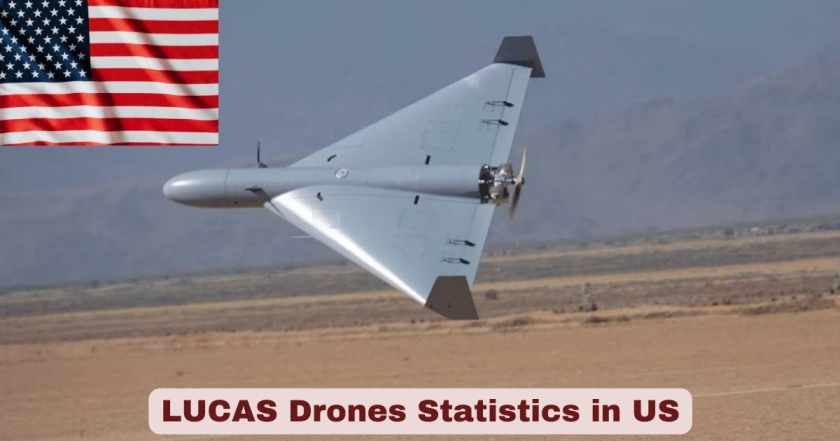
LUCAS Drones in America 2026
The Low-cost Unmanned Combat Attack System (LUCAS) is America’s newest and boldest entry into modern drone warfare, purpose-built to counter the growing threat of cheap, mass-produced one-way attack drones used by adversaries on battlefields around the world. Reverse-engineered from Iran’s widely deployed Shahed-136 kamikaze drone, LUCAS was developed at breakneck speed by Arizona-based defense startup SpektreWorks and officially unveiled at the Pentagon in July 2025. What makes LUCAS truly extraordinary in the context of American defense procurement is its timeline — just 18 months from concept to operational deployment, a pace that would have been unimaginable for any legacy defense contractor operating within the traditional U.S. acquisition system. With a delta-wing airframe, round nose cone, and autonomous targeting capabilities, the LUCAS represents a fundamental shift in how the United States thinks about expendable, high-volume, low-cost strike systems in the modern battlefield era.
In 2026, LUCAS drones are no longer an experimental concept — they are active, combat-proven assets operating under U.S. Central Command (CENTCOM)‘s Task Force Scorpion Strike (TFSS), the nation’s first dedicated one-way attack drone squadron. On February 28, 2026, LUCAS drones were confirmed to have been used in combat for the first time in history during Operation Epic Fury, a coordinated U.S.-Israeli strike campaign targeting Iranian military infrastructure. This milestone marks a seismic pivot in U.S. military doctrine — away from multi-million dollar platforms like the MQ-9 Reaper and toward scalable, mass-producible autonomous systems priced at just $35,000 per unit. The broader Drone Dominance Program (DDP), backed by $1.1 billion in Pentagon funding, is now on a course to acquire over 300,000 drones by early 2028, cementing LUCAS as the centerpiece of America’s new era of drone-centric warfare.
Interesting Facts About LUCAS Drones in the US 2026
| Fact | Detail |
|---|---|
| Full Name | Low-cost Unmanned Combat Attack System (LUCAS) |
| Manufacturer | SpektreWorks (Arizona-based) |
| Original Inspiration | Iran’s Shahed-136 kamikaze drone |
| Development Timeline | Concept to deployment in just 18 months |
| Pentagon Debut | July 2025 (unveiled by Secretary of War Pete Hegseth) |
| First Naval Launch | December 16, 2025 (USS Santa Barbara, Arabian Gulf) |
| First Combat Use | February 28, 2026 (Operation Epic Fury, Iran strikes) |
| Operating Unit | Task Force Scorpion Strike (TFSS), CENTCOM |
| Price Per Unit | Approximately $35,000 |
| Payload Capacity | 40 pounds (~twice the yield of a Hellfire missile) |
| Range (FLM 136 reference) | 444 nautical miles (approximately 500 miles) |
| Endurance | Up to 6 hours |
| Cruise Speed | Approximately 74 knots |
| Dash Speed | Up to 105 knots |
| Wingspan | 8.2 feet |
| Length | 9.8 feet |
| Maximum Takeoff Weight | 180 pounds |
| SpektreWorks Contract Value | $30 million |
| Communication System | MUSIC (Multi-domain Unmanned Systems Communications) |
| Swarm Capability | Yes — mesh network for autonomous swarm coordination |
| Starlink Integration | Confirmed on select units for advanced targeting |
Source: U.S. Central Command (CENTCOM) official press releases; SpektreWorks published FLM 136 specifications; Pentagon / Department of War official statements, 2025–2026; Defense Security Monitor; The War Zone (TWZ); Military Times; ABC News
The sheer scale of LUCAS’s capabilities packed into a $35,000 price tag is what makes it one of the most disruptive defense procurement stories of the decade. When compared to an MQ-9 Reaper — priced at approximately $30 million per unit — LUCAS offers a cost ratio of roughly 857:1, meaning the U.S. military could theoretically field 857 LUCAS drones for the cost of a single Reaper. This cost calculus is precisely why Secretary of War Pete Hegseth has pushed so aggressively for the system’s rapid scaling. The drone’s 40-pound warhead payload, described as carrying roughly twice the explosive yield of a Hellfire missile, combined with a range of 444 nautical miles and autonomous mesh-networking for swarm coordination, means LUCAS is not just cheap — it is genuinely lethal and operationally flexible. The addition of Starlink terminals on select units further elevates LUCAS beyond a simple loitering munition into a dynamic, network-connected autonomous weapons system capable of real-time targeting adjustments.
The fact that LUCAS went from concept to combat use in just 18 months — with a first-ever naval launch from the USS Santa Barbara on December 16, 2025, and its first confirmed combat deployment just 74 days later on February 28, 2026 — shatters every benchmark in U.S. defense procurement history. The $30 million SpektreWorks contract and the deliberate design of the LUCAS platform to be built by multiple manufacturers simultaneously shows a clear Pentagon intent to avoid single-supplier bottlenecks and ensure resilient mass production. The MUSIC communication system that links LUCAS drones into a coordinated network is a force multiplier that transforms what might look like a cheap knockoff into a sophisticated weapons ecosystem — one that U.S. Special Operations forces are already fielding with great operational effect across 2.5 million square miles of CENTCOM’s operating area.
LUCAS Drone Technical Specifications in the US 2026
| Specification | LUCAS / FLM 136 Data |
|---|---|
| Unit Cost | ~$35,000 |
| Payload Weight | 40 lbs |
| Range | 444 nautical miles (~500 miles) |
| Endurance | 6 hours |
| Cruise Speed | ~74 knots |
| Maximum Dash Speed | ~105 knots |
| Wingspan | 8.2 feet |
| Body Length | 9.8 feet |
| Maximum Takeoff Weight | 180 lbs |
| Launch Methods | Catapult, Rocket-Assisted Takeoff, Mobile Ground/Vehicle Systems |
| Navigation | Autonomous / Pre-programmed with mesh-networking |
| Airframe Style | Delta-wing with pusher propeller |
| Communication | MUSIC (Multi-domain Unmanned Systems Communications) |
| Companion Model | FLM-131 (smaller, threat emulation variant) |
Source: SpektreWorks published FLM 136 specifications; U.S. Army’s Operational Environment Data Integration Network (ODIN) training portal; CENTCOM official releases, 2025–2026; Army Recognition Defense News, 2026
The technical profile of the LUCAS drone reveals a platform that walks a deliberate line between affordability and operational effectiveness. At 180 pounds maximum takeoff weight, it is significantly lighter than its Iranian Shahed-136 inspiration, which carries an 88-pound warhead to a range of 1,242 miles (2,000 kilometers) — meaning the LUCAS trades raw destructive power and range for a dramatically lower unit cost and simpler production. The 74-knot cruise speed and 105-knot dash speed make it slower than many interceptor aircraft, but its low cost means that even high rates of attrition are financially sustainable for the U.S. military in a way that would be catastrophically expensive using legacy platforms. The drone’s autonomous pre-programmed navigation, combined with its mesh communication network, allows multiple LUCAS drones to coordinate attacks across a distributed swarm — a tactical advantage that goes well beyond what its humble price tag might suggest.
The three launch modality options — catapult, rocket-assisted takeoff, and mobile ground or vehicle systems — eliminate the LUCAS drone’s dependence on runways or dedicated airfields, meaning it can be deployed from ships like the USS Santa Barbara, from forward operating bases in contested territory, or from truck-mounted mobile systems hidden across a wide operational area. This dispersed basing concept is a direct response to lessons learned from the Ukraine-Russia conflict, where fixed drone launch sites proved vulnerable to counter-battery targeting. The FLM-131 companion model, a smaller variant, is being used for counter-drone training, allowing U.S. forces to practice defending against Shahed-class threats using authentic replicas — further maximizing the investment value of the SpektreWorks production ecosystem.
LUCAS Drone Cost Comparison vs. Other US Military Platforms in the US 2026
| Platform | Unit Cost | Cost Ratio vs. LUCAS |
|---|---|---|
| LUCAS Drone | $35,000 | 1x (baseline) |
| MQ-9 Reaper | ~$30,000,000 | ~857x more expensive |
| Tomahawk Cruise Missile | ~$2,000,000 | ~57x more expensive |
| Hellfire Missile | ~$150,000 | ~4.3x more expensive |
| DDP Phase 1 Target Unit Cost (Gauntlet) | $5,000 | 0.14x (cheaper target) |
| DDP Final Phase Target Unit Cost | $2,300 | 0.066x (long-term goal) |
| Iran’s Shahed-136 | ~$20,000–$50,000 (est.) | ~0.57x–1.4x comparable |
Source: Pentagon / Department of War official statements; The War Zone (TWZ) cost analysis; Stars and Stripes; Defense News; DefenseScoop, 2025–2026
The cost comparison data is where the strategic logic behind LUCAS becomes impossible to argue with. At $35,000 per unit, the LUCAS drone undercuts nearly every precision strike weapon in the U.S. inventory, and when the Drone Dominance Program’s Phase 1 target of $5,000 per drone is realized — and the eventual final-phase ambition of $2,300 per unit is achieved — the cost-per-effect calculus for American strike operations will be fundamentally transformed. The ability to deploy 857 LUCAS drones for the price of one MQ-9 Reaper is not merely a budgetary curiosity — it is a doctrinal revolution. Adversary air defense systems cost tens of millions of dollars per interceptor missile. Saturating those defenses with swarms of $35,000 attack drones forces adversaries into an economically unsustainable exchange ratio, a strategic concept that has proven devastating in the Ukraine-Russia conflict and is now being applied by the U.S. military for the first time.
The comparison with Iran’s own Shahed-136 — estimated at between $20,000 and $50,000 per unit — highlights the remarkable feat SpektreWorks achieved: building an American-made equivalent at a comparable or even lower price point, but with superior autonomous mesh networking, modular payload bays, and Starlink integration that the Iranian original lacks. This competitive parity at the unit cost level, combined with dramatically superior communications infrastructure, is what gives LUCAS its true edge. As the Drone Dominance Program’s multi-phase production ramp drives unit costs toward $2,300 by the final phase, the cost-exchange ratio will become even more favorable — positioning the United States to field drone swarms at a scale, and a price, that no adversary air defense network can sustainably absorb.
Pentagon Drone Dominance Program (DDP) Statistics in the US 2026
| DDP Program Metric | Data |
|---|---|
| Total Program Budget | $1.1 billion |
| Number of Phases | 4 phases (“Gauntlets”) |
| Phase 1 Period | February – July 2026 |
| Phase 1 Drone Order | 30,000 drones |
| Phase 1 Unit Cost | $5,000 per drone |
| Phase 1 Vendors Selected | 12 vendors (from 25 invited) |
| Phase 1 Delivery Deadline | July 2026 |
| Total Drones by 2027 | 200,000+ drones |
| Total Drones by Early 2028 | 300,000+ drones |
| Final Phase Unit Cost Target | $2,300 per drone |
| Final Phase Vendor Pool | 5 vendors |
| Gauntlet Evaluation Location | Fort Benning, Georgia |
| Phase 1 Evaluation Start Date | February 18, 2026 |
| Executive Order Authorization | June 2025 (President Trump) |
| Secretary Directive | July 2025 (Secretary Pete Hegseth) |
Source: Pentagon / Department of War official Drone Dominance Program website; DefenseScoop, February 3, 2026; Stars and Stripes, December 2025; The War Zone, December 2025; Pentagon Drone Dominance RFI, December 2026
The Drone Dominance Program (DDP) represents the largest unmanned systems acquisition initiative in U.S. military history, and its Phase 1 targets alone are staggering in ambition. Ordering 30,000 drones by July 2026 at $5,000 per unit — compared to the $35,000 LUCAS production cost — signals that the Pentagon is already pushing hard on the cost curve even during its initial scaling phase. The decision to invite 25 vendors to the “Gauntlet” competitive evaluation at Fort Benning, Georgia beginning February 18, 2026, and then narrow the field to just 12 awarded vendors, creates a market-driven pressure that forces participants to compete on both performance and scalability. This approach stands in stark contrast to the traditional U.S. defense procurement model, which historically favored single-vendor, cost-plus contracts that provided little incentive for price reduction.
The program’s trajectory — 30,000 drones by July 2026, 200,000+ by 2027, and 300,000+ by early 2028 — reflects a wartime procurement philosophy that prioritizes industrial base expansion and supply chain resilience over individual platform performance. The reduction in the vendor pool from 25 to 12 in Phase 1, and eventually to just 5 in the final phase, is designed to consolidate production at manufacturers capable of genuine mass-scale output rather than boutique small-batch delivery. The $1.1 billion total investment spread across four phases provides consistent demand signal to industry — a critical feature noted by Secretary Hegseth — ensuring that drone manufacturers can build out factory capacity with confidence. At the final phase target of $2,300 per drone, the United States would be acquiring precision strike capability at a price point comparable to consumer electronics, marking an unprecedented democratization of lethal autonomous systems within the U.S. military inventory.
LUCAS Drone Operational Deployment Data in the US 2026
| Operational Metric | Data |
|---|---|
| Operating Command | U.S. Central Command (CENTCOM) |
| Dedicated Task Force | Task Force Scorpion Strike (TFSS) |
| Task Force Established | December 2025 |
| Time from Announcement to Operational | Less than 3 months |
| First Ship Launch | December 16, 2025 (USS Santa Barbara) |
| Ship Type | Independence-class Littoral Combat Ship (LCS 32) |
| Launch Location (First Test) | Arabian Gulf |
| First Combat Use Date | February 28, 2026 |
| First Combat Operation | Operation Epic Fury |
| Combat Targets | IRGC command & control, air defense, missile/drone sites, airfields |
| CENTCOM Area of Operations | ~2.5 million square miles of ocean |
| Waters Covered | Arabian Gulf, Gulf of Oman, Red Sea, parts of Indian Ocean |
| Task Force Command | U.S. Special Operations Command-Central (SOCCENT) personnel |
| Border Drone Detections (2025) | 34,682 drone flights within 500 meters of U.S.-Mexico border |
Source: U.S. Central Command (CENTCOM) official press releases; Military Times, February 28, 2026; ABC News, February 28, 2026; SOF News Monthly Drone Report, February 2026; The War Zone, February 28, 2026
The operational data surrounding Task Force Scorpion Strike tells a story of unprecedented speed and strategic boldness in U.S. military deployment. The fact that TFSS moved from public announcement in December 2025 to full operational readiness in under three months — including validated shipboard launch capability, trained operator crews, and integration with the broader CENTCOM regional strike network — would have been considered impossible under the Pentagon’s traditional acquisition and readiness timelines. The first naval launch from the USS Santa Barbara on December 16, 2025, followed by confirmed first combat use on February 28, 2026 during Operation Epic Fury, compressed a procurement-to-combat timeline that normally spans years into a matter of weeks. This reflects a genuine transformation in how the U.S. military approaches urgent operational capability gaps, driven in no small part by the lessons of the Ukraine-Russia drone war.
The operational theater context also provides important scale for understanding LUCAS’s strategic role. CENTCOM’s 2.5 million square miles of ocean responsibility — spanning the Arabian Gulf, Gulf of Oman, Red Sea, and Indian Ocean — represents a vast maritime space where conventional air power is expensive and exposed. LUCAS drones, launched from littoral combat ships like the USS Santa Barbara or from dispersed land-based mobile systems, offer a way to extend persistent strike and deterrence coverage across this entire region at a fraction of the cost of manned aviation. Meanwhile, the separate statistic of 34,682 drone flights detected within 500 meters of the U.S.-Mexico border in 2025 underscores that the drone threat is not purely an overseas challenge — it is reshaping homeland security operations and counter-UAS investment priorities across every theater the U.S. military operates in.
SpektreWorks & LUCAS Production Data in the US 2026
| Production Metric | Data |
|---|---|
| Manufacturer | SpektreWorks |
| Headquarters | Tempe / Phoenix, Arizona |
| Initial Production Contract | $30 million |
| Production Model | Multi-vendor / Open architecture design |
| Planned Number of Manufacturers | Up to 20 vendors |
| Time from Pentagon Debut to Combat | 7 months (July 2025 → February 2026) |
| Time from Concept to Deployment | 18 months |
| Companion Training Drone | FLM-136 (“Authentic Threat Emulation” platform) |
| FLM-131 Companion Model | Smaller variant mirroring Shahed-131 |
| Predicted Production Orders by Sept 2026 | 5,000+ units (analyst projection) |
| Allied Export Potential | Gulf state purchases anticipated post-Op. Epic Fury |
Source: Special Operations Association of America (SOAA), February 2026; The War Zone; Defense Security Monitor, December 2025; DroneXL analysis, February 28, 2026; ABC News, February 2026
SpektreWorks has accomplished something genuinely rare in the defense industrial base: transitioning from a niche threat-emulation drone manufacturer to the prime contractor behind the United States military’s first combat-used one-way attack drone, in less than two years. The $30 million initial contract that funded LUCAS development is a fraction of what legacy defense programs typically require just to reach the prototype stage, let alone operational deployment. The deliberate decision to design LUCAS as an open-architecture, multi-vendor platform — with production explicitly intended to be distributed across up to 20 manufacturers simultaneously — reflects a Pentagon determination to avoid the single-source bottlenecks that have historically plagued U.S. defense procurement and left the military vulnerable to supply chain disruptions. This distributed production model mirrors the approach that has allowed Ukraine and Russia to sustain drone attrition warfare at industrial scale.
The 7-month timeline from Pentagon debut to first combat use — from Secretary Hegseth’s July 2025 unveiling to the February 28, 2026 Operation Epic Fury strikes — is not just a procurement record. It represents a complete rethinking of what “rapid acquisition” means in the context of modern warfare. The FLM-136 and FLM-131 companion training variants ensure that SpektreWorks’ production ecosystem serves dual purposes: generating operational combat drones while simultaneously providing authentic threat-emulation platforms that help U.S. forces train against the exact kind of Shahed-class systems they face in the real-world threat environment. Analyst projections that production orders will exceed 5,000 units by September 2026, combined with anticipated Gulf state allied export purchases following the global attention generated by Operation Epic Fury, suggest that SpektreWorks is positioned to become one of the most consequential American defense companies of the decade.
US Drone Industrial Base & Threat Context Statistics in the US 2026
| Metric | Data |
|---|---|
| Small Drones’ Share of Ukraine-Russia War Casualties | ~70% of all casualties |
| Russian Shahed Drone Launches Per Day (Nov 2025 est.) | ~182 launches daily |
| Russian Shahed Drones Used in Ukraine (Nov 2025) | ~5,400 drones in one month |
| Shahed Strike Accuracy (Standard Attacks) | 11.5% – 18.7% |
| Shahed Strike Accuracy (Mass Attacks) | 40% – 50% |
| Russia-Iran Shahed Licensing Deal Value | ~$1.75 billion |
| Russian Domestic Shahed Production | Started 2023 (after $1.75B deal) |
| Iran’s Shahed-136 Top Speed | ~100 knots (185 km/h) |
| Iran’s Shahed-136 Max Range | ~1,242 miles (2,000 km) |
| Iran’s Shahed-136 Warhead Weight | 88 lbs (40 kg) |
| Drone Dominance Phase 1 Vendors Invited | 25 vendors |
| Phase 1 Vendors Awarded | 12 vendors |
| Key Competing Companies (Phase 1) | Kratos SRE Inc., Halo Aeronautics, and 23 others |
Source: Institute for Science and International Security (ISIS); Stars and Stripes; U.S. Army ODIN (Operational Environment Data Integration Network); Defense Security Monitor; The War Zone; DefenseScoop, February 2026; Pentagon Drone Dominance Program official documentation
The threat context statistics surrounding LUCAS make a compelling case for why the United States moved so decisively to field this capability. The fact that small drones account for approximately 70% of all casualties in the Russia-Ukraine war — a figure cited by Pentagon officials to justify the Drone Dominance Program — represents a fundamental shift in how modern conventional warfare inflicts attrition on opposing forces. Russia’s ability to sustain a tempo of roughly 182 Shahed drone launches per day in November 2025, totaling approximately 5,400 drones in a single month, illustrates the kind of industrial-scale drone warfare that has emerged from the Iran-Russia licensing arrangement valued at $1.75 billion. The 11.5% to 18.7% individual strike accuracy rate — rising to 40% to 50% during mass swarm attacks — shows why volume and swarming behavior is so strategically effective: saturation of air defenses is the point, not individual accuracy.
The 25 vendors invited to the Drone Dominance Program Phase 1 Gauntlet, including established names like Kratos SRE Inc. and emerging players like Halo Aeronautics, represents the breadth of American commercial drone manufacturing capability that the Pentagon is now deliberately tapping. The deliberate narrowing to 12 awarded vendors creates competitive pressure while still preserving industrial diversity. Placing this in strategic context: Iran’s Shahed-136 carries an 88-pound warhead to 1,242 miles for approximately $20,000–$50,000, while LUCAS carries a 40-pound payload to 444 nautical miles for $35,000 — a performance trade-off that accepts somewhat reduced raw capability in exchange for dramatically superior autonomous networking, modular payload options, and an American-controlled production base that can scale to mass-production levels without dependency on adversary supply chains. This is the foundation of what U.S. defense planners are calling drone dominance in 2026.
Key Milestones Timeline: LUCAS Drones in the US 2026
| Date | Milestone |
|---|---|
| 2011 | U.S. RQ-170 drone intercepted by Iran — forms partial basis for Shahed development |
| 2022 | Russia begins deploying Iranian Shahed-136 against Ukraine |
| 2023 | Russia-Iran sign $1.75 billion Shahed licensing deal; Russian domestic production begins |
| June 2025 | President Trump signs executive order on U.S. drone dominance |
| July 2025 | LUCAS unveiled at Pentagon by Secretary Pete Hegseth |
| September 2025 | LUCAS integrated into Rapid Employment Joint Task Force |
| November 23, 2025 | LUCAS drones photographed staged at CENTCOM base |
| December 2025 | Task Force Scorpion Strike (TFSS) officially established |
| December 3, 2025 | Pentagon announces $1 billion Drone Dominance Program |
| December 16, 2025 | First naval launch of LUCAS from USS Santa Barbara, Arabian Gulf |
| February 3, 2026 | Pentagon names 25 vendors for Drone Dominance Phase 1 |
| February 18, 2026 | Phase 1 Gauntlet evaluation begins at Fort Benning, Georgia |
| February 28, 2026 | LUCAS used in combat for first time during Operation Epic Fury |
| July 2026 (target) | 30,000 drones to be delivered under DDP Phase 1 |
| 2027 (target) | 200,000+ drones under Drone Dominance Program |
| Early 2028 (target) | 300,000+ total drones acquired under full program |
Source: U.S. Central Command (CENTCOM); Pentagon / Department of War official statements; Military Times; The War Zone; DefenseScoop; SOF News; Stars and Stripes, 2025–2026
The LUCAS milestones timeline encapsulates one of the most compressed and consequential defense capability development arcs in modern American military history. From the June 2025 executive order to the February 28, 2026 first combat use spans just 9 months — during which the program went from executive direction to presidential authority, through Pentagon unveiling, naval testing, task force formation, Middle East deployment, and confirmed combat employment. No comparable U.S. weapons program has achieved this cadence in the modern era. The sequencing of the Drone Dominance Program announcement in December 2025, the 25-vendor Gauntlet selection in February 2026, and the simultaneous first combat use of LUCAS creates an extraordinary moment where industrial policy and operational deployment converged within the same week.
Looking forward, the July 2026 target of 30,000 drones, the 2027 target of 200,000+, and the early 2028 ambition of 300,000+ total platforms provide a roadmap for how the United States intends to transition from a military that deploys precision munitions in limited numbers to one that can field drone swarms at a scale previously only seen in the Ukraine theater. The $1.1 billion program investment spread across four phases provides the sustained demand signal that defense manufacturers need to invest in production line expansion — a lesson learned from the early years of the Ukraine conflict, when Western suppliers struggled to sustain ammunition and munitions deliveries because they had no pre-existing industrial surge capacity. The LUCAS drone program and the Drone Dominance Program together represent America’s most serious attempt yet to solve that problem before the next major conflict demands it.
Disclaimer: This research report is compiled from publicly available sources. While reasonable efforts have been made to ensure accuracy, no representation or warranty, express or implied, is given as to the completeness or reliability of the information. We accept no liability for any errors, omissions, losses, or damages of any kind arising from the use of this report.