
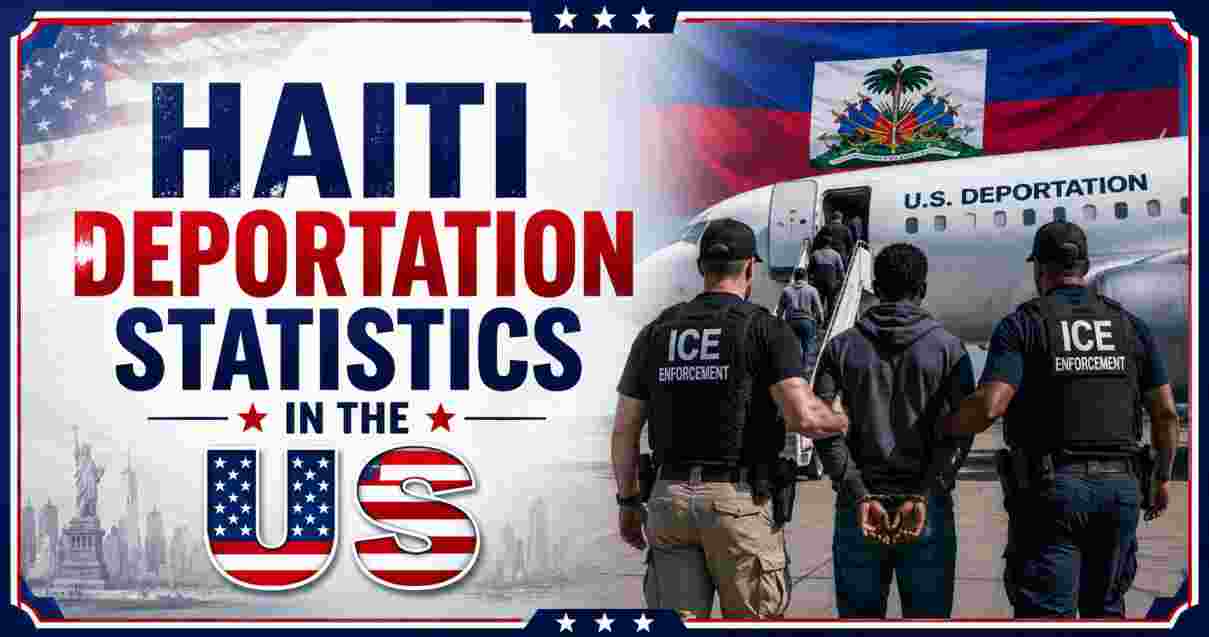
Haiti Deportation in America 2026
The United States sent its first deportation flight to Haiti since the termination of Temporary Protected Status (TPS) on August 20, 2026, when an ICE charter carrying 161 Haitian nationals landed in Cap-Haïtien, Haiti’s second-largest city. The flight, which originated in Alexandria, Louisiana, was the eighth deportation flight to Haiti in 2026 overall, but the first since TPS protections formally lapsed on July 27, 2026 for more than 300,000 Haitians who had been living and working legally in the United States. DHS officials have said they intend to escalate to twice-weekly flights, a pace that would return roughly 250 people to Haiti every week going forward.
The termination followed a lengthy legal battle: the Trump administration first announced its intent to end Haiti’s TPS designation in November 2025, only for a federal court to stay that decision in February 2026, before the U.S. Supreme Court ultimately ruled on June 25, 2026, in Mullin v. Doe, that the government could proceed with ending TPS for Haiti. This report compiles the most current, verified statistics on Haiti’s TPS termination, the resulting deportation operations, and the broader population affected, current as of August 21, 2026.
Interesting Facts About Haiti Deportation in the US 2026
| Fact | Detail |
|---|---|
| TPS Haiti Termination Effective Date | July 27, 2026 |
| Haitians Losing TPS Protection | 300,000+ (some figures cite up to 521,000) |
| First Post-Termination Deportation Flight | August 20, 2026 — 161 people, Cap-Haïtien |
| Total Haiti Deportation Flights in 2026 | 8 |
| Planned Flight Frequency (Going Forward) | Twice weekly, ~250 people/week |
| Supreme Court Ruling | Mullin v. Doe, 609 U.S. ___ (2026), June 25, 2026 |
| Haitian TPS Holders in US Workforce | ~200,000 |
| Haitians Deported From Dominican Republic (H1 2026) | 140,000+ |
| Flight Departure Hub | Alexandria, Louisiana |
| Largest US Haitian-American Population | Florida (South Florida/Miami) |
Source: USCIS official TPS Haiti releases; Associated Press, August 20, 2026; Reuters; Time, July 2026
The gap between figures citing 300,000 and others citing as many as 521,000 or 350,000 Haitians affected by the TPS termination reflects genuine differences in what each count measures and when it was taken. The 521,000 figure traces to Secretary of Homeland Security Kristi Noem’s original March 2025 decision cutting the duration of protections, a population count taken before some beneficiaries had already left the program, adjusted status through other means, or departed the country; more recent reporting from July and August 2026 consistently cites “more than 300,000” as the number actually losing status upon the July 27 termination date, making that the more current and precise figure for 2026 specifically.
The eight total deportation flights to Haiti in 2026 understate how dramatically enforcement is expected to escalate going forward: Human Rights First’s ICE Flight Monitor found the US had conducted only about one deportation flight to Haiti per period since December 2023 prior to this year’s ramp-up, meaning the shift to twice-weekly flights represents a fundamentally different operational tempo than the sporadic, occasional flights that characterized removals to Haiti in prior years.
Haiti TPS Termination Legal Timeline Statistics 2026
| Date | Development |
|---|---|
| November 28, 2025 | DHS publishes termination notice in Federal Register (90 Fed. Reg. 54733) |
| February 2, 2026 | U.S. District Court for D.C. stays the termination decision |
| February 3, 2026 | Original scheduled termination date (blocked by court stay) |
| March 25 – July 10, 2026 | Series of USCIS guidance updates extending EAD validity per court order |
| June 25, 2026 | Supreme Court rules in Mullin v. Doe, 609 U.S. ___ (2026) |
| July 24, 2026 | USCIS issues guidance implementing Supreme Court ruling |
| July 27, 2026 | Haiti TPS designation formally terminated |
| August 5, 2026 | Lower court confirms TPS for Haiti has ended |
Source: USCIS official TPS Haiti release archive; Miot et al. v. Trump et al., No. 25-cv-02471-ACR (D.D.C.); National Immigration Forum
The eight-month gap between the original February 3, 2026 termination date and the actual July 27, 2026 effective date illustrates how significantly ongoing litigation shaped the practical timeline of this policy change. Throughout that period, USCIS issued a running series of guidance updates — in March, July 1, July 10, and July 24 — each extending the validity of Employment Authorization Documents for TPS Haiti beneficiaries “per court order,” with instructions for employers to write “as per court order” directly on Form I-9 filings, a level of administrative complexity that reflects just how unsettled the legal status of hundreds of thousands of workers remained for most of the year.
The Supreme Court’s June 25, 2026 ruling in Mullin v. Doe did not immediately terminate TPS status for Haiti; the case was instead remanded to the district courts to issue an implementing order, a process the National Immigration Forum noted “typically takes 32 days” — closely matching the actual gap between the ruling and the July 27 effective termination date. That the same Supreme Court decision applied simultaneously to Syria’s TPS designation underscores that the Mullin v. Doe ruling functioned as a broader precedent for TPS termination authority generally, not a Haiti-specific legal question.
Haiti Deportation Flight Statistics 2026
| Metric | Data |
|---|---|
| August 20, 2026 Flight — Passengers | 161 (originally expected up to 175) |
| August 20 Flight Departure Point | Alexandria, Louisiana |
| August 20 Flight Landing Point | Cap-Haïtien International Airport |
| Prior Flight Date | July 16, 2026 — deportees with criminal records |
| Total 2026 Flights (as of Aug 20) | 8 |
| Planned Frequency Going Forward | Twice weekly |
| Projected Weekly Return Volume | ~250 people |
| Passengers Confirmed as Former TPS Holders | Unclear/disputed — Haiti’s ONM says none; other reports say some |
Source: Associated Press, August 20, 2026; ABC News; Haitian Times, August 21, 2026
A notable point of factual disagreement emerged immediately following the August 20 flight: Haiti’s National Office of Migration (ONM), led by director general Jean Négot Bonheur Delva, stated that none of the 161 passengers were former TPS beneficiaries, describing the group instead as individuals already in removal proceedings after entering the US illegally, or deportees who had completed prison sentences. Other contemporaneous reporting, however, described the group as including “TPS holders and Haitians who had served prison sentences,” a discrepancy that had not been definitively resolved as of this article’s publication and illustrates the genuine difficulty of independently verifying the exact legal status of individuals aboard a single deportation flight.
Delva also noted that some deportees on the flight were not born in Haiti, despite being of Haitian descent — a detail that adds a further layer of complexity to categorizing exactly who is affected by the TPS termination versus broader immigration enforcement unrelated to the TPS program specifically. He characterized Haiti’s role in accepting the flights diplomatically, stating “it is not the Haitian state that asks for them to be sent back… our mission is to welcome migrants of forced return… we welcome them with the aim of accompanying them to their home.”
Haitian TPS Population and Workforce Statistics
| Metric | Data |
|---|---|
| Total Haitian TPS Beneficiaries (2026 figure) | 300,000+ |
| Prior Beneficiary Count (2025 baseline) | 521,000 |
| Haitian TPS Holders in US Workforce | ~200,000 |
| TPS Holders Working in Agriculture | 15,000 |
| TPS Holders Working as Nursing Assistants | 13,000 |
| Original TPS Designation for Haiti | Following 2010 earthquake |
| Haitians Deported From Neighboring Countries (H1 2026) | 140,000+ (primarily Dominican Republic) |
Source: FWD.us fact sheet, January 2026; National Immigration Forum; International rights groups, August 2026
The concentration of Haitian TPS holders in specific labor sectors — an estimated 15,000 in agriculture and 13,000 working as nursing assistants, according to a January 2026 fact sheet from the immigration advocacy group FWD.us — illustrates why the TPS termination carries direct economic implications beyond the individuals and families affected. Both sectors have historically struggled with domestic labor shortages, meaning the sudden loss of legal work authorization for tens of thousands of workers in these specific roles is likely to have measurable downstream effects on employers in agriculture and long-term care, independent of the broader human and legal dimensions of the policy change.
The scale of Haiti’s own capacity to absorb returning migrants adds further context: international rights groups have noted that more than 140,000 Haitians were deported from neighboring countries, primarily the Dominican Republic, in just the first half of 2026 alone — a volume that, combined with the newly escalating US deportation flights, has prompted humanitarian organizations to warn that “there are no government measures in place to adequately assist” the scale of returns Haiti now faces, a concern compounded by the country’s ongoing gang violence crisis and displacement emergency that originally justified Haiti’s TPS designation following the 2010 earthquake.
Haitian-American Community and Regional Impact Statistics
| Metric | Data |
|---|---|
| Largest Haitian-American Population (State) | Florida |
| Primary Florida Concentration | South Florida / Miami-Dade |
| Other States With Large Haitian-American Populations | New York, Massachusetts, Georgia |
| Notable Ohio Community (Springfield) | Subject of 2024 political controversy |
| Community Response Measures | Expanded “know your rights” programming |
| Local Government Response | Public criticism from elected officials; no policy authority over federal enforcement |
Source: Haitian Times; HNGN, August 21, 2026; CBS News
South Florida’s status as home to the largest concentration of Haitian-Americans in the country has made it the epicenter of both community organizing and visible anxiety following the TPS termination, with local organizations rapidly expanding know-your-rights programming in the weeks surrounding the policy’s effective date. Similar organizing efforts have taken shape in New York, Massachusetts, and Georgia — the other states with the largest Haitian-American populations — while Springfield, Ohio’s smaller but nationally prominent Haitian community, which drew significant political attention during the 2024 election cycle, has also been specifically named in internal enforcement planning documents as a targeted location for arrest operations.
Local elected officials across these states have publicly criticized the administration’s decision to end TPS for Haiti, but this opposition has had no discernible effect on federal policy, since TPS designations and immigration enforcement priorities are set exclusively by DHS and the White House rather than by state or local governments — a jurisdictional reality that has left affected communities with organizing and legal advocacy as their primary available responses rather than any direct policy lever. For broader context on how this single-country action fits within the administration’s overall immigration enforcement strategy in 2026, the Mass Deportation Statistics in US report documents the nationwide detention and removal trends occurring alongside the Haiti-specific developments covered here.
Broader US Immigration Enforcement Context 2026
| Metric | Data |
|---|---|
| TPS Populations Also Terminated in 2026 | Venezuela (350,000), Honduras, Nicaragua, Syria |
| Total Protected Populations Losing Status (2025-26) | 1.5 million+ across multiple countries |
| ICE Detention Population (Record, Jan 2026) | 73,400+ on a single day |
| US Foreign-Born Population (Jan 2025 peak) | 53.3 million (15.8% of total population) |
| Foreign-Born Population (2026, declining) | ~51.9 million (15.4%) |
Source: theworlddata.com US Immigration Statistics by Year 2026; National Immigration Forum
Haiti’s TPS termination did not occur in isolation — it forms part of a broader, systematic rollback of humanitarian protection programs throughout 2025 and 2026 that has also stripped legal status from 350,000 Venezuelans, alongside beneficiaries from Honduras, Nicaragua, and Syria, collectively affecting well over a million people who had previously held some form of protection from deportation. Full detail on how these combined policy changes have reshaped America’s overall foreign-born population — which fell from a January 2025 peak of 53.3 million to roughly 51.9 million as of 2026 — is available in the US Immigration Statistics by Year report, which tracks the year-over-year enforcement and demographic data behind this decline.
The operational infrastructure now being directed toward Haitian deportations — expanded charter flights, a growing detention system that held a record 73,400-plus people on a single day in January 2026, and coordinated interior enforcement operations — reflects capacity built for the administration’s broader mass deportation strategy rather than infrastructure created specifically for Haiti. Readers interested in how this capacity has been deployed through targeted enforcement operations in specific American cities and communities can find additional detail in the Immigration Raids Statistics in US report, which documents the operational patterns — arrest tactics, detention facility usage, and community impact — that now extend to the Haitian community following the TPS termination covered in this report.
Disclaimer: This research report is compiled from publicly available sources. While reasonable efforts have been made to ensure accuracy, no representation or warranty, express or implied, is given as to the completeness or reliability of the information. We accept no liability for any errors, omissions, losses, or damages of any kind arising from the use of this report.