
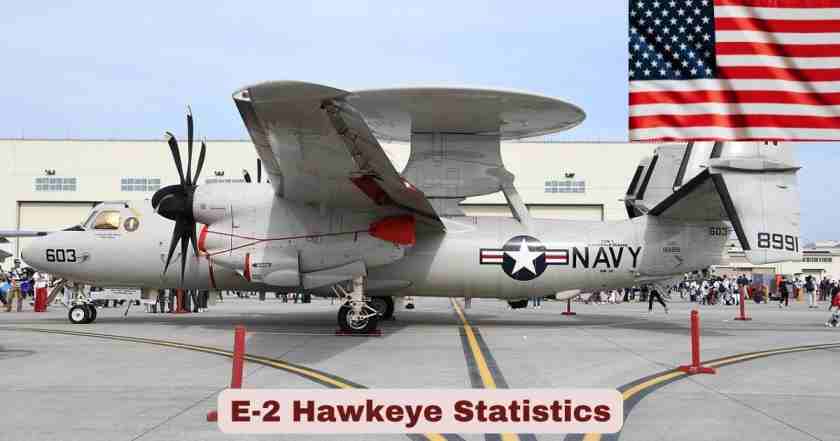
What Is E-2 Hawkeye?
The Northrop Grumman E-2 Hawkeye — universally known as the “eyes of the fleet” and nicknamed the “Hummer” by naval aviators for the unmistakable droning sound of its twin turboprop engines — is the United States Navy’s only carrier-based, all-weather tactical battle management airborne early warning and command-and-control aircraft, and the most consequential piece of electronic equipment aboard any U.S. Navy Carrier Strike Group in the world. Originally designed and developed by Grumman Aircraft Company during the late 1950s and early 1960s, the E-2A first entered service with the U.S. Navy in January 1964 with VAW-11 at NAS North Island and made its first carrier deployment aboard USS Kitty Hawk in 1965 — meaning the Hawkeye has been the electronic heart of carrier air wing operations for over 60 unbroken years. The defining visual signature of the aircraft is its 24-foot (7.3-meter) diameter rotating radar rotodome, mounted above the fuselage and wings on a fixed pylon, housing the AN/APY-9 ultra-high frequency (UHF) radar in the current E-2D Advanced Hawkeye variant — the same radar that is specifically engineered to detect fifth-generation stealth aircraft by exploiting their vulnerability to UHF-band electromagnetic sensing. Powered by two Rolls-Royce T56-A-427A turboprop engines each generating 5,100 shaft horsepower, the E-2D carries a five-person crew — two pilots and three mission systems operators — and has been in continuous production at Northrop Grumman’s St. Augustine, Florida production facility since 1960, giving it the longest continuous production run of any carrier-based aircraft in history. As of March 2026, the total U.S. Navy E-2D program is funded for 78 aircraft, with the full requirement set at 86 aircraft, and the fleet is actively transitioning from E-2C to E-2D with completion expected by fiscal year 2027.
In 2026, the E-2D Advanced Hawkeye is not simply managing carrier air wings during peacetime patrols — it is in the middle of the largest and most complex American naval air campaign in decades. On February 28, 2026, E-2D Hawkeyes from both USS Gerald R. Ford (CVN-78) and USS Abraham Lincoln (CVN-72) were confirmed by CENTCOM, FlightGlobal, Air & Space Forces Magazine, CNN, and the U.S. Army’s official website as active participants in Operation Epic Fury, the joint U.S.-Israeli military campaign against Iranian military infrastructure. Official U.S. Department of Defense photographs released on February 28, 2026 show a U.S. Navy Sailor preparing an E-2D Hawkeye aircraft for launch from the flight deck of USS Gerald R. Ford in the Eastern Mediterranean — the most publicly visible confirmation possible of the aircraft’s combat role. The E-2D from VAW-124 aboard the Ford and the Hawkeyes embarked on the Lincoln provided airborne early warning and battle management for the 100+ aircraft first-strike wave that opened the campaign, coordinating simultaneously with F/A-18E/F Super Hornets, EA-18G Growlers, F-35Cs, and Tomahawk-firing Arleigh Burke destroyers across two carrier strike groups operating from two separate bodies of water. No other aircraft in the U.S. Navy’s entire inventory performs this specific, irreplaceable mission — and 2026 is the year the world watched the E-2D Hawkeye prove it once again, from the flight deck of the world’s most powerful warship.
E-2 Hawkeye 2026 — Key Facts
| # | E-2 Hawkeye Key Fact | Details |
|---|---|---|
| 1 | 60+ Years of Continuous Carrier Service — Since 1964 | The E-2 Hawkeye first entered U.S. Navy service in January 1964 and has been the Navy’s carrier-based AEW aircraft for over 60 unbroken years — longer than any other carrier-capable aircraft in the American inventory |
| 2 | Longest Production Run of Any Carrier-Based Aircraft | Variants of the E-2 Hawkeye have been in continuous production since 1960 — giving it the longest unbroken production run of any carrier-based aircraft in aviation history |
| 3 | Confirmed Active in Operation Epic Fury — February 28, 2026 | Official DoD photographs released on February 28, 2026 show E-2D Hawkeyes being prepared for launch from USS Gerald R. Ford in direct support of Operation Epic Fury against Iran — confirmed by CENTCOM, FlightGlobal, CNN, and Air & Space Forces Magazine |
| 4 | Both CVN-78 Ford and CVN-72 Lincoln Carry E-2Ds in Operation Epic Fury | FlightGlobal confirmed that both U.S. carriers deployed in Operation Epic Fury — USS Gerald R. Ford (Eastern Mediterranean) and USS Abraham Lincoln (Arabian Sea) — operate E-2D Advanced Hawkeye aircraft as their AEW&C asset |
| 5 | AN/APY-9 Radar Detects Stealth Aircraft Including Su-57 and J-20 | The AN/APY-9 UHF-band radar is specifically capable of detecting fifth-generation stealth fighters including the Russian Su-57 and Chinese J-20 — exploiting a fundamental physics vulnerability of low-observable designs to UHF-band sensing |
| 6 | Tracks 2,000+ Targets Simultaneously — Detects 20,000 Targets at 400+ Miles | The E-2D with Hawkeye 2000 systems can track over 2,000 targets simultaneously while detecting 20,000 targets at ranges greater than 400 miles (640 km) and guide 40–100 simultaneous air-to-air intercepts |
| 7 | Total U.S. Navy Program: 78 Funded / 86 Required (2026) | The E-2D program is funded for 78 aircraft with a full requirement of 86 — an 8-aircraft shortfall currently tracked in the Navy’s program of record |
| 8 | $22 Billion Total Program Cost for 80 Aircraft | The E-2D Advanced Hawkeye program was allocated a total of $22 billion to deliver 80 aircraft by 2026 — one of the largest naval aviation program investments in modern U.S. history |
| 9 | First Carrier-Based Aircraft Designed from Scratch for AEW | The E-2 was the first aircraft ever specifically designed from the outset for the AEW mission — unlike the Air Force’s E-3 Sentry, which is a modified Boeing 707 commercial airliner |
| 10 | E-2C Fleet Retirement Completing FY2026 | The U.S. Navy had 26 E-2C Hawkeyes used solely for training, scheduled for retirement by end of FY2026 — completing the full transition to the E-2D Advanced Hawkeye |
| 11 | Aerial Refueling Capability Added from FY2020 | Beginning in FY2020, the E-2D achieved Initial Operational Capability with aerial refueling (AR) — extending on-station time from a few hours to crew endurance limits only — a dramatic transformation in persistence and range |
| 12 | VAW-124 Bears Aces — First E-2D Fleet Squadron Deployment | Carrier Airborne Early Warning Squadron 124 (VAW-124) “Bear Aces” conducted the first fleet deployment of the E-2D Advanced Hawkeye — the same unit confirmed aboard USS Gerald R. Ford in Operation Epic Fury |
| 13 | Japan Procuring 9 E-2Ds — 3 Already Delivered | Japan’s JASDF is procuring 9 E-2D Advanced Hawkeyes under two multi-year contracts — 3 have been delivered as of the latest program data, at a price of approximately $1.5 billion for 5 aircraft in the second contract |
| 14 | France Signed for 3 E-2Ds — Delivery FY2027 | France signed a letter of agreement to purchase 3 E-2D Advanced Hawkeyes for the French Navy, with delivery scheduled for fiscal year 2027 |
| 15 | NIFC-CA: E-2D Can Guide SM-6 Missiles Beyond Radar Horizon | Under the Naval Integrated Fire Control-Counter Air (NIFC-CA) architecture, the E-2D can guide fleet SM-6 and AIM-120 AMRAAM missiles onto targets beyond the launch platform’s detection range — giving surface ships and fighters engagement capability far exceeding their own sensors |
Source: U.S. Navy Fact File – E-2 Hawkeye (navy.mil); NAVAIR PMA-231 (navair.navy.mil); FlightGlobal (flightglobal.com, March 2, 2026); CNN (cnn.com, March 2, 2026); Air & Space Forces Magazine – Weapons of Epic Fury (airandspaceforces.com, March 2026); Army Recognition (armyrecognition.com, March 2026); U.S. Army official website – Hegseth Epic Fury briefing (army.mil, March 3, 2026); USNI News (news.usni.org, August 2021); Wikipedia – Grumman E-2 Hawkeye (updated March 2026); Simple Flying (simpleflying.com, December 2024)
These 15 E-2 Hawkeye key facts for 2026 bring into sharp focus the remarkable combination of historical depth and present-day operational urgency that defines this aircraft. The 60+ year continuous service record and the longest production run of any carrier-based aircraft are impressive statistics on paper — but they become genuinely extraordinary when you understand what they mean in practice: the same basic mission, the same carrier deck, the same five-person crew concept, has been continuously refined and improved across six decades of carrier aviation without a single year in which the U.S. Navy operated a carrier strike group without a Hawkeye aboard. No other aircraft in the American inventory — and arguably in the world — can make a comparable claim. The transition from the E-2A to the E-2B, to the E-2C, to the E-2C Hawkeye 2000, and now to the E-2D Advanced Hawkeye represents not a series of replacements but a single continuous evolution of the same essential idea: put the most capable radar and battle management system possible on a carrier-compatible airframe, and keep making it better.
The 2026 operational facts ground all of that history in immediate, visceral relevance. The $22 billion total program investment, the 78 funded aircraft, the 9 JASDF aircraft on order, and the French Navy’s 3 E-2Ds for FY2027 — these are the numbers of a platform that allies worldwide have independently concluded they cannot afford to be without. The NIFC-CA architecture’s use of the E-2D to guide SM-6 missiles beyond the radar horizon represents a genuinely new dimension of carrier strike group lethality: a surface ship that can engage targets it cannot see, guided by an airborne sensor on a turboprop flying overhead. In any peer conflict in the Western Pacific — against a Chinese naval force equipped with DF-21D anti-ship ballistic missiles — the ability to engage from beyond the adversary’s detection range is not a tactical advantage, it is a survival requirement. The E-2D is currently the only platform in the U.S. Navy that provides it.
E-2 Hawkeye 2026 Technical Specifications
| Specification | E-2D Advanced Hawkeye (Official NAVAIR / U.S. Navy Data) |
|---|---|
| Primary Function | All-weather carrier-based tactical battle management, airborne early warning, command and control |
| Manufacturer | Northrop Grumman Corporation |
| Production Facility | St. Augustine, Florida (continuous since 1960) |
| Airframe Basis | Original — first aircraft designed from scratch for AEW mission (not a conversion) |
| Power Plant | 2 × Rolls-Royce T56-A-427A turboprop engines |
| Power Per Engine | 5,100 shaft horsepower (shp) |
| Rotodome Diameter | 24 feet (7.3 meters) |
| Rotodome Rotation Speed | 6 revolutions per minute (RPM) |
| Primary Radar | AN/APY-9 (UHF-band; Northrop Grumman) — two-generation leap over E-2C |
| Radar Range | Detects 20,000 targets at 400+ miles (640+ km) |
| Simultaneous Target Tracking | 2,000+ targets simultaneously |
| Simultaneous Intercept Guidance | 40–100 air-to-air or air-to-surface engagements |
| Overall Length | 57 feet, 8.75 inches (17.6 meters) |
| Wing Span | 80 feet, 7 inches (24.6 meters) |
| Wingspan (folded, for carrier stowage) | 29 feet, 4 inches (8.9 meters) |
| Height | 18 feet, 3.75 inches (5.6 meters) |
| Empty Weight | 40,484 pounds (18,363 kg) |
| Speed | 300+ knots (345+ mph / 556+ km/h) |
| Service Ceiling | 37,000 feet (11,278 meters) |
| Unrefueled Endurance | Approximately 4–6 hours on station |
| Endurance with Aerial Refueling | Unlimited — crew endurance is limiting factor (IOC FY2020) |
| Crew | 5 — 2 pilots + 3 mission systems operators (co-pilot can act as 4th MSO) |
| Carrier Compatibility | All U.S. Navy active supercarriers — CATOBAR launch, arrested landing |
| Unit Cost (E-2D) | Approximately $232 million per aircraft (FY2022 dollars) |
| Total Program Cost | $22 billion (80 aircraft allocation) |
| U.S. Navy Funded Inventory | 78 E-2D aircraft (requirement: 86) |
| IOC Date (E-2D) | 2014 (fleet squadron service) |
| Aerial Refueling IOC | FY2020 |
| E-2C Retirement Timeline | By end of FY2026 (26 training aircraft) |
| Full E-2D Fleet Transition | By FY2027 (all fleet squadrons) |
| Viability Horizon | 2040s and beyond (Navy upgrade roadmap confirmed) |
Source: NAVAIR PMA-231 – E-2D Advanced Hawkeye product page (navair.navy.mil); U.S. Navy Fact File – E-2 Hawkeye (navy.mil); USNI News (news.usni.org); DoD Selected Acquisition Report – E-2D AHE (FY2022, esd.whs.mil); Wikipedia – Grumman E-2 Hawkeye; Simple Flying (simpleflying.com); airplanes-online.com
The E-2D Advanced Hawkeye technical specifications reveal an aircraft that is fundamentally different from any other airborne early warning platform on earth — not just in capability, but in concept. Where the Air Force’s E-3 Sentry is a massive, four-engine converted airliner weighing 325,000 pounds at takeoff, carrying a crew of up to 33, flying from land bases at 30,000 feet over a theater, the E-2D is a purpose-built, carrier-capable turboprop weighing just over 40,000 pounds empty, operating from a moving flight deck in any sea state, and putting its five-person crew within the carrier strike group’s own operating envelope. The AN/APY-9 UHF radar is the technical centerpiece: Northrop Grumman and Lockheed specifically engineered it to overcome the historical limitation of UHF radars — poor resolution for targeting — by applying advanced electronic scanning and space/time adaptive processing (STAP) that makes high-quality tracks possible at ranges exceeding 400 miles. The critical implication: stealth aircraft designed to defeat X-band fire control radars have much higher radar cross-sections at UHF frequencies, meaning the E-2D can detect and track the Chinese J-20 and Russian Su-57 in scenarios where other radars cannot.
The aerial refueling capability added at FY2020 IOC is arguably the single most operationally transformative upgrade in the E-2D’s history. An unrefueled E-2D can remain on station for approximately 4–6 hours before the carrier must launch a relief aircraft to maintain continuous AEW coverage — a cycle that consumes flight deck spots, maintenance hours, and crew rotations throughout a 24-hour operation. With aerial refueling, a single E-2D crew can remain airborne until they are no longer physically capable of safe operations, potentially extending a single sortie to 12 hours or more. In the context of Operation Epic Fury — where the carrier strike groups are managing hundreds of sorties per day across a sustained campaign against a nation-state adversary — the difference between 4-hour and 12-hour on-station endurance is the difference between a manageable AEW rotation and an unsustainable one. NAVAIR’s description of aerial refueling as giving the E-2D the ability to “remain airborne to the limits of the aircrew and airframe endurance” is not marketing language — it is the operational reality that makes sustained high-tempo carrier combat operations against a peer or near-peer adversary actually executable.
E-2 Hawkeye 2026 — Fleet Structure & Squadrons
| Squadron | Designation | Home Base | Carrier Wing | Aircraft | Status (2026) |
|---|---|---|---|---|---|
| VAW-120 “Greyhawks” | Fleet Readiness Squadron (FRS) | NAS Norfolk, Virginia | Training | E-2D + TC-2D | Active — training all E-2D crews |
| VAW-123 “Screwtops” | Carrier Airborne Early Warning Sqdn | NAS Norfolk, Virginia | CVW-1 | E-2D | Active |
| VAW-124 “Bear Aces” | Carrier Airborne Early Warning Sqdn | NAS Norfolk, Virginia | CVW-8 / USS Gerald R. Ford | E-2D | Active — Operation Epic Fury (Feb 28, 2026) |
| VAW-125 “Tigertails” | Carrier Airborne Early Warning Sqdn | MCAS Iwakuni, Japan | CVW-5 | E-2D | Active — 7th Fleet, Indo-Pacific |
| VAW-126 “Seahawks” | Carrier Airborne Early Warning Sqdn | NAS Norfolk, Virginia | CVW-3 | E-2D | Active |
| VAW-113 “Black Eagles” | Carrier Airborne Early Warning Sqdn | NAS Point Mugu, California | CVW-11 | E-2D | Active |
| VAW-115 “Liberty Bells” | Carrier Airborne Early Warning Sqdn | NAS Point Mugu, California | CVW-9 / USS Abraham Lincoln | E-2D | Active — Operation Epic Fury (Feb 28, 2026) |
| VAW-116 “Sun Kings” | Carrier Airborne Early Warning Sqdn | NAS Point Mugu, California | CVW-17 | E-2D | Active |
| VAW-117 “Wallbangers” | Carrier Airborne Early Warning Sqdn | NAS Point Mugu, California | CVW-14 | E-2D | Active |
| VAW-121 “Bluetails” | Carrier Airborne Early Warning Sqdn | NAS Norfolk, Virginia | CVW-7 | E-2D | Active |
| Total U.S. Navy E-2D Fleet Squadrons | 9 Fleet + 1 FRS | — | 9 carrier wings | ~78 aircraft | Active / Transitioning from E-2C |
Source: U.S. Navy official squadron pages (navy.mil); USNI News (news.usni.org); FlightGlobal (flightglobal.com, March 2026); Wikipedia – Grumman E-2 Hawkeye; Simple Flying (simpleflying.com, December 2024); VPM / PBS Virginia (vpm.org, March 3, 2026)
The E-2 Hawkeye 2026 fleet structure is organized around a fundamental carrier aviation principle: every U.S. Navy supercarrier goes to sea with a Hawkeye squadron embedded in its air wing, and no carrier air wing is considered operationally capable without one. The nine fleet squadrons — five on the East Coast under the Commander, Naval Air Force Atlantic and four on the West Coast under the Commander, Naval Air Force Pacific — are each assigned to a specific carrier air wing, meaning there is a one-to-one relationship between every active carrier and its dedicated E-2D unit. VAW-120 “Greyhawks” at NAS Norfolk serves as the Fleet Readiness Squadron training all new E-2D pilots and mission systems operators for both coasts, making it the institutional backbone through which the Navy’s entire airborne early warning human capital flows. VAW-125 “Tigertails” at MCAS Iwakuni, Japan — the only permanently forward-deployed Hawkeye squadron — provides the 7th Fleet and its rotating carrier presence with a resident AEW capability that does not require trans-Pacific transit time to make available.
The simultaneous presence of both VAW-124 (USS Gerald R. Ford) and VAW-115 (USS Abraham Lincoln) in active combat during Operation Epic Fury is a fleet structure statistic worth pausing over. In a fleet of nine squadrons, two being in active combat simultaneously — managing air wings across two separate bodies of water, the Eastern Mediterranean and the Arabian Sea — represents roughly 22% of all fleet E-2D squadrons in direct combat operations at the same time. Every remaining squadron is either in work-up cycles, post-deployment stand-down, or in the Indo-Pacific maintaining the 7th Fleet deterrence posture against China and North Korea. The margin between operational commitments and available force is, by any reasonable measure, extremely thin — which is precisely why the eight-aircraft gap between the funded 78 and the required 86 E-2Ds is not an accounting footnote but a genuine strategic concern that Navy program officials have flagged repeatedly in their annual program reviews.
E-2 Hawkeye 2026 — Operation Epic Fury Combat Statistics
| Detail | Data | Source |
|---|---|---|
| Operation Name | Operation Epic Fury | U.S. Central Command (CENTCOM) |
| Operation Start | February 28, 2026 at 1:15 AM EST | CENTCOM official |
| E-2D Confirmed Present | Both USS Gerald R. Ford (CVN-78) and USS Abraham Lincoln (CVN-72) operate E-2D Advanced Hawkeyes | FlightGlobal (March 2, 2026); Army Recognition |
| VAW-124 “Bear Aces” — Ford Confirmation | Official U.S. Navy/DoD photograph released February 28, 2026 shows E-2D Hawkeye from VAW-124 being prepared for launch from USS Gerald R. Ford | DVIDSHUB / U.S. Navy official imagery; VPM (March 3, 2026) |
| Ford Operating Location | Eastern Mediterranean Sea — south of Israel near Haifa | Army Recognition; VPM; FlightGlobal |
| Lincoln Operating Location | Arabian Sea (redeployed from Pacific) | FlightGlobal; CENTCOM |
| E-2D Role in Operation | Airborne early warning and battle management — “crucial in an environment characterized by large-scale missile and drone retaliation” | Army Recognition (March 2026) |
| First Strike Wave Size | 100+ aircraft in opening strike (carriers + land-based) | U.S. Army official (army.mil, March 3, 2026) |
| Carrier Air Wings Active | CVW-8 (Ford) and CVW-9 (Lincoln) — both with E-2D squadrons embedded | FlightGlobal; CENTCOM |
| Ford Air Wing Composition | F/A-18E/F Super Hornets, EA-18G Growlers, E-2D Hawkeyes, MH-60R/S helicopters | Army Recognition; Air & Space Forces Magazine |
| Lincoln Air Wing Composition | F/A-18E/F Super Hornets, EA-18G Growlers, F-35Cs, E-2D Hawkeyes, MH-60R/S helicopters | FlightGlobal; Air & Space Forces Magazine |
| Iranian Retaliation Managed by E-2D | E-2D provided airborne battle management during Iranian ballistic missile and drone retaliation — coordinating Patriot and THAAD intercepts and carrier CAP fighters | Army Recognition; Gulf News |
| Total Iranian Projectiles Fired in Retaliation | Hundreds — CENTCOM reported “hundreds of Iranian missile and drone attacks” successfully defended; 282 missiles + 833 drones per Day 3 update | CENTCOM; Gulf News; usarmy.com |
| Total Coalition Targets Struck — First 48 Hours | 1,250+ across Iran | CENTCOM official statement |
| Total Coalition Targets Struck — First Week | 1,700+ across Iran | CENTCOM; IBTimes |
| Complementary AEW Asset | E-3 Sentry AWACS (USAF) — operating alongside E-2Ds to provide comprehensive theater air picture | CNN; Air & Space Forces Magazine |
Source: U.S. Central Command (centcom.mil, February 28 – March 4, 2026); FlightGlobal (flightglobal.com, March 2, 2026); Army Recognition (armyrecognition.com, March 2026); CNN (cnn.com, March 2, 2026); Air & Space Forces Magazine (airandspaceforces.com, March 2026); U.S. Army official website (army.mil, March 3, 2026); VPM / PBS Virginia (vpm.org, March 3, 2026); Gulf News (gulfnews.com, March 2, 2026); DVIDSHUB (dvidshub.net)
The E-2D Hawkeye’s Operation Epic Fury combat statistics confirm that when the United States Navy decides to bring its full combat power to bear against a nation-state adversary, the E-2D is not an optional accessory — it is the foundational enabling system around which everything else is organized. Army Recognition’s operational analysis described the E-2D’s role in the starkest possible terms: “crucial in an environment characterized by large-scale missile and drone retaliation.” That word — crucial — is not hyperbole in this context. Managing the airspace around two carrier strike groups operating simultaneously, one in the Eastern Mediterranean and one in the Arabian Sea, while hundreds of Iranian ballistic missiles and over 800 drones are being fired in retaliation, while 100+ aircraft are cycling through launch-strike-recovery sequences, while Tomahawk missiles from destroyers are transiting the same airspace, while F-22s from Israel and F-35As from regional bases are deconflicting their routes — this is precisely the scenario for which the E-2D was designed, funded, and has been continuously upgraded for 60 years.
The photographic and documentary evidence from Operation Epic Fury is unusually rich for an active combat operation. The release of official U.S. Navy photographs showing an E-2D Hawkeye being prepared for launch from USS Gerald R. Ford’s flight deck on February 28, 2026 — the first day of the operation — is a level of institutional transparency that confirms the Navy wants the world to see its carrier-based AEW capability in action. The confirmation by FlightGlobal that both carriers carry E-2Ds gives the full picture: two independent Hawkeye-managed air pictures, two independent battle management nodes, two carrier strike groups capable of operating in separate bodies of water without reliance on land-based AWACS for carrier air wing coordination. The E-2D is the reason each carrier strike group is self-contained and self-sufficient in airspace management — a capability that becomes existentially important if land bases are struck or if the carrier must operate in regions beyond the range of shore-based E-3 AWACS coverage. In Operation Epic Fury, 2026, the E-2D Hawkeye is doing exactly what it was built to do: making everything else possible.
E-2 Hawkeye 2026 — Global Operators & Export Statistics
| Operator | Variant | Aircraft (2026) | Status / Notes |
|---|---|---|---|
| United States Navy | E-2D Advanced Hawkeye | ~78 funded (req: 86) | Active — 9 fleet squadrons + 1 FRS; Operation Epic Fury active |
| Japan (JASDF) | E-2C (legacy) + E-2D (new) | 13 E-2Cs + 3 E-2D delivered (9 total E-2D ordered) | E-2D deliveries ongoing under 2nd multi-year contract; $1.5B for 5 aircraft in 2nd contract |
| Taiwan (ROCAF) | E-2K (E-2C Hawkeye 2000 standard) | 6 aircraft | Active; Taiwan in discussions for E-2D per USNI News; part of Taiwan’s $40B defense expansion |
| France (French Navy / Aéronavale) | E-2C (current) → E-2D (ordered) | 3 E-2Cs + 3 E-2D on order | E-2D delivery FY2027; NRE contract modification confirmed 2021 |
| Egypt (EAF) | E-2C | 6 aircraft | Active |
| Singapore (RSAF) | E-2C | 4 aircraft | Active |
| Israel (IAF) | E-2C | 4 aircraft | Active |
| Saudi Arabia (RSAF) | E-2C | 5 aircraft | Active |
| Total Global E-2 Operators | All variants | ~120+ aircraft worldwide | U.S. + 7 international operators |
Source: Wikipedia – Grumman E-2 Hawkeye (updated March 2026); USNI News (news.usni.org); DoD Selected Acquisition Report – E-2D AHE (FY2022); NAVAIR PMA-231; airplanes-online.com; Taipei Times (cited in Wikipedia); GlobalSecurity.org
The E-2 Hawkeye global operator statistics for 2026 tell the story of an aircraft that has found an international customer base precisely because the U.S. Navy’s experience with it is so extensive and its combat record so well documented. Egypt, Singapore, Israel, Saudi Arabia, Taiwan, Japan, and France have all independently concluded that the Hawkeye’s carrier or deck-based AEW&C capability is the right solution for their naval aviation requirements — and the pattern of legacy E-2C operators now transitioning toward or ordering E-2D Advanced Hawkeyes mirrors exactly what happened with the U.S. Navy itself: once the AN/APY-9 radar’s performance became publicly documented, earlier-generation customers began seeking the upgrade path. Japan’s second multi-year E-2D contract — delivering nine aircraft total — and France’s FY2027 delivery of three E-2Ds are both driven by the same operational logic: the APY-9’s ability to detect stealth aircraft and operate in dense, contested airspace cannot be replicated by the earlier APS-145 radar in the E-2C.
The Taiwan E-2 situation in 2026 is particularly worth noting. Taiwan currently operates six E-2K aircraft — the E-2C Hawkeye 2000 standard — and has been in ongoing discussions about E-2D procurement as part of its broader $40 billion defense expansion. In the context of Operation Epic Fury demonstrating that U.S. E-2Ds are actively managing carrier air wings in high-intensity combat against a nation-state adversary, Taiwanese defense planners watching the operation’s execution have the most compelling possible real-world data point in support of E-2D acquisition: this is what a modern AEW&C aircraft looks like in action, coordinating a 100+ aircraft first strike wave while simultaneously managing the defense against hundreds of retaliatory ballistic missiles and drones. No simulation, no exercise, and no vendor briefing makes the case for the E-2D as powerfully as Operation Epic Fury’s unfolding combat record does in real time.
Disclaimer: This research report is compiled from publicly available sources. While reasonable efforts have been made to ensure accuracy, no representation or warranty, express or implied, is given as to the completeness or reliability of the information. We accept no liability for any errors, omissions, losses, or damages of any kind arising from the use of this report.