
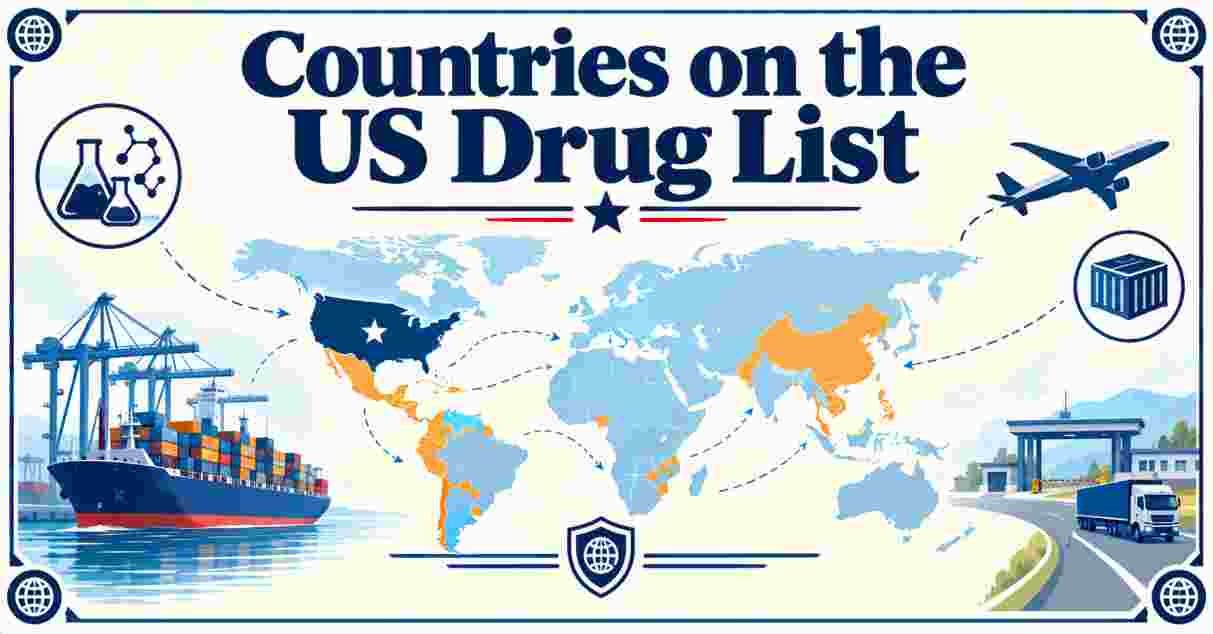
President Trump submitted the 2026 “Major’s List” to Congress on September 15, naming 23 countries as major drug transit or illicit drug producing nations for Fiscal Year 2027. Four countries, Afghanistan, Bolivia, Burma, and Colombia, were separately designated as having failed demonstrably to meet their counternarcotics obligations.
Countries on the US Drug List 2026 – Introduction
The countries on the US drug list 2026 were formally identified this week when President Trump delivered the annual “Major’s List” to Congress on September 15, 2026, naming 23 nations the United States government considers major drug transit or major illicit drug producing countries. This list, required by law every year, has remained remarkably stable in membership for nearly a decade, yet the political weight attached to it has grown substantially under the current administration, which has directly tied several countries’ presence on this list to tariff actions, foreign aid decisions, and broader diplomatic pressure campaigns.
This report breaks down the countries on the US drug list in 2026 in full: the complete roster of 23 nations, the smaller group singled out for having failed their counternarcotics obligations, the legal mechanism behind the designation, the specific roles Mexico, Colombia, and China play in the current drug crisis, and how this list connects to America’s ongoing fentanyl overdose emergency. Understanding this annual determination matters because it sits at the intersection of public health policy, foreign relations, and trade strategy, shaping how billions of dollars in foreign assistance and tariff decisions get made each year.
Interesting Facts About the US Drug List in 2026
| Statistic | 2026 Data |
|---|---|
| Total Countries on the 2026/FY2027 List | 23 |
| Countries “Failed Demonstrably” (FY2027) | 4: Afghanistan, Bolivia, Burma, Colombia |
| Countries “Failed Demonstrably” (FY2026, Prior Year) | 5 (Venezuela included) |
| List Submission Date | September 15, 2026 |
| Legal Basis | Section 706, Foreign Relations Authorization Act 2003 |
| US Fentanyl Overdose Deaths (2025, Provisional) | 38,084, down 22% from 2024 |
| Total US Drug Overdose Deaths (2025, Provisional) | 69,973, down 14% from 2024 |
| Fentanyl Lethal Doses Seized at SW Border (FY2026) | More than 100 million |
| Americans Who Know Someone Who Died From Opioid Overdose | More than 40% |
| Countries Newly Praised for Progress (FY2027) | India, Bolivia (partial) |
| Years the Core Country List Has Stayed Largely Unchanged | Since at least 2018 |
Data Source: U.S. Department of State, White House Briefings and Statements, Centers for Disease Control and Prevention (2026)
The numbers above capture a policy tool that changes surprisingly little year over year in terms of which countries appear on it, even as the political consequences attached to that appearance shift considerably. The 23-country list submitted this September is functionally identical in membership to the version submitted a year earlier, underscoring that this designation reflects structural, geographic, and economic realities, a country’s position along drug trafficking routes or its capacity to produce raw materials for narcotics, rather than a rapidly shifting diplomatic scorecard. What did change meaningfully in 2026 was the “failed demonstrably” sub-list shrinking from five countries to four, with Venezuela’s removal from that more serious designation marking the year’s single most notable shift.
Behind this bureaucratic determination sits a genuine public health emergency that has shown its first real signs of improvement in years. Fentanyl overdose deaths fell 22% between 2024 and 2025 according to provisional CDC data, a decline officials link partly to disrupted supply chains reflected in the 100 million-plus lethal doses of fentanyl seized at the southwest border in fiscal year 2026 alone. Still, more than 40% of Americans report personally knowing someone who died from an opioid overdose, a statistic that helps explain why this annual list, however procedurally routine, continues to draw substantial political and media attention each September.
The Full 2026 US Drug List | All 23 Countries
Countries on the 2026/FY2027 US Major Drug Transit List, by Region
Latin America/Caribbean |████████████████████████████████████████ 15 countries
Asia                    |████████████████ 6 countries
Africa/Other            |█ 1 country (via China's global reach)
| Region | Countries on the List |
|---|---|
| North/Central America | Mexico, Belize, Costa Rica, El Salvador, Guatemala, Honduras, Nicaragua, Panama |
| Caribbean | The Bahamas, Dominican Republic, Haiti, Jamaica |
| South America | Bolivia, Colombia, Ecuador, Peru, Venezuela |
| Asia | Afghanistan, Burma, China, India, Laos, Pakistan |
Data Source: U.S. Department of State, Presidential Determination for Fiscal Year 2027
The full 2026 US drug list names 23 countries across four broad regions, with Latin America and the Caribbean together accounting for 15 of the 23 nations, reflecting the continued dominance of this hemisphere in cocaine production, fentanyl precursor trafficking routes, and cannabis cultivation feeding the American market. Mexico anchors the North American portion of the list as the primary transit point for fentanyl, methamphetamine, and increasingly, precursor chemicals sourced from Asia, while Colombia, Peru, and Bolivia together represent the traditional cocaine-producing core of South America that has supplied the US market for decades.
The Asian contingent, comprising Afghanistan, Burma, China, India, Laos, and Pakistan, reflects a genuinely different set of concerns than the Western Hemisphere nations. Afghanistan and Burma remain associated primarily with opium poppy cultivation despite years of stated eradication efforts, China’s inclusion centers specifically on its role as the world’s largest source of fentanyl precursor chemicals rather than finished drug production, and India and Pakistan appear on the list due to a combination of licit pharmaceutical chemical diversion and geographic transit factors tied to the broader Afghan opium trade routes running through Central and South Asia.
Countries Designated as “Failed Demonstrably” in 2026
Countries Failing Counternarcotics Obligations, FY2026 vs FY2027
FY2026 (5 countries)  |██████████████████████ Afghanistan, Bolivia, Burma, Colombia, Venezuela
FY2027 (4 countries)  |████████████████ Afghanistan, Bolivia, Burma, Colombia
| Country | FY2026 Status | FY2027 Status | Change |
|---|---|---|---|
| Afghanistan | Failed | Failed | No change |
| Bolivia | Failed | Failed | No change, but cited improved cooperation |
| Burma | Failed | Failed | No change |
| Colombia | Failed | Failed | No change, hope cited for eradication pledge |
| Venezuela | Failed | Removed from failed list | Improved designation |
Data Source: U.S. Department of State Presidential Determinations, Fiscal Years 2026 and 2027
Being named to the broader 23-country list carries relatively modest direct consequences, but the smaller group designated as having “failed demonstrably” to meet counternarcotics obligations faces considerably more serious diplomatic and financial scrutiny. For fiscal year 2027, that list narrowed to four countries: Afghanistan, Bolivia, Burma, and Colombia, down from five the year before, with Venezuela’s removal representing the year’s most significant shift. Despite Bolivia’s continued inclusion on the failing list, the determination specifically credited the country’s March 2026 extradition of narcoterrorist Sebastián Marset to the United States as evidence of expanding law enforcement cooperation, even as persistent illicit coca cultivation kept it in the failing category overall.
Colombia’s continued failing designation came paired with cautious optimism, as US officials expressed hope that the country’s pledged coca eradication efforts could yield genuine progress over the coming year. Notably, the determination separately found that providing US assistance to Bolivia, Burma, and Colombia remains vital to national interests despite their failing designation, an important legal carve-out under Section 706(3)(A) of the underlying statute that allows aid to continue flowing even to governments the US has formally criticized, reflecting the tension between punitive rhetoric and the practical reality that cutting off assistance entirely could worsen the very trafficking dynamics the list aims to address.
How the US Drug List Determination Works
Legal Basis for the US Drug List
Foreign Assistance Act 1961 (Sections 481(e)(2), 481(e)(5)) |████████████████████████████████ Defines qualifying criteria
Foreign Relations Authorization Act 2003, Section 706         |████████████████████████████████████████ Requires annual determination
| Legal Element | Detail |
|---|---|
| Primary Statute | Foreign Relations Authorization Act, FY2003 (P.L. 107-228) |
| Underlying Definition Source | Foreign Assistance Act of 1961, Sections 481(e)(2) and (5) |
| Determining Authority | The President, submitted to Congress annually |
| Qualifying Criteria | Geographic, commercial, and economic factors enabling drug transit/production |
| Explicit Disclaimer in Determination | Listing is not necessarily a reflection of government’s counterdrug efforts |
Data Source: Foreign Relations Authorization Act, Fiscal Year 2003; Foreign Assistance Act of 1961
The legal mechanism behind the US drug list dates back to the Foreign Assistance Act of 1961 as amended, which defines a “major drug transit” or “major illicit drug producing” country based on a combination of geographic, commercial, and economic factors that allow drugs or precursor chemicals to pass through or be produced within a country’s territory, regardless of how aggressively that government’s own law enforcement actually combats trafficking. The Foreign Relations Authorization Act of 2003 subsequently formalized the requirement that the President submit this determination to Congress every year, a requirement that has produced an unbroken annual tradition of September announcements for more than two decades.
This legal structure explains an important nuance that often gets lost in political coverage of the list: every version of the presidential determination includes explicit language stating that a country’s presence on the list is not necessarily a reflection of its government’s counterdrug efforts or level of cooperation with the United States. In practice, this means a country with a genuinely committed, well-resourced counternarcotics program can still appear on the list simply because its geography places it along a major trafficking corridor, while the separate “failed demonstrably” designation exists specifically to identify the subset of countries where the US government believes government effort itself, not just geography, falls short of international obligations.
China’s Role in the US Drug List 2026
China's Position on the US Drug List
Primary Concern: Precursor Chemical Exports |███████████ Fentanyl precursor supply chain
Trade Policy Response                       |█████████████████████ Additional 20% tariff imposed
| Metric | Detail |
|---|---|
| China’s Listed Concern | World’s largest source of fentanyl precursor chemicals |
| Tariff Response Tied to Drug Concerns | Additional 20% tariff imposed on Chinese imports |
| Mechanism Cited by US Officials | Subsidizing precursor chemical exports to criminal networks |
| Related Executive Action | February 2025 tariff order citing fentanyl and border security |
Data Source: White House Fact Sheets, U.S. Department of State Presidential Determination FY2026-2027
Unlike most countries on the list, China’s inclusion has nothing to do with drug cultivation or domestic production within its own borders, and everything to do with its position as, in the State Department’s own words, “the world’s largest source of precursor chemicals fueling illicit fentanyl production.” US officials have directly accused Beijing of subsidizing the export of these precursor chemicals and failing to prevent Chinese chemical companies from knowingly selling to criminal networks that ship the materials onward, primarily to Mexican cartel-operated fentanyl labs, where the raw chemicals are converted into the finished synthetic opioid that eventually crosses into the United States.
This concern has translated directly into trade policy consequences that extend well beyond the symbolic weight of appearing on an annual list. The administration imposed an additional 20% tariff on Chinese imports specifically citing China’s failure to enact meaningful reform on precursor chemical exports, layering this drug-specific tariff on top of broader trade actions the two countries have exchanged in recent years. This linkage between the drug list and concrete tariff policy illustrates how what began as a relatively obscure annual State Department procedural requirement has evolved into an active lever within the broader US-China trade relationship.
Fentanyl Overdose Deaths and the US Drug List 2026
US Fentanyl Overdose Deaths, 2024 vs 2025 (Provisional)
2024 |████████████████████████████████████████████████ 48,913
2025 |█████████████████████████████████████████ 38,084 (-22%)
| Metric | Value |
|---|---|
| Synthetic Opioid Deaths, 2024 | 48,913 |
| Synthetic Opioid Deaths, 2025 (Provisional) | 38,084 (-22%) |
| Total Drug Overdose Deaths, 2024 | 81,313 |
| Total Drug Overdose Deaths, 2025 (Provisional) | 69,973 (-14%) |
| Share of Seized Fentanyl Pills at Lethal Dose (Current) | 29%, down from 76% two years earlier |
Data Source: Centers for Disease Control and Prevention Provisional Overdose Data
The human cost driving the entire drug list apparatus is documented in stark terms by the underlying mortality data, examined in far greater depth in the Fentanyl Overdose Deaths in US report. Synthetic opioid deaths fell from 48,913 in 2024 to a provisional 38,084 in 2025, a 22% decline that CDC officials have credited as a major factor behind the lowest overall US death rate ever recorded that year. Total drug overdose deaths of all kinds fell similarly, from 81,313 to 69,973, a 14% reduction that marks the most significant year-over-year improvement in the overdose crisis since it began accelerating in the mid-2010s.
One particularly telling data point suggests the decline reflects genuine supply-side disruption rather than simply reduced testing or reporting: DEA testing now finds just 29% of seized fentanyl pills contain a potentially lethal dose, down sharply from 76% just two years earlier, indicating traffickers are diluting their product as pressure on the precursor chemical and finished-drug supply chain increases. This dilution trend, alongside the sharp overdose death decline, provides the strongest evidence yet that the combination of border enforcement, the countries list’s diplomatic pressure, and international cooperation efforts targeted at countries like Mexico and China are producing measurable public health results.
US Border Drug Seizures Tied to the 2026 Drug List
Fiscal Year 2026 Border Seizures by Drug Type
Fentanyl         |████████████████████████████████████████ 100M+ lethal doses
Methamphetamine  |████████████████████████████████ 152,000 lbs
Cocaine          |██████████████████ 28,000+ lbs
| Drug Type | FY2026 Seizure Volume | Comparison to FY2025 |
|---|---|---|
| Fentanyl | 100+ million lethal doses | Fell 45% (seizure volume overall) |
| Methamphetamine | 152,000 pounds | Surpassed all of FY2025 |
| Cocaine | 28,000+ pounds | Exceeded FY2025 by ~6,000 pounds |
Data Source: U.S. Customs and Border Protection
Border enforcement statistics offer a direct, ground-level window into how the countries named on the drug list translate into physical drug flows intercepted by US Customs and Border Protection. In fiscal year 2026, CBP officers along the southwest border surpassed 100 million lethal doses of fentanyl seized cumulatively, a milestone the agency’s commissioner described as evidence of officers being “on the frontline against foreign terrorist organizations.” Interestingly, total fentanyl seizure volume actually fell 45% compared to the prior fiscal year, a trend officials characterize not as reduced enforcement effort but as a sign that upstream disruption, meaning pressure applied further back in the supply chain in countries like Mexico and China, is genuinely limiting how much product reaches the border in the first place.
While fentanyl seizures declined in total volume, methamphetamine and cocaine seizures moved in the opposite direction. CBP seized 152,000 pounds of methamphetamine in fiscal year 2026, surpassing the entirety of the prior fiscal year’s total, and more than 28,000 pounds of cocaine, exceeding the previous year’s pace by roughly 6,000 pounds, a trend detailed further in the Drug Seizure Statistics in US report. This divergence, fentanyl volumes falling while methamphetamine and cocaine volumes rise, suggests traffickers named across the countries on this list may be partially shifting product mix in response to intensified fentanyl-specific enforcement pressure, redirecting some trafficking capacity toward these other substances.
Countries Added and Removed From the List Over Time
Core List Stability, Fiscal Years 2018-2027
FY2018 |███████████████████████████████████████ 22 countries (no China)
FY2027 |████████████████████████████████████████ 23 countries (China added)
| Period | Notable Change |
|---|---|
| FY2018 List | 22 countries, China not included |
| China’s Addition | Added in subsequent years amid rising fentanyl precursor concerns |
| FY2026/FY2027 Lists | 23 countries, membership essentially identical between the two years |
| Historical “Failed Demonstrably” Members | Afghanistan, Bolivia, Burma consistently included in recent years |
Data Source: Federal Register Historical Archive, U.S. Department of State
Comparing the current 23-country list against versions published nearly a decade ago reveals just how stable this designation has remained over time. The fiscal year 2018 list, submitted during the first Trump administration’s opening year, named 22 countries and notably did not include China, whose addition to subsequent lists reflects the escalating recognition of fentanyl precursor chemical exports as a distinct national security concern that emerged more prominently in the years since. Aside from China’s addition and occasional single-country shifts on the smaller “failed demonstrably” sub-list, such as Venezuela’s movement on and off that more serious designation, the core roster of countries has proven remarkably durable across administrations of both parties.
This stability reflects the underlying statutory logic of the list itself: because inclusion depends on geographic, commercial, and economic realities rather than a country’s current political relationship with Washington, nations like Mexico, Colombia, and Afghanistan remain fixtures simply because their geography places them along enduring trafficking routes that don’t shift meaningfully from year to year, a pattern examined at the trafficking-organization level in the Drug Trafficking Statistics in US report. Afghanistan, Bolivia, and Burma have appeared on the more serious “failed demonstrably” sub-list consistently across recent administrations, reflecting long-standing structural challenges, weak central government control in parts of Afghanistan and Burma, and persistent coca cultivation incentives in Bolivia, that have proven resistant to sustained improvement regardless of which US administration is issuing the annual determination.
Consequences of Being on the US Drug List
Potential Consequences by Designation Level
On the 23-Country List (General)         |██████████████ Monitoring, diplomatic attention
"Failed Demonstrably" (4 Countries)      |██████████████████ Foreign aid restrictions possible, unless waived
| Designation Level | Potential Consequence |
|---|---|
| General 23-Country List | Increased diplomatic and trade scrutiny, monitoring |
| “Failed Demonstrably” Designation | Potential foreign assistance restrictions under FAA |
| “Vital National Interest” Waiver | Allows continued aid despite failing designation |
| Trade Policy Linkage | Can factor into tariff decisions (as seen with China) |
Data Source: Foreign Assistance Act of 1961, White House Trade Policy Statements
Appearing on the broader 23-country list carries relatively limited automatic legal consequences beyond increased diplomatic scrutiny and monitoring, functioning more as an official acknowledgment of a country’s structural role in global drug trafficking than a punitive measure in itself. The “failed demonstrably” designation, by contrast, triggers the possibility of restricted US foreign assistance under the Foreign Assistance Act, though this consequence is frequently softened in practice by the “vital national interest” waiver that allows aid to continue flowing to countries like Bolivia, Burma, and Colombia even while they carry the failing designation, reflecting Washington’s judgment that cutting off assistance entirely could destabilize these countries further and worsen trafficking rather than reduce it.
Beyond the formal legal consequences written into the underlying statute, the drug list has increasingly become entangled with broader trade policy in ways the original 2003 law never anticipated. China’s tariff treatment, directly tied to its listed role in the fentanyl precursor supply chain, demonstrates how a country’s presence on this list, or the specific concerns cited in its individual country narrative within the determination, can now factor into economic policy decisions worth billions of dollars, a development that has transformed what was once a relatively low-profile annual State Department procedural requirement into a genuine instrument of active US foreign and trade policy.
Countries on the US Drug List – Frequently Asked Questions
How many countries are on the US drug list in 2026? 23 countries were named on the list submitted to Congress on September 15, 2026, covering fiscal year 2027.
Which countries are on the full 2026 US drug list? Afghanistan, The Bahamas, Belize, Bolivia, Burma, China, Colombia, Costa Rica, the Dominican Republic, Ecuador, El Salvador, Guatemala, Haiti, Honduras, India, Jamaica, Laos, Mexico, Nicaragua, Pakistan, Panama, Peru, and Venezuela.
Which countries “failed demonstrably” on counternarcotics obligations in 2026? Afghanistan, Bolivia, Burma, and Colombia were designated as having failed demonstrably, down from five countries the year before after Venezuela was removed from this stricter category.
Why is China on the US drug list if it doesn’t produce illegal drugs domestically? China appears on the list specifically because it is considered the world’s largest source of precursor chemicals used to manufacture fentanyl, not because of domestic drug production or transit.
Does being on the drug list mean a country’s government isn’t fighting drug trafficking? Not necessarily. The official determination explicitly states that inclusion reflects geographic, commercial, and economic factors, and is not automatically a reflection of a government’s actual counterdrug efforts.
What happens to countries designated as having “failed demonstrably”? They face the possibility of restricted US foreign assistance, though this can be waived if the President determines continued aid is vital to US national interests, as was the case for Bolivia, Burma, and Colombia in 2026.
Has the US drug list changed much over the years? Very little. The core list of roughly 22 to 23 countries has remained largely stable since at least 2018, with China’s addition being the most notable membership change in recent years.
How does the drug list connect to overdose deaths in the US? The list targets countries responsible for producing or transiting drugs tied to America’s overdose crisis; fentanyl overdose deaths fell 22% in 2025, a decline officials partly credit to enforcement efforts against countries on this list.
Why was Venezuela removed from the “failed demonstrably” list in 2026? The 2026 determination for fiscal year 2027 did not specify detailed reasoning for Venezuela’s removal from the failing sub-list in the same way it did for other countries, though Venezuela remains on the broader 23-country list.
What legal authority allows the President to create this list? Section 706 of the Foreign Relations Authorization Act, Fiscal Year 2003, requires the annual determination, drawing its definitional criteria from the Foreign Assistance Act of 1961.
Disclaimer: This research report is compiled from publicly available U.S. Department of State, White House, and Centers for Disease Control and Prevention sources. While reasonable efforts have been made to ensure accuracy, no representation or warranty is given as to the completeness or reliability of the information presented. We accept no liability for any errors, omissions, losses, or damages of any kind arising from the use of this report.