
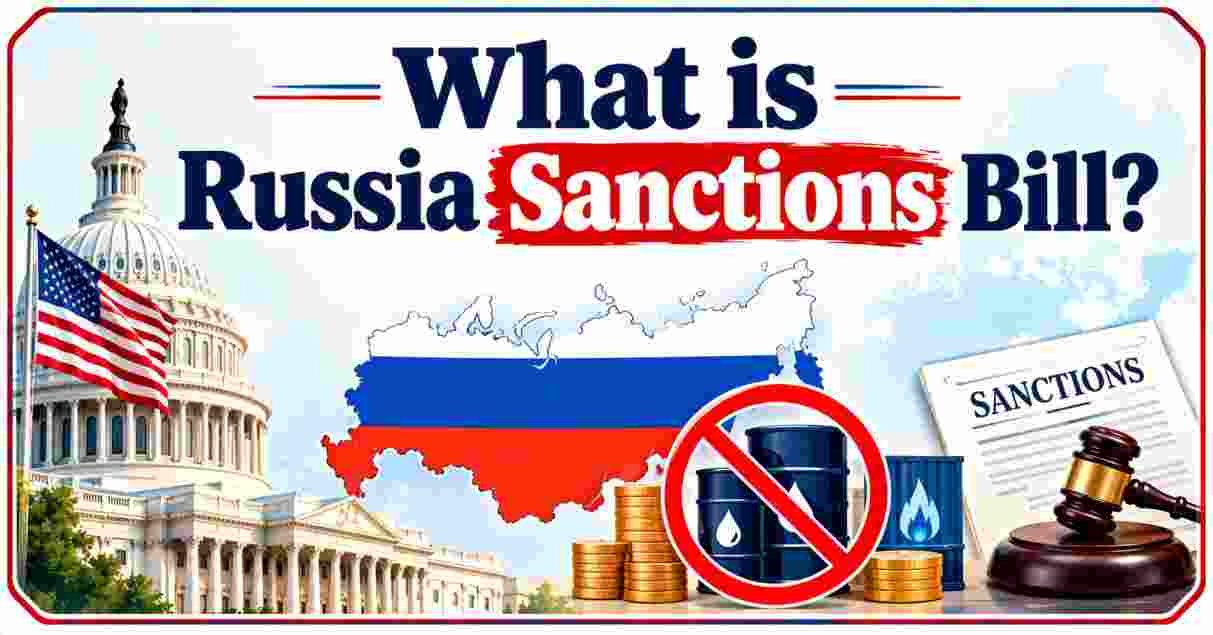
The Lindsey O. Graham Sanctioning Russia and Iran Act of 2026 passed the House 262-159 on September 16, 2026, following an 86-11 Senate vote in August, and now heads to President Trump’s desk. The bill authorizes tariffs of up to 500% on Russian goods and up to 100% on countries buying significant volumes of Russian oil and gas, with China and India named as the two largest targets.
What Is Russia Sanctions Bill?
The Russia sanctions bill moving through Washington in 2026 represents the most significant congressional intervention in Russia sanctions policy since the Countering America’s Adversaries Through Sanctions Act of 2017. Formally titled the Lindsey O. Graham Sanctioning Russia and Iran Act, named for the South Carolina Republican senator who championed it before his unexpected death in July 2026, the legislation cleared both chambers of Congress within a span of six weeks after years of stalled negotiation, a pace that reflects growing bipartisan frustration with Russia’s continued oil and gas revenue funding its war in Ukraine.
What makes this bill genuinely consequential is its tariff mechanism, which gives the president new authority to punish not just Russia directly but any country that keeps buying substantial volumes of Russian energy, most notably China and India. As of this report, the bill has cleared the House and awaits President Trump’s signature, meaning its provisions are not yet law. This report covers exactly what the legislation does, who it targets, and what remains uncertain about how aggressively it will actually be enforced once signed.
Interesting Facts About the Russia Sanctions Bill 2026
| Fact | Figure |
|---|---|
| Formal Bill Name | Lindsey O. Graham Sanctioning Russia and Iran Act of 2026 (S. 5025) |
| Senate Vote (Aug. 7, 2026) | 86-11, bipartisan |
| House Vote (Sept. 16, 2026) | 262-159 |
| Current Status | Sent to President Trump’s desk; not yet signed into law |
| Maximum Tariff on Russian Goods Directly | Up to 500% |
| Maximum Secondary Tariff on Third Countries | Up to 100% |
| Countries Most Directly Targeted | China and India (largest Russian oil/gas buyers) |
| Bill Length | 61 pages |
Data Source: Congress.gov S. 5025 Bill Text; House and Senate Roll Call Vote Records, 2026
These figures capture legislation that moved from years of gridlock to overwhelming bipartisan passage in a matter of weeks. The 86-11 Senate vote in August and the 262-159 House vote in September both reflect broad, if not unanimous, support across party lines, with 58 House Democrats joining most Republicans in favor even as 7 Republicans broke ranks to vote against it alongside most Democrats. That unusual coalition reflects a genuine split within both parties over how much unchecked tariff authority the bill hands the executive branch.
The bill’s tariff structure is more targeted than early reporting sometimes suggested. Rather than a blanket 500% tariff applying to any country doing any business with Russia, an earlier 2025 version of the concept, the final legislation narrows its secondary tariff provision to focus specifically on countries importing the largest volumes of Russian crude oil or natural gas, while including a carve-out for countries actively working to reduce their dependence on Russian energy.
What the Russia Sanctions Bill Actually Does 2026 | Tariff Mechanics
RUSSIA SANCTIONS BILL — TARIFF STRUCTURE (%)
Direct Tariff on Russian Goods            ████████████████████████████ 500%
Secondary Tariff on Russian-Oil Buyer     ████████ 100%
| Provision | Detail |
|---|---|
| Direct Russian Goods Tariff | Up to 500%, imposed by the President |
| Secondary Tariff on Oil/Gas Buyers | Up to 100%, on countries knowingly purchasing Russian crude or natural gas |
| Shadow Fleet Provision | Incorporates the Shadow Fleet Sanctions Act, targeting vessels enabling sanctions evasion |
| Additional Duty Status | Tariffs apply on top of existing duties, including Section 122, 201, 301, and 232 tariffs |
Data Source: S. 5025 Bill Text, Sections 112-113; Center for Strategic and International Studies Analysis
The legislation directs the President to impose a tariff of up to 500% directly on goods originating in Russia, while separately authorizing a tariff of up to 100% on goods from any country the administration determines is knowingly purchasing crude oil or natural gas that originated in Russia, or is otherwise facilitating sanctions evasion. Crucially, the bill text specifies these tariffs apply in addition to any other existing duties, including tariffs already imposed under Section 122, 201, or 301 of the Trade Act of 1974, or Section 232 of the Trade Expansion Act of 1962, meaning affected countries could face genuinely stacked tariff rates once all applicable duties are combined.
The bill also folds in the Shadow Fleet Sanctions Act, targeting the network of vessels, often operating under false flags or outdated registrations, that Russia has increasingly relied on to move oil around Western price caps and insurance restrictions. Monthly tracking from the Centre for Research on Energy and Clean Air found sanctioned “shadow” tankers responsible for as much as 54% of Russia’s fossil fuel exports by volume in some months of 2026, underscoring why lawmakers viewed this provision as essential to closing an enforcement gap in existing sanctions.
Countries Affected by the Russia Sanctions Bill 2026
LARGEST BUYERS OF RUSSIAN ENERGY POTENTIALLY AFFECTED
China          ████████████████████████████████████████
India          ██████████████████████████████████
| Country | Why It’s Named |
|---|---|
| China | Largest overall buyer of Russian crude oil and LNG |
| India | Record-high Russian crude imports in 2026, rising sharply month-on-month |
| Other Named Purchasers (context) | Turkiye, Georgia, Brunei among countries whose refineries process Russian crude for re-export |
Data Source: Atlantic Council Analysis; Centre for Research on Energy and Clean Air Monthly Reports
China and India are explicitly named in policy analysis as the two countries most exposed to the bill’s secondary tariff provision, since both remain by far the largest purchasers of Russian crude oil and natural gas. India’s imports of Russian crude actually rose 34% month-on-month to a record high as recently as June 2026, according to independent energy tracking, even as the sanctions bill moved through Congress, illustrating the scale of the trade relationship the legislation is designed to disrupt. China’s imports of Russian LNG and specific crude grades like Sokol have also continued climbing through 2026, with Chinese LNG purchases rising 32% month-on-month in April alone.
Beyond the two largest buyers, refineries in countries including Turkiye, Brunei, and Georgia have drawn scrutiny for processing Russian crude into refined products subsequently exported to sanctioning countries, a pattern the bill’s secondary tariff authority is broadly designed to discourage regardless of which specific country ends up formally designated.
Russia Sanctions Bill Legislative Timeline 2026
RUSSIA SANCTIONS BILL — LEGISLATIVE TIMELINE 2026
Jul 2026    Sen. Lindsey Graham dies unexpectedly
Aug 7       Senate passes bill 86-11
Sept 16     House passes bill 262-159
Pending     Awaiting President Trump's signature
| Date | Event |
|---|---|
| July 2026 | Sen. Lindsey Graham dies unexpectedly; bill later named in his honor |
| August 7, 2026 | Senate passes the bill, 86-11 |
| September 16, 2026 | House passes the bill, 262-159 |
| Pending | Awaiting President Trump’s signature to become law |
Data Source: Congress.gov Legislative Record; NPR and NBC News Congressional Reporting, September 2026
The bill’s path through Congress accelerated dramatically following the death of Senator Lindsey Graham in July 2026, after which the legislation was formally named in his honor and gained renewed bipartisan momentum, with more than 60 senators cosponsoring the revised version at one stage. The Senate passed the bill 86-11 on August 7, a rare display of near-unanimous bipartisan agreement on Russia policy, before the House took it up amid what reporting described as a “heated fight” over how much tariff authority Congress should hand the president.
The House ultimately passed the bill 262-159 on September 16, 2026, with House Speaker Mike Johnson telling reporters the chamber had “built a consensus” around the legislation after earlier hesitation. As of this report, the bill sits on President Trump’s desk, and while the administration has signaled support, including a Ways and Means Committee statement praising the president’s tariff-based approach to foreign policy leverage, formal signature had not yet occurred.
Criticism and Congressional Debate Over the Russia Sanctions Bill 2026
HOUSE VOTE BREAKDOWN — SEPTEMBER 16, 2026
For (262)         ████████████████████████████████████████
Against (159)     ████████████████████████
| Vote Category | Breakdown |
|---|---|
| Total House Vote | 262 for, 159 against |
| Democrats Voting For | 58 |
| Republicans Voting Against | 7 |
| Key Criticism | Broad, undefined tariff authority with no expiration date |
Data Source: NPR Congressional Vote Reporting, September 16, 2026
Despite the lopsided final margin, the bill drew genuine bipartisan concern over its scope. Representative Don Beyer (D-Va.) was among the most vocal critics, arguing the legislation “has a loophole that would allow him to define basically any country as a facilitator of evading Russian sanctions,” adding that the president “could then hit them with tariffs of up to 100%, with no guardrails or oversight, and no expiration.” That concern, shared by a number of House Democrats who ultimately voted against the bill, centers on how much discretion the legislation grants the executive branch to designate which countries qualify as sanctions evaders, with limited built-in checks on that determination.
Supporters framed the same broad authority as a feature rather than a flaw. Ways and Means Committee Chairman Jason Smith (R-Mo.) stated that “President Trump has proven he can use tariffs effectively to leverage other nations in support of our national interest,” framing the bipartisan support as evidence that the administration’s broader trade approach was gaining acceptance even among some Democrats who had previously been skeptical of expansive presidential tariff powers.
How the Bill Ends 2026 | The Sanctions Termination Clause
SANCTIONS TERMINATION REQUIREMENTS
Russia signs peace agreement           Required
Ukraine accepts that agreement         Required
Congressional review period            Required before relief
| Requirement | Detail |
|---|---|
| Russia Must Sign a Peace Agreement | Yes, as a precondition for sanctions relief |
| Ukraine Must Accept That Agreement | Yes, explicitly required |
| Congressional Review Period | Required before any termination takes effect |
| Unilateral Executive Termination | Not permitted under the bill’s structure |
Data Source: Foundation for Defense of Democracies Action Bill Analysis, July 30, 2026
Perhaps the most legally significant provision in the entire bill is its termination clause. Sanctions relief is explicitly tied to Russia both signing and upholding a peace agreement that Ukraine itself accepts, with any proposed termination subject to a mandatory congressional review period before it can take effect. That structure is designed specifically to prevent a future administration, or the current one, from unilaterally lifting sanctions on Russia without meeting this specific, Ukraine-inclusive condition, a direct response to criticism of earlier sanctions regimes that critics argued were too easily modified or waived through executive action alone.
Analysts at the Center for Strategic and International Studies have cautioned that the bill’s actual economic impact on Russia will depend heavily on how aggressively the executive branch chooses to implement it, since the legislation grants authority rather than mandating specific designations. Even with the bill signed, Russia’s oil price cap, currently set at $44.1 per barrel as of February 2026, has already shown mixed enforcement results, with Urals crude trading below the cap only briefly while other grades like ESPO have consistently traded well above it due to structural reliance on Chinese and Pacific markets.
Frequently Asked Questions About the Russia Sanctions Bill in 2026
What is the Russia Sanctions Bill 2026?
It is the Lindsey O. Graham Sanctioning Russia and Iran Act of 2026, legislation authorizing tariffs of up to 500% on Russian goods and up to 100% on countries buying significant volumes of Russian oil and gas.
Has the Russia Sanctions Bill become law?
Not yet. It passed the House 262-159 on September 16, 2026, following an 86-11 Senate vote in August, and now awaits President Trump’s signature.
Which countries would be most affected by the bill’s tariffs?
China and India, the two largest buyers of Russian crude oil and natural gas, are the countries most directly named in analysis of the bill’s secondary tariff provision.
How high could the tariffs go under this bill?
Up to 500% on goods originating directly from Russia, and up to 100% on goods from third countries found to be purchasing significant volumes of Russian energy or facilitating sanctions evasion.
Why is the bill named after Lindsey Graham?
The bill was named in honor of Senator Lindsey Graham (R-S.C.), a longtime champion of tougher Russia sanctions, following his unexpected death in July 2026.
What is the Shadow Fleet Sanctions Act included in the bill?
A provision targeting the network of vessels, often flying false flags, that Russia uses to transport oil around Western price caps and insurance restrictions.
How would sanctions ultimately be lifted under this bill?
Only if Russia signs a peace agreement that Ukraine itself accepts, and only after a mandatory congressional review period, preventing unilateral removal by the executive branch alone.
Did the bill pass with bipartisan support?
Yes, though with notable dissent: 58 House Democrats voted for it while 7 Republicans voted against it, reflecting concern on both sides about the scope of tariff authority involved.
What criticism has the bill faced?
Some lawmakers, including Rep. Don Beyer, argue its secondary tariff authority is too broad, allowing the president to designate “basically any country” as a sanctions evader without sufficient oversight or an expiration date.
Does the bill guarantee it will significantly hurt Russia’s economy?
Not automatically. Analysts note the bill’s actual impact depends heavily on how aggressively the executive branch chooses to designate and enforce tariffs against third-country buyers once it becomes law.
Disclaimer: This research report is compiled from publicly available sources. While reasonable efforts have been made to ensure accuracy, no representation or warranty, express or implied, is given as to the completeness or reliability of the information. We accept no liability for any errors, omissions, losses, or damages of any kind arising from the use of this report.