
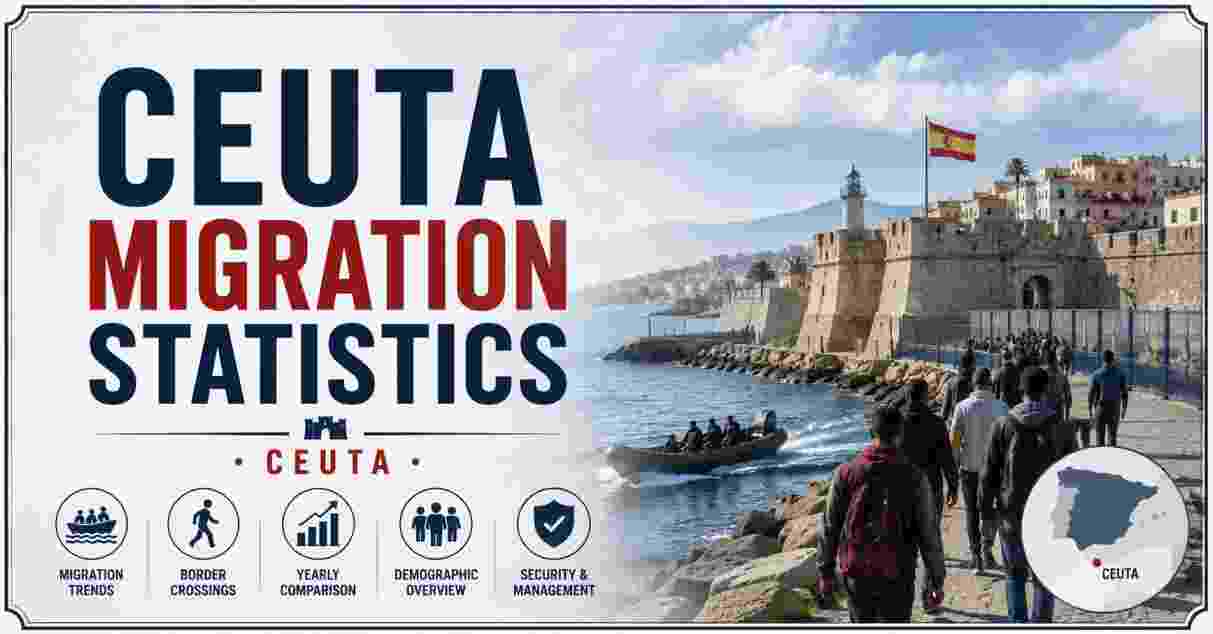
Ceuta Migration 2026
Ceuta migration in 2026 has become one of the defining border stories of the year after the largest single-event crossing since Spain began tracking modern irregular arrivals at this frontier. Late July 2026 brought a sudden, massive surge of people moving from the Moroccan town of Fnideq into the Spanish autonomous city of Ceuta, both by swimming around the breakwater fence at Tarajal beach and by scaling and breaching land barriers. Spanish officials have described the scale of the event as “absolutely unsustainable,” and the regional government has formally declared an absolute humanitarian and social emergency. For a city of roughly 83,500 residents, an inflow reported in the tens of thousands over a matter of days represents a demographic shock with few precedents in the history of Spain’s North African enclaves.
This report compiles the key verified statistics on Ceuta migration in 2026, drawing from official Spanish government figures, regional authority statements, and on-the-ground reporting from major international outlets. Because this is a live, rapidly developing situation, some figures — particularly total crossing counts and the death toll — are still being updated by Spanish and Moroccan authorities as of this writing, and different official sources have released different running totals within the same 24-hour period. Every number below is dated and sourced so readers can see exactly when and by whom it was reported, rather than treating a single snapshot as a final, fixed count.
Interesting Facts About Ceuta Migration 2026
| Fact Category | Key Data Point |
|---|---|
| Estimated crossings, past 24 hours (Ceuta president, July 31) | Approximately 60,000 people |
| Interior ministry 24-hour estimate (July 31) | Approximately 49,000 people |
| Share of Ceuta’s regular population | Equivalent to roughly 70% of the city’s population |
| Confirmed deaths (early estimate, July 30–31) | At least 18 people |
| Confirmed deaths (later same-day estimate, July 31) | At least 34 people |
| Migrants returned to Morocco (by 1pm, July 31) | More than 25,000 people |
| Ceuta’s total resident population (2026 estimate) | Approximately 83,500 people |
| Ceuta land area | 18.5 square kilometres |
| Land arrivals, comparable period 2026 vs. 2025 | 2,582 vs. 978 — an increase of 164% |
| Reported daily arrival rate before the surge (per Ceuta’s president) | More than 300 people per day |
| Comparable historical event — May 2021 Ceuta crisis | Roughly 8,000–10,000 people in two days |
| Legal trigger cited by Spain’s interior ministry | A June 29, 2026 Spanish Supreme Court ruling on migrant returns |
| Moroccan youth unemployment rate (2025) | 37.2%, up from 36.7% in 2024 |
| Moroccan female unemployment rate (2025) | 20.5%, up from 19.4% in 2024 |
| Border fence height at neighbouring Melilla | Approximately 6 metres (19 feet) |
Source: Spanish regional government statements; Spanish interior ministry; international wire and broadcast reporting, July 30–31, 2026
The numbers above illustrate why officials are calling this the most serious Ceuta border event since at least 2021. The gap between the 18-death and 34-death figures, both released on the same day by different Spanish authorities, reflects how quickly a mass-casualty situation is still being tallied — bodies recovered from the water and from crush injuries at the breakwater fence are being confirmed in stages rather than all at once, and readers should expect the final toll to be revised upward as search-and-recovery work continues. The gap between the 60,000 figure cited by Ceuta’s regional president and the 49,000 figure from the national interior ministry is smaller but tells a similar story: one is a running estimate of everyone who has entered over several days, while the other is a stricter 24-hour snapshot, and both are legitimate but measure slightly different things.
What stands out most from a purely statistical standpoint is the sheer proportional scale: a 164% year-on-year jump in land arrivals for the comparable period, and a single-event inflow equal to roughly 70% of Ceuta’s entire resident population arriving within about 24 hours. That kind of ratio has no real precedent even against the 2021 border incident, which involved an estimated 6,000–10,000 people over several days rather than tens of thousands in a single 24-hour window.
Ceuta 2026 Crisis Timeline & Key Events
| Date / Period | Event |
|---|---|
| June 29, 2026 | Spanish Supreme Court rules authorities cannot summarily return migrants arriving in Ceuta and Melilla by sea without due process |
| Prior weeks (July 2026) | Ceuta’s government reports 1,500–2,000 irregular entries over a 10-day stretch |
| July 30, 2026 | Border breach escalates; thousands cross by land and sea; at least 18 deaths reported |
| July 30–31, 2026 (overnight) | Hundreds more cross overnight; burned vehicles reported on the Moroccan side after clashes |
| July 31, 2026 (morning) | Spain’s interior ministry estimates ~49,000 crossings in the preceding 24 hours |
| July 31, 2026 (afternoon) | Ceuta’s regional president raises the estimate to ~60,000; death toll revised to at least 34 |
| July 31, 2026 | More than 25,000 migrants reported returned to Morocco by early afternoon |
| July 31, 2026 | Spanish Prime Minister Pedro Sánchez visits Ceuta, calls the breach “a violation of Spain’s territorial integrity” |
Source: Spanish interior ministry statements; Ceuta regional government; international wire reporting, July 30–31, 2026
The timeline shows a crisis that moved from a slow-burn buildup — a few thousand arrivals over ten days — into a mass single-day event within roughly 48 hours. Spanish officials directly link the trigger to the Supreme Court ruling of late June, arguing that word of the ruling spread on Moroccan social media and encouraged people to attempt the crossing on the belief that automatic pushbacks were no longer guaranteed. It’s worth noting the ruling itself did not legalize irregular entry or guarantee anyone the right to remain in Spain; it only restricted a specific fast-track return mechanism, which makes the scale of the response somewhat disconnected from the narrow legal change that reportedly sparked it.
The rapid escalation from 18 to 34 confirmed deaths within the same news cycle, alongside the jump from a 49,000 to a 60,000 crossing estimate, underscores that this is very much a live situation rather than a settled dataset. Readers tracking Ceuta migration statistics in the days ahead should expect these particular figures to be revised again as Spanish and Moroccan authorities complete search-and-recovery operations and reconcile their respective counts.
Ceuta and Melilla: Comparative Border Pressure 2026
| Metric | Ceuta | Melilla |
|---|---|---|
| Status | Spanish autonomous city, North Africa | Spanish autonomous city, North Africa |
| Border fence height | Reinforced barrier plus sea barrier | Approximately 6 metres (19 feet) |
| Recent crossing attempts (July 2026) | Tens of thousands in a 24–48 hour window | Attempts recorded in recent weeks, smaller scale |
| Historical mass-crossing precedent | 2021: ~6,000–10,000 in days | 2022: dozens died in one of the deadliest fence-crossing attempts on record |
| Primary crossing method (2026 surge) | Swimming around sea breakwater; land breach | Fence-scaling |
| Population equivalent to those affected | ~70% of Ceuta’s population in 24 hours | Not comparably surged during this event |
Source: Regional Spanish government statements; Moroccan Association of Human Rights; international wire reporting, July 2026
Ceuta and Melilla are frequently discussed together because they represent the European Union’s only land borders with Africa, and pressure often builds at one enclave with knock-on effects at the other. Migrant rights monitors noted that crossing attempts toward Melilla had already been recorded in recent weeks, even before the Ceuta breach intensified, suggesting that smuggling networks may be probing multiple points along the frontier simultaneously rather than concentrating solely on one city.
What separates the 2026 Ceuta event from Melilla’s most recent major incident, the 2022 fence-crossing tragedy, is the method of entry. Melilla’s crisis centred on a coordinated attempt to scale a roughly 6-metre fence, while the 2026 Ceuta surge has been driven overwhelmingly by people swimming around the breakwater barrier at Tarajal beach, a method that carries its own distinct drowning risk and appears to account for a large share of the confirmed deaths reported so far.
Ceuta Migration 2026: Root Causes and Contributing Factors
| Factor | Data / Context |
|---|---|
| Legal trigger cited by Spain | June 29, 2026 Supreme Court ruling limiting summary returns from Ceuta/Melilla |
| Alleged amplification mechanism | Spread of the ruling on Moroccan social media, per Spanish broadcaster reporting |
| Moroccan youth unemployment (ages 15–24), 2025 | 37.2%, up from 36.7% in 2024 |
| Moroccan female unemployment, 2025 | 20.5%, up from 19.4% in 2024 |
| Moroccan nationwide unemployment, 2025 | 13%, down from 13.3% in 2024 |
| Spanish government’s stated view of cause | Human trafficking networks allegedly exploiting the ruling to encourage undocumented entry |
| Historical parallel cited by migrant rights groups | May 2021: roughly 10,000 Moroccan and sub-Saharan youths entered within days during a diplomatic dispute |
Source: Spanish interior ministry statement; Moroccan national labor statistics; migrant rights advocates, July 2026
Spain’s official position, delivered through its interior ministry, is that human trafficking networks are actively exploiting the June 29 court ruling to encourage a fresh wave of undocumented crossings, particularly among young people. The ruling itself, as reported by Spanish broadcaster RTVE, spread widely on Moroccan social media in the days before the surge, though it is worth being precise about what it actually changed: it stopped the automatic, summary return of migrants who arrive in Ceuta and Melilla by sea without due process, but it did not grant a right to remain in Spain.
Economic conditions in Morocco provide a plausible secondary driver even if they are not the officially stated cause. Youth unemployment of 37.2% and female unemployment of 20.5% in 2025 — both higher than the year before despite the overall national unemployment rate ticking down to 13% — point to a labor market that continues to push younger Moroccans toward migration as an economic strategy, independent of any single legal ruling. Migrant rights activists have also drawn a direct comparison to the May 2021 episode, when a diplomatic rupture over Western Sahara led Morocco to loosen border controls and roughly 10,000 people crossed within days — a reminder that mass-crossing events at this frontier tend to follow either a policy shift or a diplomatic signal rather than gradual economic drift alone. <br>
Readers researching related border and migration data may also find our coverage of the Strait of Gibraltar Statistics useful, since Ceuta sits directly on this same strategic waterway that separates Europe from Africa by just 14.2 kilometres at its narrowest point — the same geography that shapes both legal shipping traffic and irregular crossing routes in the region.
Spanish Government Response Statistics 2026
| Response Measure | Data / Detail |
|---|---|
| Migrants returned to Morocco (by 1pm, July 31) | More than 25,000 people |
| Prime Minister’s visit | Pedro Sánchez travelled to Ceuta on July 31 |
| Interior Minister accompanying visit | Confirmed to accompany the Prime Minister |
| Official emergency declaration | “Absolute humanitarian and social emergency” declared by Ceuta’s regional president |
| Border reinforcement | Spain and Morocco reinforced the border fence following the surge |
| Reported outcome of reinforcement | Mass crossings largely halted as of July 31 afternoon |
| EU-level reaction | European Commission described the situation as “unacceptable” |
| Security forces response | Additional vehicles and personnel deployed; humanitarian aid teams assisting injured |
Source: Spanish government statements; European Commission remarks; international wire reporting, July 31, 2026
The Spanish response has moved on two tracks simultaneously: immediate humanitarian triage for the thousands of people who arrived, many of whom, according to a local Civil Guard workers’ representative, were sleeping in parks and on sidewalks, including unaccompanied children; and rapid border reinforcement aimed at physically stopping further crossings. By the afternoon of July 31, that reinforcement approach appeared to be working, with Spanish officials reporting that mass crossings had largely halted.
The scale of the return operation is itself one of the more striking statistics in this event: more than 25,000 people — over 40% of the reported peak-day crossing estimate — had already been sent back to Morocco within roughly 24 hours of the surge beginning. Prime Minister Sánchez’s decision to visit Ceuta in person, and his characterization of the breach as “a violation of Spain’s territorial integrity,” signals that Madrid is treating this as a sovereignty and security issue at the national level, not merely a regional administrative matter for Ceuta’s local government to manage alone.
Ceuta Demographics & City-Level Statistics 2026
| Demographic Metric | Data Point |
|---|---|
| Total resident population (2026) | Approximately 83,500 |
| Population change, past year | -113 residents, roughly -0.14% |
| Land area | 18.5 square kilometres (7.1 sq mi) |
| Population density | Approximately 4,520 people per km² |
| GDP (2024) | Approximately €1.923 billion |
| GDP per capita (2024) | Approximately €23,169 |
| Mayor-President | Juan Jesús Vivas |
| Governing status | Autonomous city of Spain since 1995 |
| Population composition | Mixed Christian and Muslim population, plus daily cross-border workers |
Source: Spanish National Statistics Institute (INE); regional government of Ceuta; municipal GDP data, 2024–2026
Ceuta’s own demographic profile is central to understanding why an inflow of tens of thousands of people in a single day counts as an emergency rather than a manageable fluctuation. With a resident population of roughly 83,500 packed into just 18.5 square kilometres, Ceuta already carries one of the highest population densities of any Spanish territory. A single-day arrival equivalent to 70% of that population is not a proportional stretch that any city of this size could reasonably absorb through existing housing, healthcare, and social services capacity, which is precisely the point Ceuta’s regional president was making when he described the pressure as “absolutely impossible” to manage.
The city’s modest economic base — a GDP of roughly €1.9 billion and per-capita output of about €23,000 — also means Ceuta has limited independent fiscal capacity to absorb an emergency of this scale without direct support from Madrid. This economic reality helps explain why the response so quickly escalated to a national-level visit from the Prime Minister rather than being handled purely through regional emergency services.
Historical Context: Ceuta and Melilla Migration Events
| Year / Event | Scale | Deaths |
|---|---|---|
| May 2021 (Ceuta) | ~6,000–10,000 people in a matter of days | 2 confirmed |
| 2022 (Melilla) | Thousands of sub-Saharan migrants attempted the fence | Dozens (one of the deadliest incidents on record) |
| July 2026 (Ceuta) | ~49,000–60,000 in roughly 24 hours | 18–34 confirmed as of July 31 (figures still being finalized) |
Source: Wikipedia border-incident records; Spanish and Moroccan human rights monitors; international wire reporting, 2021–2026
Placing the 2026 Ceuta surge alongside prior events makes clear just how far outside historical precedent this crisis sits. The 2021 incident, itself described at the time as the largest irregular entry across this border in Spain’s modern history, involved an estimated 6,000 to 10,000 people over several days and resulted in two confirmed deaths. The 2026 event has already produced a confirmed death toll at least nine times higher, in a fraction of the time, and a crossing volume that — even using the more conservative interior ministry estimate — is roughly five to six times larger.
The 2022 Melilla tragedy remains the deadliest single fence-crossing incident at either enclave in recent memory, and comparisons between it and the current Ceuta crisis are inevitable given that both involved dozens of confirmed deaths. However, the mechanisms differ meaningfully: Melilla’s 2022 tragedy centred on a crush at a scaled fence, while the 2026 Ceuta deaths so far have been attributed by a local Civil Guard workers’ representative to a mix of drowning and a stampede at the breakwater fence at Tarajal beach, meaning the underlying safety failures are not identical even though the human cost is comparably severe.
For readers following the broader enforcement picture on the other side of the Atlantic, our data on Illegal Border Crossings By Year Statistics in US shows how a different set of policy interventions produced an 85% year-on-year drop in encounters at the US southern border in early 2025 — a useful contrast to the sharp increase Spain is currently experiencing at Ceuta under a different legal and geographic context entirely.
Regional and European Migration Pressure Statistics 2026
| Metric | Data Point |
|---|---|
| EU’s only land borders with Africa | Ceuta and Melilla (2 enclaves) |
| Ceuta–Morocco border status pre-surge | 1,500–2,000 entries over prior 10-day period |
| European Commission characterization of the crisis | “Unacceptable” |
| Historical Ceuta sovereignty dispute | Traced by Morocco to claims dating to the 8th-century Islamic conquests |
| Spain’s possession of Ceuta since | 1580 |
| Comparable diplomatic-linked crisis | 2021 Western Sahara dispute-linked crossing surge |
| 2002 sovereignty flashpoint | Morocco–Spain standoff over a small uninhabited island near Ceuta |
Source: European Commission statements; Spanish and Moroccan government historical records; international wire reporting, 2002–2026
Ceuta’s status as one of only two land points where the European Union directly borders the African continent ensures that any major crossing event here draws immediate EU-level attention, and the European Commission’s description of the 2026 crisis as “unacceptable” reflects how quickly a regional Spanish issue becomes a bloc-wide political concern. This is compounded by the underlying sovereignty dispute: Morocco has never fully recognized Spanish control of Ceuta, tracing its territorial claim back centuries, and periodic diplomatic friction between Rabat and Madrid — as seen in 2002 and again in 2021 — has repeatedly coincided with sudden loosening of border enforcement on the Moroccan side.
That pattern is part of why some analysts are cautious about attributing the entire 2026 surge to the June 29 court ruling alone. The 2021 precedent, in particular, showed that Moroccan border enforcement can shift rapidly in response to diplomatic signals unrelated to Spanish domestic legal rulings, and it remains to be seen whether the current crisis reflects a similar underlying diplomatic dynamic or is genuinely a self-contained response to the court decision, as Spain’s interior ministry has stated.
Data Reliability Notes for Ceuta Migration Statistics 2026
| Category | Status as of July 31, 2026 |
|---|---|
| Death toll | Actively revised same-day, from 18 to 34; expect further updates |
| 24-hour crossing estimate | Two competing official figures (49,000 vs. 60,000) |
| Total returned to Morocco | Confirmed by interior ministry as a specific timestamped count (25,000 by 1pm) |
| Root-cause attribution | Officially stated by Spain; independently disputed by some migrant rights monitors |
| Longer-term monthly/annual totals for 2026 | Not yet available; this event occurred in the final days of July |
Source: Cross-referenced Spanish government statements and international wire services, July 30–31, 2026
Because this crisis broke within the last day of reporting available at the time of writing, it is important to be transparent about which numbers are firm and which are still moving. The 25,000-person return count was given as a specific, timestamped figure by the interior ministry and is the most stable data point in this entire dataset. By contrast, both the death toll and the total crossing estimate were revised upward within the same news cycle, and readers should treat any single figure for either metric as a snapshot rather than a final tally. As official Spanish and Moroccan reporting catches up over the coming days, expect consolidated monthly totals for July 2026 to differ somewhat from the initial hour-by-hour estimates cited here.
Disclaimer: This research report is compiled from publicly available sources. While reasonable efforts have been made to ensure accuracy, no representation or warranty, express or implied, is given as to the completeness or reliability of the information. We accept no liability for any errors, omissions, losses, or damages of any kind arising from the use of this report.