
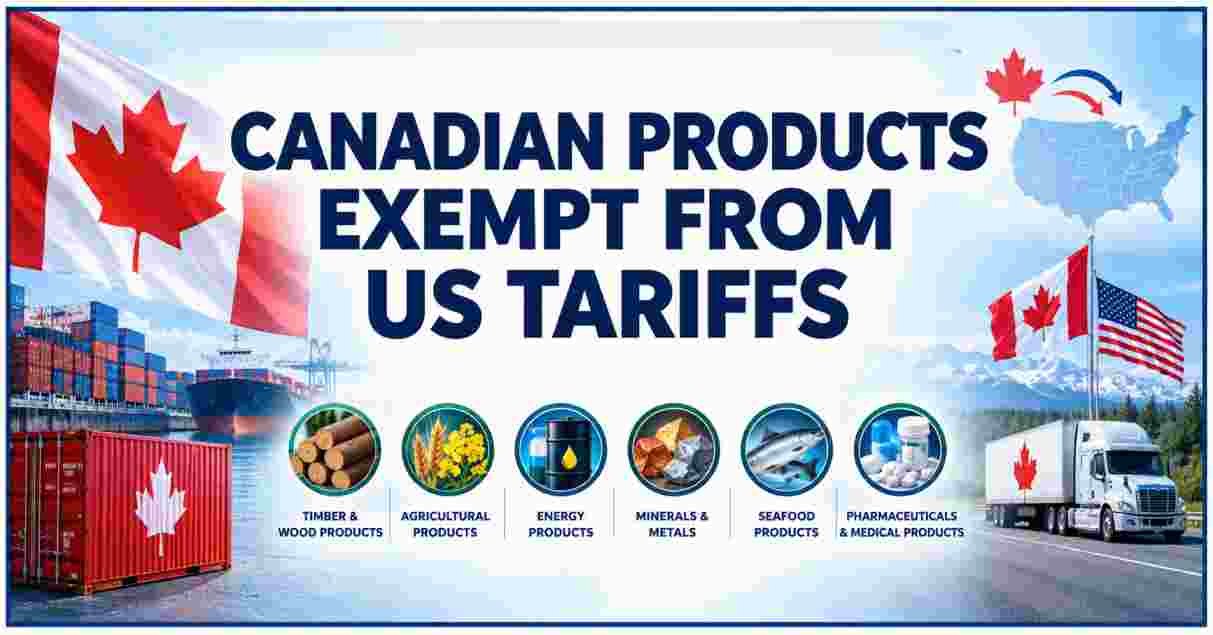
Canadian Products Exempt from US Tariffs in 2026 include goods that qualify duty-free under CUSMA/USMCA (about 89% of exports to the US), plus energy products, potash, critical minerals, fish products and civil aircraft. A 50% Section 338 tariff took effect on August 22, 2026 on selected Canadian goods with no CUSMA exemption, and the 10% Section 301 tariff replaced Section 122 on July 24, 2026.
Canadian Products Exempt from US Tariffs 2026 – Introduction
Canadian Products Exempt from US Tariffs now depend on which law applies. The Supreme Court struck down the IEEPA tariffs on February 20, 2026. A 10% Section 122 tariff followed on February 24, and it expired on July 24, when a new 10% Section 301 tariff on 60 economies took over. In both cases, goods that qualify duty-free under CUSMA stayed exempt. RBC Economics counts about 89% of Canadian exports to the US crossing duty-free, and Canada’s average effective US tariff was only 3.2% in April.
The picture changed on July 20, 2026. The White House issued three proclamations imposing 50% tariffs under Section 338 of the Tariff Act of 1930 on selected Canadian goods, and the duties took effect on August 22. They have no CUSMA exemption. This report collects the latest verified rules, exemptions and dates as of October 23, 2026.
Interesting Facts About Canadian Products Exempt from US Tariffs 2026
KEY TARIFF RATES ON CANADIAN GOODS (1 block = 5 percentage points)
Section 338 (selected goods) | ██████████ 50%
Section 232 steel/aluminum   | ██████████ up to 50%
Section 232 autos            | █████ 25%
Section 301 baseline         | ██ 10% (CUSMA goods exempt)
CUSMA-qualifying goods       | ▏ 0%
| Fact | 2026 Data |
|---|---|
| Share of Canadian exports to the US entering duty-free under CUSMA (RBC) | About 89% |
| Section 338 tariff rate | 50% |
| Section 338 effective date | August 22, 2026 |
| Section 338 exemption for CUSMA-compliant goods | None |
| Section 301 tariff on Canada, effective July 24, 2026 | 10% (CUSMA duty-free goods exempt) |
| Section 122 tariff period | February 24 to July 24, 2026 |
| US Supreme Court ruling against IEEPA tariffs | February 20, 2026 |
| Canadian counter-tariffs effective | September 8, 2026 |
| Import ban on certain Canadian dairy and vehicle products | September 29, 2026 |
Source: Trade Commissioner Service, Global Affairs Canada, Answers to common questions about U.S. tariffs (September 28, 2026); RBC Economics (2026); U.S. Customs and Border Protection guidance via GHY (2026).
The table shows two tracks. Most Canadian trade stays duty-free because 89% of exports qualify under CUSMA. A smaller set of goods faces steep rates, topped by the 50% Section 338 tariff, which applies even to CUSMA-compliant goods. The Section 301 rate of 10% is a baseline that CUSMA goods avoid.
Dates matter for shipments. The Section 338 tariff took effect August 22, after a short suspension moved it from August 19. Canada answered on September 8. The United States then added import bans on certain dairy and vehicle products on September 29.
US Tariffs on Canada 2026 Timeline: From the Supreme Court Ruling to Section 338
TARIFF LEGAL BASIS FOR CANADIAN GOODS, 2026
Feb 20 | ■ Supreme Court strikes down IEEPA tariffs
Feb 24 | ■ Section 122 10% tariff begins (CUSMA goods exempt)
Apr 6  | ■ Section 232 metals restructured to 15%-50% on full value
Jul 24 | ■ Section 301 10% replaces Section 122
Aug 22 | ■■ Section 338 50% takes effect
Sep 29 | ■ Import bans on certain dairy and vehicle products
| Date | Event | Effect on Canadian Goods |
|---|---|---|
| February 20, 2026 | Supreme Court rules IEEPA does not authorize tariffs | Ends the 35% IEEPA tariff on non-CUSMA goods |
| February 24, 2026 | Section 122 tariff begins | 10% on most imports; CUSMA goods exempt |
| April 6, 2026 | Section 232 metals restructured | 15% to 50% on full product value |
| July 20, 2026 | Three Section 338 proclamations issued | 50% on selected Canadian goods announced |
| July 24, 2026 | Section 301 forced-labor tariff begins | 10% on Canada; CUSMA duty-free goods exempt |
| August 22, 2026 | Section 338 tariffs take effect | 50% on listed goods, no CUSMA exemption |
| September 8, 2026 | Canada imposes counter-tariffs | 15%, 25% or 50% on US goods |
| September 15, 2026 | Section 338 list modified | Tariffs now stack on Section 232 duties |
| September 29, 2026 | Import bans take effect | Certain dairy and vehicle products excluded |
| October 20, 2026 | First major court challenge filed | Gellert Global Group sues at the Court of International Trade |
Source: Trade Commissioner Service, Global Affairs Canada (September 28, 2026); Norton Rose Fulbright (February 2026); CBP guidance via GHY (September 2026); Rio Times (October 2026).
The legal basis shifted three times in eight months. The Supreme Court ruled on February 20 that IEEPA does not authorize tariffs. The administration used Section 122 for 150 days, from February 24 to July 24, then replaced it with Section 301 at 10%. Canada stayed largely exempt because CUSMA-compliant goods were carved out of each.
Section 338 is different. It was signed on July 20, took effect on August 22, and has no end date. The September 15 change made it stack on top of Section 232 duties, where it had previously excluded them. Gellert Global Group, a US food importer, filed the first major court challenge on October 20. As of October 21, the Court of International Trade had not ruled.
Canadian Products Exempt from US Tariffs 2026: Full List of Exemptions
SHARE OF CANADIAN EXPORTS TO THE US (1 block = 2 percentage points)
Duty-free under CUSMA (RBC)           | ███████████████████████████████████ about 89%
Covered by new US tariffs (CNN, est.) | ███ about 5%
Effective US tariff on Canada, April  | ██ 3.2%
| Product or Category | Exempt From | Status in 2026 |
|---|---|---|
| CUSMA-qualifying goods entered duty-free | Section 301 10% tariff | Exempt (heading 9903.05.93) |
| CUSMA-compliant auto parts | Section 232 25% auto tariff | Currently exempt |
| US content in CUSMA-compliant vehicles | Section 232 25% auto tariff | Exempt |
| Energy products | Section 338 and Section 301 | Exempt |
| Potash | Section 338 and Section 301 | Exempt |
| Critical minerals | Section 338 and Section 301 | Exempt |
| Fish products | Section 338 and Section 301 | Exempt |
| Civil aircraft and parts (WTO agreement) | Section 338 and Section 301 | Exempt (unmanned aircraft excluded) |
| Pharmaceutical products | Section 301; generics exempt from Section 232 | Exempt |
| Goods with under 15% steel, aluminum or copper content | Section 232 metals tariffs | Exempt |
| Informational materials and donations | Section 301 | Exempt |
Source: Trade Commissioner Service, Global Affairs Canada (September 28, 2026); Crane Worldwide Logistics (July 2026); Troutman Pepper Locke (July 2026); RBC Economics; CNN (August 25, 2026).
CUSMA remains the main exemption. Goods that qualify and enter duty-free avoid the Section 301 tariff, and CUSMA-compliant auto parts avoid the 25% Section 232 auto duty for now. Energy, potash, critical minerals, fish products and civil aircraft are carved out of both Section 338 and Section 301. Pharmaceutical products are exempt from Section 301, and generic pharmaceuticals are exempt from the 100% Section 232 tariff. Goods with under 15% metal content left the metals tariffs in April.
The exemptions are narrower than they look. CUSMA does not shield goods from Section 338, buses, softwood lumber, upholstered furniture, kitchen cabinets, semiconductors or patented pharmaceuticals. CNN reported in August that the new US tariffs cover about 5% of what the US imported from Canada. Customs brokers must enter exemption codes in the right order, or full tariffs apply.
US Tariffs Canadian Goods Still Face in 2026: Rates by Measure and CUSMA Treatment
US TARIFF RATE BY MEASURE (1 block = 5 percentage points)
Patented pharmaceuticals (232)        | ████████████████████ 100%
Section 338 selected goods            | ██████████ 50%
Steel, aluminum, copper (232, max)    | ██████████ 50%
Autos and trucks (232)                | █████ 25%
Upholstered furniture, cabinets (232) | █████ 25%
Certain semiconductors (232)          | █████ 25%
Buses and softwood lumber (232)       | ██ 10%
Section 301 baseline                  | ██ 10%
| Measure | Rate | CUSMA Exemption |
|---|---|---|
| Section 338 (selected goods) | 50% | No |
| Section 232 steel, aluminum, copper | 15% to 50% of full value | No |
| Section 232 autos and trucks | 25% | US content exempt; compliant parts exempt |
| Section 232 buses | 10% | No |
| Section 232 softwood timber and lumber | 10% | No |
| Section 232 upholstered furniture, kitchen cabinets and vanities | 25% | No |
| Section 232 certain semiconductors | 25% | No |
| Section 232 patented pharmaceuticals | 100% | No |
| Section 232 unmanned aircraft systems | 25% or 100% | No |
| Section 301 baseline | 10% | Yes |
Source: Trade Commissioner Service, Global Affairs Canada (September 28, 2026); U.S. Trade Representative and CBP guidance; tariff guide analysis of 666 Section 338 tariff lines (October 2026).
Section 338 covers selected goods at 50%. Categories include plastics, furniture, electronics and ICT products, paper, industrial machinery, wood products, textiles, apparel and sports equipment. Changes announced September 8 and effective September 15 added more dairy and wood products, cheeses, paper, iron and steel structural components, furniture and motorboats. One tariff guide counts 666 tariff lines. Certain dairy and vehicle items were banned outright from September 29.
Section 232 rates are the highest. Since April 6, steel, aluminum and copper goods pay 15% to 50% on their full value. Goods with at least 85% US-made metal pay 10%. Autos and trucks pay 25% on non-US content, buses and softwood lumber pay 10%, and patented drugs pay 100% unless the maker has a pricing deal. The Section 301 baseline of 10% is the only measure in this table that CUSMA goods fully avoid.
US-Canada Trade Statistics 2026: Imports, Deficits and Tariff Coverage
US-CANADA TRADE, 2025 (1 block = $20 billion)
Total goods and services trade  | ██████████████████████████████████████ $879.9B
US goods and services imports   | ███████████████████████ $453.6B
US goods imports from Canada    | ███████████████████ $381.9B
US goods trade deficit          | ██ $48.3B
| Metric | Figure |
|---|---|
| Total US-Canada trade in goods and services, 2025 | $879.9 billion |
| US goods and services imports from Canada, 2025 | $453.6 billion |
| US goods imports from Canada, 2025 | $381.9 billion (-7.2%) |
| US goods trade deficit with Canada, 2025 | $48.3 billion (-21%) |
| US goods and services deficit with Canada, 2025 | $27.3 billion |
| Share of Canada’s goods exports sent to the US, 2025 | 73% |
| Share of US imports from Canada covered by new US tariffs (CNN) | About 5% |
| Share of US exports to Canada covered by Canada’s tariffs (CNN) | About 6% |
| US goods imports from Canada as a share of all US imports | About 13% to 15% |
Source: U.S. Bureau of Economic Analysis via The Global Statistics (2026); Statistics Canada; CNN (August 25, 2026); The World Data.
Trade slid in 2025 but stayed enormous. US goods imports from Canada were $381.9 billion, down 7.2%, and the goods deficit narrowed 21% to $48.3 billion. Including services, total trade was $879.9 billion. Canada sends 73% of its goods exports to the US. For a breakdown of what those imports contain, see our report on what the US imports from Canada.
Tariff coverage is narrower than headlines suggest. CNN reported that the new US duties cover about 5% of goods the US imported from Canada last year, while Canada’s duties cover about 6% of US exports. Because 89% of exports qualify for CUSMA, the average effective tariff on Canada stayed near 3.2% in April, among the lowest of any major US trading partner.
Canada’s Response to US Tariffs 2026: Counter-Tariffs, Remission and Diversification
CANADA'S COUNTER-TARIFF RATES AND EXPORT SHARE TO THE US (1 block = 2 percentage points)
Counter-tariff, top rate    | █████████████████████████ 50%
Counter-tariff, mid rate    | █████████████ 25%
Counter-tariff, low rate    | ████████ 15%
Exports to US, 2025         | █████████████████████████████████████ 73%
Exports to US, May 2026     | ███████████████████████████████████ about 70%
| Metric | Figure |
|---|---|
| Canada’s counter-tariff rates (September 8, 2026) | 15%, 25% or 50% |
| Approximate value of US goods covered by counter-tariffs | C$27.6 billion |
| US product lines covered | About 700 |
| Canada’s share of exports to the US, 2025 | 73% |
| Canada’s share of exports to the US, May 2026 | About 70% |
| Canadian vehicle remission framework expires | April 8, 2027 |
| Decline in US imports of Canadian flat and long steel, 2025 | 32% |
| Decline in all US steel imports, 2025 | 23% |
Source: Trade Commissioner Service, Global Affairs Canada (September 28, 2026); Congressional Research Service (2026); The World Data; MEPS International (January 2026).
Canada matched the US with counter-tariffs of 15%, 25% or 50% on September 8, generally copying the US rate for each product. Reports put the covered value near C$27.6 billion across about 700 product lines. Ottawa also runs a remission framework that exempts a set number of CUSMA-compliant vehicles for companies that keep producing in Canada, until April 8, 2027.
Diversification is slow. Canada’s export share to the US slipped from about 75% to about 70% by May 2026, and exports to the US rose for a fourth straight month. US imports of Canadian flat and long steel fell 32% in 2025, more than the 23% drop in all steel imports. For the full picture, see our report on Canada trade diversification statistics.
What Changes Next for Canadian Exporters in 2026: Scheduled and Threatened Tariffs
SCHEDULED OR THREATENED US TARIFF RISES ON JANUARY 1, 2027 (1 block = 5 percentage points)
Upholstered furniture, now    | █████ 25%
Upholstered furniture, 2027   | ██████ 30%
Kitchen cabinets, now         | █████ 25%
Kitchen cabinets, 2027        | ██████████ 50%
Autos, trucks, parts, now     | █████ 25%
Autos, trucks, parts, threat  | ██████████ 50%
| Date | Measure | Change |
|---|---|---|
| October 20, 2026 | Court of International Trade challenge to Section 338 | Filed; no ruling yet |
| January 1, 2027 | Section 232 on certain upholstered furniture | Rises from 25% to 30% |
| January 1, 2027 | Section 232 on kitchen cabinets and vanities | Rises from 25% to 50% |
| January 1, 2027 | President’s announced increase on Canadian cars, trucks, parts and steel | Threatened rise from 25% to 50% |
| February 9, 2027 | Third list of unmanned aircraft components | Becomes subject to 25% tariff |
| April 8, 2027 | Canada’s vehicle remission framework | Scheduled to end |
| No end date | Section 338 tariffs | Not time limited |
Source: Trade Commissioner Service, Global Affairs Canada (September 28, 2026); Congressional Research Service (2026); statements reported by The Global Statistics (August 24, 2026); Rio Times (October 2026).
Several increases are already scheduled. On January 1, 2027, the Section 232 tariff on upholstered furniture rises from 25% to 30%, and on kitchen cabinets and vanities from 25% to 50%. The President also said on August 24 that tariffs on Canadian cars, trucks, parts and steel would double to 50% on January 1, 2027, after trade talks collapsed. The sources reviewed did not confirm a signed measure, so check the status before you plan.
Section 338 has no sunset. Its first court test, filed October 20, argues the 1930 statute cannot support such tariffs. Exporters can prepare by verifying CUSMA origin, using the right entry codes and keeping records for refund claims. Refund requests to US Customs must be filed within one year of import.
Canadian Products Exempt from US Tariffs FAQ 2026
Which Canadian products are exempt from US tariffs in 2026?
CUSMA-qualifying goods entered duty-free are exempt from the Section 301 tariff. Energy products, potash, critical minerals, fish products and civil aircraft are exempt from Section 338. Generic pharmaceuticals are exempt from Section 232.
Are CUSMA goods exempt from the 50% Section 338 tariff?
No. Section 338 duties apply whether or not a good qualifies under CUSMA. This is the main way it differs from earlier tariffs.
When did the 50% Canadian tariff take effect?
August 22, 2026. The proclamations were signed on July 20 with an effective date of August 19, then moved after a short suspension.
What happened to the IEEPA tariffs on Canada?
The Supreme Court ruled on February 20, 2026 that IEEPA does not authorize tariffs. Section 122 replaced them for 150 days, then Section 301 on July 24.
How much of Canada’s trade is covered by US tariffs?
CNN reported about 5% of what the US imported from Canada in the prior year. RBC counts about 89% of Canadian exports to the US as duty-free under CUSMA.
What is the tariff on Canadian steel and aluminum in 2026?
15% to 50% on full product value since April 6, 2026, with 50% for commodity-grade metal. CUSMA does not exempt these goods.
What is the tariff on Canadian cars in 2026?
25% on non-US content of CUSMA-compliant vehicles. The President announced a rise to 50% on January 1, 2027. CUSMA-compliant parts are currently exempt.
How does Canada’s tariff treatment compare with China’s?
Canada’s CUSMA-compliant goods pay 0% on most items, while the baseline tariff on Chinese goods is 30%. For China’s side, see our report on US-China tariff cuts.
Disclaimer: This research report is compiled from publicly available sources. While reasonable efforts have been made to ensure accuracy, no representation or warranty, express or implied, is given as to the completeness or reliability of the information. We accept no liability for any errors, omissions, losses, or damages of any kind arising from the use of this report.