
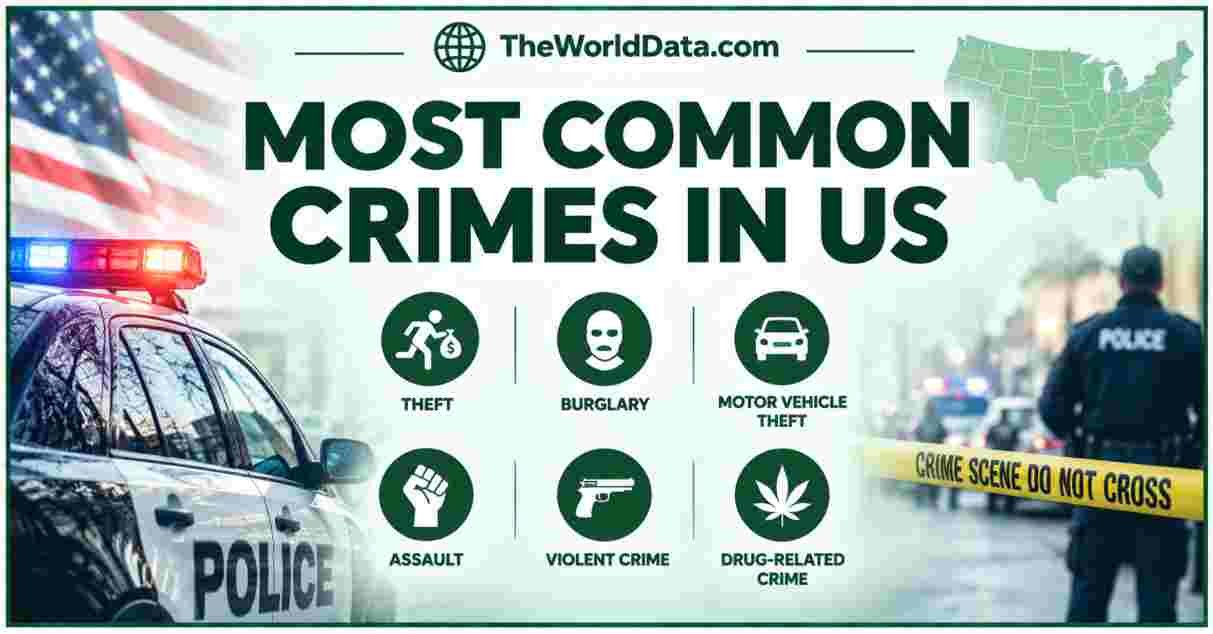
The most common crime in the US is larceny-theft, which made up 74.5% of the 5,245,768 property crimes the FBI estimates for 2025, or about 3.9 million thefts. Fraud is the fastest-growing category: consumers reported $15.9 billion in losses to the FTC and $20.9 billion to the FBI’s Internet Crime Complaint Center in 2025, both records.
Most Common Crimes in the US 2026 – Introduction
Most common crimes in the US 2026 start with theft. The FBI estimates 5,245,768 property crimes and 1,119,768 violent crimes in 2025, and larceny-theft alone accounts for 74.5% of the property total. Shoplifting, a subset of theft, accounted for 29.4% of larcenies in 2024. Arrest data tell a different story: drug abuse violations led with an estimated 845,031 arrests, ahead of driving under the influence at 798,563 and larceny-theft at 696,860.
Counts also miss the fastest-growing crime. Fraud rarely appears in police statistics, so this report adds the Federal Trade Commission (FTC) and the FBI’s Internet Crime Complaint Center (IC3). Both set records in 2025, at $15.9 billion and $20.9 billion in reported losses. This report ranks offenses, covers theft, shoplifting, fraud, cybercrime, arrests and clearance rates, and uses FBI, FTC and Council on Criminal Justice (CCJ) data through October 2026.
Interesting Facts About Most Common Crimes in the US 2026
FBI ESTIMATED OFFENSES, 2025 (millions; 1 block = 0.1 million)
Larceny-theft      | ███████████████████████████████████████ 3.91
Aggravated assault | ████████ 0.81
Motor vehicle theft| ███████ 0.68
Burglary           | ███████ 0.66
Robbery            | ██ 0.17
Rape               | █ 0.12
| Fact | Confirmed Data |
|---|---|
| Estimated property crimes, 2025 | 5,245,768 |
| Estimated violent crimes, 2025 | 1,119,768 |
| Larceny-theft share of property crime | 74.5% |
| Estimated aggravated assaults, 2025 | 813,424 |
| Top arrest category, 2025 | Drug abuse violations, 845,031 |
| FTC fraud losses, 2025 | $15.9 billion |
| FBI IC3 cybercrime losses, 2025 | $20.877 billion |
| FBI shoplifting reports, 2025 | 1,069,716 |
Source: FBI, Reported Crimes in the Nation, 2025 (Quick Stats and UCR Summary); FTC Consumer Sentinel testimony, March 25, 2026; FBI IC3 Annual Report 2025; FBI Crime Data Explorer. Counts for burglary, motor vehicle theft, robbery and rape are rounded estimates derived from FBI rates and shares.
Theft dwarfs everything else. Larceny-theft at about 3.91 million offenses is nearly five times the 813,424 aggravated assaults, the next most common serious crime in the FBI’s count. Burglary and motor vehicle theft each run about 0.66 to 0.68 million, and murder, at 14,085, is too small to appear on the chart. The FBI’s 2025 rates also fell for every property crime, so these are lower than a year earlier.
Fraud runs on a different scale. Losses of $15.9 billion reported to the FTC and $20.9 billion to the IC3 are both records, and FTC losses rose 81% between 2022 and 2025. The two datasets overlap, and neither counts unreported cases. They show that the crime most Americans are likely to encounter is increasingly online.
Most Common Crimes in the US 2026: FBI Ranking by Offense
FBI RATE PER 100,000 PEOPLE, 2025 (1 block = 25)
Larceny-theft      | ██████████████████████████████████████████████ 1,144.1
Aggravated assault | █████████▌ 238.0
Motor vehicle theft| ████████ 197.0
Burglary           | ███████▌ 193.6
Robbery            | ██ 49.4
Rape               | █▌ 36.1
Murder             | ▌ 4.1
| Rank | Offense | Rate per 100,000 | Estimated Offenses |
|---|---|---|---|
| 1 | Larceny-theft | 1,144.1 | About 3.91 million |
| 2 | Aggravated assault | 238.0 | 813,424 |
| 3 | Motor vehicle theft | 197.0 | About 680,000 |
| 4 | Burglary | 193.6 | About 660,000 |
| 5 | Robbery | 49.4 | About 170,000 |
| 6 | Rape | 36.1 | About 120,000 |
| 7 | Murder | 4.1 | 14,085 |
Source: FBI, UCR Summary of Reported Crimes in the Nation, 2025; FBI Reported Crimes in the Nation Quick Stats, 2025. Rates are from the FBI; counts other than aggravated assault and murder are rounded and derived.
Larceny-theft ranks first by a wide margin, at 1,144.1 per 100,000 people, which is 4.8 times the aggravated assault rate of 238.0. Motor vehicle theft and burglary are nearly tied at 197.0 and 193.6. Violent crimes make up only the second, fifth, sixth and seventh rows. Robbery, at 49.4, is about one fifth of the aggravated assault rate.
Rankings change with the measure. By offenses reported to police, theft leads. By arrests, drug abuse violations lead. By dollars lost, fraud leads. By victims who never report, simple theft and fraud are the least counted. The FBI’s rates also exclude simple assault, which is a common offense in its incident-based data but is not part of the FBI’s Part I index, so counts of common crime differ by definition.
Theft Statistics 2026: Larceny, Burglary and Auto Theft
CHANGE IN ESTIMATED OFFENSES, 2024 TO 2025 (1 block = 1%)
Motor vehicle theft | ███████████████████████ -22.7%
Burglary            | ████████████████ -15.8%
Larceny-theft       | ██████████ -9.8%
All property crime  | ████████████ -12.4%
| Offense | 2024 Offenses | 2025 Change | 2025 Estimate |
|---|---|---|---|
| Larceny-theft | 4,326,531 | −9.8% | About 3.9 million |
| Motor vehicle theft | 880,327 | −22.7% | About 680,000 |
| Burglary | 779,542 | −15.8% | About 660,000 |
| All property crime | 5,985,000 (approx.) | −12.4% | 5,245,768 |
Source: FBI, Reported Crimes in the Nation Quick Stats, 2024 and 2025; FBI UCR Summary of Reported Crimes in the Nation, 2025. 2025 estimates are calculated from FBI percentage changes.
Every theft category fell in 2025. Motor vehicle theft dropped 22.7%, the largest decline, and its rate was the lowest in 20 years. Burglary fell 15.8% and larceny-theft 9.8%, and both rates reached 20-year lows. Property crime overall fell 12.4%, to 5,245,768 offenses. At 74.5% of the total, larceny-theft is the offense most households actually experience.
Theft is also the least often solved. The FBI reports that 18.6% of larceny-thefts, 17.4% of burglaries and 10.5% of motor vehicle thefts were cleared in 2025, so more than 80% of reported thefts end without an arrest or exceptional clearance. Clearance means police closed the case, not that a conviction followed. Theft is also underreported when losses are small, which means the true volume is higher than any count here. Over the longer run, the burglary rate fell 73.9% from 741.8 per 100,000 in 2001 to 193.6, larceny-theft fell 54.0% from 2,485.7 to 1,144.1, and motor vehicle theft fell 54.2% from 430.5 to 197.0.
Shoplifting Statistics 2026: What Police and the FBI Report
SHOPLIFTING CHANGE, POLICE-REPORTED (1 block = 1%)
CCJ 21 cities, 2025 vs 2024         | ██████████ -10%
CCJ cities, H1 2026 vs H1 2025      | ████ +4%
CCJ cities, H1 2026 vs H1 2019      | █████ +5%
FBI reports, 2025 vs 2023           | ███████▌ +7.5%
| Measure | Figure |
|---|---|
| FBI shoplifting reports, 2025 | 1,069,716 |
| Change from 2023 in FBI reports | +7.5% |
| States where reports fell in 2025 | 42 |
| Shoplifting share of larcenies, 2024 | 29.4% |
| CCJ 21-city shoplifting, 2025 vs 2024 | −10% (first annual decline since 2021) |
| CCJ shoplifting, first half 2026 vs first half 2025 | +4% |
| Incidents involving one or two people | More than 95% |
Source: FBI Crime Data Explorer, offense code 23C, via a state-level analysis; FBI Reported Crimes in the Nation, 2024; Council on Criminal Justice, year-end 2025 and mid-year 2026 crime trends reports.
Shoplifting fell in 2025 and is rising again in 2026. The CCJ found police-reported shoplifting in 21 cities fell 10% in 2025, the first annual drop since 2021, and reports fell in 42 states. But the first half of 2026 was 4% above the same months of 2025 and 5% above the first half of 2019. It is the one tracked offense still above its pre-pandemic level, even as murder and burglary have fallen sharply.
Measurement is a problem. The CCJ warns that the FBI’s older summary system and its incident-based system gave conflicting shoplifting trends, and the FBI revised its incident-based rates. Reports of 1,069,716 in 2025 are a count of police records, not of all theft, since many stores do not report. Retailer surveys point the other way: the National Retail Federation’s 2025 study of 70 retailers found an 18% rise in average shoplifting incidents in 2024, and the federation stopped its annual shrink report in 2024 over methodology concerns. Most incidents are small: more than 95% involve one or two people, and the CCJ found about 1% involve an assault.
Fraud Statistics 2026: FTC Reports and Losses
FTC REPORTED FRAUD LOSSES (billions of dollars; 1 block = $0.5B)
2022 | ██████████████████ 8.8
2023 | ████████████████████ 10.0
2024 | █████████████████████████ 12.5
2025 | ████████████████████████████████ 15.9
| Measure (FTC, 2025) | Figure |
|---|---|
| Fraud reports | About 3 million |
| Reported fraud losses | $15.9 billion (up about 27%) |
| Investment scam losses | $7.9 billion, average over $10,000 |
| Imposter scam reports | About 1 million |
| Imposter scam losses | $3.5 billion (80% of reports lost no money) |
| Identity theft reports | Nearly 1.4 million |
| Total Sentinel reports | More than 6.2 million |
| Losses reported by adults 60 and over | More than $3 billion |
Source: Federal Trade Commission, Consumer Sentinel Network data and testimony to the Joint Economic Committee, March 25, 2026; FTC, Protecting Older Consumers 2025–2026; CNBC, June 26, 2026.
Reported fraud losses have risen 81% in three years, from $8.8 billion in 2022 to $15.9 billion in 2025. Imposter scams are the most reported, at about 1 million reports, but most victims lose nothing: 80% of those reports involved no money lost. Investment scams cause the most damage, at $7.9 billion, about half of all reported losses, with an average loss above $10,000.
Older adults lose the most per person. Adults 60 and over reported more than $3 billion in fraud losses in 2025, up from about $600 million in 2020. Identity theft adds nearly 1.4 million reports. The FTC cautions that these figures are a fraction of actual losses, since not every victim reports. Compared with burglary, fraud rarely brings an arrest, because the criminals are often overseas and the money moves through crypto or wire transfers.
Cybercrime and Internet Fraud 2026: FBI IC3 Data
IC3 REPORTED LOSSES (billions of dollars; 1 block = $1B)
2020 | ████ 4.2
2024 | █████████████████ 16.6
2025 | █████████████████████ 20.9
| Measure (IC3, 2025) | Figure |
|---|---|
| Complaints received | 1,008,597 (first time over 1 million) |
| Reported losses | $20.877 billion (up 26%) |
| Most common complaint type | Phishing and spoofing, 191,561 |
| Second and third | Extortion 89,129; investment fraud 72,984 |
| Investment fraud losses | $8.6 billion |
| Business email compromise losses | $3.047 billion across 24,768 incidents |
| Victims 60 and over | 201,000 complaints, about $7.75 billion |
| AI-related complaints | 22,364, about $893 million in losses |
Source: FBI Internet Crime Complaint Center, 2025 Internet Crime Report, April 2026.
IC3 complaints passed 1 million for the first time in 2025, up from about 860,000 in 2024, and losses rose 26% to $20.877 billion. Phishing and spoofing are the most common complaints, at 191,561, but investment fraud costs the most, at $8.6 billion. Business email compromise averaged about $123,000 per incident across 24,768 reports, and tech support scams cost $2.1 billion.
Older adults bear the largest share. Victims 60 and over filed about 201,000 complaints and lost about $7.75 billion, roughly 37% of all losses. The IC3 logged an AI-related category for the first time, with 22,364 complaints and about $893 million in losses. Cyber-enabled fraud accounted for almost 85% of reported losses. Losses have risen almost fivefold since $4.2 billion in 2020, and the FBI notes the figures reflect reported cases only.
Arrests 2026: Which Crimes Lead to the Most Arrests
ESTIMATED ARRESTS BY OFFENSE, 2025 (1 block = 25,000)
Drug abuse violations    | ██████████████████████████████████ 845,031
Driving under influence  | ████████████████████████████████ 798,563
Larceny-theft            | ████████████████████████████ 696,860
| Offense | 2024 Arrests | 2025 Arrests | Change |
|---|---|---|---|
| Drug abuse violations | 822,488 | 845,031 | +2.7% |
| Driving under the influence | 804,926 | 798,563 | −0.8% |
| Larceny-theft | 725,109 | 696,860 | −3.9% |
Source: FBI, Reported Crimes in the Nation Quick Stats, 2024 and 2025. Arrests are national estimates; changes are calculated from the FBI figures.
Drug and alcohol offenses lead arrests. Police arrested an estimated 845,031 people for drug abuse violations in 2025, up 2.7%, and 798,563 for driving under the influence, down 0.8%. Larceny-theft is third at 696,860, down 3.9%. These are offenses police find themselves, so arrests are high even when no victim reports the crime. The FBI estimates the violent crime arrest rate at 123.0 per 100,000 people.
An arrest is not a conviction, and it is not the same as a crime counted in the offense data. Larceny-theft accounts for roughly 3.9 million offenses but only 696,860 arrests, about 18% of the offenses. Drug abuse violations produce more arrests than any theft category because enforcement, not victim reports, generates them. The two datasets measure different things and should not be added together.
Clearance Rates 2026: Which Crimes Get Solved
SHARE OF OFFENSES CLEARED, 2025 (1 block = 2%)
Violent crime       | ████████████████████████ 47.4%
Larceny-theft       | █████████ 18.6%
Burglary            | ████████▌ 17.4%
Motor vehicle theft | █████ 10.5%
| Offense Group | 2024 Cleared | 2025 Cleared |
|---|---|---|
| Violent crime | Not shown | 47.4% |
| Larceny-theft | 17.3% | 18.6% |
| Burglary | 15.2% | 17.4% |
| Motor vehicle theft | 9.2% | 10.5% |
Source: FBI, Reported Crimes in the Nation Quick Stats, 2024 and 2025; UCR Summary of Reported Crimes in the Nation, 2025.
Police solve a minority of reported crimes. They cleared 47.4% of violent crimes and only 17.4% to 18.6% of burglaries and larcenies in 2025, and just 10.5% of motor vehicle thefts. Burglary clearance rose 2.2 points from 15.2%, and larceny and motor vehicle theft each gained 1.3 points. Clearances are improving slightly, but property crime remains the category where an offender is least likely to be caught.
Clearance has limits. A case is cleared by arrest or by “exceptional means,” such as a suspect’s death, and neither guarantees prosecution. Low rates for theft are one reason victims report less, which in turn lowers the counts. The result is a gap between the crimes police count and the crimes people experience, and fraud and shoplifting are the two categories where that gap is widest.
Frequently Asked Questions About Most Common Crimes in the US 2026
What is the most common crime in the US?
Larceny-theft. It accounts for 74.5% of the 5,245,768 property crimes the FBI estimates for 2025, or about 3.9 million offenses.
What is the second most common serious crime?
Aggravated assault, with an estimated 813,424 offenses in 2025, a rate of 238.0 per 100,000 people.
What crime has the most arrests?
Drug abuse violations, with an estimated 845,031 arrests in 2025, followed by driving under the influence at 798,563 and larceny-theft at 696,860.
How much shoplifting is reported to police?
The FBI recorded 1,069,716 shoplifting reports in 2025, 7.5% above 2023. Shoplifting made up 29.4% of larcenies in 2024.
Is shoplifting rising in 2026?
The CCJ found police-reported shoplifting in 21 cities fell 10% in 2025 but was 4% higher in the first half of 2026 than a year earlier.
How much do Americans lose to fraud?
Consumers reported $15.9 billion in fraud losses to the FTC in 2025, up about 27% from $12.5 billion, and the FBI’s IC3 recorded $20.877 billion in cybercrime losses.
What is the most reported type of fraud?
Imposter scams, with about 1 million FTC reports in 2025. Investment scams cost the most, at $7.9 billion.
How many identity theft reports were there in 2025?
Nearly 1.4 million reports reached the FTC’s Consumer Sentinel Network in 2025.
What is the most common cybercrime complaint?
Phishing and spoofing, with 191,561 complaints to the IC3 in 2025.
Who loses the most to fraud?
Older adults. Victims 60 and over reported about $7.75 billion to the IC3 and more than $3 billion to the FTC in 2025.
Which crime is least often solved?
Motor vehicle theft, with 10.5% of offenses cleared in 2025, followed by burglary at 17.4% and larceny-theft at 18.6%.
Did theft go up or down in 2025?
Down. The FBI estimates property crime fell 12.4%, larceny-theft 9.8%, burglary 15.8% and motor vehicle theft 22.7%.
Are these numbers complete?
No. Many thefts and most fraud cases are never reported, and the FBI, FTC and IC3 each count different things, so the datasets should not be added together.
How many violent crimes occur in the US each year?
The FBI estimates 1,119,768 violent crimes for 2025, a rate of 327.6 per 100,000 people, down 9.3% from 2024.
What is the burglary rate in 2025?
193.6 burglaries per 100,000 people, a 20-year low and 73.9% below the 741.8 rate in 2001.
How many cybercrime complaints does the FBI receive?
The IC3 received 1,008,597 complaints in 2025, nearly 3,000 a day, and cyber-enabled fraud accounted for almost 85% of reported losses.
How much of fraud goes unreported?
The FTC says its $15.9 billion total is only a fraction of actual losses, because many victims never report, and 80% of imposter scam reports involve no money lost.
Disclaimer: This research report is compiled from publicly available sources. While reasonable efforts have been made to ensure accuracy, no representation or warranty, express or implied, is given as to the completeness or reliability of the information. We accept no liability for any errors, omissions, losses, or damages of any kind arising from the use of this report.