
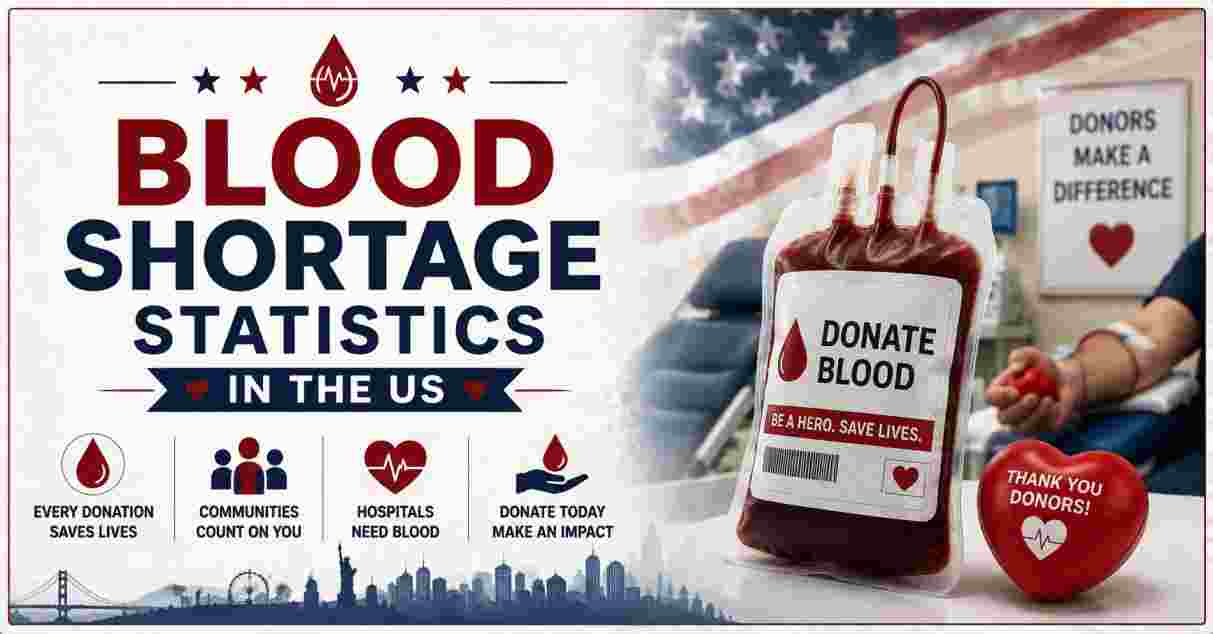
Blood Shortage in America 2026
The American Red Cross declared a national blood supply crisis on July 27, 2026 — only the second time in the organization’s history it has issued this designation, after the first-ever crisis in January 2022. The declaration came after blood donations fell to a four-year summer low, leaving the national supply of type O positive blood — the most commonly transfused blood type — at less than a one-day supply. As of the most recent update on August 3, 2026, donations have begun increasing following the crisis declaration, but the Red Cross says the improvement still has not been enough to fully stabilize hospital supply chains heading into the final weeks of summer.
The roots of the 2026 shortage trace back to June, when the national blood supply fell nearly 25% as donations dropped sharply following Memorial Day, even as hospitals faced an increase in trauma-related transfusion demand during what the blood banking industry calls “summer trauma season.” The Red Cross, which supplies roughly 40% of the nation’s blood, has been distributing nearly 3,500 more units per week than expected, a gap between supply and demand that has now persisted for more than two months. Officials have also pointed to a mix of unusual seasonal factors compounding the normal summer slowdown, including extreme heat, poor air quality in several regions, and widespread foodborne illness outbreaks that have further reduced donor turnout at scheduled blood drives. This article compiles the most current, verified statistics on the 2026 blood shortage, the donor population behind it, and the broader structural pressures facing America’s blood supply system.
Interesting Facts About the US Blood Shortage in 2026
| Fact | Detail |
|---|---|
| National Blood Crisis Declared | July 27, 2026 |
| Only Prior National Crisis Declaration | January 2022 |
| Blood Supply Decline in June 2026 | ~25% |
| Donations Compared to Prior Summers | Four-year summer low |
| Type O Positive Supply at Crisis Point | Less than one-day national supply |
| Extra Units Distributed Weekly vs. Expected | ~3,500 units |
| Share of US Population Eligible to Donate | ~62% |
| Share of Eligible Population That Actually Donates Annually | ~3% |
| Red Cross Share of National Blood Supply | ~40% |
| Someone in the US Needs Blood Every | 2 seconds |
Source: American Red Cross press releases, July–August 2026; America’s Blood Centers
The gap between 62% of Americans being eligible to donate and just 3% actually doing so each year is the single statistic that explains almost everything else in this article. That means roughly 212 million eligible Americans are not donating in any given year, while the entire national blood supply depends on a small, disproportionately loyal group of repeat donors — a structural fragility that becomes acute the moment donation rates dip even modestly, as they did heading into the summer of 2026. Unlike other medical supplies, blood cannot be manufactured or stockpiled indefinitely; red blood cells expire within 21 to 42 days and platelets within just five to seven days, meaning the entire system runs on a rolling, week-to-week balance between fresh donations and hospital consumption.
The second-ever national blood crisis designation matters because the Red Cross does not use this term lightly — a routine seasonal “shortage” is common and expected, but a “crisis” specifically signals that inventory has fallen below critical thresholds threatening patient care, not just inconveniencing hospital planning. Following the first crisis in 2022, the Red Cross said it implemented additional safeguards specifically intended to prevent a repeat; that a second crisis has occurred just four years later, driven by the same underlying summer donation slump, suggests those structural vulnerabilities have not been fully resolved even after dedicated institutional attention.
Blood Shortage Timeline and Crisis Declaration Statistics in the US 2026
| Date | Development |
|---|---|
| June 2026 | National blood supply falls ~25% |
| July 13, 2026 | Red Cross declares an emergency blood shortage |
| July 27, 2026 | Red Cross declares its second-ever national blood supply crisis |
| July 31, 2026 | Axios reports “tens of thousands” donated in the week following the crisis declaration |
| August 3, 2026 | One week post-crisis: donations increasing but still not fully meeting hospital demand |
| August 2026 (ongoing) | Red Cross offering $20 Amazon gift card incentive for donors; +$10 for type O donors |
Source: American Red Cross; Axios; WTTW Chicago; The Hill, July–August 2026
The five-week arc from the initial 25% supply drop in June to the formal crisis declaration on July 27 shows how gradually building shortages can escalate into a full national emergency once they cross a critical threshold — in this case, type O positive blood dropping below a one-day national supply. Kellie O’Connell, CEO of the American Red Cross of Illinois, described the underlying dynamic bluntly: “Increased need, and a decrease of folks donating, are sort of a perfect storm.” Blood donations reliably dip each summer as vacations, school breaks, and disrupted routines interfere with regular giving patterns, while trauma-related transfusion demand — from car accidents, outdoor injuries, and other seasonal incidents — tends to rise over the same stretch.
The donation surge reported in the days immediately following the crisis declaration — described by the Red Cross as “tens of thousands” of new donors — demonstrates that public awareness campaigns can meaningfully move the needle, at least temporarily. However, the organization’s own August 3 update cautioned that this initial surge, while encouraging, had not yet been sufficient to fully restore supply to safe levels, particularly for type O blood, underscoring that a single week of elevated turnout cannot undo a shortage that built up gradually over two full months. Officials in Illinois and elsewhere have emphasized that sustaining this donation momentum through the remainder of August, rather than seeing it taper off after the initial wave of crisis-driven media attention fades, will ultimately determine whether the shortage resolves before the traditionally slower autumn donation season begins.
US Blood Donor Population and Eligibility Statistics in 2026
| Metric | Data |
|---|---|
| Total US Population Eligible to Donate Blood | ~62% (~212 million people) |
| Share of Eligible Population Donating Annually | ~3% |
| Estimated Annual US Blood Donors | ~6.8 million people |
| Whole Blood/Red Blood Cell Units Collected Annually | ~13.6 million units |
| Average Donations per Donor per Year | 1.8 times |
| Maximum Allowed Whole Blood Donations per Year | 6 (56-day wait between donations) |
| Share of First-Time Donors (Declining Trend) | Fell from 31% to 26% |
| Donation Rate per 1,000 Eligible People, 1992 vs. Recent Years | ~88 → ~55 |
Source: America’s Blood Centers; American Red Cross; AHA News; UCI Health/Spectrum News
The decline in donation rates over time is stark when placed in historical context: Dr. Minh-Ha Tran, medical director of transfusion medicine at UCI Health, noted that national donation rates have fallen from roughly 88 donations per 1,000 eligible people in 1992 to around 55 per 1,000 in recent years — a decline of more than a third over three decades. That long-run erosion, combined with a falling share of first-time donors (down from 31% to 26% in recent national surveys), suggests the shortage crisis of 2026 reflects a structural, years-in-the-making trend rather than a single bad summer. Younger donors in particular have become harder to recruit and retain, a shift the industry has linked partly to the decline of employer-based blood drives as more Americans work remotely, and to fewer high schools and colleges hosting on-campus donation events.
Each individual donation carries outsized impact given how thin the overall donor base is: a single whole blood donation can be separated into red cells, platelets, and plasma, together capable of helping up to three separate patients. With the average donor giving just 1.8 times per year — well short of the six-donation annual maximum permitted under the standard 56-day waiting period — there is meaningful theoretical headroom within the existing donor base alone, before even considering the 97% of eligible Americans who do not donate at all. This is part of why the Red Cross campaign framing has consistently emphasized that “just three more donors at each blood drive” could be sufficient to end the 2026 crisis, rather than calling for a wholesale transformation of donor behavior nationwide.
Blood Type Demand and Hospital Usage Statistics in the US 2026
| Metric | Data |
|---|---|
| Share of Red Cross Distributions That Are Type O | ~60% |
| Population Compatible with Type O Positive | ~80% of patients |
| Population with Group O Blood (Positive or Negative) | ~45% |
| Group O Prevalence Among Hispanic Americans | ~57% |
| Group O Prevalence Among African Americans | ~51% |
| Patients Receiving Red Blood Cell Transfusions Annually | ~3.65 million |
| Average RBC Units per Transfused Patient | 2.8 units |
| Total Annual RBC Transfusions Nationwide | 10+ million |
| Daily Platelet Units Transfused | 6,000+ |
| Daily Plasma Units Transfused | ~5,200 |
| Share of Blood Supply Used in Cancer Care | 25%+ |
Source: America’s Blood Centers National Blood Collection Survey; American Red Cross
The disproportionate demand for type O blood — accounting for roughly 60% of all Red Cross distributions despite type O making up only about 45% of the population — stems directly from its universal compatibility profile: O positive can be safely transfused into about 80% of patients, while O negative remains the true universal type used in trauma and emergency settings when there is no time to confirm a patient’s exact blood type. That mismatch between population prevalence and clinical demand is precisely why type O shortages, rather than shortages of rarer types like AB, tend to trigger the most severe hospital-level supply constraints during any national blood crisis, including the one declared in July 2026.
The sheer scale of ongoing hospital blood usage — over 10 million red blood cell transfusions, more than 2 million platelet units, and nearly 1.9 million plasma units annually — illustrates why even a temporary donation slowdown can rapidly translate into a genuine supply emergency. With more than a quarter of the blood supply directed toward cancer care alone, and average transfused patients requiring nearly three units each, the margin between adequate and inadequate supply is measured in days, not months, which is why the Red Cross tracks and reports blood inventory levels on a near-daily basis during periods of strain like the current one.
Blood Donation Incentives and Public Response Statistics in the US 2026
| Metric | Data |
|---|---|
| August 2026 Donor Incentive | $20 Amazon Gift Card |
| Additional Incentive for Type O Donors | +$10 Amazon Gift Card |
| July 2026 Donor Incentive | Fandango movie ticket (up to $15 value) |
| New Donors in Week Following Crisis Declaration | “Tens of thousands” |
| Daily Red Cross Blood Drives Nationwide | ~500 |
| Additional Donors Needed per Drive to End Crisis | ~3 |
| YouTube Anchor/Media Figures Publicly Donating (Historical Precedent, 2022 Crisis) | Documented ripple effect from media coverage |
Source: American Red Cross; CBS News; Axios
Financial incentives have become a standard tool in the Red Cross’s crisis-response playbook, and the layered structure used in 2026 — a base $20 Amazon gift card for any August donor, with an extra $10 specifically for type O donors — reflects a deliberate attempt to steer donor turnout toward the exact blood type in shortest supply rather than simply boosting overall volume indiscriminately. This incentive-based approach follows a similar pattern used during the July shortage, when a Fandango movie ticket offer ran through July 31 before being replaced by the current August gift card program.
Media coverage itself has historically proven to be a meaningful driver of donation spikes, a pattern that repeated after the July 2026 crisis declaration generated national news coverage across outlets including Axios, CBS News, The Hill, and dozens of local affiliates. The Red Cross’s own framing — that ending the crisis requires just “three more donors at each blood drive” across its roughly 500 daily nationwide blood drives — is a deliberately modest, achievable target designed to counter the sense of scale-related helplessness that can otherwise discourage individual donors from believing their single contribution matters against a “national crisis.”
Structural and Long-Term Blood Supply Pressures in the US 2026
| Metric | Data |
|---|---|
| Registered Blood Centers with FDA (Hospital-Based) | ~90 |
| Registered Community Blood Centers | ~53 |
| Annual Lives Saved Through Blood Transfusion | 4.5 million+ |
| Hospital Admissions Requiring Blood | ~1 in 5 |
| Rural Hospitals at Risk of Closure Nationwide (2026) | 720+, including 294 at immediate risk |
| Blood Shelf Life (Red Blood Cells) | 42 days maximum |
| Blood Shelf Life (Platelets) | 5–7 days |
Source: America’s Blood Centers; American Hospital Association; Becker’s Hospital Review, May 2026
The decline of employer-based and school-based blood drives — a trend accelerated by remote work and shifting campus donation patterns — sits alongside a separate but related structural pressure: more than 720 US hospitals, including 294 at immediate risk, faced potential closure as of the most recent May 2026 analysis from the Center for Healthcare Quality and Payment Reform. A shrinking hospital network doesn’t reduce national blood demand so much as it concentrates transfusion needs into fewer, more strained facilities, particularly in rural areas, where hospital closures have already reshaped access to trauma and maternity care more broadly — a trend covered in detail in the Hospital Closure Statistics in US report.
Blood donation shortages also sit within a broader landscape of voluntary donation systems under strain, one that includes organ and plasma donation alongside whole blood. While plasma donation in the US operates on a compensated model that has kept collection volumes growing even during blood shortages — a distinction covered in the Blood Plasma Statistics in US report — whole blood donation remains entirely voluntary and uncompensated in the US, a structural difference that helps explain why plasma supply has proven more resilient to the same seasonal and economic pressures currently straining the blood supply. Organ donation faces a parallel but distinct challenge: only about 53% of Americans are registered organ donors despite 93% expressing support for donation in principle, a gap documented further in the Organ Donor Statistics in US report, and one that mirrors the same awareness-versus-action gap seen in blood donation, where most eligible Americans support the idea of donating without translating that support into a scheduled appointment.
Disclaimer: This research report is compiled from publicly available sources. While reasonable efforts have been made to ensure accuracy, no representation or warranty, express or implied, is given as to the completeness or reliability of the information. We accept no liability for any errors, omissions, losses, or damages of any kind arising from the use of this report.