
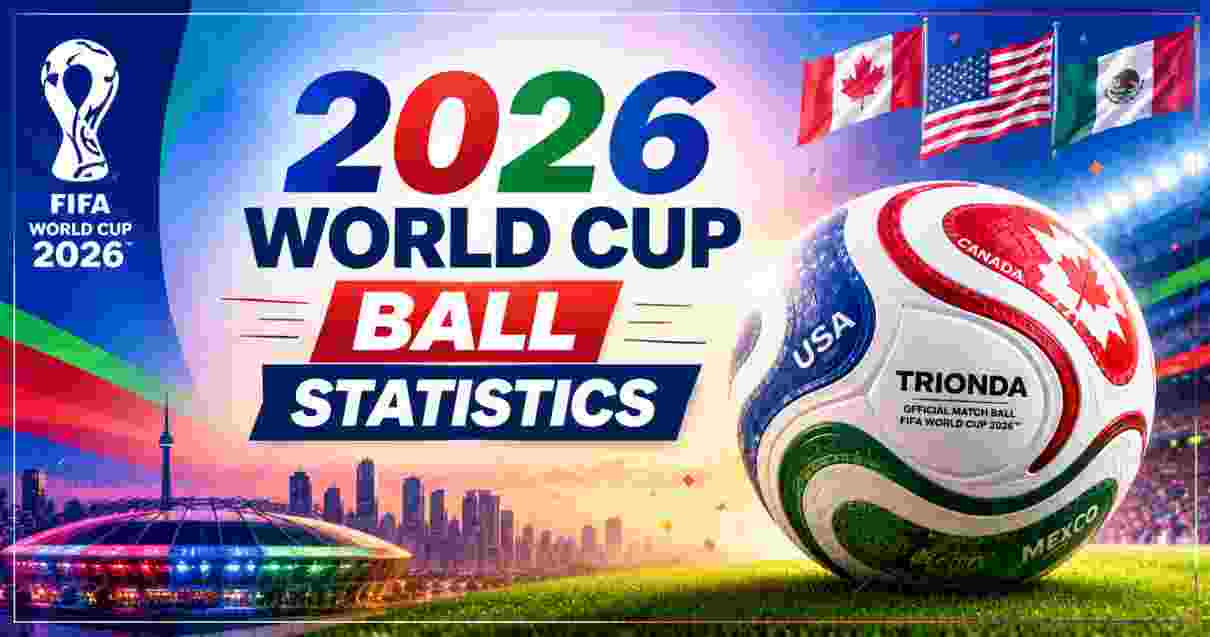
The 2026 World Cup Ball in 2026
The 2026 FIFA World Cup kicks off on June 11, 2026, at Mexico City’s Estadio Azteca — and the ball that will roll across all 104 matches in 16 host cities has already become one of the most talked-about pieces of sports equipment in the world. Its name is TRIONDA, and Adidas unveiled it on October 2, 2025, at a launch event in New York City alongside FIFA. The name fuses two Spanish words: “Tri” (three) and “Onda” (wave or vibe) — a direct tribute to the historic three-nation co-hosting arrangement between Canada, Mexico, and the United States. This is the first FIFA Men’s World Cup ever played across three countries simultaneously, and the ball was designed from the ground up to reflect and honor that unique partnership.
What separates the Trionda from every World Cup ball before it isn’t just its vivid red, green, and blue color scheme or the maple leaf, eagle, and star motifs pressed into its surface. It’s what’s happening inside. For the first time in World Cup history, the connected ball chip is side-mounted within one of the four panels — balanced by counterweights in the remaining three — delivering 500 Hz motion-sensor data directly to the Video Assistant Referee (VAR) system with every single touch recorded within 2 milliseconds. It’s the first World Cup ball ever engineered for multiple distinct climates across 16 host cities, from the cool rains of Vancouver to the high-altitude heat of Mexico City. Adidas General Manager Sam Handy called it “the most visually playful FIFA World Cup ball we have ever created.” On that score, few would argue.
Interesting Facts: The 2026 World Cup Ball
World Cup Ball — KEY FACTS AT A GLANCE
══════════════════════════════════════════════════════════════════
  Number of panels (historic first)    ████                    4 panels
  Chip data frequency                  ████████████████████    500 Hz
  Touch-to-data latency                █                       2 milliseconds
  Adidas consecutive WC balls          ████████████████        15th consecutive
  Total WC ball designs (since 1930)   ████████████████████    23 designs
  Retail price — Official Match Ball   ████████                ~$170 USD
  Retail price — Competition version   █████                   ~$65 USD
  Matches ball will be used in         ████████████████████    104 matches
══════════════════════════════════════════════════════════════════
| Fact | Detail |
|---|---|
| Official name | TRIONDA — meaning “three waves” in Spanish |
| Unveiled | October 2, 2025 — New York City, by FIFA and Adidas |
| Name etymology | “Tri” (three) + “Onda” (Spanish for wave/vibe) |
| Host nation colors | Red (Canada), Blue (USA), Green (Mexico) |
| National icons on ball | Maple Leaf (Canada), Eagle (Mexico), Five-Pointed Star (USA) |
| Gold detailing | Honors the FIFA World Cup Trophy — champion’s color |
| Panel construction | 4 panels — fewest ever on a men’s World Cup ball; previous record was 6 panels (Brazuca 2014) |
| Panel shape | Wavy geometry — fluid design replicating ocean waves; panels meet in a triangle at the center |
| Chip technology | 500 Hz inertial measurement unit (IMU) — side-mounted in one panel |
| Chip placement innovation | In 2022 (Al Rihla) the chip was center-suspended; Trionda moves it to a panel — more accurate |
| Counter-balance system | Weights in the other 3 panels maintain perfect balance |
| Touch latency | Every touch recorded and transmitted to VAR within 2 milliseconds |
| VAR application | Offside calls, handball incidents, goal-line decisions, potential red cards |
| FIFA certification | FIFA Quality Pro — highest possible FIFA rating; passed tests on weight, water uptake, shape/size retention |
| Circumference (FIFA standard) | 68–70 cm |
| Weight (FIFA standard) | 410–450 grams |
| Outer shell material | 60% polyurethane, 40% recycled polyester (per FIFA official store product listing) |
| Bladder | Butyl bladder for air retention |
| Surface texture | Debossed lines and fine dimpling — similar concept to a golf ball, improves aerodynamics and grip |
| Water-based production | Manufactured with water-based inks and glues — continuing Al Rihla’s sustainability legacy |
| Climate testing | First World Cup ball designed and tested across multiple climates — across all 16 host cities |
| Retail price — Pro (OMB) | ~$170 USD |
| Retail price — Competition | ~$65 USD |
| Retail price — League | ~$45 USD |
| Retail price — Club | ~$32 USD |
| On sale since | October 3, 2025 — via Adidas.com and select retailers worldwide |
| Adidas World Cup supply streak | 15th consecutive World Cup ball from Adidas — dating back to 1970 |
| Total distinct World Cup ball designs | 23 different designs since 1930 |
Source: Adidas official press release (October 2, 2025); FIFA.com; ESPN “Evolution of the World Cup ball” (October 2025); CBS Sports (October 2025); FIFA Official Store product listing (store.fifa.com); Footy Headlines (September 2025); British Brief aerodynamics analysis (May 2026); Gulf News TRIONDA explainer; Adidas Group official history page
The facts above reveal a ball that is as much a technology product as it is a piece of sports equipment. The shift to a 4-panel construction is the most visible engineering departure in World Cup ball history — the previous low was 6 panels on the Brazuca in 2014, itself a significant reduction from the 32-panel truncated icosahedron that defined footballs from 1970 onward. Fewer panels means fewer seams, which means a larger sweet spot for striking, a more predictable flight path, and reduced aerodynamic drag. The tradeoff — as every goalkeeper who faced the 8-panel Jabulani in 2010 will tell you — is that reducing panels too aggressively can make the ball’s flight erratic and unpredictable. Adidas addressed this with the dimpled surface texture and deep debossed seam lines, which reintroduce controlled turbulence to stabilize the ball’s path without adding physical panel edges.
The side-mounted chip placement is a meaningful technical upgrade from the 2022 Al Rihla, where the inertial measurement unit sat suspended at the ball’s geometric center. Moving it to a panel position with counterbalancing weights in the other three panels improves both accuracy and reliability, especially during high-speed spinning kicks where a centrally-suspended chip risks slight oscillation. At 500 Hz, the chip samples motion data 500 times per second — a frequency that allows VAR officials to pinpoint the exact moment of foot-to-ball contact for offside calculations, which is the most contested and consequential officiating call in the modern game. The 2-millisecond data transmission latency means that by the time a player has completed their follow-through, officials already have the ball position data they need.
World Cup Ball – Design & Technology Statistics in 2026
World Cup Ball TECHNICAL SPECS — AT A GLANCE
══════════════════════════════════════════════════════════════════
  Panel count              ████                   4 (fewest ever, men's WC)
  Chip frequency           ████████████████████   500 Hz
  Data latency             █                      2 milliseconds
  Ball circumference       ████████████████       68–70 cm (FIFA standard)
  Ball weight              ████████████████       410–450 g (FIFA standard)
  Polyurethane outer shell ████████████           60%
  Recycled polyester back  ████████               40%
  Surface texture          ████████████████████   Dimpled + debossed (aero grip)
══════════════════════════════════════════════════════════════════
| Technical Specification | Trionda (2026) | Notes |
|---|---|---|
| Panel count | 4 panels | Fewest in men’s World Cup history |
| Panel geometry | Wavy / fluid — triangle meeting at center | Inspired by “la ola” wave |
| Bonding method | Thermally bonded (seamless surface) | Predictable trajectory; minimal water uptake |
| Outer shell | Polyurethane (PU) — 60% | Premium grip and durability |
| Backing layer | Recycled polyester — 40% | Sustainable construction |
| Bladder | Butyl | Superior air retention |
| Ball size | Size 5 | FIFA / official match standard |
| Circumference | 68–70 cm | FIFA Quality Pro requirement |
| Weight | 410–450 grams | FIFA Quality Pro requirement |
| Chip model | 500 Hz Inertial Measurement Unit (IMU) | Side-mounted in one panel |
| Chip placement | Inside one panel — counterweighted in other 3 | More stable than 2022’s center-suspended chip |
| Data transmission | Every touch within 2 milliseconds | To VAR + semi-automated offside system |
| Surface treatment | Dimpled + debossed texture | Golf-ball-inspired aerodynamics |
| Water resistance | Tested; minimal water uptake | Thermally bonded seamless construction |
| Climate testing | All 16 host city climates | First WC ball engineered for multi-climate performance |
| Altitude tested | Yes — including Mexico City (~2,250m above sea level) | Affects ball aerodynamics at elevation |
| FIFA certification | FIFA Quality Pro | Highest FIFA ball certification |
| Sustainability | Water-based inks and glues; recycled materials | Builds on Al Rihla’s eco-standard |
Source: Adidas official press release (October 2, 2025); Footy Headlines (September 2025); British Brief aerodynamics testing (May 2026); FIFA Official Store (store.fifa.com); MyTourneyTime World Cup 2026 Ball breakdown (March 2026); fifaworldcupnews.com (May 2026)
The technical architecture of the Trionda represents the most consequential leap in match ball engineering since the 2022 Al Rihla introduced Connected Ball Technology to the World Cup. That ball’s chip was suspended at the center using an internal suspension system — effective, but subject to subtle movement during extreme rotational kicks. The Trionda solves this by anchoring the chip inside a dedicated layer of one panel, with precision counterweights distributed across the remaining three to ensure the ball’s center of gravity remains perfectly neutral. The result is a chip that stays in its calibrated position regardless of spin, curve, or impact force. Combined with the 500 Hz sampling rate — which captures 500 data points per second — this means every free kick, every header, every goalkeeper punt generates a precise kinematic record that officials can review in real time.
The four-panel geometry is equally deliberate. The Brazuca used at the 2014 Brazil World Cup proved that reducing panels could produce a more stable ball — it was widely praised by players after the chaos of the Jabulani. But Brazuca used 6 panels and retained relatively straight seam edges. Trionda goes to 4 panels with deeply curved seam lines that create turbulent boundary layers around the ball’s surface at flight speeds, mimicking the controlled aerodynamic drag of a dimpled golf ball — this is where the surface debossing and fine texture pattern come in. The engineering intention is to provide stable flight across widely varying conditions: sea-level coastal humidity in Miami and Vancouver, desert heat in Dallas and Los Angeles, and high-altitude thin air in Mexico City — a set of conditions no previous World Cup ball has ever been designed to handle simultaneously.
FIFA World Cup Ball History Statistics 2026
EVOLUTION OF MEN'S WORLD CUP BALLS — KEY ERA MILESTONES
══════════════════════════════════════════════════════════════════
  1930–1966  Pre-Adidas era — host nation / branded balls    8 designs
  1970–2026  Adidas era — named official match balls        15 designs
  Total distinct WC ball designs (all time)                  23 designs
  First Adidas ball: Telstar 1970 (32 panels, leather)
  Most panels: 32 (Telstar 1970 / Tango era)
  Fewest panels: 4 (Trionda 2026) ← new record
  First with embedded sensor: Al Rihla 2022 (center-suspended)
  First with side-mounted sensor: Trionda 2026 ← new
══════════════════════════════════════════════════════════════════
| Year | Ball Name | Tournament | Key Innovation |
|---|---|---|---|
| 1970 | Telstar | Mexico | First Adidas ball; 32-panel black & white; designed for B&W TV |
| 1974 | Telstar Durlast | West Germany | Thicker Durlast waterproof coating; shinier finish |
| 1978 | Tango | Argentina | New 20-panel “triad” design; impression of 12 circles; iconic for 20 yrs |
| 1982 | Tango Espana | Spain | First synthetic panels introduced; cowhide retained |
| 1986 | Azteca | Mexico | First fully synthetic World Cup ball; all-weather performance |
| 1990 | Etrusco Unico | Italy | Polyurethane foam layer added; improved feel and touch |
| 1994 | Questra | USA | Multi-layer construction; inner syntactic foam layer |
| 1998 | Tricolore | France | First multicolored World Cup ball; 5 colors |
| 2002 | Fevernova | Korea/Japan | Controversial synth-foam design; criticized for unpredictability |
| 2006 | Teamgeist | Germany | 14 panels; thermally bonded; near-perfect sphere |
| 2010 | Jabulani | South Africa | 8 panels; notorious for unpredictable “knuckleball” flight |
| 2014 | Brazuca | Brazil | 6 panels; widely praised; stable flight restored |
| 2018 | Telstar 18 | Russia | Revived Telstar look; embedded NFC chip for fan content |
| 2022 | Al Rihla | Qatar | 20 panels; first center-suspended motion sensor chip; water-based construction |
| 2026 | TRIONDA | USA/Canada/Mexico | 4 panels; side-mounted 500 Hz chip; first multi-climate WC ball |
Source: Adidas “Complete History of World Cup Match Balls” (adidas.com); ESPN “Evolution of the World Cup ball” (October 2025); Goal.com World Cup balls history; Luson Sport “Balls of the World Cup” (September 2025); FWCUMC “FIFA World Cup Balls History” (March 2026)
The history of the FIFA World Cup ball is a 55-year story of Adidas transforming a game — and it begins before Adidas even arrived. From 1930 to 1966, the host nation supplied the match ball, resulting in wildly inconsistent quality — brown leather orbs that became waterlogged in rain and were nearly impossible to follow on the nascent black-and-white televisions broadcasting the games. That all changed in 1970, when FIFA contracted Adidas to supply the official match ball for the Mexico tournament. The result was the Telstar — named for “Television Star” — a 32-panel truncated icosahedron with black pentagons and white hexagons designed specifically to be visible on both color and black-and-white screens. The design was so successful and so intuitive that it became the universal mental image of a soccer ball for half a century, remaining the default shape people draw when asked to sketch a football.
The Adidas era’s biggest controversy came in 2010 with the Jabulani — an 8-panel ball used in South Africa that goalkeepers universally condemned for its “knuckleball” flight behavior, with sudden, unpredictable dips and swerves that made it nearly impossible to judge. Goalkeepers likened it to a beach ball. Adidas overcame that legacy with the Brazuca in 2014 — a 6-panel ball that restored stability and player confidence. The 2018 Telstar 18 introduced an NFC chip for the first time, though only as a fan engagement tool allowing people to tap their phones to the ball and access exclusive content. It was the 2022 Al Rihla that took the leap into officiating technology, embedding a motion sensor chip that fed semi-automated offside decisions — a system that shaved minutes off VAR review times. Trionda 2026 inherits and advances this lineage with a total of 23 distinct designs now spanning nearly a century of World Cup football.
2026 FIFA World Cup Ball Pricing & Availability Statistics
TRIONDA BALL VERSIONS — PRICE TIERS (USD)
══════════════════════════════════════════════════════════════════
  Official Match Ball (Pro)  ████████████████████████████████  ~$170
  Competition                ████████████████                   ~$65
  League                     ████████████                       ~$45
  Club (entry)               ████████                           ~$32
══════════════════════════════════════════════════════════════════
  UK price (Pro version): ~£130
  On sale: October 3, 2025 (adidas.com + retailers worldwide)
══════════════════════════════════════════════════════════════════
| Version | Price (USD) | Key Features | Target User |
|---|---|---|---|
| Official Match Ball (Pro / OMB) | ~$170 | 500 Hz chip, thermally bonded seamless surface, FIFA Quality Pro certified, butyl bladder, full recycled polyester backing | Professional players, collectors, serious enthusiasts |
| Competition | ~$65 | Machine-stitched, FIFA Quality certified, similar visual design, no embedded chip | Advanced club and academy players |
| League | ~$45 | TPU laminated surface, seamless construction, good flight stability, no chip | Amateur match and training use |
| Club | ~$32 | Entry-level; durable for recreational play; Trionda graphics | Recreational players, fans |
| UK Pro price | ~£130 | Same as OMB spec | UK and European market |
| On sale from | October 3, 2025 | Via adidas.com, FIFA store, Dick’s Sporting Goods, and major retailers | Global |
| Materials (OMB) | 60% PU / 40% recycled polyester | FIFA Official Store confirmed | All Pro versions |
| Chip versions | Only the Official Match Ball (Pro) contains the 500 Hz sensor | Lower tiers have no chip | Pro tier only |
Source: Footy Headlines (September 2025); footballgroundguide.com (May 2026); FIFA Official Store (store.fifa.com); Dick’s Sporting Goods product listing; adidas.com
The pricing structure of the Trionda follows the same tiered architecture Adidas has used for recent World Cup balls, with one critical caveat: the connected ball technology — the 500 Hz chip — is exclusively in the Official Match Ball (Pro) version. The Competition, League, and Club versions carry the same visual design and FIFA-quality construction but contain no sensor technology. This matters for fans who want an authentic match experience versus those who simply want the aesthetic. At ~$170 for the Pro, Trionda sits in line with the Al Rihla Pro (~$165) and the Brazuca Pro (~$160) at launch, reflecting steady price growth that tracks with the cost of integrating more sophisticated sensor and manufacturing technologies. The ball went on sale the day after its unveiling — October 3, 2025 — and sold out in multiple colorways within the first 48 hours, according to early reports from Adidas.
The sustainability angle of Trionda’s construction also carries commercial weight. 60% of the outer shell is polyurethane and 40% is recycled polyester backing — a material composition confirmed directly by the FIFA Official Store’s product listing. Combined with water-based inks and glues in the printing and bonding process, Trionda continues the eco-manufacturing standard set by the Al Rihla in 2022, which was the first World Cup ball made entirely without solvent-based adhesives. For collectors and fans who want the full match-spec experience without the Pro price tag, the Competition version at ~$65 offers the closest approximation — machine-stitched rather than thermally bonded, but with the same outer aesthetic and FIFA Quality certification passed on circumference, weight, rebound, and water absorption tests.
FIFA World Cup 2026 Ball — Tournament Context Statistics
2026 FIFA WORLD CUP — KEY NUMBERS FOR BALL CONTEXT
══════════════════════════════════════════════════════════════════
  Teams in tournament           ████████████████████████████████  48
  Total matches                 ████████████████████████████████  104
  Host cities                   ████████████████                   16
  Host nations                  ████                                3 (USA, Canada, Mexico)
  Opening match date            June 11, 2026 — Estadio Azteca, Mexico City
  Final date                    July 19, 2026
  Northernmost host city        ████████████████████████          Vancouver, Canada
  Southernmost host city        ████████████████████████          Mexico City, Mexico
  First 3-nation WC in history  ✓
  First 48-team WC in history   ✓
══════════════════════════════════════════════════════════════════
| Tournament / Ball Metric | Data | Notes |
|---|---|---|
| Tournament start | June 11, 2026 | Estadio Azteca, Mexico City |
| Tournament final | July 19, 2026 | — |
| Number of teams | 48 teams | Expanded from 32 in previous editions |
| Total matches | 104 matches | All using the Trionda official match ball |
| Host cities | 16 host cities | Across USA (11), Canada (2), Mexico (3) |
| Host nations | 3 — USA, Canada, Mexico | First 3-nation co-host in World Cup history |
| Northernmost host city | Vancouver, Canada | Cool, rainy June conditions |
| Southernmost host city | Mexico City, Mexico | ~2,250m altitude; thinner air affects ball flight |
| Ball climate challenge | Coldest to warmest: >20°C range | Trionda tested across all 16 city profiles |
| First use of ball | Kickoff June 11 — Mexico City | Ball first seen in competitive match context |
| Ball used in final | Trionda (standard) | Unlike Qatar 2022 which used “Al Hilm” for semis/final |
| Semi-automated offside | Powered by Trionda’s 500 Hz chip + AI | First 48-team WC to use this system throughout |
| VAR supported by | Connected Ball Technology | Trionda chip feeds all 104 matches |
| Adidas WC supply relationship | 56 years (1970–2026) | All 15 named WC balls from Adidas |
| Trionda’s place in WC history | 15th Adidas ball, 23rd design overall | Including pre-Adidas era (1930–1966) |
Source: FIFA.com; CBS Sports (October 2025); ESPN World Cup 2026 hub; FOX Sports Trionda explainer (October 2025); Dezeen (October 2025); Adidas Group history page
The tournament context for the Trionda is unlike any ball that came before it. The 2026 World Cup is the largest men’s tournament in history — 48 teams producing 104 matches across 16 cities in 3 countries, spanning a geographic range from Vancouver in the northwest to Mexico City in the south, with all the climate, altitude, and weather variation that entails. The Trionda is the first official match ball ever designed with this kind of environmental diversity explicitly in the engineering brief. Adidas ran testing specifically calibrated to each host city’s climate profile — accounting for humidity in Miami and Dallas, cool marine air in Seattle and Vancouver, and the notoriously thin atmosphere of Mexico City at 2,250 meters above sea level, where ball flight physics change measurably compared to sea level. High altitude reduces air density, which reduces drag and can cause balls to fly faster and curve more — exactly the conditions that produced some of the most dramatic free kicks in World Cup history when Mexico previously hosted in 1970 and 1986.
The decision to use a single ball throughout the entire tournament — unlike 2022, when Al Hilm replaced Al Rihla for the semifinals and final — means the Trionda carries the entire visual and technical identity of the tournament from first whistle to last. Every offside call, every goal, every iconic moment across all 104 matches will involve this ball and its 500 Hz chip feeding data to the semi-automated officiating system. For the first time in the biggest World Cup ever played, the match ball is not just a symbol of the tournament — it is a functional part of its officiating infrastructure, embedded in every decision made by VAR officials across three countries and four time zones.
Disclaimer: This research report is compiled from publicly available sources. While reasonable efforts have been made to ensure accuracy, no representation or warranty, express or implied, is given as to the completeness or reliability of the information. We accept no liability for any errors, omissions, losses, or damages of any kind arising from the use of this report.