
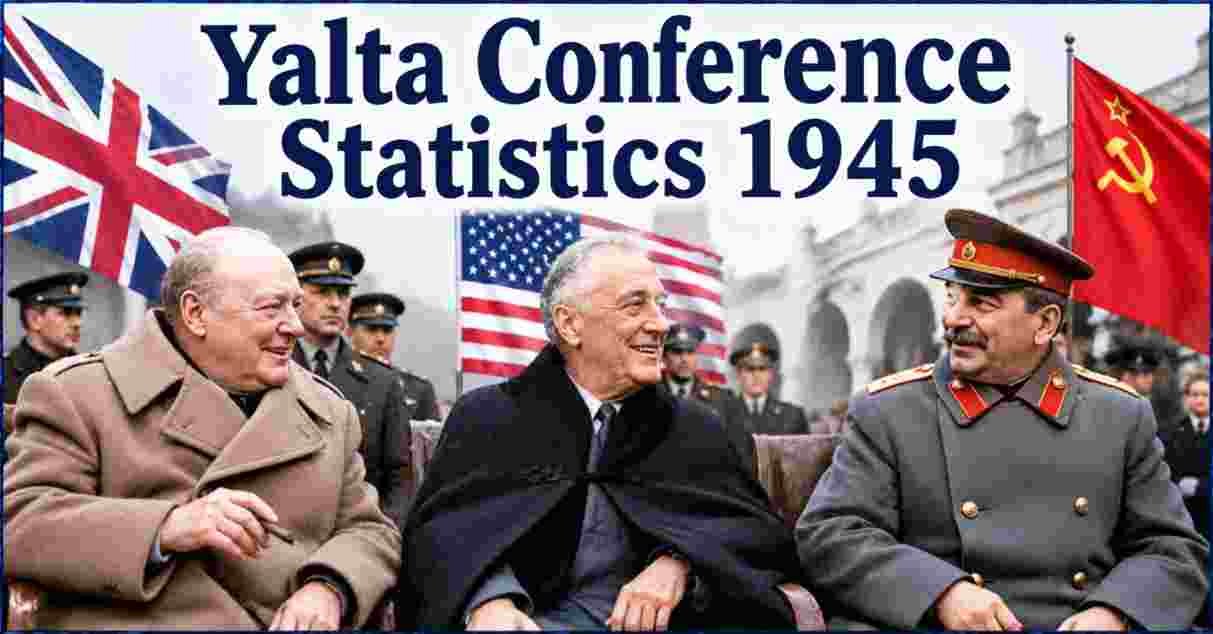
The Yalta Conference of 1945 was a meeting of three world leaders, Franklin D. Roosevelt, Winston Churchill and Joseph Stalin, held over 8 days from February 4 to 11, 1945 at the Livadia Palace in Crimea. It produced agreements on 4 occupation zones in Germany, Poland’s borders and government, Soviet entry into the war against Japan and the future United Nations, 60 days before Roosevelt died.
Yalta Conference in 1945 – Introduction
The Yalta Conference was the second of the three wartime summits attended by all of the Big Three, and it took place with Allied victory in Europe only months away. Roosevelt, Churchill and Stalin met in the Crimean resort of Yalta from February 4 to 11, 1945, under the code name Argonaut. The Yalta Conference set the plan for how to govern a defeated Germany and how to end the war in the Pacific.
The meeting still divides historians. Supporters point to the agreements on Germany, the United Nations and Japan. Critics say Roosevelt and Churchill gave Stalin too much in Eastern Europe. This report lays out the dates, the leaders, the delegations and each agreement as numbers, and it shows what happened in the weeks and months afterward. Dates and figures follow the documentary record, and where historians disagree, both views appear.
Interesting Facts about the Yalta Conference 1945
YALTA CONFERENCE KEY NUMBERS
Days of meetings                              | ████████ 8
Plenary meetings                              | ████████ 8
Leaders at the table                          | ███ 3
Occupation zones in Germany                   | ████ 4
Days from end of Yalta to Roosevelt's death   | ████████████████████████ 60
| Fact | Data |
|---|---|
| Conference dates | February 4–11, 1945 |
| Length | 8 days |
| Venue | Livadia Palace, Yalta, Crimea |
| Code name | Argonaut |
| Leaders | Roosevelt, Churchill, Stalin |
| Plenary meetings | 8 |
| Occupation zones for Germany and for Austria | 4 each |
| Reparations figure discussed | $20 billion total, half to the Soviet Union |
| Soviet entry into war against Japan | Two or three months after Germany’s surrender |
| Days between the end of Yalta and Roosevelt’s death | 60 (April 12, 1945) |
Source: U.S. Department of State, Office of the Historian, Foreign Relations of the United States, Conferences at Malta and Yalta, 1945; World History Encyclopedia; Encyclopedia.com; our day counts.
The conference ran 8 days, with 8 plenary meetings, all at the Livadia Palace. The three leaders met under the code name Argonaut. Germany was to be split into 4 occupation zones, and Austria was to receive the same arrangement. The Soviet Union demanded $20 billion in reparations from Germany, with half to go to the Soviet Union, and that sum was discussed but never fixed.
Roosevelt died on April 12, 1945, 60 days after the conference ended. Germany surrendered on May 8, 86 days after Yalta. The Soviet Union declared war on Japan on August 8, which is three months after the surrender and within the Yalta timeline. The numbers show how quickly the war’s end followed the meeting.
Yalta Conference 1945 Dates and Schedule: Eight Days of Meetings
YALTA PLENARY SESSIONS BY DATE (start time, hours after noon)
Feb 4  | █████ 5 p.m.
Feb 5  | ████ 4 p.m.
Feb 6  | ████ 4 p.m.
Feb 7  | ████ 4 p.m.
Feb 8  | ████ 4 p.m.
Feb 11 | 12 noon (final plenary)
| Date | Main Meetings |
|---|---|
| February 4 | Roosevelt-Stalin meeting at 4 p.m.; first plenary at 5 p.m.; tripartite dinner at 8:30 p.m. |
| February 5 | Second plenary at 4 p.m. |
| February 6 | Foreign ministers at noon; third plenary at 4 p.m. |
| February 7 | Fourth plenary at 4 p.m. |
| February 8 | Roosevelt-Stalin meeting at 3:30 p.m.; fifth plenary at 4 p.m. |
| February 9 | Combined Chiefs of Staff at 11 a.m.; Roosevelt-Churchill luncheon at 1:30 p.m. |
| February 10 | Conversations on Soviet entry into the war against Japan |
| February 11 | Eighth plenary at noon; tripartite luncheon at 1 p.m.; foreign ministers at 4:20 p.m. |
Source: U.S. Department of State, Office of the Historian, Foreign Relations of the United States, 1945, Conferences at Malta and Yalta, table of contents.
The schedule followed a pattern. Most plenary sessions began at 4 p.m. in the Livadia Palace, and foreign ministers or military chiefs met earlier in the day. The first plenary started at 5 p.m. on February 4, after a 4 p.m. meeting between Roosevelt and Stalin. The final plenary met at noon on February 11, followed by a luncheon and a foreign ministers’ session.
Private talks mattered as much as the plenaries. Roosevelt and Stalin met alone on February 4 and 8, and conversations on Soviet entry into the war against Japan took place on February 10. The foreign secretaries signed the Protocol of Proceedings, and the three heads of government signed the Far East agreement on February 11. Before Yalta, Roosevelt and Churchill met in Malta from January 30 to February 2.
Yalta Conference Leaders 1945: Roosevelt, Churchill and Stalin
AGE OF THE BIG THREE AT YALTA (years)
Roosevelt | ████████████████████████████ 63
Churchill | █████████████████████████████████████████████ 70
Stalin    | ████████████████████████████████████ 66
| Leader | Position | Age | Residence at Yalta |
|---|---|---|---|
| Franklin D. Roosevelt | President of the United States | 63 | Livadia Palace |
| Winston Churchill | Prime Minister of the United Kingdom | 70 | Vorontsov Villa |
| Joseph Stalin | Premier of the Soviet Union | 66 (65 by his official birth year) | Koreiz Palace |
Source: U.S. Department of State, Office of the Historian; soviet-union.com; biographical records; ages are our calculations from birth dates.
Churchill, at 70, was the oldest of the three. Roosevelt was 63, and he turned 63 five days before the conference began. Stalin was 66 by his actual birth date of December 18, 1878, or 65 by the official Soviet date of 1879. Roosevelt stayed at the Livadia Palace, where the meetings took place. Churchill stayed at the Vorontsov Villa, and Stalin at the Koreiz Palace.
Each leader arrived with a different goal. Roosevelt wanted Soviet help in the war against Japan and a role for the Soviet Union in the United Nations. Churchill pressed for free elections and democratic governments in Eastern and Central Europe, especially Poland. Stalin sought a Soviet sphere of influence, which he saw as essential to Soviet security. Roosevelt died just 60 days after the conference ended, on April 12.
Yalta Conference Delegations 1945: Foreign Ministers, Advisers and Military Chiefs
SELECTED DELEGATION MEMBERS NAMED
United States   | ██████ 6
United Kingdom  | ███ 3
Soviet Union    | ████ 4
| Delegation | Selected Members |
|---|---|
| United States | Edward Stettinius (Secretary of State), Harry Hopkins, Averell Harriman, General George Marshall, Admiral Ernest King, Admiral William Leahy |
| United Kingdom | Anthony Eden (Foreign Secretary), Sir Alexander Cadogan, Field Marshal Alan Brooke |
| Soviet Union | Vyacheslav Molotov (Foreign Commissar), Andrei Vyshinsky, Andrei Gromyko, Ivan Maisky |
| Foreign ministers who signed the protocol | Stettinius, Eden, Molotov |
| Military staff meeting | Combined Chiefs of Staff, February 9 |
Source: U.S. Department of State, Office of the Historian; standard histories of the conference; the list is selected, not complete.
The delegations included the leaders’ foreign ministers and military commanders. Edward Stettinius, Anthony Eden and Vyacheslav Molotov signed the Protocol of Proceedings as the three foreign secretaries. The American military team included General George Marshall, Admiral Ernest King and Admiral William Leahy, who met their British counterparts as the Combined Chiefs of Staff on February 9.
The lists here are selected, and the full delegations included many more aides and interpreters. Harry Hopkins, Roosevelt’s closest adviser, and Averell Harriman, the ambassador to the Soviet Union, took part in key talks. Andrei Gromyko, then the Soviet ambassador in Washington, attended. The record shows that foreign ministers met separately to settle the wording of many agreements.
Yalta Agreements 1945: Key Decisions at a Glance
MAIN YALTA DECISIONS BY TOPIC (count of core points)
Germany           | ████████ 8
Poland            | ██████ 6
United Nations    | █████ 5
Far East          | █████ 5
Liberated Europe  | ███ 3
| Topic | Decision |
|---|---|
| Germany | Four occupation zones; Allied Control Council; demilitarization; reparations commission |
| Austria and Berlin | Four zones for Austria; four sectors for Berlin |
| Poland | Eastern border near the Curzon Line; broader provisional government; free elections promised |
| United Nations | Security Council voting formula; conference called for San Francisco |
| Liberated Europe | Declaration pledging democratic governments and free elections |
| Far East | Soviet entry into war against Japan; territorial and rail concessions |
| France | A zone of occupation and a seat on the Allied Control Council |
Source: U.S. Department of State, Office of the Historian, Protocol of Proceedings and Communiqué, February 11, 1945; World History Encyclopedia; soviet-union.com.
The agreements covered five major areas. For Germany, the leaders confirmed four occupation zones and a joint Allied Control Council. For Poland, they backed a broader provisional government and free elections. For the United Nations, they set a voting formula for the Security Council and called the founding conference for April 25, 1945. For Japan, they signed a secret agreement. A Declaration on Liberated Europe pledged democratic governments.
France received a zone and a seat on the control council through the efforts of Roosevelt and Churchill, who persuaded Stalin. The Protocol of Proceedings was signed by the three foreign secretaries, and the communiqué was issued at the end of the conference. The Far East agreement stayed secret until 1946. The numbers of points per topic in our chart are our own count of the main provisions, not an official tally.
Germany Occupation Zones 1945: The Division of Germany, Austria and Berlin
OCCUPYING POWERS IN GERMANY
United States   | █ 1
United Kingdom  | █ 1
Soviet Union    | █ 1
France          | █ 1 (added at Yalta, carved from US and UK zones)
| Measure | Yalta Decision |
|---|---|
| Zones in Germany | 4 (United States, United Kingdom, Soviet Union, France) |
| Zones in Austria | 4 |
| Berlin | Four-power occupation |
| French zone | Carved out of the British and American zones |
| Governing body | Allied Control Council with a seat for France |
| Goals | Demilitarization and denazification |
| Reparations | Commission to set amounts; Germany to pay some, not all, costs |
Source: U.S. Department of State, Office of the Historian, “Yalta Conference” milestone; New World Encyclopedia; World History Encyclopedia.
Germany would be split into four zones, and Berlin would be occupied jointly by the four powers. France became the fourth occupying power at the urging of Churchill and Roosevelt, and Stalin agreed on the condition that the French zone come from the British and American zones. Austria received the same arrangement. The Allied Control Council would govern Germany as a whole.
Germany’s division did not turn out as the leaders planned. The occupation zones hardened over the following years into separate states. The leaders also agreed that Germany would bear some, but not all, responsibility for reparations. Yalta confirmed the zone structure that earlier negotiations had set, and it added France to it. The Soviet Union’s zone later became East Germany.
Poland at Yalta 1945: Borders, Government and Elections
POLAND DECISIONS AT YALTA (count)
Border points            | ██ 2
Government reorganized   | ███ 3
Elections promised       | █ 1
| Issue | Yalta Agreement |
|---|---|
| Eastern border | Curzon Line, with Poland compensated in the north and west |
| Government | Provisional government reorganized on a broader democratic basis |
| Elections | Free and unfettered elections as soon as possible |
| Stalin’s stated view | Poland “must be strong” and “free and independent” |
| Soviet motive | Poland as a historical corridor for invasion of Russia |
| Western position (Churchill) | Free elections and democratic institutions |
| Later criticism | Critics say the promises were not kept |
Source: Wikipedia, Yalta Conference, citing historians’ accounts; U.S. Department of State, Office of the Historian; Lumen Learning.
Poland was the first item on the Soviet agenda. Stalin told the leaders that Poland was a question of honor and of security, because the country had served as a corridor for invasions of Russia. He said Poland must be strong and independent. The leaders agreed on an eastern border near the Curzon Line, with Poland compensated in the north and west, and on a reorganized provisional government.
Free elections were the central promise. Stalin pledged to allow them. Roosevelt and Churchill left Yalta believing the question was settled in principle, though Polish exile leaders and later critics argued the arrangement favored the Soviet-backed government. Historians still debate whether Roosevelt and Churchill had the power to enforce it, since Soviet troops already held most of Poland. The record shows the pledge was made, not how it was kept.
Soviet Entry into the War Against Japan 1945: Yalta’s Secret Agreement
DAYS FROM YALTA TO KEY 1945 EVENTS
Roosevelt's death (Apr 12)          | ████████████ 60
Germany's surrender (May 8)         | ████████████████████ 86
Soviet declaration on Japan (Aug 8) | █████████████████████████████████████ 178
| Item | Detail |
|---|---|
| Agreement signed | February 11, 1945 by the three heads of government |
| Soviet commitment | Enter the war against Japan two or three months after Germany’s surrender |
| Soviet gains promised | South Sakhalin, the Kuril Islands and Manchurian railroad and port rights |
| Germany’s surrender | May 8, 1945 (86 days after Yalta) |
| Soviet declaration of war on Japan | August 8, 1945 (178 days after Yalta) |
| Publication of the agreement | February 1946 |
Source: U.S. Department of State, Office of the Historian, Agreement Regarding Entry of the Soviet Union Into the War Against Japan; New World Encyclopedia; our day counts.
The agreement on Japan was the conference’s major concrete accomplishment, according to the State Department. Recognizing that victory over Japan might require a long fight, the United States and Britain wanted Soviet help. Stalin agreed to enter the war two or three months after Germany surrendered, in return for territory and rights in Asia. The three heads of government signed it on February 11.
The Soviet Union declared war on August 8, 1945, 178 days after Yalta and three months after the German surrender. The agreement was secret until 1946. Churchill signed it even though he had not been directly involved in the Roosevelt-Stalin talks. Critics later said it conceded too much in Asia, and defenders said the Soviet army’s help was needed. Both views appear in historical accounts.
United Nations at Yalta 1945: Security Council Voting and Founding Conference
UN DECISIONS AT YALTA
Founding conference called for  | ████████████████ April 25, 1945, San Francisco
France as permanent member      | ██████████ agreed
Great power voting formula      | ██████████ agreed
| Item | Yalta Outcome |
|---|---|
| Founding conference | San Francisco, April 25, 1945 |
| Permanent Security Council members | United States, United Kingdom, Soviet Union, China and France |
| France’s role | Roosevelt and Churchill persuaded Stalin to accept a permanent seat |
| Voting | Agreement on a voting formula for the Security Council |
| Roosevelt’s goal | Soviet participation in the United Nations |
| Days from Yalta to San Francisco conference | 73 |
Source: World History Encyclopedia; U.S. Department of State, Office of the Historian; our day count.
The leaders agreed to call the United Nations founding conference in San Francisco for April 25, 1945, 73 days after Yalta. Roosevelt wanted Soviet participation, and the voting formula settled how the Security Council would decide. Roosevelt and Churchill persuaded Stalin that France should join the permanent members, which gave the council five permanent seats.
The voting formula gave the great powers a veto on council action, which was a priority for Stalin and accepted by Roosevelt. The conference met just after Roosevelt’s death on April 12. The United Nations system that followed rested on agreements reached at Yalta, though disputes continued over membership and representation. Our table lists the outcomes the record supports and leaves out details we could not verify here.
Yalta Reparations 1945: The $20 Billion Proposal
REPARATIONS PROPOSAL (billions of dollars)
Total demanded by the Soviet Union    | █████████████████████████████████████ 20
Share proposed for the Soviet Union   | ██████████████████ 10
Implemented                           | 0
| Item | Detail |
|---|---|
| Total reparations discussed | $20 billion |
| Share for the Soviet Union | Half, or $10 billion |
| Roosevelt’s position | Sympathetic |
| Churchill’s position | Opposed fixed sums, remembering World War I reparations |
| Outcome | The figure became a basis for discussion by a reparations commission |
| Implementation | The $20 billion figure was never implemented |
Source: Encyclopedia.com; soviet-union.com; U.S. Department of State, Office of the Historian.
Stalin proposed $20 billion in reparations from Germany, with $10 billion, half, going to the Soviet Union. Roosevelt was sympathetic, and Churchill opposed a fixed sum because he remembered how reparations after World War I had destabilized Germany. The leaders did not fix the figure. They agreed it would be the basis for a reparations commission to discuss in Moscow.
The $20 billion figure was never implemented. Reparations became a source of conflict among the occupying powers, and they were settled zone by zone instead. The record shows the number as a discussion figure only. Churchill’s concern reflected a lesson from 1919. The episode shows how the three leaders differed over how to treat Germany, even as they agreed on the zones.
Yalta Conference Aftermath 1945: Timeline From Malta to the Secret Agreement
KEY DATES AROUND YALTA (days from February 11, 1945)
Malta Conference ends (Feb 2)      | ██ -9
Yalta ends (Feb 11)                | 0
Roosevelt dies (Apr 12)            | ██████████████████ 60
Germany surrenders (May 8)         | ███████████████████████████████ 86
UN conference opens (Apr 25)       | ████████████████████████ 73
| Date | Event |
|---|---|
| January 30 – February 2, 1945 | Malta Conference between Roosevelt and Churchill |
| February 4–11, 1945 | Yalta Conference |
| April 12, 1945 | Roosevelt dies; Harry S. Truman becomes president |
| April 25, 1945 | United Nations conference opens in San Francisco |
| May 8, 1945 | Germany surrenders |
| August 8, 1945 | Soviet Union declares war on Japan |
| February 1946 | Far East agreement published |
Source: U.S. Department of State, Office of the Historian; World History Encyclopedia; our day counts.
The record shows a fast sequence. Roosevelt and Churchill met in Malta from January 30 to February 2, then flew to Crimea. After Yalta, Roosevelt died on April 12, 60 days later, and Harry Truman became president. The United Nations conference opened on April 25, and Germany surrendered on May 8. The Soviet Union entered the war against Japan on August 8.
Reaction changed over time. Initial reaction to the Yalta agreements was celebratory, and Roosevelt and many Americans saw them as proof that wartime cooperation would continue. Later critics accused Roosevelt of handing Eastern Europe and Northeast Asia to the Soviet Union. The State Department notes that the Soviets also made substantial concessions. Historians continue to weigh the two views against the documentary record.
Yalta Conference Statistics 1945 FAQ
When was the Yalta Conference?
February 4 to 11, 1945, a total of 8 days.
Where was the Yalta Conference held?
At the Livadia Palace in Yalta, on the Crimean Peninsula.
Who attended the Yalta Conference?
Franklin D. Roosevelt, Winston Churchill and Joseph Stalin.
How many plenary meetings were held at Yalta?
8, from February 4 to February 11.
What was the code name for the Yalta Conference?
Argonaut.
What was agreed about Germany at Yalta?
Germany would be divided into 4 occupation zones, with France as the fourth occupying power.
What was agreed about Poland at Yalta?
The leaders backed a reorganized provisional government, free elections and an eastern border near the Curzon Line.
What was the Yalta agreement on Japan?
The Soviet Union agreed to enter the war against Japan two or three months after Germany surrendered.
When did the Soviet Union declare war on Japan?
August 8, 1945, three months after Germany’s surrender.
What were the Yalta reparations?
The Soviet Union proposed $20 billion, half for itself. The figure was never implemented.
What was decided about the United Nations at Yalta?
The leaders called the founding conference for April 25, 1945 in San Francisco and agreed on a Security Council voting formula.
Where did the leaders stay at Yalta?
Roosevelt at the Livadia Palace, Churchill at the Vorontsov Villa and Stalin at the Koreiz Palace.
How old were the leaders at Yalta?
Roosevelt was 63, Churchill 70 and Stalin 66, or 65 by his official birth year.
When did Roosevelt die after Yalta?
On April 12, 1945, 60 days after the conference ended.
Was the Yalta Conference a success?
Reaction at first was celebratory, but later critics said it gave too much to the Soviet Union. The State Department notes that the Soviets also made concessions. Historians still debate its legacy.
Where was the conference before Yalta?
Roosevelt and Churchill met at Malta from January 30 to February 2, 1945.
Disclaimer: This research report is compiled from publicly available sources. While reasonable efforts have been made to ensure accuracy, no representation or warranty, express or implied, is given as to the completeness or reliability of the information. We accept no liability for any errors, omissions, losses, or damages of any kind arising from the use of this report.