
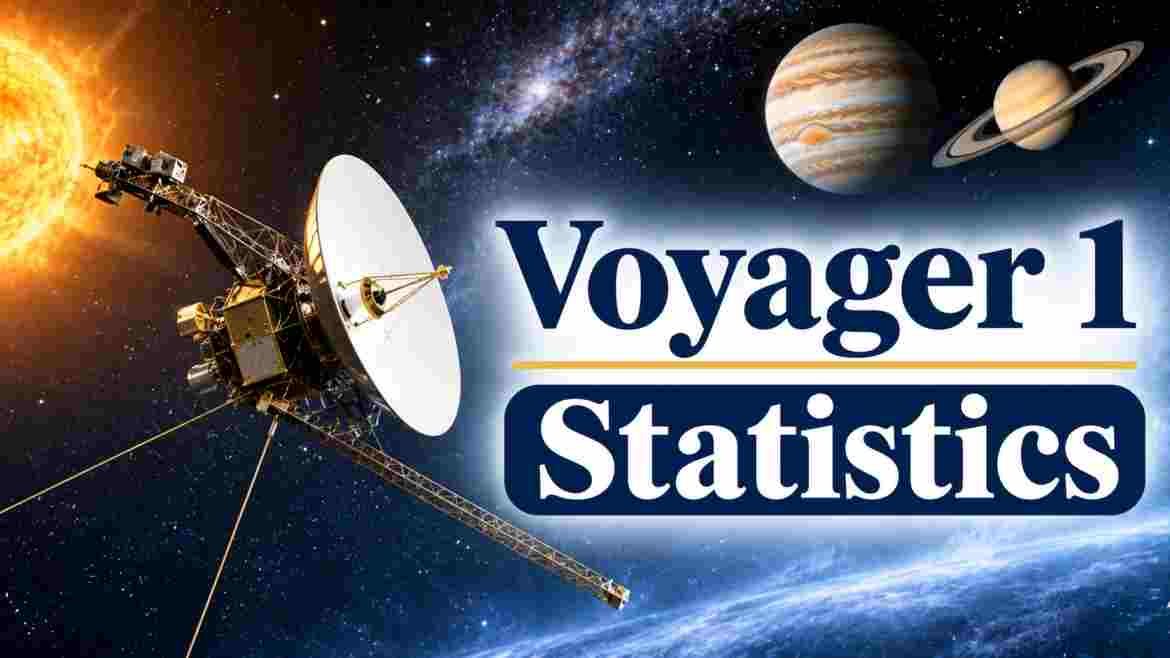
NASA says Voyager 1 will reach one light-day from Earth, a distance of 16.094 billion miles (25.902 billion kilometers), at 5:16:07 a.m. EST on Wednesday, November 18, 2026. It will be the first human-made object to travel that far, 49 years after its September 5, 1977 launch.
Voyager 1 Statistics 2026 – Introduction
Voyager 1 statistics 2026 center on one milestone. On November 18, the spacecraft will be as far from Earth as light travels in 24 hours. No human-made object has ever reached that distance. Voyager 1 is also the most distant human-made object, and it still sends data home from interstellar space, 49 years after its launch.
The probe is aging. Only 2 of its 10 instruments still work, and engineers have switched off several to save power. NASA marks the day with a worldwide light show on November 17 and a briefing on November 19. This report covers distance, speed, light-travel comparisons, mission history, instruments and the planned events, using NASA’s published figures.
Interesting Facts About Voyager 1 in 2026
Light Travel Time to Voyager 1 vs Other Targets (1 block = 1 hour)
Sun               | ▏ 0.14 hours (8 min 20 sec)
Neptune           | ████▏ 4.2 hours
Voyager 1         | ████████████████████████ 24 hours
| Fact | 2026 Data |
|---|---|
| One light-day date | November 18, 2026, 5:16:07 a.m. EST |
| Distance at that moment | 16.094 billion miles (25.902 billion km) |
| Launch date | September 5, 1977 |
| Time to reach one light-day | 49 years, 2 months, 11 days |
| Speed | Nearly 38,000 mph (61,000 kph) |
| Entered interstellar space | August 2012 |
| Instruments still on | 2 of 10 |
| Light travel time from Earth | 24 hours |
Source: NASA, Voyager 1 One-Light Day Activities (November 10, 2026); NASA Science, What Is a Light-Day and Where Are Voyager 1 and 2 Now (November 2026).
The table shows how extreme the numbers are. A signal sent from Earth takes 24 hours to reach Voyager 1, and the reply takes another 24 hours. NASA project manager Suzanne Dodd says anyone who says hello to Voyager must wait about two days for a response. The distance is 16,094,799,096 miles, the exact length of a light-day.
Voyager 1 travels at nearly 38,000 mph, yet that speed is slow next to light. Light covers about 186,000 miles every second. NASA says the spacecraft needed 49 years, 2 months and 11 days to travel one light-day. Voyager 1 entered interstellar space in August 2012 and is the only spacecraft besides Voyager 2 to operate outside the heliosphere.
Voyager 1 Distance From Earth 2026: How Far Is One Light-Day?
Distance in Billions of Miles (1 block = 1 billion)
Neptune (avg from Earth) | ███ 2.8
Voyager 1 at light-day   | ████████████████ 16.094
| Measure | Value |
|---|---|
| Distance in miles | 16,094,799,096 |
| Distance in kilometers | 25,902,068,356 |
| Rounded | 16.094 billion miles |
| Time at light-day | 5:16:07 a.m. EST (2:16:07 a.m. PST) |
| Neptune from Earth (average) | About 2.8 billion miles |
| Speed of light | About 186,000 miles per second |
Source: NASA Science, Voyager 1: What Is a Light-Day (updated November 12, 2026); NASA Science, Where Are Voyager 1 and 2 Now.
A light-day is a distance, not a time. NASA defines it as 16,094,799,096 miles, or 25,902,068,356 kilometers. Voyager 1 will pass that mark on November 18, 2026 at 5:16:07 a.m. EST, which is 2:16:07 a.m. Pacific time. NASA’s live odometer on its Voyager page tracks the count in real time.
For scale, Neptune, the farthest planet, sits an average of about 2.8 billion miles from Earth. Voyager 1 is far beyond it. Voyager 2 took 12 years to reach Neptune. Voyager 1 never visited Neptune: it left the planets behind in 1980 and headed for interstellar space.
Light Travel Time Comparisons 2026: How Long Does a Signal Take?
One-Way Light Time
Moon       | ▏ 1.3 seconds
Sun        | ▏ 8 min 20 sec
Mars       | ▏ 3 to 22 minutes
Neptune    | ████▏ 4 hr 10 min
Voyager 1  | ████████████████████████ 24 hours
| Target | Distance | Light Travel Time |
|---|---|---|
| Moon | 238,855 miles | 1.3 seconds |
| Sun | 93 million miles | 8 minutes 20 seconds |
| Mars | Varies | 3 to 22 minutes |
| Neptune | About 2.8 billion miles | 4 hours 10 minutes |
| Voyager 1 | 16.094 billion miles | 24 hours |
| Proxima Centauri | 24.95 trillion miles | 4.24 years |
Source: NASA Science, Voyager 1: What Is a Light-Day (November 12, 2026).
Light reaches the Moon in 1.3 seconds. Astronauts on the Artemis II mission needed about three days to get there. Sunlight takes 8 minutes and 20 seconds to reach Earth. A radio signal to Mars takes 3 to 22 minutes, depending on where the planets sit in their orbits. Neptune is 4 hours and 10 minutes away.
Voyager 1 sits at 24 hours, the longest light time of any human-made object. The nearest star system, Proxima Centauri, is 4.24 light-years away, about 24.95 trillion miles. A light-year is 5.88 trillion miles. In that frame, a light-day is only a short step into interstellar space, but it is the farthest humans have sent a machine.
Voyager 1 Mission Timeline 2026: Key Dates Since 1977
Voyager 1 Timeline
1977 ──► 1979 ──► 1980 ──► 1990 ──► 2012 ──► 2026 ──► 2027
Launch   Jupiter  Saturn   Pale Blue Interstellar Light-day 50th
Sept 5            Nov 12   Dot Feb 14 Aug         Nov 18   anniversary
| Date | Mission Event |
|---|---|
| September 5, 1977 | Launch, two weeks after Voyager 2 |
| March 1979 | Jupiter flyby |
| November 1980 | Saturn flyby; sent toward interstellar space |
| February 14, 1990 | Pale Blue Dot image; cameras turned off |
| August 2012 | Entered interstellar space |
| November 18, 2026 | One light-day from Earth |
| 2027 | 50th anniversary; NASA+ documentary planned |
Source: NASA Science, Voyager mission pages; NASA, Voyager 1 One-Light Day Activities.
Voyager 1 launched on September 5, 1977, two weeks after its twin. The mission took advantage of a planetary alignment that comes around once every 176 years. Voyager 1 flew past Jupiter and Saturn, then took what NASA calls the high road in 1980, steering away from the planets toward interstellar space.
The spacecraft turned its cameras on Earth in 1990 to take the Pale Blue Dot image. NASA turned them off on February 14, 1990. Voyager 1 crossed into interstellar space in August 2012, the first spacecraft to do so. Voyager 2 followed in 2018. NASA plans a documentary for 2027, the mission’s 50th anniversary.
Voyager 1 Instruments 2026: Which Instruments Still Work?
Voyager 1 Instruments by Status
Operating      | ██ 2
Switched off   | ████████ 8
| Instrument | Voyager 1 Status |
|---|---|
| Magnetometer (MAG) | On |
| Plasma Wave Subsystem (PWS) | On |
| Cosmic Ray Subsystem (CRS) | Off, February 25, 2025 |
| Low-Energy Charged Particles (LECP) | Off, April 17, 2026 |
| Ultraviolet Spectrometer (UVS) | Off, April 19, 2016 |
| Planetary Radio Astronomy (PRA) | Off, January 15, 2008 |
| Plasma Science (PLS) | Off, February 1, 2007 |
| Infrared Interferometer (IRIS) | Off, June 3, 1998 |
| Cameras (ISS) | Off, February 14, 1990 |
| Photopolarimeter (PPS) | Off, January 29, 1980 |
Source: NASA Science, Where Are Voyager 1 and 2 Now, Instrument Status (updated April 17, 2026).
Only the magnetometer and the plasma wave subsystem still work. NASA switched off the cosmic ray subsystem on February 25, 2025 and the low-energy charged particle instrument on April 17, 2026, both to save power. The plasma science instrument and photopolarimeter were shut down because their performance degraded, not because of power.
The shutdowns follow a pattern. NASA turned off the cameras in 1990, the ultraviolet spectrometer in 2016 and other instruments over the years, one by one, to keep the spacecraft running. The two instruments that remain continue to measure the magnetic fields and plasma waves of interstellar space, data no other spacecraft can collect.
Voyager 1 vs Voyager 2 in 2026: How Do the Twins Compare?
Instruments Still On
Voyager 1 | ██ 2
Voyager 2 | ███ 3
| Measure | Voyager 1 | Voyager 2 |
|---|---|---|
| Launch | September 5, 1977 | Two weeks earlier |
| Entered interstellar space | 2012 | 2018 |
| Speed | Nearly 38,000 mph | About 35,000 mph |
| One light-day from Earth | November 18, 2026 | November 2035 |
| Instruments on | 2 | 3 |
| Planets visited | Jupiter, Saturn | Jupiter, Saturn, Uranus, Neptune |
Source: NASA Science, Voyager 1: What Is a Light-Day; NASA Science, Where Are Voyager 1 and 2 Now.
Voyager 2 took a slower path to visit Uranus and Neptune, so it trails Voyager 1. It entered interstellar space in 2018, six years after its twin. NASA says Voyager 2 will reach one light-day in November 2035, nine years after Voyager 1. It travels at about 35,000 mph.
Voyager 2 has one more working instrument. Its magnetometer, plasma wave subsystem and cosmic ray subsystem remain on, while Voyager 1’s cosmic ray instrument is off. Both spacecraft continue to provide observations of the environment beyond the heliosphere, the bubble of particles and magnetic fields generated by the Sun.
Voyager 1 One-Light Day Events 2026: What Is NASA Planning?
Event Calendar, November 2026
Nov 17 ──► Nov 18 ──► Nov 19
Shine Bright  Light-day    JPL briefing
| Date | Event |
|---|---|
| November 17, 2026 | “Shine Bright for Voyager’s Light-Day,” after sunset |
| November 18, 2026 | Voyager 1 reaches one light-day, 5:16:07 a.m. EST |
| November 19, 2026 | JPL discussion, 12 p.m. EST (9 a.m. PST) |
| 2027 | NASA+ Voyager documentary planned |
Source: NASA, Voyager 1 One-Light Day Activities (updated November 13, 2026).
On November 17, NASA invites everyone to create a symbolic wave of golden light around the planet after sunset. People can flash the call sign “VGR” in Morse code with phones, flashlights or whole buildings, using a NASA web tool. On November 19, JPL hosts a moderated discussion in von Kármán Auditorium about the status of Voyager 1 and 2.
Six participants are listed: Nicky Fox, Jonathan Lunine, Suzanne Dodd, Linda Spilker, Kareem Badaruddin and Jamie Rankin. The event will include a media question-and-answer session and a preview of the 2027 documentary. NASA’s live broadcast will be available online. The Voyager mission is managed by Caltech for NASA’s Jet Propulsion Laboratory and funded by the Heliophysics Division.
Voyager 1 Destination 2026: Where Is the Spacecraft Headed?
Distance to Voyager 1's Target Star (light-years)
Proxima Centauri | ████▏ 4.24
AC +79 3888      | █████████████████ 17+
| Measure | Value |
|---|---|
| Target star | AC +79 3888 (Gliese 445) |
| Constellation | Ursa Minor, the Little Bear |
| Distance to the star from Earth | More than 17 light-years |
| Closest approach | About 1.7 light-years |
| Time to closest approach | About 40,000 years |
| Nearest star system to Earth | Proxima Centauri, 4.24 light-years |
Source: NASA Science, Voyager 1: What Is a Light-Day (November 12, 2026).
Voyager 1 is headed toward an obscure star called AC +79 3888, also known as Gliese 445, in the constellation Ursa Minor. The star is more than 17 light-years from Earth. NASA expects the probe to pass within about 1.7 light-years of it in roughly 40,000 years.
The journey is long even at 38,000 mph. The nearest star system to our own, Proxima Centauri, is 4.24 light-years away. The Andromeda galaxy, the closest large galaxy to the Milky Way, is about 2.5 million light-years away. Voyager 1 carries a Golden Record, a message to other stars, as it travels.
Voyager 1 Communication 2026: How Does NASA Talk to a Spacecraft One Light-Day Away?
Round-Trip Message Time (1 block = 4 hours)
Mars, best case   | ▏ about 6 minutes
Neptune           | ██ 8 hours 20 minutes
Voyager 1         | ████████████ about 48 hours
| Communication Fact | Detail |
|---|---|
| One-way light time | 24 hours |
| Round trip | About 2 days |
| Network used | NASA’s Deep Space Network |
| Network manager | Jet Propulsion Laboratory |
| Mission funding | NASA Heliophysics Division |
| Spacecraft operator | Caltech-managed JPL |
Source: NASA, Voyager 1 One-Light Day Activities (November 10, 2026); NASA Science, Where Are Voyager 1 and 2 Now.
Every command to Voyager 1 faces a one-way delay of 24 hours. Dodd, the Voyager project manager, says anyone who sends a message must then wait about two days for the reply. By comparison, a signal to Mars takes 3 to 22 minutes one way. Engineers must plan each instruction carefully, because they cannot see the result until a day later.
NASA’s Deep Space Network, managed by the Jet Propulsion Laboratory, makes the link possible. The Voyager mission is funded by the Heliophysics Division at NASA Headquarters, and Caltech manages JPL for NASA. Both spacecraft keep returning observations of the space beyond the heliosphere. NASA’s call-sign light show on November 17 flashes “VGR” in Morse code as a symbolic message to the spacecraft.
Cosmic Distances 2026: Where Does One Light-Day Fit?
Distance Ladder, Miles (log-style comparison)
Moon           | ▏ 238,855
Sun            | ▎ 93 million
Neptune        | █ 2.8 billion
Voyager 1      | ███ 16.094 billion
Light-year     | ██████████████ 5.88 trillion
Proxima        | ████████████████████ 24.95 trillion
| Object or Unit | Distance in Miles |
|---|---|
| Moon (average) | 238,855 |
| Sun | 93 million |
| Neptune (average from Earth) | 2.8 billion |
| Voyager 1 at one light-day | 16.094 billion |
| One light-year | 5.88 trillion |
| Proxima Centauri | 24.95 trillion |
| Andromeda galaxy | 2.5 million light-years |
Source: NASA Science, Voyager 1: What Is a Light-Day (November 12, 2026).
NASA uses light travel time to describe distances that are too large for everyday units. A light-day is 16.094 billion miles. A light-year is 5.88 trillion miles. Proxima Centauri, the nearest neighboring star system, lies about 24.95 trillion miles away, or 4.24 light-years. Voyager 1 has covered only a small part of that gap.
The Andromeda galaxy is about 2.5 million light-years from the Milky Way. At the other end of the scale, the Moon is 238,855 miles away. The gap between light-day and light-year shows why astronomers switch units. Voyager 1 will pass 16.094 billion miles on November 18, a record for a spacecraft but a tiny step on the scale of the galaxy.
Voyager 1 Statistics FAQ 2026
When Does Voyager 1 Reach One Light-Day?
November 18, 2026 at 5:16:07 a.m. EST (2:16:07 a.m. PST), according to NASA.
How Far Is Voyager 1 From Earth in 2026?
At one light-day, 16.094 billion miles (25.902 billion kilometers) from Earth.
What Is a Light-Day?
The distance light travels in 24 hours: 16,094,799,096 miles, or 25,902,068,356 kilometers.
When Was Voyager 1 Launched?
September 5, 1977, two weeks after Voyager 2.
How Long Has Voyager 1 Been in Space?
NASA says it took 49 years, 2 months and 11 days to reach one light-day from Earth.
How Fast Is Voyager 1?
Nearly 38,000 mph (61,000 kph).
How Long Does a Signal Take to Reach Voyager 1?
24 hours one way, so a reply takes about two days.
Is Voyager 1 the Most Distant Human-Made Object?
Yes. NASA says it is the most distant human-made object and the first to reach one light-day.
When Did Voyager 1 Enter Interstellar Space?
August 2012. Voyager 2 entered in 2018.
Which Voyager 1 Instruments Still Work?
Two: the magnetometer and the plasma wave subsystem.
When Will Voyager 2 Reach One Light-Day?
November 2035, according to NASA.
Where Is Voyager 1 Headed?
Toward the star AC +79 3888, which it will pass at about 1.7 light-years in roughly 40,000 years.
What Is the Shine Bright for Voyager Event?
On November 17, NASA invites people worldwide to flash “VGR” in Morse code after sunset with phones, flashlights or buildings.
What Is the November 19 NASA Event?
A moderated discussion at JPL at 12 p.m. EST on the status of Voyager 1 and 2, with a preview of the 2027 documentary.
How Long Does Light From Earth Take to Reach Voyager 1?
24 hours, so a round trip takes about two days.
Does Voyager 1 Still Send Data Home?
Yes. NASA says it continues to return observations from beyond the heliosphere.
Who Speaks at the NASA Voyager Event on November 19?
Nicky Fox, Jonathan Lunine, Suzanne Dodd, Linda Spilker, Kareem Badaruddin and Jamie Rankin are the listed participants.
When Is the Voyager 50th Anniversary?
2027, when NASA plans to release a Voyager documentary on NASA+.
Which Star Will Voyager 1 Pass?
AC +79 3888, also called Gliese 445, in the constellation Ursa Minor.
What Is on the Voyager Golden Record?
NASA describes Voyager 1 as carrying humanity’s message toward other stars on its Golden Record as it travels through interstellar space far beyond the planets.
Disclaimer: This research report is compiled from publicly available sources. While reasonable efforts have been made to ensure accuracy, no representation or warranty, express or implied, is given as to the completeness or reliability of the information. We accept no liability for any errors, omissions, losses, or damages of any kind arising from the use of this report.