
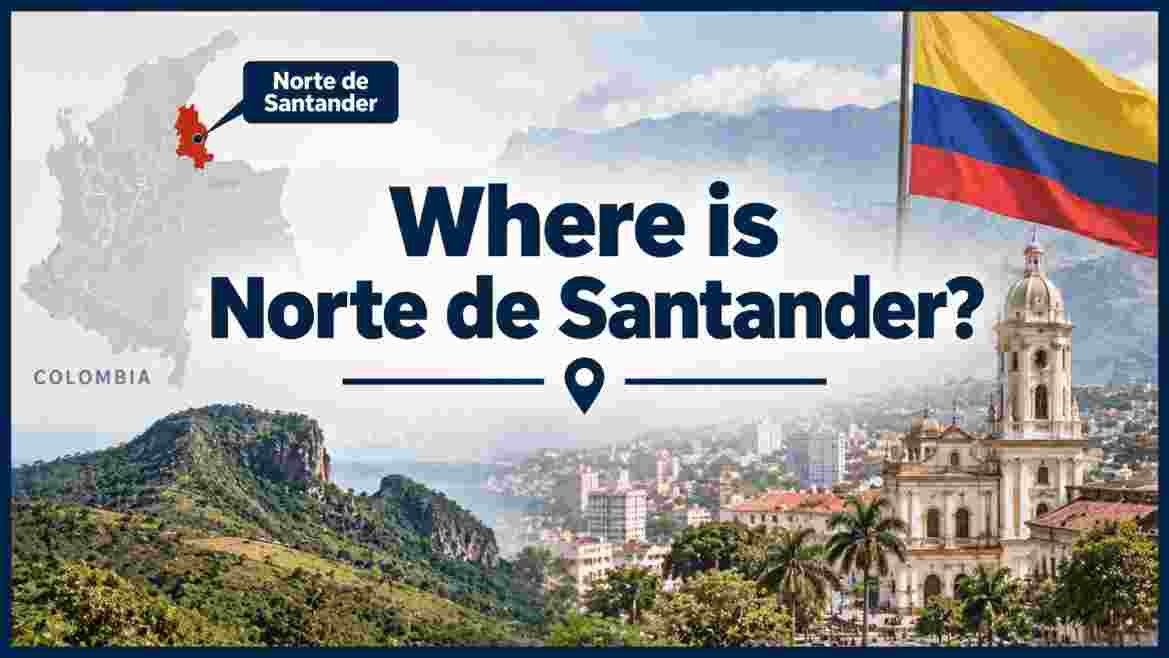
Norte de Santander is a department in northeastern Colombia covering 21,648 square kilometers, bordering Venezuela to the north and east, with a 2023 population of 1,658,835 and its capital, Cúcuta, sitting directly on the Venezuelan border. Established in 1910 and home to 40 municipalities across 6 provinces, the department is one of Colombia’s most important — and most strained — border regions, shaped for over a decade by mass Venezuelan migration.
Where is Norte de Santander – Introduction
Norte de Santander sits tucked into the northwestern corner of the Colombian Andes, a department whose entire modern identity is defined by one fact of geography: it shares a long, porous frontier with Venezuela. That single detail explains almost everything distinctive about the region — its role in Colombia’s independence history, its position at the center of the Western Hemisphere’s largest migration crisis, and the mix of coal, coffee, and cross-border commerce that shapes its economy today. The department takes its name from Francisco de Paula Santander, the Colombian military and political leader born near Cúcuta, whose legacy is written into the region’s capital city and its institutions.
Geographically, Norte de Santander is bordered by Venezuela to the east and north, by Santander Department and Boyacá Department to the south, and by Santander Department and Cesar Department to the west. It sits within Colombia’s Andes Region, and its terrain ranges from the warm, humid lowlands around the Catatumbo River in the northeast to cold, temperate mountain climates along its southern boundary with Santander. That geographic diversity, combined with its frontier position, makes Norte de Santander one of the more complex departments to describe in a single sentence — equal parts historic heartland, mountain agricultural zone, and modern humanitarian pressure point.
Interesting Facts about Norte de Santander
| Category | Figure |
|---|---|
| Capital city | Cúcuta |
| Total area | 21,648 km² (8,358 sq mi) — 24th largest of Colombia’s departments |
| Population (2023) | 1,658,835 — 9th most populous department |
| Population density | 76.6 people per km² |
| Number of municipalities | 40, grouped into 6 provinces/regions |
| Year established | 1910 (Law of July 25, took effect July 20) |
| GDP | COP 23,057 billion (approximately US$5.4 billion), about 1.8% of Colombia’s national GDP |
| HDI | 0.770 (“high”), ranked 16th of 33 Colombian departments |
| Urban population share | 79.17% |
Norte de Santander’s defining statistic may be the least visible one on paper: its position as Colombia’s single most important gateway for Venezuelan migration. In 2019, official figures identified it as the department hosting the most Venezuelan migrants of any in Colombia, a total of 176,695 people at the time — a number that has grown substantially since as Colombia’s total Venezuelan population climbed toward 2.8 million nationally by 2026. That migration reality sits alongside a more conventional economic profile: the department’s GDP leans heavily on agriculture (23.2% of departmental GDP), coal mining (6.1%), and commerce and finance, sectors shaped in large part by the department’s role as a legal and informal trading corridor with Venezuela.
The department’s population growth over the past half-century also tells its own story of steady expansion. From 703,041 residents in 1973, Norte de Santander grew to 913,491 by 1985, 1,162,474 by 1993, and 1,491,689 by 2018 — before reaching its current 2023 figure of nearly 1.66 million. That growth has been overwhelmingly urban: nearly 80% of the department’s population now lives in cities and towns rather than rural areas, concentrated heavily around Cúcuta and its surrounding metropolitan municipalities.
Where Norte de Santander Is Located?
NORTE DE SANTANDER: BORDERING JURISDICTIONS
NORTH & EAST:  VENEZUELA
SOUTH:         SANTANDER DEPT. & BOYACÁ DEPT.
WEST:          SANTANDER DEPT. & CESAR DEPT.
| Direction | Borders |
|---|---|
| North and East | Venezuela |
| South | Santander Department and Boyacá Department |
| West | Santander Department and Cesar Department |
| Region | Andes Region, northwestern Colombia |
| Coordinates (approximate center) | 7.9°N, 72.5°W |
| Capital | Cúcuta, situated directly on the Venezuelan border |
Data Source: Wikipedia (sourced from Colombian departmental geography records)
Norte de Santander occupies the far northeastern corner of Colombia, positioned within the country’s Andes Region but distinct from the higher, colder departments further south and west. Its entire eastern and northern edge runs directly along the international border with Venezuela, making it, alongside a small number of other departments, one of Colombia’s principal frontier zones. To its south lie Santander Department and Boyacá Department, and to its west, Santander Department again together with Cesar Department — meaning Norte de Santander is bordered by Santander Department on two separate sides, reflecting the historical split between the two departments in the early twentieth century.
The department’s capital, Cúcuta, sits essentially on top of the Venezuelan frontier itself, connected to the Venezuelan city of San Antonio del Táchira by the Simón Bolívar International Bridge — historically the busiest land border crossing in all of South America. That proximity is not incidental to the department’s identity; Cúcuta’s nicknames include “Gate of the Border,” a direct reference to its function as Colombia’s primary overland connection point to Venezuela, alongside more general nicknames like “The Pearl of the North” and “Green City.”
Norte de Santander’s Area and Geography in 2026
NORTE DE SANTANDER TOTAL AREA VS. CÚCUTA MUNICIPAL AREA
DEPARTMENT TOTAL      ████████████████████████████████████████  21,648 km²
CÚCUTA MUNICIPALITY   █  1,119 km²
| Geographic Feature | Detail |
|---|---|
| Total department area | 21,648 km² (8,358 sq mi) |
| National area rank | 24th of Colombia’s 32 departments |
| Natural regions within the department | 3 — Eastern Mountain Range, Catatumbo/Zulia plains, Magdalena River valley |
| Major river systems | Catatumbo, Zulia, and tributaries of the Magdalena and Orinoco basins |
| Climate range | Warm/humid lowlands (Catatumbo, Tibú) to cold mountain climates (southern border zone) |
| Cúcuta municipal area | 1,119 km² — 64 km² urban, 1,055 km² rural |
Data Source: Wikipedia, Colombian departmental geography and IDEAM climate records
Norte de Santander’s 21,648 square kilometers place it as a mid-sized Colombian department, ranked 24th by area among the country’s 32 departments — smaller than mountainous giants like Antioquia or Meta, but larger than many of Colombia’s more compact Andean departments. Geographically, the department comprises three distinct natural regions: the Eastern Mountain Range beginning near the páramo of Santurbán and running into the mountainous Motilones area; the plains formed by the Catatumbo and Zulia Rivers to the northwest; and, to the south, the upper valley of the Magdalena River. This variety produces sharply different local climates within a relatively compact territory, ranging from the warm, humid conditions around Tibú and the Catatumbo basin to the cold mountain climates found along the border with Santander Department to the south.
Within this territory, the capital municipality of Cúcuta alone covers 1,119 square kilometers, split between a 64 km² urban core, organized into 10 communes, and a much larger 1,055 km² rural zone organized into 10 townships. That ratio — a small, dense urban core inside a much larger rural municipal boundary — is typical of major Colombian cities and reflects how Cúcuta’s formal municipal limits extend well beyond its built-up center into surrounding agricultural and semi-rural land. Readers interested in how this border geography connects to Venezuela’s own demographic and economic situation can find more detail in our Venezuela Population Statistics report.
Population of Norte de Santander in 2026
NORTE DE SANTANDER POPULATION GROWTH, 1973-2023
1973  ██████████████              703,041
1993  ████████████████████████    1,162,474
2018  ██████████████████████████████ 1,491,689
2023  ████████████████████████████████ 1,658,835
| Year | Population | Change |
|---|---|---|
| 1973 | 703,041 | — |
| 1985 | 913,491 | +29.9% |
| 1993 | 1,162,474 | +27.3% |
| 2005 | 1,243,975 | +7.0% |
| 2018 | 1,491,689 | +19.9% |
| 2023 | 1,658,835 | — |
Data Source: Wikipedia, citing DANE (Colombia’s national statistics agency)
Norte de Santander’s population has more than doubled since 1973, though its growth rate has slowed considerably in more recent decades compared with the rapid expansion of the 1970s through 1990s. The department’s 2023 population of 1,658,835 ranks it 9th among Colombia’s 33 departments by population, at a density of roughly 76.6 people per square kilometer — moderate by Colombian standards, reflecting the concentration of residents in and around Cúcuta rather than an evenly distributed population across the department’s mountainous and rural terrain.
The department’s demographic composition includes small but notable minority populations: 1.8% identify as Black or mulatto, 0.60% as Indigenous, with smaller Raizal (0.01%) and Romani (0.02%) populations rounding out the total. Norte de Santander’s population figures in 2026 also can’t be fully separated from the Venezuelan migration crisis that has reshaped the department for over a decade — Cúcuta and its surrounding municipalities have functioned simultaneously as a destination for migrants settling in Colombia and as a transit corridor for those continuing onward toward Bogotá, Medellín, and beyond, or in some cases returning toward Venezuela. For a broader look at how Venezuelan migration has reshaped population patterns across the wider region, see our Venezuela Oil Fields Statistics report, which covers related cross-border economic dynamics in the Catatumbo and Maracaibo basins.
Cities and Municipalities in Norte de Santander in 2026
NORTE DE SANTANDER: 40 MUNICIPALITIES ACROSS 6 PROVINCES
Eastern (incl. Cúcuta)      ██████  6 municipalities
Western (incl. Ocaña)       ██████████  10 municipalities
South-West (incl. Pamplona) ██████  6 municipalities
Center                      ███████  7 municipalities
South-East                  ███████  7 municipalities
Northern                    ████  4 municipalities
| City/Municipality | Role | Key Detail |
|---|---|---|
| Cúcuta | Capital, largest city | Population 812,176 (2024, municipal figure); seat of departmental government |
| Ocaña | Second-tier city, western region | Historic Complex of the Great Convention; major western hub |
| Pamplona | Historic city, south-west region | Founded 1549; former departmental capital under old Santander |
| Villa del Rosario | Eastern region, borders Cúcuta | Site of the 1821 Congress of Cúcuta that founded Gran Colombia |
| Los Patios | Eastern region, part of Cúcuta metro area | Dense residential/commercial suburb of Cúcuta |
| Tibú | Northern region, Catatumbo zone | Warm, humid climate; coal and agriculture |
Data Source: Wikipedia, TerriData (Colombia’s National Planning Department municipal database)
Norte de Santander is organized into 40 municipalities grouped across 6 regional provinces — Western, Northern, Eastern, South-West, Center, and South-East — a structure that reflects both geography and historical settlement patterns. The capital, Cúcuta, dominates the department numerically and economically; as of 2024 municipal data from Colombia’s National Planning Department, Cúcuta itself was home to 812,176 residents, a figure that swells considerably when the surrounding metropolitan municipalities of Villa del Rosario, Los Patios, El Zulia, San Cayetano, and Puerto Santander are counted alongside it as part of the broader Cúcuta metropolitan area.
Beyond the capital, Ocaña and Pamplona stand out as the department’s other historically significant cities. Ocaña, in the western province, hosts the Historical Complex of the Great Convention and functions as a key commercial hub for the department’s western reaches, while Pamplona, founded in 1549 in the south-west province, briefly served as the capital of the original, undivided Department of Santander before the 1857 split that eventually created Norte de Santander as a distinct department in 1910. Villa del Rosario, immediately adjacent to Cúcuta in the eastern province, holds particular historical weight as the site of the 1821 Congress of Cúcuta, the assembly that formally established the Republic of Gran Colombia.
The Venezuela Border and Migration Crisis in 2026
COLOMBIA'S VENEZUELAN POPULATION, 2026
TOTAL VENEZUELANS IN COLOMBIA (NATIONWIDE)  ████████████████████████████  ~2.8 million
NORTE DE SANTANDER'S 2019 MIGRANT COUNT     ████  176,695
| Metric | Figure |
|---|---|
| Main border crossing | Simón Bolívar International Bridge (Cúcuta ↔ San Antonio del Táchira) |
| Norte de Santander’s Venezuelan migrant count (2019) | 176,695 — highest of any Colombian department that year |
| Venezuelans living in Colombia nationwide (2026) | ~2.8 million |
| Status as of early 2026 | Border authorities reported relative normalcy in crossing flows |
| Humanitarian shelter capacity along the Cúcuta-Bucaramanga route | Reduced from 20 shelters to just 3 in recent years |
Data Source: UNDP, R4V regional migration platform, worldpopulationclock.net (DANE/UN WPP 2024 data)
No description of Norte de Santander in 2026 is complete without its role in the Venezuelan migration crisis, now well into its second decade. Cúcuta’s Simón Bolívar International Bridge has functioned as the single most significant overland gateway between Venezuela and Colombia throughout the crisis, and Norte de Santander held the distinction of hosting more Venezuelan migrants than any other Colombian department as early as 2019, with 176,695 counted that year alone. Colombia’s total Venezuelan population has continued climbing since, reaching an estimated 2.8 million nationally by 2026 under various forms of legal status, including the country’s Temporary Protection Status program granting eligible migrants ten years of residency.
The situation on the ground around Cúcuta has evolved considerably in recent years, and not always for the better from a humanitarian standpoint: aid organizations report that international support infrastructure along the route between Cúcuta and Bucaramanga has shrunk dramatically, with the number of operating migrant shelters falling from roughly 20 to just 3 as major aid groups have withdrawn or redirected resources toward other crossing points, including the Darién Gap route toward the United States. As of early 2026, border authorities described crossing conditions at the Simón Bolívar Bridge as relatively normal on a day-to-day basis, though observers consistently caution that political and security conditions on the Venezuelan side can shift the border’s operating status with little warning. For a wider look at how Venezuelan and Colombian migration flows have shaped patterns further north, our US Immigrant Population Statistics report tracks how South American migration has factored into broader US immigration trends.
Frequently Asked Questions
Where is Norte de Santander located?
Norte de Santander is a department in northeastern Colombia, within the country’s Andes Region. It borders Venezuela to the north and east, Santander Department and Boyacá Department to the south, and Santander Department and Cesar Department to the west.
What is the capital of Norte de Santander?
The capital is Cúcuta, a major Colombian city that sits directly on the border with Venezuela and serves as the department’s political, economic, and cultural center.
How big is Norte de Santander?
The department covers 21,648 square kilometers (8,358 square miles), making it the 24th largest of Colombia’s 32 departments by area.
What is the population of Norte de Santander?
As of 2023 data, Norte de Santander had a population of 1,658,835, ranking it the 9th most populous department in Colombia, at a density of about 76.6 people per square kilometer.
Why is Norte de Santander significant to Colombia-Venezuela relations?
Its capital, Cúcuta, sits at the Simón Bolívar International Bridge, historically South America’s busiest land border crossing, making Norte de Santander the primary gateway for Venezuelan migration into Colombia. The department hosted more Venezuelan migrants than any other Colombian department as of 2019, and it remains a central hub in Colombia’s ongoing response to Venezuela’s humanitarian and economic crisis.
What are the main cities in Norte de Santander besides Cúcuta?
Ocaña and Pamplona are the department’s other major historic cities, alongside Villa del Rosario, the site of the 1821 Congress of Cúcuta, and Los Patios, part of the greater Cúcuta metropolitan area.
When was Norte de Santander established as a department?
Norte de Santander was established by law on July 25, 1910, taking effect July 20 of that year, after being separated from the original, larger Department of Santander.
How many municipalities does Norte de Santander have?
The department contains 40 municipalities, organized into 6 regional provinces: Western, Northern, Eastern, South-West, Center, and South-East.
Disclaimer: This research report is compiled from publicly available sources. While reasonable efforts have been made to ensure accuracy, no representation or warranty, express or implied, is given as to the completeness or reliability of the information. We accept no liability for any errors, omissions, losses, or damages of any kind arising from the use of this report.