
Oil Fields in Venezuela 2026
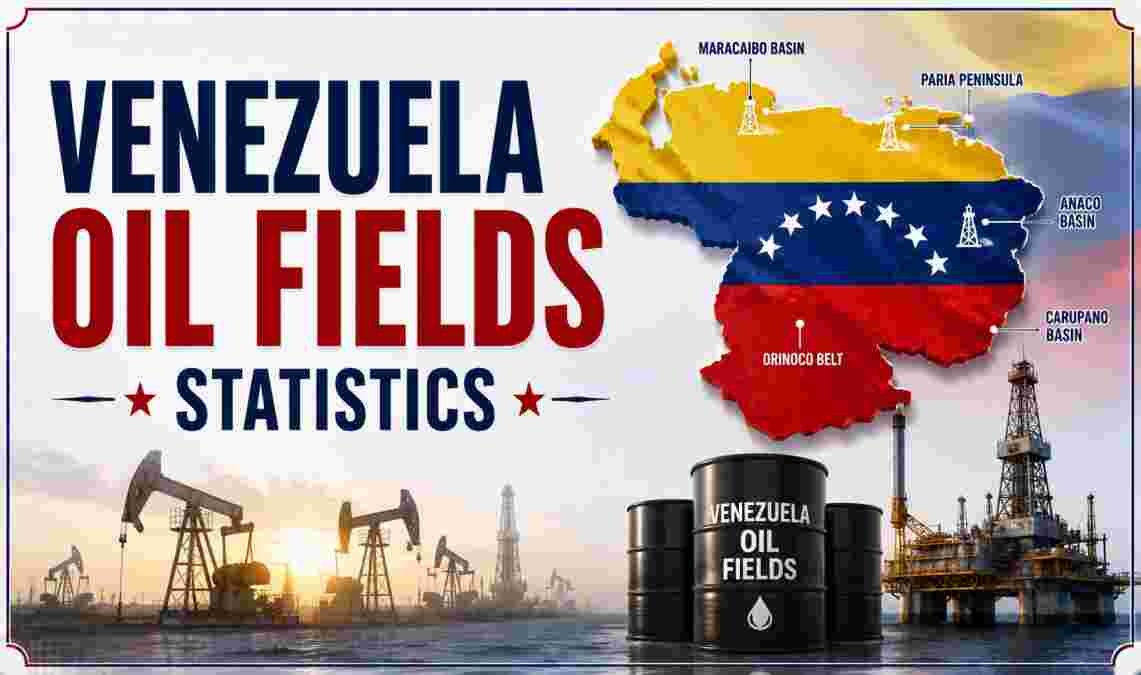
Venezuela’s oil fields are the physical production sites where the country’s 303 billion barrels of proven reserves — the largest in the world — are actually extracted from the ground. Unlike a single mega-field, Venezuela’s production is spread across hundreds of licensing blocks concentrated in three main producing basins: the Orinoco Belt in the east, the Lake Maracaibo basin in the west, and the smaller Eastern Venezuela Basin. Each basin has a distinct geological character, infrastructure history, and crude quality, which is why production costs, output rates, and foreign investment interest vary dramatically from one field to the next even within the same country. The state oil company, PDVSA (Petróleos de Venezuela, S.A.), holds majority stakes in nearly every active field, typically operating through joint ventures with international partners who bring capital and technical expertise that Venezuela’s own sanctioned and underfunded industry has struggled to provide alone.
The oil field landscape in 2026 looks dramatically different from just twelve months earlier. Following the January 3, 2026 US military operation that resulted in the capture of President Nicolás Maduro, Venezuela’s oil ministry has moved aggressively to reopen its fields to American and international operators, reforming its hydrocarbons law and, as of this week, reportedly placing 17 specific oil fields on the table in active talks with US producers. With Chevron already the dominant foreign operator and companies like Shell, ExxonMobil, Hunt Oil, and Halliburton now weighing renewed or first-time entry, Venezuela’s individual oil fields have shifted from a story about stranded, underdeveloped reserves to one of the most closely watched energy investment opportunities anywhere in the world.
Key Venezuela Oil Field Facts in 2026
| Fact | Figure |
|---|---|
| Total proven oil reserves nationally | 303 billion barrels, the largest globally |
| Orinoco Belt share of Venezuela’s oil reserves | ~90%+, roughly three-quarters by some estimates |
| Orinoco Belt geographic area | ~55,000 square kilometers (21,235 sq mi) |
| Orinoco Belt original oil in place (PDVSA estimate) | 1.36 trillion barrels |
| Orinoco Belt technically recoverable estimate (USGS 2009) | 513 billion barrels (range: 380-652 billion) |
| National crude oil production (2026, mid-year) | Crossed 1 million barrels per day |
| Exploration areas offered to foreign investors | 916 areas available, per Oil Minister Paula Henao |
| Oil fields reportedly on the table in US talks (Aug. 2026) | 17 fields |
| Foreign oil companies currently or newly engaging | Chevron, Shell, Repsol, Eni, BP, Hunt Oil, ExxonMobil (exploring) |
Source: OPEC Annual Statistical Bulletin 2025-2026; Energy Analytics Institute Orinoco Belt analysis, January 2026; Rio Times Online, August 2026; Yahoo Finance/Wall Street Journal reporting on Chevron and Halliburton deals, August 2026.
Taken together, these figures capture a genuinely rapid reopening of Venezuela’s oil sector after years of near-total isolation from Western capital. The jump to over 1 million barrels per day in mid-2026 marks a meaningful recovery from the sub-900,000 bpd levels seen during the darkest periods of sanctions enforcement, though it remains a fraction of the 3.4 million bpd the country pumped at its late-1990s peak. With 916 exploration areas now formally on offer and 17 specific fields reportedly under active discussion with US producers as of this week, the scale of the reopening effort is substantial even though, as Rio Times Online cautions, “nothing described here has been signed, published or officially acknowledged” — much of this remains reported rather than finalized policy.
What stands out most is how concentrated the actual value sits in just one region. The Orinoco Belt alone accounts for the overwhelming majority of national reserves, meaning nearly every major investment conversation happening in Caracas this year — from Chevron’s asset swaps to Hunt Oil’s first-ever Venezuelan agreement — ultimately traces back to unlocking this single, geologically extraordinary but technically challenging heavy-oil formation.
Orinoco Belt Oil Fields Statistics 2026
| Orinoco Belt Metric | Figure |
|---|---|
| The four main blocks (west to east) | Boyacá, Junín, Ayacucho, Carabobo |
| Total licensing blocks within the four areas | 36 blocks |
| Largest single concentration of resources | Junín block |
| Total belt production (July 2026) | 595,000 barrels per day, up 60,000 bpd from June |
| Carabobo block production (July 2026) | 270,000 bpd |
| Ayacucho block production (July 2026) | 165,000 bpd |
| Junín block production (July 2026) | 150,000 bpd |
| Boyacá block production (July 2026) | 11,000 bpd |
| Belt-wide production target (December 2026) | 1.235 million bpd (PDVSA president Rafael Tellechea) |
Source: S&P Global Commodity Insights, Venezuela PDVSA production report; Wikipedia Carabobo Field entry; Energy Analytics Institute, January 2026.
Orinoco Belt Block Production, July 2026 (Barrels Per Day)
Carabobo    ████████████████████████████ 270,000
Ayacucho    ████████████████ 165,000
Junín       ███████████████ 150,000
Boyacá      █ 11,000
The Orinoco Belt is organized into four strategic blocks named, west to east, Boyacá, Junín, Ayacucho, and Carabobo — a naming convention introduced under the Hugo Chávez administration to replace earlier commercial designations. Despite Junín holding the largest single concentration of resources in the entire belt, it’s actually Carabobo that leads current production at 270,000 barrels per day, illustrating how infrastructure maturity and existing joint venture partnerships often matter more for near-term output than raw underground volume alone.
The belt’s overall trajectory has been genuinely upward through 2026, climbing to 595,000 barrels per day in July, a jump of 60,000 bpd in a single month, with PDVSA’s own leadership targeting 1.235 million barrels per day belt-wide by December. Reaching that target would represent one of the most significant single-year production increases the region has seen in over a decade, though it depends heavily on whether the wave of new foreign investment currently being negotiated actually converts into completed drilling and infrastructure projects before year’s end.
Lake Maracaibo Oil Fields Statistics 2026
| Lake Maracaibo Metric | Figure |
|---|---|
| Primary field complex | Bolívar Coastal Fields (BCF), also called Bolívar Coastal Complex |
| First discovery/development year | 1914 (discovery), 1917 (development began), 1922 (production began) |
| Current production rate | 800,000 barrels per day |
| Estimated oil in place | 44 billion barrels |
| Estimated recoverable oil | ~3 billion barrels |
| Producing geological formations | La Luna and Colón formations |
| Field location | Eastern margin of Lake Maracaibo, Zulia state |
| Share of national reserves vs. national production | ~6.7% of reserves, but ~26.5% of national output |
Source: Wikipedia “Bolivar Coastal Fields” entry; Orinoco Research “Unlocking Venezuela’s Oil Rebirth,” February 2026; PDVSA operational data via Key Facts Energy.
Lake Maracaibo: Reserve Share vs Production Efficiency
Reserve Share (6.7%)      ██
Production Share (26.5%)  ██████████
The Bolívar Coastal Fields, sitting along the eastern margin of Lake Maracaibo, represent the birthplace of Venezuela’s modern oil industry, with production tracing back to 1914 — more than half a century before the Orinoco Belt was even formally evaluated. That century-plus head start explains the field’s outsized productivity relative to its reserve size: despite holding just 6.7% of national reserves, Maracaibo delivers roughly 26.5% of total national output, a productivity ratio nearly four times the national average, driven almost entirely by mature pipeline infrastructure and decades of accumulated operational expertise.
At 800,000 barrels per day, Maracaibo alone now produces nearly as much as the entire Orinoco Belt’s combined block output, underscoring why the western basin remains one of the most valuable near-term production assets in the country even as international attention increasingly focuses on Orinoco’s much larger long-term reserve potential. This basin’s oil is also generally lighter and easier to process than Orinoco’s extra-heavy crude, requiring less dilution before it can reach international refineries — a practical advantage that has helped keep Maracaibo’s infrastructure relatively better maintained through years of broader sector underinvestment.
Foreign Operator and Joint Venture Statistics 2026
| Company/Field Metric | Figure |
|---|---|
| Chevron’s existing joint ventures in Venezuela | 3 (Petropiar, Petroboscan, Petroindependencia/Petroindependiente) |
| Chevron’s April 2026 Petroindependencia stake increase | 35.79% to 49% |
| Chevron’s newly acquired development rights | Ayacucho 8 block (Orinoco Belt) |
| Chevron’s current Venezuelan JV output | ~260,000 bpd |
| Chevron’s production target | 375,000 bpd, a ~50% increase |
| Boscan field investment (Chevron, historical) | $2 billion planned, Petroboscan JV, 115,000 bpd |
| Hunt Oil status | First production agreement signed with PDVSA, August 2026 |
| SLB (Schlumberger) status | Separate exploration and services pact signed, August 2026 |
| ExxonMobil and ConocoPhillips status | Holding off; assets nationalized under Chávez, cited institutional skepticism |
Source: Insider Monkey/Wall Street Journal, August 28, 2026; PrimeXBT and CryptoBriefing Chevron investment coverage, August 2026; Fox News archive Chevron Boscan investment report.
Chevron Venezuela Production: Current vs Target (Barrels Per Day)
Current JV Output    ████████████████████████ 260,000
Target Output        ██████████████████████████████████ 375,000
Chevron stands as the clearest first-mover among American majors, having maintained operations in Venezuela even through the most difficult years of sanctions when every other large US oil company withdrew entirely. Its April 2026 asset swap with PDVSA — raising its Petroindependencia stake to 49% and securing development rights to the Ayacucho 8 block in exchange for relinquishing offshore gas interests — set the template for how renewed American investment is being structured: trading specific asset positions rather than simply injecting fresh capital into the existing state-controlled framework.
The entry of Hunt Oil and SLB in August 2026 marks a genuine expansion beyond Chevron’s solo presence, representing the first new commercial agreements between US firms and PDVSA since Maduro’s departure. Notably, ExxonMobil and ConocoPhillips remain on the sidelines, both citing lasting institutional skepticism stemming from their assets being nationalized under Hugo Chávez decades earlier — a reminder that even with reformed hydrocarbons laws and reduced fiscal burdens on offer, rebuilding trust with companies that suffered direct expropriation losses takes considerably longer than reforming the legal framework itself. Readers wanting the fuller national reserve picture behind these field-level figures can find additional context in our Venezuela oil statistics report, which breaks down the country’s complete 303-billion-barrel reserve base.
Breaking: 17 Oil Fields Reportedly Under US Talks (August 2026)
| Developing Story Metric | Detail |
|---|---|
| Number of fields reportedly on the table | 17 fields |
| Official confirmation status | Unconfirmed; no company publicly named as a party |
| Reported field condition | Many are “greenfields” lacking basic infrastructure and power |
| Estimated investment needed to develop offered fields | Billions of dollars |
| Chevron/Halliburton status | Nearing deals, per Wall Street Journal reporting, Aug. 28, 2026 |
| Executives traveling to Caracas | Expected next week (from Aug. 28, 2026) to sign production deals |
| US official expected to attend | Energy Secretary Chris Wright |
| Reformed hydrocarbons law effective date | January 29, 2026 (Gaceta Oficial 6.978 Extraordinario) |
| Constitutional constraint noted by legal analysts | Article 303 keeps all PDVSA shares in state hands; Article 13 restricts ceding national territory |
Source: Rio Times Online, August 2026; Yahoo Finance citing Wall Street Journal, August 28, 2026; Venezuelanalysis.com, March 2026; MSN/Wall Street Journal coverage, August 2026.
Venezuela Field Reopening Timeline, 2026
Jan 3    US military operation, Maduro captured
Jan 29   Reformed Hydrocarbons Law takes effect
Mar 11   Chevron/Shell reported securing major deals
Apr      Chevron-PDVSA asset swap finalized
Aug      Hunt Oil, SLB sign first new agreements
Aug 28   Reports of 17 fields on table; Chevron, Halliburton nearing deals
This week’s reporting on 17 specific oil fields being discussed with US producers represents the most concrete signal yet of how far Venezuela’s reopening has progressed, though multiple outlets have been careful to caveat that nothing has been signed, published, or officially acknowledged by either PDVSA or Venezuela’s oil ministry. What makes this round of talks notable is the description of many offered fields as “greenfields” — undeveloped sites lacking even basic infrastructure like reliable electricity, meaning any company that takes on these assets is signing up for a multi-billion-dollar, multi-year buildout rather than simply restarting existing production.
The legal backdrop adds real complexity to how quickly any of this can actually materialize: Venezuela’s constitution still reserves petroleum activity to the state under Article 302 and keeps every PDVSA share in state hands under Article 303, while Article 13 restricts ceding national territory to foreign states — constraints that haven’t been amended despite the reformed hydrocarbons law taking effect in January. With Energy Secretary Chris Wright reportedly expected to travel to Caracas alongside oil company executives as soon as next week, the coming weeks are likely to clarify whether this wave of field-level deals moves from reported negotiation to formally announced agreement. For readers interested in how Venezuela’s reserve base and OPEC membership shape its global standing, our OPEC Organisation statistics report covers the broader cartel dynamics Venezuela operates within as a founding member.
Additional Producing Fields and Infrastructure Statistics 2026
| Field/Infrastructure Metric | Figure |
|---|---|
| Monagas state crude type | Mesa and Santa Barbara light crudes |
| Monagas crude use | Refining feedstock and diluent for Orinoco extra-heavy crude |
| Punta de Mata division peak historical output (2000s) | Over 400,000 bpd |
| El Palito refinery capacity | 146,000 barrels per day |
| El Palito refinery status | Venezuela’s oldest and smallest major refining complex |
| Plataforma Deltana / Blanquilla-Tortuga offshore wells drilled since 2015 | Just 6 wells |
| New offshore 2D seismic survey coverage (completed April 2025) | 50,000 kilometers |
| Construction share of 2025 oil/gas service value | 59.72%, equating to $1.12 billion |
| New Hydrocarbons Technology and Data Management Center | Inaugurated June 2026 |
Source: S&P Global Commodity Insights; Wikipedia “2023 El Palito oil spill”; Mordor Intelligence Venezuela Oil and Gas Market report, July 2026.
Venezuela Oil Sector Service Spending, 2025 (by Category)
Construction (infrastructure rehab)    ████████████████████████ 59.72% ($1.12B)
Other services combined                ████████████████ 40.28%
Beyond the headline Orinoco and Maracaibo figures, Venezuela’s oil sector includes a network of smaller but strategically important supporting assets. Monagas state’s light crude production plays a specific technical role as the diluent that makes Orinoco’s extra-heavy crude marketable, meaning production bottlenecks in Monagas can constrain Orinoco output even when the heavy-oil blocks themselves have spare capacity. The El Palito refinery, despite being the country’s oldest and smallest major refining complex at 146,000 bpd, has drawn negative attention in recent years through a string of documented oil spills in 2020, 2021, 2023, and 2024.
The fact that offshore exploration areas like Plataforma Deltana have seen just six wells drilled since 2015 highlights how heavily Venezuela’s oil development has concentrated onshore, even as a new 50,000-kilometer 2D seismic survey, completed in April 2025, has already drawn fresh licensing interest from Shell, Equinor, and Woodside Energy for these underexplored offshore zones. With construction work accounting for nearly 60% of all 2025 oil and gas service spending, the picture that emerges is of an industry still fundamentally focused on rehabilitating existing infrastructure — well-pad expansions, flare-gas recovery units, and pipeline replacements — rather than launching entirely new greenfield megaprojects, at least for now. For readers interested in how Venezuela’s reserve base and OPEC membership shape its global standing, our overview of the largest oil producers in the world offers useful comparative context on where Venezuela’s actual output ranks globally despite its reserve dominance.
Disclaimer: This research report is compiled from publicly available sources. While reasonable efforts have been made to ensure accuracy, no representation or warranty, express or implied, is given as to the completeness or reliability of the information. We accept no liability for any errors, omissions, losses, or damages of any kind arising from the use of this report.