
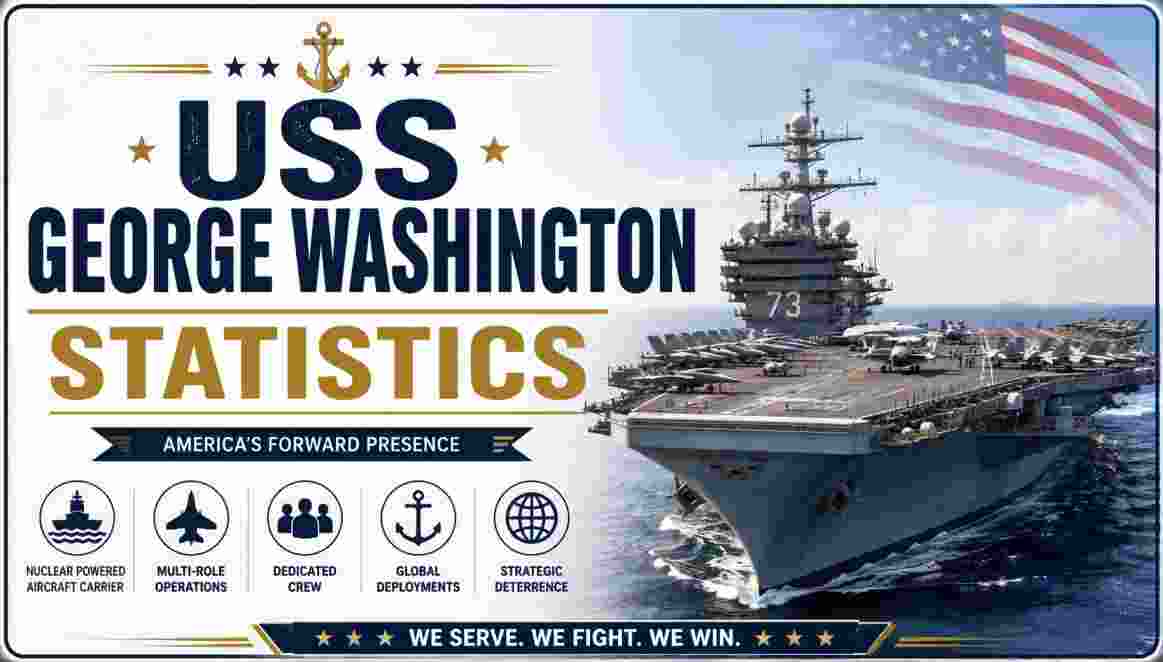
USS George Washington in 2026
USS George Washington Statistics 2026 carry fresh urgency this week, with the Navy’s only forward-deployed aircraft carrier now steaming toward the Middle East to relieve the USS Abraham Lincoln, whose crew has endured a record-setting 265-day deployment marked by reported mold, plumbing failures, and critical supply shortages. USS George Washington (CVN-73), a Nimitz-class supercarrier homeported at Yokosuka, Japan, departed the port on May 10, 2026, and was confirmed on August 13, 2026 to be transiting the Strait of Malacca en route to the Arabian Sea, a journey the Navy expects to take about a week. The move was first reported by The Wall Street Journal and later confirmed by CNN, USNI News, and Navy officials, though the Office of the Chief of Naval Operations has declined to discuss operational specifics for security reasons.
The 265-plus-day Lincoln deployment, which included roughly 200 consecutive days without a port call, has drawn sharp criticism from lawmakers including Senators Richard Blumenthal and Ruben Gallego, who are demanding Pentagon accountability over what they describe as an unsustainable operational tempo. This report breaks down the latest verified USS George Washington Statistics 2026 — covering ship specifications, crew and air wing composition, deployment history, and the carrier’s newly announced Middle East mission — using data from the US Navy, USNI News, and the Congressional Research Service.
Interesting Facts About USS George Washington Statistics 2026
| Fact Category | Details |
|---|---|
| Hull Number | CVN-73, sixth Nimitz-class carrier |
| Commissioned | July 4, 1992 — 34 years in service as of 2026 |
| Homeport | Yokosuka, Japan — only forward-deployed US carrier |
| Current Mission (Aug 2026) | Redeploying to the Arabian Sea to relieve USS Abraham Lincoln |
| 2026 Deployment Start | May 10, 2026, departed Yokosuka |
| Overall Length | 1,092 feet (332.8 meters) |
| Full-Load Displacement | ~97,000 to 104,200 tons |
| Total Crew (Ship + Air Wing) | 5,680 to 6,250 personnel |
| Aircraft Capacity | Up to 90 aircraft |
| Carrier Strike Group | CSG-5, flagship of Carrier Air Wing 5 (CVW-5) |
Data Source: U.S. Navy, USNI News Fleet Tracker, Congressional Research Service, Naval History and Heritage Command
The decision to send USS George Washington roughly 3,000 nautical miles from the South China Sea to the Arabian Sea underscores just how few options the Navy currently has for relieving an overextended carrier. As the Navy’s only forward-deployed aircraft carrier, GW is, in the words of one Forbes defense report, “currently the only aircraft carrier available that can be redirected to the region” — a stark illustration of how thin America’s 11-carrier fleet is stretched when multiple simultaneous crises demand carrier presence. The Wall Street Journal reported the redirection was described by Navy officials as part of a “regularly scheduled deployment” rotation, even as the timing coincides directly with mounting political pressure over conditions aboard the Lincoln.
USS George Washington’s own 2026 patrol, which began when she departed Yokosuka on May 10, was expected to last around six months, similar in length to her first deployment following the completion of her multi-year Refueling and Complex Overhaul (RCOH) in 2023. Before this week’s Middle East order, the carrier had spent recent months conducting high-visibility operations across the Indo-Pacific, including a landmark port visit to Da Nang, Vietnam, on July 30, 2026 — the first US carrier visit to the country since 2023 and only the fourth carrier visit since the US and Vietnam normalized relations in 1995.
USS George Washington Physical Specifications Statistics in US 2026
| Specification | Measurement |
|---|---|
| Class | Nimitz-class aircraft carrier |
| Overall Length | 1,092 feet (332.8 meters) |
| Flight Deck Width (Beam) | 252 feet (76.8 meters) |
| Waterline Beam | 134 feet (40.8 meters) |
| Maximum Draft | 41 feet (12.5 meters) |
| Full-Load Displacement | 97,000 to 104,200 long tons |
| Flight Deck Area | Approximately 4.5 acres |
| Maximum Speed | 30+ knots (35+ mph) |
| Nuclear Reactors | 2 x Westinghouse A4W pressurized water reactors |
| Propulsion Output | 260,000 shaft horsepower, 4 shafts |
| Aircraft Elevators | 4, each approximately 3,880 square feet |
Data Source: U.S. Navy Fact Files, Naval Sea Systems Command, HistoryCentral Navy Ships Database
USS George Washington Key Dimensions
Overall Length     |########################################| 1,092 ft
Flight Deck Width  |##########                              |   252 ft
Flight Deck Area   |####                                    |   4.5 acres
USS George Washington’s physical dimensions place her among the largest warships ever built, with an overall length of 1,092 feet — longer than the Empire State Building is tall — and a flight deck spanning roughly 4.5 acres, providing more usable operating space than many small civilian airports. Her two Westinghouse A4W nuclear reactors generate 260,000 shaft horsepower, driving four propeller shafts to speeds exceeding 30 knots while granting the ship a functionally unlimited operating range, since nuclear propulsion eliminates the need for underway refueling of the ship itself — a capability directly relevant to her current week-long unrefueled transit from the South China Sea to the Arabian Sea.
At a full-load displacement ranging from 97,000 to just over 104,000 tons depending on cargo and fuel load, GW carries the same core Nimitz-class hull design shared across her nine sister ships, though as the sixth vessel in the class she incorporates incremental improvements over the earliest Nimitz carriers. Her four aircraft elevators, each measuring roughly 3,880 square feet, move aircraft between the hangar bay and flight deck, a critical throughput bottleneck during the kind of sustained, high-tempo flight operations the carrier will likely be asked to support once she reaches the Middle East. For a detailed side-by-side comparison against GW’s fellow Nimitz-class vessel and the ship she is now steaming to relieve, our USS Abraham Lincoln Ship Statistics in US report offers comprehensive specifications on the carrier at the center of this week’s redeployment news.
USS George Washington Crew and Air Wing Statistics in US 2026
| Personnel Category | Number |
|---|---|
| Ship’s Company | 3,200 to 3,532 sailors |
| Air Wing Personnel | 2,480 personnel |
| Total Embarked (Full Complement) | 5,680 to 6,250 personnel |
| Embarked Air Wing | Carrier Air Wing 5 (CVW-5) |
| Assigned Carrier Strike Group | Carrier Strike Group 5 (CSG-5) |
| Strike Group Commander (2026) | Rear Adm. Eric Anduze |
| Aircraft Types Embarked | F/A-18 Super Hornets, EA-18G Growlers, E-2D Hawkeyes, MH-60 helicopters |
| Escort Vessels (2026 Deployment) | USS Robert Smalls (CG-62), USS Benfold (DDG-65), USS Shoup (DDG-86) |
| Meals Served Daily (Full Crew) | Approximately 15,000 meals |
Data Source: U.S. Navy, DVIDS (Defense Visual Information Distribution Service), USNI News Fleet Tracker
USS George Washington Personnel Breakdown (Approx.)
Ship's Company      |########################| 3,200
Air Wing Personnel  |##################      | 2,480
Total Embarked      |########################################| 5,680
With a full complement running as high as 6,250 personnel during peak operations, USS George Washington functions as a self-contained floating city, running around-the-clock watch rotations to sustain everything from nuclear reactor monitoring to flight deck catapult operations. The 3,200-plus ship’s company handles the vessel’s core operation and maintenance, while the roughly 2,480-strong air wing — flying under Carrier Air Wing 5 (CVW-5) — manages the embarked squadrons of F/A-18 Super Hornets, EA-18G Growler electronic-warfare jets, E-2D Hawkeye early-warning aircraft, and MH-60 helicopters that give the carrier both its offensive punch and its self-defense picture. The galley alone serves an estimated 15,000 meals a day, a logistical operation on the scale of a mid-sized restaurant chain, running continuously to keep the crew fed through rotating shift patterns as tight as four hours on duty, eight hours off.
Rear Adm. Eric Anduze, commander of Carrier Strike Group 5, leads the formation now escorting GW westward, which includes the Ticonderoga-class cruiser USS Robert Smalls (CG-62) and the Arleigh Burke-class destroyer USS Benfold (DDG-65), alongside USS Shoup (DDG-86), which accompanied the carrier during her earlier South China Sea and Vietnam port-call operations. This multi-ship escort formation provides layered air, surface, and undersea defense for the carrier during her Middle East transit — a defensive architecture whose broader technical underpinnings, including reactor design and next-generation launch systems now entering the fleet, are explored in depth in our Nuclear Powered Aircraft Carriers Statistics report.
USS George Washington 2026 Deployment and Middle East Statistics in US 2026
| Deployment Metric | Detail |
|---|---|
| 2026 Deployment Departure Date | May 10, 2026, from Yokosuka, Japan |
| Expected Deployment Length | Approximately 6 months |
| South China Sea Transit | July 22–28, 2026, via Luzon Strait |
| Da Nang, Vietnam Port Call | July 30 – early August 2026, first since 2023 |
| Vietnam Carrier Visits Since 1995 | 4th visit total |
| Strait of Malacca Transit | Confirmed August 13, 2026 |
| Middle East Redirect Announced | August 13, 2026, first reported by The Wall Street Journal |
| Estimated Time to Reach Arabian Sea | About 1 week from Malacca Strait |
| Carrier Being Relieved | USS Abraham Lincoln (CVN-72), deployed 265+ days |
Data Source: USNI News, U.S. Navy 7th Fleet, DVIDS, Wall Street Journal, Stars and Stripes
USS George Washington 2026 Deployment Timeline
May 10   |##                        | Departed Yokosuka
Jun      |#####                     | Valiant Shield exercises, Philippine Sea
Jul 22-28|##############            | South China Sea, Luzon Strait transit
Jul 30   |################          | Da Nang, Vietnam port call
Aug 11   |####################      | South China Sea, HMAS Perth exercise
Aug 13   |######################    | Strait of Malacca, redirected to Middleeast
USS George Washington’s 2026 patrol has followed a deliberate arc through some of the most strategically watched waters in the Indo-Pacific before this week’s abrupt pivot westward. After departing Yokosuka on May 10, the carrier participated in the Valiant Shield joint exercises with the Japan Maritime Self-Defense Force in June, then transited the Luzon Strait and operated in the South China Sea from July 22 to 28, waters where tensions between China and the Philippines over competing maritime claims continue to run high. The carrier’s Da Nang port call on July 30 was a genuinely historic diplomatic moment — the first US carrier visit to Vietnam since 2023 and just the fourth since the two nations normalized relations in 1995 — with GW’s crew hosting public tours and community events during the five-day stop, alongside escort ships USS Robert Smalls and USS Shoup.
That diplomatic and deterrence-focused mission shifted dramatically on August 13, 2026, when Navy statements and open-source ship-tracking data confirmed GW was in the Strait of Malacca, the critical chokepoint linking the Pacific and Indian Oceans, en route to relieve the USS Abraham Lincoln. The redirection comes as reports emerge of severe crew welfare conditions aboard the Lincoln during her 265-plus-day deployment, which included support for Operation Epic Fury, the joint US-Israeli campaign against Iranian targets that began in late February 2026. With Lincoln’s deployment already twice-extended and now representing what Senator Blumenthal has called a “record stretch at sea,” GW’s roughly week-long transit to the Arabian Sea is being watched closely by lawmakers and naval analysts alike as a test of how quickly the Navy’s stretched carrier fleet can respond to a genuine crew-welfare emergency.
USS George Washington Refueling, Overhaul and Cost Statistics in US 2026
| RCOH/Cost Metric | Detail |
|---|---|
| RCOH Start Date | August 2017 |
| RCOH Completion Date | May 2023 |
| RCOH Duration | Approximately 4 years, extended beyond original schedule |
| Reason for Extension | Additional repairs identified after initial refueling work |
| Typical Nimitz-Class RCOH Cost | Approximately $4 billion (comparable-class benchmark) |
| Original Nimitz-Class Construction Cost | Approximately $4.5 billion (class average, then-year dollars) |
| Reactor Refueling Interval | 20 to 25 years between refuelings |
| Designed Total Service Life | 50 years |
| First Post-RCOH Deployment | 2025, roughly 6-month patrol |
Data Source: Naval Sea Systems Command, Newport News Shipbuilding, Congressional Research Service
USS George Washington RCOH Timeline
2017  |####                            | RCOH begins
2020  |####################            | Midpoint, extended repairs found
2023  |################################| RCOH completed, returned to service
USS George Washington’s Refueling and Complex Overhaul, which began in August 2017 and was not completed until May 2023, represents one of the most extensive maintenance undertakings in naval history, effectively rebuilding the carrier at the midpoint of her 50-year designed service life. The multi-year process, carried out at Newport News Shipbuilding — the only US facility capable of building or refueling nuclear carriers — required defueling and re-fueling both Westinghouse A4W reactors, a procedure that, based on the comparable RCOH completed for sister ship USS Abraham Lincoln, typically costs in the range of $4 billion. The overhaul’s extension beyond its original schedule, driven by additional repairs identified once work was underway, delayed GW’s return to operational service and pushed her first post-overhaul deployment into 2025.
That 2017–2023 investment is precisely what makes GW’s current week-long unrefueled sprint toward the Arabian Sea possible without any concern for fuel logistics — her reactors, refueled during the RCOH, carry sufficient enriched uranium to operate for another 20 to 25 years without needing to return to port for propulsion purposes. Set against the Navy’s broader shipbuilding and maintenance investment picture, where the FY2026 Department of the Navy budget totals $292.2 billion with $47.3 billion earmarked specifically for shipbuilding, GW’s overhaul cost represents a small fraction of the sustained, multi-decade financial commitment required to keep an 11-carrier fleet — the legally mandated statutory minimum — continuously operational. Readers wanting the fuller picture of how that budget is allocated across the Navy’s destroyer, submarine, and carrier programs can find further detail in our US Warships Statistics report.
USS George Washington vs USS Abraham Lincoln Statistics 2026
| Comparison Metric | USS George Washington (CVN-73) | USS Abraham Lincoln (CVN-72) |
|---|---|---|
| Commissioned | July 4, 1992 | November 11, 1989 |
| Homeport | Yokosuka, Japan | NAS North Island, San Diego |
| Current Deployment Start | May 10, 2026 | November 24, 2025 |
| Deployment Length (as of Aug 13, 2026) | ~95 days | 265+ days |
| Assigned Air Wing | CVW-5 | CVW-9 |
| Carrier Strike Group | CSG-5 | CSG-3 |
| RCOH Completed | May 2023 | May 2017 |
| RCOH Cost | ~$4 billion (est.) | ~$4 billion (confirmed) |
| Consecutive Days Without Port Call (Lincoln) | N/A | ~200 days |
Data Source: USNI News, U.S. Navy, Stars and Stripes, Eurasia Business News
Deployment Length Comparison (Days at Sea, as of Aug 13, 2026)
USS George Washington |###################                    |  ~95 days
USS Abraham Lincoln   |#######################################| 265+ days
The contrast between the two carriers at the heart of this week’s news could hardly be starker. USS George Washington, roughly 95 days into her 2026 deployment as of mid-August, is a relatively fresh presence transitioning from routine Indo-Pacific operations into a relief mission, while USS Abraham Lincoln has logged more than 265 days at sea, including a stretch of roughly 200 consecutive days without a single port call — a record described by Senator Blumenthal as unprecedented in the modern era. That imbalance reflects the underlying strain on the Navy’s carrier fleet: with only 11 hulls available worldwide and multiple simultaneously in maintenance, RCOH, or post-deployment stand-down at any given time, extending an already-deployed carrier has repeatedly proven easier for planners than surging a fresh one, even when crew welfare data suggests the opposite approach is urgently needed.
Both carriers share the same fundamental Nimitz-class DNA — comparable RCOH costs near $4 billion, similar reactor and propulsion architecture, and nearly identical crew and aircraft capacity — which is precisely why GW was selected as Lincoln’s replacement rather than requiring a different class of ship entirely. As GW completes her transit through the Strait of Malacca and into the Arabian Sea over the coming week, the handoff between these two Nimitz-class sisters will mark one of the most closely watched carrier rotations of 2026, with lawmakers, defense analysts, and the sailors themselves waiting to see whether the relief finally arrives in time to meaningfully ease conditions that reportedly included sailors attempting to jump overboard during Lincoln’s historically extended deployment.
Disclaimer: This research report is compiled from publicly available sources. While reasonable efforts have been made to ensure accuracy, no representation or warranty, express or implied, is given as to the completeness or reliability of the information. We accept no liability for any errors, omissions, losses, or damages of any kind arising from the use of this report.