
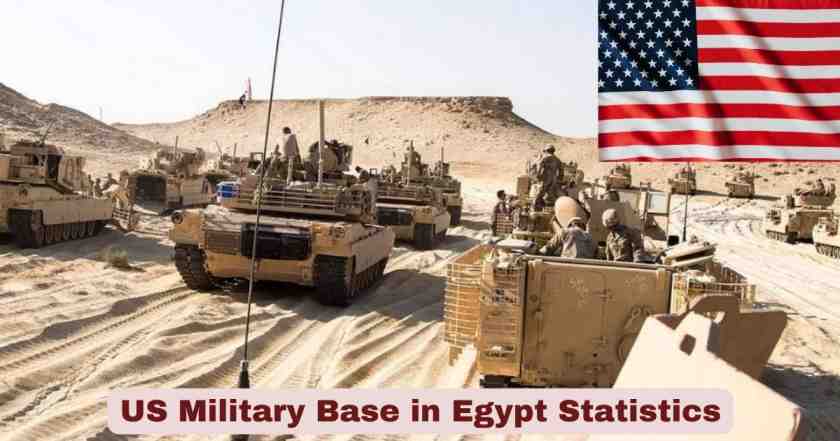
Military Bases of America in Egypt 2026
Egypt occupies a position of irreplaceable strategic importance in America’s global military architecture, and the US military presence in Egypt in 2026 reflects decades of carefully constructed alliance-building rooted in one of the most consequential peace agreements in modern Middle East history. Since the 1979 Egypt-Israel Peace Treaty — brokered by President Jimmy Carter at Camp David — Egypt has grown from a Soviet-aligned nation to the second largest recipient of US Foreign Military Financing (FMF) in the entire world, trailing only Israel. As of 2026, the United States maintains a confirmed permanent military presence in Egypt, with 188 active-duty US service members stationed in-country as of June 2025 per the Defense Manpower Data Center (DMDC), while Task Force Sinai — America’s regiment-sized contribution to the Multinational Force and Observers (MFO) — keeps approximately 700 US military personnel deployed across the Sinai Peninsula on a rotational basis. Beyond troops on the ground, Egypt provides the United States with a suite of invaluable strategic privileges: priority Suez Canal transit rights, expedited overflight clearances, and regular access to Egyptian air bases including Cairo West — privileges worth far more to CENTCOM’s operational planning than the troop footprint alone suggests.
Understanding the true depth and breadth of the US military base and presence statistics in Egypt in 2026 demands looking past the modest headline troop numbers to the structural weight of the relationship underneath. Egypt has received an extraordinary cumulative total of over $85 billion in US bilateral aid since 1946, with $1.3 billion in annual Foreign Military Financing flowing from Washington to Cairo every single year since 1979 — a figure that accounts for an estimated 80% of Egypt’s entire annual military procurement budget. Since October 7, 2023, the US-Egypt defense partnership has entered one of its most active periods in a generation: the State Department has notified Congress of $12 billion in Foreign Military Sales (FMS) cases for Egypt since October 2023 alone, representing over nine years’ worth of FMF at current appropriation rates. In August–September 2025, Exercise Bright Star 25 brought 1,800 US military personnel and forces from 44 countries to Egyptian soil — one of the most expansive multinational military exercises ever conducted on the African continent. This article uses exclusively US government sources — including the DMDC, Congressional Research Service, US Embassy Cairo, CENTCOM, US Army, and the Library of Congress — to document the complete statistical picture of American military engagement in Egypt as of February 28, 2026.
Interesting Facts: US Military Presence in Egypt in 2026
| Fact Category | Key Statistic |
|---|---|
| Active-duty US troops in Egypt (June 2025, DMDC) | 188 service members |
| US Army personnel in Egypt (largest branch presence) | 140 troops (0.3% of all US Army foreign deployment) |
| US Marine Corps personnel in Egypt | 20 troops |
| US Air Force personnel in Egypt | 20 troops |
| Task Force Sinai (MFO US contingent) | ~700 US military personnel (rotational) |
| Total MFO personnel (all nations) | ~1,667 military personnel from 12–14 nations |
| US share of MFO funding | ~33% of $86 million annual MFO budget |
| US contribution to MFO annual budget (USD) | ~$28–29 million/year |
| Annual US Foreign Military Financing (FMF) to Egypt | $1.3 billion/year (since 1979) |
| FMF as % of Egypt’s military procurement budget | ~80% |
| Total cumulative US bilateral aid to Egypt (since 1946) | Over $85 billion |
| FMS cases notified to Congress (post-Oct 7, 2023) | $12 billion in total FMS cases |
| Key US air base access in Egypt | Cairo West Air Base (used for Bright Star & periodic deployments) |
| NAMRU-3 established in Egypt | 1946 (US Navy lab; now relocated to Sigonella, Italy) |
| Office of Military Cooperation – Cairo (OMC-Cairo) | Active; housed within US Embassy, Cairo |
| Bright Star 25 US personnel | ~1,800 US military personnel (August–September 2025) |
| Bright Star 25 total participating nations | 44 countries (14 combat forces, 30 observers) |
| Egypt listed as permanent US base country | Yes — one of 8 confirmed permanent US bases in the Middle East |
| US bilateral trade with Egypt (2025) | $11.2 billion |
| US-Egypt security relationship established | 1979 (Camp David Accords / Peace Treaty basis) |
Source: Defense Manpower Data Center (DMDC) June 2025; 24/7 Wall St. US Military Foreign Deployment Analysis, October 2025; Congressional Research Service RL33003 (Egypt: Background and US Relations), February 2026; US Embassy Cairo, August 2025; CENTCOM Press Release, August–September 2025; Wikipedia Task Force Sinai; Washington Institute for Near East Policy; US Army.mil; Library of Congress CRS
These numbers tell the story of a military partnership that is simultaneously modest in its physical troop footprint and enormous in its financial and strategic depth. The 188 active-duty service members counted by the DMDC in June 2025 represent only the “in-country baseline” figure — the permanent rotational skeleton in Egypt not associated with exercises or temporary deployments. When Task Force Sinai’s ~700 MFO peacekeepers are added, along with rotational exercise forces, the actual number of US military personnel on Egyptian soil at any given time is substantially larger. The $1.3 billion in annual FMF dwarfs the modest troop count in its importance: this funding, which has been flowing uninterrupted since 1979, has financed Egypt’s acquisition of over 1,100 M1A1 Abrams tanks, 224 F-16 fighter aircraft, 10 AH-64 Apache Longbow helicopters, thousands of Humvees, and vast quantities of Stinger MANPADS and Hellfire missiles — transforming Egypt into one of the most heavily US-equipped military forces in Africa or the Middle East.
The $12 billion in Foreign Military Sales cases since October 7, 2023 is the single most dramatic data point in this entire snapshot. It reflects the Biden and Trump administrations’ shared conclusion that Egypt’s role as a stabilizing, treaty-compliant partner bordering both Gaza and the Red Sea is too strategically critical to allow the relationship to erode, regardless of periodic human rights-related congressional pressure. The fact that Exercise Bright Star 25 drew 44 nations to Egyptian soil in late August 2025 — with the CENTCOM Commander Admiral Brad Cooper personally attending the Egyptian Chief of Staff’s review — signals a deliberate US effort to use Egypt as the anchor of a broad, multinational security architecture at a moment when the entire Middle East is in its most volatile state in a generation.
US Military Installations & Access Points in Egypt in 2026
| Installation / Facility | Location | Type | US Role / Significance | Status (2026) |
|---|---|---|---|---|
| Task Force Sinai (MFO North Camp) | Sinai Peninsula (near El Gorah) | Permanent peacekeeping base | US-led MFO HQ; largest US facility in Egypt; Zone C monitoring | Fully active — rotational US battalion |
| MFO South Camp | Sharm el-Sheikh area, South Sinai | Forward peacekeeping post | Secondary MFO post; US personnel included | Active |
| Cairo West Air Base | Western Cairo | Egyptian air base / US exercise access | Primary US USAF exercise hub; F-16C deployments during Bright Star; periodic USAF rotations | Active (exercise/access) |
| Mohamed Naguib Military Base | Western Alexandria (Marsa Matruh area) | Egyptian base / US exercise hub | Primary site for Bright Star 25 (2025); all major US-Egypt joint exercises | Active (exercise/access) |
| Office of Military Cooperation – Cairo (OMC-Cairo) | US Embassy, Cairo | Permanent command office | Manages all US FMF program, FMS deliveries, and military cooperation with Egyptian Armed Forces | Fully active |
| Suez Canal Transit Corridor | Suez Canal, Egypt | Strategic maritime access | US Navy ships receive priority transit rights; approx. 40+ US warship transits per year | Active — strategically critical |
| NAMRU-3 Historical Cairo Site | Abbassia, Cairo (former) | Former US Navy medical lab | Operated 1946–2014; now relocated to Sigonella, Italy as NAMRU-EURAFCENT | Relocated (2014) |
Source: Wikipedia Task Force Sinai; Wikipedia Cairo West Air Base; US Embassy Cairo Bright Star 25 Press Release, August 2025; Congressional Research Service RL33003, February 2026; Council on Foreign Relations June 2025; Al Jazeera Middle East Military Mapping, September 2025; Wikipedia NAMRU-3; CENTCOM.mil
The most operationally significant US military footprint in Egypt is not a massive garrison but a layered web of access rights, peacekeeping commitments, and exercise partnerships that give CENTCOM capabilities in Egypt far exceeding what a 188-person troop count implies. Task Force Sinai at MFO North Camp near El Gorah in the Sinai Peninsula is America’s most physically substantial presence in Egypt, with a US Army colonel commanding the Task Force and simultaneously serving as the MFO Chief of Staff — a leadership position that gives the US organizational authority over the entire multinational peacekeeping force. Since 1982, the Task Force has rotated a full US infantry battalion through the Sinai annually, with the Hawaii National Guard historically serving as the mission’s most frequent and largest single contributing state unit, and the Alabama National Guard’s 1st Battalion, 173rd Infantry Regiment deploying in September 2025 as the latest rotation, with roughly 200 soldiers heading to Egypt for the mission.
Cairo West Air Base represents the most strategically flexible US military access point in Egypt. Located on the western outskirts of Cairo, it has served as the primary staging area for Exercise Bright Star for over four decades, and during the 2003 Iraq War, it housed the 487th Air Expeditionary Wing in the March–May 2003 period. In 1980, 400 USAF personnel and 12 F-4E Phantom II aircraft from Moody Air Force Base, Georgia, were deployed to Cairo West under Operation Proud Phantom — an early demonstration of the kind of rapid, flexible air power deployment that Cairo West still enables today. During Bright Star 25 in August 2025, US F-16C Fighting Falcons were photographed arriving at Cairo West, confirming the base’s continued operational role as an American air power staging hub. The Suez Canal access rights guaranteed under the US-Egypt partnership — allowing US Navy warships to bypass commercial queuing and transit within hours — are an invisible but enormous operational benefit that CENTCOM planners factor into every contingency plan involving the Eastern Mediterranean, Red Sea, and Indian Ocean.
US Foreign Military Financing (FMF) to Egypt in 2026 – Financial Statistics
| Metric | Figure | Source |
|---|---|---|
| Annual FMF to Egypt | $1.3 billion/year | CRS RL33003, 2026; US FMF Wikipedia |
| FMF as % of Egypt’s annual military procurement | ~80% | Washington Institute for Near East Policy |
| Total FMF to Egypt since 1979 | Over $40 billion | CRS RL33003, 2026 |
| Total US bilateral aid to Egypt since 1946 | Over $85 billion | US Embassy Cairo / AmCham Egypt |
| FMS cases notified to Congress since Oct. 7, 2023 | $12 billion | CRS RL33003, February 2026 |
| US FMF amount conditioned on human rights benchmarks | $320 million (FY2023 conditional tranche) | MEDC Fact Sheet, 2024; HRW |
| FY2023 aid from all US agencies to Egypt | $1.43 billion | AmCham Egypt / US Agency data |
| FY2024 requested US aid to Egypt (all accounts) | $1.44 billion | AmCham Egypt |
| Egypt’s rank among MENA aid recipients (FY2024) | 3rd (after Israel and Jordan) | AmCham Egypt |
| US-Egypt bilateral trade volume (2025) | $11.2 billion | CRS RL33003, February 2026 |
| Egyptian M1A1 Abrams tanks (FMF-financed) | Over 1,100 tanks (local assembly in Egypt) | US FMF Wikipedia; Washington Institute |
| Egyptian F-16 fighters (FMF-financed) | 224 aircraft | US FMF Wikipedia; GAO-06-437 |
| Egyptian AH-64 Apache Longbow helicopters (US-sourced) | 10 aircraft | US FMF Wikipedia |
| FY2026 NDAA border security authorization for Egypt | Section 1225, P.L. 119-60 (Egypt-Sudan border) | CRS RL33003, February 2026 |
Source: Congressional Research Service RL33003 (Egypt: Background and US Relations), February 2026; Wikipedia United States Foreign Military Financing; Washington Institute for Near East Policy; GAO Report GAO-06-437; Human Rights Watch, September 2024; Middle East Democracy Council (MEDC) Fact Sheet 2024; American Chamber of Commerce in Egypt (AmCham)
The $1.3 billion in annual FMF to Egypt makes Egypt the second-largest recipient of US military financing in the world, behind only Israel — and the numbers behind this headline figure reveal a military dependency of remarkable depth. The fact that FMF accounts for 80% of Egypt’s entire military procurement budget means that, without American financing, the Egyptian Armed Forces would be structurally incapable of sustaining their current force posture, let alone modernizing it. The $12 billion in Foreign Military Sales cases notified since October 7, 2023 — equivalent to more than nine full years of FMF at current annual rates — represents the most dramatic single surge in US arms transfer commitments to Egypt in decades, driven by Egypt’s critical role as a Gaza ceasefire mediator, a Sinai border security partner, and a bulwark against regional destabilization from both the Gaza conflict and the ongoing Sudan civil war.
The $1.43 billion in FY2023 total US aid from all agencies and the $11.2 billion US-Egypt bilateral trade volume in 2025 together illustrate a relationship that has evolved from post-Camp David patronage into a genuinely deep economic and security interdependence. Egypt’s role as the top export market for US goods and services in Africa reflects decades of FMF-driven procurement of American defense hardware driving broader commercial ties. Crucially, the FY2026 National Defense Authorization Act’s Section 1225 — which authorizes additional defense assistance along Egypt’s border with Sudan — signals that Congress views the Egypt relationship as an active, evolving security investment, not simply a legacy line item from 1979. The $85 billion cumulative total in bilateral aid places Egypt in the very top tier of US foreign aid recipients in the post-WWII era, alongside Israel, Afghanistan, Iraq, and Pakistan.
Task Force Sinai — US Peacekeeping Mission in Egypt in 2026
| Metric | Figure | Source |
|---|---|---|
| Task Force Sinai established | March 1982 | Wikipedia Task Force Sinai |
| US personnel in Task Force Sinai | ~700 US military personnel | Washington Institute; MFO structure |
| Task Force Sinai commander rank | US Army Colonel (also serves as MFO Chief of Staff) | Wikipedia Task Force Sinai |
| Main components | USBATT (infantry battalion) + 1st Support Battalion + HQ staff | Wikipedia Task Force Sinai |
| USBATT rotation frequency | Annually (National Guard and Active duty rotations) | US Army.mil |
| Total National Guard members deployed to MFO (since 2003) | Over 35,000 National Guard soldiers and airmen | US Army.mil (NGB Chief article) |
| MFO total military personnel (all nations) | ~1,667 personnel from 12–14 contributing nations | Washington Institute; Wikipedia MFO |
| Hawaii National Guard role | Historically the MFO’s largest single force provider | US Army.mil |
| Latest US rotation (2025) | Alabama NG 1st Battalion, 173rd Infantry Regt. — ~200 soldiers, deployed Sept. 2025 | Military.Africa, August 2025 |
| MFO area of operation | Sinai Peninsula “Zone C” — approx. size of West Virginia | US Army.mil; Washington Institute |
| MFO mission basis | Egypt-Israel Peace Treaty, March 26, 1979 | Wikipedia MFO |
| US MFO funding share | ~33% of $86 million annual MFO budget (~$28–29 million/year) | Washington Institute |
| MFO North Camp location | Near El Gorah, northern Sinai | Wikipedia MFO; Task Force Sinai |
| MFO South Camp location | Sharm el-Sheikh area, southern Sinai | Wikipedia MFO |
| Nations contributing troops to MFO (October 2025) | 14 states | Wikipedia MFO, October 2025 |
| France MFO status | Withdrew contingent in 2024 | Wikipedia MFO |
Source: Wikipedia Task Force Sinai; Wikipedia Multinational Force and Observers (MFO); US Army.mil “Soldiers Support MFO Mission in Egypt”; US Army.mil NGB Chief MFO Visit Article; Military.Africa, August 2025; Washington Institute for Near East Policy “America’s Least-Known Mideast Military Force”
Task Force Sinai is, without exaggeration, one of the most consequential and least-publicized American military commitments in the world. Since March 1982, the United States has maintained a continuous, year-round peacekeeping presence in the Sinai Peninsula — one of the world’s most strategically sensitive border zones — without a single year’s interruption, including through the 1967–1974 break in US-Egypt diplomatic relations, periods of domestic Egyptian instability, the Arab Spring, and the rise of ISIS-Sinai between 2012 and 2016. The fact that over 35,000 National Guard soldiers and airmen have rotated through the MFO since 2003 alone speaks to the sustained, institutionalized nature of this commitment — it is not a temporary deployment but a generational one, with soldiers from Hawaii, Alabama, Texas, Pennsylvania, Florida, and dozens of other states having served in the Sinai. The Hawaii National Guard’s role as the historically largest single force provider reflects a deliberate relationship built over years of repeated rotations, creating a depth of institutional knowledge and cultural familiarity with the mission that no active-duty unit can replicate.
The Zone C monitoring mission — which covers approximately the eastern quarter of the Sinai, running along the Israeli border — involves US troops manning observation posts in one of the most austere and logistically isolated environments in the entire American military enterprise. The MFO North Camp near El Gorah sits in a remote desert more than 300 kilometers from Cairo, with limited communications and support infrastructure, and it has come under direct attack multiple times: in 2012, the camp was stormed by armed Bedouin; in 2014, a US soldier was shot and wounded by an unknown gunman; and in August 2015, an ISIS IED wounded six MFO troops, four of them American. These incidents, largely unreported in the mainstream American press, demonstrate that Task Force Sinai operates in an active threat environment that deserves far more recognition than it receives. France’s 2024 withdrawal from the MFO — reducing the contributing nation count from 15 to 14 — has added pressure on remaining contributors, particularly the United States, to maintain its commitment at a moment when the Gaza conflict has made the Sinai border politically and militarily more sensitive than at any time since 1973.
Exercise Bright Star — US-Egypt Military Exercise Statistics in 2026
| Metric | Figure | Source |
|---|---|---|
| Exercise Bright Star established | 1980 (post-Camp David Accords) | Wikipedia Exercise Bright Star; US Embassy Cairo |
| Bright Star 25 dates | August 28 – September 10, 2025 | US Embassy Cairo; CENTCOM.mil |
| Bright Star 25 location | Mohamed Naguib Military Base, Egypt + Cairo West Air Base | Egypt SIS; Wikipedia Bright Star |
| Bright Star 25 US military personnel | ~1,800 US service members | US Embassy Cairo |
| Bright Star 25 total participants | Over 8,000 troops total | EgyptFwd.org; The National |
| Bright Star 25 participating nations | 44 countries (14 combat forces; 30 observers) | EgyptFwd.org, August 2025 |
| Bright Star 25 iteration number | 19th iteration | US Embassy Cairo |
| Nations observer count | Included NATO, ICRC, and civilian police forces | EgyptFwd.org |
| CENTCOM commander attendance | Admiral Brad Cooper, CENTCOM Commander, attended Bright Star 25 | Egypt SIS / Joint Egyptian-US statement |
| Bright Star 23 US personnel | ~1,500 US military members | US Embassy Cairo, Bright Star 23 |
| Bright Star 23 participating nations | 10+ nations | US Embassy Cairo |
| Training focus areas (2025) | Combined arms, counterterrorism, maritime security, air defense, live-fire, urban warfare | The National, August 2025 |
| Peak historic Bright Star size | Up to 70,000 personnel and 11 countries | Wikipedia Exercise Bright Star |
| Bright Star 14 (2013) | Cancelled by President Obama (Egypt political crisis) | Wikipedia Exercise Bright Star |
| Exercise frequency | Biennial (codified as such since 1983) | CENTCOM Citadel, August 2025 |
Source: US Embassy Cairo Bright Star 25 Press Release, August 2025; CENTCOM.mil Press Release, August 29, 2025; Wikipedia Exercise Bright Star; Egypt State Information Service (SIS), September 2025; EgyptFwd.org, August 30, 2025; The National, August 28, 2025; Jerusalem Post, August 28, 2025; CENTCOM Citadel Feature, August 5, 2025
Exercise Bright Star is not merely a training event — it is the single most visible and symbolic expression of the entire US-Egypt defense partnership, and in 2026, that partnership is running at one of its most energetic levels in memory. The 19th iteration of Bright Star in August–September 2025 brought together the largest multinational force assembled on Egyptian soil in recent years, with 44 nations, over 8,000 troops, and ~1,800 American service members conducting everything from parachute jumps over the Pyramids archaeological area to combined arms live-fire exercises and urban warfare scenarios. The exercise’s evolution from a bilateral US-Egypt drill in 1980 to a 44-nation multinational event tracks exactly the trajectory of American influence in the region: Bright Star has become a platform through which CENTCOM builds the regional coalition architecture it would need in any major contingency. The fact that CENTCOM Commander Admiral Brad Cooper personally met with Egyptian Defense Minister General Abdel Mageed Saqr and Chief of Staff Lieutenant General Ahmed Khalifa on the sidelines of Bright Star 25 — discussing “regional developments” and future military cooperation — confirms that this exercise functions simultaneously as a training event and a high-level strategic dialogue.
The cancellation of Bright Star 14 in 2013 — when President Obama halted the exercise following the Egyptian military’s violent crackdown on Muslim Brotherhood supporters — illustrates just how politically loaded this exercise has become as a barometer of bilateral relations. The fact that the exercise was subsequently restored, and has grown to record scale since resumption, reflects a bipartisan American consensus that maintaining the Egypt military relationship is a core strategic interest that transcends periodic political friction. The 1,800 US personnel at Bright Star 25 trained on combined arms operations, counterterrorism, maritime security, and air defense — all domains directly relevant to the ongoing Middle East crisis — making Bright Star 25 not just a show of force but a genuinely operationally relevant preparation event for the kinds of missions CENTCOM is actively executing across the region.
US Military Equipment Supplied to Egypt in 2026 – Hardware Statistics
| Equipment / System | Quantity (FMF-Financed) | Significance |
|---|---|---|
| M1A1 Abrams Main Battle Tanks | Over 1,100 (locally assembled in Egypt) | Largest US MBT export program; Egyptian army’s primary armor |
| F-16 Fighting Falcon Fighter Aircraft | 224 aircraft (multiple variants) | Second-largest F-16 fleet in MENA after Israel |
| AH-64 Apache Longbow Helicopters | 10 aircraft | Advanced attack helicopter; key counterterrorism asset |
| Humvees (High Mobility Multipurpose Wheeled Vehicles) | Thousands | Backbone of Egyptian ground force mobility |
| FIM-92 Stinger MANPADS | Multiple units | Short-range air defense; widely deployed |
| AGM-114 Hellfire Missiles | Multiple delivery orders | Air-to-ground precision strike for Apache fleet |
| AGM-84 Harpoon Anti-Ship Missiles | Multiple units | Naval strike capability for Egyptian Navy** |
| MIM-104 Patriot Missile Defense System | Multiple batteries | Strategic air and missile defense of key sites |
| E-2C Hawkeye Airborne Early Warning Aircraft | Operational with Egyptian Air Force | Based at Cairo West with 87 Squadron |
| C-130H Hercules Transport Aircraft | Operational fleet | Strategic airlift; MFO logistics support |
| Hawk Surface-to-Air Missile Systems | Multiple batteries | Legacy air defense; supplemented by Patriots |
Source: Wikipedia United States Foreign Military Financing; Washington Institute for Near East Policy “Inside the Complex World of US Military Assistance to Egypt”; GAO-06-437 (US Government Accountability Office); Congressional Research Service RL33003, February 2026; Wikipedia Cairo West Air Base (Egyptian Air Force order of battle)
The hardware list above is the tangible, physical output of over 40 years and $40 billion in US Foreign Military Financing to Egypt — and it tells a story of comprehensive military transformation. The 1,100+ M1A1 Abrams tanks assembled at a co-production facility in Egypt represent one of the most ambitious US military transfer programs in history, involving not just the sale of finished hardware but the transfer of manufacturing capability and military-industrial know-how to Egyptian soil. The 224 F-16 aircraft make Egypt one of the most heavily US-supplied air forces in the world, with Egyptian pilots trained at US bases under the FMF-funded International Military Education and Training (IMET) program. The result is an Egyptian military that is, at every level of its procurement chain, deeply and structurally integrated with American defense systems — creating a weapons dependency that functions as a powerful enforcement mechanism ensuring Cairo’s continued alignment with US strategic interests.
The 2026 Foreign Military Sales pipeline — with $12 billion in cases notified to Congress since October 2023 — is actively adding to this hardware list at a pace not seen in decades. New systems flowing through this pipeline reportedly include additional F-16 upgrades, air defense enhancements, and naval systems designed to improve Egypt’s capacity to monitor and secure the Red Sea’s western approaches and the Sinai’s increasingly contested border with Gaza. This military equipment relationship is not merely strategic window dressing: Egyptian Patriot batteries provide real air defense coverage over Cairo and the Nile Delta, Egyptian F-16s fly real patrols over the Sinai, and Egyptian M1A1 tanks represent a frontline deterrent force along Egypt’s borders with Libya, Sudan, and the Gaza Strip that directly serves US regional interests by maintaining a stable, US-aligned military capable of projecting force in all four strategic directions simultaneously.
US Strategic Interests in Egypt in 2026 – Key Access & Influence Statistics
| Strategic Asset | Benefit to US Military | Data / Metric |
|---|---|---|
| Suez Canal priority transit | Fastest route for US naval assets between Mediterranean and Indian Ocean | ~40+ US warship transits/year; ~12–15% of world trade passes through canal |
| Egyptian airspace overflight rights | Critical air corridor for CENTCOM logistics and strike missions | Expedited clearances; used during 1990 Gulf War, OIF 2003, ongoing CENTCOM ops |
| Cairo West Air Base access | Forward staging for USAF in North Africa / East Mediterranean | Used in 1980 (Op. Proud Phantom), 2003 (487th AEW), Bright Star exercises |
| Mohamed Naguib Military Base access | Largest multinational exercise site in Africa/MENA | Host of all Bright Star iterations 2017 onwards |
| Egypt-Israel peace treaty stability | Removes Egyptian front from Israeli strategic planning | Treaty in force since 1979 — longest-standing Arab-Israeli peace agreement |
| Egyptian intelligence cooperation | Hamas monitoring, Sinai counterterrorism, Libyan border watch | Joint US-Egypt CT cooperation documented in CRS RL33003 |
| Gaza mediation role | Egypt as primary channel for Hamas-Israel ceasefire negotiations | Egypt brokered October 2025 ceasefire per CRS RL33003 |
| Sudan border security | US-authorized Egypt border defense assistance (FY2026 NDAA Section 1225) | P.L. 119-60, FY2026 NDAA, signed 2025 |
Source: Congressional Research Service RL33003, February 2026; CENTCOM.mil; Wikipedia Exercise Bright Star; US FMF Wikipedia; Council on Foreign Relations June 2025; US Embassy Cairo
The statistics in the table above reveal that the US military relationship with Egypt in 2026 is built on a foundation of strategic access privileges that are, in many respects, worth more than any single military base. The Suez Canal priority transit rights — formalized through the US-Egypt bilateral security arrangement — allow American warships to bypass commercial queuing and pass through the canal in a matter of hours rather than days, a capability that is non-trivial when CENTCOM is managing simultaneous naval operations in both the Mediterranean and the Indian Ocean. During every major US military operation since 1979 — the Gulf War, Operation Enduring Freedom, Operation Iraqi Freedom — these transit rights have been exercised extensively, and in the current 2026 crisis environment, with US carrier strike groups needing to reposition between the Red Sea, Arabian Sea, and Eastern Mediterranean rapidly, Suez access represents a genuine operational force multiplier that few analysts factor into their assessments of the US military footprint in Egypt.
Egypt’s October 2025 brokering of the Hamas-Israel ceasefire — documented explicitly in the Congressional Research Service’s February 2026 report — illustrates the other dimension of Egypt’s value to US strategy: it is not just a military platform but a diplomatic one. Cairo’s ability to serve as an interlocutor with Hamas, host ceasefire negotiations, and manage the political dynamics of Gaza’s post-conflict governance through bodies like the National Committee for the Administration of Gaza (NCAG) is a capability that the United States itself does not possess and cannot replicate from any other partner in the region. The FY2026 NDAA’s Section 1225 authorization of additional defense assistance along Egypt’s Sudan border — formalized in P.L. 119-60 — signals that Congress views Egypt’s stabilizing role along its southwestern frontier as a US security interest worthy of dedicated legislative authorization, further deepening the structural entanglement between American defense planning and Egyptian military capacity.
US-Egypt Military Relationship Timeline in 2026 – Key Historical Milestones
| Year / Period | Event | Significance |
|---|---|---|
| 1942 | US Typhus Commission established in Cairo | First US military scientific presence in Egypt; precursor to NAMRU-3 |
| 1946 | NAMRU-3 formally established | Oldest continuous US military overseas research facility (until 2014 relocation) |
| 1967–1973 | Lapse in US-Egypt diplomatic relations | NAMRU-3 operated with Egyptian co-director and Spanish embassy support |
| 1978 | Camp David Accords signed | Foundation of US-Egypt-Israel security architecture |
| 1979 | Egypt-Israel Peace Treaty signed | $1.3B annual FMF program begins; US-Egypt military partnership born |
| 1980 | First Exercise Bright Star & Op. Proud Phantom | 400 USAF personnel + 12 F-4E aircraft deployed to Cairo West |
| 1981 | MFO Protocol signed | US agrees to lead Task Force Sinai peacekeeping mission |
| 1982 | Task Force Sinai created (March 1982) | Continuous US peacekeeping presence begins in Sinai |
| 2003 | 487th Air Expeditionary Wing at Cairo West | Cairo West used as USAF staging base during Iraq War |
| 2013 | Bright Star 14 cancelled | Obama cancels exercise after Egyptian military political crackdown |
| 2014 | NAMRU-3 relocated to Sigonella, Italy | US Navy lab leaves Egypt after 68 years; becomes NAMRU-EURAFCENT |
| 2023 (post-Oct. 7) | $12B in FMS cases notified to Congress | Largest US arms transfer commitment to Egypt in decades |
| Aug–Sept 2025 | Exercise Bright Star 25 | 44 nations, 8,000+ troops, 1,800 US personnel; CENTCOM Commander attends |
| Oct 2025 | Egypt brokers Hamas-Israel ceasefire | Egypt’s most significant diplomatic-security act in decades; US-backed |
| Feb 2026 | FY2026 NDAA border security authorization | US Congress formalizes Egypt-Sudan border defense assistance |
Source: Congressional Research Service RL33003, February 2026; Wikipedia NAMRU-3; Wikipedia Exercise Bright Star; US Army.mil; Wikipedia MFO; Wikipedia Task Force Sinai; US Embassy Cairo; CENTCOM.mil; Wikipedia US FMF
The 84-year arc of this military relationship — from the 1942 US Typhus Commission to the 2026 FY NDAA border security authorization — is one of the most sustained bilateral security partnerships in American foreign policy history, outlasting administrations, regional wars, political upheavals, and periods of deep diplomatic friction. The relocation of NAMRU-3 from Cairo to Sigonella in 2014 was the only significant reduction in the US physical military footprint in Egypt in the entire modern period, and even that was driven by bureaucratic consolidation rather than any deterioration in the relationship itself. The 2013 cancellation of Bright Star by President Obama stands as the single sharpest rupture in the relationship’s exercise dimension, and its subsequent restoration and growth to a 44-nation event in 2025 illustrates the structural resilience of the partnership — political disagreements cause temporary pauses, but the underlying strategic logic always reasserts itself.
October 2025’s Egypt-brokered ceasefire and the $12 billion in FMS cases flowing since October 2023 together represent the clearest evidence that the US-Egypt military relationship in 2026 is not a relic of the Cold War but an actively expanding, deepening, and operationally relevant partnership. Egypt’s geography — controlling the Suez Canal, bordering both Libya and Sudan in the west and south, sharing a long border with Gaza, and sitting at the nexus of the Mediterranean, Red Sea, and Nile Valley — makes it indispensable to American strategy in a way that no amount of political friction can easily overcome. As long as CENTCOM requires access to the Eastern Mediterranean, the Suez Canal, and the Horn of Africa, Egypt will remain the pivot point around which much of that access rotates — and the $1.3 billion annual FMF program, the 700 US MFO peacekeepers in the Sinai, and the biennial Bright Star exercise will remain the concrete institutional expression of that strategic reality.
Disclaimer: This research report is compiled from publicly available sources. While reasonable efforts have been made to ensure accuracy, no representation or warranty, express or implied, is given as to the completeness or reliability of the information. We accept no liability for any errors, omissions, losses, or damages of any kind arising from the use of this report.