
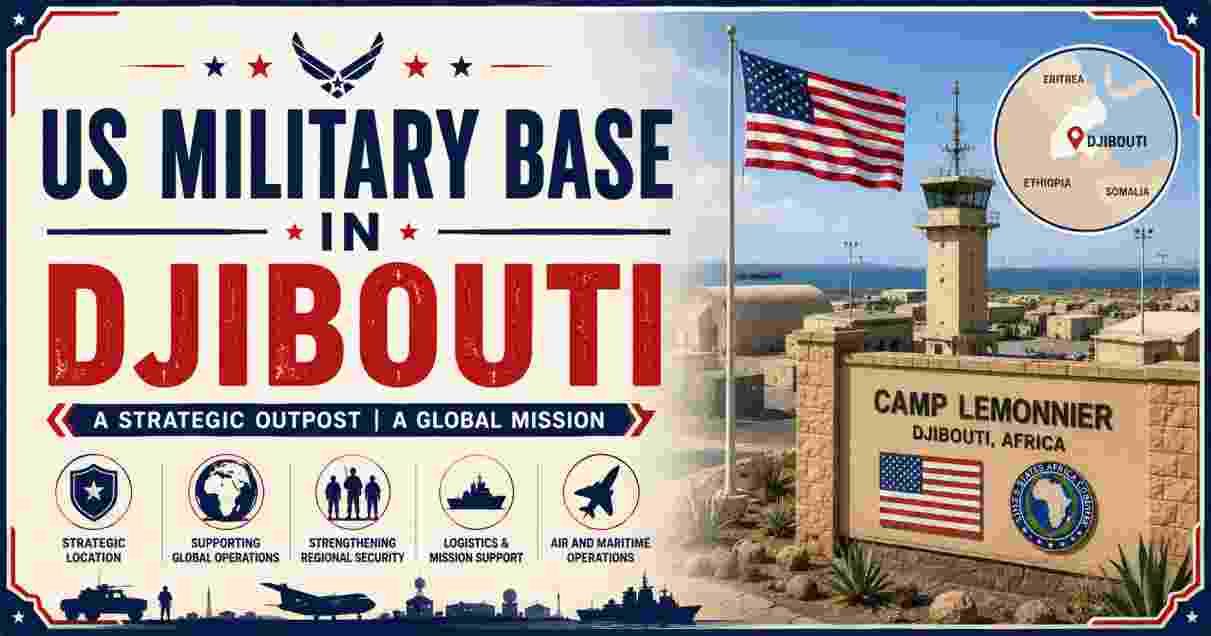
US Military Base in Djibouti 2026
The US Military Base in Djibouti 2026 remains the only enduring American military installation on the African continent, anchoring nearly every counterterrorism, intelligence, and crisis-response mission the United States runs across the Horn of Africa, the Red Sea, and Southwest Asia. Known officially as Camp Lemonnier, the base sits beside Djibouti–Ambouli International Airport on the outskirts of Djibouti City, occupying roughly 500 acres of leased land at one of the most strategically valuable maritime chokepoints on earth, the Bab-el-Mandeb strait. It serves as the headquarters of Combined Joint Task Force–Horn of Africa (CJTF-HOA), a component command under US Africa Command (AFRICOM), and hosts thousands of American troops, allied forces, and a rotating fleet of surveillance and strike aircraft.
Throughout 2026, Camp Lemonnier has continued to function as the logistical and operational backbone for American power projection into East Africa, Yemen, and the wider Horn of Africa region, running joint exercises with partner nations such as France, the United Kingdom, and Japan, while coordinating closely with the Djiboutian Armed Forces. This article breaks down the latest verified US Military Base in Djibouti 2026 statistics — covering troop numbers, aircraft, lease costs, infrastructure, and the base’s expanding regional security role — using data drawn from official US government and Department of Defense-linked sources.
Interesting Facts About US Military Base in Djibouti 2026
| Fact Category | Details |
|---|---|
| Official Name | Camp Lemonnier, Djibouti (CLDJ) |
| Host Command | Combined Joint Task Force–Horn of Africa (CJTF-HOA), under US Africa Command (AFRICOM) |
| Location | Adjacent to Djibouti–Ambouli International Airport, Djibouti City, Horn of Africa |
| Strategic Waterway | Sits at the Bab-el-Mandeb strait, linking the Red Sea and the Gulf of Aden |
| Base Size | Expanded from 88–97 acres in 2006 to roughly 500 acres by 2007 |
| Africa Status | Only enduring, permanent US military base on the African continent |
| Current Lease | 30-year lease signed in 2014, costing $63 million per year |
| Approx. US Personnel | Roughly 4,000 US troops and personnel, about two-thirds of AFRICOM’s continental force |
| Secondary Airfield | Chabelley Airfield, used for remotely piloted aircraft operations |
| Key 2026 Exercise | Exercise Pale Serpent 26-3, conducted May 15, 2026, at Camp Lemonnier and Chabelley Airfield |
| National Guard Command | 158th Maneuver Enhancement Brigade, Arizona Army National Guard, leads CJTF-HOA headquarters staff |
| Host Nation Population | Djibouti’s total population is under 1 million people |
Data Source: US Africa Command (AFRICOM), Combined Joint Task Force–Horn of Africa (CJTF-HOA), U.S. Department of Defense
The table above captures why the US Military Base in Djibouti 2026 punches so far above its geographic weight. Camp Lemonnier’s roughly 500-acre footprint is modest compared with sprawling American installations in Europe or the Middle East, yet its position at the Bab-el-Mandeb strait places it directly astride one of the busiest maritime corridors on the planet, giving Washington a permanent foothold for monitoring shipping lanes, launching crisis-response missions, and supporting CJTF-HOA’s counterterrorism mandate across more than a dozen African nations. The 30-year lease, now paying Djibouti roughly $63 million annually, reflects how much more valuable the location became after the base’s original 88-acre footprint proved too small for the surge in operations following the September 11 attacks.
The 4,000-troop estimate, while an approximation rather than a precise real-time figure, illustrates just how central Djibouti has become to AFRICOM’s overall force posture — the base alone accounts for the majority of all US military personnel stationed anywhere on the continent. The presence of a rotating National Guard brigade, currently the 158th Maneuver Enhancement Brigade from Arizona, running the CJTF-HOA headquarters staff mission also shows how the Pentagon increasingly relies on Guard units for sustained overseas deployments rather than only active-duty formations, a trend that has held steady across the 2024–2026 rotation cycle.
Camp Lemonnier Location and Infrastructure Statistics in US 2026
| Infrastructure Metric | Detail |
|---|---|
| Original Base Size (2001) | 88 acres, following the initial lease agreement |
| Expanded Base Size (2007) | Nearly 500 acres, under a five-year renewable lease |
| Adjacent Facility | Djibouti–Ambouli International Airport, shared runway access |
| Secondary Site | Chabelley Airfield, roughly 10 km from the main camp |
| Living Quarters Upgrade | Containerized living units (CLUs) replaced tents after the 2007 land expansion |
| 2018 Facility Expansion Budget | $240 million allocated for facilities expansion |
| Airfield Construction (2009–2010) | $15.2 million aircraft apron, $2.9 million taxiway completed |
| Realignment Date | October 1, 2008, realigned under US Africa Command (AFRICOM) |
Data Source: U.S. Navy, Naval Facilities Engineering Command (NAVFAC), US Africa Command (AFRICOM)
Camp Lemonnier Footprint Growth (Acres)
2001  |####                              |  88
2007  |################################  | 500
2026  |################################  | ~500 (stable)
      0        100      200      300      400      500
The infrastructure data underscores how deliberately Camp Lemonnier was scaled up to match its growing mission. The jump from 88 acres in 2001 to nearly 500 acres by 2007 was not simply about square footage — it enabled the Navy’s NAVFAC EURAFSWA command to replace tents with containerized living units, pour concrete sidewalks, and build the kind of hardened aircraft apron and taxiway infrastructure needed to support C-130 Hercules, CV-22 Osprey, and larger transport aircraft such as the C-17 Globemaster III. The $240 million facilities expansion approved in 2018 further cemented the base’s role as a long-term, hardened installation rather than a temporary staging post.
Because Camp Lemonnier sits directly beside a civilian international airport, its runway-sharing arrangement with Djibouti–Ambouli International Airport has always shaped how the base operates, particularly for larger fixed-wing traffic. That is precisely why the US military maintains Chabelley Airfield as a separate, less visible site roughly 10 kilometers away, used primarily for remotely piloted aircraft operations that benefit from a lower-profile location away from commercial air traffic. Together, the two sites give the US Military Base in Djibouti 2026 a layered infrastructure model: a large, multi-service main camp for personnel, logistics, and manned aviation, paired with a discreet secondary airfield purpose-built for unmanned systems.
US Troop Levels at Camp Lemonnier Djibouti 2026
| Force Category | Approximate Number |
|---|---|
| Total US Personnel at Camp Lemonnier | Approximately 4,000 troops and support personnel |
| Share of AFRICOM’s Continental Force | Roughly two-thirds of all AFRICOM forces stationed in Africa |
| CJTF-HOA Headquarters Command | 158th Maneuver Enhancement Brigade, Arizona Army National Guard (since Dec. 13, 2024) |
| Prior Rotation Command | 204th Maneuver Enhancement Brigade, Utah Army National Guard |
| Component Commands Present | US Army Southern European Task Force-Africa, US Air Forces Africa, US Marine Corps Forces Africa, US Naval Forces Africa, US Special Operations Command Africa |
| Marine Aviation Unit (2025) | Marine Medium Tiltrotor Squadron 364 (Reinforced) transferred authority Oct. 1 |
| Coalition Partner Nations | France, United Kingdom, Japan, and multiple African partner militaries |
Data Source: Combined Joint Task Force–Horn of Africa (CJTF-HOA), US Africa Command (AFRICOM)
Troop Presence Comparison: US Djibouti vs Allied Bases (approx.)
US (Camp Lemonnier)   |########################| ~4,000
France (FFDj)         |########                | ~1,450
Japan (JSDF Djibouti) |##                      | ~180-600
                        0     1000    2000    3000    4000
The 4,000 US troops stationed at Camp Lemonnier represent a mix of Army, Navy, Air Force, Marine Corps, and Special Operations personnel, organized under CJTF-HOA but drawing on five separate AFRICOM component commands simultaneously present at the same installation. This multi-service structure is unusual compared with most single-service US overseas bases and reflects the base’s role as a true joint hub rather than a dedicated airbase or naval station. Command rotations, such as the 158th Maneuver Enhancement Brigade’s takeover of the CJTF-HOA headquarters staff mission from the 204th Maneuver Enhancement Brigade in December 2024, illustrate how the Pentagon cycles National Guard formations through Djibouti on roughly year-long deployments, a pattern that has become the default staffing model for the headquarters function in recent years.
For readers researching related overseas basing patterns, our detailed breakdown of the US Military Base in Middle East shows how Djibouti’s roughly 4,000-troop presence compares with the tens of thousands stationed across CENTCOM’s Gulf installations, highlighting just how much more concentrated and specialized the AFRICOM footprint is by comparison. Coalition integration is another defining feature of the base: French, British, and Japanese forces frequently train alongside American units at Camp Lemonnier and the nearby Arta training range, most recently during live-fire exercises involving joint terminal attack controllers from the East African Response Force in June 2026, reinforcing Djibouti’s function as a genuinely multinational security hub rather than a purely American outpost.
Aircraft and Drone Operations at US Military Base in Djibouti 2026
| Aircraft/Aviation Metric | Detail |
|---|---|
| Primary Drone Airfield | Chabelley Airfield, roughly 10 km from Camp Lemonnier |
| Transport Aircraft Supported | C-130 Hercules, C-17 Globemaster III, C-5 Galaxy |
| Tiltrotor Aircraft | CV-22 Osprey, MV-22B Osprey (Marine Medium Tiltrotor Squadrons) |
| Aircraft Apron Capacity (2009 upgrade) | $15.2 million concrete apron built for large transport aircraft |
| USAF Reaper Fleet (2026, all locations) | 230 aircraft in current USAF inventory |
| Target USAF Reaper Fleet Through 2035 | 140 aircraft |
| Force Protection Exercise | Exercise Pale Serpent 26-3, May 15, 2026, tested mass-casualty and force protection protocols |
| Supporting Air Unit | 449th Air Expeditionary Group |
Data Source: US Air Force, US Africa Command (AFRICOM), Combined Joint Task Force–Horn of Africa (CJTF-HOA)
Aviation Roles at Camp Lemonnier / Chabelley Airfield 2026
Transport & Airlift      |##################|
ISR & Drone Ops          |################  |
Tiltrotor / Marine Avn   |##############    |
Force Protection Drills  |##########        |
Chabelley Airfield has functioned for over a decade as the discreet home for the remotely piloted aircraft that give the US Military Base in Djibouti 2026 its long-reach intelligence, surveillance, and reconnaissance capability over Yemen, Somalia, and the wider Horn of Africa. While the Pentagon does not routinely publish exact drone squadron numbers stationed at any single overseas location, the platform most closely associated with this mission set is the MQ-9 Reaper, whose broader USAF fleet stood at 230 aircraft in 2026 against a planned drawdown to 140 aircraft by 2035. Readers wanting the full technical specifications, payload capacity, and worldwide deployment picture for this aircraft type can find a complete breakdown in our dedicated MQ-9 Reaper Statistics report.
Beyond unmanned systems, Camp Lemonnier’s main airfield handles a steady rotation of manned transport and tiltrotor aircraft, evidenced by the October 2025 transfer of authority ceremony between outgoing and incoming Marine Medium Tiltrotor Squadrons flying the MV-22 Osprey. The $15.2 million aircraft apron completed by NAVFAC in 2009, engineered specifically to handle C-130, C-17, and C-5 class aircraft, remains the backbone of the base’s airlift capacity today, allowing Camp Lemonnier to function as a resupply and personnel-rotation hub for operations stretching from Djibouti into Somalia, the Comoros, and Nigeria. The 449th Air Expeditionary Group, which supports Exercise Pale Serpent and other force-protection drills, further reflects how aviation-focused units embedded at the base now train jointly with medical and security forces to prepare for mass-casualty and contested-airfield scenarios.
Camp Lemonnier Lease and Budget Statistics in US 2026
| Financial Metric | Figure |
|---|---|
| Original Annual Lease (pre-2014) | $38 million per year |
| Current Annual Lease (since 2014) | $63 million per year |
| Total 10-Year Lease Value | $630 million over the base 10-year term |
| Lease Term Structure | 10 years, with options for two additional 10-year extensions |
| 2018 Facilities Expansion | $240 million allocated for base upgrades |
| AFRICOM Estimated Annual Operating Cost (region-wide) | Approximately $3–5 billion across roughly 29 sites in Africa |
| FY2026 Total US Defense Budget | Approximately $1.05 trillion, the first US defense budget to cross the $1 trillion threshold |
Data Source: U.S. Department of Defense, Associated Press, US Africa Command (AFRICOM)
Camp Lemonnier Annual Lease Cost (USD Millions)
Pre-2014 Lease   |###############                    |  $38M
2014-2024 Lease  |#########################          |  $63M
                 0        20        40        60      80
The jump from $38 million to $63 million annually when the lease was renegotiated in 2014 nearly doubled Djibouti’s rental income from hosting Camp Lemonnier, reflecting both inflationary pressure and Djibouti’s growing recognition of its own strategic leverage as multiple foreign powers, including China and Japan, competed for basing rights along the same coastline. Set against the backdrop of the broader FY2026 US defense budget — which for the first time in American history crossed the $1 trillion threshold in total national defense discretionary spending, as detailed in our US Pentagon Budget Statistics report — the roughly $63 million Camp Lemonnier lease is a comparatively small line item, yet it buys outsized strategic access to the Bab-el-Mandeb chokepoint.
AFRICOM’s regionwide operating costs, estimated at $3–5 billion annually across roughly 29 sites on the continent, place Camp Lemonnier’s basing costs in proper context: Djibouti hosts by far the largest concentration of AFRICOM troops and infrastructure investment of any African location, meaning a disproportionate share of that regional budget flows through Camp Lemonnier’s logistics, maintenance, and personnel support systems. The $240 million facilities modernization approved in 2018 further indicates that despite periodic debate in Washington over overseas base costs, the Pentagon has continued treating Camp Lemonnier as a long-term, capital-intensive asset rather than a temporary or expendable outpost.
Regional Security Role of US Military Base in Djibouti 2026
| Operational Metric | Detail |
|---|---|
| Countries Covered by CJTF-HOA | Multiple East African nations including Somalia, Kenya, Comoros, and neighboring states |
| January 2026 Exercise | Emergency Deployment Readiness Exercise, Union of the Comoros, Jan. 23–26 |
| May 2026 Exercise | Exercise Pale Serpent 26-3, Camp Lemonnier and Chabelley Airfield, May 15 |
| June 2026 Exercise | Combined live-fire training in Arta, Djibouti, with French and US JTAC/TACP teams, June 22 |
| AFRICOM Leadership Visit | Gen. Michael Langley, AFRICOM commander, met CJTF-HOA leadership at Camp Lemonnier |
| Related AFRICOM Nigeria Strikes | May 17–18, 2026, coordinated kinetic strikes against ISIS targets in Northeastern Nigeria |
| Annual Partner Event | Partner Appreciation Day, hosted with Djiboutian and allied forces |
Data Source: US Africa Command (AFRICOM), Combined Joint Task Force–Horn of Africa (CJTF-HOA)
CJTF-HOA 2026 Exercise Tempo by Month
Jan (Comoros EDRE)     |##########        |
May (Pale Serpent 26-3)|##################|
Jun (Arta Live-Fire)   |###############   |
The operational cadence emerging from Camp Lemonnier in 2026 shows a task force running near-continuous readiness exercises rather than a garrison in a holding pattern. The Emergency Deployment Readiness Exercise conducted in the Comoros in late January tested how quickly CJTF-HOA forces could mobilize, deploy, and begin joint aviation operations during a simulated crisis, while Exercise Pale Serpent 26-3 in May specifically stress-tested mass-casualty response and force-protection protocols alongside the 449th Air Expeditionary Group. These exercises are not staged in isolation — they directly support AFRICOM’s broader counter-extremism mission across the continent, exemplified by the coordinated kinetic strikes against ISIS targets in Northeastern Nigeria that AFRICOM conducted in mid-May 2026 in partnership with the Nigerian government.
Camp Lemonnier’s role as a coalition-building platform is equally central to its 2026 mission set. The June 2026 combined live-fire training in Arta, which paired American and French tactical air control parties and joint terminal attack controllers under the East African Response Force, demonstrates how the base functions as a training ground for allied interoperability rather than purely a US staging point. High-level visits, including Gen. Michael Langley’s engagements with CJTF-HOA leadership and deployed service members, further reflect how AFRICOM leadership continues to treat Djibouti as the command’s most operationally significant African installation, worthy of direct command attention rather than routine, hands-off oversight from Stuttgart, Germany.
Foreign Military Presence Compared to US Base in Djibouti 2026
| Country | Base Name | Approx. Personnel |
|---|---|---|
| United States | Camp Lemonnier | Approximately 4,000 |
| France | French Forces in Djibouti (FFDj) | Approximately 1,450 (2018 figure) |
| China | PLA Support Base (China’s only overseas base) | Not publicly disclosed |
| Japan | JSDF Base Djibouti | Approximately 180–600, rotational |
| Djibouti (host nation) | Djiboutian Armed Forces | Approximately 10,450 active personnel (2026 estimate) |
Data Source: US Africa Command (AFRICOM), French Ministry of the Armed Forces, Japan Self-Defense Forces, Global Military Index
Foreign Military Personnel Presence in Djibouti (approx.)
US (Camp Lemonnier)         |########################  | ~4,000
France (FFDj)               |########                  | ~1,450
Japan (JSDF)                |###                       | ~180-600
Djibouti Host Forces (total)|##########################| ~10,450
Djibouti’s small territory, still home to fewer than 1 million people, hosts one of the densest concentrations of foreign military installations anywhere in the world, with the US Military Base in Djibouti 2026 operating alongside French, Chinese, and Japanese facilities within a few miles of one another. China’s PLA Support Base, established near Camp Lemonnier, remains Beijing’s only overseas military installation, making Djibouti one of the very few places on earth where American and Chinese forces maintain a permanent, side-by-side military presence, a dynamic that continues to shape US strategic messaging about competition for influence in East Africa. France’s roughly 1,450-strong garrison, formalized under a new bilateral defense cooperation treaty ratified by the French National Assembly in June 2025, represents the second-largest foreign contingent, reflecting Paris’s historical ties to its former colony.
Set against Djibouti’s own Djiboutian Armed Forces, estimated at roughly 10,450 active personnel in 2026 with an annual defense budget of only about $36 million, the combined foreign military presence in the country significantly outweighs the host nation’s independent defense capacity. This imbalance is precisely why Djibouti has leveraged basing rights so effectively as a revenue source, with lease payments from the United States, France, China, and Japan collectively representing a meaningful share of the small nation’s government income. For a broader regional comparison of how these Horn of Africa and Middle East basing arrangements compare in scale, cost, and mission, our related coverage of American installations elsewhere in the region provides useful additional context for readers tracking the full scope of the US Military Base in Djibouti 2026 and its surrounding strategic environment.
Disclaimer: This research report is compiled from publicly available sources. While reasonable efforts have been made to ensure accuracy, no representation or warranty, express or implied, is given as to the completeness or reliability of the information. We accept no liability for any errors, omissions, losses, or damages of any kind arising from the use of this report.