
US Military Presence in Italy 2026
The United States military presence in Italy is one of Washington’s oldest and most strategically consequential overseas deployments — a fixture of European security that traces its roots not to a policy memo or a budget decision, but to the liberation of Italian soil from Nazi occupation in 1943–1945. From that founding moment of shared sacrifice, the bilateral military relationship hardened into permanent form through the 1954 Italy–United States Bilateral Defence Infrastructure Agreement, which formalized American basing rights across Italian territory and set the framework still governing the relationship today. Eight decades later, as of December 2025, the U.S. Defense Manpower Data Center (DMDC) confirms that 12,662 active-duty U.S. military personnel are permanently stationed in Italy — the second-largest U.S. military contingent in Europe after Germany — spread across a network of Army, Navy, and Air Force installations stretching from the Dolomites foothills in the north to the volcanic island of Sicily in the south. Italy is not simply a host nation; it is the home of Naval Support Activity (NSA) Naples, headquarters for both U.S. Naval Forces Europe and U.S. Naval Forces Africa, making Italy the command nerve center for American sea power across two entire continents. Across approximately 120 installations — a mix of major operating bases, support sites, logistics hubs, and classified facilities — Italy punches far above its geographic weight in the architecture of American global force projection.
What makes US Italy troop statistics in 2026 particularly charged reading is that the deployment picture documented here is under active political pressure. On May 1, 2026, President Trump told reporters at the White House “Yeah, probably will” when asked whether he planned to pull some U.S. troops from Italy — describing Italy as having “not been of any help” to the U.S. during the Iran war, after reports emerged that Italy had denied clearance for U.S. military aircraft to operate from NAS Sigonella in Sicily for certain Iran-related missions on the grounds that proper authorization had not been obtained. Italian Prime Minister Giorgia Meloni — once counted among Trump’s closest European allies — emphasized Italy’s distance from the conflict, calling the war an added source of instability. No formal withdrawal order for Italy had been issued as of May 2, 2026 — unlike Germany, where Defense Secretary Pete Hegseth ordered the removal of ~5,000 troops on May 1 — but Trump’s comments placed Italy’s 12,662 permanently stationed personnel and the entire U.S.–Italy basing relationship squarely in the crosshairs of the broader transatlantic crisis. Every statistic in this article reflects a force whose future disposition is being debated in real time.
Interesting Facts About US Troops in Italy 2026
| Fact | Data / Figure |
|---|---|
| Active-duty US personnel in Italy (Dec 2025, DMDC) | 12,662 |
| Italy’s rank among US troop hosts in Europe (Dec 2025) | 2nd largest (after Germany’s 36,436) |
| US military presence in Italy since | 1943 (liberation); formal basing from 1954 |
| Governing treaty for US basing in Italy | Italy–US Bilateral Defence Infrastructure Agreement, 1954 |
| Total US installations in Italy (approx.) | ~120 (major bases + support sites + classified facilities) |
| Military branches stationed in Italy | Army, Navy, Air Force |
| Largest US Army base in Italy | Caserma Ederle / Caserma Del Din, Vicenza |
| Key Army unit at Vicenza | 173rd Airborne Brigade Combat Team |
| Personnel at Vicenza military community | ~6,000 (military + civilians + families) |
| Largest US Air Force base in Italy | Aviano Air Base, Pordenone (Friuli-Venezia Giulia) |
| Key Air Force unit at Aviano | 31st Fighter Wing (F-16 Fighting Falcons) |
| Personnel at Aviano | ~4,000 |
| US Navy headquarters in Europe/Africa | NSA Naples (Capodichino + Gricignano di Aversa) |
| Commands at NSA Naples | NAVEUR, NAVAF, US Sixth Fleet |
| Personnel at NSA Naples | ~8,500 (50+ separate commands) |
| US Navy air hub in Mediterranean | NAS Sigonella, Sicily |
| Logistics base in central Italy | Darby Military Community (Camp Darby), near Pisa/Livorno |
| Personnel at Camp Darby | ~1,200 |
| Annual US military economic contribution to Italy | >$4 billion (across all bases) |
| Jobs supported by US military presence in Italy | ~20,000 (direct + indirect) |
| Ongoing construction investment at Vicenza | $500 million housing project (470+ homes by 2028) |
| Nuclear weapons hosting | Italy hosts US B61 nuclear gravity bombs under NATO sharing |
| Total US active-duty in all of Europe (Dec 2025) | ~68,064 |
| Italy’s share of US forces in Europe | ~18.6% |
| Trump comment on Italy troops (May 1, 2026) | “Yeah, probably will” withdraw — no formal order yet |
| NSA Sigonella Iran-war authorization dispute | Italy denied access for unauthorized Iran missions |
Data Source: U.S. Defense Manpower Data Center (DMDC), December 2025 data release; Reuters Factbox — US Troops in Europe, April 10, 2026; Stars & Stripes, May 1, 2026; MilitaryBaseGuides.com Italy (April 2026); Italian Facts / ItalianFacts.com, August 2025 (updated January 2026)
The 12,662 permanently stationed U.S. military personnel confirmed by the DMDC in December 2025 make Italy the second most significant American military footprint in Europe — far behind Germany’s 36,436 but comfortably ahead of the UK’s 10,156 and dramatically larger than Spain’s 3,814. What the raw number does not fully convey is the strategic density of Italy’s military hosting: those 12,662 personnel are distributed across a command architecture that spans two continents simultaneously. NSA Naples serves as the headquarters for Commander, U.S. Naval Forces Europe and Commander, U.S. Naval Forces Africa, meaning the management of American sea power from the Arctic to the Cape of Good Hope and from the Strait of Gibraltar to the Bosporus is conducted from Italian soil. The 173rd Airborne Brigade at Vicenza is the U.S. Army’s designated contingency response force for Europe and Africa — a rapid-reaction unit specifically structured to parachute into crises across a vast geographic arc. The 31st Fighter Wing at Aviano maintains the only permanently forward-deployed F-16 squadrons in southern Europe, providing NATO’s southern flank with a credible air deterrence and strike capability that no other alliance member currently replicates. Italy’s 120 installations — the highest count of any US basing nation in Europe — reflect the organic accumulation of strategic real estate assembled over eight decades of the relationship.
The economic dimension of the U.S. military presence in Italy is substantial and locally transformative. The $4 billion+ annual economic contribution across all Italian bases generates roughly 20,000 direct and indirect jobs — a figure that carries special weight in regions like Friuli-Venezia Giulia (Aviano), Veneto (Vicenza), Campania (Naples), and Sicily (Sigonella) where the military presence is concentrated. The $500 million housing construction project at the Vicenza Military Community — scheduled to deliver over 470 new homes by 2028 — is a particularly vivid indicator of how deeply the U.S. military has embedded its long-term physical infrastructure in Italian soil, a commitment that makes any rapid or politically reactive withdrawal deeply complicated regardless of what any president says at a press conference.
US Troops in Italy 2026 | Current Numbers vs. Europe
| Country | US Active-Duty Personnel (Dec 2025) | Rank in Europe | Key Branches |
|---|---|---|---|
| Germany | 36,436 | 1st | Army, Air Force, EUCOM, AFRICOM HQ |
| Italy | 12,662 | 2nd | Army, Navy, Air Force |
| United Kingdom | 10,156 | 3rd | Mainly Air Force |
| Spain | 3,814 | 4th | Navy, Air Force |
| Poland | 369 (perm.) + ~10,000 rotational | 5th | Army (rotational-dominant) |
| Romania | 153 (perm.) + rotational | 6th | Army (rotational-dominant) |
| Hungary | 77 (perm.) | 7th | Small permanent; rotational exercises |
| Total Europe | ~68,064 | — | All branches |
Data Source: U.S. Defense Manpower Data Center (DMDC), December 2025 data; Reuters Factbox — “Details of US Troops Based in Europe,” April 10, 2026; Al Jazeera — “Trump’s Threat: Why Cutting US Troops in Europe Won’t Be Easy,” May 1, 2026
Italy’s position as second in Europe with 12,662 permanently stationed personnel is simultaneously its greatest strategic asset and — as 2026 events have demonstrated — its greatest point of political vulnerability. The comparison with Germany’s 36,436 makes clear that any Italy-based withdrawal would be proportionally more significant than the 5,000-troop Germany announcement in absolute strategic terms: Italy’s force is smaller, more concentrated in specific high-value commands, and harder to replicate elsewhere. The U.S. Navy has no comparable Mediterranean hub to NSA Naples; the U.S. Army has no comparable southern Europe contingency force to the 173rd Airborne; and the U.S. Air Force has no comparable southern flank fighter presence to Aviano’s 31st Fighter Wing. Italy accounts for 18.6% of all permanently stationed U.S. forces in Europe — but it hosts an outsized share of the command infrastructure that makes the rest of that force functional. The United Kingdom’s 10,156 personnel are overwhelmingly Air Force, concentrated in a smaller number of bases with a narrower mission portfolio. Spain’s 3,814 are primarily a naval presence at Rota and Morón focused on the Strait of Gibraltar corridor. Italy’s force, by contrast, is genuinely tri-service and genuinely multi-continental in its command responsibilities.
The ~10,000 rotational U.S. forces in Poland — funded through the European Deterrence Initiative (EDI) and not captured in the permanent DMDC basing figures — represent a growing alternative to permanent basing in southern Europe, particularly for ground forces. Poland has repeatedly offered to host additional permanent U.S. forces, and the Trump administration’s announced strategic pivot toward the Indo-Pacific has generated internal Pentagon discussions about whether southern European basing can be reduced without undermining the U.S. position on NATO’s southern flank. Italy’s value in this calculus — as the geographic bridge between European, African, and Middle Eastern theaters — makes it a uniquely irreplaceable node, even as Trump’s rhetoric in May 2026 suggests that irreplaceability is not being treated as protection.
US Military Bases in Italy 2026 | By Location & Mission
| Base | Location | Branch | Est. Personnel | Primary Mission |
|---|---|---|---|---|
| NSA Naples (Capodichino + Gricignano) | Campania | Navy | ~8,500 | NAVEUR, NAVAF, US Sixth Fleet HQ |
| Caserma Ederle / Caserma Del Din | Vicenza, Veneto | Army | ~6,000 | 173rd Airborne BCT; USARAF HQ |
| Aviano Air Base | Pordenone, Friuli-Venezia Giulia | Air Force | ~4,000 | 31st Fighter Wing; F-16 operations |
| NAS Sigonella | Catania, Sicily | Navy | ~4,000 | Mediterranean naval air hub; routing |
| Darby Military Community (Camp Darby) | Livorno/Pisa, Tuscany | Army | ~1,200 | War reserve storage; rapid deployment logistics |
| Caserma Del Din | Vicenza, Veneto | Army | Part of Vicenza total | 173rd Airborne support; strategic commands |
| NSA Naples – Gaeta Detachment | Gaeta, Lazio | Navy | Part of Naples total | Sixth Fleet ship support |
Data Source: MilitaryBaseGuides.com Italy (April 2026); OperationMilitaryKids.org — “US Military Bases in Italy: Locations & Roles in 2026”; ItalianFacts.com — “US Military Bases in Italy: Region by Region” (August 2025, updated January 2026); Stars & Stripes, May 1, 2026; Wikipedia — List of United States Army Installations in Italy
The base map of US military Italy in 2026 is a study in strategic concentration. The five major installations — Naples, Vicenza, Aviano, Sigonella, and Camp Darby — together account for the overwhelming bulk of the 12,662 permanently stationed personnel, and each represents a distinct and largely irreplaceable functional role. NSA Naples is by far the largest community, with approximately 8,500 personnel across 50+ commands operating from three geographic nodes: the main base at Capodichino, the support site at Gricignano di Aversa, and the Gaeta detachment supporting Sixth Fleet warship logistics. Caserma Ederle and Caserma Del Din in Vicenza together form the largest U.S. Army ground force community in Italy, with approximately 6,000 military personnel, civilians, and family members — a figure that is actively growing, as the $500 million housing project underway at the Vicenza Military Community is designed to add over 470 new residential units by 2028, signaling a long-term U.S. Army commitment to Italian soil that is hard to square with the political threats coming from Washington in May 2026.
NAS Sigonella in Sicily sits at the center of the 2026 Iran war authorization controversy. Reports that Italian authorities declined clearance for certain U.S. military aircraft to operate from Sigonella for Iran-related missions — on the grounds that the Italy-U.S. basing agreement requires explicit Italian authorization for non-routine military operations from Italian soil — prompted Trump’s blunt rebuke on May 1, 2026: “Italy wasn’t there for us, we won’t be there for them.” The episode illustrates a structural reality that every U.S. military planner in the Mediterranean fully understands: Italy’s basing is not unconditional. The 1954 bilateral agreement and subsequent accords give Italy meaningful legal authority to restrict how its bases are used, particularly for offensive military operations not pre-authorized under standing NATO agreements. Camp Darby, the least visible of Italy’s major installations, is arguably among the most operationally critical: sitting between Livorno and Pisa with direct connections to both a major port and a civilian airport, it serves as the Pentagon’s primary war reserve material storage facility in the central Mediterranean — a strategic preposition point for ammunition, weapons, and vehicles that enables rapid force generation anywhere from the Sahel to the Black Sea.
US Troops Italy 2026 | Historical Troop Levels Trend
| Period | Approx. US Troops in Italy | Key Context |
|---|---|---|
| Late 1940s–Early 1950s | ~50,000–65,000 | Post-WWII occupation; Korean War era buildup |
| 1960s (Cold War peak) | ~55,000–60,000 | NATO southern flank reinforcement vs. USSR |
| 1970s | ~35,000–40,000 | Détente-era drawdown begins |
| Mid-1980s | ~18,000–20,000 | Rationalization; base consolidations |
| 1990s (post-Cold War) | ~12,000–13,500 | Peace dividend; major drawdown complete |
| 2000s | ~12,000–13,000 | Stabilized; Iraq/Afghan ops support through Aviano |
| 2010s | ~12,000–12,500 | European Reassurance Initiative; post-2014 modest boost |
| 2020 | ~12,500–12,700 | COVID impact; force posture review begins |
| Dec 2025 (DMDC confirmed) | 12,662 | Official current figure |
| Projected 2026 (if withdrawn) | Under political review | Trump threatened cuts; no order issued as of May 2 |
Data Source: Stimson Center US Global Force Posture Dataset (DMDC-sourced, 1991–2020); Congressional Research Service reports; DMDC December 2025 release; Stars & Stripes, May 1, 2026
The historical arc of US troops in Italy is one of the most dramatic drawdown curves in the entire postwar global military story. At the height of the Cold War in the 1950s and early 1960s, there were an estimated 50,000 to 65,000 U.S. military personnel in Italy — numbers that reflected both the size of the Cold War army and the genuine Soviet threat to NATO’s southern flank through the Balkans and the Austrian corridor. The gradual drawdown through the 1970s and 1980s tracked the broader rationalization of U.S. overseas basing as the Army became smaller and more capable, and as base consolidations reduced the number of small installations while concentrating forces at the installations that remain active today. The sharpest single drop came in the early 1990s with the end of the Cold War: the “peace dividend” eliminated entire force structures that had been permanently based in Europe, and Italy’s permanent garrison fell from the upper teens of thousands to the 12,000–13,000 range that has characterized the modern era.
What is striking about the data from 2000 to 2026 is the stability. For a quarter-century, through the September 11 attacks, the Iraq War, the Libya intervention, the Ukraine crisis, and now the Iran conflict, the permanently stationed U.S. force in Italy has barely moved from its ~12,000–12,700 person plateau. This stability reflects a strategic equilibrium: Italy’s bases are genuinely irreplaceable for their specific missions, making reduction politically and operationally costly, but the force is already at the minimum viable size for executing those missions, making expansion equally difficult to justify to budget committees. The DMDC-confirmed 12,662 for December 2025 sits almost exactly in the middle of that quarter-century range — a number that was achieved not by design in any single year but by the accumulated logic of operational requirements, treaty obligations, and congressional appropriations playing out over decades.
US Military Italy 2026 | Branch Breakdown & Key Units
| Branch | Primary Base(s) | Key Unit(s) | Approx. Personnel | Core Mission |
|---|---|---|---|---|
| U.S. Navy | NSA Naples; NAS Sigonella | NAVEUR; NAVAF; US Sixth Fleet | ~8,500–12,500 | Mediterranean/Atlantic/African sea power command |
| U.S. Army | Vicenza (Ederle/Del Din); Camp Darby | 173rd Airborne Brigade Combat Team; USARAF | ~6,000–7,200 | Rapid reaction; Europe/Africa ground force |
| U.S. Air Force | Aviano Air Base | 31st Fighter Wing | ~4,000 | NATO air defense; strike; southern flank coverage |
| Special Operations | Embedded across installations | SOCEUR elements | Classified | Counterterrorism; partner force training |
| Total (DMDC official, Dec 2025) | All locations | All units | 12,662 | Full-spectrum joint operations |
Data Source: DMDC December 2025 release; MilitaryBaseGuides.com Italy (April 2026); NSA Naples official page; Stars & Stripes May 1, 2026; OperationMilitaryKids.org (April 2026)
The branch breakdown of US forces in Italy reveals a deployment structure whose center of gravity is overwhelmingly naval. NSA Naples — with its approximately 8,500 permanently assigned personnel across 50+ commands — is not simply a base; it is the command and control architecture for American naval power across Europe and Africa simultaneously. When Commander, U.S. Sixth Fleet needs to respond to a crisis in the Black Sea, coordinate with NATO maritime forces in the North Atlantic, or support operations off the Horn of Africa, that response is coordinated from Italian soil. No other U.S. base in Europe hosts this level of naval command concentration. The combined Navy total — covering both NSA Naples and NAS Sigonella — accounts for the majority of Italy’s 12,662 permanent personnel and virtually all of its command-level strategic weight.
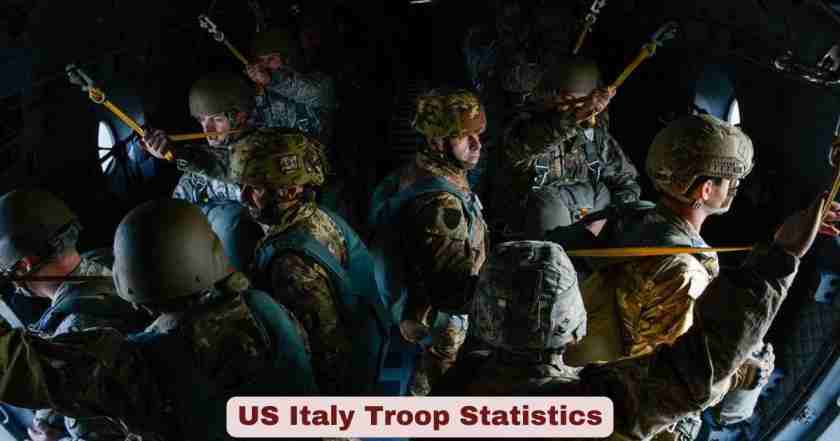
The U.S. Army’s 173rd Airborne Brigade Combat Team at Vicenza is the force structure component that makes the Italy garrison operationally distinctive from any other European deployment. Designated as the Army’s primary contingency force for Europe and Africa, the 173rd Airborne is specifically structured, equipped, and trained for rapid forced-entry operations — the ability to parachute into a crisis environment with minimal warning. This mission set has made the 173rd one of the most consistently deployed units in the U.S. Army’s European posture, with rotations in support of Baltic Air Policing, exercises in Georgia, and deployments to support stability missions across Africa. The Air Force’s 31st Fighter Wing at Aviano — the only permanently forward-deployed F-16 unit in southern Europe — provides NATO’s southern flank with an air deterrence and precision-strike capability that fills a gap no other alliance member currently covers. Together, these three components — the naval command hub at Naples, the airborne rapid reaction force at Vicenza, and the fighter wing at Aviano — form a genuinely joint, genuinely irreplaceable forward posture that the Pentagon’s own planners have repeatedly described as among the hardest deployments in the world to relocate without strategic cost.