
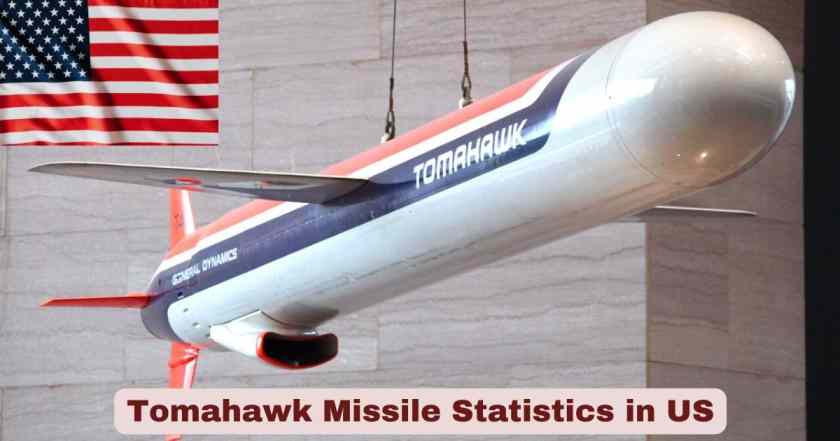
Tomahawk Missile in America 2026
The Tomahawk missile — officially designated the BGM-109 Tomahawk Land Attack Missile (TLAM) — is the most battle-tested and operationally significant long-range precision cruise missile in the United States military’s entire arsenal. First entering operational service in the early 1980s, the weapon has evolved through multiple generational upgrades — Block II, Block III, Block IV, and now the cutting-edge Block V series — transforming from a Cold War deterrent into a GPS-guided, all-weather, terrain-following precision strike system capable of hitting targets at ranges exceeding 1,553 miles (2,500 km). In 2026, the Tomahawk cruise missile in the United States sits at the absolute center of American naval strike doctrine. It is deployable from over 140 US Navy ships and submarines, and for the first time in history, from ground-based Army and Marine Corps launchers as well. Its ability to fly at extremely low altitudes, follow complex routing around air defenses, strike with a circular error probable (CEP) of under 10 meters, and be redirected mid-flight to alternative targets makes it the weapon of choice every time the United States opens a major military operation from standoff distances.
In 2026, the Tomahawk missile program is simultaneously at its busiest operationally and its most ambitious industrially. On February 4, 2026, RTX (Raytheon) announced landmark multi-year framework agreements with the U.S. Department of Defense to scale Tomahawk annual production to over 1,000 units per year — a more than tenfold increase over recent production rates — enabled by the FY26 Defense Appropriations Act. This surge in production has been driven by unprecedented combat depletion. From Operation Midnight Hammer in June 2025 — when 30 Tomahawks struck Iranian nuclear sites at Natanz and Isfahan from an Ohio-class submarine — to the massive Operation Epic Fury launched on February 28, 2026, in which US warships fired Tomahawk missiles as part of a sweeping joint US-Israel strike on Iran’s nuclear and military infrastructure, 2025–2026 represents the most intense period of Tomahawk operational use since the 1991 Gulf War. This article presents the most current, verified statistics on the Tomahawk missile in the United States in 2026, sourced directly from Pentagon budget documents, US Navy official releases, CENTCOM statements, and Raytheon/RTX announcements.
Interesting Facts About the Tomahawk Missile in the US 2026
| Fact | Verified Data |
|---|---|
| Official designation | BGM-109 Tomahawk Land Attack Missile (TLAM) |
| Manufacturer | Raytheon (RTX), Tucson, Arizona |
| First combat use | 1991 — Operation Desert Storm |
| Total combat deployments (through 2026) | More than 2,350 times (plus 2025–2026 Iran combat use) |
| Total units produced since 1983 | Over 8,919 units (latest confirmed figure, March 2024) |
| Maximum strike range (Block IV/V) | 800 to 1,553 miles (1,287–2,500 km) |
| Cruising speed | Mach 0.7–0.75 (~880 km/h / ~550 mph) |
| Warhead weight | 1,000 lb (454 kg) class — unitary warhead |
| Terminal accuracy (CEP) | Less than 10 meters |
| Missile length | 5.56 meters (18.2 ft) |
| Wingspan (deployed) | 2.67 meters (8.76 ft) |
| Flight altitude | As low as 30–50 meters above ground (terrain-following) |
| Guidance systems | GPS, INS, TERCOM, DSMAC, two-way satellite datalink |
| Current active variant | Block V (Block Va Maritime Strike + Block Vb Multi-Effects) |
| Platforms capable of launching | Over 140 US Navy ships and submarines |
| First multi-service procurement | FY2022 — Navy, Army, Marine Corps |
| US FY2026 planned procurement | 57 missiles (per Pentagon budget data) |
| Average unit cost (2026) | ~$1.3 million to $2.2 million per missile |
| New target annual production rate (Feb 4, 2026) | Over 1,000 missiles per year |
| Stockpile available for transfer (CSIS, 2026) | ~1,000 missiles |
| Tomahawks fired in Operation Midnight Hammer (June 2025) | 30 missiles at Natanz & Isfahan nuclear sites |
| Operation Epic Fury (Feb 28, 2026) | Tomahawks fired from US warships in joint US-Israel strike on Iran |
| New variant spotted in Operation Epic Fury | Black-coated Maritime Strike Tomahawk (MST) — first-ever combat use |
| Service life extension via Block V upgrade | +15 years per missile |
Source: U.S. Department of Defense (defense.gov); Pentagon FY2025–FY2026 Budget Request (comptroller.defense.gov); RTX/Raytheon (rtx.com, February 4, 2026); USNI News (usni.org); Reuters (February 28, 2026); CSIS (csis.org, February 2026); Wikipedia — Tomahawk Missile (updated March 1, 2026)
The Tomahawk missile has been active in direct combat against Iranian nuclear targets twice within a single 12-month period — a first in the weapon’s entire 35-year combat history. The June 2025 Operation Midnight Hammer saw a single Ohio-class submarine fire over two dozen TLAMs at Isfahan in the opening minutes of the operation, while the June 22 B-2 strikes simultaneously hit Fordow and Natanz with GBU-57 bunker-busters, with a combined total of approximately 75 precision-guided munitions used. The February 28, 2026 Operation Epic Fury then marked a dramatic escalation, with US warships deploying Tomahawks from the Persian Gulf alongside F-18s, F-35s, and — in its first-ever combat use — the Low-Cost Unmanned Combat Attack System (LUCAS) drone. What makes the Tomahawk statistics in 2026 especially alarming to defense planners is that the US has been consuming Tomahawks at a rate far outpacing production, having burned through approximately 15 years’ worth of stockpile in just five years, making the new 1,000-per-year production agreement an urgent national security imperative.
Tomahawk Missile Technical Specifications in the US 2026
| Specification | Data |
|---|---|
| Official name | BGM-109 Tomahawk Land Attack Missile (TLAM) |
| Length | 5.56 m (18.2 ft) |
| Wingspan | 2.67 m (8.76 ft) |
| Diameter | 51.8 cm (20.4 in) |
| Launch weight | ~1,440 kg (3,174 lb) with booster |
| Warhead | WDU-36B — 450 kg (1,000 lb) class unitary blast-fragmentation |
| Range (Block IV / V) | 800–1,553 miles (1,287–2,500 km) |
| Cruising speed | ~880 km/h (Mach 0.74) |
| Cruise altitude | 30–50 meters AGL (terrain-following) |
| Propulsion | Solid rocket booster (launch) + Williams F107 turbofan (cruise) |
| Accuracy (CEP) | < 10 meters |
| Guidance | GPS, INS, TERCOM, DSMAC, two-way satellite datalink |
| In-flight retargeting | Yes — Block IV/V can be redirected mid-flight |
| Alternate targets storable | Up to 15 pre-planned alternate targets |
| Anti-jam GPS | Yes — integrated in Block V |
Source: U.S. Navy NAVAIR (navair.navy.mil); Federation of American Scientists (fas.org); Wikipedia BGM-109 Tomahawk (updated March 1, 2026)
The Tomahawk missile’s technical specifications in 2026 underscore why it remains the US military’s first weapon of choice for precision long-range strikes. Flying at speeds around Mach 0.74 (~550 mph) and as low as 30 meters above ground level, the TLAM’s terrain-following flight profile allows it to hug valleys and ridgelines, dramatically reducing its radar cross-section and interception risk. Its guidance suite — combining GPS, Inertial Navigation System (INS), Terrain Contour Matching (TERCOM), and Digital Scene Matching Area Correlation (DSMAC) — gives it a terminal accuracy of under 10 meters CEP, meaning it consistently strikes within a 10-meter radius of its aim point regardless of weather or time of day.
What elevates the Block V Tomahawk above its predecessors is operational flexibility. The two-way satellite datalink allows commanders to redirect the missile to one of up to 15 pre-planned alternate targets or re-task it entirely while in flight — a capability that proved critical during the rapidly shifting target sets of Operation Epic Fury on February 28, 2026. The Block Va Maritime Strike Tomahawk (MST) adds a seeker enabling it to strike moving surface vessels at ranges over 1,000 miles, while the Block Vb introduces a Joint Multi-Effects Warhead System (JMEWS) capable of defeating a wider range of hardened land targets. Both variants have now been operationally confirmed in combat against Iran in 2025 and 2026.
Tomahawk Missile Production & Cost Statistics in the US 2026
| Production / Cost Metric | Data |
|---|---|
| Sole manufacturer | Raytheon (RTX), Tucson, Arizona |
| Average unit cost (FY2026, per Pentagon budget data) | ~$1.3 million per missile |
| Average unit cost (Block V full-rate production contract) | ~$2.2 million per missile |
| Lowest per-unit cost (high-volume order, Dec 2024) | ~$1.75 million |
| FY2023 actual production | 68 missiles |
| FY2024 actual production | 34 missiles |
| FY2025 planned production | 22 missiles |
| FY2026 planned procurement (budget) | 57 missiles |
| New target production rate (Feb 4, 2026 agreement) | Over 1,000 missiles per year |
| Production rate increase factor | More than 10x current rate |
| Agreement duration | 7 years |
| Contract value (Dec 2024 — 131 Block V missiles) | $401.2 million |
| Combined contract value (May + Dec 2024 orders) | $785.2 million for 350 missiles |
| Prior production rate (FY2022–FY2025) | ~50–86 missiles/year |
| Enabling legislation | FY26 Defense Appropriations Act |
| Additional funding (One Big Beautiful Bill, Sec. 20009) | ~$938 million for multiservice long-range cruise missiles |
Source: Pentagon FY2025 Budget Request (comptroller.defense.gov); RTX Press Release (rtx.com, February 4, 2026); USNI News (usni.org, February 4, 2026); Defense Express (defence-ua.com); National Interest (nationalinterest.org, January 2026)
The Tomahawk production statistics for the US in 2026 reveal one of the most dramatic gaps between operational demand and industrial supply in modern American military history. In FY2023, only 68 Tomahawks were produced — that figure dropped to just 34 in FY2024 and a planned low of 22 in FY2025, while the United States simultaneously consumed hundreds in combat across Yemen, Iran, and other theaters. Defense analysts noted that the US had burned through approximately 15 years’ worth of Tomahawk stockpile in just five years — an unsustainable trajectory that directly triggered the February 4, 2026 emergency production agreement between Raytheon and the Pentagon.
The $785.2 million combined contract for 350 Block V missiles across 2024 was just the immediate stopgap. The far more consequential action was the 7-year multi-billion-dollar framework agreement targeting a production rate of over 1,000 Tomahawk missiles per year — more than a tenfold surge in output. To achieve this, Raytheon is partnering with Anduril, Northrop Grumman, Avio USA, and Nammo to massively expand solid rocket motor supply chains — the historic chokepoint in US cruise missile production. The FY2026 planned procurement of 57 missiles represents only the baseline appropriated figure; the new framework agreement, funded in part by the ~$938 million in Section 20009 of the One Big Beautiful Bill Act, supersedes this with far larger multi-year commitments.
Tomahawk Missile Combat Use Against Iran 2025–2026 – Operation Midnight Hammer & Operation Epic Fury Statistics
| Operation / Event | Key Statistics |
|---|---|
| Operation Midnight Hammer — Date | June 21–22, 2025 |
| Tomahawks fired in Operation Midnight Hammer | 30 Tomahawk missiles (confirmed by Pentagon) |
| Launch platform | Ohio-class guided-missile submarine (SSGN) |
| Targets struck by Tomahawks | Natanz Nuclear Facility & Isfahan Nuclear Technology Center |
| Simultaneous weapons used | 14 GBU-57 MOP bunker-busters from 7 B-2 Spirit bombers |
| Total precision weapons used (combined operation) | ~75 precision-guided munitions |
| Iranian nuclear program setback (Pentagon, July 2025) | ~2 years |
| US casualties in Operation Midnight Hammer | Zero |
| Operation Epic Fury — Date | February 28, 2026 |
| Nature of Operation Epic Fury | Joint US-Israel strike — largest coordinated attack on Iran in history |
| US designation | Operation Epic Fury (U.S. Department of War) |
| Strike commencement time | ~1:15 a.m. EST, February 28, 2026 |
| Weapons used in Epic Fury | Tomahawk cruise missiles + F-35s + F-18s + LUCAS drones (first-ever combat use) |
| New Tomahawk variant spotted in Epic Fury | Black-coated Maritime Strike Tomahawk (MST) — first-ever confirmed combat use |
| CENTCOM confirmed US casualties in Epic Fury | Zero |
| Iranian retaliatory strikes (within first 24 hours) | 137 missiles + 209 drones (intercepted/dealt with per UAE) |
| CENTCOM official statement | “Damage to U.S. installations was minimal and has not impacted operations” |
| Targets in Operation Epic Fury | IRGC command facilities, air defenses, missile/drone sites, nuclear targets, Tehran |
Source: Pentagon press briefing (June 22, 2025); US Secretary of the Navy John Phelan — Senate Appropriations hearing; USNI News (usni.org, June 21–22, 2025); Wikipedia — United States strikes on Iranian nuclear sites (updated March 1, 2026); The War Zone (twz.com, March 1, 2026); CENTCOM official statement (centcom.mil, February 28, 2026); Reuters (February 28, 2026); SOF News (sof.news, February 28, 2026); Army Recognition (armyrecognition.com, 2026)
The Tomahawk missile’s combat statistics against Iran in 2025 and 2026 represent the most consequential deployment of the weapon since the opening of the Iraq War in 2003. In Operation Midnight Hammer (June 21–22, 2025), a single unidentified Ohio-class guided-missile submarine operating under U.S. Central Command fired 30 Tomahawk land-attack cruise missiles targeting critical infrastructure within the Isfahan Nuclear Technology Center, while seven B-2 Spirit stealth bombers simultaneously dropped 14 GBU-57/B Massive Ordnance Penetrators on the deeply buried Fordow and Natanz enrichment facilities. A total of approximately 75 precision-guided munitions were used in the joint operation. A Pentagon damage assessment in July 2025 concluded Iran’s nuclear program was set back by approximately two years. The Ohio-class submarine that launched the Tomahawks has a capacity for up to 154 Tomahawk cruise missiles across approximately 22 missile tubes, underscoring the concentrated firepower a single US submarine can deliver in silence.
The even larger Operation Epic Fury (February 28, 2026) escalated the use of Tomahawks against Iran dramatically. Beginning at 1:15 a.m. Eastern Time, US and Israeli forces launched coordinated strikes across Iran in the largest direct military operation against the Iranian regime in American history. US warships in the Persian Gulf fired Tomahawk cruise missiles in rolling salvos as part of a multi-domain strike package that also included F-18 Super Hornets, F-35C Lightning IIs, and — in its first-ever combat deployment — the LUCAS (Low-Cost Unmanned Combat Attack System) drone. Analysis of open-source footage by The War Zone and unclassified NAVAIR briefing slides confirmed the deployment of a brand-new black-coated Maritime Strike Tomahawk (MST) variant — the first time this advanced low-observable Tomahawk had ever been seen in combat. CENTCOM confirmed zero US casualties, while Iran launched over 137 missiles and 209 drones in retaliation across Gulf countries within the first 24 hours — the vast majority successfully intercepted.
Tomahawk Missile Stockpile & Deployment Platforms in the US 2026
| Stockpile / Platform Metric | Data |
|---|---|
| Total Tomahawks produced (all variants, since 1983) | Over 8,919 units |
| Total combat expenditures (through 2025) | Over 2,465 Tomahawks |
| Estimated remaining US stockpile (unofficial, ~2020 baseline) | ~4,000 missiles (before 2020–2026 attrition) |
| CSIS estimated stockpile available for transfer (2026) | ~1,000 missiles |
| Number of US Navy ships/submarines capable of launching | Over 140 |
| Ohio-class SSGN max Tomahawk capacity | Up to 154 Tomahawk missiles per submarine |
| Ohio-class SSGN active in US Navy | 4 submarines |
| Primary surface launch platform | Arleigh Burke-class DDG-51 destroyer — Mark 41 VLS |
| Ground-based launcher (Army, 2022+) | Typhon Mid-Range Capability (MRC) — Mark 41 VLS |
| USMC ground-based launcher cost | $6.2 million per launcher |
| USMC planned launchers (FY2026) | 36 launchers for $222 million |
| Japan order (FY2026–27 deployment) | 400 Tomahawks — $2.35 billion deal |
| Australia — approved sale | Up to 200 Block V + 20 Block IV |
| Germany — Typhon deployment | Episodic deployments planned from 2026 (NATO joint statement, July 2024) |
Source: CSIS (csis.org, February 2026); Defense Express (espreso.tv, October 2025); U.S. Navy NAVAIR (navair.navy.mil); Defense News (defensenews.com, June 25, 2025); DSCA (dsca.mil); Wikipedia — Tomahawk Missile (updated March 1, 2026)
The Tomahawk missile stockpile and platform statistics in 2026 paint a picture of an incredibly capable but increasingly strained asset. Of the over 8,919 Tomahawks produced across all variants since 1983, more than 2,465 have been expended in combat operations — a number growing rapidly given the 2025–2026 Iran operations, Yemen Houthi counter-operations, and global deployments. The CSIS estimate of approximately 1,000 missiles available for potential transfer reflects a stockpile substantially smaller than the unofficial ~4,000 missile figure cited around 2020, illustrating how aggressively the US has drawn down its reserves over the past five years. The upgrade program converting all remaining Block IV missiles to Block V standard — extending shelf life by 15 years per missile — is crucial to preventing further stockpile erosion through obsolescence.
On the platform side, the Tomahawk’s deployment footprint in 2026 has never been broader. While over 140 US Navy surface ships and submarines remain the primary launch platforms, the Army’s Typhon Mid-Range Capability (MRC) — using the standard Mark 41 vertical launch system adapted for ground use — has introduced the weapon to an entirely new domain. Planned episodic deployments of Typhon launchers to Germany starting in 2026, confirmed in the July 10, 2024 US-Germany joint NATO statement, mark the most significant forward basing of land-attack cruise missiles in Europe since Cold War-era BGM-109G Gryphon GLCMs were withdrawn under the 1987 INF Treaty. The 400 Tomahawks Japan ordered for $2.35 billion, set for FY2026–27 deployment aboard Japanese destroyers, and Australia’s approved sale of up to 200 Block V missiles further extend the Tomahawk network into the Indo-Pacific.
Tomahawk Missile Variants & Upgrades Statistics in the US 2026
| Variant | Key Details |
|---|---|
| Block IV (TLAM-E / Tactical Tomahawk) | Two-way datalink, in-flight retargeting, loiter capability — primary legacy variant |
| Block V (TLAM Block V) | Introduced 2021 — upgraded warhead, navigation, anti-jam GPS, enhanced comms |
| Block Va — Maritime Strike Tomahawk (MST) | Anti-ship seeker — strikes moving surface vessels 1,000+ miles away |
| Block Vb — JMEWS | Joint Multi-Effects Warhead System — defeats diverse hardened land targets |
| Black-coated MST (new) | Low-observable coating + infrared suppression — first combat use: Feb 28, 2026 |
| Forward-swept wing Tomahawk | New aerodynamic design observed in Feb 28, 2026 Epic Fury footage |
| Block IV → Block V upgrade | Hundreds of upgrade kits procured annually; adds +15 years service life |
| BGM-109A (TLAM-N, nuclear) | Retired 2010–2013 (W80 nuclear warhead) |
| BGM-109G Gryphon GLCM | Ground-launched nuclear variant — withdrawn 1991 (INF Treaty compliance) |
| Tomahawk Anti-Ship Missile (TASM) | Withdrawn 1994 — converted to TLAM-E Block IV |
| Nuclear-armed variant (under consideration) | US Navy evaluating reintroduction of nuclear cruise missile (2018+ reports) |
Source: U.S. Navy NAVAIR (navair.navy.mil); The War Zone (twz.com, March 1, 2026); Defense Post (thedefensepost.com, December 2024); Wikipedia — Tomahawk Missile (updated March 1, 2026)
The Tomahawk missile variant and upgrade statistics for 2026 reveal a weapon system being rapidly evolved to stay relevant against modern air defense systems. The Block V series, introduced in 2021, represents the most significant capability leap in Tomahawk history, with the Block Va Maritime Strike Tomahawk (MST) transforming the TLAM from a pure land-attack weapon into a credible long-range anti-ship missile capable of striking moving warships at distances exceeding 1,000 miles — a direct counter to China’s growing naval capabilities and Iran’s Persian Gulf fleet. The Block Vb with its Joint Multi-Effects Warhead System (JMEWS) adds the capability to defeat deeply buried, hardened, and structurally diverse targets in ways the older unitary warhead could not.
The February 28, 2026 Operation Epic Fury produced a bombshell for defense analysts: the first confirmed combat use of a new black-coated, low-observable MST variant, identified through analysis of unclassified NAVAIR briefing slides and open-source footage of the strikes. This black Tomahawk — never publicly seen before — features a radar-absorbent coating and potentially infrared suppression properties similar to those on the stealthy AGM-158C LRASM, and was also observed with a new forward-swept wing design, suggesting significant aerodynamic refinements. Additionally, the Navy’s commitment to upgrading all remaining Block IV Tomahawks to Block V standard — each conversion adding 15 years of shelf life — means the service is simultaneously expanding stockpile utility while new Block V production ramps toward 1,000+ units annually.
Tomahawk Missile Program Costs & US Defense Budget in 2026
| Budget / Program Cost Metric | Data |
|---|---|
| Average unit cost (Pentagon FY2026 budget data) | $1.3 million per missile |
| Average unit cost (Block V full-rate production) | $2.2 million per missile |
| Lowest contracted per-unit cost (high-volume, Dec 2024) | $1.75 million |
| FY2026 planned Tomahawk procurement (base budget) | 57 missiles |
| FY2022 contract (154 missiles — Navy/Army/USMC) | $217.1 million |
| FY2024 contract (131 Block V — multi-service + Japan/Australia) | $401.2 million |
| Combined contracts under N0001925C0071 | $785.2 million for 350 missiles |
| 7-year production framework (Feb 4, 2026) | Targets 1,000+ Tomahawks/year |
| One Big Beautiful Bill Act (Sec. 20009) funding | ~$938 million for multiservice long-range cruise missiles |
| USMC Block V missiles (FY2023–FY2025) | 38 missiles for $85.1 million (~$2.2M each) |
| USMC launcher cost | $6.2 million per launcher |
| Japan Tomahawk deal total value | $2.35 billion (400 missiles) |
| Comparison — SM-6 unit cost | $4.3 million |
| Comparison — LRASM unit cost | $3.5 million |
| Comparison — Naval Strike Missile unit cost | $2.2 million |
Source: Pentagon FY2025 Budget Request (comptroller.defense.gov); DOD contract announcement N0001925C0071 (defense.gov); CSIS (csis.org); AFCEA (afcea.org); RTX Press Release (rtx.com, February 4, 2026); Reuters (February 28, 2026); USNI Proceedings (usni.org, August 2023)
The Tomahawk missile budget and program cost statistics for 2026 tell a story of a nation finally reckoning with decades of underinvestment in cruise missile production. At $1.3 million per unit based on current Pentagon FY2026 budget data — or between $1.75 million and $2.2 million at full-rate Block V production pricing — the Tomahawk is among the most cost-effective long-range precision weapons in the US arsenal, significantly cheaper than the SM-6 ($4.3M), LRASM ($3.5M), or the Naval Strike Missile ($2.2M). Yet despite this relative affordability, annual procurement through FY2025 was capped at just 22–68 missiles per year — a catastrophically low figure given that a single Ohio-class submarine can fire up to 154 of them and a single operation can expend 30 in one salvo.
The $785.2 million combined 2024–2025 contract for 350 Block V missiles was a necessary correction, but still insufficient given demand. The February 4, 2026 agreement targeting over 1,000 Tomahawks per year through a 7-year framework — backed by the ~$938 million in Section 20009 of the One Big Beautiful Bill Act — represents the US government’s most serious attempt in decades to restore stockpile adequacy. The challenge remains execution: scaling solid rocket motor production, expanding Raytheon’s Tucson manufacturing floor, and building supply chains across Pontiac, Michigan; Camden, Arkansas; and Huntsville, Alabama. Japan’s $2.35 billion purchase of 400 Tomahawks alone is almost as large as the entire recent US domestic procurement budget, underscoring how dramatically allies are now investing in Tomahawk firepower — and helping drive per-unit costs down from $3 million in earlier estimates to $1.75 million in high-volume orders.
Tomahawk Missile Global Reach & Allied Deployment in the US 2026
| Country / Deployment | Details |
|---|---|
| United States — Navy | Over 140 ships/submarines; primary operator since 1983 |
| United States — Army | Typhon Mid-Range Capability (MRC) ground launcher — operational 2022+ |
| United States — Marine Corps | Ground-based launcher; 36 planned FY2026; 38 missiles procured FY2023–25 |
| United Kingdom | Royal Navy submarines — Tomahawk Block IV/V operator |
| Japan | 400 Tomahawks ordered — $2.35 billion — FY2026–27 deployment on destroyers |
| Australia | Up to 200 Block V + 20 Block IV approved — Royal Australian Navy |
| Germany | Episodic Typhon MRC deployments from 2026 (NATO joint statement, July 2024) |
| Netherlands | Tomahawk operator (Royal Netherlands Navy) |
| Spain | Tomahawk operator (Spanish Navy) |
| Total export orders confirmed (2024–2026) | Japan 400 + Australia 200+ = at least 600 additional missiles |
| Combined US-allied Tomahawk-capable naval vessels | Among the most distributed cruise missile networks globally |
Source: U.S. Defense Security Cooperation Agency (dsca.mil); Wikipedia — Tomahawk Missile (updated March 1, 2026); USNI News (usni.org, February 4, 2026); NATO Joint Statement (July 10, 2024)
The global reach and allied deployment statistics of the Tomahawk missile in 2026 reflect its emergence as the Western world’s preferred long-range precision strike weapon and a cornerstone of collective deterrence. Beyond the United States Navy’s more than 140 capable launch platforms, the US Army’s Typhon Mid-Range Capability launcher has broken the Tomahawk out of its exclusively naval context, enabling ground-based employment anywhere in the world reachable by a C-17 transport aircraft. The announcement that Typhon launchers with SM-6 and Tomahawk missiles will be episodically deployed in Germany starting in 2026 — confirmed in the July 10, 2024 US-Germany joint NATO statement — marks the most significant forward basing of land-attack cruise missiles in Europe since Cold War-era BGM-109G Gryphon GLCMs were withdrawn under the 1987 INF Treaty.
The international export data is equally striking. Japan’s $2.35 billion deal for 400 Tomahawks — scheduled to reach Japanese destroyers in FY2026–27 — represents one of the largest cruise missile purchases in history by a US ally, motivated by the need to counter China’s growing naval power and North Korea’s missile arsenal. Australia’s approved acquisition of up to 200 Block V missiles for the Royal Australian Navy further extends the Tomahawk network across the Indo-Pacific, creating interoperability between US, Japanese, and Australian naval forces that no other cruise missile system can match. Together, the US domestic production surge and allied purchases are injecting enough volume into the Raytheon production line that per-unit costs are actually falling — from $3 million per unit in some earlier estimates down to $1.75 million in the most recent high-volume order — making the long-term case for continued Tomahawk investment increasingly compelling for both the Pentagon and its international partners in 2026.
Disclaimer: This research report is compiled from publicly available sources. While reasonable efforts have been made to ensure accuracy, no representation or warranty, express or implied, is given as to the completeness or reliability of the information. We accept no liability for any errors, omissions, losses, or damages of any kind arising from the use of this report.