
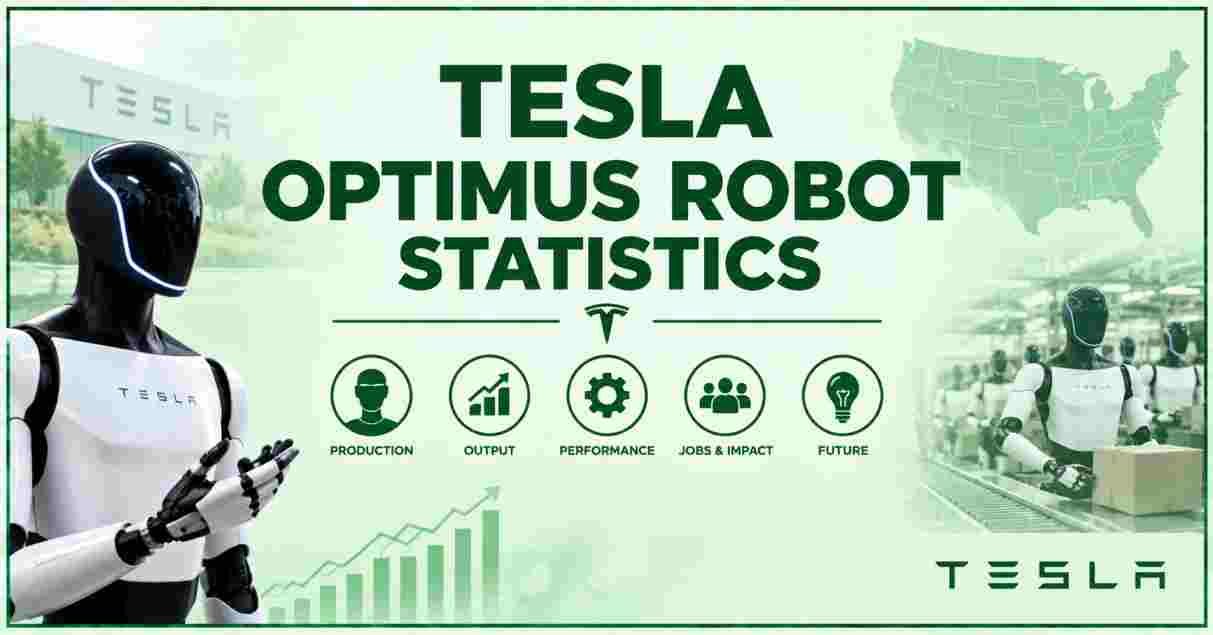
Tesla Optimus Robot – Tesla began early production on its Fremont, California line in October 2026, targets a $20,000 to $30,000 price and plans first deliveries to outside companies around the end of 2027. Humanoid robots displace almost no US jobs in 2026, but Morgan Stanley models 8 million humanoids working in the US by 2040 and 63 million by 2050.
Tesla Optimus Robot 2026 – Introduction
Tesla Optimus Robot 2026 news moved from promises to production on 21 October 2026. On the third-quarter earnings call, Elon Musk said Tesla has started early production on a high-volume Optimus line at its Fremont factory. He also warned of a slow start, with robots reaching outside customers around the end of 2027. This report covers the price, production plans, capabilities and labor effects, using Tesla disclosures, Goldman Sachs, Morgan Stanley and Bureau of Labor Statistics data.
The numbers matter because Optimus now drives Tesla’s spending. Research and development jumped 69% to $2.76 billion in the quarter, and operating income fell 56% to $718 million. Investors are paying for a robot with no published price, no customer deliveries and no full Gen 3 specification sheet. Musk says Optimus will be the biggest product on Earth. Rivals such as Unitree already sell humanoids from $5,900. Each section below separates confirmed facts from targets.
Interesting Facts About Tesla Optimus Robot 2026
OPTIMUS HEADLINE NUMBERS 2026
Fremont line design (units/year)  |████████████████████   1,000,000
Goldman global shipments, 2026    |█                         75,000
Price target, low end (USD)       |██                       $20,000
Hand degrees of freedom, Gen 3    |▌                             22
| Interesting Fact | 2026 Data |
|---|---|
| Production status (21 October 2026) | Early production on the Fremont line |
| Fremont line design capacity | About 1,000,000 robots a year (20,000 a week) |
| Time to reach full rate | At least 1 year |
| First outside customer deliveries | Around the end of 2027 |
| Price target (not a retail price) | $20,000 to $30,000 |
| Gen 3 hand | 22 degrees of freedom |
| Q3 2026 research and development spend | $2.76 billion (up 69%) |
| Goldman Sachs global humanoid shipments, 2026 | 75,000 units |
Source: Tesla Q3 2026 earnings call (21 October 2026); Tesla SEC filings; Goldman Sachs Research, Physical AI report (September 2026).
Tesla confirmed the production news on its own call, not in a product launch. Musk described a line “landed” at Fremont that can build about 1 million robots a year, but he said reaching 20,000 units a week will take at least a year. Parts of the design still change. Outside deliveries depend on fixing the hand, the artificial intelligence software and robot lifespan, which he expects around the end of 2027.
The price figure is a target, not an offer. Tesla has never published an Optimus price, and nobody can order one. Goldman Sachs expects about 75,000 humanoids shipped worldwide in 2026, from all makers combined. That is a tiny base next to Tesla’s Fremont design rate, and it shows how early the market is. Tesla reports no Optimus revenue yet, so every dollar spent in 2026 funds a product customers cannot buy.
Tesla Optimus Robot Price 2026: Target Cost, Production Cost and Rival Prices
HUMANOID ROBOT PRICES 2026
Unitree R1            |▌        5.9
Unitree G1            |█       13.5
1X NEO                |██      20.0
Tesla Optimus (low)   |██      20.0
Tesla Optimus (high)  |███     30.0
Agility Digit (est.)  |█████████████████████████  250
| Robot | Price | Status |
|---|---|---|
| Tesla Optimus | $20,000 to $30,000 target | Not for sale |
| Unitree R1 | $5,900 | Orderable |
| Unitree G1 | $13,500 | Orderable |
| 1X NEO | $20,000 or $499 a month | Pre-order |
| Agility Digit | About $250,000 (third-party estimate) | Warehouse deployments |
Source: Tesla shareholder meeting and earnings call statements (2024-2026); manufacturer online stores (checked 30 September 2026); Agility Robotics investor presentation, SEC Exhibit 99.2.
Musk set the $20,000 to $30,000 range in October 2024 as a long-term consumer target. In November 2025 he put production cost near $20,000 per robot at scale. Public sales are pointed at the end of 2027. On the Q3 call, Tesla’s chief financial officer said Optimus costs are tracking well and trending toward Cybercab costs, but design changes make a firm number premature.
Rivals set the reference points. The Unitree G1 costs $13,500 and ships today, and the R1 costs $5,900. Agility’s investor presentation puts the build cost of its current Digit near $125,000. At $20,000 to $30,000, Optimus would cost roughly one-eighth of Digit’s estimated price. Tesla must first prove it can hit that cost while the design is still changing. Early units will likely cost more, because industrial buyers come first and Musk’s cost goal assumes 1 million robots a year, a volume Tesla is unlikely to reach before 2028 on this report’s reading.
Tesla Optimus Production Plans 2026: Fremont, Austin and Capacity Targets
OPTIMUS CAPACITY TARGETS (robots per year)
Goldman global shipments 2026 |▏                        75,000
Goldman global shipments 2030 |█                        890,000
Fremont line design           |██                     1,000,000
Texas long-term target        |████████████████████  10,000,000
| Milestone | Detail |
|---|---|
| Fremont production line | Early production started; most equipment installed |
| Fremont design rate | About 1 million a year (20,000 a week) |
| Time to full rate | At least 1 year |
| Austin Optimus factory | Under construction; 10 million a year long-term target |
| AI5 chip in Optimus | Expected around April 2027 |
| Training fleet needed | 10,000 to 20,000 robots |
| Outside customer deliveries | Around the end of 2027 |
Source: Tesla Q3 2026 earnings call (21 October 2026); Tesla Q1 2026 shareholder update; Goldman Sachs Research (September 2026).
Tesla converted floor space at Fremont for Optimus, and Musk calls the start of production an S-curve with a shallow, bumpy first stage. He counts about 10,000 things that must go right. Output will move at the pace of the slowest part. Tesla also started building a larger factory in Austin, which supports a long-term goal of 10 million robots a year. Installed capacity does not equal output. Tesla’s own filing warns that limits can appear as production rates approach capacity.
Data is the second bottleneck. Musk said Tesla needs roughly 10,000 to 20,000 robots running self-play in an “Optimus Academy” to train the software. The faster AI5 chip, about ten times the compute of AI4, should reach Optimus around April 2027. Goldman Sachs forecasts 890,000 humanoid shipments worldwide by 2030, so even Tesla’s early plan would hold a large share.
Tesla Optimus Capabilities 2026: Hands, Compute and Training
OPTIMUS HAND DEGREES OF FREEDOM
Gen 2 hand |███████████          11
Gen 3 hand |██████████████████████  22
Human hand |███████████████████████████  27
| Capability | Confirmed Detail | Status |
|---|---|---|
| Size (design target) | 5 ft 8 in (173 cm), 125 lb (57 kg) | Tesla AI Day targets |
| Walking speed (design target) | 5 mph | Tesla AI Day targets |
| Carry capacity (design target) | 45 lb (20 kg) | Tesla AI Day targets |
| Gen 3 hand | 22 degrees of freedom per hand, about 50 actuators | Revealed February 2026 |
| Main hardware problem | Hand wear, sensors and custom gears | Still changing |
| Software goal | Tasks not pre-programmed | Video due in 1 to 2 months |
Source: Tesla Q3 2026 earnings call; Tesla AI Day 2021 presentation; Tesla Optimus program updates (February 2026).
The hand decides what Optimus can do. Gen 3 doubles the Gen 2 hand from 11 to 22 degrees of freedom, close to the human hand’s 27. Tesla engineers said most of the body has converged on a working design, but the hand, its fingers and its gears still need work. Humans repair their hands. Robots do not, so durability is the hard part. Compute is the other limit. A humanoid has far more degrees of freedom than a car, so the added compute in AI5 should help the robot handle a wider range of tasks.
Tesla has not published a full Gen 3 specification sheet, and third-party sites list conflicting numbers, so treat any spec beyond the table as unconfirmed. Musk said Tesla may release a video in one to two months showing Optimus doing tasks that are not pre-programmed. First customers will likely use robots for dangerous, repetitive or around-the-clock factory work. Home use comes later, as production scales.
Tesla Optimus Timeline 2026: Key Dates From January to October
OPTIMUS 2026 MILESTONES (months from January)
Jan  Q4 2025 update: Gen 3 reveal planned for Q1  |█
Feb  Gen 3 hand shown                             |██
Apr  Q1 call: reveal moved closer to production   |████
Jul  Q2 deck: lines being installed               |███████
Oct  Q3 call: early production begins             |██████████
| Date | Event | What Changed |
|---|---|---|
| January 2026 | Tesla shareholder update | Gen 3 unveil planned for Q1; production start planned before the end of 2026 |
| January 2026 | Musk at Davos | Public sales pointed at the end of 2027 |
| February 2026 | Gen 3 hand shown | 22 degrees of freedom per hand |
| 22 April 2026 | Q1 earnings call | Gen 3 unveil moved closer to production start |
| 22 July 2026 | Q2 shareholder deck | Fremont lines being installed; production expected later in 2026 |
| 21 October 2026 | Q3 earnings call | Early production started; at least 1 year to full rate |
Source: Tesla SEC Form 8-K shareholder updates (January and October 2026); Tesla Q1, Q2 and Q3 2026 earnings calls; Tesla Form 10-Q (March 2026).
The calendar shows a plan that slipped but did not stall. In January, Tesla told shareholders it would unveil Gen 3 in the first quarter and start production before the end of 2026. The first part did not happen on schedule. On the 22 April call, Musk said the unveil would come closer to production start, and the Q3 call named no unveil date. The production target held: Tesla did start building robots in 2026.
Treat the pace as the real story. Tesla’s first stated goal was only a start of production, not volume. Full volume now sits roughly 12 months past the Q3 call, which pushes meaningful output into late 2027. Past Tesla timelines for new products often moved right, so investors and buyers should plan around 2028 for any large fleet. That view is this report’s reading of the record, not a Tesla forecast.
Humanoid Robot Market Forecast 2026: Shipments and Revenue Through 2050
GOLDMAN HUMANOID SHIPMENTS (units)
2026  |▏                       75,000
2030  |██                      890,000
2035  |████████████████████  6,500,000
| Forecaster | Forecast |
|---|---|
| Goldman Sachs, 2026 | 75,000 units shipped worldwide |
| Goldman Sachs, 2030 | 890,000 units (raised from 256,000) |
| Goldman Sachs, 2035 | 6.5 million units, $138 billion market |
| Morgan Stanley, 2050 | 1 billion humanoids, $5 trillion market |
| Morgan Stanley, US 2030 | 40,000 humanoids working |
| Morgan Stanley, US 2040 | 8 million humanoids working |
| Morgan Stanley, US 2050 | 63 million humanoids, about $3 trillion in payroll |
Source: Goldman Sachs Research, Physical AI report (September 2026); Morgan Stanley Research, humanoid robot outlook.
Forecasts keep rising. Goldman raised its 2035 shipment estimate from 1.4 million to 6.5 million units, and its 2030 figure from 256,000 to 890,000. The bank values the 2035 market at $138 billion. Morgan Stanley looks further out and sees 1 billion humanoids and a $5 trillion market by 2050, with about 90% in industrial and commercial settings. Chip makers gain too, with $3,000 to $6,000 of semiconductor content in each humanoid.
Forecasts are not orders. Tesla’s Fremont design rate of 1 million units a year would exceed Goldman’s 2030 global estimate of 890,000. That gap shows either Tesla’s ambition or the forecasters’ caution. Morgan Stanley expects adoption to stay slow until the mid-2030s, then accelerate after 2040. Forecasters also differ on definitions, since some count only business shipments and others add household units, so compare each number with its source and its date.
Jobs at Risk From Tesla Optimus and Humanoid Robots in the US 2026
MORGAN STANLEY: US JOBS EXPOSED TO HUMANOIDS (percent)
Construction jobs           |██████████████  70%
Farming, fishing, forestry  |█████████████   67%
All US occupations          |███████████████ 75% (some exposure)
All US employees            |████████        40%
| US Job Area | Employment (BLS, September 2026) | Humanoid Exposure |
|---|---|---|
| Manufacturing | 12,652,000 | Replaced first in Morgan Stanley’s model |
| Transportation and warehousing | 6,608,700 | Logistics replaced first |
| Warehousing and storage | 1,831,800 | Down 1.2% from September 2025 |
| Construction | 8,364,000 | Up to 70% of jobs affected |
| Farming, fishing, forestry | 1,178,000 | Up to 67% of jobs affected |
| All employed Americans | 163,152,000 | About 40% have some exposure |
Source: US Bureau of Labor Statistics, Employment Situation (September 2026); Bureau of Transportation Statistics; Morgan Stanley Research.
Jobs at risk are a 2030s and 2040s issue, not a 2026 one. Goldman expects 75,000 humanoids worldwide this year against 163,152,000 employed Americans, so robots equal roughly 0.05% of the US workforce even if all of them landed here. Tesla itself keeps early robots inside its own plants and will not deliver outside units until around the end of 2027. BLS data shows manufacturing employment up 72,000 since December 2025. The September unemployment rate was 4.2%, with 7.1 million people jobless, so any robot effect would land on a labor market that already has slack.
The long-run model is larger. Morgan Stanley scored 831 US occupations and found about 75% have some “humanoidability,” covering roughly 40% of employees. It models 8 million humanoids working in the US by 2040 and 63 million by 2050. The World Economic Forum projects 170 million jobs created and 92 million displaced worldwide by 2030 across all trends, and it does not isolate humanoids. Dangerous, repetitive and hard-to-staff work comes first.
Tesla Optimus Financial Impact 2026: Q3 Spending and Investor Timeline
TESLA Q3 2026 (USD billions)
Revenue                  |████████████████████████████   28.05
Research and development |██▊                            2.76
Free cash flow           |█▌                              1.53
Operating income         |▋                              0.72
| Metric | Q3 2026 |
|---|---|
| Revenue | $28.05 billion (flat year on year) |
| Research and development | $2.76 billion (up 69%) |
| Operating income | $718 million (down 56%) |
| Operating margin | 2.6% |
| Free cash flow | $1.531 billion |
| Cash and investments | Over $45 billion |
| 2026 capital spending guidance | About $20 billion |
Source: Tesla Q3 2026 shareholder update and earnings call (21 October 2026); Electrek and Teslarati results coverage.
Optimus costs show up in operating expenses first. Tesla’s finance chief said spending will keep rising until new products reach commercial sales, naming Optimus, Megapack 3 and Semi. Operating income fell to $718 million on flat revenue of $28.05 billion, a margin of 2.6%. Free cash flow stayed positive at $1.531 billion, and cash and investments top $45 billion. That cash pile lets Tesla fund the build, but operating spending is growing faster than gross profit.
The timeline gives investors three checkpoints. A non-scripted Optimus video could arrive within one to two months. The AI5 chip should enter the robot around April 2027. Outside deliveries start near the end of 2027. Tesla also secured borrowing capacity of up to $30 billion and plans more spending on Optimus capacity, a Terafab chip plant and robotaxi fleets.
Tesla Optimus Robot FAQ 2026
How much does the Tesla Optimus robot cost in 2026?
Tesla has not published a price. Musk’s target is $20,000 to $30,000 at scale, with production cost near $20,000. Nobody can order a robot in 2026, from Tesla or any reseller.
When will Tesla Optimus go on sale?
Tesla expects outside company deliveries around the end of 2027. Industrial customers come first. Musk says home use follows as production scales.
Has Tesla started producing Optimus in 2026?
Yes, early production began on the Fremont line, as Musk confirmed on 21 October 2026. Reaching 20,000 robots a week will take at least a year.
How many Optimus robots will Tesla make?
The Fremont line is designed for about 1 million a year. A planned Austin factory targets 10 million a year long term. Both are targets, not current output.
What can the Tesla Optimus robot do in 2026?
It walks, handles objects and trains in Tesla factories. The Gen 3 hand has 22 degrees of freedom. Open-ended household tasks are not ready.
Will Tesla Optimus take jobs in 2026?
No measurable US job losses trace to Optimus in 2026. Goldman expects only 75,000 humanoids worldwide this year, about 0.05% of the US workforce.
Which jobs are most at risk from humanoid robots?
Manufacturing, warehouse, construction and farm work lead the lists. Morgan Stanley sees up to 70% of construction jobs and 67% of farming jobs exposed over decades.
Can you buy a humanoid robot today?
Yes, from other makers. The Unitree G1 costs $13,500, the R1 $5,900, and 1X takes $20,000 pre-orders. Tesla Optimus is not for sale.
Why is Tesla Optimus production slow?
Musk counts about 10,000 things that must go right, and the design still changes. The hand, custom gears, robot lifespan and the supply chain all limit the first output.
Did Tesla unveil Optimus Gen 3 in 2026?
Tesla showed the Gen 3 hand in February 2026. It has not announced a full Gen 3 unveiling date, and a non-scripted demo video may arrive within one to two months.
Disclaimer: This research report is compiled from publicly available sources. While reasonable efforts have been made to ensure accuracy, no representation or warranty, express or implied, is given as to the completeness or reliability of the information. We accept no liability for any errors, omissions, losses, or damages of any kind arising from the use of this report.