
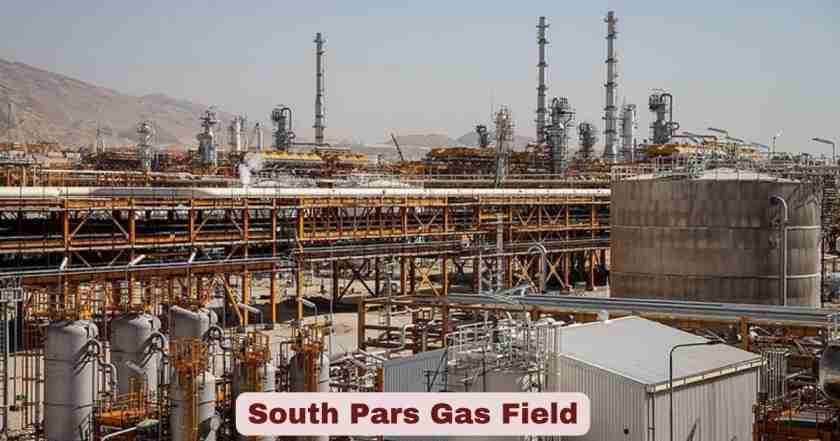
Where is the South Pars Gas Field?
The South Pars Gas Field is the Iranian portion of the single largest natural gas reservoir ever discovered on Earth — a colossal offshore structure lying beneath the shallow waters of the Persian Gulf, approximately 100 kilometres (62 miles) southwest of Asaluyeh on Iran’s southern coast. Geologically, South Pars is the northern extension of Qatar’s North Dome (North Field), and together the two sides form the South Pars/North Dome Gas-Condensate Field — a reservoir so vast that it holds an estimated 1,800 trillion cubic feet (51 trillion cubic metres) of in-situ natural gas, enough to supply the entire world’s energy needs for approximately 13 years. The Iranian portion alone, covering 3,700 square kilometres of seabed at a water depth of just 65 metres, sits atop an estimated 14 trillion cubic metres of recoverable gas and 18 billion barrels of gas condensate — representing more than 40% of Iran’s total proven gas reserves and approximately 8% of the world’s total. Discovered in 1990 by the National Iranian Oil Company (NIOC) through an appraisal well that encountered gas in Upper Permian and Lower Triassic carbonate formations, South Pars is developed and managed by Pars Oil and Gas Company (POGC), a wholly owned NIOC subsidiary based in Assaluyeh, Iran.
As of March 2026, South Pars sits at the centre of both Iran’s energy security and a rapidly escalating geopolitical crisis that has drawn global attention to the field’s extraordinary strategic value. Before the recent conflict escalation, Iran’s daily rich gas production from South Pars had reached a record 730 million cubic metres per day in January–February 2026, the highest output ever recorded in the field’s more than two-decade operational history — an achievement announced by Iranian Oil Minister Mohsen Paknejad as a landmark in the face of international sanctions and pressure. The field’s 24 development phases, most of which are now operational, supply the overwhelming majority of Iran’s domestic natural gas — fuelling power generation, heating, industry, and petrochemical production across a nation of 87 million people. South Pars is not just a gas field; it is the beating energy heart of the Iranian economy, and its output statistics, investment figures, and geopolitical context make it arguably the most strategically significant piece of real estate in global energy today.
Interesting Key Facts About the South Pars Gas Field in 2026
The table below consolidates the most important, striking, and verified facts about South Pars drawn from authoritative international and Iranian government energy sources as of March 2026.
| Key Fact | Verified Statistic / Detail |
|---|---|
| Full name | South Pars Gas-Condensate Field (Iranian portion of South Pars/North Dome) |
| Location | Persian Gulf, ~100 km southwest of Asaluyeh, Iran |
| Coordinates | 52°E–52.5°E, 26.5°N–27°N |
| Area (Iranian side) | 3,700 square kilometres |
| Water depth | 65 metres (reservoir located 3,000 m below seabed) |
| Discovery year | 1990 (by NIOC appraisal well) |
| Operator | Pars Oil and Gas Company (POGC), subsidiary of NIOC |
| Iranian gas reserves (South Pars) | ~14 trillion cubic metres of gas + 18 billion barrels of condensate |
| Share of Iran’s proven gas reserves | More than 40% |
| Share of world’s total gas reserves (Iranian side) | ~8% |
| In-situ reserves (full field incl. Qatar) | 1,800 trillion cubic feet (51 trillion cubic metres) — per IEA |
| Record daily production (Jan–Feb 2026) | 730 million cubic metres per day of rich gas — all-time high |
| Share of Iran’s domestic gas supply | ~70% of Iran’s total domestic gas consumption |
| Total development phases | 24 phases (28 production blocks) |
| Phase 1 production start | December 2002 |
| Full-field production target (all 24 phases) | ~790 million cubic metres per day |
| Total investment as of 2010 | Over $30 billion |
| Planned total investment (2011–2015 govt. plan) | $90 billion |
| 2024 gas pressure maintenance plan | $70 billion investment plan |
| 2025 pressure upgrade initiative | $17 billion (S&P Global, March 2025) |
| GDP contribution per phase | ~1% of Iran’s GDP per phase; Phase 12 alone: 3%+ |
| Iranian companies involved (as of 2012) | 400+ Iranian companies supplying equipment |
| Offshore platforms in operation | 38 production & logistics platforms + 14 pressure-boosting platforms |
Source: Wikipedia – South Pars/North Dome Gas-Condensate field (updated March 18, 2026); IEA; NIOC/POGC; Financial Tribune Iran (February 2026); Trend.Az (November 2025); Offshore-Technology.com; S&P Global Market Intelligence (March 2025); Ports MarineLink – South Pars All Phases
The raw numbers behind South Pars are almost incomprehensible in their scale. The fact that the Iranian side alone accounts for more than 40% of Iran’s entire proven gas reserves — and supplies roughly 70% of the country’s domestic gas consumption — makes it impossible to overstate the field’s centrality to Iranian energy security, economic stability, and social welfare. When production falters at South Pars, Iran’s power grid buckles: the country has suffered rolling electricity outages and industrial gas rationing during periods of reduced output, even though it sits atop one of the world’s largest hydrocarbon endowments. The record production of 730 million cubic metres per day in January–February 2026 — achieved under the compounding pressures of international sanctions, declining reservoir pressure, and aging infrastructure — is a remarkable operational achievement that speaks to the effectiveness of domestic engineering and asset management by POGC.
The investment figures are equally staggering. The $70 billion gas pressure maintenance plan announced in 2024, and the separate $17 billion upgrade initiative identified by S&P Global in March 2025, reflect the urgent challenge Iran faces as the reservoir enters the second half of its productive life. Natural reservoir pressure naturally declines over time in any gas field, and without aggressive compression and reinjection infrastructure, output will fall. Iran’s inability to access international capital markets, advanced compression technology from Western suppliers, and foreign technical expertise under sanctions means these investment plans face enormous execution risk — even as the need for them grows more acute each year.
South Pars Gas Field Reserve Statistics in 2026
South Pars Iranian Side — Reserve Profile & Resource Data
| Reserve / Resource Category | Figure | Source / Context |
|---|---|---|
| Recoverable natural gas reserves (Iranian side) | ~14 trillion cubic metres (Tcm) | NIOC / Trend.Az, 2025 |
| Gas condensate reserves (Iranian side) | ~18 billion barrels | NIOC / WION, 2026 |
| Total in-situ gas (full South Pars/North Dome field) | 1,800 trillion cubic feet (51 Tcm) | IEA (cited by CNN, Reuters) |
| Total recoverable gas (full field, ~70% recovery) | ~1,260 trillion cubic feet | IEA / Wikipedia |
| Iran’s share of total field reserves | ~36% of combined recoverable gas | NIOC / IEA |
| Qatar’s share of total field reserves | ~64% of combined recoverable gas | IEA / QatarEnergy |
| Iran share of world proven gas reserves | ~17.1% (total national, incl. South Pars) | IEA / Enerdata 2025 |
| South Pars share of Iran’s national reserves | >40% | NIOC / Multiple sources |
| Reservoir depth below seabed | 3,000 metres | Offshore Technology |
| Reservoir rock type | Upper Permian & Lower Triassic carbonates (Dalan-Kangan formations) | ScienceDirect, 2006 |
| Reservoir age | ~250–270 million years (Permo-Triassic) | Peer-reviewed geology |
| Gas bearing formations | Upper Dalan (Khuff-equivalent) & Kangan Formation | ResearchGate / ScienceDirect |
Source: IEA (cited by CNN, Wikipedia); NIOC; Trend.Az (November 2025); WION News (March 2026); ScienceDirect – Geochemistry of South Pars (2006); Offshore-Technology.com; Wikipedia – South Pars/North Dome (updated March 2026)
The geology of South Pars is as impressive as its reserve numbers. The reservoir rock — primarily Upper Permian and Lower Triassic carbonate formations known as the Dalan and Kangan units — was deposited roughly 250 to 270 million years ago in a shallow marine carbonate ramp environment. The gas accumulation is part of the broader Qatar Arch structural feature, a north-trending anticlinal structure that spans the Persian Gulf and is bounded to the north and northeast by the Zagros fold belt of Iran. The reservoir sits approximately 3,000 metres below the seabed in a water depth of just 65 metres — a geologically shallow and technically accessible setting that, under normal investment and political conditions, would be highly amenable to development. The Upper Dalan Formation (Khuff-equivalent) is the principal gas-bearing horizon, characterised by a complex mix of dolomitisation and dissolution that creates variable but generally strong reservoir quality. The presence of high mercaptan (sulfur compound) concentrations, however, has been one of the enduring technical challenges of South Pars development, requiring specialized processing facilities that added cost and complexity to each phase.
The reserve asymmetry between Iran and Qatar is a product of geology but its consequences are entirely a product of politics, investment, and technology. Iran’s ~14 trillion cubic metres of recoverable gas on its side is itself an extraordinary endowment — more than the entire proven reserves of the United States — yet it remains heavily underdeveloped relative to Qatar’s side. The 36% vs. 64% split in recoverable reserves reflects both the relative areas of the two sides (Iran’s 3,700 sq km vs. Qatar’s 6,000 sq km) and the fact that gas naturally migrates toward the lower-pressure side of a shared reservoir. Iran’s lagging extraction rate means that gas is effectively migrating toward the Qatari side of the field over time — a phenomenon that Iranian energy analysts and parliamentarians have repeatedly flagged as a national energy security emergency.
South Pars Gas Field Production Statistics in 2026
South Pars Iranian Side — Production Data by Phase & Overall
| Production Metric | Figure | Period / Context |
|---|---|---|
| Record daily rich gas production | 730 million cubic metres/day | January–February 2026 (all-time high) |
| Daily production in 2024 | ~700 million cubic metres/day | Trend.Az, November 2025 |
| Daily production early 2026 (per Wikipedia) | ~2 billion cubic feet/day (~57 Mcm/day) | Early 2026 pre-conflict estimate |
| Full-field target (all 24 phases) | ~790 million cubic metres/day | POGC target — Ports MarineLink |
| Gas production start date | December 2002 (Phase 2 online) | NIOC/POGC |
| Phase 1 output | 1 bcf/day gas + 40,000 bbl/day condensate + 1,500 t/day LPG + 200 t/day sulfur | Offshore-Technology / Wikipedia |
| Phases 2–3 output | 2 bcf/day gas + 80,000 bbl/day condensate + 3,000 t/day LPG | Wikipedia (Total/Petronas/Gazprom) |
| Phases 6–8 output | 3 bcf/day gas + 120,000 bbl/day condensate + 4,500 t/day LPG + 600 t/day sulfur | Wikipedia / Offshore-Technology |
| Phases 17–18 output | 50 Mcm/day gas + 80,000 bbl/day condensate + 1 Mt/year LPG + 800 t/day sulfur | MEED / Offshore-Technology |
| Phases 22–24 design output | 56 Mcm/day gas + 75,000 bbl/day condensate + 400 t/day sulfur | Wikipedia / POGC |
| South Pars Refinery No.1 sweetened gas (FY 2024–25) | Over 10 billion cubic metres | Egypt Oil & Gas / SHANA, April 2025 |
| Refinery No.1 condensate production (FY 2024–25) | Over 7.26 million barrels | Egypt Oil & Gas / SHANA, April 2025 |
| Refinery gas consumption reduction (FY 2024–25) | 16% below permitted levels | Egypt Oil & Gas / SHANA, April 2025 |
| Share of Iran’s domestic gas supply | ~70% | CNN / WION, 2026 |
| Share of Iran’s total gas production | ~33% | Trend.Az, November 2025 |
Source: Financial Tribune Iran (February 2026); Trend.Az (November 2025); Wikipedia – South Pars/North Dome (March 2026); Egypt Oil & Gas / SHANA (April 2025); MEED; Offshore-Technology.com; Ports MarineLink
The production trajectory of South Pars over the past two decades is one of the most significant industrial stories in the Middle East. Starting from just 1 billion cubic feet per day when Phase 2 came online in December 2002, the field has been built up phase by phase — through sanctions, contractual disputes, bribery scandals, political upheaval, and technical challenges — to reach a record 730 million cubic metres per day in early 2026. The sequential upward production records documented between 2023 and 2026 — climbing from 710 to 712 to 714, 716, 718, 722, 723, 725, 727, and finally 730 Mcm/day — tell a story of incremental operational gains achieved through discipline and domestic ingenuity rather than the large-scale international investment the field truly requires. That the first South Pars Gas Refinery exceeded its production target by 5% in the Iranian fiscal year 2024–25, while simultaneously cutting gas consumption 16% below permitted levels, points to genuine operational efficiency improvements even within a sanctions-constrained environment.
The disparity between the 730 Mcm/day record production figure and the earlier 2 bcf/day (~57 Mcm/day) figure cited in some sources reflects a key distinction: the higher figure represents total rich gas extracted from the wellhead (all phases combined before processing), while the lower figure represents net usable gas delivered after processing losses, reinjection, and fuel gas consumption at the facilities. Both numbers are accurate for their respective definitions — understanding this distinction is essential when reading South Pars production data from different sources. The field’s full-phase target of 790 Mcm/day remains the benchmark POGC is working toward as later phases (22, 23, and 24) ramp up, though delayed commissioning and reservoir pressure challenges continue to push timelines.
South Pars Gas Field Development Phases in 2026
South Pars Phase Development Summary — Key Phases & Outputs
| Phase(s) | Developer(s) | Key Output | Status |
|---|---|---|---|
| Phase 1 | Petropars | 1 bcf/day gas, 40,000 bbl/day condensate, 1,500 t/day LPG | Operational (2002) |
| Phases 2–3 | Total SA, Petronas, Gazprom | 2 bcf/day gas, 80,000 bbl/day condensate | Operational (2003) |
| Phases 4–5 | Eni (Agip 60%), Petropars | 1+ bcf/day sour gas | Operational (2005) |
| Phases 6–8 | Petropars, Statoil | 3 bcf/day gas, 120,000 bbl/day condensate, 4,500 t/day LPG | Operational |
| Phases 9–10 | GS (Korea), OIEC, IOEC | 2 bcf/day gas, 80,000 bbl/day condensate, 3,000 t/day LPG | Operational (2009) |
| Phase 12 | Petropars (+ PDVSA 10%, Sonangol 20%) | 2.5 bcf/day gas, 80,000 bbl/day condensate, 3,000 t/day LPG | Operational |
| Phases 13–14 | Khatam-ol-Osea Consortium | ~$5 billion contract; Persian LNG project | Operational |
| Phases 15–16 | Khatam al-Anbia | 50 Mcm/day gas for domestic use, 1 Mt/year LPG export | Operational (Jan 2016) |
| Phases 17–18 | OIEC, IOEC, IDRO | 50 Mcm/day gas, 80,000 bbl/day condensate, 1 Mt/year LPG | Operational (Apr 2017) |
| Phases 19–21 | NIOC Consortium | ~50 Mcm/day gas | Operational (Apr 2017) |
| Phases 22–24 | POGC | 56 Mcm/day gas, 75,000 bbl/day condensate, 400 t/day sulfur | Under/advanced development |
| NIOC full-field plan | NIOC/POGC | 25–30 bcf/day (710–850 Mcm/day) total capacity target | Long-term target |
Source: Wikipedia – South Pars/North Dome (March 2026); Offshore-Technology.com; MEED; Ports MarineLink – South Pars All Phases; NSEnergy Business
The 24-phase development structure of South Pars is one of the most ambitious and complex industrial programmes ever undertaken in the Middle East. Each standard phase was designed to deliver 1 billion cubic feet per day of natural gas, 40,000 barrels per day of condensate, 1,500 tonnes per day of LPG, and 200 tonnes per day of sulfur — with some phases departing from this template based on specific technical configurations. Each phase carries an estimated average capital expenditure of approximately $1.5 billion, and most were originally planned to involve foreign oil companies as lead developers in partnership with Iranian companies. The Phase 12 development stands out as particularly significant: economic analysis showed it was projected to add more than 3% to Iran’s entire GDP upon full operation — a staggering figure that underscores how transformative a single development phase can be when the underlying reservoir is large enough.
The international partnerships embedded in South Pars’ development history read like a who’s who of global energy: TotalEnergies (then Total SA), Petronas, Gazprom, Eni, Statoil (now Equinor), GS Engineering & Construction of South Korea, and Venezuela’s PDVSA all participated in various phases. However, successive rounds of international sanctions — particularly from 2010 onwards — forced foreign companies to exit, leaving Iranian state-owned firms and domestic engineering consortia to complete and operate phases with increasingly limited access to cutting-edge technology. The result is a field that is operational across most of its planned phases but operates below its geological potential due to infrastructure constraints, rather than any deficiency in the underlying reservoir.
South Pars Gas Field Economic & Investment Statistics in 2026
South Pars Economic Impact & Investment Data — Iran 2024–2026
| Economic Indicator | Figure | Source |
|---|---|---|
| Total investment in South Pars by December 2010 | Over $30 billion | Wikipedia / NIOC |
| Projected total investment to 2015 (2010 estimate) | Over $40 billion | NIOC |
| Govt. petroleum investment plan 2011–2015 | $90 billion ($60bn upstream, $30bn downstream) | Iran Ministry of Petroleum |
| 2024 gas pressure maintenance investment plan | $70 billion | Wikipedia / NIOC, 2024 |
| 2025 S&P Global reported upgrade plan | $17 billion | S&P Global Market Intelligence, March 2025 |
| Average capex per South Pars phase | ~$1.5 billion | Wikipedia / Multiple sources |
| Phase 12 project total cost | ~$7.8 billion | Wikipedia |
| GDP contribution per phase (economic study) | ~1% of Iran’s GDP per phase | NIOC economic analysis |
| Phase 12 alone GDP contribution | >3% of Iran’s GDP | NIOC economic study |
| Phase 1 investment (Petropars) | $770 million | Offshore-Technology |
| Phases 6–8 contract value | $2.65 billion | Offshore-Technology |
| Phase 11 (Total/CNPC/Petropars) | Total stake 50.1%, CNPC 30%, Petropars 19.9% | Offshore-Technology |
| Iranian companies supplying to South Pars (2012) | 400+ companies | Wikipedia / NIOC |
| South Pars refinery fuel efficiency gain (FY 2024–25) | 16% below permitted gas consumption | SHANA / Egypt Oil & Gas, April 2025 |
Source: Wikipedia – South Pars/North Dome (updated March 2026); NIOC; Iran Ministry of Petroleum; Offshore-Technology.com; S&P Global Market Intelligence (March 2025); Egypt Oil & Gas / SHANA (April 2025)
The economics of South Pars are defined by a central paradox: it is one of the most valuable hydrocarbon assets on Earth, yet it has been chronically underfunded relative to its potential due to the compounding effect of international sanctions and political isolation. The $70 billion gas pressure maintenance plan announced in 2024 is a case in point — a figure that rivals the GDP of many mid-sized nations, announced by a government whose ability to access international capital markets is severely constrained. The $17 billion upgrade plan reported by S&P Global in March 2025 represents a more near-term, operationally focused slice of this broader investment agenda, targeting reservoir pressure preservation at specific phases to prevent the accelerating production decline that would otherwise result from natural depletion. Every dollar of that investment is difficult to raise and deploy under the current sanctions regime.
The GDP contribution data from NIOC’s own economic studies reveals just how much South Pars has already delivered to the Iranian economy despite these constraints. The finding that each phase adds approximately 1% to GDP — and that Phase 12 alone was projected to add more than 3% — suggests that the cumulative GDP impact of South Pars development over two decades has been enormous. The field’s 70% contribution to Iran’s domestic gas supply also carries an enormous implicit economic value: without South Pars gas, Iran’s power generation, domestic heating, and petrochemical industries would collapse. The 400+ Iranian companies that were already supplying equipment to the field as of 2012 illustrate how the development of South Pars has been a major driver of domestic industrial capacity building, even as the absence of foreign technology has limited the field’s ceiling.
South Pars Gas Field Infrastructure Statistics in 2026
South Pars Offshore & Onshore Infrastructure — Key Metrics
| Infrastructure Element | Detail / Figure |
|---|---|
| Offshore production & logistics platforms | 38 platforms in operation |
| Pressure-boosting platforms | 14 platforms in operation |
| Total offshore platforms | 52 platforms (38 production + 14 pressure-boosting) |
| Pipeline diameter (main offshore-to-shore) | 31-inch (790 mm) per platform group |
| Onshore processing location | Assaluyeh (Pars Special Economic Energy Zone), Bushehr Province, Iran |
| Distance of field from Assaluyeh coast | ~100 km offshore |
| Gas pipeline from South Pars to Agha Jari (Phases 6–8) | 500 km pipeline for gas reinjection |
| Refinery 1 – sweetened gas output (FY 2024–25) | Over 10 billion cubic metres |
| Refinery 1 – condensate output (FY 2024–25) | Over 7.26 million barrels |
| Refinery 1 – sulfur output (FY 2024–25) | Over 34,000 metric tonnes (granulated) |
| Refinery 1 – gas odorant output (FY 2024–25) | Over 373,000 litres (100% domestic materials) |
| GTL plant (ORYX, Qatari side) | 34,000 barrels/day — world’s first commercial GTL plant in Qatar (2007) |
| Production wells (Phase 11 planned) | 30 natural gas wells tied to 2 wellhead platforms |
| Phase 11 capacity | 2 bcf/day gas (400,000 boe/day equivalent) |
| Wellhead platform per standard phase | Typically 2–4 offshore platforms per phase |
Source: Wikipedia – South Pars/North Dome (March 2026); Offshore-Technology.com; Egypt Oil & Gas / SHANA (April 2025); NSEnergy Business; MEED; Ports MarineLink
The physical infrastructure of South Pars is a remarkable engineering achievement, built incrementally over more than two decades in an offshore environment with challenging technical requirements. The 52 offshore platforms — 38 for production and logistics and 14 dedicated to pressure-boosting — represent billions of dollars of steel, subsea pipeline, and sophisticated processing equipment deployed across hundreds of square kilometres of Persian Gulf seabed. The 31-inch (790 mm) pipelines running from each offshore platform cluster to the Assaluyeh onshore processing complex form the arterial network through which billions of cubic metres of wet gas flow daily. Assaluyeh itself has grown into one of the largest special economic energy zones in the world, with refineries, fractionation units, petrochemical plants, LPG export terminals, and sulfur handling facilities lining the Persian Gulf coast of Bushehr Province.
The onshore refinery performance data from the Iranian fiscal year 1403 (March 2024 – March 2025) offers a rare window into the operational efficiency being achieved within the system. South Pars Gas Refinery No.1’s output exceeding its target by 5%, while simultaneously reducing gas fuel consumption by 16% below permitted levels, demonstrates a mature operational culture and effective asset management — particularly noteworthy given that the facility relies on 100% domestically sourced materials, having been cut off from most international supply chains by sanctions. The over 7.26 million barrels of condensate and 34,000+ metric tonnes of granulated sulfur produced as co-products in that fiscal year add significant economic value beyond the primary gas stream and highlight South Pars’ importance as a multi-product facility, not just a natural gas source.
South Pars Gas Field Geopolitical Significance in 2026
South Pars Geopolitical & Energy Security Indicators — 2025–2026
| Indicator | Data / Context |
|---|---|
| Share of Iran’s domestic gas supply from South Pars | ~70% |
| Iran’s dependency on South Pars for electricity | Critical — power outages recorded when production dips |
| Qatar’s North Dome — share of Qatari govt. revenue | ~80% of all government revenues |
| Qatar’s LNG share of global supply from North Dome | ~20% of all global LNG |
| Key LNG buyers from Qatar (North Dome gas) | UK, France, India, China, Italy, South Korea |
| Strait of Hormuz global energy throughput | ~20% of global oil and LNG passes through |
| Iran pipeline gas exports from South Pars region | Turkey, Iraq (key recipients) |
| Turkey’s South Pars gas dependency | Significant — major source of Iranian pipeline gas |
| June 2025 — Israeli strike on South Pars | Partial production suspension; fire in processing unit |
| March 18, 2026 — Israeli airstrike on South Pars | ~12% of Iran’s total gas production affected; 2 refineries halted; fire reported |
| March 2026 European TTF gas price reaction | Rose ~18% following field disruption news |
| March 2026 Asian JKM LNG spot price reaction | Rose ~16% on supply disruption fears |
| Trump statement (March 19, 2026) | Threatened to “massively blow up” South Pars if Iran continues attacks on Qatar |
Source: Wikipedia – South Pars/North Dome (updated March 19, 2026); CNN (March 19, 2026); WION News (March 19, 2026); Türkiye Today (March 18, 2026); IEA Global Gas Security Review 2024
The geopolitical significance of South Pars has arguably never been more visible than in March 2026. The field sits at the intersection of three of the most consequential energy security dynamics in the world: Iran’s domestic energy survival, Qatar’s LNG export empire, and global gas market pricing. When the Israeli Air Force struck sections of South Pars on March 18, 2026 — halting output at two refineries with a combined capacity of 100 million cubic metres per day and affecting an estimated 12% of Iran’s total gas production — global energy markets moved immediately and sharply. European gas benchmark prices rose approximately 18% and Asian LNG spot prices surged approximately 16% within days, demonstrating that disruption to a single field can send shockwaves through markets on three continents. This is the practical meaning of South Pars being the world’s largest gas field: its operational status is a global energy security variable, not just an Iranian or Qatari domestic concern.
Iran’s near-total dependence on South Pars for domestic energy creates a uniquely acute vulnerability. With ~70% of domestic gas supply flowing from this single offshore structure, any sustained disruption to South Pars — whether from infrastructure failure, natural pressure decline, or military action — directly threatens electricity generation, residential heating, and industrial production across a country of 87 million people. The rolling power outages Iran has experienced during peak demand periods, even during normal operations, are a forewarning of what sustained South Pars disruption would mean. For Qatar, the stakes are equally existential: the North Dome accounts for approximately 80% of all government revenues and powers the LNG export contracts that fund Qatar’s entire social and economic model. The shared reservoir that connects these two nations beneath the Persian Gulf has, in 2026, become one of the most fought-over pieces of geography in modern history — and its statistics are no longer just figures in an energy report. They are numbers that governments, militaries, and markets watch every day.
Disclaimer: This research report is compiled from publicly available sources. While reasonable efforts have been made to ensure accuracy, no representation or warranty, express or implied, is given as to the completeness or reliability of the information. We accept no liability for any errors, omissions, losses, or damages of any kind arising from the use of this report.