
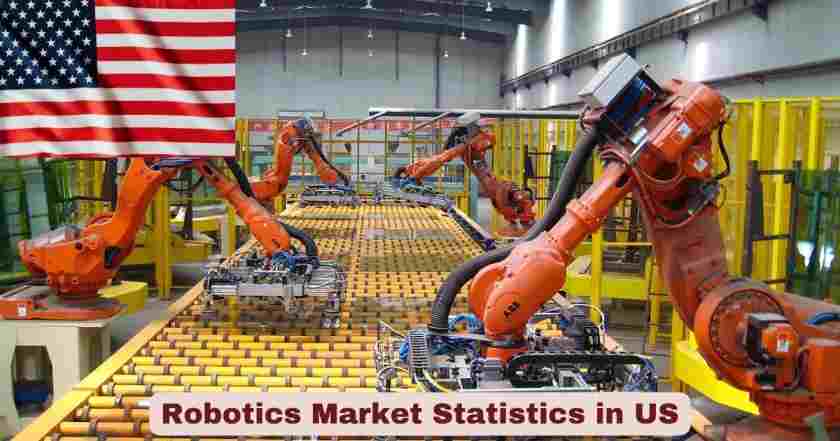
Robotics Market in America 2026
The robotics market in the United States encompasses the design, development, manufacturing, deployment, and servicing of robotic systems — machines that perform tasks autonomously or with minimal human intervention — across the full spectrum of American industry: manufacturing floors, surgical theaters, distribution warehouses, dairy farms, construction sites, defense installations, and increasingly, the homes and offices of everyday Americans. It is one of the most rapidly transforming sectors in the entire U.S. economy in 2026, driven simultaneously by an accelerating labor shortage crisis, a federal policy push to reshore manufacturing through the CHIPS Act, Inflation Reduction Act, and tariff-driven supply-chain restructuring, the dramatic cost reduction of key enabling technologies including LiDAR sensors (now below $1,000) and AI compute chips, and an investment wave from both corporate and venture capital sources that is putting more robotic capability into more economic sectors than ever before. The United States generated the highest robotics revenue of any single nation on earth in 2024, recording $9.4 billion — according to Statista and AIPRM’s analysis of IFR data — a figure that reflects not just the scale of American industrial automation but the dominance of the U.S. in the service robotics segment, which includes surgical robots, logistics automation, and professional service platforms where American companies like Intuitive Surgical, Boston Dynamics, iRobot, Rockwell Automation, and Symbotic hold global market leadership positions. By 2026, total U.S. robotics revenue is projected by Statista to reach approximately $11.4 billion, growing at a CAGR of 8.12% through 2029 toward a projected $14.28 billion — making it the world’s single largest national robotics market, even as its share of global industrial robot installations remains modest compared to Asia.
The structural drivers pushing robotics adoption in the United States in 2026 are stronger than at any previous point in the industry’s history, and they are reinforcing each other in ways that create genuine demand acceleration rather than gradual incremental growth. On the labor front, the U.S. manufacturing sector carried over 500,000 unfilled job openings as of early 2026, a gap that demographic trends guarantee will widen rather than close organically. On the policy front, the reshoring of semiconductor fabrication (TSMC Arizona, Intel Ohio, Samsung Texas), electric vehicle battery manufacturing, and pharmaceutical production has created demand for highly automated domestic factories — because the labor-intensive production models that worked in low-wage offshore locations are not economically viable when restoring those jobs to American soil at American wage rates. On the technology front, the integration of physical AI and large language models into robot control systems — a trend that dominated CES 2026 in January with humanoid robot demonstrations from Apptronik, Figure AI, and Chinese OEMs — is expanding what robots can do from narrow task-specific automation to broader, more adaptive machine intelligence that can handle unstructured environments. The convergence of these forces is why two-thirds of U.S. manufacturing organizations acknowledge they need to fundamentally redesign their operations around advanced automation — while simultaneously, per a Gartner May 2025 survey of 128 manufacturing and supply-chain leaders, most of those organizations have not yet done so. The gap between recognition and implementation is the primary commercial opportunity in the U.S. robotics market in 2026.
Robotics Market Key Facts in the US 2026
| Fact Category | Key Fact / Data Point |
|---|---|
| US Robotics Market Revenue (2024) | $9.4 billion — highest of any single nation globally — per AIPRM / Statista / IFR data |
| US Robotics Market Revenue (2025 Projection) | $10.25–$10.45 billion — per Statista US Robotics Outlook |
| US Robotics Market Revenue (2026 Projection) | Approximately $11.3–$11.5 billion — growing at CAGR 8.12% |
| US Robotics Market Revenue (2029 Projection) | $14.28 billion — per Statista US Robotics Market Forecast |
| US CAGR (2025–2029) | 8.12% — per Statista US Robotics Outlook |
| US Robotics Market CAGR (2024–2035 — Broader) | 16.61% — per Market Research Future; projects $84.4B by 2035 (broader scope) |
| Global Robotics Market Revenue (2024) | $94.54 billion — per AIPRM; $50.38 billion per Statista narrow scope |
| Global Robotics Market Revenue (2025) | $50 billion (ABI Research); $108.43 billion (Precedence Research — broad scope) |
| Global Robotics CAGR (2024–2034) | 14.7% — projects >$372 billion by 2034 |
| US Industrial Robot Installations (2024) | 34,200 units — down 9% from 2023’s high — per IFR World Robotics 2025 Report |
| US Share of Americas Robot Installations (2024) | 68% of all Americas installations (50,100 total) |
| US Industrial Robot Operational Stock (2023) | 381,964 units — 12% increase vs. prior year |
| Global Industrial Robot Installations (2024) | 542,076 units — second-highest in history; 4th consecutive year above 500,000 |
| Global Industrial Robot Operational Stock (2024) | 4,664,000 units — up 9% YoY |
| Cobots Installed Globally (2024) | 64,542 units — up 12% YoY; market share rose to 11.9% of all industrial robots |
| US A3 Robot Orders Growth (H1 2025) | +4.3% increase in robot orders vs. H1 2024 — per Association for Advancing Automation |
| US Robotic Engineer Jobs Forecast (2025) | 161,766 robotics engineering jobs — up 6% from 2020 |
| US Robotics Engineer Average Salary (2025) | $114,789 — up 10.3% from 2020 |
| Service Robotics US Market Share (2025) | $9.68 billion of $10.45 billion total — service robots dominate US market |
| Global Service Robots in Operation (2024) | Approximately 36.83 million — 98.9% of all robots are service robots |
| Reshoring Impact on US Robotics Demand | Reshoring driven by tariffs + CHIPS Act + IRA is a major demand driver for factory automation — companies can’t reshore at competitive cost without robots |
Source: IFR World Robotics 2025 Report (September 25, 2025, ifr.org); Statista US Robotics Market Outlook (statista.com); Statista Global Robotics Market Forecast; AIPRM Robotics Statistics 2025 (July 10, 2025, aiprm.com); Market Research Future US Robotics Market (marketresearchfuture.com, September 2025); A3 Association for Advancing Automation H1 2025 data; ABI Research Global Robotics Market Outlook (abiresearch.com, August 2025); DC Velocity IFR Report Summary (September 25, 2025)
The $9.4 billion in U.S. robotics revenue in 2024 represents a striking contrast with the U.S.’s relatively modest share of global industrial robot installations. While the United States installs only about 6% of the world’s annual industrial robots — compared to China’s 54%, Japan’s 8%, and South Korea’s 6% — it generates a far larger proportion of total global robotics revenue because of its dominance in the high-value service robotics segment. A single Intuitive Surgical da Vinci surgical robot costs $1–2.5 million and generates substantial recurring service revenue. A Boston Dynamics Spot inspection robot sells for approximately $75,000. A Symbotic warehouse automation system for a major distribution center can cost tens of millions of dollars for a full installation. These are not the same economics as a mid-range industrial welding robot costing $80,000–$150,000, and the United States’ concentration in surgical, professional service, defense, and logistics automation — segments where the intellectual property, software, and system integration value dwarfs the hardware cost — is why the country leads the world in robotics revenue while ranking fifth in industrial robot installations.
The IFR’s forecast that global robot installations will grow 6% to 575,000 units in 2025 and surpass 700,000 units by 2028 — with the A3 confirming a 4.3% increase in U.S. robot orders in H1 2025 — suggests that the 2024 installation dip was a pause in a strong long-term trend rather than a structural shift. The macroeconomic conditions that drove the dip — elevated interest rates increasing capital equipment financing costs, softness in automotive investment as the EV transition generated uncertainty, and the general corporate caution of 2024’s economic environment — are partially resolving in 2026. The reshoring story adds a specifically American tailwind: every semiconductor fab, battery gigafactory, and pharmaceutical plant that returns to U.S. soil through policy incentives represents a capital-intensive facility where automation is not an optional efficiency upgrade but a structural economic necessity. A TSMC fab in Arizona paying American labor rates cannot be cost-competitive with a TSMC fab in Taiwan staffed at Taiwanese wage rates without aggressive automation. The robots are built into the business model of reshoring from day one — and that means the U.S. industrial robot installation curve should be heading upward through 2026 and beyond even as the global cycle fluctuates.
US Industrial Robotics Market Statistics in 2026
| Industrial Robotics Metric | Data / Statistic |
|---|---|
| US Industrial Robot Installations (2024) | 34,200 units — down 9% from 37,500+ in 2023 — per IFR World Robotics 2025 |
| US Industrial Robot Installations (2023) | 37,587 units — third-best result in US history despite 5% decline from 2022 |
| US Industrial Robot Operational Stock (2023) | 381,964 units operating in US factories — up 12% YoY |
| Global Industrial Robot Installations (2024) | 542,076 units — second-highest ever; 4th consecutive year above 500,000 |
| Global Industrial Robots in Operation (2024) | 4,664,000 units — up 9%; nearly doubled in 10 years |
| Top Sector — US Industrial Robots (2023) | Automotive: 33% of all US installations — largest end-user |
| Second Sector — US Growth Leader (2023–2024) | Metal and machinery — strong YoY growth |
| Globally Top Sector (2024) | Electronics/Electrical: 128,899 units — surpassed automotive globally for first time |
| Cobots Globally (2024) | 64,542 installed — up 12%; 11.9% share of all industrial robot installs |
| Cobot CAGR (2021–2028) | 17.4% estimated annual growth rate |
| Cobot Leading Vendor | Universal Robots (Denmark/US) — dominant in cobot segment |
| US Robot Density (2024) | Approximately 295 robots per 10,000 manufacturing employees — above global average |
| Global Average Robot Density (2024) | 151 robots per 10,000 manufacturing employees |
| Top Robot Density Nation | South Korea: 1,012 robots per 10,000 employees — world’s highest |
| Industrial Robot Average Selling Price (2026) | ~$22,700 per unit (2026) — per Sci-Tech-Today robotics statistics |
| Global Industrial Robot Revenue Forecast (2026) | ~$52.68 billion (combined industrial + service) — Sci-Tech-Today |
| US Robot Installations Forecast (2025–2026) | Expected slight recovery; IFR projects global growth 6% in 2025; A3 confirmed +4.3% US orders H1 2025 |
| US Industrial Robot Imports | US imports most robots from Japan and Europe — few domestic manufacturers |
| Top 5 Global Industrial Robot Countries (2024) | China (54%), Japan (8%), South Korea (6%), USA (6%), Germany (5%) |
| Americas Robot Installations (2024) | 50,100 units — 4th consecutive year above 50,000 |
Source: IFR World Robotics 2025 Report (September 25, 2025); Robot Report IFR Summary (September 25, 2025, therobotreport.com); Robotnik Industrial Robotics 2025 Analysis (December 18, 2025, robotnik.eu); IFR World Robotics 2024 Report (Statzon analysis, September 2024); AIPRM Robotics Statistics July 2025; Sci-Tech-Today Robotics Industry Statistics (December 4, 2025); Robot Forum World Robotics Report 2025 Summary
The United States’ 9% decline in industrial robot installations in 2024 — from approximately 37,500 in 2023 to 34,200 — does not represent a reversal of the underlying automation trend but rather the normal business cycle volatility that affects capital equipment procurement. The IFR President Takayuki Ito’s September 2025 statement that 2024 represented the “second-highest annual installation count in history” globally — and the Association for Advancing Automation’s (A3) confirmation of a 4.3% increase in U.S. robot orders in the first half of 2025 — confirm that the pause is temporary. The automotive industry’s influence on U.S. industrial robotics cannot be overstated: with 33% of all U.S. industrial robot installations going to the automotive sector, any hesitation in automotive capital spending — driven by the EV transition uncertainty, elevated financing costs, or production slowdowns — produces an outsized downward effect on U.S. robot installation counts. As the EV transition stabilizes and the reshoring-driven electronics manufacturing buildout accelerates, the U.S. industrial robot installation curve is positioned to resume its longer-term upward trajectory.
The cobot revolution — collaborative robots designed to work safely alongside human workers without traditional safety cages — is one of the most significant developments reshaping U.S. industrial robotics in 2026. The 12% growth in cobot installations globally in 2024, bringing the market share to 11.9% of all industrial robot deployments, reflects a structural shift in how automation is being implemented at the plant floor level. Traditional industrial robots require extensive guarding, dedicated floor space, and significant safety infrastructure — barriers that make them economically accessible primarily to large manufacturers running high-volume repetitive operations. Cobots, with their force-limiting joints, visual safety monitoring, and intuitive programming interfaces, can be deployed by a mid-sized machine shop or food processor without the same infrastructure investment. This democratization of automation — making robotic capability accessible to the American small and medium enterprise manufacturing base that had previously been unable to justify the investment — is one of the strongest growth vectors in the U.S. market and one that the reshoring industrial policy wave is directly accelerating.
US Service Robotics Market Statistics in 2026
| Service Robotics Metric | Data / Statistic |
|---|---|
| US Service Robotics Revenue (2025) | $9.68 billion — dominates US total of $10.45B; service > industrial in the US market |
| Global Service Robotics Revenue (2025) | Projected $39.57 billion — per Statista global service robotics forecast |
| Global Service Robotics CAGR (2025–2030) | 5.23% — per Statista; market reaches $65.02 billion by 2030 |
| Global Service Robots in Operation (2024) | Approximately 36.83 million — 98.9% of all robots globally are service robots |
| Global Service Robots Forecast (2029) | ~61.75 million units — 68.3% growth from 2024 |
| Logistics / Transport Robots Globally (2024) | 102,925 new units installed — 52% of all service robot installations — dominant sub-segment |
| Logistics Robots Growth (2024) | +14% YoY — IFR World Robotics 2025 |
| Medical Robots Globally (2024) | 16,700 new units installed — growth of 91% YoY — fastest major segment |
| Surgical Robots Growth (2024) | +41% YoY globally |
| Rehabilitation Robots Growth (2024) | +106% YoY globally |
| Diagnostic/Lab Analysis Robots Growth (2024) | +610% YoY — extraordinary growth from smaller base |
| Professional Cleaning Robots Growth (2024) | +34% YoY |
| Security Robots Growth (2024) | +19% YoY |
| Global Medical Robotics Market (2026) | Projected $20.6 billion — CAGR 21.1% from 2021 to 2026 |
| Intuitive Surgical (da Vinci) — Revenue (2023) | $7.1 billion — largest surgical robot company; da Vinci installed in 10,000+ hospitals globally |
| Intuitive Surgical — Oct 2025 Expansion | Expanded product line to include robotic systems designed for outpatient procedures — broadening market |
| Global Domestic Robot Market (2025) | $14.7 billion — robotic vacuum cleaners = 70% of domestic robot sales |
| US Domestic Robot Ownership | Approximately 17% of US households own at least one domestic robot |
| Domestic Robot CAGR (2021–2026) | >30% — personal service/companion robots fastest-growing consumer segment |
| Global Warehouse Robots by 2025 | 4 million+ commercial warehouse robots — installed in 50,000+ warehouses globally |
Source: Statista US Robotics Market Forecast; Statista Global Service Robotics Forecast; IFR World Robotics Report 2025 via Robot Forum Summary; Robot Statistics and Facts January 13, 2026 (scoop.market.us); AIPRM Robotics Statistics July 2025; Market Research Future US Robotics Market; Precedence Research Robotics Technology Market (December 17, 2025); Intuitive Surgical corporate data
The dominance of service robotics in the U.S. market — with $9.68 billion of the $10.45 billion total U.S. robotics revenue coming from service applications — is a defining structural characteristic that sets the American robotics market apart from every other major robotics economy on earth. In China, South Korea, Japan, and Germany, industrial robots are the primary revenue driver — these are export-manufacturing economies where factory automation has been the central application of robotics for decades. In the United States, the combination of a large, wealthy consumer economy (generating demand for domestic robots, surgical robots, entertainment robots), a massive and technologically advanced healthcare system (driving surgical, rehabilitation, and diagnostic robot demand), and a logistics infrastructure operating at extraordinary scale (Amazon alone has over 750,000 warehouse robots deployed globally, with a large fraction in the U.S.) creates a service robotics demand base that no other country can match in absolute dollar terms. The 36.83 million service robots in operation globally in 2024 — of which the U.S. is the largest single-country market — vastly outnumber the 4.66 million industrial robots in operation, confirming that service robotics is the dominant volume driver of the global sector even if industrial robots receive more manufacturing-sector press coverage.
The 91% growth in medical robot installations globally in 2024 — combined with the extraordinary +610% growth in diagnostic and lab analysis robots — represents the early stages of a transformation in healthcare automation whose implications for U.S. healthcare economics and patient outcomes could be profound. The United States already leads the world in surgical robotics deployment through Intuitive Surgical’s da Vinci platform (installed in over 10,000 hospitals globally, with the U.S. as the largest single market), and the October 2025 expansion of Intuitive Surgical’s product line to include robotic systems for outpatient procedures signals that the market is moving beyond hospital operating rooms into ambulatory surgery centers, clinics, and eventually physician offices. This expansion is not merely a commercial strategy — it reflects the fact that the U.S. healthcare system’s chronic labor shortage in nursing, pharmacy, radiology, and laboratory functions has created an economic imperative for automation that matches or exceeds what is driving automation in manufacturing. When a medication dispensing robot achieves 99.9% accuracy versus the human pharmacist average of approximately 99.5% (per Pharmacy Times), the case for deployment is simultaneously a quality, safety, and labor-cost argument — and in 2026, all three are compelling simultaneously.
US Robotics Market by Sector Statistics in 2026
| Sector | Robotics Market Data / Adoption Level | Key Metric |
|---|---|---|
| Automotive Manufacturing | 33% of all US industrial robot installations (2023) — historically largest US end-user; EV transition creating new automation requirements | 33% share |
| Electronics / Semiconductor | Growing rapidly — reshoring via CHIPS Act creating new fab demand; 128,899 units installed globally (2024) — #1 sector worldwide, surpassing automotive for first time | Fastest-growing industrial sector globally 2024 |
| Logistics / E-Commerce | Amazon: 750,000+ robots globally; Symbotic and Locus Robotics leading US warehouse automation; 102,925 service robots installed (2024) = 52% of all service installs; +14% YoY | 52% of service robot installs |
| Healthcare / Surgery | Intuitive Surgical $7.1B revenue (2023); da Vinci in 10,000+ hospitals; medical robots +91% YoY (2024); Global medical robotics market $20.6B by 2026 | +91% global 2024 |
| Warehouse / Distribution | 4 million+ commercial warehouse robots globally; 50,000+ warehouses; AMR (Autonomous Mobile Robot) market booming | 4M+ units globally |
| Food & Beverage | Robot adoption CAGR 15.2% from 2021–2028; growing due to sanitation standards + labor shortages | 15.2% CAGR |
| Metal / Machinery | Notable US growth 2023–2024; stable demand from precision machining and fabrication | Notable growth |
| Domestic / Consumer | 17% of US households own ≥1 domestic robot; robotic vacuums = 70% of domestic robot sales; $14.7B global market 2025 | 17% household penetration |
| Defense / Military | Significant government investment; Boston Dynamics Spot widely used; drone robots in surveillance, EOD, logistics | Major R&D funding |
| Agriculture | US specialty crop growers: 70% already investing in farm robots; USDA ERS Jan 2026 confirms +13% net dairy returns with robotic milking | 70% specialty crop grower investment |
| Construction | Emerging segment; robotics reducing risk in hazardous environments; limited mass deployment as of 2026 | Emerging / early-stage |
| Retail | Inventory robots (Simbe Tally), self-checkout automation, customer service bots growing at US retailers | Growing |
| Hospitality | Delivery and service robots in hotels/restaurants; -11% global hospitality robot decline (2024) — post-COVID normalization | -11% global 2024 |
| Professional Cleaning | +34% global growth (2024) — commercial floor cleaning, industrial cleaning — driven by post-COVID hygiene awareness | +34% global 2024 |
Source: IFR World Robotics 2025 Report; AIPRM Robotics Statistics July 2025; Robot Statistics and Facts January 13, 2026; Statista US Robotics Market; Market Research Future US Robotics Market 2025; USDA ERS ERR-356 January 22, 2026; Sci-Tech-Today Robotics Industry Statistics December 2025
The 2024 global data point that the electronics industry surpassed automotive as the world’s largest industrial robot end-user — with 128,899 units installed versus automotive’s approximately 119,000 — is one of the most consequential structural shifts in industrial robotics history, and it has direct implications for the U.S. market’s trajectory in 2026 and beyond. For the first 50 years of industrial robotics, automotive assembly was the dominant application: the welding, painting, and assembly of car bodies at high volume with extremely precise specifications was the paradigmatic robot use case, and the automotive industry’s willingness to make massive capital investments in robot cells drove the entire global robotics equipment supply chain. The shift to electronics — driven by the demand for precision assembly of semiconductor packages, displays, circuit boards, and consumer electronics at scales that no human workforce can match — reflects both the increasing complexity of electronic products and the extraordinary volume of EV battery packs, solar panels, and semiconductor chips that the green-energy transition is requiring the world to produce. For the U.S., where the CHIPS Act and IRA are funding a massive domestic buildout of exactly these manufacturing categories, the electronics sector’s rise to global dominance in robot deployments is both a global trend and a specifically American policy outcome playing out in real time.
The Amazon robotics deployment — with over 750,000 robots globally, making the e-commerce and logistics giant the single largest robot operator on earth — is the defining scale example of how logistics automation has redefined the U.S. service robotics market. Amazon’s robots — ranging from the Kiva-origin drive units that move inventory shelves to pickers, to the Proteus fully autonomous mobile robot that operates safely alongside humans, to the Sequoia robotic storage and retrieval system, to the Digit humanoid robot being piloted for tote movement — represent a vertically integrated robotic ecosystem that no other company on earth has deployed at comparable scale. The competitive pressure Amazon’s robotics-enabled operational efficiency places on every other U.S. retailer and logistics operator is one of the strongest forces driving robot adoption across the U.S. warehousing and fulfillment sector. When a competitor observes that Amazon can process orders 24 hours a day with consistent throughput because its robots do not tire, call in sick, or demand overtime pay, the economic argument for their own robotic investment becomes increasingly difficult to dismiss.
US Robotics Investment, Funding and Key Companies Statistics in 2026
| Investment / Company Metric | Data | Source / Detail |
|---|---|---|
| Largest US Robotics Revenue Company (2023) | Honda Motor — $142B revenue; $42B market cap (highest among robotics-adjacent companies) | Sci-Tech-Today citing Zippia |
| US Public Pure-Play Robotics Companies | Intuitive Surgical, iRobot (acquired by Amazon), Rockwell Automation, Symbotic, Teradyne among key public companies | Market data |
| Intuitive Surgical Revenue (2023) | $7.1 billion — largest medical robotics company; da Vinci surgical robot | Intuitive Surgical Annual Report |
| Rockwell Automation Revenue (FY2023) | $9.1 billion — industrial automation and information leader | Rockwell Annual Report |
| Symbotic (warehouse robotics, NASDAQ: SYM) | Went public 2022; building AI-powered autonomous case-handling warehouse robots; Walmart is lead customer | Market data |
| Figure AI (Humanoid) Valuation | $39.5 billion valuation sought (as of early 2025) — 15× increase vs. last valuation | ABI Research August 2025 |
| Apptronik (Humanoid) Series A | $350 million Series A — February 2025 — Texas-based humanoid developer | ABI Research / Axios February 2025 |
| Boston Dynamics | Owned by Hyundai since 2021; Spot inspection robot widely deployed in US industry and military | ABI Research |
| Average Humanoid Robot Cost | $158,400 per unit — most expensive robot type available commercially | ABI Research August 2025 |
| Average Industrial Robot Cost (2026) | ~$22,700 per unit (industrial); ~$12,170 per service robot unit | Sci-Tech-Today December 2025 |
| Global Venture Capital into Robotics (2025) | Record levels — humanoids attracting disproportionate attention; ABI Research notes VCs “all ears for humanoid suppliers” | ABI Research August 2025 |
| Amazon Robots Deployed Globally | Over 750,000 — world’s largest single corporate robot fleet | Multiple analyst sources |
| Top 5 Global Robotics Investment Companies | Honda Motor, Siemens AG, Sony, Denso Corporation, Midea Group | Sci-Tech-Today citing Zippia |
| US Manufacturing Robot System Integrators | Numerous domestic integrators implementing imported robot arms — key US competitive strength | IFR World Robotics 2025 |
| Robots Per Human in Manufacturing | Approximately 1 robot per 71 manufacturing employees globally | AIPRM July 2025 |
| VC into Agri-Robotics (2022–2025) | Over $1 billion — harvesting and weeding startups | Mordor Intelligence January 2026 |
Source: ABI Research Global Robotics Market Outlook (August 2025, abiresearch.com); Sci-Tech-Today Robotics Industry Statistics (December 4, 2025); AIPRM Robotics Statistics (July 10, 2025); Market Research Future US Robotics Market; IFR World Robotics 2025 Report; Mordor Intelligence Agricultural Robots January 2026
The Figure AI valuation story — seeking a $39.5 billion valuation in early 2025, representing a 15-fold increase from its prior round — is the most extreme data point in a broader venture capital phenomenon that ABI Research described in August 2025 as investors being “all ears for humanoid robot suppliers.” The humanoid robot investment frenzy of 2024–2025 reflects a convergence of technology breakthroughs — particularly in physical AI, imitation learning from video, and dexterous manipulation — and a strategic narrative about the ultimate commercial prize: a general-purpose robot capable of performing the full range of human physical labor in existing human-designed environments (factories, warehouses, homes, healthcare facilities) without requiring the costly facility redesigns that specialized industrial robots demand. The $158,400 average selling price for humanoids documented by ABI Research reflects both the genuine cost of advanced actuators, sensors, compute, and software and the premium that novelty commands in early-market adoption cycles. Whether that price falls on the same curve that brought LiDAR sensors from $75,000 to below $1,000 over the course of a decade is the central investment thesis bet that hundreds of millions of venture dollars in 2026 are riding on.
The United States’ structural position as a dominant technology developer and system integrator — rather than a primary robot manufacturer — is the most important contextual fact for understanding the U.S. robotics market in 2026. The IFR explicitly noted in its World Robotics 2025 Report that “the United States imports most of its robots from Japan and Europe, with few domestic suppliers” — but simultaneously “there are numerous domestic robot system integrators implementing robotic automation solutions.” This is a crucial distinction. FANUC, KUKA, ABB, Yaskawa, and Universal Robots manufacture most of the robot arms used in U.S. factories. But Rockwell Automation, Cognex, Zebra Technologies, PTC, Plex, and hundreds of smaller integrators provide the software, vision systems, connectivity platforms, and system integration services that turn those robot arms into operational production systems. In the value chain of industrial robotics, the manufacturing of the robot arm is often the least profitable segment; the software, integration, training, and service revenue streams that follow the hardware sale are where the highest margins are earned — and those are precisely the segments where U.S. companies dominate globally.
Global Robotics Market Comparison Statistics in 2026
| Global / Comparative Metric | Data / Statistic |
|---|---|
| Global Industrial Robots Installed (2024) | 542,076 units — 2nd highest ever; 4th consecutive year above 500,000 |
| Global Industrial Robot Operational Stock (2024) | 4,664,000 units — nearly doubled in 10 years |
| China Share of Global Installations (2024) | 54% — 295,000 units — highest annual total on record for any country; Chinese domestic brands now hold 57% of Chinese market |
| Japan (2nd) | 44,500 units — slight 4% decline from 2023 |
| South Korea (4th globally) | 30,600 units — robot density world leader at 1,012/10,000 employees |
| US (5th by installations) | 34,200 units — 9% decline vs. 2023; but #1 in robotics revenue |
| Germany (5th by installations) | 26,982 units — 5% decline but 2nd-best ever |
| 80% of Global Robots | Installed in just 5 countries: China, Japan, US, South Korea, Germany |
| Asia Share of Global Installations (2024) | 74% of all new industrial robot installations |
| Europe Share (2024) | 16% of global installations — 85,000 units |
| Americas Share (2024) | 9% — 50,100 units |
| Electronics Industry Global (2024) | 128,899 units — surpassed automotive as #1 industrial end-user globally for first time |
| Global Robot Installations Forecast (2025) | 575,000 units — +6% growth — IFR projection |
| Global Robot Installations Forecast (2028) | 700,000+ units — IFR long-range projection |
| Global Robots by 2030 | ~13 million commercial and industrial robots — ABI Research 3Q 2025 report |
| Global Robotics Market Revenue (2030) | $111 billion — ABI Research; growing at 14% CAGR from $50B in 2025 |
| Global Robotics Revenue Forecast (2035) | $258.3 billion — Future Market Insights; $416.26 billion per Precedence Research (broader scope) |
| Businesses Expected to Adopt Robotics by 2030 | ~90% of businesses globally — scoop.market.us January 2026 |
Source: IFR World Robotics 2025 Report (September 25, 2025); ABI Research Global Robotics Market Outlook (August 2025); Future Market Insights Robot Market Report (August 2025); Sci-Tech-Today Robotics Industry Statistics (December 4, 2025); DC Velocity IFR Report Analysis (September 25, 2025); Robotnik Industrial Robotics 2025 Analysis (December 18, 2025)
The 2024 milestone of Chinese domestic robot brands capturing 57% of their home market — up from approximately 28% a decade ago — is one of the most consequential structural developments in global robotics, and its implications for U.S. companies extend beyond the Chinese market. ESTUN, STEP, Inovance, SIASUN, and other Chinese robotics manufacturers built market share by competing on price in low-end applications, then progressively moved up the capability curve through state investment, technology acquisition, and scale economies. The same pattern has played out in EVs, solar panels, and consumer electronics. If Chinese robotics companies follow the same trajectory in the global market — moving from low-cost competition in basic industrial robots to competitive products in collaborative robots, service robots, and eventually surgical or professional service robots — U.S. and Japanese robot manufacturers face the same competitive dynamic that other sectors have already experienced. The U.S. policy response — semiconductor export controls, investment screening through CFIUS, and the CHIPS Act — recognizes this dynamic but primarily addresses the semiconductor inputs to AI-driven robotics rather than the robotics hardware itself.
The ABI Research projection of 13 million commercial and industrial robots in circulation by 2030 — up from approximately 4.66 million industrial and 36.83 million total (including consumer service) robots in 2024 — illustrates the scale of the robotic transition underway in the global economy. By 2030, the number of commercial and industrial robots alone will approach three times the current stock, concentrated in electronics manufacturing (driven by green energy and AI hardware demand), logistics and warehousing (driven by e-commerce), healthcare (driven by demographic aging), and agriculture (driven by labor shortages). The United States will be at the center of each of these trends: the electronics manufacturing reshoring is happening in Arizona, Ohio, and Texas; the e-commerce logistics automation is headquartered in Seattle and Bentonville; the healthcare robotics leadership is held by California and Massachusetts companies; and the agricultural robotics adoption is concentrated in California, Florida, and the Pacific Northwest. The robotics market in the United States in 2026 is not one story — it is five or six converging stories, each large enough to sustain an industry on its own, all accelerating simultaneously.
Disclaimer: This research report is compiled from publicly available sources. While reasonable efforts have been made to ensure accuracy, no representation or warranty, express or implied, is given as to the completeness or reliability of the information. We accept no liability for any errors, omissions, losses, or damages of any kind arising from the use of this report.